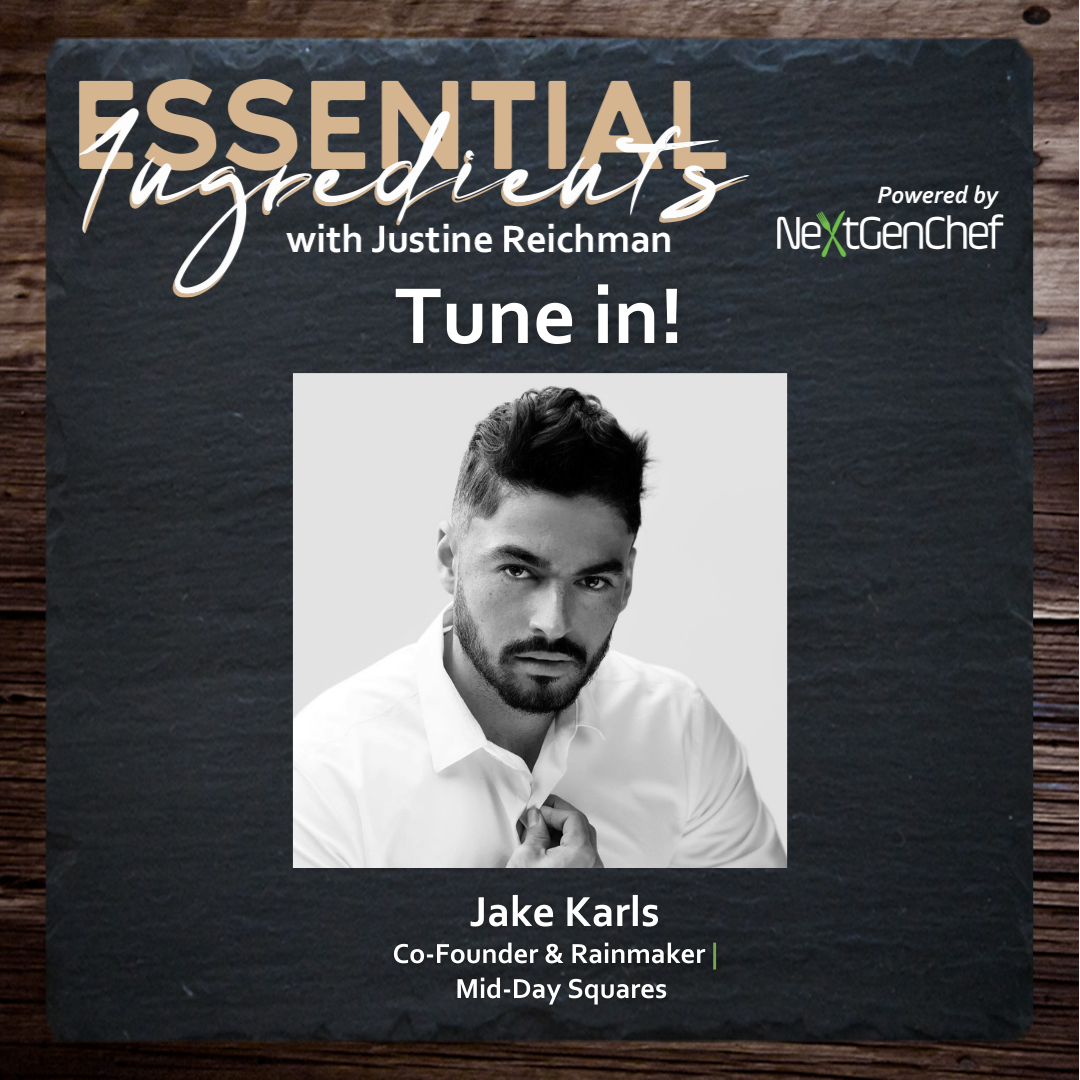
Jake Karls · NextGen Purpose
Watch on YouTube
Transparency and Authenticity is the New Currency with Jake Karls
The Incorporation Method helps you turn what matters into practical changes that fit your life.
“Mid-Day Squares co-founder, Jake Karls is back for part 2!”
Full Transcript
Full conversation between Justine Reichman and Jake Karls.
Thank you so much. It's great to be here.
It's great to be here. We're here at Fisher & Paykel, thank you for hosting us here today.
Lovely to have you at our customer experience center.
Yeah. We're really excited to be here, and we're excited to learn about you and what you're doing. Because I know that you have a really exciting and different background, and your goals are so innovative. And you've chosen to be here for a lot of different reasons, and I can't wait to share that with our audience.
Thank you so much. I've worked in the design world kind of my whole career, but I really love to be focused on sustainability. I'm a WELL AP, I love the concept of wellness and making things right for people, and people being healthier and having a better life.
So wait a sec, before you go on, you gotta tell everybody what's a WELL AP because not everybody knows what a Well AP is.
It's funny. WELL has kind of come more into focus since the pandemic, actually. And WELL is a building standard, but it picks up where LEED, where you build your building--
Because not everybody knows what LEED is.
LEED is a sustainable building standard, and it measures how sustainable your building is? Or do you use water efficiently? Is your HVAC efficient? Do you have a green roof? Or have you repaired a brownfield to build your building? All of this goes into LEED and LEED is rated gold, silver, basic. And WELL in the same way, and WELL picks up where LEED leaves off. WELL is how the building relates to the people that are in it. So WELL runs everything from, if you have clean water, do you offer (inaudible) lead? It runs the gamut of how people relate to the building and how that building can be better for the people that inhabit it.
So how did you get into this industry? What made it so interesting for you?
I actually kind of ended up in the kitchen and bath world by accident. And I've worked for lots of sustainable companies. I used to sell textiles and furnishings. And it's very hard to go from something beautiful, colorful and tactile to hard white hard surfaces. So sustainability was kind of the thing I latched on to.
And was not because of the impact it has on the environment, what interested in--
The impact it has on the environment, but the impact it has on people in general. That's what drew me to WELL also is the impact it has on people. Sometimes, I don't think people realize how bad for them their environment can be. So that's kind of one of my goals in becoming a WELL AP is to try to educate designers as to how they can make their environments better for their clients and better for the people who are going to live in them.
So you've made the choice now to end up at Fisher & Paykel. Why Fisher & Paykel?
Fisher & Paykel is a very human centered brand, and it's a very human centered company. I'm so excited to work for a company that actually cares about the people that work here. Resources cares, the VP of Marketing cares, people care about each other. And in addition to the fact, we have an amazing product, we're a New Zealand based company. And I think because of that, and just the whole philosophy of coming from an island with limited resources, they're sustainable just by nature. We care that our products last. We care that they're made right. We care that we ship and sustainable packaging. We have goals for the future to become even more sustainable. All those things are really important to me. I just can't work for a company that helps to feel connected, and I feel very connected here.
Can you talk to me about some of the impacts that these products have on the environment?
Well, one of the things is like we're standing in front of an induction cooktop. A lot of people are a bit, oh, induction. But it's kind of the up and coming idea gas kind of is going away because of global warming, and environment, and all of that induction has a lot of really great concepts. Things are changing in the world. You have like multi generational homes, which means maybe you have little kids, you have older people, maybe somebody has memory compromised. One of the great things about induction is that the only thing that's hot is the vessel. So like my house, my cats love to jump on my stove. Nobody would get burnt because the only thing that's hot is actually the vessel. So that's really great. It's super easy to clean.
What do you mean the vessel?
The pot, where you're cooking.
Oh, the pot.
Imagine there was a little pot cooking here, and if you came up into this, you wouldn't get burnt. If you touch the pot, you would. But the rest of the surface stays nice and cool, which is a really great concept. As I said, it's super easy to clean. It cooks really well. You do have to get adjusted to how quickly induction heats. We got to go to our New York Experience Center when I first started. And the first time I clicked on it, I have to say, I have to start over.
So you mentioned it has a positive impact on the environment. Can you talk to me a little bit about that?
A lot of municipalities are considering moving away from gas cooking. Even though I think gas buys a lot of people and a lot of chefs, it's really a preferred method of cooking. The electrical, it's a lot cleaner. It doesn't use as much energy. All the other things I've mentioned, I think it's kind of where the future is going.
Okay, and to that end, I think we have a chef that's coming to cook on it, so maybe we can bring the chef on. And joining us is Hilary Pisor, Restaurant Tour and Chef.
Hi.
Hi, welcome. Thanks so much for joining us.
Welcome. Thanks for having me.
We're really excited. I can't wait to hear what you're going to be making us today.
Well, this is First Light Wagyu beef from New Zealand.
Wonderful.
So yummy.
Can you tell us a little bit about the First Light Beef?
This is Wagyu beef from New Zealand. The farm is called First Light, and it's this beautiful, tender, delicious grass-fed wagyu.
That sounds amazing.
Yeah, it really is.
I can't wait, shall we?
We shall. Okay.
So you're gonna be using the induction of it. So tell us, how do you make this meat in the induction oven?
Well, I love that the induction has this turbo mode where you can boom. Set it to heat up instantly.
Wow, seriously?
Yes. It's like magic. It's so awesome. I have to say I've been reluctant to convert over from gas to induction, but it's been. I have to say, this is an amazing piece of equipment. It goes from zero to 100. And then you can easily dial it back down.
So how do you know when it's ready?
Well, that's sort of, that comes with experience.
But how do you know when the pan is ready?
That's also how I feel. And you can hear it, start to sizzle a little bit as well.
Okay. And what do you put on the pan here? Is it any different preparation?
I usually put a little film on high cooking oil. Today, I'm using an organic sunflower because it doesn't have any taste. We want the taste of the meat to come through. And we're the grill pan, you can kind of smell it. So I'm going to go ahead and put these on, and we're going to leave it all the way on high for just a few moments to get that sear.
Now, do you find that this cooks any more quickly or slowly with the induction versus--
I mean, this speed definitely, this turbo--
I think with the induction, the initial heating is really fast. You have to be ready for that. But once you actually start cooking, it seems to me that it cooks really nicely.
You don't want to watch it, worry. Once it gets really hot, you can start, which saves you time right there. And then it's very easy to control the heat from there.
Like it's great. If you're making spaghetti and you have a huge pot of hot water, your heating time is--
Boiling water.
Exactly. That doesn't happen with--
Great. Okay, wonderful. And I'm just curious. So have you found that when people are cooking their meals, and they're preparing them that they have, is it a large learning curve for people?
I think it depends on the person more than just how willing you are to sort of pick up on the differences. Because, as I said, the quickness you have to really be ready for that and you have to pay attention because, especially like she hated the pan first--
And then forget.
Yeah, you put it into a hot pan, but if you put something in the pan and just put it on straight away, you have to be ready for the fact that you're ready to roll right now.
We're ready to flip.
That looks amazing.
And so for chefs, chefs like yourself, are you finding that chefs are really embracing this? Is it changing?
I think the old guard is slow, and is slow to change. And I think that most chefs that I've talked to about it are just very reluctant. And unless they're put into a situation where they have to adapt, they don't. But once they try it, they're sold.
And given the impact having on the environment, which Leslie and I were talking about before, why not? I don't know if you guys have done any studies on the impact it's having on the environment.
I think that a lot of municipalities are making those studies because they're basically making the case for going to something that's all electric as opposed to gas. So I think a lot of the studies are being conducted now, because I think that would be really impactful. And I'm sure to make that transition and enable easier. Anytime you're cooking, you're going to be generating heat. But induction generates less heat than like a huge gas range. So you don't have to work as hard to cool off to your house off because you can feel now that she's cooking if you put--
This is not hot at all.
I mean, don't touch the pan, but you can totally come--
A little hesitant to get too close.
It's just barely warm.
Yeah. barely warm. Wow. Well, I can't wait to see the whole meal put together. Hilary, thank you so much for putting this together for us.
I can't wait to get into (inaudible). It's calling my name.
Share This Episode
Enjoyed this conversation? Share it and tag @nextgenpurpose
Listen on Apple ▶Listen on Spotify ▶Your Host
Justine Reichman
Founder & CEO of NextGen Purpose. Host and Executive Producer of Essential Ingredients — 11 seasons, 330+ episodes, and a growing movement.
About Justine →