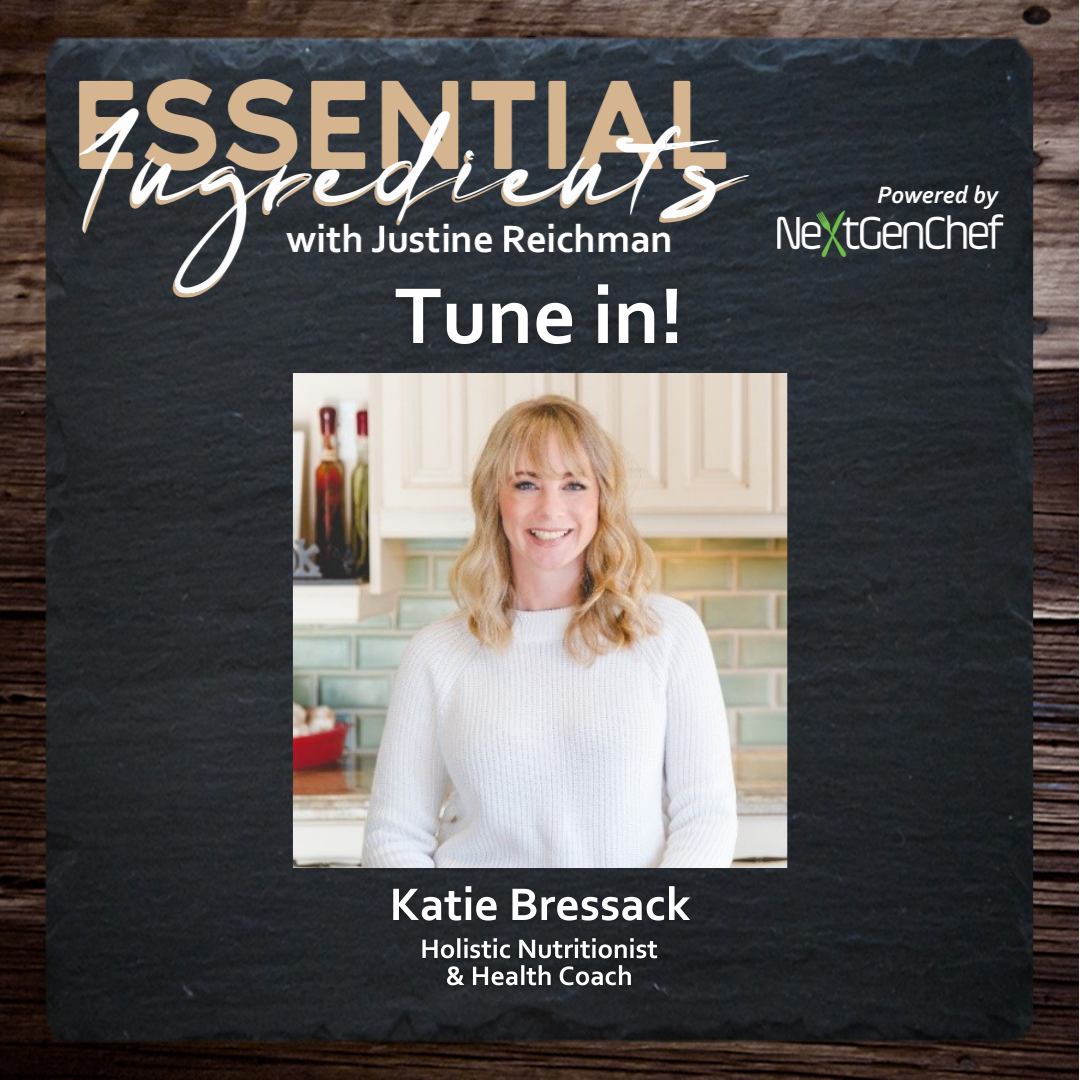
Katie Bressack · NextGen Purpose
Watch on YouTube
Eat for Your Hormones, Improve Your Health with Katie Bressack
The Incorporation Method helps you turn what matters into practical changes that fit your life.
“Holistic nutritionist and coach Katie Bressack is on a mission to educate women on the profound connection between food and hormones. She shares how balancing blood sugar is the cornerstone of hormonal health — affecting energy, mood, sleep quality, and stress response. From eating within the first hour of waking to understanding cortisol, estrogen dominance, and hormonal shifts across life stages, Katie offers practical tools to help women take control of their health at any age.”
Full Transcript
Full conversation between Justine Reichman and Katie Bressack.
Thanks, Justine. Great to be here.
Looking forward to having this conversation and learning about what you're doing. I hear so many exciting things from everybody about what's going on at Bon Appetit Management Company, so I'm looking forward to hearing what you guys are up to. Can you share a little bit for me about what you guys are doing?
Sure. Well, we have three markets that we serve. We serve private colleges and universities, corporations, and specialty venues which are museums and two ballparks. So you can imagine that our business has been greatly impacted by COVID-19 with everything shutting down about 18 months ago and then reopening at different rates. So what we're doing now is adjusting the business as the needs adjust, rolling out new programs with technology both front of house for our guests, as well as back of house to make things more efficient for our people and trying to figure out how to serve food in this new world.
Wow. So you've got a lot of different people that you're servicing. It's a very new time so I can imagine dealing with a lot of different challenges. What are the big things that you were able to achieve during this time that maybe were very unexpected, and maybe really positive in some ways that you can share?
The really positive thing that's come out of this time is us ramping up development from a technology perspective that we have full force into a really cool program called Curated, which is an app enabled ordering system that allows people to pre order meals that there are specific dietary needs. May they be around vegetarian, or vegan, or around allergen, and using some of our closed cafes as ghost kitchens to serve these people really efficiently and effectively.
Wow, that's great. Because especially in this time and in this era, so many people have so many allergies, and going out can often be such a challenge. I mean, I know so many people don't go out because of it, or they bring their own food, so that really is a real opportunity for people to participate and still be able to go out. So that's great.
What we're trying to do is cut down that awkward conversation that you have with the server about, I don't need this, I don't need that. But instead, use an algorithm to say, if you say that I plant based, I'm only going to show you the offerings that are plant based and let you just have a wonderful experience looking at all the things you can eat, not sifting through all the things you can't eat. You can really enjoy your food.
Well, I think that's great. Because I know that I've been telling you so many times, I've gone to the restaurant, you sit at the table and you're with people. First of all, it takes away from the experience, it changes the experience and it puts the onus and the spotlight on you when you're really not trying to make a big deal necessarily. But you do have these challenges and these obstacles. Sometimes embarrassing, or you're self conscious, or you just want to be part of the group and all you can do is say, well, I can't eat this, and I don't eat this, and this gives me issues. And it becomes all about that as opposed to just going out to dinner with friends.
Or you're scanning the menu looking for the one thing you can eat, the needle in the haystack, and it becomes about scarcity rather than abundance and hospitality.
Yeah, it's true. So how has the response been?
Well, we just announced it, and there's about an eight week rollout from a technology perspective. So the response from our people has been really positive. And we see when we come back from COVID how the responses are with guests.
That's exciting. I'm sure you've looked at the numbers, and you see the number of people that you're dealing with, and the target audience is tremendous. And it's not just here in San Francisco, this is across the board. People are dealing with these issues. So now, to be able to do this and talk to people, I think it's going to be a huge opportunity.
Because we serve the college market, we see a lot of these trends starting on college campuses first, but we know that they're going to be in the corporate setting within four years. So we've got this little bit of runway of what we see people asking for when they're 18, 19, 20 years old. We know when they're 22, 23, 24 that they're going to want it as well, so we see it across the board.
So what does the experience look like? What does the app experience like?
It's like any other ordering app. In fact, it can be embedded into any ordering app and you just pick first your diet that you're interested in. So whether it be avoiding an allergen lab based plant forward, plant bless as we call it, or something like high protein, low carb, you pick which diet you're interested in, and then you're going to build either a bowl or a salad. So you'll start with a base of either a grain or greens, add a protein, add pickled vegetables, add raw vegetables, cooked vegetables, sauces, toppings, those sorts of things. But in every category, the choices that are presented to you meet the dietary requirement that you started with.
Wow. So how does this work if I'm with a group of people, and we're all ordering off the same account, if you will.
That's actually not a very common use case in our world because we aren't having people going out to dinner in most places. We do have some restaurants, but most of our locations are on corporate or school campuses. So people are ordering for themselves individually, then they may choose to sit at a table together, but they don't place their orders together. You could just go through the process once, put it into your cart, and then go through the process again. But it would be one ticket, then you wouldn't split the charge with a friend.
But it could be easily done. You just go and you just do it again.
Right. You do it twice, and then checkout at the end.
That's really great. Well, I wish I was doing that in an office or at a school again, because I remember having to go through those processes. Even now, when you go to order, it'd be so nice to be able to have that option. Instead, I call the restaurant and it's Justine's style. No tomatoes, no this, no gluten, no sugar. But then I just go back to the same place so often, because now, it's easy. It's less of a thing. If only you could have that everywhere. But now, you do with Bon Appetit Management Company. All you have to do is go to Bon Appetit Management Company, and they have it created for you. So that's wonderful. And how do you see, now that you've built this and you're going into the colleges, and you're going into the ballpark, what's sort of the plan going forward after that? How do you see it expanding?
We're focused on many different areas. That's one thing that we've been focused on during this sort of downtime. Another thing that we've been focused on is what we call our food standards dashboard. So this is technology that's facing to our people, not to our guests, but it helps them make menuing decisions that meet our standards or meet certain environmental goals. So one of the things that we've done is we've embedded the World Resources Institute carbon calculator into our food standards dashboard. So when our people look at what they've been menuing, the chef's can see the carbon impact of their menus and make different choices about what they meant to you. Lower the amount of beef and cheese, raise the amount of plant based protein, those sorts of things that impact climate change.
Well, you guys are working on all levels, you're working with the people, the end consumers, you're working with the chefs, the complete cycle from beginning to end. It's really amazing to say, I'm so impressed. I mean, it's not just one end of the spectrum, you're going from the beginning to add from soil to the mouth. Wonderful. And what's the response from the chefs?
Chefs love information, and they love being able to use these tools that we actually use chefs to do the development. So the programmers work directly with chefs directing them. So it makes things the chef would think about. So for example, the food standards dashboard is connected to our menu management system which works on a week calendar view. So they can scan a week and they can see I've got chicken, I've got beef, and they can balance their menu across days of the week. And that was something created by chefs for chefs. We also created our own waste tracking software. It's an app on a tablet in the kitchens that rolls into our menu management system. Again, created by chefs so it uses the vocabulary that chefs would use and focuses on the information that they need to make change in the kitchen. So they love using it. It's really for that.
Have you heard from the chefs the impact it's had for them at all? Are you using the metrics from this to see what kind of impact they're having on a weekly basis, on a monthly, on a yearly basis? I don't know how long you've been doing this, but I'd love to better understand, or dig a little deeper into the metrics because I betcha, it's amazing what they're saving and what they're learning from this.
We've got all sorts of great stories like on the waste tracking app which is called Waste Not. We had a situation where the chef was at a main cafe, and they have a satellite cafe where he's not there every day. And when he looked at the waste tracking data, they were consistently throwing away romaine lettuce, and he wasn't seeing it because he's not physically there, but he could see it in the data. And he went and asked, and it turned out that they just had a standing order for romaine lettuce. They always ordered the same amount of romaine every single order. Well, it didn't matter if they were busy or slow. So they were throwing away a lot of romaine, he caught that in the data. That's the sort of savings that we're seeing.
That's great, though. I mean, to be able to implement something like that and to catch those things. And if you catch one little thing here and then you multiply them, the impact could be tremendous.
It's impacting in so many ways. So there's the cost of the lettuce, obviously. So you're looking at your food cost. If you've prepped that lettuce also, you're looking at labor cost. And then just as importantly, when food goes into a landfill, it doesn't actually biodegrade food in a landfill releases climate changing gases. So it's an environmental issue as well.
Yeah. Well, you guys are really making a change there. That's so exciting. Are there any other stories you could share about the impact you're having, whether it's from waste or from how this is impacting the chef's in the restaurants?
So on the climate change piece, one of the biggest things you get to very quickly is reducing the amount of beef that you're buying, or that you're serving beef is incredibly highly impactful. And we put together a goal to reduce our beef purchases by 25% over a three year period, and we actually hit 33%. But the most important piece of it is that we did it without guests noticing.
Wow.
Just by what we call menu engineering. So offering fantastic other items that are so delicious, people don't ask the proverbial question of, where's the beef? If we do serve beef, can you create a dish that has maybe two ounces of beef, like doing a stir fry where you're loading up with a lot of vegetables and you still have beef. So if you don't have beef in the center of the plate, like a steak where it's really obvious, the portion size, if you can do it in another way, you can still satisfy people that have a craving for beef, but give them other things to bulk up their plates and reduce your climate impacts.
Yeah, that's amazing. It's really, really great. And they're such innovative ideas and ways to impact both climate as well as the restaurant and the bottom line, and how we're being in the world. So I think it's all around helping the consumer, it's helping the chef's and it's helping the planet. What an innovative approach.
Thank you. I'm sure you've heard a lot about how much labor shortage there is in the hospitality industry right now, and it becomes only that much more important that we're an employer of choice. And one way that we do that is by being a values driven company about people being really connected to what they're doing at work and feeling good about what they're doing at work. And a lot of our initiatives around sustainability drive that interest in people working for Bon Appetit.
I can only imagine because people do have a choice in where they work as well, and it's really important. I had an earlier conversation with somebody who runs a B Corp. NextGenChef is also a B Corp. And more people are really driven by a mission, purpose, and values, we have a choice. I think my vision is I can make money, but I want to make money doing something good. I want to have an impact in the world. You guys are certainly having an impact in the world, not just on it, but with the people, and how you support the chefs on the planet. So to hear this firsthand from you, and to hear how you're developing this program, and how robust it is I only imagine what you guys plan to do for the future. And how this will evolve, not just today, not just tomorrow, and not just next year or two. But even down the road, I'm sure the innovations are going to be that much greater. I'd love to hear what you hope to do for the next three to five years. I can even imagine what you did during COVID. What are your plans for the foreseeable future?
We're really looking at more ways that we can give chefs data so they can make better decisions. We're in a rather unique part of the food service industry where the menus change every single day, and we're not like a traditional sit down restaurant or even a fast casual restaurant where you perfect the menu and then you just do the same thing over, and over, and over again. Our menus change every single day in every location. So it's all about educating and empowering the chef's to make better choices, and we can do that by giving them information, but in a way that they can digest it. It's not about big data. It's not about getting them all the indicators. It's about boiling them down to what are the few things that you can watch that will lead to many different good outcomes. That's really where we're focused right now is how do we create the right user interfaces to give the right information to the chef's at the right time, at that time of decision making. Where does that take us in three to five years? I don't know. It's hard to imagine. But some of the things that we're focused on around climate change as we have been for many years, we started our low carbon diet in 2007, and we're called left wing crazies for doing it. But now, people are coming around the connection between food and climate change. We also have launched a new program around supplier diversity. And I think that in three to five years, that program will mature. It's really in its nascent state right now, but we're looking at how we can use our purchasing power to support essentially mom and pop minority owned restaurants and food businesses, they've been so hard hit with COVID. You've seen those statistics, 80% of independent restaurants are at risk of closing. So how can we tap into those supply chains and support those businesses? We've got some ideas around it. So I think in three to five years, you'll see those small, independent minority owned businesses will become a really crucial part of our supply chain, and that we will be able to provide them a consistent customer. At a high level, we're always looking at the human impact of the supply chain, we've really been struggling for years trying to unwind the seafood industry, and the literal slavery that goes on in the seafood industry. I think in three to five years, there'll be a lot more transparency there as well. Who knows what our chefs will come up with something delicious that I can't even imagine.
There's so much innovation even around seafood these days. I'm sure you're seeing it because it's been all over the news with AKUA burgers, the CV burgers and all sorts of different kinds of things that are happening. I'm always inspired as I see these new innovations come up with what the future of food has in store for us. Because people are much more mindful about what they're putting together is happening on our planet, but also for our bodies. And I think it's really great to see, I think even during COVID, people became even more mindful and more thoughtful about what they're doing as it reflects in regards to the world. They want to play and want to have a more mindful way of doing things and be more thoughtful.
When we went down to this place that none of us as Americans had ever experienced, which was going into the supermarket and having the shelves be empty, and things that you took for granted that you could always have like canned tomatoes, who knew that getting a can of San Marzano tomatoes was getting to be impossible. It makes you much more aware and value each of those items as you build them back into your pantry and your repertoire.
That completely, and also, I think people started to go back to their roots, go back to growing their gardens. How many people do you know that started growing gardens? Whether you live in the suburbs, or you live in the middle of New York City, I can't tell you how many people I started to talk to that were growing their own little gardens on their patios or in their backyards. And were very thoughtful about how they were doing it with organic soil, and learning about this, and trying to start at the roots again. And think about how things were done 100 years ago versus how they were done more recently. It really goes back to the way we did things originally versus how we started to do things more recently. From the whole supply chain to the whole way we think about how we started to hoard things versus just taking what we need and all of that. So I think that when people are putting together food, they're making these new products, they're really thinking about what's going into it. What's local? And what's around right now? And where did that come from? All these things. I've been learning so much as I talk to new people about what they're building, and why they're building it, and the impact it's having on the planet, and the impact it has on their wellness, and building up immunity, all these different reasons why they're thinking about what they're doing. I'm just so inspired because it's not just these large corporations, a lot of small companies and individuals that really want to change the future of food. And to be able to have resources like you're putting out there, like NextGenChef is putting out there to support these small businesses. Whether chefs or businesses really allows these individuals and these businesses to have the resources they need to be able to take it to the next level. It makes all the difference, I think. The research that you guys are doing, the information that you're putting out there, I think is crucial and really is going to allow these chefs to be able to do things in a new way. So I'm excited to see this new app.
It's embedded in an app. We have our own app Cafe Bon App you can use for ordering, but we also partner depending on the point of sale system that each location has with different off the shelf apps. So it's embedded in those as well.
If it could be embedded kind of in Uber Eats almost.
Equivalent to that. Like it's in Grubhub for locations that use Grubhub, that sort of thing.
Yeah. It feels like a luxury right now, but it feels like something that should be a necessity. It really feels like you're part of it because everybody should have access to healthy food options.
Absolutely.
Maisie, thank you so much for joining me, I really appreciate it. I so enjoyed learning about what you guys are doing, and you really are making healthy foods so much more accessible. I just want to know if anybody wanted to learn more about this or have access to this, where would they be able to find this information? And how could they order?
The best place to go to learn about what we're doing is bamco.com, Bon Appetit Management Company, lots of information there. To actually access our food, you've got to be a student at a school we serve or an employee at a corporation that we serve. Pre COVID, we're doing over 250 million meals a year. So that's a lot of people, and look forward to seeing them all again soon.
If there was a school listening, or there was a corporation that was listening that wanted to perhaps learn more and see how they might be able to have your services participate. How would they learn about that?
info@bamco.com
Wonderful. Thank you Maisie, and thank you to our listeners and viewers today for joining us. If you haven't yet downloaded Essential Ingredients on iHeartRadio, or on Spotify, or any of the other channels, we look forward to seeing you here every week. Thanks again for joining us. Thank you Maisie so much.
Thanks for having me.
Share This Episode
Enjoyed this conversation? Share it and tag @nextgenpurpose
Listen on Apple ▶Listen on Spotify ▶Your Host
Justine Reichman
Founder & CEO of NextGen Purpose. Host and Executive Producer of Essential Ingredients — 11 seasons, 330+ episodes, and a growing movement.
About Justine →