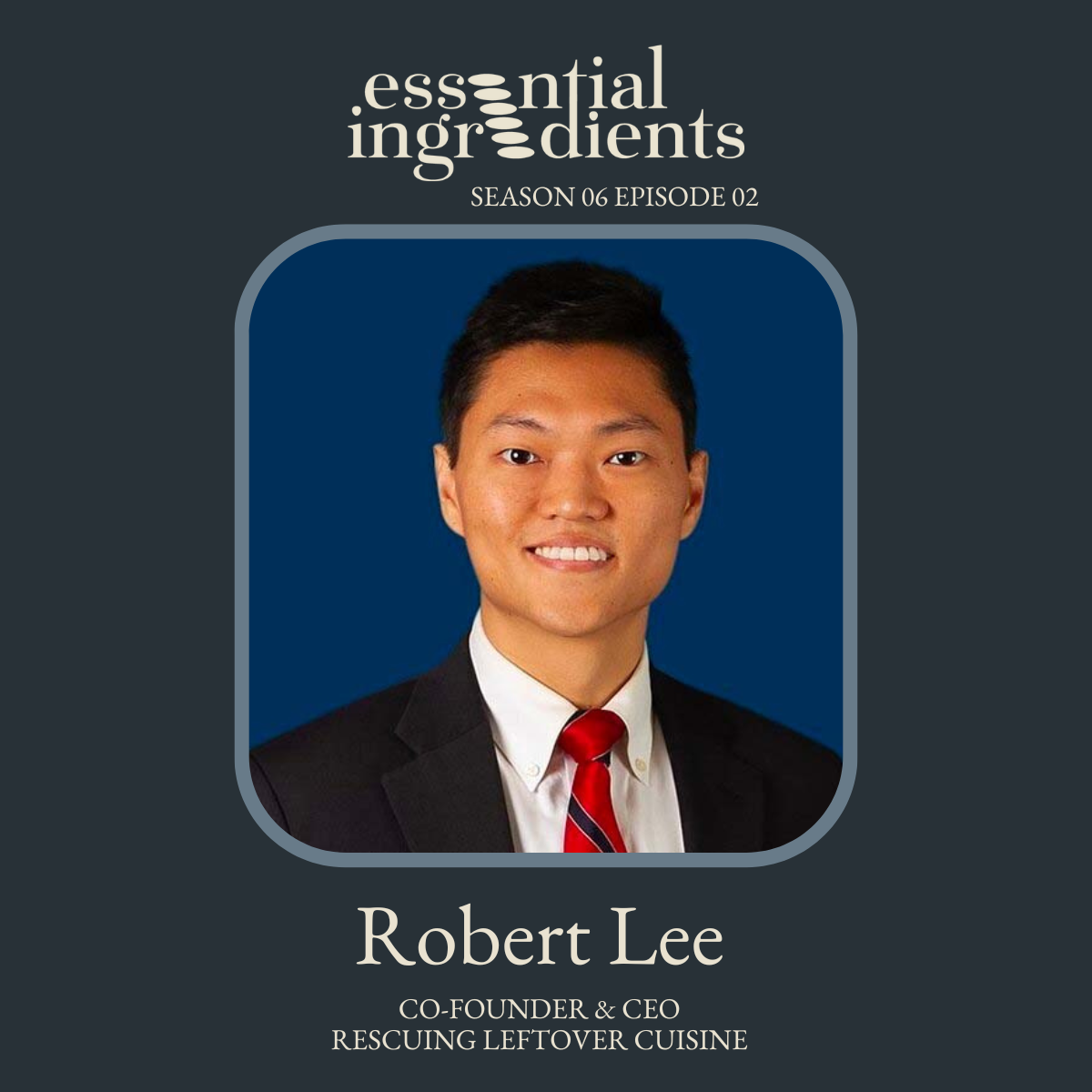
Robert Lee · NextGen Purpose
Watch on YouTube
Rescuing Leftover Cuisine — Fighting Hunger and Food Waste with Robert Lee
The Incorporation Method helps you turn what matters into practical changes that fit your life.
“Food insecurity and hunger is a tragic reality. Despite the overwhelming abundance of food, millions of people around the world are still hungry and do not have regular access to enough nutritious food to support a healthy lifestyle.”
Full Transcript
Full conversation between Justine Reichman and Robert Lee.
Thanks for having me.
Thanks for joining me. I'm glad that we were able to organize this. I know it's a busy time around the holidays, so thanks for joining us.
Thanks for arranging this. And thank you so much for having the opportunity to amplify our voice.
Yeah. It's great. Because I think so often, there's a lot of different kinds of organizations around and we just don't get to talk about them enough, or share your story and tell people what it is you're doing. So I'd love to kick it off with you sharing what Rescuing Leftover Cuisine is for those listeners and viewers today that are tuning in and may not be familiar with it.
It's very self explanatory in the name. But what we do is we bring excess food to those in need at home shelters, soup kitchens and food pantries. Our mission is to redistribute excess food to people experiencing food insecurity. And we do that in various ways. But typically, we engage rescuers, volunteers, much like me, and we just go out there. And we rescue food from all kinds of food businesses, restaurants, catering companies, to even wholesalers and distributors. And so we've been doing this since 2013, and looking to continue to kind of grow and expand, and really make food rescue the universal standard rather than the exception.
Wow, that's wonderful. What a great mission. Tell me what inspired you to co-found this organization.
We got started, honestly, very organically. But it also started with my own personal kind of background. I grew up in New York City, second child of two immigrants who basically struggled to find footing here in the US. I grew up thinking that food insecurity was normal. I thought that everyone's struggling to find food. When I went to school, I realized that was definitely not the case when I saw people throwing out bags of carrots, apples and perfectly great food. And as I kind of grew up and really learned a lot about how much excess food there was, it always bothered me. And by the time I went to college at NYU, I came across this club that brought leftover dining hall food to homeless shelters. And that was when I really got really impressed by what they were doing, but also just engrossed in the work of taking excess food to those in need. And it was just a club in the beginning, kind of got super involved and I helped grow it throughout the four years of college. But afterwards, after kind of getting a job at Morgan, I realized that it was something that I wanted to continue to do after graduation. And so started Rescuing Leftover Cuisine in 2013 and kept on growing it, and ended up quitting my job. Achieve more in 2014. So it's been about nine years since then, which is insane to think about. But that's kind of the story in a nutshell.
Wow. Well, I appreciate you sharing that so much. And because there are other organizations, I'm trying to think of what the one is in New York City that I know about. Oh, God, I can picture the trucks.
Oh, City Harvest, probably.
Thank you. I'm also from New York City so I can see these trucks. I knew about growing up there.
Yeah. And it's insane. I think City Harvest was one of the very first food rescue positions where I think the first, and they did amazing work and kind of paved the way for food rescue to kind of become a thing. And what I realized while going to NYU was that City Harvest had a minimum power requirement because of the kind of the model that they had, which was very reasonable and very intelligent. And you don't want to kind of bring a truck into the city and get all these parking tickets, and pay for all this gas just to pick up something that was less than a load for a truck. And basically, we started to specifically target that niche gap, the smaller amounts of food, because of the 26,000 food establishments in New York City. The vast majority of them are not going to have above 150 pounds or 100 pounds of food to donate every night. We specifically tried to create a model that didn't rely on trucks, that didn't rely on larger amounts of food to make it worthwhile to transport.
Yeah. I also thought that was interesting when you were talking about the school cafeterias. And that's something that City Harvest was targeting that was not their niche. So can you just go into that a little bit more because I think that that's a unique market. I don't know how many other people are touching on that, and I'm not quite sure just how large that market is. But I'd love to learn a little bit more about that, if you would, just dig a little deeper into that.
Absolutely. I think, in general, a lot of cafeterias, both for corporate cafeterias, as well as school cafeterias are a huge untapped kind of area. Within our college within NYU, we worked with dining halls to rescue the excess foods, and it's insane how much excess food is just thrown away. And especially in these kind of establishments with our NYU club, after we started Rescuing Leftover Cuisine, we actually kind of moved away from student cafeterias because there were a lot of really great groups. For example, the Food Recovery Network that focuses specifically on kind of advocacy and getting students together to rescue food from their dining halls, mostly within colleges. But overall, I think just private schools, in general, have become more and more of a kind of proponent for rescuing food and donating the excess food. And we still haven't seen much from the public and as much, but there's a lot of excess food happening there. What's exciting is at the end of last year a couple of weeks ago, the Food Donation Improvement Act was just passed by Congress, which actually helps solidify and clarify some language for schools to donate excess food. And I think that kind of momentum has really helped us to really kind of continue to push the universal standard of having excess food be donated instead of thrown away.
Well, that's a great push out a great movement forward. So that's great to hear. You're working with J.P. Morgan, you were inspired by your childhood, which I think is so often where we get these ideas, and what sort of enables us to create our vision for the future. I know that I'm really inspired by my childhood, and it's sort of cultivated my value system and what I'm doing today, so I can see that in what you're doing as well.
Right. Yeah, it's super important. I think that a lot of idealistic things, dreams that we've had since childhood, get harder and harder to kind of push for as you grow older. But I think it is just that push and that belief and faith that helps make it a reality that you're in.
Yeah, I would agree. And I hope that continues in my future, and I can continue to hold on to that.
Yes, absolutely.
But it keeps me going every day. I'm more motivated to do that than I am anything else. You left J.P. Morgan, falls out on this mission to build this company and this organization that's impact driven. And so I'm wondering, this shift from JP Morgan to grow this business, can you talk a little bit about that? You're a first time entrepreneur, you're young, you're green, you're excited? Can you talk to us a little bit about what your journey was like?
Yeah. It was very, very winding. I think starting your own organization or company is a lot of learning. I think JP Morgan, I had the opportunity to learn a lot about all kinds of things, even just on a basic level. Learning how JP Morgan was structured kind of internally, it's in terms of how they incentivize employees and how they cultivate talent. And I tried to learn as much as possible before leaving JP Morgan, as well as kind of like the people aspect of it as well. And when I first started on the journey, I think there was just a lot of working in the business. It was a lot of creating pilots, proving out the model, getting the proof of concept, and kind of pushing the envelope more and more. And I found myself physically rescuing food after working a 9:00 to 5:00 like in the office type of setting on growing more food donor partners, growing more nonprofit recipient partners and things like that. And I found myself being in the weeds too much and learned a lot about trying to think about growth and what the next steps are, and hiring your first employee and figuring out all these different structures, systems and processes that help grow the organization and grow the processes overall so that it doesn't just get stuck in the same things over and over again.
So it was an important part of the journey actually. I had a similar, I mean, not a similar experience. But I was working at PwC years ago, it was the process and the boundaries and the structure that helped me in my startups. It was learning, understanding that, and then use that in my startups event, and being able to understand. And without getting that skill set, and without getting that education, it would have been a little bit more difficult. For me, that was my excuse for having that opportunity. I always think about it when I see these entrepreneurs and they are coming right out of graduate school, they're coming right out of college. I'm like, I'm amazed, and I'm in awe. And I think it's amazing. There's no judgment there. I don't know that I would have been able to do that. I don't know that. I would think through that cleverly, I don't know that I would have had the skill set to do it. And yeah, interesting.
Many approaches, but I think when I first started and kind of early in the stages of RLC, I was a huge proponent of working at various companies and interning at various companies. During the four years of college, I interned at various large nonprofits, small for profit companies, startups, as well as large for profit companies, and kind of got as much experience across different sectors, as well as sizes of companies. But what's interesting is I think as I kind of worked on RLC longer and longer, I kind of see the experience is not as important as having the mechanism to learn while you're still growing your organization. Because learning from mentors, learning from people's lived experiences, as well as just having people who can help provide the right advice at the right time. I think it is super key. I think that sometimes, you don't even have to live through certain things to kind of have access to those things. So it's interesting. There's a lot of different methods.
I think it's interesting, because we can have a great idea. There's a lot of different ways to sketch out that idea. Sometimes having that great idea also means that in order to execute it, you need to surround yourself with people that for sure get you from point A to point C, or D, or E. Because you can be the visionary, but you may not have all those skills to get you where you need to go. And talking to those mentors and bringing them into the fold, and understanding their processes, what worked and what didn't work. So cultivating that community is so important to hear their experiences. I couldn't agree more. I think having all those experiences, the access to the people, the information and being open to it, like you said, is really key. Sometimes, we know everything when we're young or old. It doesn't matter. We have all the answers. The greatest gift I ever gave myself was letting myself know that people know more than me.
Yeah. Brewing is also about not repeating mistakes that others have already made, and trying to make newer mistakes, or just trying to kind of learn from as many people as possible,
But the only way to do that is to be open to listening. So tell me, you built this, where are you currently right now? Oh, I heard you call it ROC.
Yeah, RLC.
Okay. So where are you guys right now? And what's new and what's on your, and what's on the horizon for you guys?
Yeah, it's a very exciting time. I think over the past year and 2022, we've done a lot of kinds of consolidation and alignment within our organization. We grew fairly quickly. In 2021, we rescued about 1.2 million pounds of food that year alone. And then last year, we're still finalizing count, but we're at 2.9 million pounds of food. So we've nearly tripled. And we're looking to kind of continue that momentum and that rapid kind of growth, but there's a lot of work that needs to kind of be done in terms of continuing to expand, grow and work with new federal partners. There's a lot of attention being placed on excess food and wasted food as a whole which is incredible and needs to happen. Especially as things continue to be highlighted around the environmental impacts of wasted food, there's just so many different components. And I think that for RLC, we're year one of our kind of three year plan, if you will. And our plan is to try and get to 6 million pounds of food per year, and we're almost halfway there already. And so our plans are to continue to grow and grow as much as possible. But really, the end goal, as I mentioned before, is to make food rescue the universal standard to make it so widespread that we reach a tipping point where food businesses have either no choice culturally, or just socially, or even legally to kind of donate their food. And I think as the movement continues, and as more food businesses lead by action by actually donating their excess food, it's going to be a culturally acceptable thing. I think it'd be culturally unacceptable to throw away food. And I think at some point, there'll be this massive push across all food establishments to donate and to publicly say that they're donating their excess food instead of throwing it out. So that's how we see things being situated at the current moment.
Wow. Okay, so going forward, is there anything that you're looking for to help grow your organization?
Yeah. I think there's so many things people can do. Even at home, people can be conscious of their excess food and their wasted food. Truly for us, it's our dollars. We're paying for these grocery items. And then if we throw it out, that's our dollars. We could use something else. So that's the first thing I always talk about, which is, there's a lot of tips that even I've implemented just because there's always ways to improve. But for instance, I saw a notable improvement by just not grocery shopping when I'm hungry. I can definitely eat all this, and then just take all this, this amount of food home. I think there are other ways to continue to make it more at the forefront. I think it's important for people to ask their favorite restaurant or their place where they get food, what they do with their excess food, and kind of make it known that the values of their customers should align with their business. More and more we will use our dollar votes to support businesses that actually donate throughout their access. So I think there are a lot of those lifestyle changes and things that you could do to help. But obviously, to support specifically our LLC, you can always donate, you can always volunteer. We have a calendar of events where you can sign up online, there's a bunch of different opportunities that are available at different times of day by different areas of your location. We're in 90 cities right now so you can feel free to just check us out in rescuingleftovercuisine.org, and there's a calendar there. And at the very least, you can always follow us on social media and just check us out and follow our story.
Awesome. Thank you so much for joining us today. It was a great conference. I learned so much and it was good to chat. I always love meeting fellow New Yorker too. But well, we'll continue to follow along. Well ask everyone to follow along too, we'll throw it in the show notes, and we hope to see you again soon.
Awesome. Thank you so much.
Share This Episode
Enjoyed this conversation? Share it and tag @nextgenpurpose
Listen on Apple ▶Listen on Spotify ▶Your Host
Justine Reichman
Founder & CEO of NextGen Purpose. Host and Executive Producer of Essential Ingredients — 11 seasons, 330+ episodes, and a growing movement.
About Justine →