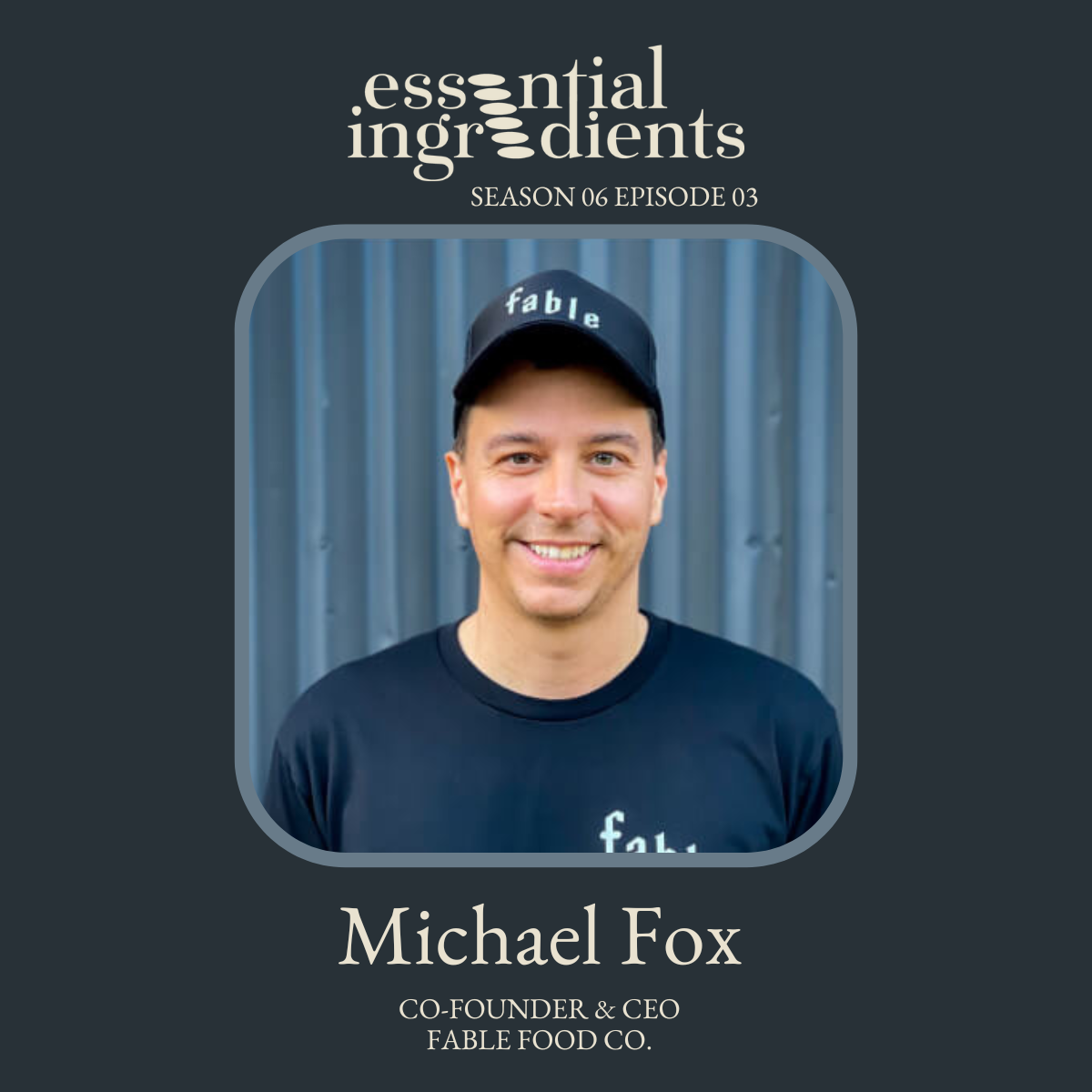
Michael Fox · NextGen Purpose
Watch on YouTube
The Mushroom Meat Alternative Transforming the Food System with Michael Fox
The Incorporation Method helps you turn what matters into practical changes that fit your life.
“One fine day, a vegetarian, a celebrity chef, and a mushroom geek were out for a leisurely walk in the woods. They stumbled upon something special— an opportunity to transform eating habits and create a more sustainable and nutritious way of cooking with mushrooms.”
Full Transcript
Full conversation between Justine Reichman and Michael Fox.
Yeah, I'm good. Thanks, Justine. Thanks so much for having me along. It's a real honor to speak to you on the podcast.
Yeah. Well, I'm really pleased we were able to connect. I know that there's different time zones, different times of days, and it can be challenging so I am so pleased that we are able to coordinate. And for those of you who are not familiar with Fable, just to kick this podcast off. And for those watching the video cast, I thought, would you give us a little intro into what Fable is?
Yeah. So our mission is to help end industrial animal agriculture, and we do that by making delicious meaty food out of mushrooms. So we take farmed mushrooms, like shiitake mushrooms, white button, portobello mushrooms, and we turn them into really delicious meaty food. We sell that mostly through restaurants and foodservice, and a little bit in retail.
Wonderful. So I got to ask your goal, your mission is around agriculture. What got you inspired to solve this problem, specifically in agriculture?
Yeah. I went vegetarian seven years ago. For me, a mix of and actually an order of ethical environmental health and pandemic prevention reasons. I went vegan about two years ago for all those same reasons. And so I finished up doing, I was doing a fashion business for about 10 years, which I finished up with about four years ago. So it took some time off after that thinking about what I wanted to do next. And I got very passionate about the idea of wanting to help end industrial animal agriculture for all those ethical environmental health pandemic prevention reasons. I was thinking through how I could best go about doing that, and I've been one of those annoying vegans trying to convince everyone around me to turn vegan. And I think in seven years, I've managed to convince three people to work for Fable, which probably doesn't really count. And the third I caught up with the other day, and he's back eating meat. So I'm obviously a pretty terrible activist. But I could see out of all those conversations, people get the reasons why, and they do want to reduce their meat consumption. It's just hard because animals do taste great. I didn't go vegan because I didn't like the taste of meat. Quite the opposite, it was hard to give up because of that. So I started realizing out of all those conversations, if you can give people the taste and texture of meat and make it out of something other than animals, that's the best route to helping end industrial animal agriculture. I know you had Bruce Friedrich from the Good Food Institute on the podcast in November, and he articulates very well all of the background on this. So yeah, that was kind of the goal of what I wanted to work on and help achieve. And then I was thinking through how I could best go about making something that helps people reduce their meat consumption.
That was my next question. Why mushrooms?
So I'm a pretty healthy eater. I live on the Sunshine Coast. My wife and I live on 41 acres, and we grow a lot of our own food and make sourdough bread and butcher, and got a big veggie garden and try to sort of learn about regenerative agriculture and trying to apply some of those principles on our property. So I eat a very minimally processed whole food based diet. I wanted to develop a meat alternative that aligned with that thought.
I was just gonna ask you because I asked everybody this when they use the term regenerative agriculture, and I asked this because I've heard so many different definitions. And since you threw it out there, I have to ask, what does regenerative agriculture mean to you?
Oh, good question. I guess I've seen all the different definitions too. I'm trying to figure that out as well. I think to me, the thing that draws me to it anyway with growing food at home is I want to grow food for our family that is really nutritious. So ideally grown in very healthy biodynamic soil is obviously organic. No fertilizers, chemical fertilizers, or pesticides, or herbicides, or anything used. That's probably the primary goal from a health perspective. And then in doing that, ideally, also regenerating the soil on the property so that we caretaker, we might own the property. But I'll hopefully live for another 50 or 60 years. We'll pass the property over to other people in the future, and hopefully leave it in a healthier state than we found it.
I appreciate you taking a moment and going through that.
No worries. And it's a really interesting space to learn because like you said, all sorts of different definitions of it, but that's how I think about it.
Pretty personal to you and to your family, and to your food, and how you're feeding your family, and then how you're taking from your soil. And so you're really creating a regenerative farm for your family to eat from. You're living a regenerative life.
Yeah. And I guess, I also want to learn about it too because we're applying into the Fable business. Now obviously growing the vegetable and fruits in regenerative farming on the property as a sort of side hobby. The Fable is the core place I'm spending my time, and I guess I'm having the biggest impact. Hoping to have the biggest impact. So yeah, learning about these regenerative processes, we can hopefully apply some of that into our sourcing of mushrooms and different things. So that's been really interesting to learn about as well.
So how do you apply regenerative agriculture to the sourcing of the mushrooms, and how you produce the products?
Yeah. Mushrooms start with are an amazing part of any regenerative agricultural cycle. So we should talk about mushrooms as our primary ingredient. Shiitake mushrooms in nature, they grow on rotting wood. So tree falls down, mushrooms growing on the tree. Sometimes, there's lots of different mushrooms that will do that. The shiitake are one of them. And when they farmed, they're grown on and sort of man made logs that are made out of off cuts from the timber industry. So yeah, the timber industry has a whole bunch of wood off cuts and sawdust that they need to dispose off. It's a byproduct of the timber industry so shiitake farms basically take all of those off cuts, compress them into logs, and then grow the shiitake mushrooms on those logs. And the aside from using a waste stream from another industry, the other big benefit is when the shiitake mycelium grows through the logs, it helps to break down the wood and turns it into really good compost, then is sent to farm. Then have partnerships with other sort of plant farms that will then go and take the shiitake logs and composite them onto their farms. That's not specifically asked, that's just shiitake mushrooms as a whole. That's what's done in the industry, and it's similar with most other types of mushrooms. They grow on byproducts from other industries, so really good as part of an overall regenerative agricultural cycle.
Wow, tell us what kind of products are you providing NASA?
Yeah. So going back to what got me into mushrooms and then leading into that. So yeah, I'm a very healthy eater. I wanted to develop an alternative meat, but make it out of really natural, healthy whole food ingredients. So I didn't want to use textured vegetable protein or binders like methylcellulose or other things that are sometimes used for meat alternatives. I want to make something really natural, whole food and healthy. So I started exploring different base ingredients. Some chefs put me on to the idea of using mushrooms as a base ingredient because mushrooms have a lot of those natural meaty umami flavors in them, and they're incredibly healthy and good for us. So I started exploring mushrooms through that exploration, and met my two Co Founders. So Jim Fuller grew up as a Texas fine dining chef for the first 12 years of his career, studied chemical engineering because he wanted to understand the science behind food. He fell in love with mushrooms as an ingredient, left cheffing, moved to Northern California and got a job in a mushroom farm, went down the rabbit hole on mushrooms, fell in love with everything about mushrooms. He also fell in love with an Australian woman, went back to college and studied Agricultural Science majoring in mycology. Just mushroom science, and worked as a mycologist around Australia and Asia for the last decade. And then our third Co Founder, Chris McLoghlin is an organic mushroom farmer and has a really strong background in organic mushroom farming. So yeah, we teamed up to co-found Fable to make alternative meat out of mushrooms. So the kinds of products that we make, basically products that you can use to replace animal meat in your diet. So our first and our primary product is a pulled meat style product, and it's made from shredded shiitake mushrooms. So we take the shiitake mushrooms, we have some unique ways of cooking them that we've developed using Jim's mycology science, chemical engineering science and shipping background. So we cook them in really unique ways which amplify the meaty umami flavors and de-emphasize some of the more kind of traditional sulfuric mushroom flavors, and then we would shred them. So you get a really delicious like beef, pork style taste and texture out of the product, but it's made primarily from shiitake mushrooms and then shortlist of other all natural plant based ingredients. A little bit of coconut oil and natural flavors.
Wow, that sounds amazing, I can't wait to try it. Tell me about your experience as a founder. Is this your first time as a Founder?
First time in the food space. I previously did a fashion tech startup called Shoes of Prey, co-founded in 2008. And I did that business for about 10 years prior to doing this one side. I've done a startup, been a founder and done a startup before, raised capital, high teens or those kinds of things. I guess when I started Shoes of Prey, I was sort of 24, 25 olds and really thinking about the mission for the world type side of things. Whereas Fable for me is much more of, came at it from what can I do to help give the purpose side that you talk about a lot on the podcast, what can I do to help improve the world and make it a better place? And kind of came at the business idea of starting at that angle.
Or impact driven? This was a new kind of way for you. It came from a different place. Do you think that was just a new place in your life that you were at?
Yeah, I think so. When I started Shoes of Prey, that was 2008, 2009, I think my awareness has grown dramatically in that time of issues like climate change and loss of topsoil and all the issues around industrial animal agriculture. I was only vaguely conscious of those things prior to 2008. So yeah, when I finished that, when I started Shoes of Prey and all those kinds of issues in front of my mind and wanted to do something for my second business that could help solve those problems.
Yeah, I think it's partly experience and what's going on around us, and what type? And then, of course, what's important to us? So from what I'm hearing from you going vegan and changing the way you eat really played into, from what I'm hearing that food was changing the way you were living because of the impact you wanted to have on the world. What was important to you with the impact you are already having on a personal level, and created your startup.
Yeah, that's it. There's a framework called the ICA guy framework, which I only became aware of after I'd started Fable, but it perfectly kind of describes what my thinking was and lead into Fable. Ideally, the thing that you work on is a mixture of what you're good at, what the world needs? Something that you can make a viable living from. And for me, Fable marries up on all of those things. I was already vegetarian for three years before starting Fable. So the mission side and what I could see would be good for the world was all aligned. Yeah, I've been a founder before, so starting another business was my skill set. And making alternatives to meat, you can see that that's a way to solve this problem in the world whilst also building a business. It feels good, right? It feels great. Much more enjoyable than doing women's shoes.
I do like women's shoes.
No, no, I enjoyed it, too.
You can have a company like Rothy's. They're impact driven, they're doing positive things in the world, and they're making shoes.
Yeah. Shoes of Prey was manufactured on demand, so it was designed to reduce a lot of the waste in the supply chain, marketing fashion to consumers, which is designed to make people buy stuff I don't really need.
Oh, curious, you went from fashion to food, right? You can do eco fashion, by the way. And then reusable fashion. And that's the whole thing too, refashion they call that. So anyway, I digress. That's all. But what I was going to ask you was, as a second time Founder, you were Founder in fashion, now you're a founder in food. I'm wondering, what things do you see when you go from founding a fashion company to founding a food company that you can utilize? What skills can you take with you, and what skills did you have to then acquire? Did you feel like, oh, I can do this? I found that in one company, I can do another. Or did you think, okay, this is a totally different industry. Where was your head at?
I'd say most of the skills that I learned from Shoes of Prey apply into Fable. The real only differences are around learning about food. And obviously, there's a lot to learn about food and the food industry itself. But all of the other pieces around, develop consumer research and consumer insights to understand what consumer wants, what product development and the processes there for shoes and for food is not dissimilar the way you go about understanding consumer insights and doing product development. Then manufacturing, shoes and food are obviously different manufacturing processes. But working with contract manufacturers or building your own manufacturing facilities, a lot of that's the same even though it's a different product. Then raising funding, hiring and managing team building, building a good culture, marketing sales, all of those pieces are really the same across industries. Or at least for me, the same in fashion as they were in food. But then it's been learning a lot more about the technical side of the product. So learning a lot more about mushrooms, about nutrition. I had a really strong interest in those areas beforehand, but really getting into the detail of it. And then obviously, food safety is probably the other really big one, it's difficult. You'd have to do something very wrong to kill someone with a pair of shoes. But in the food space, you've really got to be conscious of having all of your eyes dotted, T's crossed on food safety, and allergen management, those kinds of things. I'd say it's like 80% overlap on the skills and 20% have been different, or associated just with the product and food industry.
In your fashion company, were you a solo founder? Or did you also have a partner?
Also had two Co Founders in that business. So that's been similar..
I was just curious, because oftentimes, we go from one company to another. I'm curious because you've done it. You've gone from one industry to the next. What was the biggest thing that was different from the two companies, or the greatest learning that you've had from one that you took to the next?
I'd say, I'll give you a couple. So definitely doing something that I'm passionate about and then it is good for the world is a massive plus for just my own personal motivation and enjoyment. Shoes of Prey, I don't wear women's shoes. I do really enjoy the fashion industry, but I didn't necessarily love it in the same way that I love food. And yeah, we weren't necessarily doing something as good for the world as what we're doing now. So picking a business concept, pursuing a business concept that is impact driven for me has been massively motivating. I've really enjoyed that. Probably my other biggest learning out of Shoes of Prey was for that business, we kind of did the full rollercoaster ride of a startup where you kind of ended up in raising about 25 million US dollars at our peak. We had about 200 employees, we built our own shoe factory in China, we were sort of doing about 10 million a year in revenue, but we just couldn't get mass market, product market fit. We've done really well in these niches of really passionate creative consumers, and extended sizes and wedding shoes. But we couldn't get a scaled product market fit in the mass market. And we kind of bet the company on that we would be able to achieve that scaled product market fit. And so in the end, we didn't get the outcome in the business that we'd aim for, and we sort of ended up selling off the assets of the business and weren't able to return all the money to investors that had been invested. So wasn't the outcome we were looking for. So my big learning out of that into Fable is to really focus on consumer insights, ensuring that we've got product market fit in some mass market segments before we go and build out scaling the business. And I think in the middle alternative space, I think one of the things we've seen over the last few years, there's a lot of companies that have raised huge amounts of capital. I don't think most of them really have scaled mass market product market fit yet. And so I think a lot of what's going on in the meat alternative category at the moment is the same thing. People are making the same mistakes that I made in my last business, so I totally empathize with them. But the approach that we've taken with Fable is keeping the business really small and lean. We have only 17 full time employees, we're pretty close to profitability. We've had a few profitable months, we've raised venture capital and just closed another round now, which we'll announce shortly. But doing it in a really efficient way and making sure that we've deeply understood the consumer, we deeply understand where we've got product market fit before we go and build out our fixed cost base and employee base before we start really scaling the business in a big way.
Are there any recommendations you would say for new startups that are looking for product market fit that they might not think to look for that you've learned is really important to consider?
Yeah, good question. So probably the biggest error I made in Shoes of Prey was, and this was difficult to do in Shoes of Prey. It wasn't easily solvable. In my experience, being able to watch consumer behavior versus doing consumer surveys and asking consumers what they want is so much more valuable. The problem that we had in Shoes of Prey was no one had built an online customizer for women's fashion shoes so we couldn't go and watch how mass market consumers behave. And so we ran, we did surveys, we did focus groups, we asked consumers what they wanted, the mass market fashion consumer, she'll tell you that she wants to design her own shoes and that she loves the concept of that. But deep down, she doesn't actually really want to do that. She wants to see what's popular in fashion magazines and on Instagram, and buy that exact design front even from a designer. So what you ask, a mass market fashion consumer, what they tell you is very different to what they'll do in their behavior. And we made the mistake of just going off the focus groups and surveys, and what will these consumers be super excited about wanting to design their own shoes. So we went and built the scale out. But in the end, they didn't actually want to design their own shoes. So with Fable, I spent a lot of time watching consumer behavior standing in the in the grocery stores, watching consumers shopping the meat in alternative shelves, see what products they're picking up, which ones they're putting back on the shelf and not buying, which ones they are buying, and then crucially going up to them afterwards and asking why they picked that product or didn't pick those other products, and having a conversation with them about it after I've watched their behavior. And that's worked much, much better for us. And it's also what helped lead me into the path of mushrooms and doing a really healthy whole food or natural product.
What was the most comment that you got that you were, maybe you didn't think you were gonna get? Something that you get a lot of comments you expect them, but what was the most unexpected comment?
Good question. The most insightful piece I think I expected was just how much consumers particularly shopping that category care about health, and how much they wanted really natural ingredient tech. Because I would say that of all the customers I watched in the grocery stores, half of them would turn over the packet, read the ingredient tech, and we're making decisions based on what the ingredients were in the products. I don't think that happens as much in other food categories. Happens a bit, but not as much in that on a health food aisle. It obviously would be in the health food category, but it was happening a lot in the meat alternative category. And that was kind of four years ago that I was first doing that. So that was a big part of what helped lead me down the path of mushrooms. That's the way I shot. I could see that lots of other consumers were shopping that same way in the category, so that doesn't quite answer your question because I was hoping for it. But maybe it was a bit unexpected that many people who were shopping that way were in that category.
I think it's interesting to hear that because I think that now, more and more we're hearing that people want transparency. I think that that really supports that thought. There were a lot of these meat alternatives. And when they first came out, I'm not trying to shame any one of them, there was a lot more filler when they first came out, and without pointing fingers. And then as more and more came out, we'd see it pressed people to come out with better and better alternatives. Why? Because they wanted to create something that was better than the other. So they would take out the filler because they had to prove that this item was better than the next. This is just my observation, and what I think so all the sudden we're seeing more and more transparency because people are looking and demanding a better product. Because as you're observing, people care what's in these products.
Exactly.
So here, you're proving out what I was hypothesizing, you're hearing that people want transparency. And four years ago, you started to see that. So maybe people like you that were doing research in this niche we're observing that people really did want to see this. And so then later on, we started to see these products come out and people be more transparent about it and create better products without sugars and fillers, all sorts of things.
I agree. I think it's important to still keep in mind, I always have to tell myself to not just think about the way I shop for food, because that segment is definitely building. But it's still not the mass market, like you're on the need to walk into a grocery store and look at the products on special occasions on the islands, and it's Doritos, Coca Cola, Oreos, all the kind of really, really, really not good for you things. Still the mass consumer isn't thinking the way that you and I do, but definitely that segment is growing in certain categories in the grocery store. It has changed and improved, and I definitely agree with your transparency. It's a big thing that more consumers are looking for. Maybe it hasn't crossed over into the mainstream yet, but hopefully, it will soon.
I think the more education that's out there for the community and the masses will start to see a greater demand for more than we even see now. Because the more people know, the more people will question. What's new and what's next for Fable?
We've recently launched into the United States. So we kind of started out focusing on Australia, but we've recently launched it to the United States. So we're now on the menu in New York City. There are 10 restaurant vegan chains. We're about to launch the Butcher's Daughter into their three restaurants in New York City, and we will get into the one in LA soon, and then we're going national into SDK steakhouses. We'll have a slider burger patty. Fable slider burger patty going to the menu, that'll be the first vegan item on the menu at SDK steakhouses. So that will be exciting. And then into Kona Grill nationally as well. And then we've been partnering with Whole Foods to develop burritos, which will be going in under one of their private labels into their ready to eat section. And all of those launches are happening before the end of January, which is exciting.
That's exciting.
Thanks. So we mostly focus on food service, but then we also do a little bit in retail. So we're available online in GTFO vegan in the United States,
Very exciting that you have a lot going on in the first quarter of this year. So that's very exciting news. I'm super excited. I can't wait to try it. Hopefully, there'll be an SDK or the Butcher's Daughter, depending on which Coast I'm in or where I am at any given moment. But that sounds amazing, and your story is inspiring. I'm so glad that we're able to have you on to share what you've done, what you're doing and where you guys are headed. Are there any new skews that you guy, new products that you're going to be putting together in the second, third or fourth quarter this year down the road?
Yeah, so we've been working, we've got that pulled meat product, we've got the slider party, we'll launch a full size burger patty later this year in the United States. And then we've also done a meatball, a breakfast sausage patty, and a riblet. So we will hopefully get some more of those skews into the market later on in 2023. We're excited.
Awesome. Okay, well, we were gonna stay tuned, and we're going to have you back so we can keep up to date on what's going on at Fable and where everyone can taste and try your products, whether it's retail or in the restaurants.
Thanks, Justine. Really appreciate it.
Yeah, of course. So happy to have you on here, and we look forward to continuing your journey with you and following you. So thank you, and we'll see you again soon.
Share This Episode
Enjoyed this conversation? Share it and tag @nextgenpurpose
Listen on Apple ▶Listen on Spotify ▶Your Host
Justine Reichman
Founder & CEO of NextGen Purpose. Host and Executive Producer of Essential Ingredients — 11 seasons, 330+ episodes, and a growing movement.
About Justine →