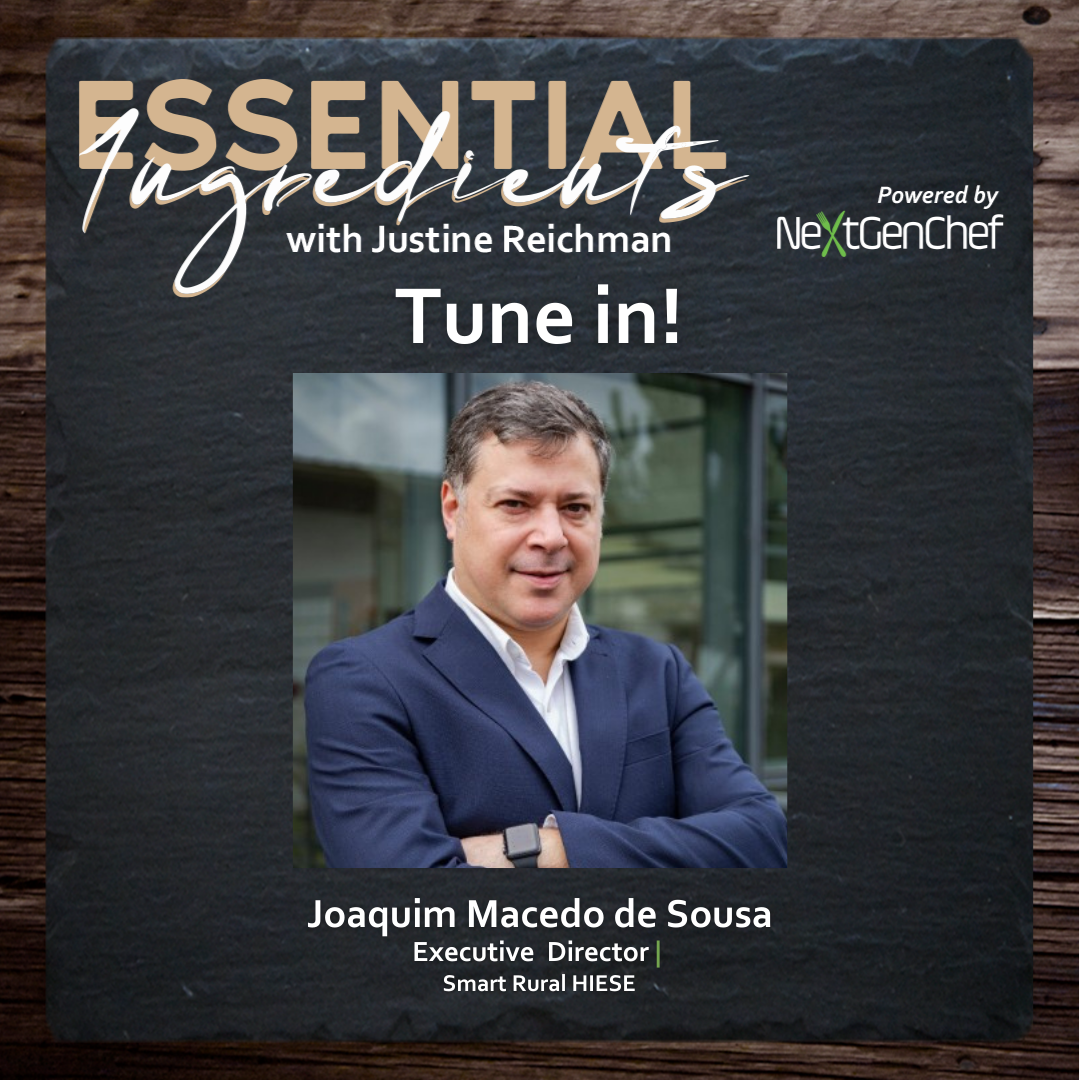
Joaquim Macedo de Sousa · NextGen Purpose
Watch on YouTube
Developing A Sustainable Business with Joaquim Macedo de Sousa
The Incorporation Method helps you turn what matters into practical changes that fit your life.
“The Habitat for Business Innovation in Strategic Sectors (HIESE) serves as an innovation space that promotes entrepreneurship in rural areas. Launched in 2016, this business incubation facility in Quinta Vale do Espinhal, Penela, Portugal has 15 offices that accommodate companies in the critical early stages of their business. HIESE offers various services including physical and virtual incubation and acceleration programs, internationalization, training, and business planning.”
Full Transcript
Full conversation between Justine Reichman and Joaquim Macedo de Sousa.
Thank you. Hello, hello.
Happy to have you here today. So excited to learn more about reBLEND and how you got started here, and what inspired you so let's get going. Let's start. So tell us all a little bit about reBLEND so that our listeners and our viewers can know what we are talking about today.
The story of reBLEND kind of strikes a little bit with the story of me, and I'm a food person. I spent my entire life/career in the food world from an early age. I was slinging Easy-Bake Oven baked goods at my lemonade stand. And then, shortly thereafter, kick started a career working with companies like payWave, Panera, Starbucks, Clif Bar, and Safeway and Pop Chips, and marketing sales and R&D roles. One of the areas that I wanted to get more exposure to was in product innovation. So I went to Northwestern, got my master's in engineering in my MBA. And it was while I was at school that I saw two things happening. On one end, I had learned about the food waste epidemic. I was seeing these crazy statistics. And as I tried to make sense of the staggering statistics of waste, I just started to call farmers, manufacturers and distributors. When I was speaking with them, they all kept saying the same thing that one of the biggest gaps in the supply chain is that most manufacturers are not able to source their quote unquote waste, because most manufacturers cannot blend whole fruits and vegetables. As most products in the market are made just by stirring up concentrated juices, flavors and processes. And they all kept saying that if there was a company that could start with full fruits and vegetables, that they would suddenly be able to offload all of this quote unquote waste, and that this type of company really could revolutionize the fight on food waste. And I didn't know exactly what to do with that. But at the same time, I was a busy grad student, I was struggling to get enough fruits and veggies into my own diet. I had started to make smoothies in the morning kind of as my way to get the good stuff in. And quickly, this well intended idea devolved into a 40 minute process of cleaning the fruits and veggies. Chopping the fruits and veggies, you're measuring your goji, your chia, then you're cleaning your blender, then you're looking around, your kitchen is a warzone. I had this idea to take my smoothie and to strip out everything that bolted up. So take out the ice, the water, the milk, the excess banana, everything that is designed to add volume and to pack it into something that I could grab from the freezer and head to class. So selfishly, I just started doing this for myself. My friends saw me eating my pops and route to class, and soon started to ask like, hey, if we pay you [inaudible]. And I was like, sure. Then I started to get messages from people I didn't even know asking if I was a smoothie woman. Until then, the light bulb went off. It became clear that there was actually a massive audience of consumers looking for seamless and convenient ways to get boosts of fruits and veggies back into their diet. And there was a huge opportunity to build a supply chain and a company on the premise of starting with whole fruits and veggies. And I saw that there were all of these sources of quote unquote waste, what we call re-harvested and repurposed opportunity produce. And I brought both of those passions together and started reBLEND.
Wow. So when was this? What year was this?
This was 2017. When I started, no manufacturer would work with me. I would get on call after call consistently, be laughed at, being told that I didn't understand manufacturing. This was a great idea, but it was never going to be scalable. So I just figured, if I can show there was enough demand for our products, and for this type of product, that I could get the attention of a Co-Packer to think a little bit differently. So I bought my own equipment down at the suit factory, they let me come in from 6:00 PM to 6:00 AM overnight when they weren't operating, and I just started making products by hand. I mean, 15 gallon batches. I was hand pumping every single pouch, hand sealing every single pouch, hitting the Farmers Markets every single weekend. My mom and dad would be in front of the booth with an iPad collecting feedback or taking surveys. I was hitting Mom and Pop shops, coffee shops, golf shops, anywhere I could get this product. I was getting it in front of customers. Really, the goal was to figure out, is this scalable? Is there demand? And then it became clear very quickly that the demand was outpacing what I could produce. I went back to some of those manufacturers, I showed them what we had done, showed them that we've been featured in Forbes, and CBS, and Real Simple, and People Magazine, and people were buying our products. One of the manufacturers I wanted to work with wouldn't respond, and I kept kindly sending a few messages here and there. Finally, he said: "Hey, we're not interested." I reached back, I just said: "That's fair, will you give me 10 minutes of your time. And if at the end of 10 minutes, you're still not interested, I'm gone. I won't bother you. But I'm just asking for those 10 minutes." So we met, and 10 minutes later, he became very quickly one of our fiercest advocates, he recognized the vision of what we were creating. And now, we produce that well over 300,000 units per production run are sold nationally with Thrive, Fresh Direct, Sun Basket, Amazon, QVC, vitacost. And it's been exciting to see that the media also continues to pick up our story. Retailers, media and our customers all really care about what we're bringing to the table, which is a meaningful way to seamlessly get fruits and veggies into your diet, free of any of the junk and preservatives that really follow a lot of the products out there.
I'd love to just go back a little bit, because it's a great story. But I'd really love to be able to just go back there were a couple of things that you were talking about that I kind of wanted to get in there and dive a little bit deeper, so that our guests can really get to know a little bit more about this process. And while the story is so amazing, inspiring and aspirational, hear about some of the nitty gritty, what were some of the challenges? You talked about why people would not give you access to the distributors, and why the Co-Packers didn't want to work with you. Or you mentioned that they didn't want to [inaudible]? What were the challenges for you? Why wouldn't they work with you? Maybe you could share a few of those reasons.
Yeah, I mean, challenges, gosh, I wish I kept a running list in the moment in time throughout this process, there have challenges at every single step along the way. I think the first challenge was, how can I scale this production? And those nights when I was making products by hand, it was really lonely. And it was exhausting to be working overnight and then selling during the day. And I think one of the reasons why manufacturers were reticent to take a product that required whole fruit and vegetable processing is that few of them to none of them have that equipment on site. Being able to pouch a product, it sounds really simple, it's actually a piece of equipment that is very technical. It's a very finicky piece of equipment, and none of the processors out there have the ability and the equipment at scale to blend down whole fruits and veggies. So really, their equipment just did not facilitate it. And so I think that was primarily the first block that I had when I was trying to scale this type of supply chain. And I think in the manufacturing world reticence to do things differently. For a lot of these operators, they have done things a certain way for decades. And the idea of drastically changing part of their operations, for a lot of them, at first glance didn't seem to be something that they felt was necessary or of interest.
What was your process in dealing with that?
I just kept going. I mean, I think ultimately where I landed at some level intuitively, it wasn't like I was trying to draft up rocket science. All I was asking is for someone to be able to blend a whole piece of fruit. While getting a lot of no's, I also just knew it was going to be a numbers game, was really just the reminder that I just kept going back to is, that it only takes one. And I also just knew it was really important. The fact to me that so few of the products and market are made with whole fruits and vegetables was really disturbing. Just to see that, oh, my gosh, over 90% of the products that you see on the shelf don't start from a whole piece of fruit or vegetable when they're fruit and veggie based. And I think that just encouraged me to say, hey, we're going to tackle this rising waste epidemic. And if we are actually going to fuel people with the types of foods that they should be eating, someone's going to need to shake and shake things up. Yeah, it didn't feel great. No one wants to be laughed at on a phone call. No one wants to be told, no, time and time again. So it wasn't fun, but it felt really important.
What do you think were the takeaways for you to be able to get past that so that you could achieve what you have? What would you recommend to somebody, another food entrepreneur that's going through this process?
I think the thing I always lead with is know your why, no part of this venture has been easy. And I think without a lot of clarity on why you are doing this, and for it to really resonate with every ounce of your body, it's really difficult to withstand a lot of those no's. And I do believe that one of the biggest advantages and kind of superpowers behind this brand is there's a really strong WHY that I just feel in every ounce of my body, I feel that people need to be eating more fruits and veggies. I feel very strongly that when you say fruits and veggies on a package, it should be coming from a fruit and vegetable, not a canister of processed juice and flavoring. I feel very strongly that the food waste epidemic is something that we cannot continue to ignore. We want people to be able to continue eating fruits and vegetables for generations to come that we need to put a stop gap on all of this loss that occurs at every facet of our supply chain. And so I think the WHY is the first place that you need to start with. Because if you believe in what you're doing, and you know that other people do too, it really arms you with the conviction to do what I think is the second most important thing, which is, don't be foolish, and don't be blind to any sort of realities that are insurmountable. But I also think that to be able to grow anything, you can't be scared of NO, because you're going to get a lot of those. And so I think that for me was the second piece was like, yeah, there's going to be a lot of people that say no, there can be a lot of doors that shut in front of me. But it's a numbers game, it just takes one.
Yeah. And your drive is really clear, your mission is really clear. And the combination of creating a better for you food, solving the waste problem and making a product that includes both waste and healthy foods, to me is really important. I think that we're seeing more and more of those these days. I'd love to hear what your goal is, and your drive for that for the future, because this is what you're doing today. But I'd love to see what your hopes are, and what your plans are for the next three to five years, and how you have to grow them.
Yeah. So we're incorporated as Re-Harvest Provisions. The goal was to start with smoothie pops, and really to build out our supply chain and our capabilities to identify other opportunities in someone's day where there is wasted time and wasted ingredients at play. Really to scale this concept of convenience without compromise, that there's a lot of convenient products out there. But a lot of them require you to compromise on your values, your preferences of the types of foods that you're putting in your body. And what we're trying to pioneer is a different way of thinking about convenience, and to look at gaps where we can come to the table with formulations that are packed with whole fruits and vegetables, and packaging solutions that deliver unparalleled convenience, and to always have an undercurrent of our supply chain, how those fruits and veggies came to be.
That's great. I love that. And then it sounds like, I can't even imagine what the numbers will be as you start to figure out how much waste you're using them, and how much you're saving as time goes on.
Yeah. We're just scratching the surface on the amount of waste that is out there. And I'm really passionate about the work we're doing. I'm also just really passionate to see other players come online. Because I am constantly asked, what happens when you run out of waste? My response is like, there is sadly enough waste to go around. Really, there needs to be a whole host of other players out there playing as well.
It's a growing field with a lot of education and a lot of learning. I'm so excited to share reBLEND with everyone, I just want people to know a little bit more about how they can get reBLEND? Where they can get reBLEND because it's a great product. I have mine. What's your favorite one that you have out?
That is like asking a mother to pick a favorite child, which there is no good answer.It really very genuinely, it depends on the day, I bounced around. Some days I have certain favorites. I don't have a good answer on that because I'm constantly rotating. When I'm having in the mornings, I will say generally, I like very, very beautiful or tropical bliss in the mornings. I love our newest flavor, Raspberry Lemonade in the afternoons, all frozen all day. And daily detox really hits the spot. Oftentimes for me, that's like a mid morning snack. That's me taking an assessment of what I ate for breakfast and being like, okay, really, actually any fruits or vegetables in that mix, time to get a detox in my system. So I know that wasn't the most direct answer, but I do love all of them.
Now, I think that that's great. And I'm gonna continue to finish mine off because I have a couple that I haven't tried yet. There's one that reminds me kind of like that Country Time Pink Lemonade that I had as a kid, and it's just a little nostalgic for me. So that so far has been the one that I quite like. The one other question I wanted to ask you was, I know that you came up with this while you were University, while you're studying. So many of us, I remember being innovative and industrious when I was at college, what did you know this was really going to be what you are going to do, that this was your future.
Yeah. I did not go to grad school. My goal is to start a company. It really was something that once I started going, I had an offer to go back to Starbucks to work on their innovation team, and I gave myself three kinds of guardrail that I had to hit before I could go after this full time. I knew that there were certain sales metrics that I wanted to make sure I hit. I knew that if people were willing to spend money on what I was creating, that there was value there. I had certain requirements of the amount of capital that I was able to raise. I applied to every pitch competition, grant application. There was an opportunity to win a check. I was there, and I knew that I needed to have some runway when I graduated. So that was one of the guardrails. And I also just knew that I needed to hear from people that reBLEND was solving a problem. That when you spoke to someone who consumed it, that they confirmed this was delivering real value to them. And I needed to feel that, and I needed to see that before I could have the conviction to go after this. I really felt ready, to be quite honest, I was terrified. Like all my friends were going to McKinsey, and brand managers at Fortune 500, and here I was. I was walking dogs for the first six months because I was using that to cover my rent. I was using the grant funds to cover the initial expenses. And there are times when I'm picking up dog poop, walking a dog, that I'm going into the back of my mind like, is this really the right call to make? But I did go back. I knew that what we were doing was important. I saw other people letting me know it was important to them, and I'm just one foot in front of the other
Well done. I'm so glad you were able to come on and tell us about it, because I think that you're going to inspire so many others. I think your story is wonderful, and I love your product so we want to follow you, we want to continue to see to be successful, we want to continue to watch you fly and continue to watch reBLEND explode.
Thank you for having me. And you can find reBLEND on Amazon, on reblend.co, pop on the Thrive Market, go on Misfits Market, go on QVC, Fresh Direct, Sun Basket.
Hopefully, we'll have you in the NextGen pantry when we launch.
I look forward to it.
Okay. Well, Kathryn, thank you so much for joining us, and we will keep in touch. For those of you that haven't downloaded Essential Ingredients, please do. We're here every Tuesday with a new founder, researcher, somebody changing the future of food so stick with us, and thanks for joining us. If you're listening to us on the podcast, or following us, and watching us on YouTube, thanks.
Share This Episode
Enjoyed this conversation? Share it and tag @nextgenpurpose
Listen on Apple ▶Listen on Spotify ▶Your Host
Justine Reichman
Founder & CEO of NextGen Purpose. Host and Executive Producer of Essential Ingredients — 11 seasons, 330+ episodes, and a growing movement.
About Justine →