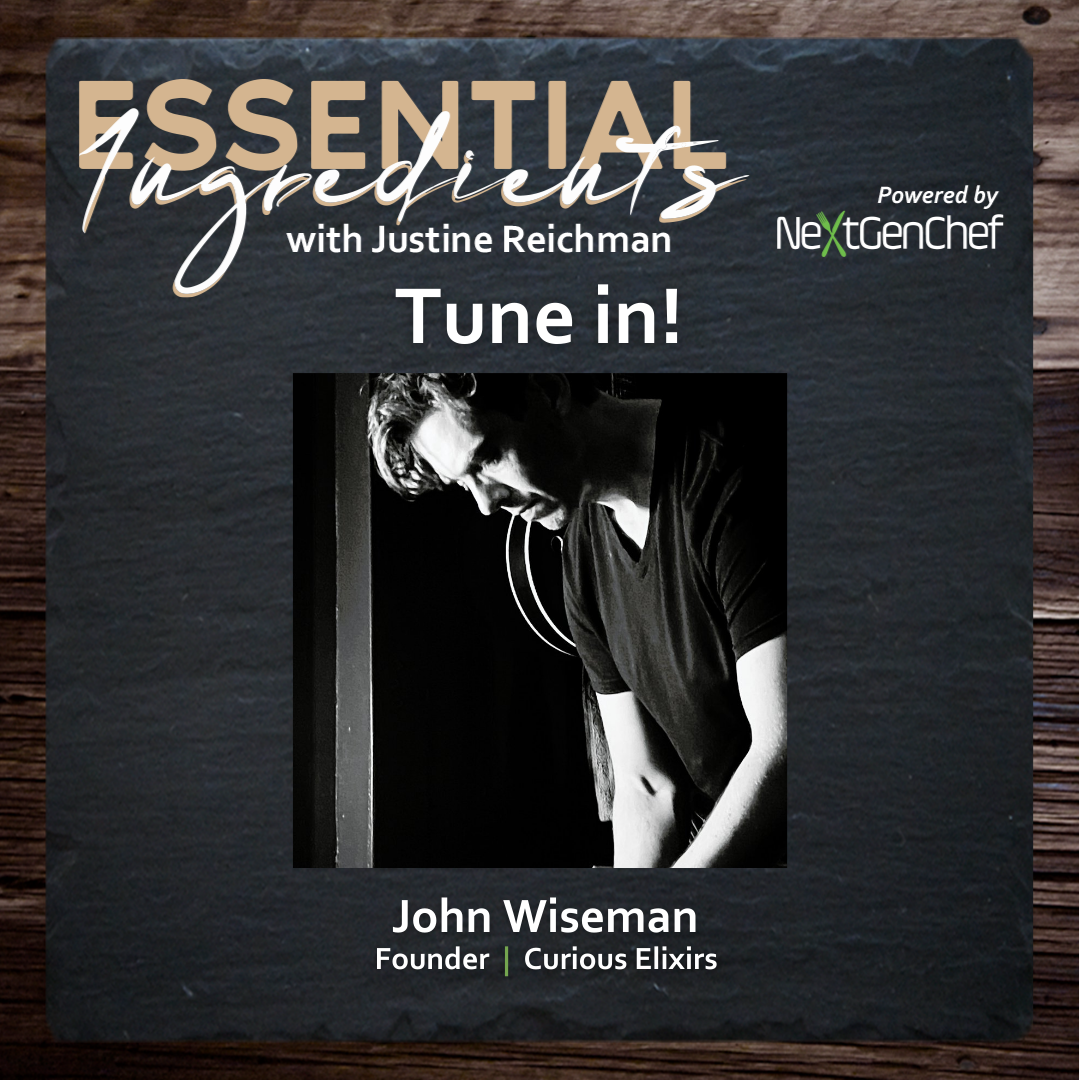
John Wiseman · NextGen Purpose
Watch on YouTube
Better-for-You, Booze-free Craft Cocktails with John Wiseman
The Incorporation Method helps you turn what matters into practical changes that fit your life.
“Since the pandemic, people have become better aware of their health. To boost their immunity, many have made significant lifestyle changes regarding their drinking habits. Some have reduced their alcohol intake with others shunning booze all together. Yet, alcohol has long been a part of celebrations and associated with having a good time. Is there a way to unwind and enjoy real adult drinks without sacrificing sobriety and health? Thankfully, there is!”
Full Transcript
Full conversation between Justine Reichman and John Wiseman.
Well, thank you, Justine, for having me. I really appreciate it. It's fun to be here. It's virtual.
It is. It allows us to be able to have this conversation, or otherwise, we're not exactly around the corner.
No, we're not. That's the beautiful thing of virtual, really. I'm up in Oregon, you're down in Southern California. But yet, here we are somehow magically in the same room.
Exactly. So I'm so pleased to be able to have you, learn more about you and what you're doing in Riff, and share that with our guests.
I love it.
So it even matches my background.
We sent this to you specifically based on our informational interview, I took note of your background. I want to make sure it match.
I appreciate that, [inaudible] would be very pleased.
I'm fine with the design backgrounds. There you go, so design sensibility.
So before we get going, those who are not familiar with Riff, because I'm sure we have some guests out there that are wondering what is Riff. Can we just tell them a little bit about what Riff is? It says sparkling Booyah Berry, Blackberry and Elderberry Riff.
Yep, that's great. That's our energy plus immunity product that we just launched this past spring. And so Riff, a little background about Riff, we launched product and market in 2018. We launched as a cold brewed coffee brand. We were really seeking to bring a craft sensibility to coffee space to the cold brew coffee space, redefine the coffee experience. And so we launched with a line of cold brews in the market. And with a focus in our backyard of Oregon, the Pacific Northwest. In 2019, coming with a sort of a craft brim mind we had innovation as one of our cornerstones because like craft beer or other craft beverages, it's really about exploration, discovery and experimentation. So one of my co-founders is Nate Armbrust, he comes to us from Stumptown, and he was actually the one, he invented Nitro Cold Brew. And he took Stumptown from benchtop brewing in cafes, individual small batch brews to a complete brewery with packaged products distributed nationally. And so he had done some work with what's called Cascara. For the listeners out there, viewers who are not familiar with Cascara, Cascara is the fruity pulp that surrounds the coffee bean on the plant. And most people that I talked to are completely unaware that coffee is actually a fruit, and that the beans are actually a two headed seed within this fruit. So it's kind of like, imagine taking like a peach, apricot, or plum, or an avocado, extracting the pit and making a delicious, wonderful beverage out of that. But then taking the fruit, throwing it away. That's what--
Visual by the way, because the minute you told me about the avocado with the pit in the middle, I'm envisioning the coffee bean with the fruit being the (inaudible).
That's exactly right.
It really gave me that visual, so I could really understand it. I didn't mean to cut you off there, but it really gives me the sense of what you're talking about.
Well, you cut me off all you want, because this is meant to be a conversation. And if I can reciprocate, then it's all good. That's what's happening within the coffee industry. But coffee is a 400 year old agricultural category commodity. And so the practice has always been, well, initially, actually, in origins like Yemen and other coffee growing regions actually, cascara is a beverage that's consumed by locals. But what's exported and famous is the pit called the coffee bean. So due to lack of awareness, there's no demand. And hence, we have a massive, what I'm going to get into is nutritionally food waste problem within the coffee industry. So we started experimenting with cascara because Nate was familiar with that, working with it at Stumptown and doing some collaborations with other people in the coffee industry. And we decided, traditionally, it's presented more as sort of a still tea product whether it's chilled like an iced tea or hot tea, it has some flavor notes that are similar to a black tea, a little bitterness on the back end. And if you had lemon with your tea, there's a little bit of a tartness with cascara. And then outside of that, it has flavor notes that are more akin to dried fruit, might be dried apricot, dates, raisins, dried plums. So we started experimenting with it. And so then, that led to a few things. One was we started to become suspicious about what was actually happening with cascara. The party line within the industry is that it is composted and converted to fertilizer. We started doing our own kind of backing the nap in math, thinking about, there's 25 billion pounds of green coffee exported annually. And so what does that mean as far as Cascara? So if you're imagining, you take your image of an avocado with fit, like if there's 25 billion pounds of avocado pits that are being exported, that's a lot of fruit. So it turns out that Cascara actually makes up about 65% of the coffee fruit by weight, whereas beans make up about 25%. So there's a significant amount of waste just in our calculations and doing your own desk research, we became suspicious that it was substantial, and sort of wondering about really the farmers capacity to process it by composting, converting your fertilizer. So we partnered with Oregon State University on an in depth environmental impact study to have fact based claims around the magnitude of the cascara that's produced as a byproduct of coffee harvest, and then really having a clear evidence based understanding of what's happening with that. So it turns out this study estimated, and we believe this to be conservative that 100 billion pounds of cascara is produced annually as a byproduct of the coffee harvest. 30% of that is either compost, converted fertilizer, it might be converted to biofuel, some of it is used for animal feed. But 70% of it, the estimate is the 70 billion pounds of cascara is thrown to waste and wreaking havoc on the environment as it's laid to sit in mountains and landfills are piled up in the back corners of farmers plantations. Or in some cases, dumped in streams. It's creating havoc on the environment. What makes us even a graver sin is what we would argue is actually, cascara is actually, like you would assume with an avocado, peach or plum, that the cascara is the better half of what the coffee plant has to offer. We love coffee, we love cold brewed coffee, we think that's the best form of coffee, but we see even greater potential with cascara. And the last thing it should be done is thrown to waste. It should be really converted, translated into food and beverage products that benefit consumers because it's nutritionally rich, it's loaded with potassium, iron and antioxidants. And so it's really a wonderful agricultural product. So that's what led to what you chose, you held up the Riff Energy+ Immunity. So we started out with three SKUs, we've got Get-It-Guava. What's that?
Favorite SKU?
I'm holding up my favorite SKU but it's really hard. When you have three kids and somebody asks, which one is your favorite child? It's hard. But luckily, these drinks don't take it personally. But for me, Get-It-Guava. I love the tropics, so this is really wonderful. It's my favorite.
First one that you kicked off?
We kicked off with these three. We launched all three at the same time. So we had triplets.
Yeah. So okay, so just let's go back for a minute. Before you were doing this, what got you into this coffee? Doing this?
Well, my background really is design advertising, art direction, ran an agency that specializes in craft beverages for about 18 years. We specialized in craft beer, but we worked in non ALC as well. And one of the things I loved about the crap category is it re-stated the relationship with, and I'm going to use this what I consider to be an ugly term, consumer. Because I see people not just as consumers really commoditized and don't like it, you consume things, we manufacture things. It restated that whole relationship, set a new bar where it was more of a co-op relationship where craft consumers become kind of co owners of the brand, and it became more of a relationship based above transactional. That's what we loved about the craft space is that it restated that relationship between the maker of the thing, and the enjoyer or the lover of the thing. So I really love that space. We always saw ourselves as a branding agency, maybe it's more like a marriage counselor where you're helping to generate a more vibrant, mutually fulfilling relationship. That's the way we saw it rather than traditional advertising is about, tell them and sell them. This is more about creating a relationship. So that's my background. I co-founded a craft brewery here in Bend, it's called Crux Fermentation Project. I like to think that it's one of the premier craft breweries in the Pacific Northwest. We have an amazing brew pub location right in Ben with a panoramic view of the Cascade Mountains and about three quarters of an acre of lawn area. Now, Bend has beautiful weather, so it's a perfect place to enjoy a great beer on a sunny day, or watch the sunset, or it's an amazing spot. So I left day to day operations there after being involved between launching it, fundraising, planning and day to day operations after about 10 years. I have a strong partner who's really highly capable of running the business and decided to venture off into something new and different, and was looking at something that was non alcohol, kind of complete the day I guess, maybe get your day started. Already worked on finishing every day, so why don't we help get your day started? And so I was having conversations with a lot of folks in the space beverage and trying to find out what the most exciting categories were back then. This is in 2016, late 2016, early 2017. And Cobra Coffee actually was one that came up quite often, and so decided to venture into that.
So why do you think this was prevalent at that time? Why was this coming up so much for you?
Well, the people I was talking to are people who have like air traffic control view of the industry. Cold brew coffee was really emerging at that time, 2016, 2017. There were some major players like Stumptown, Blue Bottle that were kind of setting the stage, but there was some exciting innovation and different approaches happening within the cold brewed coffee space. So that's what kind of got me excited about it.
How did you get connected with, I think you said it was Nate from Stumptown. How did you guys connect? Were you guys already friends?
No, no. I met him through Stumptown, and the CEO of Stumptown back then was a gentleman by the name of Joth Ricci. He actually came from, he was former CEO of Jones Soda. He worked in the craft beer space. He was at first beverage group. So I got to know him when he was in craft beer. In fact, he came to Crux is what we call a wall breaking. We didn't have a groundbreaking, we had a wall break where we're tearing down the interior walls, what was an AAMCO Transmission shop. And so he was there. So we were good friends. And at this time, he was CEO of Stumptown. And so he had a craft background as well, craft beverage, craft beer. And so he let him know that I was interested in getting into the cold brew coffee space and he said: "We will help you as long as you promise to do an excellent job, because that will only help grow the category and help elevate the brand of that cold brew sector within the coffee space." So he was very helpful. And by way of just touring the brewery and getting to know him, getting to know the team behind the cold brew division within some town, we ended up meeting Nate and asking him now, how would you define the qualifications of a head brewer for a cold brewed coffee startup like ourselves? And he said: "I would just hand you my resume. And that's what I would do." So that's how we met.
So out of curiosity, you went from being, you're in the consumer packaged goods, and you were in the brewery business. And now, your coffee. You mentioned something in the beginning of this conversation about weights, which to me rings a bell because we are about supporting better for you products and building a better free food system. And I love the cascara, I just love the whole package, if you will, what you're talking about. So was that important to you? And did that play a role in what you're doing? Because it's not just about coffee, it's about the cascara, it's about the waste. This whole package of what you're putting together here, which is a better for you, if you will, kind of coffee energy drink. What was that part of your mission initially? Or was not just did you just call into that? Was that intentional?
When we started Riff, what we wanted to do was kind of build a super cool cold brew coffee brand. And then when we stumbled upon, we started experimenting with cascara, stumbled upon this issue of food waste, and learned more and more about the nutritional value of cascara, the volume, etc. And in conducting a study with Oregon State University, which was supervised by senior climate change scientists, that was transformative to us. As with anything in life, you're walking along and something unexpected comes in the way. And so the question is, how do you respond to that? And when it's something as significant as this, we couldn't help but say, we have got to do more than just introduce a product, we've got to really listen to the gravity of this and learn more about it because there's a lot at risk with the situation. I mean, there's multiple problems that we're seeking to solve, and it's really oriented around the purpose of exploring and celebrating 100% of the coffee plants agricultural value, and being a force for good in our community and in our world. So there's multiple problems happening with coffee right now. One is this enormous food waste problem. So coffee growers, especially 80%, 80 to 85% of coffee grown by smallholder, independent farmers, they have this massive food waste problem that they've got to manage because there's no orders or demand for cascara. The other thing is that there's significant supply chain inequity. So coffee farmers get paid very little. They don't have a reliable source of income, and they're exporting coffee to wealthy countries like the US where we can ruminate over our $6 latte. And meanwhile, they're taking what we would say is something that should have significant economic value, and they're throwing it two ways because there's no demand. The other thing is that scientists, leading scientists are now predicting by 2050 and expecting that that estimate is going to be accelerated and some years shaved off of it. But they're estimating that by 2050, as much as 50%, the current land being used for coffee production will no longer be viable because of rising temperatures associated with climate change, coffees grown in a very narrow temperature window that's why it's in the equatorial zone. So the only option that these small independent coffee growers have is to move up to higher elevation. And they have limited resources. It's not like they can buy a new plot of land higher up and then take years for the coffee plant to mature to get to a place where it's actually producing coffee. So we see this is kind of, taking Cascara, translating it into a product that has promised for scale solves, at least addresses a significant portion of all those problems. We're saving nutritional agricultural food from going to waste, we're injecting new revenue streams for coffee farmers. They could potentially double revenue, double employment with their farms. And then we're also, this carbon neutral product, and that's because we're largely because we're saving cascara from going to waste and as it's decomposing, emitting methane gas that is equivalent as a whole to 31 billion pounds of carbon dioxide annually, which is the same level of emissions of 3 million automobiles. So saving it from going away. So we like to call it a win-win-win-win, like a triple win. A triple win. It might even be a quadruple.
So as you fill out these different businesses, has your definition of success changed?
I would say immensely. Riff is an early stage company. We are still proving the concept, this Energy+ product line was just launched this spring during a pandemic, getting it under retail shelves is even harder than it was before. We're in a highly competitive space. And being an energy, I actually don't draw a salary because we're all about reducing our burn rate so that we can prove concepts and generate revenue to where we become profitable takes three to four years for a beverage, non alc beverage company to become profitable. So there's a lot of investment, sliding fees, etc. But that said, I would say, I have never been so energized and so clearly focused, and having a real sense of purpose and meaning in the work that I d
Wow. Well that's amazing. And so if anybody wants to find your product, where will they find it?
Were distributed in nine western states, from Idaho, Montana, Washington, Oregon, California, Hawaii, but primarily is going to be in Northern California, the Bay Area in Oregon and southwest Washington. We are scheduled to launch with Gopuff in January in Southern California, so you can have easier access to Riff Energy+. But anybody in the US can have access to Riff Energy+, they just go to our website, letsriff.com.
For those people listening, because we do have everybody from anyone that wants to purchase a product to investors, to other entrepreneurs, or you guys self funded or looking for funding?
We are looking for funding. So we rely on investor capital to fund operational requirements and then continue to invest behind the brand. Pay for those, the trade spent with the slotting fees, etc. So we are actually, we've just launched a campaign on Wefunder, it's in the private phase, it's going to be migrating to the public here within the next 30 days. But if somebody wanted, who was interested in the investment side, they could just send me an email. I'll give you my email address, pretty easy. It's heypaul@letsriff.com.
I even remember that because it's so catchy, letsriff.com.
letsriff.com, letsriff.com. What I'd love to do is offer your viewers a discount code on letsriff.com. So they can get their first order of Riff Energy+ with a 25% discount, and I'm gonna let you come up with the code.
Oh, Essential Ingredients.
Essential Ingredients. Okay. So if you use a discount code, Essential Ingredients, you'll get 25% off your first order, Riff Energy+. And generally speaking, that comes with free shipping.
Awesome. So we'll make a note that everybody will put it in the show notes, that if they listen to the whole podcast, at the end, they get the discount code.
There's the carrot (inaudible). That's good. Our conversation didn't occur enough.
I agree with you. So appreciate the time you gave us. I love your drinks. I haven't tried this one yet, but I will today.
Excellent.
And we'll continue these conversations, and we'll make sure to follow up because we want to keep hearing what's going on with Riff and how you guys are growing.
Wonderful. I really appreciate that, thank you for being interested in our story and sharing your story with your audience. That means the world to us. It really does. And we're passionate about wanting to be a poster child for this cascara issue, and generating interest in demand for cascara, and solving this pretty significant sustainability problem.
Well, thanks again for joining us. I want to thank our guests for tuning in whether it's on the podcast or the video cast. We're here every Tuesday, and we appreciate all our viewers for tuning into Essential Ingredients here on iTunes, or iHeartRadio, or the NextGenChef channel. So thanks again.
Excellent. Thank you, Justine, you take care.
Thanks, Paul.
We'll see you next time.
Share This Episode
Enjoyed this conversation? Share it and tag @nextgenpurpose
Listen on Apple ▶Listen on Spotify ▶Your Host
Justine Reichman
Founder & CEO of NextGen Purpose. Host and Executive Producer of Essential Ingredients — 11 seasons, 330+ episodes, and a growing movement.
About Justine →