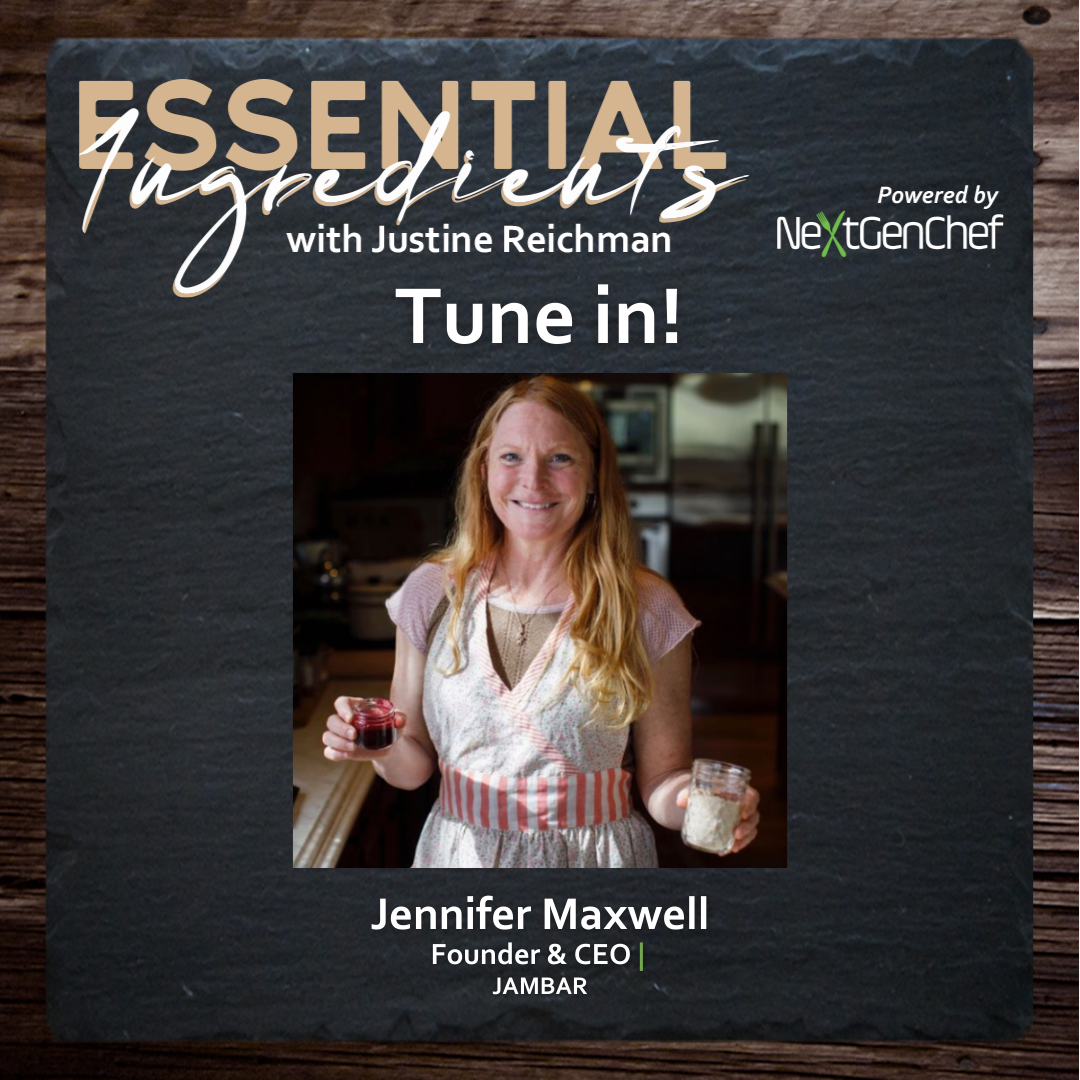
Jennifer Maxwell · NextGen Purpose
Watch on YouTube
JAMBAR — An Ensemble of Organic, Nutritious, and Tasty Snack with Jennifer Maxwell
The Incorporation Method helps you turn what matters into practical changes that fit your life.
“Energy bars and protein bars became popular among athletes and young adults because of the instant boost of energy they provide and the number of proteins and fibers they contain. However, because of their daily busy schedules, these supplemental bars have also reached the adult market who barely has time to eat.”
Full Transcript
Full conversation between Justine Reichman and Jennifer Maxwell.
Hi Justine, thanks for having me again. It's been great.
It's always great to have you here. And today, our guest is Andrew Shakman. Thank you, Andrew, for joining us. He's the CEO and Co-Founder of Leanpath. Did I get that right?
You did. Perfect.
Thank you so much for joining us. We're excited to learn a little bit more about you and have a great conversation today about Leanpath, and all things, food loss, and food waste, and all these different things that we come together to talk about. So Lisa, I know that we've introduced you before, but for those people that are listening and watching the videocast that maybe are first time viewers, I always like to give them a chance to get to know you a little bit. Would you mind just giving a short little intro to yourself?
Sure. I've been doing research on food loss and food waste starting back in early 2009, 2010, 11, something in there. And I have focused my work on food loss coming from fresh fruit and vegetable farms. And so I work with agricultural producers to try and understand why they're losing so much of their crop, and how we can recover that and get it to people who need it. And that's been my work for a long time. I guess I fit into the food loss and food waste research category.
You do. And you're making so many changes and having such an impact in so many different ways. You've been a great resource partner to me as we build this podcast, and we bring in so many guests that I've been able to bring in so many different resources for our audience to be able to learn and connect, and be able to make more informed choices as they're building businesses, or putting food on their table. So it's been a tremendous resource for our listeners, and for me as well, and for the podcast. So thank you
Thanks. I'm particularly excited to hear from Andrew today, and let your audience hear from Andrew today, because he's been an inspiration to me and my work for a long time. I know he inspires a lot of other people, so maybe your audience is going to be swept away too by what he has to say.
Well, we're excited. Andrew, we'd love for you to just maybe share a little bit about Leanpath and a little bit about your background so that our listeners can get a sense of who you are and a little bit about what Leanpath is.
Absolutely. Well, first, thank you for having me. It's great to be with both of you here in the virtual space. So I'm Andrew Shakman, as you mentioned, the Co-Founder and CEO of Leanpath. And what Leanpath is, is a company that's focused on preventing wasted food. We start with the view that the things that people measure are the things that they manage, and the things that they measure are things that they improve. And so the challenge is that for the most part, people haven't been measuring food waste, it's been a blind spot. And as a result, it's been an under managed part of most foodservice operations. And so we created a company to basically enable measurement through technology, so that people could make the invisible visible, and begin working on reducing the amount of food waste that they have. And in fact, our mission is to make food waste prevention an everyday practice in the world's kitchens. So that's what I do, and I've been doing that for about 17 years. And when we got started on this journey, food waste was really not a topic of conversation the way it is today. So we're really excited that it has become such an important consideration. I think broadly, not everyone is thinking of it, but many are. And of course, it is a huge problem. And I'm sure we'll talk about that today why it's such a big problem, but that's who I am and what we do.
I'd love to start at the beginning though and learn a little bit about what inspired you to get into this space.
Yeah. So there's an S with many things. There's not ONE MOMENT, there are several threads that came together for me that brought me to work on wasted food is an issue. So when I began, I had started an earlier business in food marketing of consumer products. Mostly food and beverage and a few other things, but I wish I hadn't done selling pre sweetened cereal to children, doing marketing programs and things like that. I went back and go, how did that happen in my 20's? But I was looking at that point that it ended to figure out what I wanted to do next. I said, I want to do something that has meaning, makes a difference and solves a real toothache for people. Something that is a product that's enduring, that's resilient through economic cycles. Those were some of the things I sort of set out to do. And through just good luck, I came to focus on food waste. And at that time, menu prices were growing at a slower compounded annual growth rate than the cost of food at the wholesale level. I looked at that and I said, wow, like this is two thick for low margin businesses, which most foodservice operations are operating with pretty thin margins. That's a problem. They can't pass on those costs to their customers. And would it be possible for us to help them be more efficient in the middle of their P&L? And so we started looking at that problem. So initially, I came to this really through an efficiency and financial business lens and started looking at how we could take management science that worked in manufacturing and other parts of the world, things like Lean Six Sigma. And could we bring those into the kitchen in a lightweight manner that would allow people to tackle food waste? What we found was that, yes. When you began a practice of daily measurement, you indeed could cut food waste in half or better change culture, focus behavior that all those techniques that worked in automotive, manufacturing and other kinds of manufacturing. Kitchen is really a factory just for food. Obviously, there's an art component to it, but it's still producing something. And when you implemented that, you could drive those outcomes. But what was interesting about this journey is that no one really cared. At the beginning, we said, we can do this, and we can help you. But there were leading edge operators who were willing to take this on because they saw it, but the majority of the industry didn't quite see it yet, and they were thinking about a lot of things, just beginning to think about sustainability as a concept. This was not smack dab in the middle of their view, so I realized I had to go into education on the concept. And so I went out, and anywhere they would invite me to speak, I would show up, whether it was three people in Eastern Texas. And literally, I did that three people in Eastern Texas. I would go if they're willing to listen to me to talk about food waste, I would show up. And my goal was, first, to explain to people why food waste was a problem, then why prevention was the most important thing we could do about food waste. And then from there, why measurement was the mechanism to accomplish prevention. And finally, why the automation of that measurement was important, which was how people would ultimately come to Leanpath and need our services in products to automate that measurement in the base layer, then explaining why food waste mattered. I learned a lot as I was preparing to teach that topic more broadly, and I had come at this through that financial lens. As I started looking at it, I realized, oh, my goodness, like 8% of greenhouse gas emissions come from food that is lost or wasted. Depends which area you're from, but roughly. And 25% of our freshwater is going into producing food that is lost or wasted. And a massive amount of petroleum based farm inputs are being used for this. And 15% of Americans are food insecure. I started looking at this, and it was like this moment where, as I was teaching this to people, sometimes when you're teaching, you are also the student. And I realized this was a nexus issue, that when you worked on food waste, you were working on the most important things. You were working on climate, you were working on food security and feeding the world. And in a world where we're facing climate change and we're trying to feed 9.6 billion people by 2050, these are imperatives. Like, we have to solve these problems. And when you're wasting a third of the food that's produced in the world, roughly, or losing it, there's no way you can, frankly, run that in a sustainable way. So I looked at all this and realized that this was a massive problem, and it needed to be solved. And so we started working on it in terms of bringing people to the table to understand the holistic approach to it. Environmental, social and financial. That was my journey.
Wow. That is a big journey, and you've accomplished a lot. It's been a while, and I'd love to just know some of the bigger impacts that you've made that have been most meaningful to you.
Yes, I love that question because impact happens in a variety of ways. So on one hand, there's foodways prevented. That's a metric for us. We measure how much food waste have we partner with our clients to prevent. And I think at this point, it's over 30 million pounds to go check my latest stats, but it's a big number. That's actually just from like 2014 forward because we didn't keep that measurement from the earliest days when we began.
Tell me, for what geographic areas is that.
We have customers in about 40 countries. We've grown a lot in recent years. So think of it, earlier years was more a smaller community of people working on this and growing into it. And then more recently, a substantial pre COVID as a substantial uptick. And then during COVID, it was a difficult time. I'm sure we can talk about that more. But impact wise is that measurement of wasted food. I think the other part of the impact, though, is that, in working in these kitchens, we've come to really see the frontline food service worker as a global change maker. I will fully admit, in the same way, I didn't see the environmental and social problems around food waste at the beginning. We learned about them, and then we call people to work on all of it. We didn't see that that frontline worker was that critical change agent. So we started working in these kitchens and we realized all of these decisions are being made by the people who are making the food and trimming the produce, and they don't know that they're the global change makers. So I think the second big impact for me is that we're changing kitchen culture in a way where people are coming to work with purpose, and they're seeing that what they do matters well beyond the exact task they're working on. And that's exciting for me. The third impact is just building a company with what we hope is a great culture and will be consequential over time, and making that impact on food waste, and bringing together a group of people to do this work. And when you're doing something that's new, icebreaking, and it's exciting, and also super challenging, when I think about the impact, those are three areas I look at.
Lisa, you're just shaking your head.
Well, it's really amazing. As I mentioned, Andrew's work has really inspired me over time. But even today, I'm writing down how his work and mine intersect. It's really unusual maybe to take my inspiration in working on farms to reduce food loss from someone who is working in foodservice kitchens. You might think that they're very different environments. But the reason that my work has been so successful is because I followed what Andrew said very closely. When I heard him speaking at a conference in 2015, he was taking all these speaking gigs, I guess. But this was a particular conference where he was really showing leadership in this issue nationally, given by the EPA, I believe.
Right.
What he said was so moving to me, he was just getting started, and the rest of the audience also heard it, I guess. But he said it right to me, the measurement is the tool to prevent food loss and food waste. And I have found that to be exactly the case in working with growers. Growers did not understand how much of the crop was getting left behind until we did measurement. And once we did measurement, it was a huge aha moment for them. Hey, we could sell this to so and so. Hey, I know somebody who might want this quality. They knew what the next step was. But what they didn't know was how big the issue at their own farm. And so right now, I am sort of taking that work in measurement on the farm and graduating it to the next level, which Andrew again, has done in automating those types of measurements. So right now, I'm starting a project to use drones and use image based data collection to try and understand what's left. Let's say that works. That could make things a lot faster. And growers often use drones for other purposes. So it's kind of a technology that they are somewhat comfortable with. But when you mentioned that those frontline food service workers are change agents, and making those small decisions that really add up all day, I thought immediately of farmworkers who are making zillions of little decisions in every 62nd period that really can contribute to higher yield, less food loss, more profits and more food getting to people. So still continuing to inspire my work with his works. It's really cool to hear from him today.
I'm saying that it was inspiring, and I take no credit for taking some of the things that came before on measurement and saying, hey, let's put these in a kitchen. And I'm really psyched that you talked about that. Because, particularly measurement as an intervention, I think it's worth just focusing on that for a second because there's an adjustment and thinking that I found people go through. Initially, they hear about measurement, and they think about data. And they say, okay, we're gonna have data, and data will be useful. And that's true. But the process of measuring is in and of itself an intervention. And so that's that key idea that when you ask people to measure something, they think differently about it. And there's this Buckminster Fuller quote that I referenced pretty often, which is, if you want to change the way a person thinks, don't bother. Instead, give them a tool. And through the use of the tool, it will change how they think. And so by asking people to measure food waste every day in a kitchen or in the farm environment, you're calling them to an awareness of this issue, then they get to make all those choices. And no one has to tell them in many cases to make those little adjustments. Because now, they're thinking about it, and it's on their priority list. So that would be one thing I hope people would take away is that measurement is in and of itself action. And sometimes, people would look at me and say, well, why does it matter? I'm going to measure it. Now I know what I throw away. How's that helped me? And I'd say, well, it's going to help you. Because next time, you're not going to do it, and you're thinking about it. That shift is, I think, a pretty, pretty big deal.
Once you've done it, you can't unknow it. Right?
Well, sometimes, people actively try to do unknown things. It's like, I used to walk into kitchens and get a lot of resistance. I've mentioned this in some of my talks where people would just say that they didn't have food waste. And it was often like the body language, it was literally like a chef would kind of meet me this way and say, we don't have any food waste. In the early days, I would accept it. I would say, oh, you guys are one of the good guys. Congrats who figured it out. And I believe now, it's more like a Colombo thing where you hang around a little and ask a few questions and look in a few bins. And pretty quickly, what you find is nobody has fully solved food waste, because every kitchen has food waste. It's impossible to not have it. There's going to be something. We can aim for zero, but there's going to be something. And what I learned was that the chefs were pretty universally aware that food waste mattered and sensitive to the idea that maybe if they had waste, they weren't doing a good job. And maybe they've consciously knew that or subconsciously just weren't looking for it. It was a blind spot. So we talked about it, it's kind of the elephant in the kitchen that people have learned to work around and have sort of suppressed that they don't even see it. And so once you come to them and say, hey, everybody has it. It's totally safe to talk about this and work on it. The best culinarian's are doing that. And look here, and look here, and look here. At least you talked about this the moment you show people the magnitude of it. What they think of is a little bit of this and a little bit of that. They look at the totals and they go, oh, my goodness, I had no idea. And now, it's safe to talk about it and work on it. And so it's a little bit of that overcoming the blind spots. And frankly, the fear of waste is a bad thing as opposed to recognizing that this is a thing we have to manage every day. The same way we manage safety, or sanitation, or customer service, or creating very flavorful dishes.
I wanted to go back because that was so interesting. I love how you work with the chefs and all the workers in the restaurants, and all these different things. Go back to what Lisa was talking about how it inspired her, and talk about the impact it could have with the farmers. I just connect the dots there for a minute because I think about the amount of food loss and food waste, actually, I like to call it food loss. Because every time Lisa and I get into this conversation, it's really food loss with the farmers, I think, because we're not placing blame on them because it falls off.
-- in the chain, and then waste exists later in the chain.
So with the farmers, I think, we want to call it food loss. So I just want to connect the dots here and see, maybe even just figure out for a second. I don't want to take up too much time here. But how could we collaborate here? All of us, you, Lisa, collaborate here and maybe take it one step further and say, how could we go from this inspiration and really use this tool? What the farmers are doing to impact them, to have less food loss, to incorporate measurement to be able to really make a difference there.
Lisa, you're the expert on the farm.
You're the inspiration, Andrew.
I'm not gonna take credit. I'm not accepting that credit, but I appreciate it. I think it sounds like you're doing with this measurement really, like the right thing. Because I remember when you did those methodologies where you'd say, take a trunk of the field, and look at that trunk and then project out like a sample, and project out the loss, if I remember correctly. So to be able to actually do a complete calculation based on the whole field from eye in the sky, sounds great. I'm sort of artificial intelligence to understand that, it seems like it's cutting edge.
Yeah. And that's a project that we're just starting up right now. So I'm excited to work on that. I also have another project going with the World Wildlife Fund and a few other partners where we have created a tool, so to speak. It's basically an Excel file that growers can use to sample and track their losses all throughout the portion of the supply chain that falls under them. So if they do growing, packing and shipping, it can encompass all of that. And so along with that, we have created a tutorial video to show people how to use it, some frequently asked questions, and this can be found on my website, if you're interested, at lisakjohnson.com. But this particular metric, we are basically providing to growers. It's also on the stewardship index for specialty crops website, providing to growers for free to empower them to do their own measurement without having to share that data with anyone, and just to try it, see how they're going to use the data. And it's been really interesting so far. Because we have done some interviews pre and post measurement with growers, and are finding that while the measurement aspect of it was easier than they thought it would be, that wasn't their favorite part. Their favorite part was being able to have the data about their crop, because they don't just see it as food loss, which that's what we're interested in. But they see it as a way to compare different cultivars, or compare different soil types, or compare different crews to see what's happening in which areas, what drivers are we seeing on our own farm, they contribute further to food loss. So it's been really exciting to see growers' response to that kind of a tool.
I think that's great.
Yeah, it's so interesting. And I love all these different tools or use of measurements to be able to have such a great impact, and really mitigate and continue to mitigate food loss and waste.
Yes. Andrew and I were on a panel a long time ago both talking about measurement. It was very well attended. But I find it hard to believe so many people are interested in the actual act of measurement. Maybe they are, I don't know,
I'll keep you posted. Because I'm telling you, people are interested. It's a way to see in a tangible way how they're having an impact and the difference they're making. And I like measurement, because I can see how many people listen to this podcast. So measurement is important.
Yeah. Those analytics, people want to know.
So getting back to Leanpath, what are your plans for the future and the impact you hope to have. Not just right now, but in the next 3, 5, 10 years. What's the impact you're hoping to have on changing the future of food?
Well, I think I mentioned briefly upfront our mission. So the vision is we want to help contribute to ensuring a sustainable future, and doing that by helping to eliminate food waste. But the way we're doing that is really around making food waste prevention everyday practice in the world's kitchens. And for us, that's a simple statement, which is a huge lift to get to the point where something is truly everyday practice. That's a big deal. It's got to be easy, and there's got to be people to buy into it. It's got to be part of the culture, it's a priority. So that's what we're working on. And if you think about our 10 year vision, how widely can we help to grow that practice? And through our tools, and not just our tools, our advocacy or training, how can we, and frankly, others who will do currently or will create tools like ours get out there and push for that? So we see that as a very clear focusing activity. And from where we stand today, I think coming out of COVID is an interesting time because there was so much disruption in the food service world. I mean, it's really impossible to contemplate or to have imagined in advance what happened in terms of immediate shutdowns, massive food waste, then food insecurity because the supply chains were all broken and shut down, like cold shutdowns in big parts of the food service industry. And it's just a pretty cataclysmic time. And so as we come out of that, I think the first thing is, how do we do that in the strongest possible way? And we recognize that immediate term that food waste can be part of that because operators are paying more for clamshell containers, single use plastic disposables, which everyone has made great progress on minimizing that stuff. Unfortunately, it's been back there paying more money in labor for sanitation activities that they didn't do before. The labor pool is obviously very challenging right now. People can't get enough workers. And so all of these things are pain points. If you can actually control food waste during this period, you have the ability to put some dollars from the garbage back into those other things. So we think it plays a critical role right now. The other thing is that this is so disorienting. And we talked a minute ago about measurement and data. And normally, an operator can make a plan for today based on what happened before. Might be, what did we serve you last year on this date? You can't do that. But if you look at your food waste, it tells you immediately a lot about what's going on. Are people enjoying your menu? Is what you're serving working? Are you on course or off course in your forecasts? So I think when you asked me about 3, 5 and 10 years, the 10 year goal hasn't changed a bit. But I think in the near term, there's a goal on helping people come back from this volatility, and really dial in their understanding of their business. And the last thing we want is for this to have disrupted the important work on foodways, but also just generally on climate action. Like we have very little time to make really big progress. So the goal is, let's get everybody back to working in the right direction.
I think that's great. Do you have a toolbox or some sort of, I think toolbox is the best word, that you share with people?
Yeah. So we have a lot of information on leanpath.com. We have a blog, and we're constantly publishing on issues around this. It's very little promotional stuff around our business, it's a lot about practice. So we do that. Periodically, we host webinars which are free and available to all where we have chefs on our team and we talk about, basically culinary strategies to take action, and as well as the broader issues and opportunities around measurement. And so those are a couple things that we do, and everybody can take advantage of those. And then for our customers, we have a further sort of depth of resources that are inside our help center, which includes videos and a lot of content around these things and tools to communicate with end users. But it's all pretty specific to our ecosystem of our technology. So it's a little less relevant to someone who's not using those tools. But there's a lot of stuff. I would love for people to come to our website, check it out.
That would be great. We are launching, in the near future, our discussion boards on the NextGenChef app. So maybe in a few weeks, we can have a little Q&A session for the people that have watched this videocast so that they can come back and maybe ask some questions as follow up on these tools. And so they can go to the website, and then maybe you guys can come back and have a follow up Q&A on our discussion board. So if you guys are up, we'd love to maybe invite you back and pick a date so that anybody that's listening to this or watching this videocast can join us for a little Q&A session once they checked into Leanpath and checked in to Lisa's website, and then come back and ask them questions and follow up on this conversation because there's so much to dig into. There's so many tools and so many resources that I think it's worthy of a follow up conversation.
Happy too.
I have a question I want to give to Andrew real quick right now, you have such exciting technology that you're working with. I know that practice and that culture is so important when you're building a team around this issue, but the tech is super interesting. Could you please describe it a little bit for the audience?
Right. Yeah. So what we do is we have three sorts of aspects of the technology. The first is to track food waste. So imagine scales to weigh waste cameras to take photos of it by touchscreen input devices to get context. Like, why are you throwing it away? Some of those scales are underneath bins. Sometimes, they're on countertops. We also have tablets where people will count each is. So we had 12 bagels and three muffins, and that sort of thing. So we have a variety of data capture tools which are designed to do two things. One, make it really fast and easy to record, but also create some consciousness. We don't want to do this with such a light touch that people don't even know that foodways matter. So that's a fine line between making super efficient, but also just slightly attentive from their point of view. The second piece is what we call, after tracking is called Discovery. And that's where we have a cloud based analytics platform which gives folks the highlights of what's happening. It gives them photo galleries, it's literally like going through Google Photos and seeing all the pictures of food waste. And when the chef sees that, it's like eyes pop open. And they go, I had no idea we were doing that and that. You look at trimming. The way we are cutting strawberries, lopping the top third off of all the strawberries, why are we doing that to begin with? And number two, if we are going to be trimming them? Why aren't we trimming them much more efficiently? So you can see it, discover to see patterns and trends ascribe value to the food. What's it worth when you're throwing it away. So we do that. That's the second piece. And we push that data to people via reports that show up in their inbox every morning once a week. And there's all kinds of stuff around making them aware and drilling down into it. And it's also neat. Because if you are running multiple operations, you can see them come together and be able to understand that. Then the third part is what we've got track and discovery. And then the third part is driving action. And that's where we want people to go from collecting data and looking at it to actually using it and implementing change. And so we have a series of capabilities around that, including helping people, prompting them with suggestions for things they should work on, encouraging them to set goals around those items, tracking their progress against those goals. So you take a big problem and break it down into small pieces, alerting them when they're out of band conditions, like a large waste event. And immediately telling them, notifying them those kinds of things. And overtime, we think those three things work together in a really holistic way. And then we support that with our chefs and our Customer Success teams to kind of help people understand that, and then make sure in big organizations that all the sites are moving in tandem and doing the right things, and that it's consistent with an overall food waste strategy. So really, people come to us for kind of a turnkey enterprise food waste prevention platform. And we create that ecosystem with all of those moving pieces in it. And it's exciting. And it is in the end behavioral, all the tech is about helping people make the right call, and doing that consistently. So while I love technology, I care about people more. And so much of what this is about empathy for what's going on in a kitchen. And how can we put this intervention in without making life hard for people who are already working really, really hard. I like to remind people of this to like, in every kitchen, you have an opportunity to be fired three times a day, breakfast, lunch, and dinner like it is right now. If you serve food that makes people sick, you drop stuff on the floor, you fail a health inspection like it is right now. Those of us who work in longer timescales, were on the hook for our annual plan, or our quarterly plan, or whatever. We're not thinking about the stresses and strains of that performance, that immediate performance every single day. So we have to do all this food waste work in conjunction with those kinds of environments that are really difficult and make it easy. And I think one of the exciting things is when you up level it to purpose, people go, yeah, like I get it. I'm working hard, but I'm feeling good about what I'm doing. And not everybody's gonna get it, but a lot of people do. And when you start asking them about it, they don't like food waste. Like when you talk to frontline team members, they are not--
Sensitive tool. Can you share any companies that have made great strides using your program?
Yeah. There are a number of them that speak publicly about it. So we work a lot with Google, all over the world in their cafes. We work with large food service management companies like Sodexo and Aramark as well as others. So those are some examples of people that we work with. We also work with a lot of hotels or hospitality organizations. And then with large foodservice operators who you might not think of them as food service operators but like colleges, and hospital systems that are managing a lot of food. It's amazing how much food goes through a college or a hospital. So we do a lot of that work as well. And then there are things that you would just never expect, we do a lot of work in mines.
Oh, I was gonna say prisons.
Not because there isn't food in prison. There's a number of reasons why we do a lot of on site training, at least we did in earlier phases of our business. And I didn't feel super comfortable asking my team to work in that environment. And secondly, you have to make your equipment really battle hardened, and we weren't prepared to make a prison version of our product. But like the mines, I think, are a fascinating example. We are measuring food waste in places as far afield as Andes and Chile, in Canada, in Western Australia, in the Pilbara, in Kazakhstan. These are mining camps where people fly in, and they work for whatever week, or 10 days, and then they go home and they have a rotating community. So that's like a college campus that just creates itself in the middle of nowhere. They have a ton of food, and they have all the same food waste challenges everybody else does. So yeah, so we're doing those kinds of things. And military bases, and sports arenas, and senior living facilities. It's really fascinating when you see all the places that food exists, it's out there. And I think, I believe food connects everything. Connects us to our own health, to our families, our culture's, our communities. And so you find it everywhere, and thus you find food waste everywhere.
It's true. Thank you so much, Andrew. I love what you're doing. It's so inspiring. And I love, Lisa, how you've been so inspired by it. And now, you've taken that and then implemented it, and made so many changes within what you're doing.
Just to say one thing I just wanted, like plus one on that. Because when we rethread the first report on food waste in 2016 in the US, it was really hard to get farm data, kind of educated guess, kind of like this, like this is. How much and when you saw the updated report, it's much, much, much bigger. And I think that, Lisa, you have been leading the way on getting people to see this blind spot that was really not in the conversation anywhere near enough. And so if we're going to solve this problem, we have to take bold action. We have to cross boundaries, we have to go to places like farms, we have to deal with plate waste, what people aren't eating, we have to deal with grocery stores, like the stuff all around. So thank you for leading in that area.
Sure.
You take it to another level. You are so innovative in this, and you take what people are doing, and then you take it to another level, and you continue to do the research, and you get inspired from all these different people.
There's a lot of people doing great work. I mean, we're all sort of pulling in the same direction. And so hopefully, the needle will start to move.
Well, you do exactly what I hope to inspire, which is connect, collaborate and innovate.
Yeah. Yeah, try to.
Lisa, thank you so much for organizing this. And Andrew, thank you for sharing what you're doing, the impact you're having. I really hope that you can imagine how it will inspire and support some people that are listening to this to inspire change, and help them in their process as they continue to build new businesses, and make change in the world of food, so thank you so much.
Thank you.
Share This Episode
Enjoyed this conversation? Share it and tag @nextgenpurpose
Listen on Apple ▶Listen on Spotify ▶Your Host
Justine Reichman
Founder & CEO of NextGen Purpose. Host and Executive Producer of Essential Ingredients — 11 seasons, 330+ episodes, and a growing movement.
About Justine →