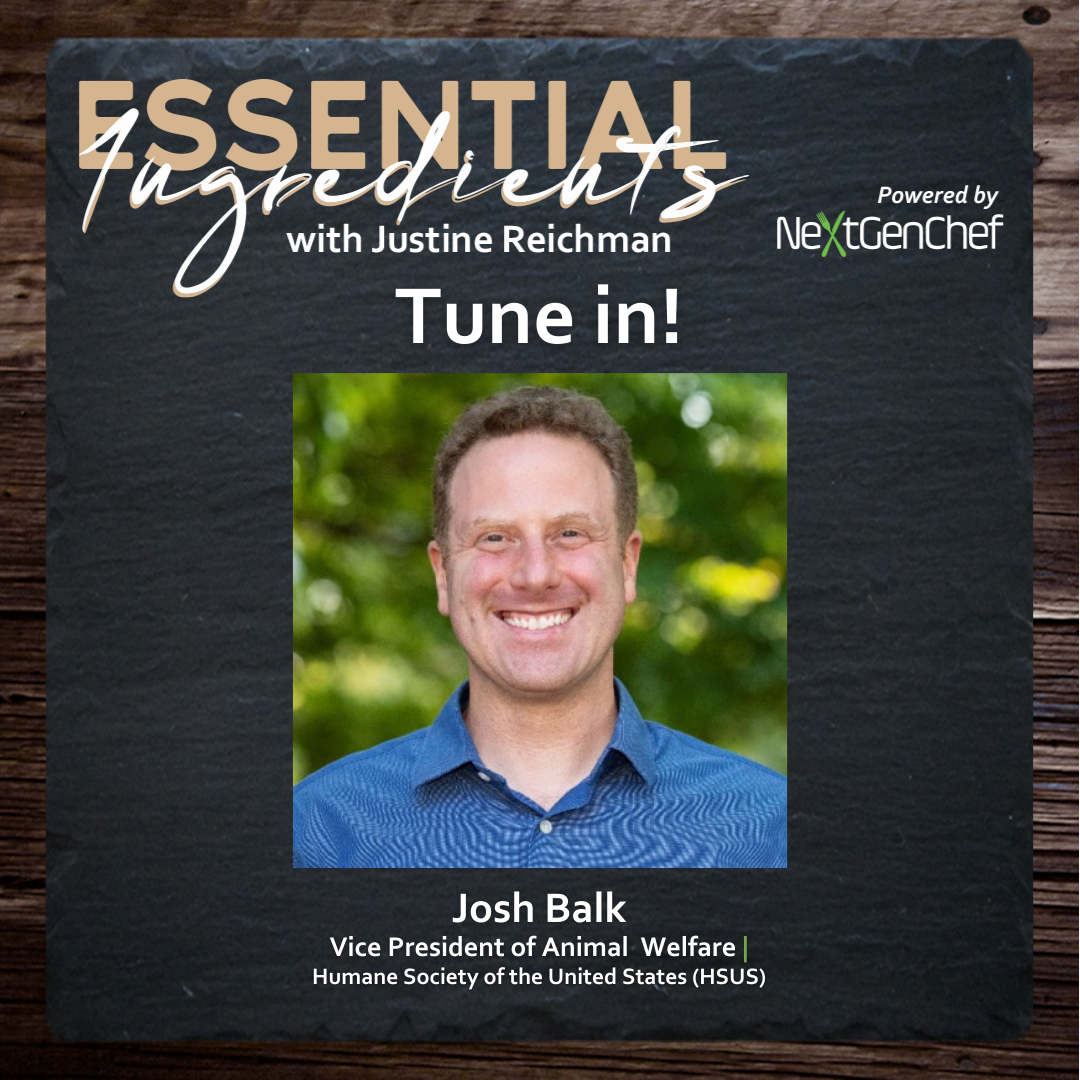
Josh Balk · NextGen Purpose
Watch on YouTube
Moving Towards a More Humane Food System with Josh Balk
The Incorporation Method helps you turn what matters into practical changes that fit your life.
“Josh Balk, VP of Farm Animal Protection at the Humane Society of the United States, has dedicated his career to abolishing the worst practices in factory farming. He shares the story behind Proposition 12 — California's landmark ballot measure banning cruel cage confinement for egg-laying hens, mother pigs, and veal calves — a campaign that resulted in more than 100 million chickens living cage-free, representing the greatest single reduction of farm animal suffering in US history. He also discusses working with major food companies to mandate cage-free and crate-free standards nationwide.”
Full Transcript
Full conversation between Justine Reichman and Josh Balk.
Hi, Justine. Thanks for having me.
Thanks so much for joining me. I'm excited to have this conversation. And have you here on the EI.
Nice.
Wonderful. So great to chat with you, and great to introduce you to the EI and have you here to share a little bit about Jambar and about your journey.
Nice. Okay.
Wonderful. So maybe we can just sort of jump in and have you introduce yourself, and talk a little bit about Jambar, and then we'll get further into the conversation and just go from there.
Okay, thanks, Justine. So a little background on me. I'm Jennifer Maxwell, and I am the co creative PowerBar with my late husband, Brian, which spans back 35 years. So I've been in the energy bar industry for a really long time. Brian and I founded PowerBar in 1985, and we sold the company in 2000. I raised my six children, and then in 2015, decided to get back into a mission of creating another energy bar. So that's kind of the timeframe of what we're talking about with Jambar. And I think that the impetus was really, I was sitting in the kitchen with my daughter, Julia, and she says: "Hey, Mom, there's no super high quality, like all organic, super high quality energy bars." And I'm like, I think that I could create something. And so I kind of take it in the kitchen for a little bit like, back in the old days, in the 80's, it's the same thing except we weren't creating a PowerBar, I was having new entrants into the category. So the playing field was different. I had a lot of time. I worked on the formulation of a Jambar for four and a half years to make sure that I had a product and I'm really happy with it, and that I think everyone else will be happy with, and there's a market for it. And again, that something differentiated it. Really what differentiates Jambar, the product is a quality of ingredients being organic and no expensive sparing with our ingredients. It's not about trying to just create something to just be in the category, it's really the differentiating premium for every premium product. And the sweeteners I use are called authentic sweeteners, which is maple syrup, grape, honey and date. So all real food ingredients. It's grain based, gluten free, working with new proteins like sunflower protein, and no added fats or oils, nut butters, and super high quality premium chocolate, and the chocolate from [inaudible] out of San Francisco. And we'd like to know our suppliers, you'd like to know what ingredients are coming from, and we'll be family based companies that are supplying us with ingredients. And it's very hands-on. I'd say everything I've done is super hands-on with the goal of trying to create a really innovative, high quality healthy product.
So there's so many things I want to dig into here. I mean, I want to go back to the beginning, when in 1985, you're building an energy bar. Because to me, that was very forward thinking. And building an energy bar was really forward thinking.
Yeah, yeah, you're right. We were bored making them, Brian and I. I'm still forward thinking now. But to create a category, the energy per category, to create, it really came out of a personal need that Brian and I had as athletes. Brian was an Olympic Marathon Runner. At the time, remember the new energy bars. People who didn't eat before they would go run a marathon, or do a two hour training run, or even Tour de France, which was kind of our first group of highly competitive athletes. All the riders were eating sandwiches, and their thought out the back of the pocket onto the course. So having an energy bar, something that you could easily transported and easily assimilated digested. Again, we didn't use hydrogenated oils, which was kind of a key thing back in the 80's. And that really created the market. And then, of course, there's been a lot of energy bars since then. Dozens and dozens, if not more than a hundred, a little bit of different spin on each one. The markets really evolved and created little niches within itself. But I think Jambar, again, is still full thinking that it's all about quality. So the markets have been established for quite some time now since I was 35 years, that's a long time. But to get something that is high quality, I think has not been done, and it's organic.
I do want to add to that, even now, when I look at these bars and people, I'm with a friend, and I get a little hungry. Because if I don't eat, I get really agitated. And I'm sure I'm not the only one in the world, but I don't keep 12 things in my bag, which I probably should. But all my friends with kids, they're whipping out their bars in their bags. I'm always looking at all the ingredients, and they either have nuts, or sugar, or something that doesn't make me feel good. And the challenge is that they're all claiming to be healthy, and they are probably healthy, but healthy not for me. And so what I found unique about yours was they didn't have those processed sugars, or there is an option for somebody that may not eat nuts.
That's right.
And a lot of these bars are packed with almonds and all these different kinds of nuts that a lot of people can't eat, and a lot of sugars that people can't process. So your bar equally takes this category to a new level. Because these healthy bars that many people use for protein, and nuts are a large part of those proteins, you now take that bar and you pack it with protein because it is packed with protein in healthy ways that I can now digest, like a lot of other people can. So I'd love to just hear, I mean, you did that intentionally.
I did. That's a really good analysis of, actually, where I was coming from intellectually, and from a food scientific background. I'm a food scientist. That's my background. I love to cook and love to create. But you're absolutely right because I looked at protein, which is a really beneficial macronutrient that most active people like to get enough of it. It sustains you and controls your hunger so you don't have the spikes of blood sugar, this is very important. And I want to provide different types of protein within Jambar. So I have two that are vegan, and that's from this innovative sunflower approach that I mentioned, as well as my grains. I had quinoa or brown rice, and Lumina oat bran, this was a protein. So there's a lot of different protein sources within Jambar. Then I have two, they're using a very high quality wheat protein. So we you can have a traditional wheat protein as well. I wanted to create a kind of a diversity platform, the lack of a better term in terms of what people might want when they're looking at a bar. So I have a chocolate, which is a very high quality, really pretty rich chocolate. And I have the malt nut, which goes back to the early days of PowerBar which is a combination of sesame, malt, vanilla, tahini, and peanut butter. But then I have some that don't have enough as a berry and the mango, which isn't a really new flavor that a lot of people get excited about. So I was really trying to have something for everybody.
I think you achieved that. And I think you also reach there by really creating a power packed protein packed bar that addresses a lot of the new allergens that people are challenged with. So they reached out for these protein bars. And you really touched on a lot of the issues that people are facing today. So for me who's never been able to buy a bar before that hasn't made me feel not good, I now have access to a bar.
You touched on something that's really important. And one of my main focuses was not using the brown rice syrup and tapioca syrup. And it's not that it's really bad or good, I just wanted to use something that's more natural. Personally, from my own nutritional emphasis, I like to eat things that are as close to nature as possible. So less processed and more inherent in nature, which maple syrup is, and the grape, we use 100% grapes, the date concentrate and honey. So they're all unprocessed, more [inaudible] processed, more natural, inherently authentic sweeteners rather than using a manufactured syrup. And that was super important to me. You taste the difference, they taste super good. And of course, it's a very expensive way to go.
So that was my next question is these bars, and these bars are often very expensive, and you want to make them accessible, and you want to make them so that people can afford to buy them. Because often these bars can be very expensive. I heard you say that some of the ingredients are organic and high quality ingredients. So how do you, as a small business, create a product that is good quality, organic accessible and affordable?
Absolutely. The same is so important because I price Jambar right in the middle of the market. It's not overpriced, it's a very good value. And that was super important to me, because I want this 100% Organic nutrition of this quality to be available to everybody. And really, how we do that? We make it ourselves. I embarked on the mission of creating my own factory. I don't think I could do this if I co packed it because I gotta be in charge of the process. I know what I'm doing, I know what I want to do. And so, okay, I gotta figure out how to do this. And so I embarked on this mission of creating a factory, which we did. We're here in Marin County, and also just keeping things pretty lean, making sure that I'm not wasting money, making sure that I'm putting out the best efficiencies and personnel, and manufacturing process, and really being careful with our numbers, and taking it from there. Also, we intend to stay pretty small. We want to do what we do super well. And sometimes, when a company gets bigger, some of that can be really challenging to do what you do super well, and just focus on what you do, and provide it to your customer base. And that's what we intend to do.
So with that said, your small business, your family business, I don't know if you're self funded or you had to raise money. But do you feel like that has an effect on how you're able to produce the way you are producing?
I think everyone has to figure out their funding. Each situation is different. When you have a group of investors or yourself funded, whatever structure you have, you have to kind of play within your means. So don't get over leveraged in terms of taking on a lot of debt, that then impacts decisions that you make that you might make down the road. That was very important to me in terms of really making sure that we know what our numbers are going to say. Things will tie up at the end of the day where we need to be careful.
Right. And many times, though, I know that when people take money, they lose some control over what they can do and how they produce. So I guess my question to you is, based on your circumstances, do you have more or less control based on how you decided to build your business?
Yeah. I am fortunate enough to have the amount of control that I have. Yeah, I'm not leaving it to someone else to make these decisions for me. Jambar was really a manifestation of my passion of giving back to the community in a big way. And I give back only by creating this company, creating this product, but our mission is to give back 50% of our proceeds.
Wow, that's amazing.
So obviously, this is not just for making more money. No, this is about doing a lot of good, and I just want to support active living. I think that being active and physically fit, supporting athletes, supporting all kinds of activities, it doesn't have to be very core competitive is being living active life is so important for overall health and overall productivity for people. And then music is my passion. I've been a musician for 15 years. I want to tie across the name, kind of ties in Jambar. That is where a lot of the time with music. But we already have collaborations with a lot of musicians and organizations that support music in the community. So we're super excited about that.
That is exciting. And so now, you have Jambar, and are you expecting in the coming years to expand what you have there? Or are you planning to grow?
Well, probably too early to tell because we're just now launching. We've got four flavors, I would say that I love to create. So new flavors are definitely in the pipeline. Even seasonal flavors can be super fun. Keep it fresh, look at new ingredients that are out on the market. I love working with food suppliers, ingredient suppliers. That's really my daily work in terms of reaching out of energy bars, probably not. I mean, we've got a lot of work to do, and a lot of accounts to open customers to share our products with.
So where would people find Jambar right now?
Well, we have a website, jambar.com. Cool, cool website, I have to say. And you can order directly on the website. And in fact, we have a wholesale component. So any stores that want to carry Jambar can go on the wholesale or the website and get approved as an account. And then we do have distribution starting really about next week. It was in the MArin County for the most part. It's going to take time. It's not the best time of year to launch going into the holidays, but we're doing it. And we don't have about 20 or 30 accounts just in the bay area right now. Health food stores, high end healthy stores, some smaller kind of grocery store, that kind of thing. And then bike shops, running stores and some music stores.
That's super exciting. So just to sort of share this timeline, so you got in the kitchen, what year was it? Just 2000?
It was 2016.
Okay, and you were in the kitchen for how long now?
Kitchen and just putting stuff in, working with different ingredients for over four years. Three and a half, but three years I said, okay, here, here, do this. Let this product age, see what it does. Look at the texture, look at my nutritional components. Do I like this? Or like that? Maybe I want to make it more crunchy or more smooth, and more hard and more soft. All these different textural kind of things and tastings, different ingredients I'm using. Took about three and a half to get where I was really certain, and then it was perfect. It was another year and a half to two years after that.
Did you know, you had perfected it?
About two years ago?
What was that moment?
That's a good question, I guess. I've been sharing it with my kids. Of course, a couple friends. Not too much, though. I've been keeping it pretty close to the chest. I think when I saw the consistency that I want, I saw this consistency, this super good texture and taste, it was not going to waver, and I knew that I could produce it in a reliable way in terms of making sure I can consume secure my ingredients. And doing the nutritionals, I would set out to a lab making sure my nutritionals were consistent, and the shelf life was great, yeah, so that took about two years now. And then the last few years have really been spent building the factory.
So what made you decide you wanted a factory because you wanted to be there, you're at that and be part of it as the scientists that you are. The food scientists, they're able to take ownership of it.
Yeah. I want to create a little business. So I want to create some jobs, be able to just have a little bit of control of my destiny. These people we need to hire that can help you do your mission, this is how you're going to get back to the community. You're going to make this product, and you're just staying really, really focused on what we wanted to accomplish. And we started getting the equipment just before COVID, so we were able to still make progress, actually, because we've ordered mostly equipment already. Thank goodness.
Well, thank God. Yeah. Because with its supply chain the way it is, and not as been during COVID, probably would have been quite delayed. So what would you say to other founders that are watching or listening to this podcast as they're building their startups and develop their products?
Yeah. I think back like, what are some key elements that really kept me driving forward? And I would say every day, I want to accomplish something. Some days are more productive than others. But every day, just a little bit of forward momentum was super important in some aspect of what I was trying to do. And just stay super focused. Build a group of people around you that you can trust is very important. You can't do everything yourself so you've got to have good people's interests around you that know your mission and understand your mission. And actually for me, I think the most successful people, it's having a buy-in with those people around you and having them benefit from your mission. So you're really creating a type of company or organization where people feel a bit of ownership, or people feel a real high motivation to come work every day and give it their best.
And would you say that your experience at PowerBar, and all your learnings there have really positioned you in a really good place to be able to take Jambar?
Yeah. Yeah. I mean, I learned a lot. I was super young when we did PowerBar. I just got out of college.
Yeah. I thought you were in college.
When Brian and I were doing the formulation, I was still in college, and then we got married. And then there were so many things. We got married, and then PowerBar took off, and we also have six children.
I can still see the labels from PowerBar. They're forever imprinted in my brain.
Yeah, yeah. I mean, Brian did the logo of PowerBar. I did the logo Jambar. And that's another important point. I do feel Brian's presence during me looking from above, I mean, he is definitely cheering me on. There's no doubt about that.
Awesome. Yeah, I am so excited for you. I can't wait to go into Whole Foods and Sprouts, and Good Earth, and all the different stores and see Jambar everywhere. For those of you that have not gone on to their website, it's great, it's a fun website. It really is a fun website when you go, and it looks very fun and cheery, and it's jambar.com. Is that right?
Yeah. Thank you. Our big intention was to be positive. It's all about positivity and keeping it fun. Yep, that's what it's about.
Jennifer, thank you so much for joining me today on Essential Ingredients. I really appreciate it.
My pleasure.
And thank you guys for joining us. We're here every Tuesday, and we will see you here again next week, and have a great afternoon.
Share This Episode
Enjoyed this conversation? Share it and tag @nextgenpurpose
Listen on Apple ▶Listen on Spotify ▶Your Host
Justine Reichman
Founder & CEO of NextGen Purpose. Host and Executive Producer of Essential Ingredients — 11 seasons, 330+ episodes, and a growing movement.
About Justine →