Kathryn Bernell · NextGen Purpose
Watch on YouTube
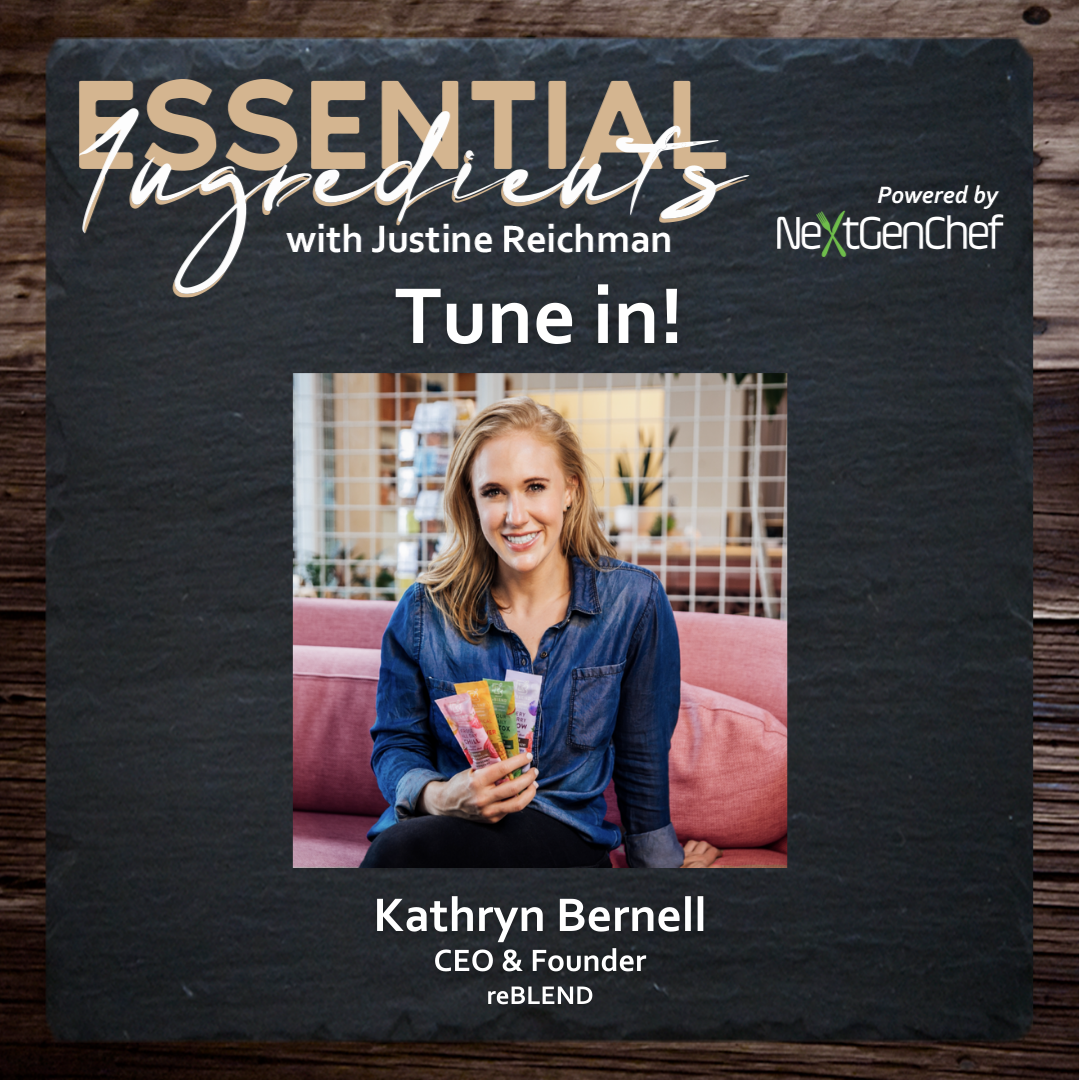
Revolutionizing the Fight Against Food Waste with Kathryn Bernell
The Incorporation Method helps you turn what matters into practical changes that fit your life.
“reBLEND CEO Kathryn Bernell saw two problems and solved them with one idea. As a busy grad student struggling to eat enough fruits and vegetables, she created frozen smoothie pops made from "re-harvested" surplus and imperfect produce that manufacturers couldn't otherwise sell. What started as a late-night DIY project grew into a company that builds its entire supply chain on whole fruits and vegetables — turning food system waste into convenient, better-for-you nutrition.”
Full Transcript
Full conversation between Justine Reichman and Kathryn Bernell.
Yes. That was correct. Yeah, that was good. It was worth spending 20 minutes on it. You did it very well.
Really? Okay. Okay, Alrighty, so co-founders of QOA.
Perfect. Yeah, cool.
I like her. She said perfect. And that was the first one out the door, probably because I spent 10 minutes before this practicing.
Isn't that hard.
Guys, tell me about QOA. Tell me about this chocolate, or non chocolate?
What should we say? I mean, we're making cocoa free.
Okay, yes. I want to hear all about the cocoa. I want to hear about the cacao.
Yes. So I think you already pointed out something quite important. There's a difference between cocoa and cocoa. Cacao refers to the raw plant. So not processed things that you would encounter in Ivory Coast or Ghana. And then cocoa is the processed form. So the fermented and roasted, make chocolate out of, but not out of raw cacao. So people always get confused about the thing.
I appreciate that. So let's start at the beginning. So tell us a little bit about, first, what are we talking about? What is QOA?
Yeah, so we are basically making cocoa free chocolate by fermenting byproducts of the food industry to turn them into our cocoa powder and cocoa butter. So basically, you could call them like alternative to conventional cocoa, conventional chocolate if you want. And our quality is 10 times more sustainable than conventional chocolate.
Okay, that's super interesting. I have so many questions already. How did you get started? How did you guys come together to come up with this and more. Max, tell us, so you've been working with your sister now. Is this the first project you guys started together? Or have you guys always worked together?
I mean, we know each other since 32 years, right? I think that's the process. I don't think there are too many founders that know each other since over 30 years. We had several decent fights, I would say that gives us a certain like fundamentals in a way to start a company. Because for sure, we won't experience the founder’s conflict. And it's not the first project actually. I think the first project, like a business project was when we were 18 to 20. We searched for a place where we could drink beers. You can drink beers when you're 16, and we were looking for places where we can drink like our Friday and Saturday beers. In the bars, it was too expensive so we had an old place that we renovated and we started drinking with our friends there. And then suddenly, more and more friends came, and friends of those friends. And then we'd say like, okay, maybe I will charge money for this. Because why do we kind of make it for free and buy the beer for the others? And we started charging money, then we invited bands to that place. And suddenly, kind of had a bar running together in a way. So I always tend to say, we accidentally kind of found a product market fit in a way. And that was our first project. Unfortunately, we realized that regulation is quite strict with bars, and that it is not allowed to just open a bar without any kind of obeying regulations. So the police closed it down, and our first business was already done. I think that was our first project together. And the second one was, rather than the product in like the 10 best meatspace, just a little bit of experimenting around. And now, this is our third venture. And by far, the most successful one I would say.
Wow, so you guys are the sibling entrepreneurs.
That's cool. Sounds cool.
That sounds fancy.
You guys can use that.
Yeah, people. Thanks.
So you guys have sort of grown up together not just as family but in the workplace building business. How is it working with your sister? I mean, it's hard starting a business, or how is it working with your brother?
I think it works exceptionally well because Max has this unique skill set that I would say he's structuring my mind. I like to be creative, I like to spend my time in the lab, to be honest. But he's the kind of person that is taking care that my mind is aligned with the company. And also, his experience in building companies is quite helpful for me because I lacked the skills. I have 10 years of background in flavor science and food chemistry, like all these kind of academic disciplines, you might say. So I think we're quite complementary with that. And as he's the older brother. I think it's also easy for me, easy to rely on his larger extent of experience because he's older.
How much older are you Max?
Two years? Two and a half.
Two years. Wow, okay.
It's amazing, right?
That's quite a burden to bear. All those years of experience and wisdom, it's quite an ability.
I think the only thing that what Sara pointed out is true in a way. I think from our core, like education, we are both scientists in a way. But in my previous occupations, I somehow got moved away. I mean, that's how life plays. Sometimes, I get moved away from science. I had my own company already in the past. For the last seven years, I work on my own company. Building enterprises in a way. And let's say, I did some mistakes in those previous companies that will help us to kind of leverage now in a way, and I think that's what I'm bringing in. And I'm quite happy that Sara is doing the legwork, and really going deep into the science because that's something that, I'd say, I lost it away the last years. And that's cool. And that's why we play well together in a way because we have that complimentary in our roles. And that's, I think, crucial also, that's how it works.
So how'd you guys land on cocoa?
I will say this one side, we have both our motivations and ended up doing QOA. I think for me, it was like I was working for seven years in the corporate space. I'm originally coming from the automotive space. Then in 2017, I founded my own company. We help big corporations to work together with startups. What does it mean? The corporation's always have to leverage external innovation sources to be competitive in the future. They had no idea how to work with startups, and we built a company to kind of help them to work together with startups. For example, Bosch in my previous company, we worked for LafargeHolcim construction company, we work for the Whole Foods of Europe in a way. And I've seen like 7,000 startups trying to network with corporates, which was very interesting. But on the other hand, after some time, I realized that there are more pressing problems on the planet than corporates, and their lack of digitization in a way. I read a good book written by Rob Dunn, which is called Never Out of Season. It's really an amazing book. Rob Dunn is writing about how the food system that we built is threatening our food supply, that we're just relying on three animals that we eat, that we just rely on five crops that we eat all the time, and everything is quite threatened in that food system. There are a lot of pathogens out there, there's climate change threatening our fly. Next femen is just like across the doorstep in a way. There's a chapter in that book written by Rob Dunn that is kind of dealing with cow plant, and the certain pathogens, and the climate change is threatening our chocolate in a way. And chocolate is not a future proof product in a way. And I read the chapter and I thought, this is crazy. I won't have chocolate in some years, crazy. And why do we pour billions of dollars on stupid corporate problems, instead of just securing the chocolate, securing the weeds, securing the potatoes, securing all that stuff in a way. Makes much more sense to pay more attention to ag tech, infotech, and those domains. And that's when I contacted Sara. Sara rather came from the science side, and that's where we met. Maybe you can describe how you came to that?
What is it that you're hoping to achieve? Not just in the short term, but in the long term with your initiative?
I think long term, we think it's necessary that we create a future proof chocolate brand. We want to kind of de-risk the cocoa supply chain. For us, it's not about substituting cocoa or removing cocoa from this planet. It's rather about providing a second pillar to the cocoa supply chain and taking a little bit of load from the supply chain. You must imagine that for every person in Europe, it's seven to eight kilograms per head in the year of chocolate. This is enormous. China and Asia, pardon?
That's a lot of chocolate.
That's a lot of chocolate. I think in America, it's just four to five kilograms. So the Europeans eat more chocolate now, but still it's a lot. In China and Asia, just picking up. They're eating like under one kilogram. But they're picking up heavy growth rates. Nowadays, we have to produce 5 million tons of cocoa to satisfy that craving for chocolate, which is enormous. And there's no other solution than sourcing cocoa from Ghana and Ivory Coast. 70% is coming from two countries. And now that we know that the supply is in a way threatened by pathogens and climate change, I mean, it's devastating. And we want to provide a second pillar to de risk that supply chain and not substitute cocoa. And we think long term, for sure, we're going to be a B2B player. And kind of the mission that we formulated is that we're going to replace chocolate and mass market products by 2035. So that the precious cocoa can be used for the exclusive chocolate cravings. We're talking about pralines, talking about 70% chocolate bars in a very sustainable way. And we do the M&M, we do the Snickers, we do the products that we enjoy, but that do not necessarily need to contain cocoa.
That's a lofty goal. Yeah, I think it's a great goal.
You need to have goals.
So and in the short term. What's the big goal?
I think we have two goals. One is, of course, from the RD perspective, having an amazing tasting QOA, or like you can have chocolate that has the same sensory properties. I think there are almost already, I would say. Or I'm at least confident that we are there. So we had, for example, blind tasting earlier this year with sensory experts from the chocolate research, chocolate industry, and they could not differentiate between our QOA and conventional chocolate. So that is, or was one goal. But I think the other goal is to kind of maybe launch our first own product, either B2C, or B2B2C. Or example in coffee shop chains, to kind of lay the narrative or govern the narrative. Because I think a lot of people are aware that meat is bad, people are aware that cheese is bad for the planet. But most people don't know about the devastating effects of our enormous production of global cocoa harvesting, or how cocoa is produced like deforestation or the land use change. The water usage is like 27,400 liters per kilogram of cocoa. I think in gallons, like 3, like 8000 gallons of water per kilogram of chocolate. So that's enormous. And I think that's important for us that consumers understand or get to learn, in a way get educated, educated about the problems. And that's what we want to achieve with our own first product by mid next year, like launching in the US or Europe. I'm quite certain about that yet. But yeah, we are working on our first kind of product there.
And what can we expect to see for your first product?
That's still secret, because we know [inaudible] on one hand. On the other hand, it's going to be, like expect to something very emotional. We're looking for a very emotional product, or like we're developing a very emotional product that a lot of people enjoy to eat on a daily basis. Our first prototypes are quite promising. And yeah, I think we're going to introduce our product in quarter one next year for the Big Bang. For now, I mean, we already have a product.
You say first quarter?
Yeah, introduce the form in a way. Like it will be available, like mid of next year for sure. But there's no need to wait for this. I mean, everyone who's listening to this, go to our website, qoacompany.com. You can order our supermassive test kit which contains nine prelims with white QOA, dark QOA and milk QOA. Chocolate substitute, dark chocolate substitute, white chocolate substitute, and just ordered there. Get your hands on it.
I can't wait to try it myself. Can you tell us what ingredients are in this?
Can't tell a bit about it. I have to stay a little bit opaque because the formula is not yet finalized. But what we can say for sure is that, let's say cereals play a part in that. Gluten free cereals for sure. Kernels and seeds from fruits play an important role. So all natural ingredients. It's going to be a clean label product so you do not find any additives. There are no flavorings, nothing. It's just like pure ingredients that we ferment and roast. So maybe it's like three, four ingredients in the end like sugar, all dairy milk powder, and then our two core ingredients that we center our formulation all around.
It's clean, it's dairy free. Is it gluten free?
It is gluten free.
Allergen free?
Yeah. We have like this kind of a list of things that we want to nail it which is like gluten allergen free, lactose free. It's a kind of a product that everyone can enjoy. Like no one has to be afraid that either they're harming their body or they're harming the environment, like a sin free or guilt free.
And the most cool thing about is we're using byproducts. No tree needs to be harmed, no additional farmland needs to be created for our product. We just use products that are anyway they're in other food processes and we take them, and we make more value out of leveraging our process. And that's a cool thing. It doesn't harm the planet, it doesn't take more farmland, it doesn't take any trees to be cut down. I think that's a cool thing in addition to that.
So Max and Sara, I'm curious. When you came up with this idea, was your goal to build a better for you company, was waste on your mind? Was the planet on your mind? What was foremost on your mind? Was it the chocolate? Was it the planet? Was it the waste? Was it creating something that would really hit all those things? Or did you come up with those things as you're building this business with the overarching mission of building a better for your business? I don't want to put words in your mouth, I'm trying to just understand where you are coming from because you really have hit, you've nailed every single thing about building a better for your business. And it's so inspiring.
I at least came from the chocolate flavor part. I really wanted to nail an amazing product. The texture should be right, the aroma should be right, and it should be amazing tasting chocolate. And soon after we started to work on this project, we, of course, learned quite quickly that all the other things. I think you just named like the environmental issues are a big threat actually to our planet, and this played in our hands, I would say. But at least from my side, it was all about flavor and making a perfect chocolate.
I wanted to make an impact. With my previous company, it was financially successful. It was a business that worked. It was a business net that helped corporates to kind of get more profits, more margins in a way. But in the end, I was a little bit unsatisfied. After some years, I said like, okay this cannot be the case, which is like increasing profits of corporates. I want to do something for the planet. I want to turn the big wheel in a way it really makes an impact as long as I'm extending on this planet. I'm also a member of the Green Party in Germany. I moved into politics, but realize that I am not probably like a person that succeeds in politics. And rather with my head through the wall in a way, I'm better building companies than being in politics. So I thought it just can make a bigger difference if I make something in the food business. And luckily, Sara, a statistic scientist, had the science already in her pocket in a way so we could leverage it. And I think with Sara's kind of want to really replicate the chocolate flavor, and I would say my motivation about the thing behind it, I think we started that and learned more and more about really the impact on the planet.
Well, it's inspiring, and I cannot wait to try what you guys have put together. I hope to be able to get the little package that you have, and I hope that our viewers will go onto your website. Can you repeat for them? We have some people listening and some people that will be looking at the podcast, so maybe you could spell it out for them. We'll also include it in the show notes, of course.
qoacompany.com, and QOA is written with a Q-O-A, and then company like public company .com Yeah, I think if you can put it down in the comments somewhere, that would be great.
And then for anyone that might be interested in talking to you guys further for whatever the reason, maybe they're interested in partnering, or investing, or just learning more, and maybe getting in touch, what's the best way to connect with you?
maxandsara@qoacompany.com. Again, like Q-O-A company.com, and just our first names, and Sara without an H
Anyone is welcome to talk to us. We'd love to discuss with you guys, and we're looking for two things. Maybe that will be cool too ended up. We're looking for partners, always said that want to pioneer QOA. So we're looking for early adopter companies, companies that want to be innovative in their business and they want to get their hands on QOA and try it out. Let it be in the bakery space. Let it be in the confectionery space. Anyone that wants to try it out in has a company. Chefs, yeah, restaurants.
Because sometimes, we get chefs listening too, and I think that could be an interesting space.
Yeah, definitely. Yeah, NextGenChef. If anyone's listening, reach out to us. QOA can be kind of processed similar to chocolate. It's not too difficult, and it's definitely adding an edge to any--
Wonderful. Well, I'm so appreciative to be able to have had you both here to learn more about QOA, which I so appreciate, Sara, you sharing with me the K in that, just for phonetical for phonetics. Because now, I can actually say it properly. Otherwise, I'd still be sitting here saying, hemming and hawing without the confidence to say it. Anyway, thank you guys for joining me. I want to thank our listeners for joining me. To learn more about them, go to their website, and we will have show notes up soon. We're here every Tuesday. Thanks again for joining Essential Ingredients.
Share This Episode
Enjoyed this conversation? Share it and tag @nextgenpurpose
Listen on Apple ▶Listen on Spotify ▶Your Host
Justine Reichman
Founder & CEO of NextGen Purpose. Host and Executive Producer of Essential Ingredients — 11 seasons, 330+ episodes, and a growing movement.
About Justine →