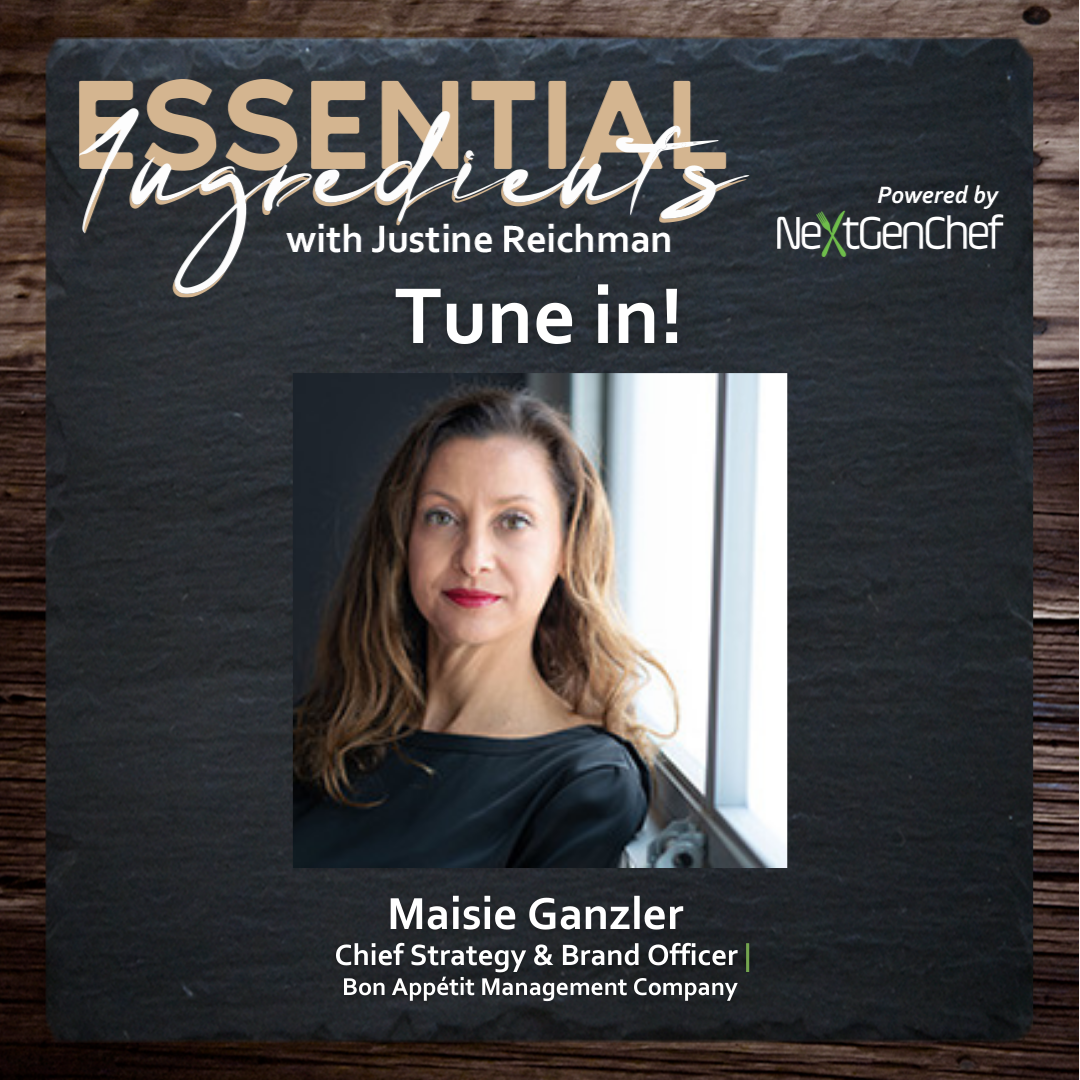
Maisie Ganzler · NextGen Purpose
Watch on YouTube
Creating Positive Change through Tech: Sustainability, Food Loss & Customer Access with Maisie Ganzler
The Incorporation Method helps you turn what matters into practical changes that fit your life.
“As chief strategy officer at Bon Appétit Management Company — serving colleges, corporations, and specialty venues — Maisie Ganzler is using technology to transform the food service experience. She discusses "Curated," an app-enabled ordering system that personalizes menus around dietary needs and allergens, and the company's food standards dashboard that embeds a carbon calculator to help chefs make climate-smart menu decisions. From ghost kitchens to waste tracking software built by chefs for chefs, Bon Appétit is reimagining hospitality from the inside out.”
Full Transcript
Full conversation between Justine Reichman and Maisie Ganzler.
Justine, thank you so much. Pleasure to be here.
It's a pleasure to have you. I'm really excited about having you on here and learning a bit more about Nucleus Capital, and learning about your journey there. But equally, some of the companies that you have come through there, and what is happening in food. Specifically some of the innovations you're seeing come through the pipeline. So Max, tell me a little bit about how you got involved and how you got started with Nucleus Capital.
Yeah. That has actually been quite a journey. There's a long version, the short version. But maybe to start out in the very early days, I actually had the spark of startups. And the passion that comes with that was originally found in my very first internship, probably my second internship back in the day. So this has been a very fundamental moment for myself. Enter at a venture fund and multiple companies, and then the innovation that they were doing. And ever since I kind of have set my mind on sticking around, so to speak, and then eventually working my way up through several stations, having founded my own company in a brief time, that miserably failed. Some great lessons learned there. Joining other venture funds at more mature stages in my career, and then eventually also helping set up a company from day one as the first employee. And so I've always been in the ecosystem for the last eight years, both on the operation side, as well as the venture side. And then the last three years, I spent at a local seed fund here in Berlin called Atlantic Food Labs, which essentially also got me very intrigued in the whole food tech scene. And then started thinking about venturing out on myself on my own, and using all that entrepreneurial drive and energy to move something.
So it's interesting because you talk about your first internship and the role that it plays in what you do today. So I'd love to hear a little bit about that. Maybe you can just share with us what was your first or your second internship?
Yeah. This was actually a venture capital internship at a very newly established firm back in Munich, essentially, they were a startup themselves. So very similar to what I'm doing right now. I currently also have an intern whom I think will be a great experience as well, and I certainly hope that it might trade that particular person's career trajectory as well. Just back then it was very evident that for millennia like myself working in an industry, that seems to have a lot of impact both nowadays, also environmental sectors, but essentially like technology and developing companies to developing technology that touches everyday life. And just being part of that and feeling that energy in the room with founders when they demonstrate that intrinsic passion for a certain problem that they're trying to solve. And so that really kind of ignited the spark. And I was lucky enough to be at a fund where there were very few processes in place, very low hierarchies, I was part of all the meetings and compressional departments, and that really helped.
Was there a specific moment, time or event while you're at this internship when you realized that this was what you wanted to do for the foreseeable future?
I don't necessarily think there was one particular instance. It really just developed over time. And so back then, we were looking at a company called HelloFresh, which turned out to be one of the first unicorns in Germany. The fund passed on it because the valuation was too high. That's certainly something that in hindsight, and some people might regret. But that's just part of being in the industry. And everybody has this kind of story to tell. But back then, it was a food company. So it was the first touch point with food as well. I just thought the concept was really smart. I tested the product myself. I figured, hey, this is actually something that people want, and it matters. So it matters how you can save foodways with that, how you can make lifestyle more convenient, especially to target groups like myself. And just having been around the energy that really comes from these companies and also the energy that comes from VCs were dedicated to that and bring passion to the table. It's something that I think always stayed for me and has never changed since. And then throughout the rest of my journey, being operationally involved looking at how it feels to build a company from day one scaling that up. Obviously, I don't have a background of being able to say, hey, build a unicorn before anything. But I think just having been on the side of, and seeing having been in the trenches, and seeing what it feels like, also from an emotional standpoint to believe in something and then try to make it happen in reality is just something very beautiful. And I think that's something that people in a corporate job, for example, would really kind of lack at least. I mean, I'm being very naive here because I've never been on the corporate side. So maybe that's something for later point in my life. But I honestly don't think that they will ever make that move.
Right. And so when you first went into this industry, was it all about food for you? Or was it not industry specific?
So as I mentioned, my first point was food tech in 2012. I had another one in 2014 when we set up one of the first vertically integrated online restaurants back in the day for Rocket Internet in London. So I think that the food story has always been there. I myself would consider me being a foodie. So I love to eat. And I, the most important part I think is that investing in food technology actually leaves you with a tangible physical product, most of the time, consumers and customers. And sometimes, users. Yes, you can definitely call them that. They have emotional association with that. And this is something that's beautiful because people, yeah, when they eat it, it reminds them of previous situations that they might have had, or great moments, and so on and so forth. And I think that's the key difference that interests me when investing in food is, hey, you have an emotional association with a particular kind of food, versus you invest in a purely tech productivity app. So who has an emotional association with Slack. I mean, it's a great company, I use it myself. But just to make that example, and to make that point.
Yes. I have an emotional frustration with Slack sometimes.
I mean, thinking about, even goes a bit further than that, for me, because it's a lot of intellectual curiosity around the ways we now have. The means and the ways we can now influence the future of food as in this biology, especially synthetic biology, we can now create new kinds of foods, develop something that has never been there before. And while doing, we also have a very positive impact on the planet because we can restructure how the value chain works. And we can restructure how production systems work. So in the future, I highly doubt that we will still use animal agriculture as a main way to satisfy our protein demand. So this will, in 10 years, or maybe an 8 to 10 years time. VCs, I think, are always terribly bad at making predictions on those. Might seem as though that was part of our job, but I still think that most people heavily underestimate the way. Technology grows exponentially. So I think maybe in eight years time, we will see the first cultivated meat products, or meat really grown in a lab which seems a bit odd to some people. And there's certainly a communications issue around that because we need to break that negative stigma or the negative connotations that that might carry. But I think looking at it as a production method, growing meat from cells in the lab is so much more efficient on every dimension than actually traditional animal agriculture. And sort of looking at that, it's both fascination for the end product and appreciation for the end product, but also intellectual curiosity as to how does that works, and what drives the underlying technologies.
Yeah. We're only just beginning to see some of these things, and they've been in the process right now for years. Some of them. Lab grown meats, and we've seen some more in Singapore. We're starting to see and hear a bit more about this now.
And it's important that politics and the regulatory environment starts taking these things serious. Because I think with these kinds of industries, it only works in just a three way equation, right? It's the technology and company building part. It's the regulatory part, and it's the consumer part. And I think the regulatory part is obviously one where there might be a little bit more of a slower adoption. But as you rightfully said, with the advances that stayed in Asia already in Singapore did, I think it's the first important step. The question is, will the other follow? And if they don't, what happens with countries who are slow on that, will they be left out in terms of technological innovation, which is something that I could see actually happening in Europe. Because the awareness there, and I mean, in general digitization and the whole startup industry in Europe is from a regulatory standpoint still. It feels like we're in the 19th century.
Yeah. So with all that being said, what do you think the greatest challenges are as an investor when you see these companies coming through?
That's actually a very good question. So purely from an investor's perspective I think, one, of course, incredibly important to be able to filter through to the obviously bad companies. Meaning, you do need some aptitude for technical feasibility and at least a network of experts where you can have. Because it's not like you're investing in a software model that has been around for ages. So B2B is something which you can benchmark quite easily where you have investors looking at comparing certain KPIs, and then drawing up on that and development good picture. For Nucleus, or especially for myself, investing in tree seeds is really trying to be at the Nucleus of the founders journey essentially means that you have to build up conviction superfast, and you need to be able to skim through the technological feasibility. And I think this is something that we can bring to the table, and is super important in the beginning. Because obviously, you don't want to end up with a tech that eventually really doesn't work or is a complete scam. And I think there was a story of Trusera? I'm not sure if you remember that, super hype Silicon Valley startup that developed a machine where they can actually--
Trusera, yeah.
Yeah, exactly. So it turns out you can just use it with your hands, and you can just press it, you don't need the machine for it. And I think it raised hundreds of millions of venture funding. And then eventually, it's just a scam. So this is a very predominant example. This doesn't happen all like most of the time. This is really out there. But nevertheless, I think, yeah, looking at that, and then also understanding the different layers that technology is moving, and essentially what drives them. So it's a combination of many things.
Right. And you talk about the Nucleus, you talk about tree seed, so I'd love for our viewers and our listeners to just know a little bit more about how Nucleus works, your process for investing in that way, and how a company might come to you and approach you, and how this works.
As an emerging fund manager, or like first timers, it's a similar way as the first time founder, first time manager. So I'm a startup or Nucleus and startup of itself, as well. And so with that in mind, I really tried to be as approachable as possible. So I answer all my LinkedIn messages. I always get back, it might be two days late, but I'll do it. So I'm not at the point in my career where I can just brush these things off. So in terms of reaching me, it's really easy to just write me a message on LinkedIn, and then maybe wait a day. And then hopefully, I get back. But in terms of operating with Nucleus, we really have that idea of building a better product for founders which is something that happens every now and then. Every stage firms reevaluate their positioning. So Tiger Global being one of them at the moment, at the later stages as a hedge fund coming in, and simply overpaying on valuation and being super fast which turns out to be a better product for founders. And so similar to maybe their approach, I think, one of the big advantages of being a very small and agile team is that we can make decisions incredibly fast. So if they meet the team today, and I really love it, I'll dig in over the weekend, and I will give them an answer on Monday. I think that's something that doesn't happen if you have long ways of getting into a decision and kind of talking it through with several partners. So this is obviously one dimension that really works out. And then the second dimension is being incredibly sector focused. I'm not a generalist, I only invest in synthetic biology with applications in food, with applications and material. I also invest in, generally, in climate positive companies. It's a bit broader there. But nevertheless, those are nascent, narrow markets. And I think the combination of knowing having a thesis and being fast, and at the end of the day having a network. And we're a very close relationship to people who are capable of evaluating the technologies very, very, like very distinctively, and build up conviction through that. This is somewhat of a secret sauce where I think you build up a better product for founders. Because not only do the founders understand that. We understand what they're talking about, but they also realize that we are also able to help them. Because through the community that I've built with Nucleus, we do have experience of scaling these technologies going through the typical challenges that are associated with that. And I think this is a powerful cocktail if you mix it with the fact that we only invest very small ticket sizes. So typically $200,000 as a precedence check, which it's still angel territory and it gives the founder the freedom to say, hey, we want Nucleus, but we also want that great VC who's facing downward pressure from the shared investors.
Can you give us an example maybe of what a company could expect from you?
Yeah, for sure. For sure. So I think there's a very interesting real life example right now going on,.I think, I'm not sure if you spoke to the founders already, but there's my portfolio company core which is replacing the cocoa bean and chocolate. So super, like lovely founders, siblings. They also have develop somewhat of a brand for themselves being the--
Chocolate siblings.
Yeah, exactly, I think it works very well in the US. Something that sticks in people's minds. So that's actually a really good example of the kind of value that we bring, and also the way we work with companies. So having said that, we invest a small check. We obviously not, we're a co-investor by design. So we're not a lead investor, the expectation should be that we are very helpful. Certainly, my northstar metric is trying to be five times as helpful as my check sizes. So that's somewhat of my ratio. And that obviously implies that, with QOA for example, we let the precede round. We help them really to sharpen the equity story. We help them with their Y combinator application. We offered access to a very wide network of biotech founders who are a little bit further ahead in their journey who faced similar challenges, who have gone through fundraising with generalist VCs and have seen also those challenges. And then in the end, we really have to get the right lead investors and to find the right lead investors where we thought not only from a fuel brand or money standpoint, but also which particular apartment that firm could be a great fit for this couple of founders who could really help them. And so putting this all together, I think we were quite hands on with working with the company. And then also ongoing, we chat every day. So I really want to be perceived. And not only perceived, but it's that feeling that I want to evoke is, hey, I'm super approachable. You could call me at 2:00 AM in the morning, I'll pick up the phone, and I'll discuss the hard stuff that you have to present the next day to your lead investor. And I will give you a dry run before that. Because with me, it's a little bit less serious. And I think if you're young, and if you're sort of considered a junior in VC like I am, and if you're just starting out, this is one of the few things that you have an advantage over with more established partners because you still need to hustle and still need to make a brand for yourself. And I think that's not as tangible, but it works.
What is it that the chocolate twins would say about their experience?
I think they would say that they're quite content. At the end of the day, it is also a case by case. And I think in this particular instant, it was very clear from the beginning what Nucleus was able to bring to the table. And I always very transparently communicated that. And I think that the expectations were met. And I think, at the end of the day, that's what it's all about. You can't over promise and under deliver. So at the end of the day, they knew going in what they were to expect. I think that's exactly what I delivered, hopefully, over delivered a bit. That's always the goal.
So as you bring in more and more companies, and you are innovating in the food space, what's your hope for the future of food in the next three to five years? What do you hope to see?
So I really hope to see that in the next five years is probably a little bit too short term. But I can answer the question in two ways. So in 10 years, I hope to see that the incremental cost of these enabling technologies has come down to a point where we're not only able to reach price parity with conventional products in the Western world, but also be able to drive that price point even further down so that we can actually do something good in emerging economies. So we have a huge monetization protein deficiency crisis in the rest of the world that maybe we in Europe or even the US don't really, I mean, we're not really aware of that on a day to day basis. But I think that if you look at the possibilities of technology, we might actually be able to get future meat production from, I don't know, mycelium or even plant based to a point where we can actually start feeding the world. And I know this sounds a little bit melodramatic. But I think this is what I would love for the, not only capitalist reasons to deal with these things to happen. And in the next five years, I think what is going to happen is we're going to see a lot of second layer companies. And what I mean by this is really focusing on enabling technology, focusing on specific verticals within the value chain of, for example, cultivated meat. Meaning, the first generation of companies, obviously, is end consumer focused they're trying to build the first version of the product. The next generation of companies will be more focused on, for example, developing growth media, developing scaffolding, focusing on the downstream process and kind of being an expert in a particular part of the value chain. And I think that could be very interesting. And then there's the big elephant in the room. And the biggest problem in the industry is the scale of infrastructure. So I think most of the company or any of the companies really like a couple of years away from industrial scale productions. And the pioneers like the Impossible Foods and the best meat of this world, they still have to invest a crazy amount of money in building production capacity themselves. I don't think this is going to be the case in the next five to six, seven years because incumbents will have understood that the risk associated with this product is quite low, and the benefits are actually quite high. So they might open up production capacity. And the other one is that startups will start to innovate on that model as well. So I have a very big thesis around contract manufacturing 2.0. So actually, doing the heavy lifting and building an asset heavy model in the space to create production capacity, because there's so much demand for that. And I think, I'm looking forward to and for founders who actually tackle that, because it's certainly one of the harder ventures to build. And historically, hardware has not been venture friendly.
Not at all. And it actually goes into what I was going to ask you, which is, will you expand your niches throughout as time goes on. So right now, you have various specific niches, how do you see expanding them as time goes on?
So very good question. I think it's a broader strategic question that I have to answer for the fund. Which in all honesty, I really haven't thought through all the way just yet. Because for me, it's really taking one step at a time. But I think looking at the idea of doing one thing very well versus becoming more of a generalist, I think that's essentially the core decision that one has to make. And my thesis is that at this, like food tech synthetic biology intersection, we're still in the very beginning of those markets. And we're still in the very, very beginning of the first couple of really quantum leaps in technology. And so my thesis is that for the next 10 years, at least, there will be enough and plenty of room to just focus on that and continue doing this. And also, obviously, accumulate the learnings that come from that. So if I'd rather want to be an expert than a generalist? Yeah.
I think we can learn if we're a generalist, and we are jack of all trades and a master of none. There's only so much we can do. But having experts in certain different things allows us to really dig in, and be able to make a greater impact.
I think that's the name of the game.
To help. And that's why I bring on experts in different industries to be able to really enable people to make more informed choices.
Look, I would never consider myself an expert. I just think that if you spend a significant amount of time in a particular field, you become knowledgeable. And then there's still the question, if you have access to the right experts, I think that's helpful.
That's really what this platform is all about. Just bringing people in that are experts and have enough information, and have done the due diligence, and have really sought after information in different niches to be able to share that information. So that the people listening and watching can make more informed choices as they continue to innovate and build new innovations in the food space to help change and create greater access.
And I think you touch up on a very crucial point. 10 years ago, I think it would have been really hard for an entrepreneur. I mean, it's still really hard, so never undervalue that. But it would have been even harder for any entrepreneur or even any emerging fund manager to start something themselves because there was still such high information asymmetries in the market. And so little information on the internet and accessibility is a huge topic. And so podcasts like yours, but also very specifically focused from a content perspective on how do you build a venture fund, how do you build a venture firm have been very helpful and also inspiring for myself. And I think that if the question is manage your own time, do you have the time and to know when to listen? For me, it's taken me a year to find a routine where I can cramp in my podcasts in the morning on my commute. It's like the self learning moment of the day.
I mean, everybody's got their moment. I spoke to somebody yesterday who will be coming on the podcast in the future, and she listens whenever her husband's traveling. It's her time to meditate and listen in the kitchen while she's cooking and chopping vegetables.
I do the same thing. Actually, when I cook, I also listen to podcasts once in a while, or when I clean.
When you clean. That's a good time to time pass.
Oh, yeah, for sure.
I listen sometimes in the car, or when I'm walking the dogs. So we all listen to different times. And one other question I wanted to ask you is we have all these listeners, whether they're watching the podcast or they're listening on iTunes, how would somebody get a hold of you?
Yeah. Very simple. My email is maximilian@nucluescapital.com. So you know, it might take a while. Otherwise, just reach out on LinkedIn. That's the easiest way to reach me. And again, I try to be as approachable as possible. And to do, hopefully, I'll be able to get back to everybody.
Well, that's what this podcast is all about, making people accessible, and making the information accessible so that everyone's got equal access to the information, so that they can hopefully get a little information to make more informed choices. So Max, thank you so much for joining me. I really appreciate it. And I hope that our listeners got something out of this. And we're here every Tuesday. So Max, thanks for joining us. And thank you to our guests for joining us. And if you haven't downloaded us, we're on iTunes, Spotify, and our video casts are on YouTube.
Thank you so much for giving me the opportunity.
Thank you.
Share This Episode
Enjoyed this conversation? Share it and tag @nextgenpurpose
Listen on Apple ▶Listen on Spotify ▶Your Host
Justine Reichman
Founder & CEO of NextGen Purpose. Host and Executive Producer of Essential Ingredients — 11 seasons, 330+ episodes, and a growing movement.
About Justine →