Kara Goldin · NextGen Purpose
The Incorporation Method helps you turn what matters into practical changes that fit your life.
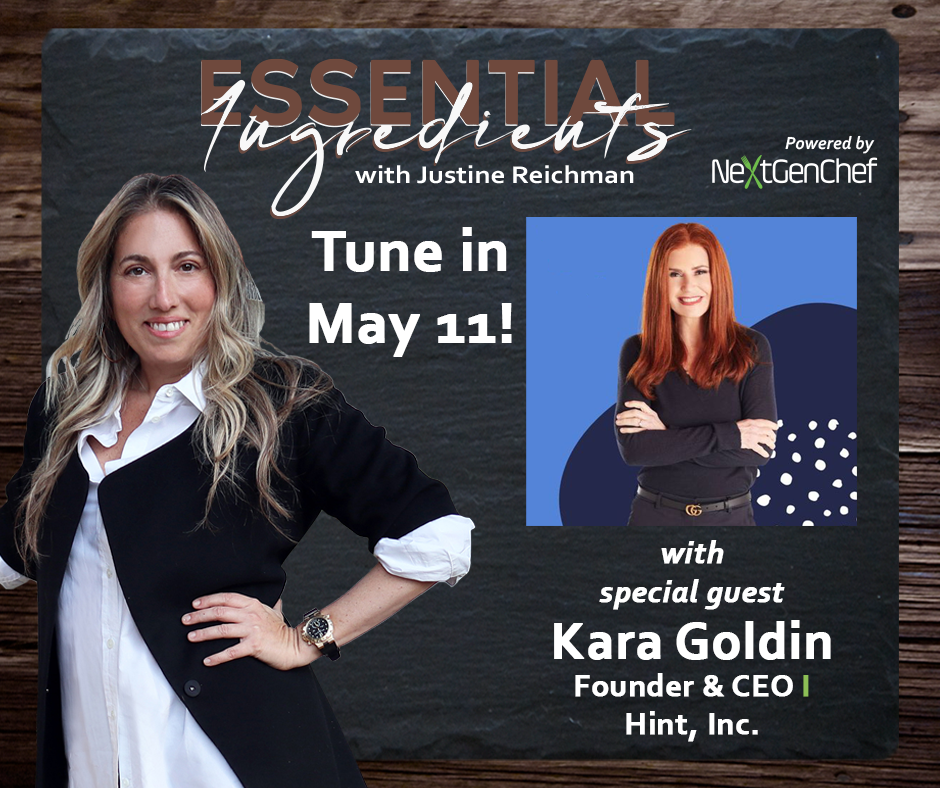
“Kara Goldin is the Founder and CEO of Hint, Inc., best known for its award-winning Hint® water, the leading unsweetened flavored water. She has been named one of InStyle's Badass 50, Fast Company's Most Creative People in Business, Fortune's Most Powerful Women Entrepreneurs, and EY's Entrepreneur of the Year 2017 Northern California.”
Full Transcript
Full conversation between Justine Reichman and Kara Goldin.
Welcome to Essential Ingredients. I'm your host, Justine Reichman. Today, I want to welcome Kara Goldin who is founder of Hint and the award winning and best selling author of Undaunted. Welcome Kara, thank you so much for joining me.
Thanks for having me. Excited to be here.
Me too. So first, I've got your Hint water here. Can you tell our listeners a little bit about what Hint is?
Yeah,. So Hint is an unsweetened flavored water. And what that means is that there's no sweetener, so there's no sugar, there's no diet sweeteners like stevia. In it, it's really just the fruit and water. And so that really stemmed out of my own interest for getting a product that didn't have sweeteners in it, that was water to get me to drink more water because I was bored with plain water. And when I went looking for something that just had a little more taste in it, what I found was that everything had some sort of sweetener in it. And I thought, how are things called water, and then they really are not water. And that was kind of the beginning of my journey.
I love that. Water is such a saturated market. You go into Woodlands, or any of the supermarkets, whether it's here or New York City, and the aisles are filled with water. So how did you get it to be so popular and flood the shelves, and get so many people to buy it in such a saturated market?
It's interesting, thinking back almost 16 years ago now, it was one of our first markets. You mentioned Woodlands, which is a store in Marin County, and that was one of our first markets. Whole Foods in the city as well. But when I was starting Hint, I knew that it was a new concept that I was having a hard time finding the product that I was looking for on the shelf. I knew that it was a new product, a new company. And we had also looked on the East Coast and couldn't find it anywhere on the East Coast. But what I didn't really understand that I share with a lot of entrepreneurs now about the problem that exists when you find this new thing that you're doing right, you're all excited because you're like, no one's doing it. And now, I got this great idea. The downside of that is often that you're creating a new category. And this is true, whether it's beverages, or food, or tech, or whatever. So you're creating a new category. And why is that significant? Because you have to educate not only the consumer on their need for it, but also if you have buyers that Woodlands, for example, who are making decisions whether or not they put your product on the shelf. And you've got this brand new unsweetened flavored water, they don't know whether or not the customer actually wants that product. And so that's one way that you can think about actually getting your message out to consumers is to advertise. We didn't have any money to advertise, so it wasn't even an option. Instead, we just sampled like crazy and we got it. I mean, I was living in the city at the time, right across the street from a school that had kids drop off. So a lot of the parents that would drive through, I actually knew from around the neighborhood and I would run up to them. I knew that their drop off was at 8:15. So I'd run across the street with bottles and get people to try it, and tell me whether or not the flavors were right. But again, it's really, it's something that I always share with consumers because it's not just about launching another beverage company, we not only did that, but we also launched an entirely new category. So getting it out there, I think more than anything takes sort of creativity, especially if you don't have money to advertise. I'm not even sure that advertising would have really done it. And more than anything, I think it just takes time for the consumer to kind of catch on to this, discover it and find it in their own way.
I want to just go back because you were talking about education. I really find it important in this category when we're talking about better for you food products and beverages to educate not just businesses, but end consumers about these better for you products. I'd love to learn a little bit about how you're doing that outside of the sampling, because it's a big challenge to educate.
Yeah. Well, I think sampling is, of course, in the water category in particular, I think in many ways was easier because there's always events that need water. So we would either get phone calls for water, and we wouldn't do money. In addition, we would just give products because people would want water for whatever it was. Like a fun run or something at school, the PTA, whatever people would reach out to us. But I think over time, the other thing that we found was that consumers really responded to the press. And so the press always been something that, I think, I've always viewed as really important. A lot of entrepreneurs think about processes like, oh, when I get bigger. But I think that so often when I talk to consumers, and I know, I believe this myself when you're trying to understand what a product is and you happen to be reading your instyle magazine, for example, and you see maybe that a celebrity is drinking your product, but also that they've highlighted the product, there's kind of an edit that goes on where you see it. And maybe you've seen it at woodlands, but then you see it in the magazine. And maybe you hear the story behind why the founder started the company. And maybe in some ways that really resonates with you. So I always share with entrepreneurs, when they're starting a company, that if you have any budget at all, trying to get your message out there. And also the story out there behind your why, which I think is the case for so many entrepreneurs today. Whether it's in any category, you've got the why? Why did you decide to do this? And particularly, if it's a little bit crazy story like mine, where you were in tech, and in Silicon Valley where tech is kind of the thing to do. And I had done that. And now, I wanted to go on and do something else. That type of story I think also probably resonates with people. And people would ask me though, why did you do that? Or how did you get so brave, or any of these things. So it wasn't always just about the product, it was also about my why. And that is the stuff that I think consumers remember.
So maybe you could share with our audience a little bit about your why, which I read in your book. And your story, which was so inspirational. I think our listeners would love to learn a little bit about, and the book Undaunted. So maybe you could just share a little bit about that with us, the Hint and Undaunted.
So I was a tech executive. I had been at a company called America Online for seven years. Really, in prior to that, I was with a small startup that was actually acquired by America Online. So I really enjoyed what I had been doing. I was running e-commerce and shopping partnerships. I was traveling a ton. I lived in San Francisco. I had three small kids under the age of four when I decided to leave AOL primarily because I was just traveling so much. And I really wanted to enjoy being a mom. I remember like the United Airlines pilot said, every time I got on, they knew my name. I mean, I was almost on that flight, almost going from San Francisco to go to Washington DC every Monday morning for many, many months. And I thought, this is crazy. What am I doing? And that's when I really thought, okay, I'm going to sign off and I'm going to be a mom. I remember people asking me how long I was taking off and I thought, I don't know. I mean, eventually, I'll start working again. But I'm really enjoying this. During that time, I think I also decided to get healthy. I had gained a bunch of weight over the course of many of my pregnancies and couldn't really lose the way. I thought I was pretty healthy, but then I started developing adult acne, which I had never even had as a teenager. And my energy levels had gone down. I thought, I'm just not quite right, and maybe now is the time, while I'm taking a break, to really start cooking, exercising and get healthy. And what I realized was I was pretty healthy. I always exercised. I was always eating pretty well, but I never really looked at my diet drinks that I was drinking. And diet coke in particular was my thing. The people at Pepsi love me because I never talked about diet pepsi. I was talking about diet coke as my vice, and I had been drinking diet coke since I was in high school thinking that it was actually better for me. My mom actually drinks tab. And of course, as a teenager, I was never gonna drink the same thing that my mom drank. So I just started drinking it. And every year, I think I drink more, and more and more. I got to a point where I was drinking anywhere from equivalent to 8 to 12 cans a day, and thinking that it was just fine because it was diet. And what I learned just by giving it up just really as a trial, because I didn't understand all the ingredients that were written on the can. I realize two things. One, I knew I should drink water. I always knew that eight glasses of water was kind of what was recommended to me, but I found water really boring so I didn't do it. I justified my diet coke because I thought, well, there has to be water in here somewhere. But I just didn't really think about what else was in there. And then the other thing that I realized after giving it up was, two and a half weeks later, I lost over 20 pounds just by eliminating diet coke. People always asked, well, did you change anything in your diet? Not really. I mean, it was really shocking. It sounds shocking, and imagine living it. I mean, I just thought what just happened to me, this is crazy. And then I really looked at the industry as a whole, and not just the diet soda industry, but also the diet industry. How much money was put into all these diets that we're out there, and how hard it was. And at the time, there was a store that just opened, Whole Foods, and I thought that Woodlands is great too. When this new store Whole Foods opened, I thought people are going in there and really aspiring to get healthy. And yet, it's just not so easy. Especially with this word diet that I thought was healthier and better for you. So took me about a year actually to, I was still taking time off. I was starting to interview at different tech firms, but I just really felt like there was just so much confusion. And maybe it could be better. I had started slicing up fruit and throwing it in my water. And that was in my kitchen. I thought, gosh, maybe there's this product on the shelf somewhere, not still thinking that it was a business. But really because I wanted to buy it, I wanted it to be easier. I missed my convenience of having my diet coke already and popping the can open. So that's when I really saw this hole in the market. And as you know, we talked about earlier, I knew I was starting a company. I'd no idea that I had sort of conceptualized this whole new category that was nowhere to be found. I remember going in and talking to buyers about the product. I would say: "Hi, our product is really different. It's not like vitamin water, it's not like diet coke, it's not like plain water." And they would try it. They'd say: "Well, this is really good. What's it sweetened with?" And I'm like, nothing. It's an unsweetened flavored water. And they'd say: "Oh, well, what category does it fall under?" And I'd say: "I don't know, does it matter?" And they'd say: "Yeah, it matters a lot because we only look at certain categories, and it has to fall into some category because that's how we do planograms." And I thought, I don't know. I mean, I didn't know anything about the beverage industry. Again, I had come from tech other than the fact that I was a consumer. So when people asked me why I wrote this book was because I had so many doubts. When I first started, I thought that there were so many points along the way where I thought I've never started my own company. I've never been in this industry. There's plenty of people around, mostly people in the food and beverage industry, but also family and friends who were like, what are you doing? You could go get a great job in tech, why would you want to do this? I think for me, it had so much purpose. And this was even before people were talking about purpose driven companies or mission driven companies. I mean, I just thought it was a lot of fun. And at the end of the day, I felt like I could really help people get healthy. I helped myself get healthy just by making this one change. I thought, if I could do that as a company, then I'm in. I mean, that just sounds awesome on so many levels.
I think it is awesome. I think that you have everyone in NextGenChef criteria. And a lot of the people here went online in order to just, so they can all taste it. But I want to go back to reading your book from the beginning, from back when you were in Arizona, and when you were going to get your first job and you're knocking on doors, as we like to call it, and sending out resumes. I love when you went to the HR department and literally asked for an interview. I love that.
Crazy, right?
That's totally crazy. But to me, that's what an entrepreneur does, right? We knock on doors, we send out random texts and emails, and we try to get every, we're just knocking on doors literally to get up, or fearless. But a lot of entrepreneurs have good ideas, but they don't necessarily, they're not comfortable knocking on doors that same way. So I'd love to ask you what your thoughts are? For those entrepreneurs that have that great idea, but don't have that comfort level in doing that knocking on those doors like that?
Well, if you ever think about maybe you did knock on a door once before, and maybe you got the door shot, maybe you learned some things, and maybe you just didn't knock on enough doors. I think that that's the key thing that I've learned is that, what's the worst that can happen? You survive, it wasn't a good day, whatever, and you just move on. I think instead of focusing on what could happen, just go and do, and you just never know what could happen. So that was the story of even getting my first job. Not my first job because my first job was kind of in a toy store. But my first job after college, and I just had a dream that I wanted to be a writer and that I wanted to move to New York City. I had never, we didn't travel a lot when I was a kid. I mean, I grew up in Arizona. And for me to go to New York City, that was just big and scary. But it was one where I thought I've met people from New York, they're not all bad. Maybe I'll go out there and see what will happen. And that's what I did. I really loved Fortune Magazine. I tried to get a job there. I had written to the Managing Editor of Fortune Magazine, Marshall Loeb, and he sent me this nice note back saying, if you're ever in the New York area, let me know. And I took that as, okay, I need to get on a plane. Didn't do it tomorrow, but I did it in a few weeks from that point. I went into the HR office. I said, this is before security at the bottom of the building. Fortune was in the Time & Life Building. Everybody knew that, that they were part of Time, and Fortune and Sports Illustrated. And so I just went up there. I remember being really nervous about walking in the building thinking, I mean, I wonder if I'll be able to get a meeting with Marshall. I wonder if I'll be able to even get in the door. I had no idea. But I thought, well, I'm going to just figure it out whether or not it's going to work. And at each point along the way, something kept happening. That there would be people, I mean, I really think that it goes to something else that I really truly believe about humanity is that people try to be helpful. I mean, if they can, and you automatically think like people are just going to not help you. I don't know, I think especially if you're a college student and you look like you're a little confused. I'm sure I did, and I was going into the elevator, and I got off and I remember just thinking, okay, here goes. And I just kept asking and I thought that I was leaving the next day to go home. And that's when I learned that I was not gonna actually get in to see the Managing Director of Fortune, and also that they weren't gonna hire me because they didn't have any experience. That's when I asked the head of HR who had come out to talk to me, because she didn't know what to do with me when I'm just landing there. And inside of her office, she said: "Well, I do have this one person that's kind of looking for somebody if you're willing to be an Executive Assistant." And I thought, okay. I mean, why not? I've got to start somewhere. And maybe eventually, I'll get a job at Fortune Magazine. But that's really how it started. And it's funny, I've shared that story a few times. I also talked about my friend Alex Wallace in there who ended up running the Today Show. I mean, she kind of started the same way. She just walked into the office, so you just never know. Whether it's doing things like that that are a little different, or cold calling is another way that I've been able to just do it. I mean, sometimes, it works. And sometimes, it doesn't work. And today, I often talk on college campuses about LinkedIn, I mean, just reaching out to people who maybe are on LinkedIn. And again, asking people for like 15 minutes is probably not the way to do it, you're most likely not going to get a response back. But if you really make some kind of connection, like I read your book, I heard you speak on, or I heard you on a podcast, or something that makes some kind of connection, then you just never know what can happen.
Yeah. I think those are great recommendations because we have a lot of founders listening to these podcasts. I'm often asked, What if I can do that? Or do you have any recommendations because I'm trying to start my business? Or I'm not getting anywhere doing this or that. So I love to be able to ask our guests for recommendations for them.
Well, I think that the other thing that's a really important lesson that I learned along the way is that I kept thinking that there were these people that really had a lot more experience than I did. They were, I don't know, I sort of fluctuated between being almost terrified of them because I thought they were going to crash me at some point if I got too noticeable, or I thought I would live on every single word that they would say. And when you're, particularly when you're starting a new category, they haven't really sort of fully grasped or gotten thought about, gotten their arms around it, whatever. They're of course going to tell you that you're wrong because they're focused on the big behemoth. And in our case, the soda industry. So that was another story that I shared when I realized that. I was really excited to have this meeting with Coca Cola, and I ended up having a phone call with a person thinking, it was at a stage when I had really given up on how to actually create this product and get a big enough shelf life. I had so many challenges going on. Also distribution, I didn't know how to get distribution throughout the US. I had been trying to get Cisco and some of these other big distributors who wouldn't even talk to me because I just wasn't relevant and wasn't big enough, and I just could not figure it out. So when a friend connected me with this person at Coca Cola, I mean, what so many people have talked to me about when they've heard the story is like, they said, if somebody that big, this guy's like running a billion dollar company said: "Oh, you shouldn't do this." In my case, he said: "Sweetie, Americans love sweets." People would just stop at that point and not do any further. But for me, it actually brought so much clarity, because it was at that point when I realized that what I was doing really did have purpose. And the purpose was really health, and that was just not what they were doing. I mean, they weren't running a mission driven company product or anything like that. So we were so different. And then I started to think, well, should I really listen? Why do I care if that person is not on the same page as me? And again, I wasn't thinking about it that way too. It doesn't make you fear them. And it's just one more opinion. I've got lots of people's opinions around. Who do you listen to I think is really the key thing. What I always share with entrepreneurs is that it's clearly for what I would say is, it's not the people who have the most experience. Those are the people that don't think about innovation and don't think about new categories in any industry.
Yeah. As a healthy driven business, you are in a health category. This is healthy water, you're providing something that is changing the future of food. That's a big deal. I have to imagine that as you're looking at the future, and how are you looking to change the future of food, is it through education? Is it through policy? Because I feel like there's so much more you're working on.
Yeah, yeah. Well, I think that the key thing for me is really focusing on, it's always been on helping people enjoy water and getting healthy. And I think that since day one of getting our product on the shelf, we would hear from people that just by having this email or 800 number on our bottle, that was kind of a tech thing to do. That in tech, we always did that. You always had like a phone number and an email on there. In food, not so much. It was not, it's become more and more prevalent, but it really was not kind of the thing to do back then. But we would hear from customers from day one that Hint was helping them drink more water, or started hearing about this disease that I had never heard about called type two diabetes. And type two diabetes at that time was, maybe 2% of the population had type two diabetes or prediabetes. And I was so curious about it. What was it that was causing this, which by the way, is different than type one diabetes. The people who get type two diabetes are claiming that they are dieting, they're eating healthy, they're eating a lot of diet sweeteners and low fat things. And I thought, wow, it's just, again, so hard for consumers. If I could just help them just as a first step, drink more water, then maybe this will help them in some way and change their lives. I mean, that's been consistent for 16 years that we've heard this over, and over, and over again. When you have kids, I think that's a main time for babies when women are really looking at what they're putting into their body. If they have been having diet soda, then they cut back during that time and really focus on what they're putting in their body because they know that that's going to transfer to the baby in some way. So I think that that was really from day one, and it hasn't changed. Frankly, I think that that's the other thing that I would say about, really just kind of your mission. What's important for founders to do, you're always going to be, especially as you scale, you're going to be adding people, you're going to be trying to figure out the following year and determining growth plans and all those kinds of things. But as the founder, it's really your responsibility, and as the CEO to really put stakes in the ground around what is the mission. The mission really hasn't changed. I mean, it really is that we work on things in Washington around clean water and policy stuff. Yes, absolutely. But I think that that really stems from really just how much knowledge I've gained just by doing what I do every single day around producing this product. So again, it satisfies my curiosity, and my ability, and my passion for helping people. I think it really stems like I'm constantly thinking about how else can I do that?
I want to be mindful of time, but I have just a few more that I just want to just chat with you about. I want to go back to Undaunted. I want to make sure that we just cover a couple of things if you don't mind.
Absolutely.
Okay. Great. So when I was reading Undaunted, you talk about being an accidental entrepreneur. I talked to a lot of people that say that, and I'd love to just hear from you a little bit more about that.
Yeah. I think a lot of people think that entrepreneurs are born this way, or that they always planned on being an entrepreneur. I've just found that, yes, that can be the case where people are, I guess born that way. I have no idea. I just know that for ME, I've just always been incredibly curious and wanting to do things that really satisfied my curiosity. And even as a kid, I was constantly asking questions. And really, I think that that's the thing that I see. So many entrepreneurs that I've met that they didn't really have a goal, they basically found this hole in the market. Some of them maybe saw another product that was out there, and they decided to develop a company that was better in some way. And then others are super crazy, like me, where they just see an entire hole in the crater in the market, and they decide to just go out and try and figure out how to make that happen. I always share with people, especially ones that are kind of thinking it's so daunting, it's so scary to go and do that. You can always go back to what you've done before. Let's say, for example, you weren't working, you were being a mom and not that isn't working in some way. But you can go back to that, right? Or you were a tech executive and you decided to go do this. There's no rules anymore that say that you have to, like once you go down one path, you have to stay there. So I think that that's the most important reminder for people is that you can do what you're passionate about, you can do what you're curious about. And you can go try it, and you should go try it. And especially if you've been successful, especially if you're just starting out, why not? I mean, what's the worst that can happen? That's always been my attitude about things. And part of the reason why I wanted to call myself an accidental author too because I never thought I was going to write a book, even though I was a journalism major. People are like, oh, come on. For sure, you're gonna write a book. And I said: "No." I mean, I really just did this because I wanted to help people. I'd been answering so many questions over the years. And speaking at a lot of different conferences I thought, maybe I could just get this out there and just let people know that it's out there. So it was four years in the making, and I'm so happy I did it. I don't know if I've got another one in me or not, maybe after the pandemic, since this was actually, totally turned in and inked prior to March of last year. But it's definitely, it's been a lot of fun doing it.
Well, it was a great read. I say for me, it's hard to get into books. If I can't get in within the prologue or the acknowledgement instead of the first chapter, it takes me a little while. But this one, you have me, and literally the first two pages.
Thank you.
And I read the first 100 pages in the first sitting.
There's a lot of life lessons in there too. So even if you're, again, I'm a parent. Actually, four kids, I was pregnant with my fourth. I did not look like the typical entrepreneur when I started this company. I mean, four kids under the age of six, what was I doing? And it was, I think, hopefully it's entertaining at times. It wasn't entertaining for me at the time starting it, but there were definitely moments where we didn't know whether or not the company would succeed. My husband also works with me too. So that can be very humorous at times.
I also would love to just chat about that a little bit. What's it like working with your husband?
We have such different skill sets, and we never planned on it either. I think some couples say, oh, we should work together. And that was never us. I mean, he's an attorney. He is an intellectual property attorney. So of course, when I was thinking of the company and naming it, I went right to him and I said: "Okay, how do I put this thing together? This is the name." He didn't like the name. He was like, wait, what are you doing? And I had made some money at AOL. So he wasn't arguing with me about investing this money in this trial of buying bottles and caps and getting it off the ground, but he didn't think it was the best idea that I had ever come up with. But when he really saw the purpose and the idea of starting something that really helped a lot of people, he's the son of a doctor so it probably was kind of ingrained in him that helping people would be really awesome. And that's when he really started helping me initially delivering cases to Whole Foods because I had nobody else in the company. It was just me, and then he eventually came on and started working. But I think raising four kids, our kids are now older. Our youngest is in high school and three in college. Raising a family and raising a company, I think in many ways is easier. I think that if you've got the right mix, it's not for everybody. But oftentimes, I hear about co-founders who are, they're trying to figure out whose job is more important. Husband and wife were trying to figure out whose job is more important. The dynamics are even more complicated than what ours are? So I think that, again, it's risky for some people, but it worked for us.
Yeah, it sounds like it's a big success between the water, the book, and creating a healthy beverage that really is making it healthier for people to live. One thing I'm really curious about is because it is a healthy beverage, and you did do this from a personal story that you share, right? You were drinking diet coke. It changed your life, made you healthier. How do you go and promote a healthier beverage without doing negative publicity on all those other things when your story was really about creating a healthier diet for yourself?
I think, again, just sharing your own story around why you did it. I think for me, that was another thing that I wanted to get out was that. Yes, there was this story about diet coke for me. But I think more than anything, it was really about the industry as a whole, I was really invested in many ways. I spent a lot of money primarily because I thought that the word diet was really helping me get healthier. And I was pretty bummed out, when I figured out that not only had I thrown a lot of money into this industry, but that there was no intention. And yet, you look at people who are trying to diet, who are trying to get healthier, and that's what they do. They do diet, they do low fat, they think that that's really equivalent to health. And again, I really was trying to figure out a way not to sell against those companies, but try to figure out a way to help people really get help. I mean that that was real. And the easiest way to do that, frankly, was really just by telling my own story.
I think it's the most impactful way too. Personal experience. Sharing your personal story is the most impactful way to make an impact. I don't know if you're familiar with Gina Bria and the Hydration Foundation. We had our podcast a while ago, and one of the things that she talks about is adding lemon or some sort of fruit to water to actually create really hydrating water, which is what you do. So she talks about how this is far more hydrating than the water that comes out of a tap. I just thought that it was really interesting to bring that together because she talks about that this just makes it much more hydrating. We could drink this, and we're going to be far more hydrated than drinking the water out of our tap.
I love it.
Yeah. I just thought I'd share that with you because we've had her on her podcast, and she's done a variety of studies. She's an anthropologist, and the studies just showed that by drinking this kind of enhanced water were far more hydrated than any of the regular water.
I totally agree.
I knew you would. Kara, thank you so much for joining me.
I enjoyed the conversation very much. And if you guys want to reach out to me at any point along the way, it's Kara Goldin with an I, and I'm all over social media. But also my book is Undaunted: Overcoming Doubts and Doubters. I hope you'll read it. It's on Audible. I read my own book as well on Audible. So that's another great way to listen in while you're doing other stuff, or enjoy it if you enjoy listening to books more than reading them.
And where can they find Hint?
Hint is nationwide at most stores, but also at drinkhint.com, in Amazon, it's everywhere.
Also, thank you so much for joining us today. And for those of you, follow Essential Ingredients. You can download this podcast here every Tuesday on all your favorite channels. So again, thank you Kara so much for joining us. Again, the book is called Undaunted, it was a great read, you won't want to miss it.
Thanks everyone.
Thanks so much, Kara. I really appreciate it. It was a great conversation.
Thank you.
Share This Episode
Enjoyed this conversation? Share it and tag @nextgenpurpose
Listen on Apple ▶Listen on Spotify ▶Your Host
Justine Reichman
Founder & CEO of NextGen Purpose. Host and Executive Producer of Essential Ingredients — 11 seasons, 330+ episodes, and a growing movement.
About Justine →