Sandra Velazquez · NextGen Purpose
Watch on YouTube
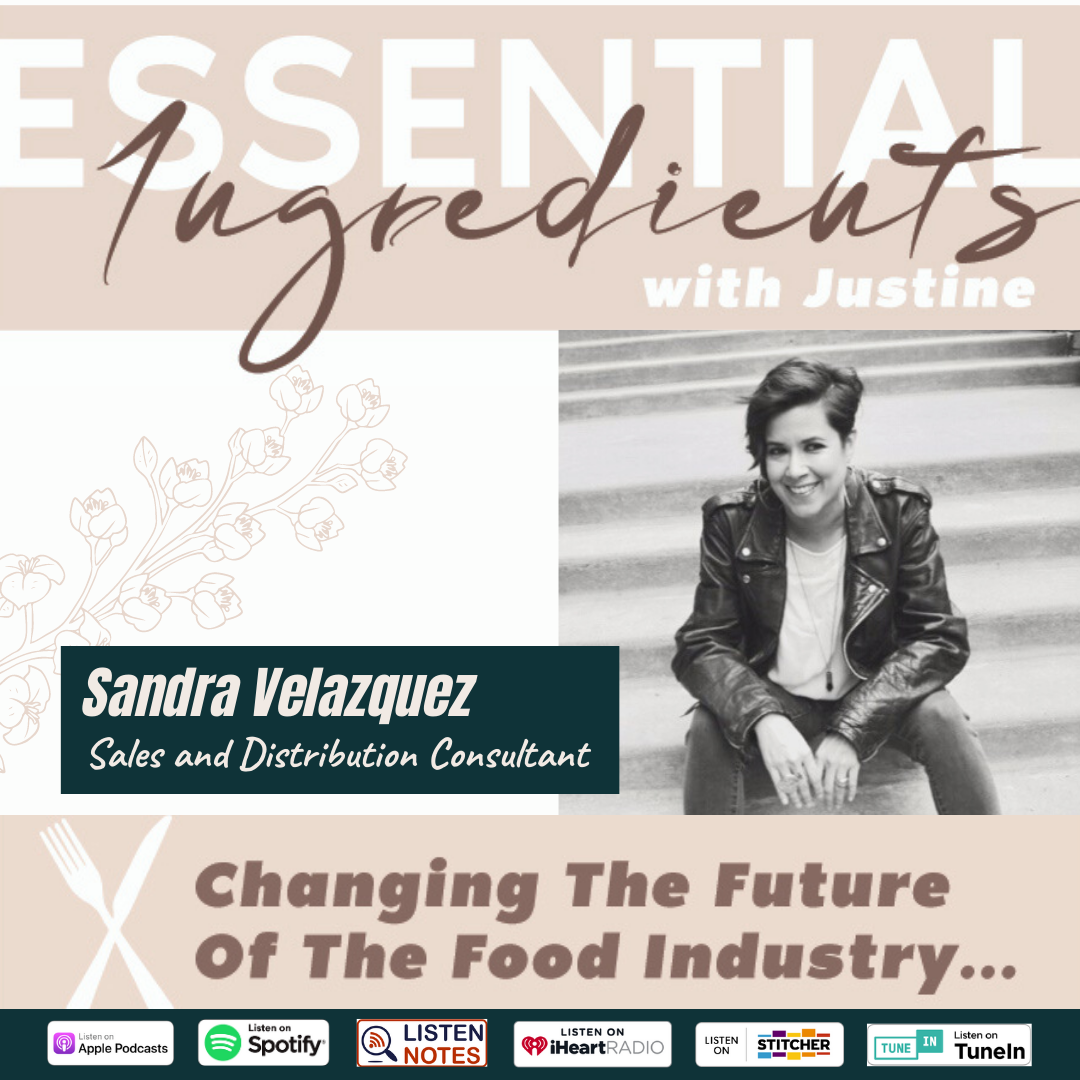
Win the Product Competition — What You Can Do to Level The Playing Field in the Food Industry with Sandra Velazquez
The Incorporation Method helps you turn what matters into practical changes that fit your life.
“The market competition became unbelievably tight during this pandemic. Products with appealing promises emerged and more small business owners are stepping up in the arena. But how can entrepreneurs rise above the competition while being aligned with their purpose and mission? Sandra Velazquez shares her amazing journey and the lessons she learned about transition and purpose-driven endeavors.”
Full Transcript
Full conversation between Justine Reichman and Sandra Velazquez.
Welcome to Essential Ingredients, I'm Justine Reichman and today with me is Sandra Velasquez. Hi Sandra, how are you?
Justine, how are you?
Good. Thanks so much for joining us.
Thank you for having me.
I appreciate you having a little faith in this new podcast that I'm launching here. So super excited.
Awesome. Me too.
So for some of our listeners, you're new to them. For some of our members, people know you already because you do a lot of lunch and learn. But if maybe you could just share a little bit about your story and how you got into it. I know it's super interesting from music to food, and I can't wait to find out a little bit more about that.
Yeah, sure. So I currently work in sales and distribution here in New York city. So I'm the New York area sales manager for Van Leeuwen Ice Cream. I manage the grocery side of the business, and then I also have another client called HiBAR, which is a zero waste hair care line at Minneapolis, which is super beautiful and cool. And so that's what I do now for a living, but I've been doing that for maybe, I don't know, I've been in sales and distribution for about six years or five years. And really, I've been a musician my entire life, that is what I've been doing since I was child. I have a degree in music actually, and the transition wasn't really conscious or planned. I think like most people who kind of fell into the grocery space, unless you kind of grew up in it with your family or something, I find a lot of people fell into this space. So for me, it was just an opportunity that came my way to help launch a health drink company, and I took the opportunity and that's where I really cut my teeth and learned everything about the industry. Now I've been able to take all that knowledge and teach it to new brands that are entering into the space so that they really have a fighting chance. So they understand how the industry really works.
And it's a challenging industry in so many ways.
Very competitive, yeah. I mean, every category is saturated, but some more than others for sure.
Yeah. So can you just go back a little bit and tell me a little bit about the music that you did. I'm super interested.
I don't really talk about my music stuff to my students because it's not why they come to me. But I moved to New York in 1999 to pursue my music career, that's why I moved here from California, which is where I'm from. And this is where I founded my first band piece to let out, which is, it was an all female band. I sing in Spanish, I'm the band leader, I'm the song writer, I'm the guitarist and had a lot of great opportunities performing at Central Park, Brooklyn, celebrate Brooklyn, we went to Europe a couple times, open for Los Lobos, lots of great opportunities. And again, it was because what we were doing was super niche, which is I think what I try to teach the students in my class now who are in grocery. Like, you need to know like who your audience is and who you are making this thing for. So mine was super niche. I mean, I only sing in Spanish, and I play like Latin, like my own blend of Latin music of different styles, and the lyrics are pretty like political so it was like very, very niche.
You can send me a track?
Yeah, absolutely.
I'd love to hear that and I'd like to include it in our intro and outro.
Yeah, absolutely. And you know, had some great opportunity, had some good music placements. You can hear my music in Breaking Bad, in Sons of Anarchy, Travel Channel. Lots of cool stuff, and did that for many years. Then when I had my daughter, I decided to make a kid's version. So I made a bilingual kids version. I had to give it a different name because "Pistolera," for those of you that speak Spanish know that that means female gunslinger, so that's definitely not an appropriate kid's band name. So I started a new version, same band members, same everything, just different names, different songs called Luna Luna. That also became really successful because, again, talking about being really niche, there's always kids in the world. There's always parents that need to do things with their kids. Like they need to take them to do stuff. And so we also performed great opportunities like the LA Times Books Festival, we played in Washington, we played big festival stages. There's always a family stage, usually at festivals. So great opportunities there, and some licensing with Scholastic to really help educate younger school children who are learning both English and Spanish. So it became an educational tool. So that was kind of my intention. That's cool that that really manifested. So that's what I've been doing pretty much my entire adult life, and then I also just happened to work in grocery.
It just happened today. Was there any connection from food to grocery?
I can't say that there was a connection. For me, in terms of how I brought my knowledge from being the band leader into the grocery space, that is a very, very strong connection. But there was no correlation between my decision from being a musician to now entering into the grocery space. It's just that the reason I became good at sales is because I was a bandleader and I was booking my own tours. I was doing all the logistics because when you're a band leader, it's 80% logistics, 20% art. Just like when you run a food business, you don't just get to bake bread all the time. You have to do all the logistics, and all of the paperwork, and the math, all of that stuff that is unglamorous. So for me, I just took that knowledge of how I learned to communicate to people and how I learned to understand, like really understand your niche and really communicate your value to the person on the receiving end, which is ultimately what sales is. Sales is just learning how to communicate, tell and understand what people need, and providing that solution to them. That's really in a nutshell, honestly.
And building relationships, right?
100%.
All about relationships and fostering those relationships, which is a full time job.
Yes, absolutely. All business is relationships at the end of the day. It's people helping people, and learning how to talk to people is a real life skill, you know?
I don't know about you, but it's been challenging or changing, I should say, with COVID. Because we're used to seeing each other face to face and establishing that rapport, and now we take it to the computer and we're writing emails. I don't know if you feel this way, but I'm always just very efficient. I'm like, okay, what time? And I forget to establish that relationship, I have to go back. I mindfully go, I reread this. I'm like, okay, he sent me, how are you this labor day? Whatever it is, because sometimes, that gets lost.
It's true.
And I think that communication building relationships sales has pivoted or changed a little bit and we've had to figure out those new ways to establish those relationships. Are you experiencing that too, or is it just me?
No, you're 100% correct. I use this example with my students in my class, we all know how to write a letter, a hard copy letter. You know how to write the envelope, first name, address, city, state, zip code, to put that in the center and to put your return address at the top. We learned, we were trained on how to do that, but no one ever really taught people how to write emails. So they're all over the place. One of the things I teach people is, and I show them how I write emails, and they are very efficient, but it's combined with humanity. So it's like efficiency plus empathy. So yes, like, Hi Justine, how are you? How is San Francisco? I hear the fires are really bad. And then we can talk about, is 2:00 PM good for you? But you need to connect with people digitally. It doesn't mean that it's long-winded, it's just those little things, those details really come through those pieces of humanity.
I was actually having a conversation with my father and he just writes down what he's thinking. I'm like, I need some more context here. And he's not the first person so it's not meant to point them out to say that he's, but people just come out of nowhere or they'll just respond. I think we got to take a step back sometimes. And in sales, I'm sure you have to do this all the time on people, it comes out of how we feel, or how we are connecting the dots, and making those and establishing those relationships and continuing them during these times.
Yeah, absolutely. We've been selling all through COVID, so my job never stops because grocery, as you know, was like the only place we were allowed to go was the grocery store. During COVID, everyone was going grocery shopping, like it was going out of sale. It was like black Friday everyday. Yeah, I've been working the whole time. I'm grateful that I work in an industry that had work during COVID because all of my musician friends, basically their careers, ended overnight. Anyone that had a tour booked was canceled. Anything that had to, you know, music is something that you do with people in the same room.
Online and happy hours, we did them even when we brought people in from Brooklyn, doing it on their stoop, and we tried to say, Hey, donate to them, they're providing a service, but it was really challenging.
It's really, really challenging. Even as a music lover, like a person in the audience, I have a hard time engaging with a concert that's happening online. It's really challenging, it's not the same. Yeah.
I want to just go back for a second. I know that you were a musician first and then you decided to go into grocery. Was there something that happened that was pivotal or there was a moment that just inspired this change?
It's just an opportunity that came my way. I had always been a musician and I always had a really safe day job, an easy safe day job. I worked in Higher Administration, I worked at Columbia University, I worked there for 15 years because I had summers off. It was great as a musician co'z I could go on tour in the summer, I had spring break, I had Christmas break, and I had health insurance. So I had these perks that were really helpful to my lifestyles as a musician, as a working artist. But I didn't really foresee what else I could do that would give me that kind of freedom as an artist. And so this opportunity came my way where an acquaintance said that her family was starting a health beverage and they could see that I was really good at logistics, et cetera. So they asked me to help and I was just like, well, this is just totally random, but this sounds like a great opportunity to kind of get out of this office job that I'm in. So I took the opportunity, and super challenging, really hard learning grocery, learning everything from formulation to packaging, and to actually selling into stores and how to work with distributors. There's a lot to learn when you don't know anything, which we didn't. So that's really where I learned everything. It was really just a chance opportunity that, for whatever reason, I thought it was a good idea.
Well, how many years later is it a good idea? What do you think?
It was definitely a good idea because, as hard as it was, I learned everything through that, from like zero to being like national, like we learned everything from scratch. Like everyone in your community, they're doing everything themselves, you know what I mean? They're bootstrapped brands and they're wearing seven hats, and that was totally me. I was in charge of production, I was in charge of sourcing, I was in charge of sales, I was in charge of mopping the floor. I feel like it's just great training for life because when you really learn new skills, and learn how to communicate and just everything that I learned from grocery, I feel like it can be applied to the rest of life, honestly.
So can I go back to something you were talking about when you were looking at this new opportunity and you mentioned working at Columbia, and the fact that it allowed you to continue to do your music and equally have the freedom and the flexibility to do that. You're working there, you got your bills covered, you got your insurance covered, and as a bonus, you got the ability to continue your music. It sounds like work life balance was really important to you?
Yeah, it is. I wouldn't call it a balance, it's really important, I feel like when you're an entrepreneur, or when you're an artist, working artists, it's really hard to have a balance. I think that it's about understanding what's important to you. So it's important to me, and making sure that those things happen. So it's important to me to be a working artist and it's also important to me to have my rent paid. Whatever I have to do to make those things happen, but there was a sacrifice even as a working artist. People would have parties, or there would be events and I'd be like, sorry, I'm out of town, I'm on tour, I'm recording the record. It was always recording a record. When you're an entrepreneur, you have a food brand, you also make that sacrifice. Like if you run a restaurant, you don't get to also hang out and go to barbecues, you're running a restaurant, you know what I mean? So, it's about what's important to you.
A pattern.
Yeah.
It's less about the work life balance and more about integrating your passion for purpose into what you're doing. Doing the job at Columbia facilitated you following your passion to be able to continue to do music.
That's right. That's right.
Integrate that into your life. And I think that that's a really important point because so often, I like to talk about purpose, passion and how I've completely followed that. I love to connect people, and I love to fix problems, and I love to do all those things and so I channeled that all into NextGenChef.
Yeah.
But that gets me up in the morning, and that's my purpose built business. I think this is interesting. So you worked at Columbia to facilitate this and then you're now doing a distribution, marketing and helping all these brands get into the groceries. Would you say that that's a new passion, or would you say it's still the day job now facilitating your passion.
No. Definitely less than a musician now, I've been a musician my entire life.
You're always going to be a musician.
Exactly. Like my father is a painter and he'll go like six months without painting the painting. He's still a painter, he's still an artist, you know what I mean? To answer your question, I think that what my passion and my purpose is, is to really equalize the playing field. It really, really excites me to empower other people and to make an impact in that way. So for many years, I did that as a musician. My lyrics were political. I would talk about the immigrant experience because my family's from Mexico so there was a lot of that in my music. And I was speaking to a certain audience and making an impact because they felt seen, they felt understood, they felt connected, and that's what really motivated me. And now, me in the grocery space, and teaching my class, to my students about how to get into stores, I feel the impact that I'm making on them is sharing my experience and my knowledge from already having gone through it, and currently being in it, and really empowering them and giving them the tools so that they can go and do it themselves. Because otherwise, it takes you years to learn this information. It took me years, right? And I'm trying to save people like two years of time. So really empowering them and leveling the playing field because most of the brands that I work with, they don't have like a board of directors, they don't have millions of dollars, they don't have everything in place. They're literally building the house from the ground up so they have a lot of questions. I really like empowering them and making that impact. I ultimately feel my passion, like the thread of passion from being a musician to now in grocery which seems totally disconnected. Like empowering people, when it comes down to it.
I love that. I love that. It's a great metaphor. It's a great way to explain it. I have a question for you, my question is that, you are supporting these individuals with all these access to all these different resources, which is amazing to me co'z we equally just launched around table, and I don't know if I told you about that, but if I didn't, I should, and we should include you in it. It's a way to create or provide the resources and expertise at a high level to these food and beverage entrepreneurs building better for your food businesses. So we curate these tables based on people's needs. Okay, we want to get distribution. Okay, we need to build our brand. We need to identify our audience, whatever it is we build up. So that's for another day, but it sounds like there could be a way for us to collaborate on that.
Sure. Oh, I love round table discussions. I feel like the more people that are asking questions, the more everybody learns. This is why I don't really do many one-on-ones because I love when other people ask questions and then other people get to learn the answers.
Yeah, I would agree. And I think that we feed off of each other from founder to founder, mentor to mentor consultant to consultant, we all have a little bit of a different point of view and expertise to share the minute you say something, it might even trigger something for me that I never considered.
Correct. Absolutely. Absolutely. And this goes back to the thing of like, we're all connected and we need each other.
And I think people are finally getting that now. I feel like there's a shift in the paradigm, and unfortunately I think it has to do with COVID. I don't know if that's what it took, but that might've been one of the reasons behind it.
Yeah.
I don't know. But I'd love to hear, maybe if you could share a specific story, you don't have to give us a specific person's name or anything, but the impact that they had by going through your program, and where they were before, and by going through your program, what they achieved and the success that they had.
Yeah. It is actually ongoing, I have more than one story to share. It's an ongoing thing where students will say things like, Hey, thanks to your class. Like, we're now in all of these retailers and now they feel confident. I really like giving people the confidence, that's what I pass on to them because, again, I have a degree in music, how does that help me work in grocery? So my point to them is like, if I can do it, so can you. And sales is not something that you go to school for, there's no such thing as a degree in being a sales rep or being a broker. You learn it by doing, like throw Justine into the pool and she's going to learn how to swim.
Yeah.
So I love the success stories that I hear kind of just an ongoing basis of like, Hey, we got into the biggest retailer. I had a student who's in Canada and she got into the big conventional grocery there with her kombucha. I love hearing those success stories because they're able to, they did it themselves. They didn't go and hire a sales rep, they didn't go and hire a broker, they did it, and that's really what I want to show people how to do is, you can actually do this. You'd rather save your money, save it for your business or your marketing, whatever. Just go do this work yourself in the beginning because you can. She comes to mind, the kombucha. And then I have another one who actually took my class who's actually a PR consultant. She has a PR firm and she wanted to take the class because she wanted to be able to help her clients. I also let other people into the class, not just founders, because the more people that can empower more people, the better. She was able to get several of her clients into some great retailers in California as well as a result of learning how the whole system works. So that's always great to hear too.
That's really important, right? It empowers people to be independent and not rely on others and not make it a function of the money.
Yes.
Because we get paralyzed by this so often as founders and startups, because we don't have the financial resources necessarily to do what we need to do. So being able to have a resource like yourself, to be able to go through a class like that, to be able to empower myself to then go off and do that puts me on a whole other level.
100%, yes. Yeah. And I'm like, listen, at some point, you will have to hire somebody to maybe do this work, but you can train them because you will know what that job is. I don't want anyone to ever be like the old lady whose husband died and they don't know how to write a check because it has been, he always did that. I want everyone to know how this works, how you can do it yourself and then you can always train your own team because you will be like the master.
I agree. And I think it's so important because the truth is, we're not going to be able to do everything. We're not going to know how to do everything. But as a startup, being scrappy and having access to a resource like yourself, and somebody that knows a little bit about supply chain, and somebody that knows a little bit about [inaudible], which is what we're facilitating in these round tables, which is why we're bringing in experts like you to be able to give them that access and portable way in a way that they're not hiring these consultants for $25,000.
[inaudible] started to have that kind of money to do that. That's like a different level of what a startup is., Some people think of a startup as if you start with $3 million.
Who was it, somebody was saying, Oh, Facebook is still a startup. I was like, really?
I love what you're saying, and I think that's great because resources, there's so much to learn when you're starting a food business or beverage business, and you don't have to be good at everything, there are some things that you can outsource. I wouldn't say that you have to be like a good HTML coder and you have to build your own website because that's something that you do, gets done once and then it's done. You do need to know how to update it, which I would recommend you learn how to use it. But in terms of real skills that you need to start a business, the reason is sales, I really want everyone to learn how to do it because sales is just communication. And if you don't know how to sell your own product, then that's a little scary to me. I feel like you're always going to then rely on a professional quote unquote to go and do that job for you. You'll never be able to do it yourself because you never had to.
Back to passion, which is where I had started this conversation a little bit ago with you about purpose and passion. Because as a founder, they need to have the passion, and the drive, and the vision.
Yes.
If they're not, that's not coming out of them, it's going to be even harder to sell.
Yes.
Then how you're going to get other people to sell it for you. One of the reasons I feel like NextGenChef has had some success is because people see my passion come through.
Absolutely, it's so true. Like emotions are contagious, and you can't build a team without great leadership. It has to begin with the founder, and that passion is contagious. And that's how you attract people to you. Just to say, well, I wanted to make this product so I'm gonna just go to outsource everything. Well, then you're going to have this fragmented team, you'll never have a real team. And then what happens when people quit, you're just going to go and replace them because you never knew how to do that job in the first place and so on and so forth. So absolutely, you need to have the passion and you need to have clarity on, why? Why did you make this product? Who is it for? What problem does it solve? How does it make their life better? Have clarity on that because that is what you use to sell, you need to have that clarity.
Exactly. I can't agree more. And I've learned that because I had other companies that I worked for in businesses that I started, and I ran a gaming company for awhile, and I could see how this could expand, I could see how it could grow up. You could hear my voice that I didn't believe I should get that investment because I was like, yeah, I think this is a good idea. I could see how it could work, but for so many reasons, my values did not align with it. It didn't align with it because I didn't like the idea of creating a platform for people to connect. They connected and they weren't always nice to each other, or it would be a place to go and hide, but equally be someone else. And it wasn't authentic and genuine, which is the antithesis, I think of what I'm trying to create. Everybody, regardless of your level meets you where you are so you're approachable.
Yes. I think that point that you just made is super important, understanding your own values and finding people, making sure that your values aligned with the company that you're starting, or that you're working for or whatever it is. I think people don't talk about that enough, and there's some great companies out there that I think are doing that really well, one is Alipop. I just heard on other podcasts that they have this really rigorous hiring process because they want to make sure that you are aligned with their values and mission because otherwise, if you're just there to get a job, you're not interested. You need to align with their values and mission because that's the only way you're going to really help the company grow. I think that's a really overlooked thing as well. And people ask me like, how do I find a sales rep? How do I find this? And I'm like, well, it's not just about people's resumes. You need to like it, it's a character test. If you're a daughter, I have a teenage daughter and if she has a new boyfriend I would like, I need to know what is his character. So it's really a character test. And again, it just goes back to this thing that you said about having the same values that are aligned.
Yeah. I agree. And as I meet more and more founders, you'll see them really authentic, and you'll see the difference between the ones that are super passionate and motivated versus the ones that came up with a really smart idea, not to say it's not, but they're just connected. It's really just to connect the dots because they see the dollar signs at the end, which I'm not trying to negate, but it's a very different sell, it's a very different process, very different kind of company. I'm looking to support our purpose driven people who would have never done tribunal arts.
Of which there are plenty and there are many.
Plenty. Exactly. And I'd love to just talk to you a little bit about the different kinds of brands you have. I will tell you during COVID, I've had a little bit of a weakness, but maybe the COVID-19. I mean, I could eat it, what is it? Is it cookie dough in raspberry, or cookie dough with caramel or something?
It's a strawberry cookie, cookie crumble strawberry jam?
Thank you, yes, that one. And then the one with the cookies and cream and caramel or something.
Cookies and cream caramel swirl.
Those are my favorite.
I know, it's so good. It's really a dangerous job, to be honest with you. Because I always have like 15 pints of ice cream in my freezer. Because when I'm in the field and I see a damaged pint, I have to buy it out. Well, if it's like dented, or whatever, or so anyways.
Oh, that's with cans. So do you work mostly with, I mean, you have a variety of brands, I'm curious with the pivot for so many companies to build healthier products that are either vegan, or just less sugar, or just we're local. How has that experience been for you? And is that a bit of a transition? And do you deal with those companies a little bit of a different way?
I work with a lot of things that are better for you brands. In my class, a lot of them come through that are creating better versions of legacy products, a better cleaner ramen, right? Like don't eat top ramen because we don't know what, buy this one instead, it's a cleaner. And I actually love those ideas of people that take legacy products, like cookie dough, ramen, things that we all grew up eating our entire lives, like Kraft Macaroni & Cheese. They make a cleaner, better version. I feel like there's always opportunity for that so I love people that do that. But I think it still just comes down to understanding who you made this product for. And Van Leeuwen has like 32 flavors. Vegan line, we have our own milk line so there's a lot of flavors to choose from. But we created those vegan lines because there are people that needed that one ice cream but they're vegan or whatever. So you solve a problem with your product, you still make it taste good and just because it's vegan doesn't mean it can't be creamy and delicious.
That ice cream is so creamy and soft from the minute you just put your spoon in the container.
Yeah. That's why people love it co'z it tastes good.
The consistency also reminds you of ice cream versus some of these other--
Like gelato or frozen dessert.
It's not creamy, that gives me the sensation that I'm eating ice cream and then it's not compromised. I don't have to eat sorbet, I get that same sensation of cream ice cream.
Yeah.
When I was a kid, I went to the corner and got ice cream.
I know, I know, I love that. Yeah, absolutely. And then with HiBAR, we've seen explosive growth because it's just one of a kind product. There's very few options for quality shampoo, like in a bar form that also has a conditioner pair. So it's actually like, for me, I love representing that brand because I know that when I'm presenting to stores, I know that they don't have anything like it. With Van Leeuwen, frozen is a very competitive category. There are a lot of ice cream brands. And there are obviously a lot of shampoo brands, but there's not a lot of solid shampoo brands that are not bars of soap. So again, understanding what the unique quality of your product and being able to present that as the opportunity to the retailer like, this is going to help your category because right now, all you have on the shelf is like this other shampoo that is really just a bar of soap if you look at the ingredients. And you know, most women spend lots of money on their hair and hair color. They don't want to rub a bar of soap on their hair so they're really into the plastic even though they know it's bad for the environment, it's going to end up in the ocean, and it doesn't get recycled and whatever. But you know, HiBAR is solving a problem. I think it just comes down to, again, understanding what problem your product is solving and for who?
Let's go back for Van Leeuwen for a second because you said that the ice cream market, the frozen market, is so competitive, what would you recommend? If you were going to give two recommendations to our listeners here that are for you, probably they're solving in the frozen section that is really competitive.
Yeah.
What would you say to them?
I would say, start local. I like to say, go hard in your own backyard, which is what Alipop did, they went hard in San Francisco first, and get your sales data because that's what you use to go sell into other stores. I present the stores very often and I always have a pitch deck. And it's very short, it's not complicated, it's mostly pictures because people don't like to read. People don't read, they like to just see big images. But every deck has sales data in it so even if you are just starting out, you can have one slide that just shows your sales data., In Q1, here it is in Q2, you see how it's gone up. Or maybe you have a competitive chart where you show all of your competitors and where you sit. And that also just shows the retailer that you understand your category, because you're always in competition with people in your category. HiBAR is not competing with Van Leeuwen. It's not competing with cold brew coffee, it's always about you and your category. So understanding, I would say one tip to anyone out there is really understanding your category as best as possible. And you can do that by going to the store, hanging out to the store, look at what else is on the shelf, what are their price points, ask the people of the store what is selling? What's not selling? Just to understand the territory, the landscape. I think that was more than two things.
That's great because I think people want something to take away. And with your expertise and the classes that you teach, you give people great insight. So this is just a snippet for them to get to know you a little bit better, maybe have a couple of takeaways for those. So before we wrap up, is there a pandemic recipe or product that you have to go to right now?
Oh, my God, yes. So my favorite thing about the pandemic, is that, that's a little bitter sweet because here in New York, there was an avocado supplier who supplied all of the restaurants in New York with avocados. It was like perfect Mexican hass avocados. So imagine all of the restaurants who may [inaudible], et cetera. And because of COVID, all the restaurants shut down and he was stuck with his warehouse of pallets of avocado. So he started doing home delivery. and you could just text him and order six avocados at a time. And so my friends, my neighborhood and my band together, we would order many cases and then we'd all go to our friend's house and pick them up from her backyard with our masks on, it was a Monday avocado pickup. We'd all go with our shopping bags. But the thing is, I'm from California and I grew up eating good avocados. And here in New York, for those of you that are in California, this might not seem special because you're so spoiled with your good Mexican food, and tortillas and avocados. But here in New York, we're suffering deeply, do not have good avocados, they're always hard, they haven't been ripened, you open them up and they're like rotten or they're stringy, or it's just really a mess. This has been the first time in like 20 years where I have access to great avocados since I moved to New York. So you can get a subscription. I have an avocado subscription. He brings it to my house every Saturday. He brings me eight.
Wow. So if we have any New Yorkers in our podcast, how would they sign up for this subscription?
So he's on Instagram, he finally started a website, he's called davocadoguy. So D and then avocado guy, all one word. You can find them on Instagram, you can find him on his website, which is davocadoguy.net and you can order a subscription and have it brought to your door, it's the best thing. So my favorite pandemic recipe of course has been guacamole because I'm now able to have it on a regular basis.
You put tomato in your guacamole, or no tomato?
I do, I put tomato, onion, cilantro and lemon juice.
I do all of that except for the tomato.
You don't like tomatoes?
No, it makes it too liquidy. When we lived in Mexico City, we had a woman that worked in our house and she made the best guacamole. And the reason it was the best to me was it was thick and it was chunky, a lot of lime juice and some salt. I like chunky and I like it thick, and when you add the tomato, it makes it a little bit more watery. So I'm just trying to recreate my experience living in Mexico City.
Listen, you do what you just saw, but I totally hear what you're saying. Because what I do with the tomato is I actually take out the center, and I use plum tomatoes. So I don't use these state tomatoes that are super watery. But I also put a dollop of like a tomato sauce or something to give it a little zing so that's a little more special than just avocado. Yeah, this is really like, I feel like I'm living my best life here.
If anybody wanted to find out about your course, maybe for the listeners here, you can share where they might find out more information about you.
Yeah. I'm actually in the process of launching my website, the distrotalk.com website. I'm not sure when this episode will air so I will just say, people can find me on Instagram at distrotalk, D-I-S-T-R-O-T-A-L-K. There will be links to my website there and how to reach me, and sign up and book a call, read articles, all that fun stuff. And I'm always posting tips of information on my Instagram feed.
For any listeners who downloaded the NextGenChef app, you can connect with Sandra there as well. All of our mentors and members are on the app and you can text them, email them and connect one on one with them. So in the meantime, while she's waiting to get that website up, we don't want to impede the process, we're here to continue the process. So thank you so much for joining me here with Essential Ingredients, super great to talk to you and we'll have to bring you back with maybe one of your students so we can learn a little bit about their experience and the impact it's had and share it with the community so everyone else can get on board and get excited.
Yes, I'd love that. Thank you for having me, it was a great talk.
Thank you.
Share This Episode
Enjoyed this conversation? Share it and tag @nextgenpurpose
Listen on Apple ▶Listen on Spotify ▶Your Host
Justine Reichman
Founder & CEO of NextGen Purpose. Host and Executive Producer of Essential Ingredients — 11 seasons, 330+ episodes, and a growing movement.
About Justine →