Yvette Yi Yuan and Jessica Kwong · NextGen Purpose
Watch on YouTube
How Entrepreneurs Can Make a Success in the Growing Plant-Based Food Business with Yvette Yi Yuan and Jessica Kwong
The Incorporation Method helps you turn what matters into practical changes that fit your life.
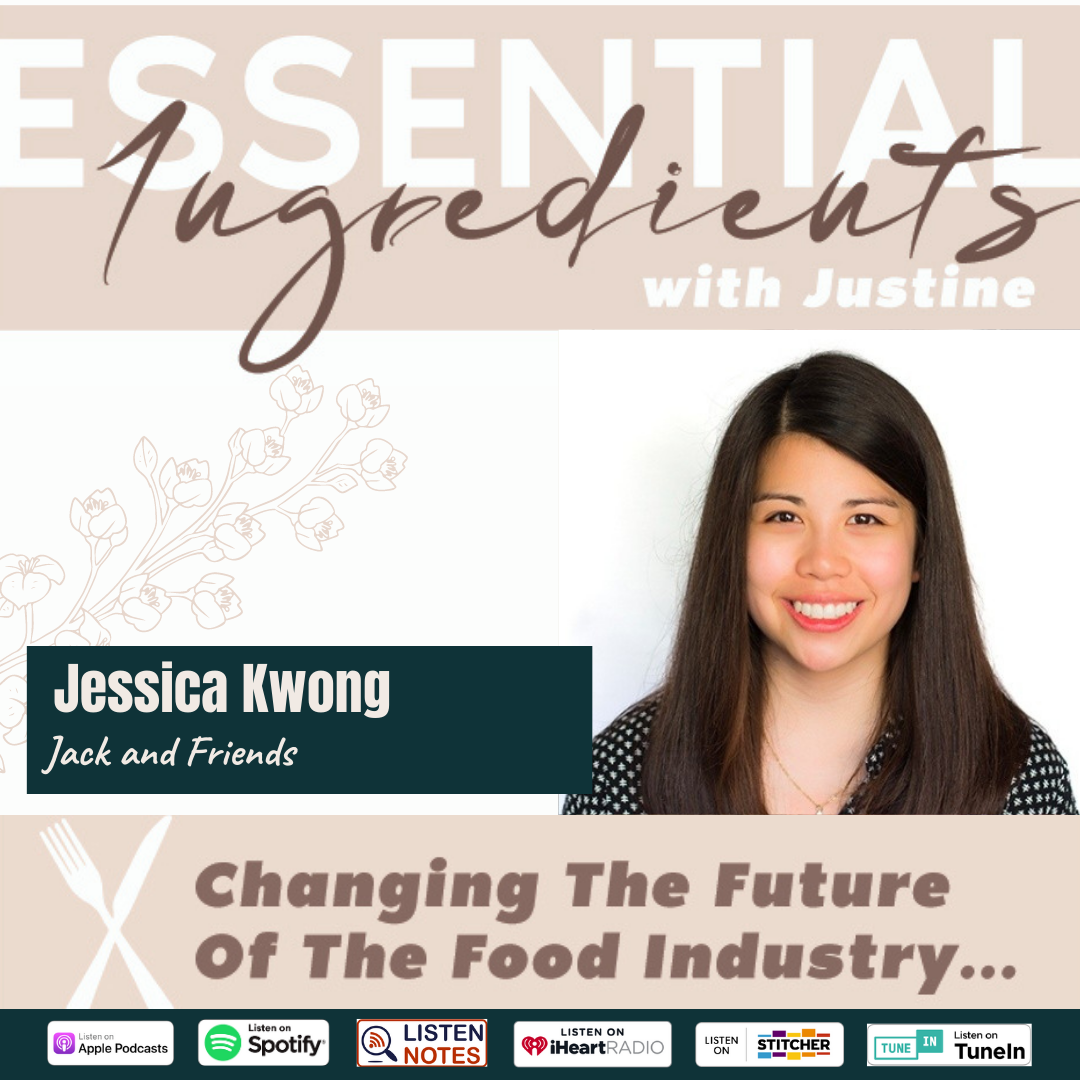
“Jessica Kwong turned down a job offer from a multi-billion dollar company after graduating from Cornell's food science program to start Jack & Friends, a plant-based jerky company built on the mission of creating food for anyone and any lifestyle. Justine and Yvette Yi Yuan explore Jessica's journey from food science student to entrepreneur, and what it takes to build a plant-based brand with both technical rigor and purpose.”
Full Transcript
Full conversation between Justine Reichman and Yvette Yi Yuan and Jessica Kwong.
Good morning and welcome to Essential Ingredients. I am so pleased to introduce you today to Jessica Kwong, from Jack & Friends Jerky. An entrepreneur that is focused on building a plant based jerky, which I'm super excited to learn more about. I also have a Yvette here today, who is with NextGenChef, and just super excited to learn more about this. She has been with me, you will have heard her and seen her on a couple of other podcasts that we've had, mostly based on plant based initiatives. She continues to research and innovate in this movement. But the idea is that I invited Yvette here so that she can be part of the conversation because she's always with me, as I'm looking to change the future of food and bring on new guests, and bring the information to the forefront and craft these talks, so it's important for her to join us. We want to learn from you, and we want to hear a little bit about your story and your journey, and what you're hoping to build. So Jessica, with that, I'd love to hear a little bit about you if you introduce yourself and share a little bit about your story.
Yeah, of course, thanks so much for having me. So excited to be here and kind of share my background and how I got started with Jack & Friends. But like just being mentioned, I'm the founder of Jack & Friends, a company creating my base jerky for any lifestyle. My background with food is a little bit different from most food entrepreneurs. I actually have a background in food science, so very technical, and basically went this crazy route going straight out of college into the world of entrepreneurship.
Wow, that's amazing. And that honestly takes a lot of guts to do that, right? Because usually you get out of college and everybody's like, I need a job, I need to have security, I need to pay rent, I need to do all these things, I need to get my foundation so that I have the skills to be able to do that. And it's remarkable to be able to have the vision to be able to build a company at college. I give you a lot of credit for that to be able to see forward and have that vision, and be able to take that vision and build your product from concept to purpose. So awesome.
Thank you.
A little bit about this. I mean, obviously you haven't been doing it that long, but can you tell us a little bit about your impact career? And how you became involved in the space of plant based foods specifically?
Mm hmm. Yeah. So like I mentioned, I went to Cornell for four years for my bachelor's in food science. So I was already very involved in the food industry through product development competitions on campus as well as interning for actual food companies doing R&D, and development for their existing product lines or upcoming product line. So during those four years, I kind of gained a lot of insight and experience from both the technical side to the curriculum, as well as the industry side through these like extracurricular activities. So when it came time to graduate, I had already developed this, my base jerky concept for a previous competition and really felt that, in looking at the plant based market, and what I wanted to do with my career, and have an impact on the food industry, I felt that I couldn't really take it to the next level and create this product that was very viable in the marketplace, but also embodied inclusivity as a platform, which I really wanted to stand behind. So the whole mission behind Jack & Friends is that we're creating food for anyone in any lifestyle, and I really wanted a brand that embodied those kinds of ideals. So senior year, I took a very non traditional route and turned down the job offer from the multi-billion dollar company and decided to start Jack & Friends for those reasons.
Okay, you got to tell what did your parents say?
It was a mixed bag, I'm not gonna lie. There was like a two week period where I had to decide on the return offer for this multi-billion dollar company. And not gonna lie, super stressful. A lot of input from my parents, friends, colleagues, etc. My dad is also an entrepreneur, so he was definitely more for the idea and said: "You're young, take the risk. Now, this is such a great idea. And like the crashes and burns on, like, worse comes to worse, you'll come out of it, knowing so much more. So he was kind of in that corner. My mom was definitely a little bit more on the flip side where she was working at the same company for, like, 20 plus years, so she really liked job security, and liked a more spaced out. So she was very worried about returning down stable income and benefits at a very established company to basically just launch a startup straight out of college. But you know, they're both very supportive in the end, and I think that's why I'm here.
So what was the one thing that enabled you to take that leap of faith to say, okay, this is it. I'm going off on my own.
Yeah. I think it was kind of a multitude of factors, but it really boiled down to, I was confident that I had the abilities to make this work, Like, take this concept, make it into an actual product and make into an actual company. I think I had the reassurance in the back of my mind that the food industry is not going anywhere, everyone needs to eat. I said: "Worst comes to worse. If for some reason that Jack & Friend, like, totally bombed, there is always an industry position to go back to. And I didn't want the fear of failure to really hold me back on taking this leap of faith.
I think that it was very brave, and I give you a lot of props for that. It's certainly an honor to be able to interview you now, before you're so big. Yeah, the cue to get you on on our podcasts. But it's interesting because I've met a few entrepreneurs out of Cornell in the food space, I think there's one called Jinka, I don't know if you heard of it. It's a vegan tuna, have you heard of them? They're in the Bay Area, right? She also went to Cornell. And I remember, I went to Ithaca for one year before I left. I'm sorry, I could not handle the cold. It's during the spring finals, and I abandon ship. Advantage after my airplane missed the runway when it was landing, I said: "I'm out of here." I transferred to American. But that being said, I remember there were a lot of food entrepreneurs. When I was there, there was somebody that opened something called dance cookies, and there were all these food innovators. And of course, they weren't based on plants. They were not plant based entrepreneurs back when I went to school. But they weren't food entrepreneurs building these food businesses, and they were selling them directly to the students. Was that something that you guys were doing back then when you were building these companies?
Yeah, I think like, personally, I wasn't involved with creating an actual company on campus and selling direct to students. But I think what was great about the Cornell community, but also the community at large too was that, even though it was somewhat isolated, just like in the middle of Upstate New York, there was a real camaraderie between the city and the colleges on campus, where there was a lot of development and entrepreneurship going on. I know a few companies that are still located there, like it's a Hummus. It's a beer company, and he's an organist. I think it is in Africa as well. So there's a really nice entrepreneurship community around there. And Cornell specifically has a lot of resources for students that are looking to explore that route, as a career as well. So there's a lot of opportunities just in that Africa region.
Yeah, I remember that vaguely, it's distant.
Probably got clouded out by your fear of missing the runway or something like that.
I spent more time with the hot truck than anything else anyway. Do they still have that there
They did when I was still there. I'm not sure that moved at all in the past like two and a half years, but yeah, it was definitely.
Yvette, just so you know, the hot truck came at 11 o'clock at night, I think. And it came outside some of the dorms, and they made like these hot pizza sandwiches, which is not helping me at all. But this was 20 years ago when I did this.
It has sentimental values and those are important things because we connect over food.
Anyway, I want to get back to learn how to, talking to you a little bit more about your background, research, development and food science, and talk about why that's important for any food and beverage company today. What was the moment when you were inspired to create your own company? And to take that leap? Can you share a little bit about that with us, on our listeners today?
Yeah, definitely. I think it perfectly ties into why I think food science and product development is so important in starting a food company and how I got started with that. Because I think, especially within plant based, even product innovation is so important, people want something new, they want something fresh, and now more than ever, they want it to be good for them or have some type of functionality. I really think that's where R&D and food science comes in. Where you're able to take this technical background and really apply it towards food so that you're creating a product that satisfies all your customer needs. I think that's what inspired me to create my own company with a food science background, I have that technical knowledge. I know how to apply it to create an end product that would be sold in the market. So if I knew how to do that myself, and I know as a consumer myself, I know what products I want to see on the shelf, why not start my own company and do it on my own? I think, if someone has to do it, why not me?
Yeah, and I think food sciences are integral to it, right? I mean, there's so many different things that go into building a business, but coming from the food science background, and understanding what goes into building that product from that angle, because it's unique and gives you an advantage. I mean, having an expertise in something gives us all different advantages, and this just gives you that advantage. I think that that's really important. Yvette, is there anything you want to participate. I felt like you had something to say, so I just wanted to open up the conversation and include you.
Just nodding, thanks. Yeah. The piece of food science product development is so big in the space of plant based today. We're just so glad to see entrepreneurs like Jessica, yourself, being equipped with such integral skills. And then just as a young startup, pushing the edge of innovation in the industry and possibly even influencing the multi-million dollar. a snack company that made you an offer, we really need everyone on board to push the edge of innovation. And then small organizations like startups just have such flexibility, agility to achieve that, then we can talk about all jackfruit, I'm super interested because this ingredient has this natural mimicry of meat and the muscle texture. But then there's so much more that happens to it before it goes into the back to create, to become like an analogue of jerky that, like consumers, I personally am a huge fan of jerky. But now, I'm kind of plant based. So there's a problem for me, like I always want to eat jerky. But there's just kind of like a lack of quality, high quality jerky that replicates the same experience so I don't have to make sacrifices.
Yeah, I think that's super interesting. You touched upon a lot of the points that I was thinking about when I started Jack & Friends, when I was developing this time base jerky concept because, I think as the plant based movement become more mainstream and people are just looking to be healthier and more sustainable in general, there's a real need for plant based products that mimic their traditional animal protein counterparts. And I think that's really where the industry or the category is heading. So with jackfruit, specifically, I came across the ingredient. And like you said, it's so interesting, so versatile, it basically has like two different versions almost where when it's ripe, it's like this bright yellow color, super sweet has this very floral tropical taste. But when it's young and green, which is what we use in our jerky is almost white in color and very neutral in flavor. So it absorbs all the flavor that you put into it, and like a recipe or a product, which was why it was so attractive to me as a food scientist because it's basically a blank canvas for formulation. So with this jerky products, I really wanted to take the time and make sure that I was nailing all those sensory components for traditional jerky so that the texture, the flavor that people are really looking for when they pick up like a beef or pork jerky product, I wanted to be in my plant base jerky, and that's why I decided to go with jackfruit as a main ingredient. Because with my science background, I was able to formulate it in a way where it did have those [inaudible] I was looking for while still being vegan, topping out and free, a good source of protein, fiber and no added sugar.
So there is a nutritional element and the culinary element.
And it goes hand in hand, which is perfect, nutrition. It's just a perfect combination. So I think we're just going to take a short break and have an announcement from our sponsor. We'll be right back. Okay, so we're going to come right back right now, and I just want to follow up on that conversation that we were having.I'm just curious, are you looking at expanding your product line with jackfruit to expand things outside of the jerky line like chili or anything?
Yeah, for sure. I think that's the beauty of jackfruit and why I was so attracted to it. It's a very versatile ingredient. And that being said, I started with a jerky because I noticed that jackfruit wasn't really being utilized in the snack space. But I thought that was a great way to start, especially with people who are just getting their feet wet with plant based food, it's much more low commitment than, like, going all in on like a whole meal or just like changing your diet completely. So that was kind of the reasoning behind starting the jerky. But with Jack & Friend, Jack being from jackfruit, our main ingredient, there's so much opportunity to expand it into different product lines that do satisfy the meal function, or no other snack categories and just outside of jerky in general.
Yeah, as you were talking about the texture, the mouthfeel and the look of jackfruit I was thinking of mycelium, which is another ingredient that some of the vegan jerky companies use, and they're also innovative. I'm sure you have reasons why you picked jackfruit in particular, maybe it's across the entire supply chain more efficiently, or it's more of a whitespace compared to other ingredients, or you just have a personal resonance with jackfruits. Because jackfruit, it's such a cute fruit.
Thank you. I think definitely a combination of all of the above, like you said. I think the jackfruit ingredient definitely sparked my interest in the beginning, back even when I was a student, so I definitely wanted to continue developing it through that. And then as I learned more about and continue playing with ingredients, it just made sense to include it in this jerky concept, including the whole naming system with Jack & Friends coming from jackfruit but also from a nutritional standpoint, great source of fiber, super nutritional flavor, has a lot of vitamins and minerals, as well as from a sustainability standpoint to, it's very hardy crop that's grown in South Asia and Southeast Asia. So kind of all those elements came together of why jackfruit became the star of this product and this brand.
But who are the friends?
Yeah. So the whole naming system works is that JACK comes from jackfruit, and then each friend is essentially a different flavor. So if you look at our plant based jerky line, we have flavors like Jack & Tom and Jack & Barb. So Tom comes from tomato, for the tomato poblano pepper flavor, and then barb is for barbecue for our sweet barbecue flavor. So that's kind of how the whole Jack & Friends system works. So every time we add a new friend, it's like an addition to our product line.
That's super fun. Did you come up with the branding yourself? Or did you hire a whole branding team?
No, it was literally just me, and I think just my parents like sitting on the kitchen table before I even graduated and before this whole product launch. I need a great name for this size and this brand. I want it to be able to be expandable. I was like I want to include chestnut in there, like jack and someone was like you need jack and something jack and whatever. It's really like bouncing ideas back and forth. I think it was my dad who was like, oh, well how about Jack & Friend or something, and then each friend can like a different turkey or something. Oh, yeah, it's like, oh my god. That's amazing.
You said your dad's and entrepreneurs, is he also in the food space?
No. No one I think in my family is in the food space, outside of my cousin who also graduated with a degree in food science. It was kind of a weird coincidence there, but yeah, my parents are nowhere near the food space, so it was very, very new for me.
Marketing, there in marketing?
My dad is into real estate.
I was only kidding. I was kidding. You guys came up with the concept, the branding, the marketing, off the table, I figured you had to have a team.
Yeah.
Everybody in your family had a role that fit on your advisory board to fill all those places.
He 's a de facto marketer.
Awesome. Well, that's super exciting. It seems like we're coming to a tipping point for plant based food. I know I'm from New York, we were talking about plant based food, I think therefore a time where Pure Food and Wine was quite popular before it closed, and Lucky Duck and some other places. I moved out to California thinking California would be ahead of us where in actuality, I think they're quite behind New York in many ways on this. And when I was in New York, we had just a few restaurants. And now, I think they've got hundreds of plant foward restaurants and plant based restaurants. And California seems to be coming up. But California seems to have all the fruits and vegetables you could imagine, right? Because they all grow here. We have access to them, and it's very forward in that kind of way. I guess what I'm curious to hear your thoughts are, as we're coming to this tipping point of the plant based food industry, how do you see that's going to impact the demand, both from the consumers perspective, as well as as a business? Do you feel like there's going to be more and more businesses that are going to be standing out in this space? Do you feel like there's going to be many more customers demanding this? Where do you see the trajectory for it? And I can stand out in space.
Mm hmm. I think that's full of really important questions. I think everyone can agree just from the data and like looking at projections and industry experts that plant based food is not going anywhere, it's only going to grow from here, on both in the restaurant side that you mentioned, also in the CPG side where people are really looking for plant based options for like health, sustainability and a variety of other reasons. So I think with that, consumer demand is going to continue to grow. And with that, companies will be more interested in either creating plant based versions of their existing products, or just new plant based companies popping up every day. I think we're starting to see that in the industry. Now, even if just like scrolling on LinkedIn, or reading food news, there's always a lot more news on plant based initiatives going on right now, which is awesome and super great. So I think as the industry continues to grow and it becomes more mainstream where people are becoming more plant based forward in their diet, or adopting a flexible lifestyle, that consumers will naturally want more product innovation. I think there's going to be a huge push for creating plant based products that better mimic their traditional animal protein counterparts. So the companies that can rise above that increase in competition I think will be really forward in their innovation and their product quality that you guys mentioned previously. So that's definitely my number one, I guess area where you can stand out in the competition. And I think two other areas that will probably come into play are the branding or messaging. So what do you want your brand to stand for? Who are you targeting as your consumer? I think for Jack & Friends personally, that was something that wants to develop an early stage where our branding and messaging is all about inclusivity, that's our platform. We're creating food for anyone in any lifestyle. I think the more that brand can convey that to the consumers, especially in the plant based space, the more that they'll stand out from the increasing number of people that are trying to attack the same category. I think from a third perspective, probably integrability, I guess as a way to sum it up, so going back to that point where people are looking for products that are good counterparts or good alternatives for the traditional like meat products, finding out a way to integrate it into the lifestyles, and people that are not necessarily vegan or completely plant based, but people that are just interested in plant based foods or want to supplement part of their diet or are flexitarian, I think that would be a really important area for companies to keep in mind as they continue to grow their plant based portfolio or just like plant based companies in general.
Great tips.
It sounds really exciting. Sounds like there is innovation in terms of product assortment, as well as the occasions where consumers can enjoy the products. Like you said, you can enjoy Jack & Friends for any kind of occasion, and that's your idea of inclusivity.
And it's great because I think while I am a meat eater, and a fish eater and all those things, I would say that, with education, which is one of the core pillars of NextGenChef, I've slowly been eating less and less meat, not because I don't want, I don't enjoy it, but because I understand the impact it has both on my body and on the planet. So I've chosen to eat more plant based foods in a healthy way, because you can eat, you can be a vegetarian and not be healthy, right? So I think it's about thinking about it in a healthy way and how to eat a healthy diet. Not about me, it's not about being vegetarian, vegan, pescatarian or plant forward, it's about, I mean, in some ways but about being healthy, and eating well for my body and for the planet. Including products and innovation like yours is really important to me. I really like to support better for you brands, and I'd love to hear a little bit about the importance for you in that because you've built a better for your brand. For NextGenChef, it's really important for us because we want to support people to build better for you. We want people to be able to understand why you've built this round so that they can make more informed choices as they build their rounds, and as they make their choices when they go to the store to choose an item off of the shelf.
Yeah, I think that's super important, like you said. I'm definitely with you on the whole aspect of choosing and adapting my lifestyle, my diet based on health and to continue to educate myself, what certain ingredients or certain products? And I think that's where a lot of the consumer mindset is trending towards that too. I think people are a lot more interested in knowing, where their food is coming from? How does it affect your body and the planet? And just being educated more in general. So I think that really plays an important part of why better for you brands, or why better for you brands are so important, and why it's so important to take that education aspect into building a better for you brand, because consumers will look for that information. Now, that's kind of a no brainer. So the more that you educate yourself as the producer of this product, the more that you can convey that to the consumer and explain to them, why this will be great for their body, good for the environment, etc, which you know will not only help them buy your product, which is great as a company, but also satisfy their needs and the planet needs.
Yeah, and make an informed choice. It's not exactly, it's really making an informed choice because the greatest challenge I see is that people don't know WHY to choose something. They don't know why one thing is better than the other. And the greatest gift I can get, we can give them is the power of understanding how to make that informed choice, which is why we were so pleased to be able to invite you on for our listeners here today so that you can better understand what jackfruit is. Why is this so good? Why is it important to understand that this is now a choice? Why this versus regular jerky.
And as brands have such an important role in educating consumers in a nascent space, like jackfruit, and even plant base overall, at a critical stage where consumers would love and need to grow awareness of this product and their nutritional profile. So you're sure that Jack & Friends and other jackfruit companies are spreading the message of how it's so fun, delicious and better for you. I think once the consumers know more about how this product is good for their bodies, they're going to vote with their dollars and buy more products. So what is your view, just in touch a little bit on competition or earlier, what is your view of competition/collaboration in this nascent space? Do you see it more as a partnership? Or you're really rushing towards the competitive edge? Because it's interesting.
Yeah. I think there's definitely a little bit of both. I mean, you can't deny that there's competition. But the one thing I really like about the food entrepreneur, food startup community is that it really does feel like a community. I cannot count the amount of times I've like cold emails or like cold LinkedIn messages, someone just asking me to pick their brains on a topic that they have more experience than me, or some arbitrary area that I'd like to learn more about. Because I write about them in an article, and that was really interesting. I think this community is really welcoming, and people are very willing to pay it forward, which is great. There's not this belief, or not this belief that you can't be friends with other food entrepreneurs, because it has to be competitive, and cutthroat, and everything like that, which is definitely not a space I want to be in. At the same time, obviously, your products are competing on the shelf at some point, and there is a competitive landscape. So I think rather than being playing towards competition on an emotional level like a founder, the founder trying to take each other down, it's just really about trying to make your product stand out. And I think that's a healthier way to approach competition. Because then, everyone is trying to be a better version of themselves, or a better version of someone else, and it's just going to increase the quality of the product that consumers are purchasing, which is a win win for everyone. And it kind of maintains that healthy level of competition of like, okay, where can I stand out with my product characteristics, or my branding, or some other areas in my company. I think that's the way that I approach my business, and a lot of the food entrepreneurs that I've met also follow those kinds of beliefs as well, I think.
It comes down to taste, it comes down to transparency, right? You want to know what's in the product, and you want it to taste good.
Exactly.
And come down to which tastes best, and which has the best ingredients. And that's a win because it's pushing each other to create the best product. And at the end of the day, competition, I don't look at as a bad thing, it just means there's a greater demand.
Exactly. Yeah. And I think like competition will naturally drive innovation to circling back to that whole point that's been throughout this whole recording, and definitely a plus for everyone. So I definitely see competition as a great thing in the food industry. I think what's my basis typically, that'll only increase from here on out.
So, Jessica, while you've been sitting at home for the last, God knows how many months are there, in New York, you're in New York, right?
Yes.
New York City?
I'm about half an hour in Manhattan on Long Island.
On Long Island, okay. So as you're sitting on Long Island in Nassau County?
Yes.
You can't be that much further, because then you wouldn't be 30 minutes out, right?
Yeah.
In Nassau County, in your house, are you putting together any interesting recipes, pandemic recipes with the jackfruit? Since you're a food scientist, have you created any fun and inventive innovative recipes that you're toying with? That you want to bear.
I've definitely been on both sides of like the healthy or not healthy recipes during the pandemic, and different phases of like as the months passed by which is the more prevalent type of recipe that I'm trying. Definitely went through that weird banana bread phase that everyone went through. The beginning of the pandemic.
Oh, I think it was sourdough here in California.
Yeah, it was like banana bread. sourdough, yeast was pulled out everywhere. I was partially to blame for that. I've been definitely exploring a lot of different cooking, baking and recipes in general. So using our own Jack & Friends Jerky in different functions, like tearing on top of salads, or putting it in sandwiches of like a vegan BLT, different interesting ideas like that which our customers can also then replicate if they desire, as well as playing around with more traditional Chinese cooking since then, you know, come from a Chinese background, and seeing all the different types of options, especially plant based that we can play around with there. So yeah, it's been interesting how being holed up at home. Definitely not ideal, but no, the silver lining is that there's a bit more time or more opportunity to play around in the kitchen.
Right, that's true. Are you a dim sum fan? I'm a big dim sum fan.
Yeah, I am. I'm so sad that like that experience, like in person dining for dim sum has been taken away.
So we used to go to a place in, Oh, my God, where is it? It was in Queens, in search of the J, what's the name of the area? It's not Astoria, Jackson. Oh, my god.
Jackson's Height?
No, we're in Queens, they've all the Chinese restaurants, in Flushing, in Flushing.
In Flushing, okay.
In Flushing, and we used to go for Dim Sum there and they come with their cards. They had these teach tables and we'd sit up stairs, and I missed that. That was yummy.
Yeah--
There it was, are you gonna make Dim Sum with [inaudible]?
That couldn't be a possibility. Definitely, we'll play around with that idea.
Because there's a big market for snacks. And Yvette, can talk more about that. I mean, you're doing snacks, right? Like this is a snack. But the market for snacks, the Vegan, the plant forward snacks is huge. And dim sum with jackfruit in it, I could see it now in the freezer section, flash frozen. You're not sold? Yeah, she's totally not sold. Okay. All right. I was gonna be your first customer. Okay, well, in any case, so that's awesome. It sounds like you've been doing a lot of fun recipes, some healthy, some not so healthy. But is there any that you want to share with our audience that maybe they can do at home themselves?
Yeah. I think something really easy, especially if you want to either use our Jack & Jerky, or just Jack in general. We have a flavor called Jack & Barb, it's a sweet barbecue flavor. It goes super well with savory concepts, and a lot of our customers have actually been incorporating it on pizza, or sandwiches, or other rice bowls, things like that. So we want something super quick, but also super flavorful. We do all the work for you. Basically, just take that onto your salad, your rice bowl, pizza, anything that you already have, and add some really nice texture and a punch of flavor.
Okay, and so what's your favorite?
Yeah, oh, that's hard. Oh, my god. All three of them are my babies so it's hard to choose a favorite. I'd probably say Jack & Barb is my favorite. I'm a sucker for barbecue flavors.
Okay.
Yeah. So that's probably my go to, but don't tell Jack & Tom or Jack & Teri.
I will. But I would love to tell our listeners how they might be able to get their hands on some of Jack & Friends, if that's possible.
Yeah. So you can find us online or in select retailers. Online is probably much easier these days. So jackandfriendsjerky.com. Have an online shop, you can order our jerky there and have it shipped straight to your door. I think with our, this might be handed out, but do you want me to include something like a product code or something like that?
Why would I say no to that?
Okay, yeah.
Stupid to say no to that.
Yeah, you can find us at jackandfriendsjerky.com. All three of our flavors are available there, order online and shipped straight to your door. And especially for our podcast winners today, especially for our podcast listeners today, you can use the code Essential Ingredients and get 10% off your first order.
Oh, my god, I'm gonna go order mine.
Yes.
Yvette, order yours? Order hers too. Awesome. Jessica, thank you so much for joining us, I really appreciate it. It was so fun to get to learn a little bit about you, your journey, your products. I hope our listeners enjoyed it. It was really inspirational and aspirational. And Yvette, as always, it's always fun to share the conversation with you. It always brings another dimension, and it always goes a new way in new angles. I love that, and I love sharing the space with you. So thank you both for joining me, and thank you listeners.
Thank you.
Thank you so much. So great to be here and thank you both for hosting me.
Share This Episode
Enjoyed this conversation? Share it and tag @nextgenpurpose
Listen on Apple ▶Listen on Spotify ▶Your Host
Justine Reichman
Founder & CEO of NextGen Purpose. Host and Executive Producer of Essential Ingredients — 11 seasons, 330+ episodes, and a growing movement.
About Justine →