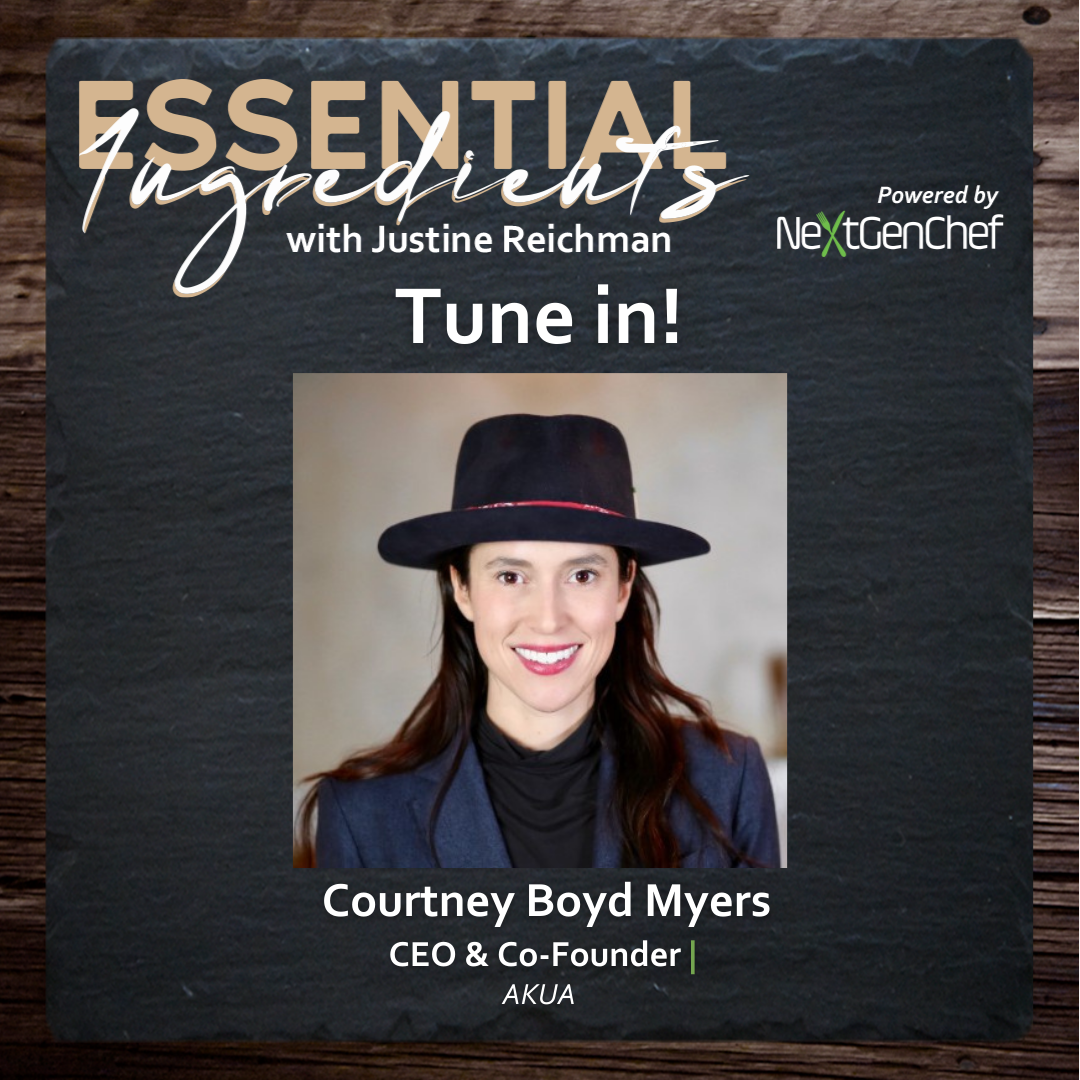
Courtney Boyd Myers · NextGen Purpose
Watch on YouTube
Kelping is Helping: A Regenerative Way to Enjoy the Burgers We All Love with Courtney Boyd Myers
The Incorporation Method helps you turn what matters into practical changes that fit your life.
“Did you know? Over 50 billion burgers are consumed annually in the US alone. If arranged in a straight line, they could circle the earth 32 times!”
Full Transcript
Full conversation between Justine Reichman and Courtney Boyd Myers.
Good morning, and welcome to Essential Ingredients. I'm Justine Reichman, your host. Today with me is Courtney Boyd Myers and Yvette Yuan. Is that right Yvette?
Yeah.
Okay, good. Okay. I don't know why it's early day. Apparently, it's hazy. It's affecting my ability to speak correctly. So anyway, Courtney, so excited that we finally got you on the podcast. I'm glad we could coordinate them.
Yeah, me too.
Good. I see you petting a dog there. Can you do a little show in town where you can't move around like mine?
Oh, she's not gonna growl. She's a real sweetie pie.
Oh, hi Honey. Our listeners cannot see her or him, but our viewers can. And they'll definitely have our attention now. What's your dog's name?
We're actually hosting, what's his dog's name is Echo. We just moved in to take care of our friends, two dogs and two cats for 10 days. And it's the best.
That's so wonderful. Wonderful. So tell us, you told us your house sitting, where you house today?
I certainly have been sitting right now in Cape Town, South Africa, in a neighborhood called Hout Bay. So when I'm not trying to convince everyone to eat seaweed and running around New York City, I'm living in Cape Town with my French husband who owns an ice cream business here. And our kind of like life goal is to just always live in summer. So with the opposite seasons, we've been trying to navigate that.
I like that idea. I think I'm gonna have to navigate that. I feel like I did try to do that a little bit for a while.
We're living in LA. We're kind of doing that.
California, and I have to tell you.
Oh, my apologies.
That's okay. But when I came--
You don't really have seasons there.
No, there are no seasons here. There are not, it's just like brown or green. Those are the seasons.
Yeah, randomly like August is terrible. And October's like amazing. Every time I'm there in August I'm like, how do you deal with this? It's raining and cold. And then they're like, oh, come back in October. Like, okay.
Well, what's really funny is that when I first came here about six years ago, and I came because my boyfriend lived here. The guy I was dating was here, and I had just met him, and I was coming to California. I'm a New York City girl. Come with my suitcase. I'm coming for two weeks in my suitcase, I'm prepared for California, sunny California, New Yorker. So what do you think is in my suitcase? Sundresses, because I'm going to California.
You actually just need to like to go raid a Patagonia store.
I'm from New York City. Yeah, no, I did not want to go to Patagonia. For me, I think fashion, I do not, athleisure is not my idea of fashion on a daily basis.
I didn't have any fashion. It literally looks like people go in their closets and like to roll around as many layers as they can, and they're like alright, I'm ready to go hiking or to a party.
So anyway, for two weeks, I'm freezing. I have the coat that I came in that I thought was like that midweight code so it didn't really work for New York when I was gonna land. But likewise, it didn't work when I got here either because it was too lightweight, because I didn't know how cold it was going to be here. And then of course, he lived in Marin, no shopping.
Patagonia store.
Yeah, there's totally a Patagonia store or North Face. Anyway, let's move on. I want to hear more about what you're doing. AKUA, tell me about AKUA?
Yeah, I can tell that you miss New York.
Not right now, Courtney.
New York's not having a moment. Although I hear this whole new outdoor/indoor dining scene is quite the trip.
Just so funny. My dad took me pictures last week having lost her outside in Brooklyn, underneath heaters,
Amazing.
Good for him right?
The heaters are a whole controversy. Because before COVID, you weren't allowed to have those outdoor heated lamps because you weren't about to have combustible things anywhere near a building in New York, which totally makes sense. But yeah, we were really gritty like Brooklyn based company. We started with a couple employees. We basically started in this little East Village lab, working with a chef on how to create meat alternative products made from ocean farmed kelp, which is so nice. I'll tell you how we got here. I basically turned the corner on 30 and I said: "What's going to be my thing?" Because I'd been in a career kind of like a juggling phase where I was like, always wanting to work on different projects and with different people in different companies. And I found that that gave me a lot of satisfaction and lit up like my very kind of add brain. I started getting really serious about climate change. I think a lot of very passionate smart people which is amazing. I started doing research around regenerative agriculture, and this idea that we can grow food in a way that is positive and not demonstrative for the planet. So we basically went out on this kelp farm. So this whole idea of like, farming kelp is like very weird, and I was really into it. I was like, alright, we're gonna grow seaweed and a farm in the ocean. Why? Really sustainable in the sense that you're growing like tons of nutrient dense food at scale without using dry land, water, fertilizer or feed, which is pretty different like anything you and I have already had to eat or drink today. But then the other cool part of it is you have this element of building a rain forest underwater, and you have any plant that grows through photosynthesis. It's sequestering carbon and nitrogen. So there's these couple of reasons. And I just said: "Wow, this is very cool." And I just dove in and said: "I'm going to create a business trying to get more people like you to eat ocean farmed kelp."
Wow, I love that. So let's go back to the beginning. Let's talk a little bit about regenerative ocean farming. And can you explain that to listeners so that to don't understand what that idea is, they can get a better word before we go further into the conversation.
Yeah. So as your listeners, there's all these like words that get hyped and overused. And what's cool today won't be cool tomorrow. So just take it all with a grain of salt, salt water that is. And if you think about, a really long time ago, maybe 10 years, we were talking about sustainability a lot. And now, everyone's like, oh, don't say sustainability. Which is like crazy, because they're just words. So now, the new term is regenerative. So it goes one step beyond sustainability. It's not just about sustaining the kind of status quote, it's about actually making something better than you found it when you're creating whatever it is. So with regenerative agriculture, a lot of people talk about building farming systems where you're moving different crops in a crop rotation so that you're creating more soil health than when you first put that crop into the soil. And with regenerative aqua culture, we talked about, thinking about a plot of ocean the way you would apply the land and putting kelp there where it didn't exist before. And because you're putting plants there, you're sequestering the carbon and the nitrogen, and that's actually leaving the ocean better than you found it. So it's called regenerative aquaculture. The ocean farming piece is pretty self explanatory. It's in the ocean, and you're farming it. And what's really important, especially for Californians near where you're living is this difference between, a lot of people say, well, what do you mean? You're making products from kelp? Because the kelp forests up in Monterey, they're being depleted because all these sea urchins are eating them. And then the Otters though, what about the Otters? I'm like, what we're doing is totally different. That's a wild kelp forest. What we're doing is we're planting our kelp, we're growing it in a nursery, we're putting it out on a rope, we're letting it grow for six months, and we're harvesting that, and we're turning that into our product. So we don't touch wild harvest. In fact, by farming, we're actually allowing all of the wild forests to just stay out so it doesn't even touch it. So that is regenerative ocean farming.
Well, I think that that really gives people a clear picture. I appreciate you sharing that. And on a personal level, what are you hoping? What's the impact you're hoping to have on a global scale? The long game. I see what the short term impact is, what's your long game?
Yeah. The long game is just like for thousands of years, people have been eating seaweed all over the world, it is very much linked. If you type in like eating seaweed, and like human brain development, and you go back thousands of years, like, really, we sort of evolved from these coastal communities that were getting this really high levels of like DHA and Omega-3s that were creating these big human brains we have today. And then like somewhere along the lines, we stopped eating seaweed and started eating like Big Macs, and like cookies, and like Frito Lay, and like all this overly processed food. But in Asia where their life expectancy is released like quite a bit further than the average American life expectancy, they like to keep eating seaweed. Seaweed is a huge part of their diet especially in like Japanese and Korean cultures. And so what my big vision is for seaweed in general. And what we're doing with AKUA is to bring this whole new form of food like the algae plant kingdom into the limelight in the States. Kind of in the same way you've seen like mushrooms become really cool the past five or seven years. I think the next five or seven years are going to be all about macro and micro algae.
Okay, so for our listeners out there who now really wants a kelp burger, because I know, don't you want your kelp burgers. So I did a little interlude here. So if anybody wants to get a kelp burger, how would they get them now, Courtney? I think this is the appropriate time to let our listeners know.
Of course. So let me backup just a minute, though. Because it's like, no, there's--
I just wanted to give them an opportunity. We're not finished talking, I know.
We were like, I think most people would be like, wait, okay, so you're wanting more people to eat kelp? And then there's this kelp burger. So that's kind of, when we were like, how do we get more Americans in kelp? We're like, well, obviously, Americans love burgers. So we're in the process of just putting the finishing touches on this product. We're in this pre launch mode. We're getting the product out to as many people as we can, but our packaging is not ready. The recipe is not finalized completely, so it is pre launch. And the way you can get a kelp burger is if you follow @lifeakua, which is our company Instagram. DM us and you just say, hit me with the kelp burger link and then we'll send it to you. So we've been making it a little bit tricky because we want people to be engaged, really want it, and we're not ready to say that it's launched yet because the packaging is not done. And we really want to hold that launch moment for April, probably around Earth Day when we bring it to the market.
For our listeners, can you just spell out the Instagram handle just in case?
Yeah, sure. So L-I-F-E, life, and then A-K-U-A, akua.
Wonderful. I don't know about you, but I'm ready to go out a lot of kelp. I already love kelp, and I love seaweed. Since I'm a little girl, I remember going to the Japanese restaurant and eating it as I waited for my sushi, just as a little snack. I used to ask them for little pieces of seaweed to just snack on. I was a big fan.
Totally. Oh, my god, you're making me want sushi so badly right now for dinner. And we're having lasagna, and it's so upsetting. I mean, I'm really [inaudible] lasagna. But when you get sushi in your head, I hear you, I love the seaweed salads too. I was making them on my own a lot. I was just like, I felt so energetic after I was eating seaweed. And I was thinking like, how is it only in these kind of obscure Asian packages, and I have to go hunted down at these Asian stores in New York. It doesn't make any sense to me. This is a vegetable of the ocean and we're totally not giving it the opportunity it deserves to be the centerplate.
It's true. I remember my favorite place to go get snacks as a kid was a store called Katagiri on 58th Street or 59th Street underneath where the Roosevelt tram. It was a little Japanese market and they had all the little Japanese snacks, some sushi. And then you can get the good seaweed there. I used to schlep my mom all the way over there to go get this little seaweed because not all seaweed is created equal. I don't know if you have a thought on that or a position on that, but I did at a very young age.
Yeah. No, of course it's true. Today, 98% of the seaweed that you buy in supermarkets is from Asia, and they don't have as rigorous testing around heavy metals as an example as we do in the United States. One of the things that we're really proud of it, AKUA has resources 100% of our kelp. We'll always source our seaweeds from the United States, specifically in Maine, we might branch out to Canada because Canadians definitely know what they're doing. And we might go to Norway because they're great too. But for the moment, there's this incredibly growing ecosystem around locally produced seaweeds from Maine. And then also Alaska, I'll shout them out. They've been doing some really interesting ocean farming stuff too. But yeah, why not have this amazing new form of sustainable aquaculture right here in the United States.
Gonna just to move on a little bit, because I know that not only are you an entrepreneur, you're an investor and you're a marketer in the space. For the founders and the other entrepreneurs out there, are there maybe three or four tips that you could maybe share for the other folks, the other startup entrepreneurs in the space?
Sure. What kind of tips?
Things that you think other startup entrepreneurs might benefit from hearing.
Yeah. I think, something that I've spent a lot of time studying is like different personality types. Whether you're looking at the enneagram, or the Myers Briggs, or you're doing your start chart on Co-Star. Everyone's very different in what kind of tips that they need and will receive. But for me, they're really leading kind of guideposts in my life and have just been about building community around the things that I do. So as an example, with AKUA, we launched on Kickstarter and built this really funky amazing community there. And then now, we're raising money through this platform called Republic. For 100 bucks, you can be an investor in AKUA. Even taking a step back from that, just moving from technology and startups to the food space. I didn't know what I was doing so I started a Facebook group called OMG, CPG. And just like added CPG people to it to be able to ask them questions. I think that my number one piece of advice to people is to always look at whenever they're like life transitions, or they're unsure of what to do next, just to start with who's my community? Okay, I don't have one, then build one. And it could be as simple as inviting six people to a dinner party that you want to all meet, and then you're like that gather, and by creating value for other people. That value comes back like 100x. Community buildings have been really integral to my life, in my career. And it's really one of those things where the more you give them, where you get back.
I would agree.
Yeah. And like doing a podcast like this is like 100% community building. Every person you interview is now a part of your community and feels like, wow, what an honor to have shared my story with you. And like any sort of thing that I can do for you now, like I'm going to pay it forward. So there's a lot of ways to go in the community. Not just dinner parties, but podcasts are a great one too. So yeah, other other tips that I think have guided my life is not to get stuck in one place. I've been very nomadic from the age of maybe 24. And I really think that getting the lease is the kind of like always one of the worst decisions I ever make. But obviously, it's nice to have your own house and all the things. But giving yourself the freedom, especially in your 20's, I mean, I'm now in my 30's. But looking back as advice is to just travel and explore. And thank God for 2020 in some ways, because we've now totally thrown out the whole, like we need an office to run a business saying, and like people can work from home, and people can work from Cape Town, or wherever it is. That kind of flexibility and freedom is so amazing. I hope that it continues for a couple more life advices.
Great. I think that everybody has different tips that they share, because they've all had, everyone's had a different set of experiences. And the experiences you've had and what you've taken away from your journey is what you leave to other people, what you share with other people. And it's those similar experiences that you share, and different people will take with it, and learn from it in different ways. And this podcast is a way to share that. Different people will take it and use it in different ways. What we're trying to do is give you a platform to share that so that different founders and different startups and entrepreneurs can access the information whether it inspires them, or it gives them an idea, or a way to collaborate or innovate. I don't know, but I know that the ways that I've gotten information is by hearing other people's stories, whether that gives me a way to think about something in a new way, or reframe it. Or it's given me an idea to collaborate with them, or just reshape my thinking. So thank you for sharing that. I really appreciate it. And hopefully, the founders listening, the entrepreneurs listening will take something away from that, and maybe innovate, or collaborate, or hopefully change the future of food. Because really about--
Their lease in New York City.
Exactly, exactly. So with that said, as you're looking at the future of food, what is your hope, or your dream vision for the food system going forward?
Yeah. So there's kind of three things on my mind. One, I really don't like tha overly processed fake meat industry where I pick up a product and it has like 300 ingredients on it. And a lot of them, I can't pronounce. I would argue that like there's an element right now that we're in, where we're kind of in between fully accepting that like eating plant based is gonna give us enough nutrients. Some people still don't believe, and then this affordability around that base meat. So we have these really juicy starchy chemical based overly processed weird products that are worth billions and billions of dollars, and I just think the whole idea of like baking people and eating something is super weird, just like that notion of fake meat. It's like, why should the word fake and food ever be in the same sentence? Two is, I think that there's a lot of work to be done on packaging. We rightfully get a lot of angry customers saying things like wires, your sustainable kelp jerky in a plastic bag. And even if it's recyclable, who recycled, and I'm kind of like, look, we're just a food company, we're not really here to fix the national recycling program. But you do bring up good points. I'm definitely on board for having those discussions with our customers, but I think that there's much larger issues at hand around how we package things, and how we dispose of that packaging. I really want to see start to shift. We're already seeing it, but it sadly is like only coming from consumers. And then maybe a little bit of businesses, like zero from the government. It's a new dawn and a new day. So we'll see what happens in the next four years. And then three, it's just like stepping back from not allowing yourself to feel these quick shots of adrenaline for doing something good. Because you're like thinking, or you're eating something, like slightly more sustainable, like a sustainable seafood restaurant is an example, and like really understanding what sustainable seafood even means. I want people, I guess to question more than what's on a label of something, it's like, okay, this is a sustainably caught tuna, is there such a thing as sustainably caught tuna? I'm not so sure. I want people to start having those conversations. So yeah, I want there to be more. Well, it's more curiosity and food.
Courtney, that's really in line with what we're doing, which is all about education. And we're not here to change necessarily people's minds, but more to give them the information so that they can make more informed choices. My goal is not to tell you what to go out to buy, but it's to give you the information and to bring the experts on so that at the end of the day, if you want to choose a kelp burger or an alternative protein, because it resonates with you that that's your choice. I eat meat, I eat all sorts of things, and it's my choice. Maybe I become more plant forward, maybe I'm gonna do all these different things. Because as I invite these guests on, I get more educated and can make more informed choices. So that's what we're really trying to do. Yvette, I feel like you have a question, and I want to incorporate you into the conversation. She is all about alternative proteins, and I feel like this is where her jam is. I want to make sure that she is really part of this conversation. So Yvette, can you lead us through this part of the conversation, and maybe talk to some of those points?
Yeah, definitely. A great point on consumer education and being mindful about what really is sustainable seafood. I'm sure you have watched and up the line, the ocean health documentary that is really in the movie. Their investigative journalists calling up restaurants to ask them where does your bluefin tuna comes from, especially the high end ones. And the movie uncovers a whole labor abuse and ocean law violations of practice across the world. Essentially, no restaurants are able to elaborate, are willing to share where their bluefin tuna comes from. So after watching that, a lot of consumers started calling up restaurants and doing that. I think, yeah, definitely, that is a great way to encourage end customers to be more active, proactive in participating in this conversation and driving the change. And now, we've talked a little bit about the brand vision, we can dive into the granularities of how to run a business. So for example, from your experience, can you share with us what are some key areas of opportunities and challenges in the space of running a business?
Yeah. So just also to say that I haven't seen the end of the line. It definitely well, it sounds like a great film. And yeah, sustainably caught tuna is such a question mark. When it comes to, I think like the kelp space in general, I think it's important to kind of just talk about seaweeds in general. I mean, macroalgae and microalgae. And within the macro algae family, there's reds, greens and brown seaweeds. And just to trip you out a little bit, I had a breakfast this week with a seaweed biologist who told me that green seaweed, if you're at the beach and you see like sea lettuce, it's more related to green colored plants on land, which I get then a brown seaweed, like a kelp, which is actually more related to a mushroom than to its green seaweed cousin. And that kind of just like flipped me out, because you think about an evolutionary perspective. There's probably like 50,000 different kinds of edible seaweeds. We haven't even scratched the surface of getting edible few weeds into, like modern day cooking in the United States. And looking at you, you're Asian, and I'm gonna guess that you probably had a little more theory growing up than I did when my parents would probably take me to like McDonald's on weekends, your parents hopefully wouldn't. And it's just to in terms of opportunities like that question, it's just about first like, pick a seaweed. There's 50,000 kinds. Get in there, and get educated, and start eating it. Experimenting like this is just, literally, we're just getting started on like the next 20 years of like a seaweed revolution in my opinion, my humble opinion. And then in terms of challenges, I think that in an opportunity, it always comes to challenges which is just that consumer education that's required to tell people like, okay, well, what is seaweed? What is my micro algae? What is macro algae? Why does it matter? Oh, it's grown in the ocean. It's scary. There's plastic in the ocean. Yeah, but like seaweed, so that whole conversation just opening up something so new is a challenge in itself. So you have to be really excited, brave and also humble, and continually educating yourself. Supply chain issues for sure, it's a small supply chain. But what's small is the actual ocean farming of the kelp supply chain. Ways to get seaweeds around the world, there's actually like thousands of ways. A lot of it is wild harvesting. But the more people that are getting into wild harvesting, there will be more people getting into the sustainable version of it, which is farming. So I think that there's a lot of opportunities for more entrepreneurs to incorporate seaweeds into their fruits. It's very, very exciting.
There are so many questions around what are the differences between wild kelp farming and wild harvesting versus cultivating a farm seaweed. I'm thinking of like, in terms of salmon, for example, there as well caught salmon and also cultivated farmed salmon, and they both have some challenges. But farmed salmon has been praised a lot recently, mostly for its supplying the majority of the consumer demand for salmon. Even though, occasionally, some salmons can escape from the cages and interbreed with the wild salmon. And that is one of the key challenges in the space. You don't want to mess with the wild population.
So basically, if you're a very smart aquaculturist, you're actually like not farming seaweed or a fish in a place or an environment where it shouldn't already be. So we see this a lot in aquaculture. Someone takes a seaweed from one part of the world and brings it to another part of the world. A 100% going to have repercussions. That's how we've decimated so many of our natural plants on land by doing just that by accident, by seeds coming over on planes and people's clothes. And then there's an alien species that kind of kills all of these native ones. So it's the same thing with fish. A smart aquaculturist, if you're in business, there is recruiting scientists to advise on this. You don't farm fish in a place for that fish doesn't naturally grow, it's gonna cause issues. And it's the same thing with seed plants as it is with sea animals.
Okay, oh, that's a great point. I'm glad you pointed that out. Now, back to the Mommybalm kelp, I'm Chinese but I did grow up eating a lot of kelp. A very hearty soup, just boil kelp and the brown kind. [inaudible] and then put a bit of tofu chunks in it. Yeah, it's very much like dashi. There is so much flavor into it, even though it sounds very light. So talking about health, we can buy it in the form of a burger. That's very delicious. But what happens before that, you say you get your kelp from me. But what then?
Yeah, what does that mean? So we've got this amazing group of all female ocean fishermen farmers who grow our kelp in Maine. They're this group called the Salt Sisters. They actually are all in recovery for alcoholism, and they've found each other, and they've started this ocean farm, and we buy most of their kelp on an annual basis. So we take that kelp basically from the dock. It's grown in a nursery, it's put out on ropes, it grows about a foot a month. And then after six months, it's harvested. So this kind of six foot long calp, it's put into barrels and stuck into a processing center. It's branch turns from Brown to bright green, it's super beautiful, and then it's a rough cut, and then frozen, and it lasts for five years. And it's frozen form, and we mix it with all sorts of other superfoods. Really love mushrooms. We think that to take your phrase, the Mommybalm that the kelp really pairs well with the mushroom. So those are the two main ingredients in all of our products. We mix this essentially like the world's largest Vitamix into either the burger form, or we put it into custom molds, and we make the kelp with it. So this all happens up in Portland, Maine where all of our products are made, and then it gets shipped out to the United States.
Wow. Okay. So now, on to alternative seafood, by the way, it's super cool to hear the backstory of where, a source of your kelp, and you're supporting this local group of women who are trying to recover from alcoholism. That is a super empowering story. Yeah, so on to alternative seafood, we know that animal meat analogues, like plant based burger patties have received a lot of attention and it is trending since beyond IPO. What about the space of alternative seafood as it is pretty much nascent. So what do you know about this space? How many people are using kelp as an ingredient to recreate seafood?
So one of my amazing mentors of AKUA, her name is Dominique Barnes. She was one of the co-founders of New Wave Foods, and they're doing seaweed based shrimp. And they just raised 18 million bucks to do that. And good catch, they raised $35 million to do all their alternative tunas and more. There's a lot of these really cool new alternative seafood companies coming to market. Seafood in my opinion is so much harder to replicate than a meat burger, or a meat sausage, etc. It's very technical. And when these guys figure it out, it's gonna be amazing. I'm a big fan of the alternative seafood space, probably like a bigger fan of that than I am of the alternative meat space right now. Mostly because a lot of these companies are using algae, which I think is really cool. But yeah, it's highly, highly technical work. But if we can, there's a company called Finless Foods that has raised quite a bit of money that's replacing tuna. And if you mentioned going to Anobu and ordering like a lab grown tuna, and we'd have to over fish anymore. That'll be a really beautiful day--
[inaudible] you can trust that. Yeah, that the cultivated seafood definitely is not illegally fish in international ocean areas. Yeah.
I just wanted to circle back on a couple things as we come to the close of our podcast here because we've gotten so much great information. I really appreciate you taking the time to chat with us because I think that we're coming to an end here. I just want to make sure that we can tie this up in a pretty little bow for our listeners. So with that said, Courtney, if our listeners wanted to connect with you, how might they be able to do that? I know that I wanted to invite you to join the NextGenChef app, which is who sponsors this podcast. And everyone, including you can download it for free. So I hope you'll join that. And our listeners can definitely connect with you there. But outside of that, what's the best way for our listeners to connect with you?
Honestly, there's two apps that I open up all day long. One of them is less embarrassing than the other. So the most embarrassing one is just the amount on Instagram. So I'm at CBM, it could not be easier. CBM on Instagram, and you can just slide into my DMs, I'm still accepting those. And then yeah, also, I invested in a company called Public earlier this year, it's kind of like a really cool new age version of fidelity.com, like our parents used to trade stocks. And I've gotten really into public market investing over this crazy year. And yeah, I definitely can chat with people there about the future of the markets. I would say Instagram or public.com are the best ways to reach out, and you can message me on either of those platforms. And then we can move to email, or Zoom calls, or whatever makes sense.
Wonderful. I love that. I want to just thank you again for joining us on the podcast, and for sharing your story. Because I really enjoyed getting to know you learning about AKUA and hearing all about your journey. And we want to stay in touch. We want to hear where you're going next in your nomadic life, and how that evolves. And equally, we want to stay, tuned to learn more about your husband's ice cream and how that evolves. So maybe we'll have him on next as we want to hear more about how that evolves. So thank you for that also for joining us. And I want to thank our listeners. So if those listeners out there enjoyed this podcast, please don't forget to subscribe to the Essential Ingredients podcast. It's available on all networks, iTunes, Spotify, whatever you choose to listen to your podcasts on. And again, these podcasts are made possible by NextGenChef so don't forget to join the community. It's a free community right now. So upload your profile, connect with other minded individuals and be part of the change as we build, as we work to build a better for you food system. So again, thank you all for joining us, and I hope to see you again here soon.
Share This Episode
Enjoyed this conversation? Share it and tag @nextgenpurpose
Listen on Apple ▶Listen on Spotify ▶Your Host
Justine Reichman
Founder & CEO of NextGen Purpose. Host and Executive Producer of Essential Ingredients — 11 seasons, 330+ episodes, and a growing movement.
About Justine →