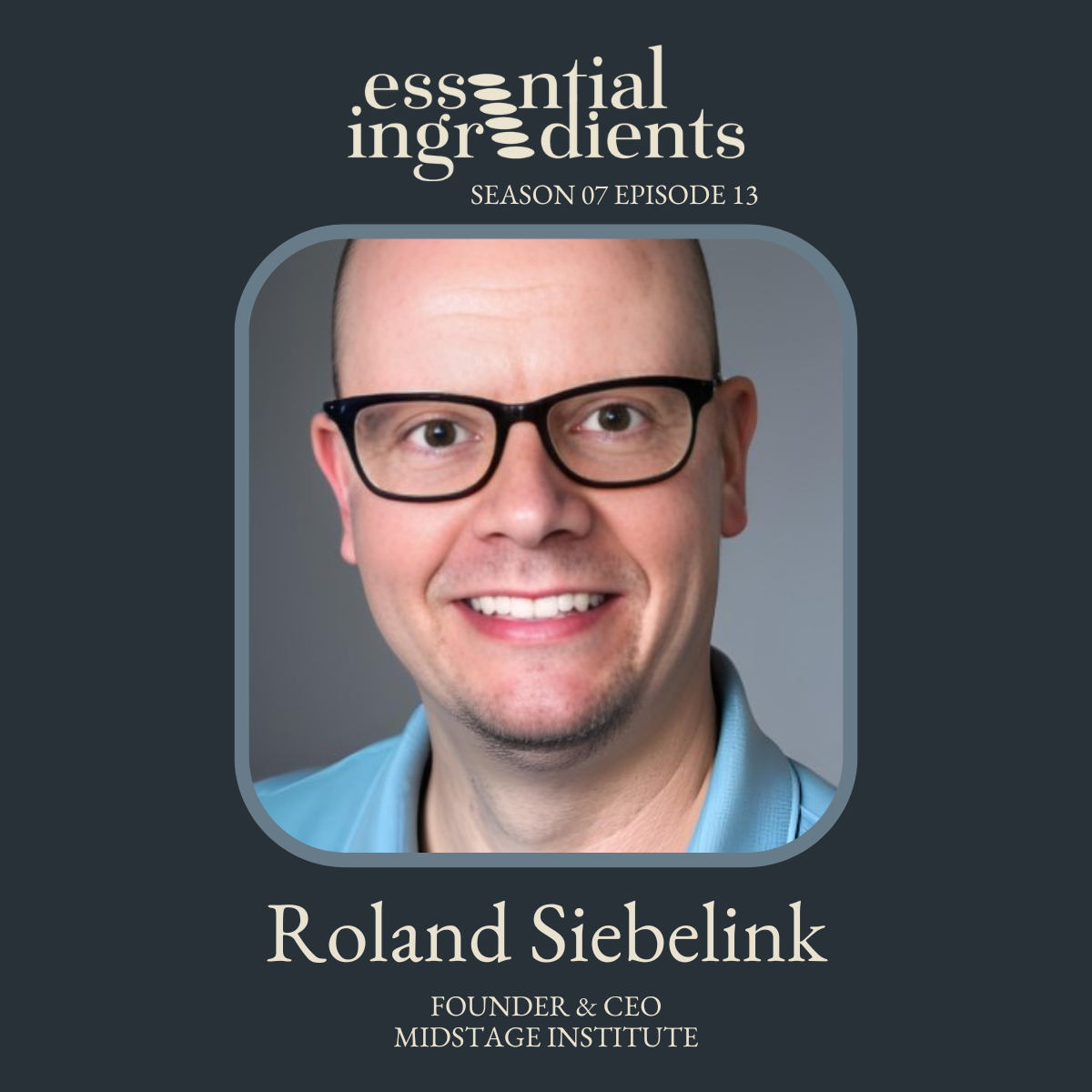
Roland Siebelink · Founder & CEO, Midstage Institute
Watch on YouTube
From Founder to Facilitator: How Shifting Perspectives Can Transform a Growing Company
The Incorporation Method helps you turn what matters into practical changes that fit your life.
“Roland Siebelink on the pivotal shift from founder-operator to facilitator — why letting go of control and building the right team infrastructure is what separates companies that stall from those that scale.”
Full Transcript
Full conversation between Justine Reichman and Roland Siebelink.
Good afternoon, and welcome to Essential Ingredients . I'm your host, Justine Reichman. With me today for this very special series on resources or better for you food businesses is Roland Siebelink, the CEO and Founder of Midstage Institute. Welcome, Roland.
Hello, Justine. Thank you for the invitation. It's such an honor to be on this podcast.
Oh, well, I'm so pleased that you're able to join us. I think it's so important. Often, our podcasts revolve around people's journeys, and what goes into the food to inspire innovation. And this one really is meant to be a resource for everybody that is listening to the podcast, watching the podcast, building a business. So we're pleased to be able to bring everyone this special series, and we're pleased that you're able to share with us your organization and how you can support these better for your food businesses.
Excellent. Well, as I said, it's an honor to be here. I love supporting entrepreneurs that are growing successful businesses, especially when they get to this scaling stage or mid stage, as we call it. And I hope to be a good resource for that.
I can't imagine you wouldn't be. And I think if we could just start, if you could introduce yourself and tell us what your title is and what you do, that would be great.
Okay. So Justine, I am the Founder and CEO of Midstage Institute, which is a small consulting company that focuses on companies that are scaling beyond the mere startup stage. So once they start really growing, once they need more management skills, that's what I do. We're based in San Francisco, but I have clients all over the world.
Awesome. Thanks for sharing that with me. And what's your specialty and background?
A specialty is really how things need to change in a startup once you start getting more people, once you start getting more funds, but still need to satisfy investors. So I was lucky enough in my background to work through three unicorn journeys. It started with 10 employees, and it was 1,000 employees three years later, so I've seen that story a few times. I know what's going to happen. And so I can often advise Founders on what to watch out for, how to invest in the future and make the right changes so that they can stay in charge.
Awesome. That's amazing. And I think it is a much needed resource. So I'm curious, what drew you to this specific field, this area of expertise?
Very early on a long time ago in the last century when I was still young, there was this newfangled thing called the internet. I was one of the first people to be researching it. Still an assistant at university in those days and so I got into early internet businesses, those became unicorns. And basically, that was the red thread that kept on going, always being on the cusp between the technology people and the market. So how do we translate what we can build into something that the market will actually want and pay for it?
Obviously, that's what we all want. That's a special sauce. So when you work with these companies, and we'll dig into what kinds of companies, or if it's all kinds of companies, what are you overall hopeful for to be able to work with them to achieve?
The emotional aspect of why I started this business is that I've seen far too many businesses where, because they attracted investors, and then inevitably, every business goes through rough patches. And then the investors have as a first reaction, that's just check out the founder and bring in a friend who can take over as CEO. And I think it's really become clear that more often than not it just basically ruins the business. So my purpose here is really to keep the founder in charge and to keep them running the business for as long as they can with one condition. That is that they're open to learning, because the business does require a completely different skill set for every face you grow through. And so if that founder is willing to stay in charge and is open to learning, then we can help them stay in charge for a very long time.
I would want that right. And I know that there are times in people's careers where they don't want to stay in charge where they do want to bring other people in. I've heard many stories where people feel like they don't have the skill set to do it. But did they have the skill set? Maybe they could have done it. So it sounds like that's where you come in.
Absolutely. Yeah. And the skill set is actually relatively easy to learn. There's nothing all that difficult about management and leadership is what I always say. It's just complex. You have to think of many different things all at this same time, many different things at the same time. And what that also means is you start realizing that you cannot do it all by yourself. So how do you start delegating? How do you start becoming a better listener? How do you start focusing on scaling a company through people and not just through your own efforts?
Yeah, I think that is the key. As you're sitting here, I'm thinking and wondering, you get a variety of founders I'm sure that come to you. Is there a single or a few single kinds of common maladies that you see when people come to you?
Yes. I would say, obviously, almost every founder we interact with is driven and is eager to get to a certain outcome. Otherwise, they wouldn't even contact us. I would say that there's two types. And this is a huge simplification because everyone is different. But there's the type who maybe feel they're a little bit of God's gift to the world and are just so frustrated that they can't get their team to come along with them. And then there's the other type that's maybe a little bit more too much. How would you say self effacing in the face of wanting to hear all opinions not wanting to make a decision? And so of course, the coaching for those folks happens very differently as you can imagine.
You give us an example, or maybe two of these different kinds of experiences or candidates that might come as founders, if you will, that come to you? What the process would be? Obviously, no two processes will be the same. But maybe from your experience, share two different stories with us?
So in general, I would say that we always run on two tracks. One is coaching individually with the co-founder. And the other track is quarterly sessions with the whole leadership team so that we get to coach both. And that burden is not just on the CEO to transfer all the new wisdom to their team selves. So that's just the logistics. But I would say from an example point of view, this very dominant personality type that is a very driven founder typically often gets huge benefit out of learning to listen. So all we ask in one of those workshops is, can you sit back and be the one to speak last whenever we ask a question? And it is so amazing how the first hour, they're all fidgety and anxious, and they're just not used to it. You can see it after an hour, they start relaxing a little bit. Start saying things like, wow, I'm so surprised. My team came up with exactly what I would have said. And then later in the morning, maybe early afternoon, they also start realizing that some of the people who are best contributors were the people that they were not actually holding in high regard versus on the other hand, the people they thought were actually the most powerful executives they have are not contributing all that much. So what do you think happens there? It is a shift, but it's also a pattern where basically you start learning. Some executives are just very good at saying what they think the CEO wants to hear, or just repeating what the CEO is saying. And so to kind of tease that out is already something we can have huge effects with even in a first session together.
Wow, that's amazing. So are there ever founders that you come across that you feel like, I'm sorry, I just can't help you?
Of course. And I think this is partially just the nature of coaching. People have to gel with each other, which is why we also have several coaches in the businesses. Sometimes, there's people who cannot deal with me, but they can deal with Doug, or Annie, or whoever else is one of our coaches, or vice versa. So that happens. It's just a personal chemistry connection, a trust that you have to establish. And then there are some people who are so convinced of their own perfection. They feel they shouldn't be coached. We often nip that in the bud quite early when we notice it's actually other people in the organization that are trying to pull us in as coaches because they feel the CEO needs coaching. But if the CEO is not convinced they need coaching, we cannot do much.
Yeah, I bet. And I'm curious, I'm sitting here as a founder myself, and I always want to grow. And I think it's so important to learn from the people that we bring on board because they bring different skill sets. And equally, I want to lead in many ways, but also give people the opportunity to shine by listening to them so that I can learn from them, so that we can collaborate and make more informed choices. Because we now have the benefit of everybody's expertise. And that's my philosophy on that. So I'm curious, as you deal with all these different people, and the different chemistry, and the different kinds of personalities, are there ever instances or maybe you can share an instance where it's really more personality than it is the leadership skill just in terms of how people are communicating? Because I know often that communication really plays a big role in the way that we communicate. That make sense?
I would actually struggle to find an example where that's not the case because there are some fundamental communication gaps. People not being aware of how others perceive them, people not quite understanding what where somebody else is coming from. And that's why I think the facilitation of those workshops is so important so that we as a neutral party can kind of provide a safe space where everyone can share their contribution. But then also, it's often astounding even for fundamental disagreements that the team has not been able to resolve for months at a time, sometimes years, where just getting everyone to air their perspective makes everyone so open to coming to a joint solution even if it doesn't go their way. And so you're so right. I'm biased. I'm a Communications major by training so that definitely helps. But it is absolutely fundamental to learn to communicate better as a team first before you can do anything else, just like in a relationship or in other walks of life.
I couldn't agree more. I think every relationship, whether it's a friendship, a family member, or a business needs a little coaching because people have different kinds of conversations, the tone that they speak, their sense of humor, the way that they were raised all plays into this. And being able to understand and read people is really important. And it takes time and patience to hear what people are saying, and it's really important to listen and not judge. I mean, we all have an opinion. That's what makes the human race have different opinions. But it's being able to communicate with them in a respectful way. Because one thing that concerns me is that when you don't do that, you alienate your team members. So how do you recover from something like that? Because I'm sure that you get people that come in, whether it's the team that is fighting it, or the founders fighting it, but somebody's saying, we need to do this. And so not everyone's a willing participant.
Absolutely. So I think once the crisis has happened and people are really reeling from some outburst, or some tantrum, and I definitely have some clients that are great with tantrums, let's just say. I think often, you can clear the air with more of a feed background without actually going into the very issue. You ask people, okay, you each write down one thing you like about each other's style and one thing you don't like so much about his, or what you find helpful about their behavior, not so helpful about their behavior. The questions can differ a little bit, but you get drift. And we typically are those actually in a group, it feels very scary. But actually, that provides a safer space because then nobody can really do an outburst in front of the rest of the team. And we also tell the people receiving the feedback, all you need to say is thank you. Do not respond, do not try to argue. Just learn that everyone's perspective is different. And it's not because they say something that you have to agree to or disagree with. You can just say thank you, I appreciate your perspective. And that often clears the air to such a degree that the team can actually learn to communicate better and not be so afraid of confrontation the whole time. And once they can do that, then of course, they can start applying that to fundamental business issues they haven't been able to see.
Yeah, I mean, as you're saying this, I'm imagining, oftentimes, it's people's tone that we take the wrong way. And then we create this old narrative in our heads and we're like, how could they have done that? I'm sure we've all been in that situation.
Narrative in our heads is something that a lot of us are not aware of. I'm sure those of us who have been through couple therapy or similar things, I've learned that lesson as well. But part of getting everyone feedback, let's say the dominant figure in the room is also that when they get the negative criticism from others in the room, I will say just in 90% of the cases that negative criticism is far more benign and far weaker than the criticism they give themselves in their own heads.
We're our own worst critics. I strive for perfection in everything I do. I don't want to do anything wrong. Just in general, I don't expect that I'm always perfect, but I am criticizing myself. However, if somebody else does it to me, I feel very defensive, of course. So what would you say to somebody that, is there a different way to approach it when we're talking about constructive criticism so that we're not pandering, but we're not equally being so confrontational? I'm from New York, I like to be very direct. Is there a way that you can say something to somebody that's not going to be taught across as brash, but equally just constructive?
Absolutely. Some pretty standard techniques are to point out a situation rather than a behavior the other person had, and then how it made you feel. So the one thing we always want to do is say, you did that because, that's when we're projecting intentions. And almost always we get these wrong. So the trick is actually never to project somebody else's intention. Just say objective things like, this was the situation, this is what you did, and this is how it made me feel. I have one client that used to argue with his wife about, well, you can feel that way because blah, blah, blah. And he said, since then, she has taught me that she is the world's greatest expert on what she feels.
Oh, I'm the world's greatest expert on what I feel.
So what you feel cannot be challenged either. How you can basically bring that down to earth a little bit more situations clearly, the behavior is observed by everyone. And yes, that's how it happened. This is how it made me feel. That's all you need to understand. Doesn't mean you need to immediately say what you would have done differently. It's just like, I just want you to know that.
I think that's a great takeaway. So for those founders that are tuning in today, whether they're watching or listening, what is one important thing that someone could do to take control of their role, their place in the company as a leader?
I think as a leader, one of my quickest tips is for a week, try never to make any statements, or any opinions, or any decisions like this is what's going to happen for a week. Try to only ask questions. What they get out of that is, one, a lot of people that are suddenly surprised, oh, he or she wants me to do the thinking. I'm not bringing just the fact that I'm not just showing the problem in their face. No, now I need to bring a solution. So that's why you have to do a week and not just the day. Otherwise, they won't even get used to the new situation. But once you do that, you actually start being surprised at how much more thinking is going on in the team below you than you would have held possible. And it starts to help you realize where most likely you've been focused on the minute details of how things should be done. You can probably graduate from that and say, like, okay, I just want these things done in broad strokes. Or if the thinking is even more advanced and people are more experienced, you could maybe just focus on the big, really big circles or drawings like the why behind everything. Are we focusing on our purpose? Are we focusing on the big problems that we're trying to solve? And do not ask me to make a decision of exactly what needs to be done, that's what I have you guys for.
That's a great tip for folks, I think I'm going to even try it. See what my experiences are, and how it makes me feel. And equally, I would love to be able to do that just so you can really give your team the opportunity to do whatever it is they're going to do to shine. If you're always telling everybody what to do and how to do it, there's really no opportunity for them to fix their own problems, manage their own situations, or even share a different point of view.
Absolutely. And most of us entrepreneurs, of course, didn't like being in more bureaucratic environments very much. So we wanted to start something to have more liberty. And then if we don't learn those things, just steam then basically, we are creating the worst bureaucracy or environment for our employees to work in. It's only when we learn to also let go and let other people make suggestions that they can grow and they can become maybe even entrepreneurs of the future.
I agree. So are there any statistics that you know of or that you can share of the impact of this kind of resort working with a coach or working with somebody for founder's, whether it's for longevity or the climate in the office?
Absolutely. There are many indicators. But the ones I like to focus on are ultimately still bottom line indicators or top line indicators. So typically, with the methodology we apply, we get to a company that can triple its growth rate. It can typically eat double, or even triple as well its profitability above the market standard. And sometimes, even most important, it liberates the Founder, CEO from all of the weights inside the company. And many people report that they've liberated 60 to 80% of their time, or what they call market development activities such as new partnerships, exploring new suppliers, big clients that you might have in one business or the other. So basically becoming more of finding more time to do external stuff where the business grows. And that's where these three times growth factors often come from.
Thank you so much for participating in this series that we're doing to showcase resources for founders. I learned a lot. I can't wait to incorporate it myself. So thank you. And for those founders or folks watching or listening, if they wanted to get in touch with you, what's the best way?
We've collected all our resources, as well as our contact information on one page. Very simple. It's midstage.org/thrive . And so just going to that link, you will find everything you need. Feel free to just use the email or the social media handles there to ping me. I'm very responsive.
Awesome. Roland. Thank you so much again for joining me.
Absolutely. It was an honor and a pleasure.
Share This Episode
Enjoyed this conversation? Share it and tag @nextgenpurpose
Listen on Apple ▶Listen on Spotify ▶Your Host
Justine Reichman
Founder & CEO of NextGen Purpose. Host and Executive Producer of Essential Ingredients — 11 seasons, 330+ episodes, and a growing movement.
About Justine →