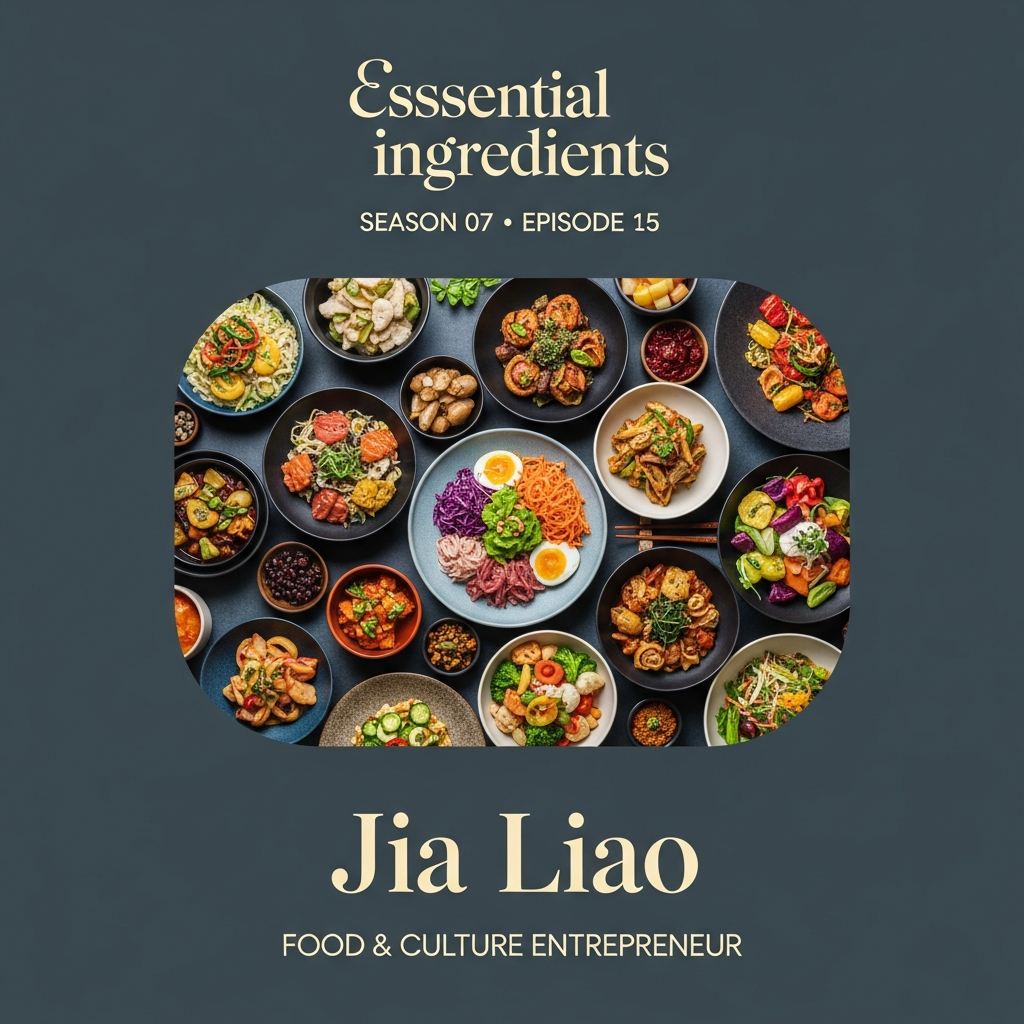
Jia Liao · Founder, Hotpot Queen
Watch on YouTube
A Taste of Discovery: Bridging Cultures by Sharing Diverse Flavors Around the World
The Incorporation Method helps you turn what matters into practical changes that fit your life.
“Jia Liao on using food as a bridge between cultures — how sharing diverse flavors fosters understanding, connection, and a deeper appreciation for the richness of global culinary traditions.”
Full Transcript
Full conversation between Justine Reichman and Jia Liao.
Good morning, and welcome to Essential Ingredients. I'm your host, Justine Reichman. With me today is Jia. She is the founder of Hotpot Queen. I'm super excited to have you here on the show to learn more about you, and what you're doing.
I'm very excited to be here. Thank you so much for having me, Justine.
Oh, it's my pleasure. I've investigated and researched your website to try to find out as much as possible. Because for me, integrating culture into food, it's home, it's family, it's community is connectedness. And so when I read that about yours, I was really inspired. I think, oh, it's my pleasure. I mean, oftentimes, I think that when people try to recreate cultural foods from way back when, they don't know how to change them for today to make them healthier, better for you, use good ingredients and maintain the taste, or even elevate it a little bit. It's so important. It brings home to you, it brings your family together. So this is your story and not mine. I was just sharing my passion for what you're doing.
Thank you. Maybe just a quick introduction here. So hello everyone. I'm Gia and the passionate Founder behind Hotpot Queen. So I was born and raised in the very culinary rich region of Chongqing in China. So five months after I was born, my mom started a hotpot restaurant that has only three tables. So I will say that we have been in the restaurant business for over four decades. So at Hotpot Queen, what I'm really trying to do is to kind of encapsulate the essence of Sichuan, and really to bring the mala flavor to the global audience. So what is Mala? Mala is a combination of Sichuan peppercorn with Sichuan chillies to create that sensation of numbing and spicy, which is the quintessential flavor profile of all the classic Sichuan cooking. So that's what I'm trying to do. We'll make it easy if we still have premium Sichuan spicy condiments. But I don't really want it to be just a condiment bread, but I really wanted to be a kind of bridge between the east and west culture. And I really think that food is a great vehicle to kind of evangelize culture and to break stereotypes, and to kind of bring people together. That's what I'm trying to do. So anyway, I'm very delighted to be here. That's just kind of like an easy, simple intro, and we can kind of dive a little bit deeper.
I would love to do that. Thank you for introducing us to Hotpot Queen. I have so many questions. I don't know if third, fourth generation of Hotpot Queen. As it's changed, as your family has been in this business for so long.
Second generation. My mother, yes.
I love that. My mother, also a woman, owned a family business, and I ran her business. Now I have a different one.
Now we have something in common, yeah, that's great.
Out of curiosity, because I'm curious. For me, when my mother was building her business, I thought everything was possible here. I saw that. She started at the dining room table, and then she moved on. And your mother had a three table restaurant. From your perspective, what were you thinking as a kid?
I literally grew up amongst vibrant flavors, aromatic spices, and boisterous people personalities. The woman trying marriage at 20 is famous for being very entrepreneurial spirit, very strong minded, and also quite loud. Just speak their mind. So growing up like, so my mother, remember when I was young, she would lock me. I was like five, six years old. She would lock me into the manager's office in the restaurant, and wanted me to listen to all her meetings. She's saying that, one day you're gonna grow, you're gonna take over my family business. That subconsciously instills all those business being cons to your mind where you grew up one day that you can also carry on my legacy. So in a way, that's what I'm doing. So you might be asked, why do we call it Hotpot Queen. People ask me, are you the queen? I'm like, no, I'm not. My mother started that hotpot restaurant. They will serve you with a pot, that kind of device that has a spicy broth. So my mother invented that pot in 1982. So she invented the pot, and she was regarded as the Queen of Hotpot by Chinese and international media. So if you go to Vice, and there's an article that Vice wrote about her called an audience with the Queen of Hotpot from Chongqing. So that's why I wanted to use the name Hotpot Queen. But this name actually is not my parents company's name. It's a brand I created for the US market that we just launched our product line this March, but I think is a way for me as a second generation to carry that legacy. But I also want to rewrite my own story. So that's why it's not me. I want to be a little bit more humble and modest.
But I gotta tell you, your mother is so inspiring. She's done so many things. I also look at my mother and think, wow, she was super inspiring ahead of her time. And these strong women, to have them as mentors and to have them to look up to, I think puts us in this position where we want to create our own thing, innovate, build, which is what you seem to be doing. And I'm curious, when your mom had this business and she said that you were going to take it over, what were your thoughts? Were you like, do that when I get older? Or did you want to do your own thing?
I didn't want to do my own thing. I wanted to be stuck because I was an only child. I don't have anyone to chat with. Oh, my god, I'm an only child so my best friend is my mom. So I used to stand in front of the mirror and it just tried to act out of my imagination. I wanted to be an actress, but I knew back my mind that my responsibility is to take over the family business. So I went to business school. So I studied Economics and Business at University of Washington. I always kind of back my like, what is the film and TV production something I wanted to go into. At the time, I didn't really particularly want to be an actress anymore because I heard about all those things. They don't like me, they want to be a director. So actually after college, I went to UCLA for a year, and I studied TV and film production. I did a couple of short films and I realized that it's not really for me, either. It was just kind of like a childhood fantasy because I was so lonely. I started to learn about the culture and the business, the people behind my parents' business, and I feel like I'm an only child. I do have that responsibility. I don't want my parents when they leave the world with nothing. I just tell the company, there's no name behind it, there's no legacy behind it. So more and more as I grow older, I have more of that burden in my heart that I want to share the culture, and share the essence, and the people that's behind all those brands and products. So yeah, I feel like I have definitely changed in terms of my mindset.
I think we all do as we get older. My father has his own business as well. We are aligned in so many ways. He was like, well, who's gonna take over this? I only have one daughter. We've always said to him, I've always wanted to do something with him because I've always admired what he's done. And he always built these amazing things. And if I can support him for that legacy, whatever it is, whether it's his business, whether it's a charity that he has, in whatever way I feel honored.
And then to me it is like, I didn't go back to China though. After graduating from college, got a job, got married, (inaudible) for 13 years. At that point I was thinking, you know, I can carry on the legacy, I can continue the business, but I'm kind of a waste of my education from my upbringing in the western world in the United States. But what if I bring even a broader audience? What if instead of doing the same thing we were doing the past 40 years, what if I bring this phenomenal flavor, this Mala flavor or the wonder for the essence of Sichuan to the US to the global market and other people experience culture through food? So that's why I think a lot of times like taking over a business career on legacy doesn't necessarily mean that brand or that company, how do you continue that story? And that's what I wanted to do.
I think that's amazing and beautiful. Because I think you're right, people have one narrative around what it means to honor and take over our business. But you're expanding it, you're broadening it, and you're sharing their culture with the rest of the world. And that's more than I'm sure your parents ever dreamed of in terms of what we're doing.
Yeah, I just started up. We launched our product line this March at Expo West. It was really exciting that we had this very flamboyant, very loud, colorful booth. And then people come in like, how long have you been here? Today, we're one day old. We launched today. It's been a challenging journey just to navigate the CPG world with no connection, really starting fresh. But I just got so much support from all aspects of different industries, and people just gave me a lot of love. And they really love our product. So I've been very blessed. It's definitely had its ups and downs. But I'm very happy where I am today trying to push this idea forward.
I think that it's amazing. I'm curious because culture plays such a large role in it. What's the feedback that you're getting from people? Are they embracing it?
What I really want to evangelize is this flavor of mala. Have you ever had Sichuan peppercorn before?
No.
Sichuan peppercorn by itself, oh, my god, that is the most electrifying immersive journey that you will ever have because that's kind of the key flavor profile or ingredients in our product line. You have that spicy, a little bit tingly, numbing sensation. So join the Expo West. Because right now, we're kind of voting in two different retail shops. We're mostly Pacific Northwest, but we're also going to go into the Fresh Market which has 162 stores this October. So I started doing store demos. So why to demo? There's always some adventurous customers. I love the product. Want to try more? I say okay, why don't you try sichuan peppercorn? So once they tried it, they were like, oh, my god, what is this? Are you drugging me? No. This is just food. Because when you first taste the Sichuan peppercorn it has this original raw form. It doesn't taste much the first 30 seconds, and then that little tingly, numbing sensation, it feels like a microcurrent that goes through your tongue. And then you're like, whoa, what is this? My thought is you just eat a huge, beak back soup like pop candy, or a super carbonated drink. And then your mouth starts to salivate. And then you embrace it with a deep citrusy taste, depending on the person's flavor. And that sensation is gonna continue coming in waves for about five minutes. So we still have that tingling sensation. So it was so funny. And the people be like, what is this? I have never had this in my life. This is so crazy. And I think that is my last sensation. And the people were like, I wish I knew this more. I knew this better. And there were customers saying like, could you give me a cup of peppercorn so I can go back and share with my family and friends and let them experience what I just experienced. So the feedback was phenomenal. I have so much fun just watching the reactions and seeing what they think. I just think that the time is now. Before, people generalized Chinese food like the Americanized version. You see that there's a lot of niche in food culture. 10 years ago, there's no hotpot restaurants. We never found it. But now, there's a ramen shop. There's a dumpling shop. So people want to get into the niche. And I think right now, Asian culture is rising and it's a perfect time to instill that curiosity and give them what they want. So it was just so fun.
I remember the noodle shops because I'm from New York. I remember they first started opening in New York. I remember wanting to try all the new ones and they had the buckwheat noodles, and then they had udon noodles. They had all these different noodle shops and then something else emerged. But the new experience is about the new culture because we're so used to eating our own culture in many places around the world. Not everyone lives in New York City where you can get exposed to all these different things. I live in Marin. I mean, aside from one or two Chinese restaurants, there's two Japanese restaurants. But in terms of other cultures, not a whole lot. So I think it's just amazing for people to be able to come and share their culture, share their food and let people experience what they have from their home that they're bringing to share.
Yeah, absolutely. I think there's so many ships in the culinary world. Umami took the world by storm. Our product is also very umami rich. Like the way you mentioned today, you want to try the wild mushroom chili sauce? Great taste. That is actually our star product. We don't have any preservatives or MSG. But when people try, especially that product, that's actually the star product. I'm super passionate about it, there's a lot of chili. But nobody has really put mushrooms and chili together. Mushroom was also a very popular ingredient in all cooking, and it mimicked that meat texture. So our product, we have three ingredients that add that umami layer, but without having that MSG. So one is we use dried mushrooms, or we have dried wild porcini and shiitake mushrooms. But because it's in this dry form, we rehydrate it. There's a texture change, it becomes more chewy. When you dry the mushroom, you take the moisture out of the mushroom content, it creates more glutamate which is responsible for that umami flavor. The second is that we use fermented soy sauce. It's not just salty as that salty, savory, sweet, bitter umami, and just another dimension of flavor. And the third one we use is fermented black beans which are also very key ingredients in cooking. So the combination of those three (inaudible) sensations that makes this, I will say this product or our product a flavor bomb. It is just like exploding your tongue, your mouth with all kinds of flavor notes. That's what makes this so special, I think.
So what's your favorite way to use the product?
I love to eat noodles. Ramen, I ate at least once or twice a week. So I will call this a ramen bomb. So when you do just regular ramen, I put a big scoop inside and it becomes the spicy and mala-savory kind of broth. And because we have lots of mushrooms inside, we collect chunky chili sauce. So there's like a bit of mushroom floating on top and making the food taste good.
I am hungry. We should have had soup over. We should have had some while we were chatting.
I know, I know. But then we're gonna make everybody else hungry.
I think so.
So a simple lunch will be just plain white rice, and I'll put a big scoop of chunky mushroom sauce. That will be a great simple lunch.
We're gonna have to get some recipes from you that we can share with our community. So that when they watch or listen to this podcast, they're like, they want to order it. They know how to use it.
Absolutely. Right now, I'm doing the sampling. The sample purchase rate was so high. Last weekend we gave up like 50 samples and 24 jars. So fun to see people try and they could walk by and then they come back like, what is this? You just let me taste it like, whoa, this is a wild mushroom chunky chili sauce. They're like, I really love it just hearing the name.
So I'm curious because you came up with this idea. Your parents had their business, you decided to expand and create something that could broaden the reach. So are you connected with your parents' business? Is this a separate thing? Are you guys working together on it?
Absolutely. We're connected. We have our own food factories situated in the heart of the hometown of Sichuan in China. I am working with my parents factory as a way to manufacture products. So basically, the way we work is we work with chili farmers, and we would take their whole entire year. So we're not just any bar from them. We don't just like to pick their best batch, but we'll just take it a whole year. And we'll be working with them for 15 years. And a lot of the Chilli farmers in our region are minorities. So in China, besides the hand which is a majority of the ethnic, that takes about 98% of the population. So 2% consists of 55 minorities. So those minorities are kind of like aboriginals. You think about Native Americans, they live on the land for thousands of years, and they have their own clothes, culture, language, and most of them are farmers. So farming is almost all their livelihood. So for us to kind of work with them and take all their harvest is really helpful with their community. So that's what we'll be doing. Also, we ensure the best quality chili's that we could possibly have. So that's where we source our products. And that's how I tie in to my family business with what we're doing now. So that's kind of what the manufacturer is.
You shouldn't have any supply chain issues. I was only kidding.
We're not doing OEM, so that in a way is much, much easier. And I think that is a big advantage in our brand. We're not just starting out trying to look for an OEM factory that I've never worked with. I mean, this is our own people so we know what we put into the food.
Yeah. So for those folks that are listening that may not be familiar with what OEM is, would you just explain what that stands for?
Okay. I don't really remember what's on my mind. It means that you find a factory that just manufactures this product, but you want to slap your name on it, your brand on it. They may or may not reformulate your products according to your preference, they might already have that product. But what it means is now your own factory is the factory that has an OEM like many different brands. Let's say that you find a chili sauce manufacturer and then there's a ton of other brands, they're using the same factory, they just formulate the product just a little bit, or maybe didn't even refer to them at all, and they just put a different name.
Any labels on it. They do the same thing in the makeup industry.
Yes. Yes. So the problem with that is that if you never worked with this factory before, you just don't know how they do their quality control. You don't know if it's going to be consistent. But definitely, if you're a company or brand starting up, not everybody has their own factories that have been around for 40 years. It's just another layer of the uncertainty added into this whole brand. But I think that because we have our own factory, our own people, it adds that reassurance that we shouldn't have any quality issues.
For those folks, though, that don't have a family factory, and are starting off, innovating and creating something new, as somebody that's been in this business for a while and knows what to look for, what might you recommend to them to be mindful if they're using a factory like that that's not their own?
Well, first of all, there's a platform like alibaba.com. How many years have they been long? And if you can physically be there, I guess the only way you can start is through the internet. If you have a person in China that refers to you, that is a better way. And you also use the internet to verify, of course, all the certifications should be there. Are they FDA registered? All this rubbish is necessary to export to the United States. If someone or you can hire a virtual assistant to go to the factory and just check it out, a lot of times it looks really legitimate on the internet with all those pictures, right? But when you go there, you can see, oh, do people wear protective gear? Is the factory clean? Where is it situated? How do they handle food? I mean, you'll get a much better idea than just looking at the pictures. So I think that due diligence is really, really important. But of course, I understand that people can't always go.
Not everybody is.
There's so many tools now. It's like a virtual assistant. You can hire someone for Upwork or Freelancer. They have servers in China that you can hire someone to go in and take some pictures. I mean, that's a possibility if you're willing to do the extra mile to do that.
I think that's great advice. And I think the point really is to level the playing field for people. So while you had access to this, you're really lucky to have that. The experience that you grew up in, of course, listening to your mom's conversations, you have that insight, that additional information. And so being able to have you share that on this podcast with those guests that are listening is really important, because I think it allows them to realize or advise everybody to realize these opportunities we can take advantage of. We have to look at different ways to go about doing it, and so I appreciate you sharing that. So for those folks that are listening today, or watching that want to get a product, how would they go about doing that?
Well, right now you can go to www.hotpotqueen.com . That's the easiest way that you can order online. Also, we're on Amazon. So you can search for Hotpot Queen, and you can find our store. We are starting rolling to different retail shops in the country, in the Pacific Northwest. And we're the fresh market starting October. So I know we're in a kind of like 50 independent shops across the country. Actually, the ones that sell the best are those small independent shops, like wine shops, coffee shops and small independent gift shops and groceries. They should do very well because they're able to do a little bit of sampling. So our products, once you sample, are very easy to purchase. But I guess it's always difficult when you don't know a brand. You just look in the package and we're thinking, oh, well, what do with this?
You've only been around seven months. With that being said, what can we expect from Hotpot Queen in the coming next three years? What do you bring to us?
Well, definitely I wanted to, I'm focusing on offline retail channels like Costco is kind of like my main goal in the next three years. Actually, we're going into the Australian market. We're kind of in a negotiation phase. So definitely, I wanted to see more of us. I hope to build a presence mainly through Amazon. Right now, the cost of acquisition is quite expensive for a website. And yeah, I really wanted to be the spokesperson for pushing the mala flavor forward. I really believe that mala could be the next umami, and I want to start a mala revolution.
Well, we're behind you on the leg. We're standing with you. We're behind you, we'll help spread the word and help get the mala culture out there.
I will send you a little bit of sichuan peppercorn so you can try it. You'll know this sensation I described, and you will be amazed.
Can't wait to go on my electrifying journey. Awesome. It was great to meet you, Jia. Thank you so much for joining us. I hope to connect you with lots of other people that are curious about learning about Mala and trying your product, so keep an eye on things progress.
Thank you so much. I'm so excited. I was so happy to be on the show. Thank you so much.
It's my pleasure.
Share This Episode
Enjoyed this conversation? Share it and tag @nextgenpurpose
Listen on Apple ▶Listen on Spotify ▶Your Host
Justine Reichman
Founder & CEO of NextGen Purpose. Host and Executive Producer of Essential Ingredients — 11 seasons, 330+ episodes, and a growing movement.
About Justine →