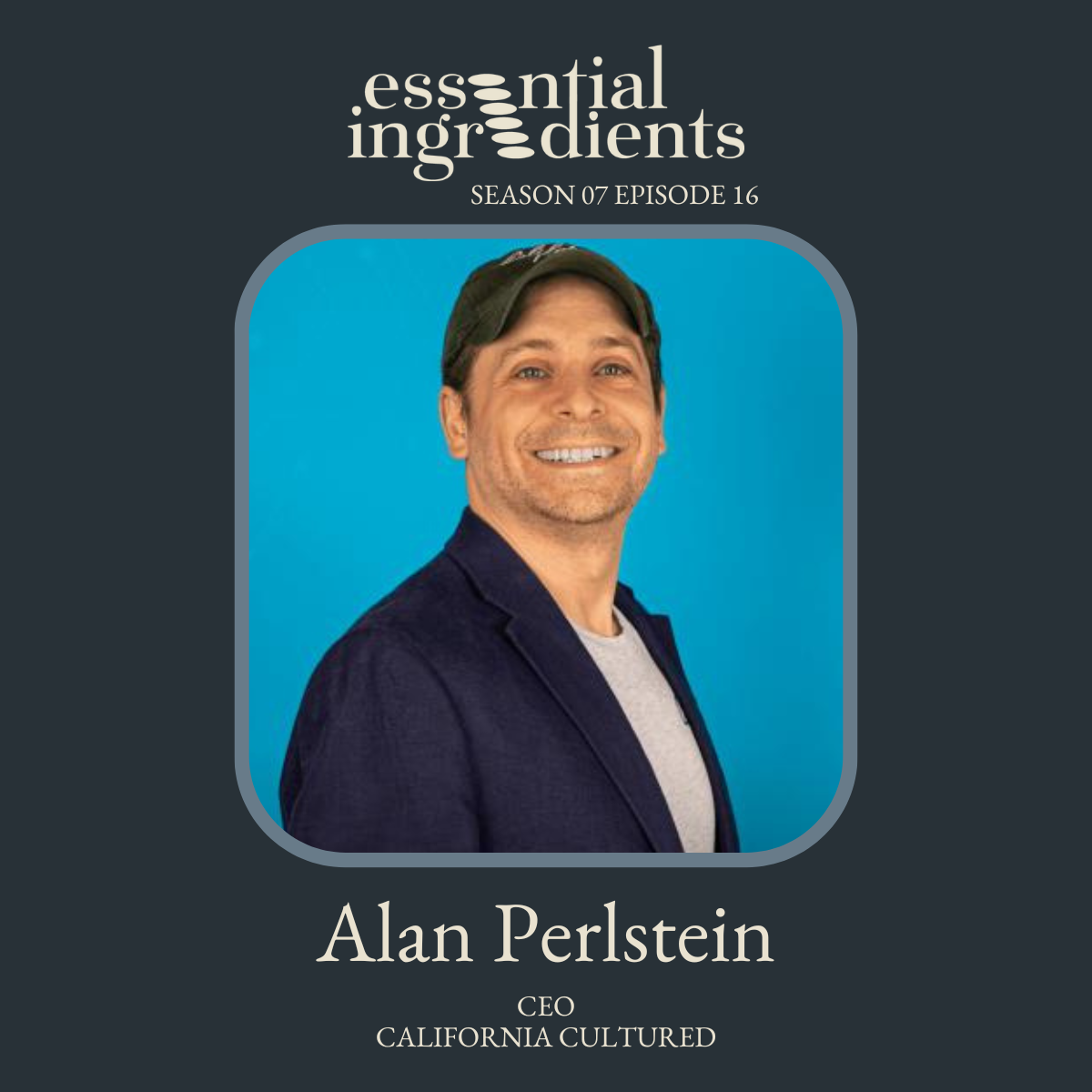
Alan Perlstein · CEO, California Cultured
Watch on YouTube
Chocolate to Love: How Cell-Culture Is Creating a Healthier Treat
The Incorporation Method helps you turn what matters into practical changes that fit your life.
“Alan Perlstein on how cell-culture technology is transforming the way we grow and enjoy chocolate — creating a treat that's better for people, farmers, and the planet.”
Full Transcript
Full conversation between Justine Reichman and Alan Perlstein.
Welcome to Essential Ingredients. I'm your host, Justine. With me today is Alan Perlstein, who is the founder of California Cultured. Welcome, Alan.
Thank you, Justine. Glad to be here.
It's great to have a fellow New Yorker here. I always love to connect with people regardless of where they're from. But it's fun when they're from New York, and we can connect over food, culture and all those things. So I appreciate that. When I read about California Cultured , I was super excited. And it seems really innovative and fun. I'd love for you to share with our guests, those that are watching or listening, exactly what it is before we get into your whole story and how you got there. But what is California Cultured?
California Cultured is a food tech company that is building a platform to mass produce chocolate and coffee from a specific type of plant technology called plant cell culture, where we can basically take a single basic cell of the being and grow infinite amounts of either cocoa beans or coffee beans starting from that original cell. And from there, we could put that into large tanks and produce large amounts of chocolate and coffee, all originating from that single cell.
So I gotta ask, how did you come up with this?
Well, that's a long story. But I guess in truth, it started about a little bit over 20 years ago. I was an undergrad in New York working in different labs. And one of the labs that I worked in was a smaller lab in Bay Shore of Long Island that had a grant from NASA to explore a technology called cell cultured meat. And they were one of the first in the US to really pursue this where they could actually take a cell from a carp or for many other types of fish to give it some sugar and nutrients, and they would be able to go infinite amounts of fish cells, eventually, culminating in like a fish, a fish bite, or fish steak all coming from a couple of fish cells. And this was the beginning of this type of technology called cell culture meat or cultured meat, which now has about 80 companies around the world pursuing different versions of this type of technology. And that was the beginning of it in the US. I was very lucky and privileged to stumble upon that. And after working on that for two years working on some really interesting technology, it really inspired me with the possibilities of growing infinite amounts of materials, foods, medicines, anything all starting from a couple of cells. And that technology and concept stuck with me. From there, I worked in different labs in New York City designing different drugs, pharmaceutical devices. And from there, I started my previous food tech company originally called Miraculex now called Oobli Foods, which also focused on another new food called a protein sweetener. And that was my first big foray into this type of technology where you could grow these new types of ingredients using biotechnology.
What was your initial background then?
Mix of biotechnology entrepreneurship, and developing different technologies in growing cells. So that's where I worked. And for quite a bit, I developed a lot of different ideas and technologies. And I loved thinking about it, creating it and testing it. And in the lab was this great environment to test these crazy ideas I had.
And so going from being in the lab to being an entrepreneur, and doing the business end of things, I heard you say you did entrepreneurship and all those things. But spending so much time in the lab, it's got to be different now. Also running a business and innovating, and being able to take that experience and that research, what you're finding in the lab and build a business. Can you talk me through that a little?
It's always about mixing both of them. When it comes with science, it's more about exploration and making sure you ask really good questions. And you don't necessarily want to predict where your data is going to end up. If not, it could sort of cloud your judgment. But when it comes with business, everything you want to do is focus on that ending goal as well. So you could focus on the most important thing, which is returning the investment to those who gave you the capital to achieve a specific goal. So whereas we have to explore an entrepreneur, figure out why they exist, what has to happen, but also come up with your target. And the trick is, how can you tie that exploration with a potential good return over time? And that's always the challenge, I think, of a scientist, entrepreneur, of how to go from that exploration type of thinking to more of a concrete and targeted outcome. And that's the biggest transition I think I had to make.
And how do you feel now being, I imagine, I don't know, let me ask. Are you still in the lab as much?
Definitely not as much, but it's very good that you can ask the right questions. For instance, you need to understand what the rough protocols and processes are, and have a good understanding if something goes wrong, how would you fix it? Or who would you call in to fix it? Or what's the next important step to take? Because there are like 10,000 steps between coming in with this idea, and bringing it to market, and putting it in front of people's table. So figuring out every single one of those thousands of steps is also exploratory in itself.
I would say that's an advantage for you having that experience, having that education, and now taking that with you as the entrepreneur to be able to connect with those in the lab that are working with you to be able to execute on this, and replicate and innovate that for those that are not watching and just listening because they can't see you nodding your head. I can see that that gives you an advantage. What do you think are the biggest advantages for you?
The biggest one is to think really outside of the box and think about this problem for a very long time. How can you grow cells? How can you make them taste good? How can you make it inexpensive so you could actually have the most consumers have it and not just turn this into a once in a while thing, but make this more common and affordable? So I guess the advantage is thinking about this for such a long time, and coming up with a whole bunch of unique answers that can allow us to tackle and get to our goals without necessarily needing to raise monster amounts of funding to do that. And it's finding shortcuts. Sometimes, one of the tricks is also being strategic versus being scrappy. And when you're working in the lab, many times, you might not have the newest or best equipment and you have to make do with what you have. And that's also the same line when it comes with science, entrepreneurship and deep technology. We're trying to develop the processes that were never scaled or done this way before. So we first start very, very scrappy like we would in the lab. But as we grow and develop, we become more strategic. And that's the line and pieces which I've also taken from my research career.
I think that's eloquently said and words of wisdom because we all believe that we need to be scrappy. But at some point, you have to turn your scrappiness and interject your strategy so that you can grow, evolve and become what you want whatever that is. But it is definitely important in the beginning. There is a fine line at some point that you really need to start to strategize. I'm very curious, what else can we look for in what you guys are bringing out there from cells?
Our focus right now is basically cocoa and coffee ingredients. We're able to basically produce cocoa powder, cocoa butter. And one of the most interesting things that we've discovered is we're able to produce a large amount of, probably the most expensive part of the cocoa bean. These are a group of compounds called cocoa flavanols. So for instance, when people are looking to have dark chocolate, they've usually heard that dark chocolate is healthier than milk chocolate. And the underlying reason why are these compounds called cocoa flavanols, they usually range in like 1 to 3% naturally in cocoa, and they've been shown to have a lot of amazing health benefits. For instance, the largest clinical trial ever on these cocoa flavanols was published last year, and they showed that a daily consumption of around 500 milligrams can reduce the risk of multiple cardiovascular illnesses and events by over 30%. That ranges from heart disease, stroke, afib and heart attack by roughly 30%. So just having about 500 milligrams of the supplements can have a massive impact on people's heart health. And now that we're seeing COVID is still very present and evolving with even greater amounts of air pollution and stress as well as people still having bad diets, heart disease is still the number one killer of all people around the world. So our secret and deeper technology is imagined that we can put tons of flavanols secretly in milk, chocolate, dark chocolate, dozens of different types of chocolates so we can make almost every single type of chocolate a lot more healthy technically without even people noticing flavor change, price change or anything. And that's our big vision. A goal that we can actually make chocolate. One of the other deeper things that we're able to change within ourselves is, unfortunately cocoa in itself is a bio accumulator in nature. They basically suck up large amounts of lead and cadmium from the surrounding soil. So it's roughly about three ounces of chocolate from many of the most major chocolate distributors that have a really disturbing amount of lead inside of them. And this has always been a problem. But this problem has actually been getting worse and worse over time for many reasons. And this has led to the creep of lead and chocolate over the last 30 years. So we're trying to basically have a chocolate that's completely free of lead, high in these healthy flavanols, and we're able to play around with the flavors and the technology. So we can even technically make it lower sugar and healthier for you on the most decadently tasting chocolate ever. So what we're trying to do is sneakily make chocolate better for you, while at the same time, make it taste better.
It's a dream. Not everybody, but my dad loves chocolate. I love dark chocolate. You try to eat a little bit of it, not too much, but it had health benefits, and it had all those additional things. And you're getting a treat. It seems like the perfect combination. I really admire your innovation to build this business to not only create it from a cell that has an impact in of itself, to building a better for you business are good for you even business that makes chocolate and coffee, and takes the best of all these things, and tries to replicate them so that people have access to something that could be good for them and even support their systems. Let's just say that's a fair statement.
It definitely is. And while trying to make this affordable and scaled up, that's also an important thing. I think the three main factors are its taste, price and availability. So our focus is basically scaling up now going from the lab bench to industrial production. And that's the process which we're in right now.
Okay. Well, you're gonna have to keep us posted because I know everyone's gonna want to try these products. And we're gonna have to let everybody know how they can do that, when they can do that, and follow your journey because it's very exciting. And it seems like it's going to change the future of chocolate in so many different ways. It's going to increase standards, it's going to increase people's need for transparency, it's going to increase what people expect should be in chocolate and in other treats in my mind. Because if I could go get yours, and it's doing all these things for me, I'm gonna get one other brand. So I think it's really inspiring. I think it's going to inspire others to do good as well and to build us other products.
This is always part of my guiding principles, make sure things taste amazing. Make sure it's affordable. And if you can accomplish those things, make it even more healthy. That was always the guiding principle of building my previous company and this company as well.
We're gonna catch up again because there's a lot to discuss here. And there's so much material, so I'd love to have you back on sometime. And in the meantime, if people want to learn more, what's the best way for them to do that?
Sure. Please visit us at cacultured.com . Follow us on LinkedIn , Twitter , Instagram and Tiktok .
Perfect, awesome. It was so nice to meet you. I can't wait to try the products and follow your journey as it evolves and see what else you can come up with.
Thank you so much, Justine.
Share This Episode
Enjoyed this conversation? Share it and tag @nextgenpurpose
Listen on Apple ▶Listen on Spotify ▶Your Host
Justine Reichman
Founder & CEO of NextGen Purpose. Host and Executive Producer of Essential Ingredients — 11 seasons, 330+ episodes, and a growing movement.
About Justine →