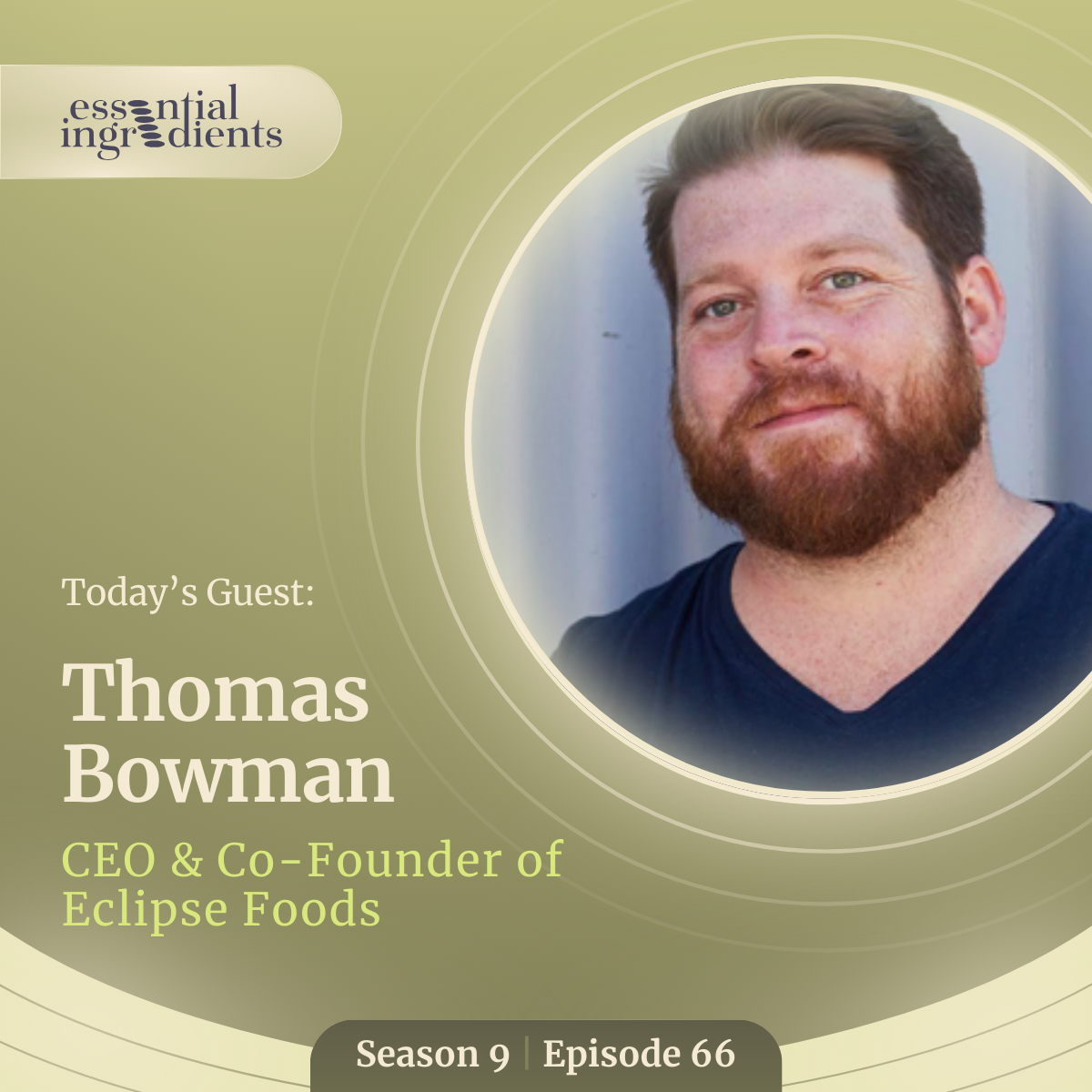
Thomas Bowman · CEO & Co-Founder of Eclipse Foods
Watch on YouTube
Milking Innovation: The Future of Dairy-Free Milk
The Incorporation Method helps you turn what matters into practical changes that fit your life.
“Thomas Bowman, CEO and co-founder of Eclipse Foods, uses molecular science to map the composition of real dairy — protein by protein — and engineer plant-based alternatives that actually look, taste, and cook like the real thing.”
Full Transcript
Full conversation between Justine Reichman and Thomas Bowman.
Good morning, and welcome to Essential Ingredients. I want to welcome you, Thomas. I want to welcome our listeners and our community that choose to join us each week to hear more about how food is impacting the future of life, health, beauty, fitness, fashion and the planet. So today, we have Thomas Bowman, who's here to talk to us from Eclipse. This is not our first conversation with Eclipse, but our first conversation with Thomas, so we're excited to introduce you as the CEO to our community, and equally learn a little bit more about what Eclipse is for those listeners that are tuning in and are not sure what Eclipse is, and then we can dig a little deeper. So welcome Thomas.
Thank you, Justine. Excited to be here, and have a great conversation.
Likewise. So last time I was on the phone or on the podcast with Aylon, apparently you were filming behind the scenes. So fun, a little different. Now, you've come to join me in the conversation, and I would just love to start with, if you could just let people know what Eclipse is today versus what it was when we first spoke. Because, of course, my memory, and if I had a video right now, I'd interject it right now is me eating an ice cream cone.
Absolutely. I think Eclipse is still on the same journey of creating a happier, healthier, more sustainable food system, and we're doing this by reinventing dairy, really creating amazing dairy products that are a little different than your alternatives out there. They are true dairy replacements. They look, taste and function just like dairy.
That is quite a feat too, right? To look, taste, to have all those senses and be dairy. I know when I eat anything that's made of cashew or soy, there's a definite different taste, and even consistency, I'd say. So I'm curious, after the taste of the whole thing, how are people responding to that? Is that something they're looking for, they're searching for, and they come and find this? Or is it sort of a new thing that people are still getting accustomed to?
We get amazing feedback from the consumer. A lot of people can't believe that it's not an actual cow's milk dairy, a lot of times. We kind of consider this like the third wave of dairy alternatives or dairy replacements, kind of first wave being your soy milks, almond, coconut oat milk, and some of the barista options being the second wave. But really, what we're doing is a little different than those extracted dairy alternatives where we're looking at the molecular composition of milk, all of its proteins and components, how they function together, and what makes it magical. And we're doing that from functional plant ingredients. We use a blend of functional plant components to replicate dairy to be a true dairy replacement.
It's super interesting. And as you're saying this, I had memories of conversations around the technology and how that differs from what people are doing with plant replacements or plant milks. Can you talk a little bit about that?
Absolutely. The magic of milk are its highly functional proteins, the casein and the whey. And we extract functional proteins from plants that are the same types of proteins, the same ionic charges as those proteins and we extract another protein that functions like whey, then really, our technology is around, how do we get those to come together and function in a way that looks, tastes and functions like dairy? So the overrun or air incorporated in our ice cream is from the functional proteins, not from like a gum system. Our milk steams hot and cold from those functional proteins interacting together. So we're not taking, like a whole plant and kind of pureeing it with water and straining it out and having a, you know, soy milk or almond milk. We're really just taking small, small fractionations of plants and highly functional parts of plants and reassembling them just like dairy.
Wow, interesting. And it is a different process, and so you get a little bit of a different result. And now, you're able to actually replace milk. And are you calling it milk replacement? Is there some sort of name? Because whenever we think of almond milk, or we say almond milk, we say goat milk, we say all these different things, hemp milk, we're calling it a milk. But is there an opportunity here to make your own, I don't want to say category, but something that would stand alone, and then people start to talk about it like that's a thing?
We just launched Firm milk recently, and we're calling it non dairy whole milk. Whole milk is considered whole based on the fat percentage in it. We have the same fat percentage as a whole milk. It's got the same texture, viscosity and mouth feel as a whole milk. So we're calling it non dairy whole milk. I think the consumer has been a little bit trained to go to dairy alternatives based on the main ingredient it's made from. But interestingly, non dairy creamer has been around since the 1950s, and nobody really asks, oh, what is that non dairy creamer made of? So we're trying to kind of get back to that. Just talking about what it is, and not what it's made from. I think it is technically plant based, but it's somewhat of a misnomer because we're using such small fractionations of a bunch of plants. So really, how we've been describing it as a multi plant milk or a plant blend, this is really something that I created, somewhat selfishly. A large portion of the planet loves dairy. But unfortunately, my body had different plans. And as a former chef, I couldn't go and grab a soy milk, or an oat milk, or an almond milk on the shelf, and use it in cooking the same, and beverage applications. It just didn't function or taste the same. So being someone who grew up in the Midwest loving dairy, and over time, just becoming more and more dairy sensitive really set out to create Eclipse. To create a true dairy replacement, instead of an alternative that maybe can cover a couple of the functions of what dairy can do. But we really want it to cover all the functions, look, taste, and function the same. We want to make the right choice, the easy choice.
Thomas, I know that in March of 2024, you guys launched in Japan. I'd love to learn more about the decision behind that. I understand that maybe one of your investors has relationships there. But can you talk to us a little bit about that, and what that journey has been like going from the US to Japan?
Absolutely. Yeah. So we were very lucky due to our Series B lead investors, Sozo Ventures having deep connections and the business and food world in Japan. The food in Japan is so centralized. A few companies run all of the food business around Japan. So by making these connections at the right levels, we're able to quickly launch our products. Our ice cream is first in Japan with Family Mart. And it started as a 50 store test, and quickly grew to 100, and then 300 store tests. And as of April 21 of this year, we're in every family mart in the Tokyo region around 2500 stores. And as of the end of June, we started a trial with 7/11 as well. So it's just expanding rapidly there.
As you're sitting there saying, and I'm going through and thinking about this journey and it looks like you've made huge strides, getting into all those stores and being potentially in 7/11, or at least doing a taster there, how did that compare to your experience here in the US?
In a lot of ways, it was very different. Business in Japan is just very different than it is in the US. And in a lot of ways, it was easier. I would say one of our biggest struggles in the US has been getting products commercialized, especially in the midst of a global pandemic. But the way that it works in Japan is to become manufacturers, or contract manufacturers there. They want to do all of that legwork and perfect your product before they even show it to you. So it's actually in a lot of ways easier getting the product commercialized there. Just speaks to the way that they run their contract manufacturing. And we really think that Japan is the trendsetter for Pan Asia, and kind of the springboard into expanding into other areas knowing that there's a lot of dairy sensitivity in Pan Asia. It's a great place to start.
Well, I'm gonna probably butcher it a little. But you had said that the co-packers take control and want to make sure everything's perfect for you before they show it to you. Did I hear you right?
That's correct. We're here for all of that. Groundwork, leg work has to be done on our end. They want to run tests in their pilot labs and bench top, and make sure that they know how to do it perfectly before they even show it to you, so it kind of expedites the process. And really great partnerships in all of our co-manufacturers there.
It sounds to me like they really take ownership over what they're producing, whether it's on their behalf, your behalf, or whoever's behalf. But there's an ethic there that is really strong so that they can produce something that is perfect before they even give it to you, which talks to character, in my opinion. I'm not saying that people here don't have character. I'm just saying this process highlights that in Japan, which I really admire.
Sure, yeah. They really care. It's, I think, the kaizen mentality of just constant improvement and really owning whatever it is you're doing to the best you can possibly do it. Any job worth doing is a job worth doing well. And I really appreciate that mentality of theirs. The perfection mindset of just constantly trying to improve, and make everything as perfect as they can.
Are there any other sort of things that stand out to you that I would say either impressed you or confused you as it related to the way they do business there, or was hard to even get a handle on because it was so different?
I would say one thing about Japan in general, and this explains a lot about the culture. There isn't a word for NO. There's no liketrue equivalent for NO in the Japanese language. We have seen rapid growth there, which has presented us with a lot of exciting opportunities. But that saying NO to opportunities with our team on the ground there, it was really a training process of, don't say no. Just say, not right now. We'll explore this down the road. Otherwise, you could quickly get distracted with all of the opportunities that pop up from it, and not having a word for NO.
That's it. That's an interesting thing to learn. Being culturally competent these days when you're doing business in different countries is so important. Did you feel like there was a lot to learn in order to do that? Was there somebody there that took you by your hand and said, okay, here's a couple things you really need to know.
To some degree. I also think that they are trying to somewhat reinvent, slightly change the business culture there. I think they want to be a place where they can innovate from within. But I think just the way that the business culture has been, it's very hard for people to put their hand up and say, I have an idea. So they are trying to invite more of this startup mentality to Japanese business. I also think one of the most important things about doing business in Japan is you really develop the relationship first, before you even start talking business. And that's actually my favorite part. Developing that long term relationship and having really strong partners there. We don't want to be one of those brands that comes in and pops up, and it's a flash in the pan, and now we're gone. We're not in Japan anymore, so we really looked at other places that have come in there and become lasting names and brands in Japan. Blue Bottle, for example, it's done an amazing job of not just being a pop up. And now, really gaining roots and using that as a springboard into other parts of Asia.
I'm so glad you shared all that. Because to me, that's really interesting. I think that we don't talk about it enough, whether it's the culture, whether it's the growth in other countries, the decision to do that. And I think it adds another dimension to the conversation. But I do want to go back a little bit to the beginning, because you originally started out as the CTO, right? You worked in the kitchen world, you worked in the food world, then you were the CTO. Aylon was CEO. Is that correct? That's correct? And now it seems like there's been a transition, and I'm wondering what that transition was like for you, both professionally and personally? And why did you make the transition?
I knew what I was signing up for, and I knew it was going to be a lot of work. But as the CTO, it was a lot of work. I think I just have to spend more of my time focusing on things that I wasn't before. One thing that was really important too in the transition was to get a really, really strong leader in house to kind of oversee product development and QA, and work very closely with operations logistics marketing. So we brought on Ben Roche to really run, and that he's done amazing since he's joined and running all the things on the product side. And that was really a key part in me taking this step up into the CEO level, knowing that that side of the business was well covered.
What are the biggest changes you've made since you've taken over as CEO?
I think the biggest change is that we've reverted our focus back to food service. We started as a food service first company, coming in and starting Eclipse. I know Food Services is difficult. It's expensive slotting fees and slim margins out of the gates. It's a small company. You're paying higher tolling at lower MOQs. So there's a path to profitability there, but it just takes so much marketing dollars and money to really build the brand and food service.
And what I think I remember hearing is you came out of food service. So I'm wondering what role foods, your expertise, your time, your experience in food service played with your decision to go back to food service?
I think being a former chef, chefs speak their own language. I'm fluent in chef, so I think there's conversations there that can be on my level that aren't quite the same as coming from just a typical sales person. So I think being able to speak the language, knowing the difficulties working with distribution and food service, and how I like to have been sold to, as in my restaurants, and what I didn't like, and just knowing that having been on the other side, I think, has really helped get a leg up in the food service side.
I was just gonna say, do you feel like it gave you that extra edge?
I do. I also think that we have a very strong outside of ourselves, just really strong culinary pedigree here within our product team. And we kind of want to make our food service partners feel like we are an extension of their R&D. If you have troubles, we'll work through it with you. We'll fly out and help you troubleshoot, help you menu ideas. You can come here to our headquarters and work in our pilot facility or lab, and we really just want to be true part innovation partners for a lot of our food service side as well.
It makes a lot of sense to me. I think, as you're saying this, and I'm thinking about people coming there and trying to put things together, one of the things that it just jogged for me was the conversation around processed milks. Not yours, necessarily. But just the conversation around plant based milks, and that there's been some speculation about them being overly processed. And I'm wondering if you have any thoughts on that?
I think good or bad due to some very old laws. The pareve act of the 1920s we are in, and a lot of the dairy alternatives are in what's called the PRMP category, Product Resembling Milk Product. Meaning, we have to be processed the same way as dairy. We have to go through the same pasteurization steps. We have to be processed on the same equipment. And it's interesting. It's like the ingredients on our label are written out clearly. People are like, oh, what is that like? What is calcium, lactate, gluconate? And it's actually calcium that's naturally in cow's milk. A lot of these things are naturally in milk. It's just the way we put it together. Everything is written out. And a lot of those on a milk label, it just says milk. They don't have to break down what it is. But we've kind of taken that breakdown and built it back up so it does make for a longer ingredient statement. But I don't think anything in there is scary. It's all non GMO products from plants, right?
So you're saying it's not overly processed. You're just being more explicatory about how you do it, and what you're including, and that's basically that supports the clean label?
Exactly, yes. One thing that I think is the future of Eclipse is the Intel insider powered by Eclipse model, where if we really, truly want to make an impact and create a better food system, it's by partnering with bigger, more established companies to help them make their use our technology to make their products better. And in Japan, we just did our first kind of proof of concept test of this, working with a big ice cream manufacturer called Takeshita Seika. They actually took our milk powder, our non dairy milk powder, and made their most famous, it's called Black Mont Blanc bar. It's like a little ice cream bar, almost like the good humor bars back when I was a kid like that in Japan. They made it using our Eclipse non-dairy milk, and nobody can tell the difference. And so I think doing more of that, powered by a close model, is the true future.
And as you're talking about the future, I'm wondering with all the success you're having in Japan and continue to have, what other markets might you explore?
I think with Japan, some of our partners on the ground there do have connections around Asia, from South Korea to Singapore, Taiwan, Indonesia. Really, it's going to depend on which sector of the market we go after. If it's ice cream, it's probably South Korea. If it's milk, it's probably Singapore, Taiwan. But we just launched our milk in Japan as of two weeks ago, and we just launched it here about a month and a half ago. So it's really just getting off the ground, and we really think that there's opportunity for both. But I think another good learning from Y Combinator was really picking one product and growing that one, and finding the market that it works in. So I would say Singapore, Taiwan for milk. And then likely, ice cream for South Korea.
So can you talk a little bit about some of the exciting partnerships you have coming to fruition? And what can we expect next with Eclipse here in the US?
We are working on some exciting partnerships with Bluestone Lane coming up here soon, and doing some fun events with them. Including one at their Chelsea pier with our soft serve, and then some other kind of more coffee focused events as well here in the Bay Area.
So Thomas, I'm excited to know that you have a couple new launch partners and things that are coming down the pipeline, whether they're in Japan, whether they're in New York, or whether they're in the Bay Area. We want to know what we can expect?
Absolutely. We have a very exciting partnership coming up with SG group. SG Club has been named one of the top 50 bars in the world by the Senate felt green. And they are going to be doing a featured cocktail using Eclipse non dairy whole milk.
That's exciting. And where are the majority of their clubs?
Mostly in Asia. They have one in New York as well.
Okay. Is that something we're gonna see coming down this fall that will be starting in September? That's super exciting. I'm so glad you shared that with us. Is there anything for the folks? Well, I am a New Yorker. I do live in the Bay Area, and would be very remiss if I didn't ask you what we can expect here in the Bay Area.
Here in the Bay Area, I think we have some exciting opportunities. We just did an amazing event with Timeless. They've been an amazing partner with Eclipse for quite a while. And we'll be doing more events with Timeless Coffee featuring our non-dairy whole milk.
And when can we expect to see those? When can we hear what cafes we want to go to, to try this?
You can actually go to Timeless Coffee right now and find our Eclipse milk here in the Bay Area at either of their locations. Soft Serve at Mamahuhu as well at Mill Valley, as well as all of their other Bay Area locations. That's a new partnership, and we've just been amazing working with their product team, and seeing the amazing products that they're creating using the Eclipse Soft Serve.
Wow, that's exciting. And I say that on a personal level, because I could throw a stone at Mill Valley from where I am, so I can go there after the podcast.
Yeah, that's right.
So I'm curious, as we wrap this up, I just want to know, can you maybe share one myth about plant based dairy that you'd love to debunk?
Our plant based dairy isn't about a single ingredient. It's about all of them coming together. It's about what it is, and not what it's made from. And we spent a lot of time building up a library of options from the plant kingdom to where we can find these functional proteins and functional components, that there are amazing things all around us in the world that we can create amazing products from.
I think that's true. And I think people sometimes forget that we get uncomfortable with something that's different or unknown. And I think that sometimes, it's been a journey to get people over that hump.
One thing that we're excited about with our Eclipse non-dairy whole milk is that a lot of times, dairy milk, cow milk is used almost like a kokumi ingredient to where it kind of elevates more than the sum of its own parts. Like coffee, they really want the intricate flavors of coffee to shine through on a coffee and milk to just be kind of a neutral dairy elevator. And we think our milk has a great kokumi effect, where I think oat milk has that in a lot of ways, with some things, but not others. And we really want kaizen to continue to improve, and be able to be that one for one dairy replacement.
And what's your favorite way of using this dairy replacement?
I was so excited when we first commercialized our milk, because I used to love a bowl of cereal with milk, and it had been so long since I'd had that. Went home and had a big bowl of cereal with milk, and it was amazing. And so many other people in the office have tried it. They're like, oh, my gosh, the milk left in the bowl is the best thing ever. It's better than dairy milk. It's just something about it, like pulling in those flavors that you love from cereal milk.
Bringing back all these things. I'm wondering, to me, it makes me feel like we've tried to make a lot of strides in the world to make things better, but maybe we haven't always made them better. Maybe we've complicated them or use things we didn't need to use. So I'm curious, what are your thoughts on that?
I think our thoughts on our products is that we don't want to put anything in there if it doesn't need to be in there. If it doesn't make it 10x better, it's not going to be in there. We use non GMO products, all natural plants for our special, magical proteins. We try to use waste streams as much as possible for sourcing our proteins. For example, our canola protein came from the waste stream of canola oil production where that mash or meal that was left over contained highly functional proteins in it. Or potato protein came from the first wash of the potato starch industry, and it normally went down the drain. There are amazing, highly functional proteins in there. So we're going to continue to find new sources, more sustainable sources and ways of using up waste streams to create amazing products. So I think food waste is somewhere where we've continued to get worse since the olden days, and we need to find ways to get better at that, and find better ways of using those waste streams for delicious products.
Well, I think we buried the lead, but upcycling is such a big topic around this. I feel like we're not giving the time that it needs. I really appreciate what you just said and how you're integrating that into what you use. While we've gotten better at certain things, we certainly have gotten worse at that, and I love how you've integrated that. I'm wondering, what part of the conversation is focused around upcycling? Is that just a benefit to what you're doing? Is that a focus on what you're doing? And how are you communicating that with your consumers?
Something that we communicate, I think, more on our website and social than we do on pack. I think we want to create something that's for everybody. There's such a large population that is dairy sensitive like myself. So we don't kind of scream it on our packaging, but we make it more of our mission. I think there will be true, deep partnerships as well in the future. I think about the yellow pea industry where it just boomed. And every protein producer was doing yellow peas, but then it created this huge stockpile of yellow pea starch that we didn't have enough outlets for. So I think down the road, partnering with a hummus maker and all of that aquafaba that normally goes down the drain has amazing proteins in it. And finding the right partners to where there's a use for all parts of what we need and what they need, and that would be the ideal partnership and true sustainable way to do this.
Awesome. So we have our highlights. What's coming down the pipeline in both New York, Japan and the Bay Area for some exciting news. And you guys are looking to include upcycling in this. I feel like this was a jam packed episode of how to build a better for you food business, changing your function in the role to a new one, and learning about your experience doing all that. And I think it's just been so inspirational as our listeners and our viewers tune in to hear all that goes into the thinking behind building this business and how it's coming up. So I love the pivots. I think they're super interesting. I think they're very topical. When you talked about covid and how you direct the consumer was a big change. But equally, at that time, it gave you a business. And then, of course, post covid, then you're like, okay, well, that's way too expensive. We got to do this. So I love the inside viewpoint that you gave us, and I just want to thank you for that.
Absolutely. This has been a great conversation.
Oh, likewise. I want to thank you, Thomas, for joining me today. I want to thank our listeners and our viewers for tuning in each week. And don't forget, if you have not subscribed to our podcast, you can find us wherever you listen to podcasts, Essential Ingredients. And if you want to watch the video, we have a video cast that is on our YouTube channel called Essential Ingredients. We hope you'll like, subscribe, download, and leave us a little note already. Talk to y'all soon. Talk to you next week.
Share This Episode
Enjoyed this conversation? Share it and tag @nextgenpurpose
Listen on Apple ▶Listen on Spotify ▶Your Host
Justine Reichman
Founder & CEO of NextGen Purpose. Host and Executive Producer of Essential Ingredients — 11 seasons, 330+ episodes, and a growing movement.
About Justine →