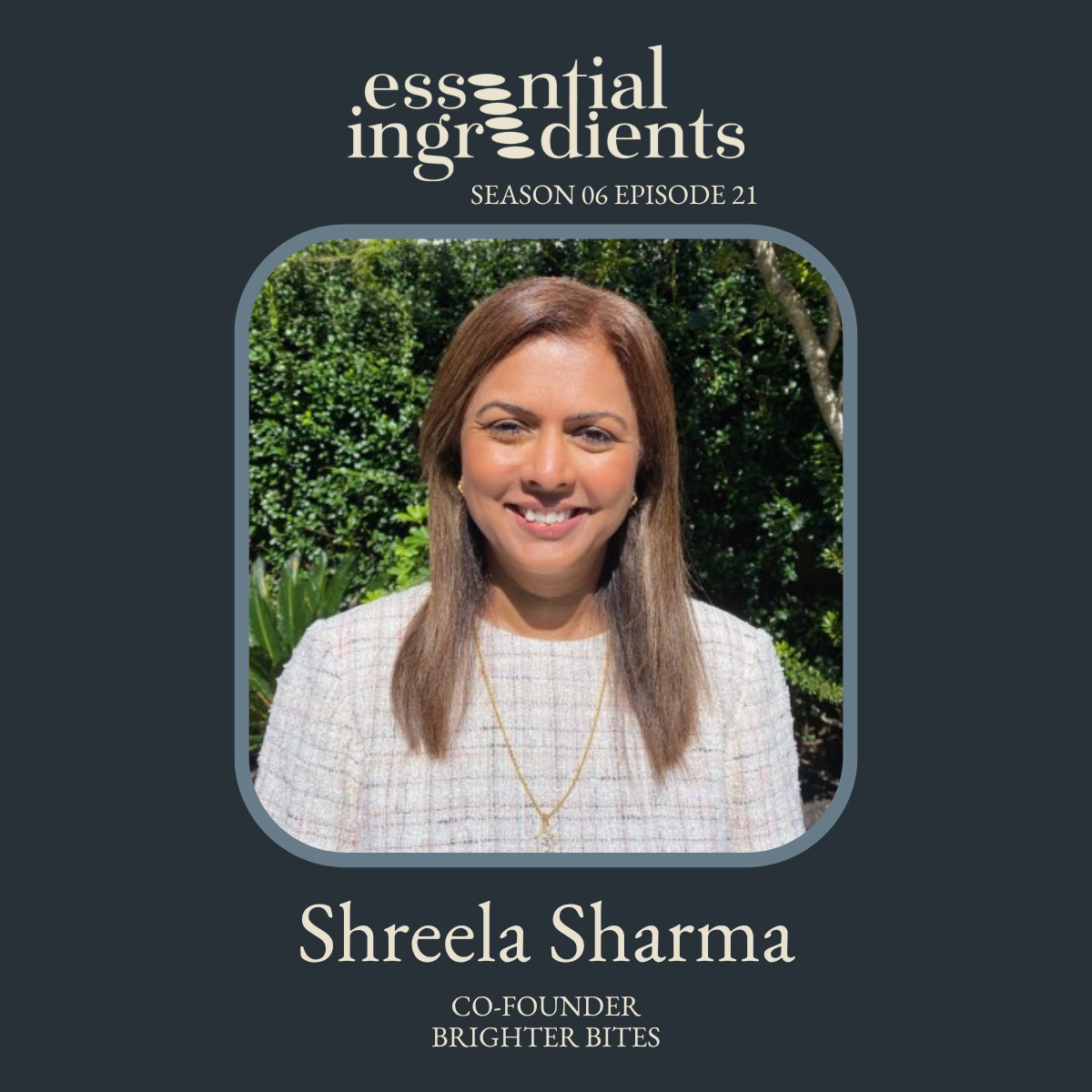
Shreela Sharma Ph.D. · NextGen Purpose
Watch on YouTube
Democratizing Health and Nutrition with Shreela Sharma Ph.D.
The Incorporation Method helps you turn what matters into practical changes that fit your life.
“We are currently living in one of the most prosperous times in human history. The problem is that many people are still not having access to enough high-quality food or even the right education about it.”
Full Transcript
Full conversation between Justine Reichman and Shreela Sharma Ph.D..
Thank you so much, Justine.
I'm so glad that we finally got this going. I know, it's been a little challenging for all of us, and part of it is my fault. So thank you for your patience.
It's a delight to be here. Thank you for inviting me.
Wonderful. So for those that are not familiar with Brighter Bites, let's just start there. What is Brighter Bites?
So Brighter Bites is a nonprofit, it's a national nonprofit. And our mission is to create communities of health through fresh food. And what it is, is that it's a program that's implemented like a school based food co-op. And right now in America, we have a huge food waste problem on one side, so about 60 to 80 billion pounds of produce actually just die in the landfill. And on the flip side, we have about 40, 50 million Americans who are struggling with food insecurity. Families who are food insecure, the same families are also struggling with diet related chronic diseases. And so they have poor diet quality that leads to health issues later on in life. We need to really think about health, not just health care, right? And that starts orally. And so through Brighter Bites, what we have done is we've taken, we want to channel this produce that would otherwise be thrown away and bring it into communities that needed the most using schools as sort of the venue to implement the program. So every week, our families get about 20 to 25 pounds of fresh fruits and vegetables. It's 8 to 10 different kinds of chocolate tomatoes, or grapefruit, or oranges, or just this variety of fruits and vegetables. And then we combine that with a lot of education in school and for parents. And so that way, we teach our kiddos to enjoy the fruits and vegetables that they're going to get at home, and we teach the parents how to use what they're getting. Just because you have it doesn't mean you know what to do with it. And let's be really honest, nobody wants to eat a sad salad just because it's healthy. Flavor really is what's the game changer when it comes to food and behavior change. And so we teach the parents how to, can work that food, the beats that they're getting into are brownies. I know it sounds crazy, but we've had kids literally like chase us, or kale smoothies, it has to be tasty. And so we work a lot with the schools, and we work a lot with the parents to really make the fruits and vegetables tasty and flavorful. And most importantly, healthy as well.
Wow. First of all, that's so smart. I love the mission. I think it's a great idea because it's all part of their upbringing, and it becomes part of what they know from the very beginning. This is what they're going to take with them through their life, so this is what they're going to know. This is what they're going to create as part of their model going forward.
Yes. And there is such a thing called intimidation by produce. I came to the US about 25 years ago, and I remember I had never eaten broccoli before. I was a student, poor student. And so I remember circling the grocery store. I knew what cauliflower was, but right next to it was this green broccoli and I was intimidated by it. I did not want to spend my two bucks on buying a vegetable that I didn't know what to do with. And so every week for six months, we ID each other, and I was like no, no, no, not this week. Until finally, my roommate, one day she was like, Shreela, you just gotta put some olive oil, salt and pepper and stick it in the oven, and it's going to be delicious. To this day, that's how I eat my broccoli. It's about access, but it's also knowing what you do when you have it in front of you. So it's that combination.
I don't know about you, because culturally, everybody eats things differently, right? We prepare them differently, we've grown up eating them differently. I remember hearing stories from my dad who said that his mother used to boil everything to death years ago. She was Eastern European for Kyiv, and she used to boil everything to death, and it didn't have any taste. And so the vegetables, they lose their vitamins, they lose their taste, and so you don't like them. So if you grow up eating vegetables that were boiled to death, don't have any vitamins, which take away all the value of them, right? And then they don't have any taste, you don't want to eat them. So from the beginning, you're doing with education, with preparation, giving people the tools that they need, well then you can change the future of how people think about this narrative around vegetables, how they're going to prepare them, why they're going to eat them and how they can eat them. They've got a chance at creating a better future for themselves around what they're putting on their plate. So I have to ask, what inspired you to start this company?
So Brighter Bites is 10 years old. So about 11. A little over 11 years ago, I was introduced to this wonderful woman who is now my partner in crime, Lisa Helfman. Lisa and I, when we met the first time, she said to me that I have this idea. And I don't know if I'm going to sound crazy, but I'm going to share it anyway. And she said that I've been participating in this fruit and vegetable co-op with my family. And I found that just by having the fruits and vegetables at home, my kids are eating better. So much so that her son who was 6 at the time was at a birthday party and actually rejected the cake and asked for the fruit instead. And that's when the light bulb went on in her head. She was like, well, if we can do this in our home, then why can't we replicate the same model in communities that are struggling with diet related chronic diseases. She's an attorney by trade. She was working at a children's hospital at the time doing their real estate. And when I met with her, very interestingly, the week before the Institute of Medicine had come out with a report. And the report said that just doing nutrition education is not going to cut it. When it comes to changing behavior and having healthy behaviors, especially for children. And especially for children who are coming from lower income families, we need to combine access with education. So when Lisa shared her idea, I was like, yes, this is it. Let's do it. So we came together. I'm actually a professor of epidemiology. I work at the University of Texas School of Public Health by day. Food insecurity is the epidemic that I work on. So we came together, put a plan, one of the big things that I really believe in and I can bring to the table is data. And not just on whether the program is implemented correctly, but whether it works. And so we put the whole package together on what is Brighter Bites. That's what brighter bytes are now. And also, we formulated a backbone for the data side of things to collect the data. So we know that whatever we're implementing is working, and so on and so forth. So anyway, 10 years ago, in 2000, well, actually a little over 10 years ago, in the fall of 2012, we launched in one school with 150 families. We were just on a mission of, is this going to work? Is this something that schools want? Is it something that families want? Because not only are we providing them with the fruits and vegetables, we are flooding their pantries every week. We do it for 16 weeks in the school year, eight weeks in the summer. But we are also asking a lot from the school. We train the schools and implement a very rigorous nutrition education curriculum. The whole point of the nutrition education in the schools is, all of that is gone out to home which was part of the fabric of the schools that no longer even exists.
I don't remember the last time I heard somebody even mention the ers home back in a school.
So how do we expect kids to learn the language around food and nutrition and get engaged in it? And we also want it to have a whole school approach, which means that everybody in the school gets the program including teachers, including the principal, everybody gets the produce, and everybody gets to participate in the nutrition education. So the school commitment is pretty substantial. And then we needed the logistics, right? The parents have to come, they have to pick up their bags of produce, and so on and so forth. So we wanted to just try it that first year in 150 families. And it was quite remarkable. We had over 90% participation in the program, and consistent participation throughout the school year, the principal just loved it. I still remember the story talking about the boiling of vegetables. So the program runs as a co-op, it runs as a co-op in the school. And so every week, we have parents who come and help with the bagging of the produce in the school. The food bank drops off pallets of produce, and then we just bag it. And one mom used to come week after week, after week. And we used to be there. Lisa and I were there that first year. We were doing it all. We had the blender, we were making kale smoothies, we were bagging the vegetables, we were cleaning up after everybody was gone. It was 9:00 o'clock by the time we came home at night. But this mom said to me that I never bought brussels sprouts until I got them through Brighter Bites, and you guys taught me how to roast the brussels sprouts. And the reason I never bought brussels sprouts was because my mom used to boil them, and they tasted awful. I want a limited budget, and so you gave me this risk free trial. And so now, my kids love the brussel sprouts so much that even when I don't get them through Brighter Bites, I go to the grocery store and buy them. And that's kind of the magic, right? It's about providing families with that risk free trial that is healthy, tasty, and giving them the tools in converting those foods into healthy meals for their whole family. So that's kind of the magic of Brighter Bite.
Yeah, that's wonderful. I'm curious, for these kids that now have the access, are you seeing any stories where perhaps previously, they had really bad habits? And how have they changed? Are there any stories like that you could share? Because I think that would be really impactful.
Yes. Oh, we have. So interestingly, as part of our data, I'm a big believer in capturing lived experiences and using lived experiences to really guide our work. So every year, we intentionally collect stories from our families, just tell us what your experiences are and tell us what we can do better as well. And so I still remember this one mom who is an immigrant, and she was in the school that actually had over 32 languages spoken at that school. So it was a very diverse school. She had come from South America and immigrated to the United States with her family. She said that when I moved to the US, our eating habits drastically changed. We were eating a lot of junk food because it was cheap, and it was readily available. My kids liked it because it was fried, it had the salt, sugar fat that they liked the taste of. But that's not how we ate when we lived in South America. We had healthier food habits, we were eating beans, we were eating rice, we were eating vegetables. But because I came to America, I cannot afford them anymore. That's what we would default to. We were eating all the junk. But with Brighter Bites, she was able to have this whole array of fruits and vegetables. We give them 8 to 12 different kinds of fruits and vegetables at every distribution. So she had this whole array of fruits and vegetables. We also try to be very culturally sensitive to the communities we serve. And so she could now convert those foods into her culturally specific meals that our family enjoyed back from being in South America. And slowly, our kids' habits and her entire family's habits changed so much that now they are craving the vegetables just as they did years ago when they were back in South America. That's just an example. Unfortunately, the fact that our families live in what we call food swamps that it's high density or fast food restaurants. But that 's not a done deal. We can shift those behaviors, we can bring it back to where we were years ago just by eating, just by having some fresh in the house. So yeah, that's one story that comes to mind.
Thank you for sharing that. I'm curious, so your partner, what's your partner's name again?
Lisa Helfman.
Okay. So when you and Lisa came together, you from the medical field, and her from the legal background. You came together with different backgrounds, different skill sets, but equally this passion around giving people access to better foods so that they could change their diets and have accessibility to fruits and vegetables. How did that work? How did you guys decide who was going to do what, and how did you lean on your own experiences to be able to build this business? As I think you're both first time entrepreneurs.
Yes. So I think that is such a good question. We are now intensities. We served 54,000 families last year, week after week. We've come a long way from one school and 150 families. I'll say that the number one factor has been trust and respect. Any company only grows at the speed of trust that you have, especially within the leadership team. So when Lisa and I came together, we both brought very complementary skills to the table. Lisa is probably one of the most passionate and strongest advocates. She does such incredible advocacy work. She has this incredible strength and resilience in terms of giving a voice to the communities that we serve, and we have the privilege of serving. My strength is bringing the science, and bringing the data, and bringing the elements of, okay, how do you actually put this into operation and action? And so bringing those complementary skills were critical because you can have all the great data in the world. But if it's not used to move the needle in terms of advocacy, then you're really not doing the service by the communities that you're serving. So it does take those complementary skills. We also knew what we were not, I think it's equally important to know what you're not. So neither Lisa nor I actually ever worked for Brighter Bites. So Brighter Bites was a program for about three years when we started. And that was important because we really wanted to invest all the money into developing our model and testing our model. We already had full time jobs, and we were very fortunate that our employers said, this is great, just keep going. And so we really were able to invest all of the funding that we got into testing and building the model, and in developing our scaling platform. And then three years into it, we became our own nonprofit. So it was only in December 2015 that Brighter Bites became its own nonprofit. And then we actually hired our first CEO. So we knew that we wanted to continue providing and serving Brighter Bites and the families, but we necessarily did not want to be the CEO. We wanted to serve in a different way. So I think it's important to know what you're not as well, but that allowed us to continue to build on our strengths and the respective strengths that we built while the CEO was there for building the operations and building out the organization. So I think that was the chemistry.
Do you guys still sit on the board of directors? Still, you are the founders and still ,you don't hold the vision for its growth, and what your plans are for the future?
Yes, yes, we are very intimately involved. In fact, I just came back from a meeting. You're very intimately involved in setting the strategy and the vision, or the organization along with an incredible board of directors and an incredible CEO, Rich Dachman who is the CEO of Brighter Bites. He used to be the vice president of produce for Sysco foods. So he knew the entire produce industry and how we can get the volume of produce that we need because we grew very fast. We went from one city in Houston, and now we are in 10 cities in 10 years. Our program is very high touch.We meet families every week, and we do a lot of intense programming. So it's a very immersive programming approach. So we are still very much involved in the strategy alone, and the vision and the board of directors. But having the CEO allows us to build on our strengths, allows us to focus on just that. My family has been able to support an endowment through this university and through Brighter Bites that actually allows us to bring in the brainpower and the science of new students. The fresh blood and the fresh knowledge to the program to advance science and keep pushing that forward. While Lisa, she works now at H-E-B which is the largest grocery retail chain in Texas. And so she has been able to bring that to the table. So we continue to bring the strengths and the partnerships that our respective professions have allowed us to do. And I'll say, probably the most important lesson I have learned in this process is the importance of partnerships. Brighter Bites does not own a single warehouse, or a single truck, or any physical infrastructure. We have been able to leverage all of the partnerships along the food chain. We've been able to partner with food banks, food growers, distributors and create this alternative supply chain framework. We've been able to distribute over 50 million pounds of produce doing just that. I think the foundation of this work has also been building a lot of those relationships which both Lisa and I love doing.
That's amazing. What you guys have built is, it's just wonderful. It's amazing, while you also had a completely other full time job. This was like what they call a side hustle. That's a really big site. And I'm curious, so I know that you guys were excited, you guys were having an impact getting traction. And at some point, you must have realized this company is taking off, and we're gonna have to figure out how it's going to run. But at what point did you realize you were either going to have to run this company or bring somebody in? And when did you realize that you wanted to bring somebody in? And why did you realize that you wanted somebody in and that you weren't going to run it yourself?
Yeah, that's a really good question. And sometimes there can be something like a founder's ego, right? Which is real because you own the idea. The thought sometimes can be that only you can run the company because it's your idea. And I think those are two different things. Running a business is a completely different skill set than incubating an idea and putting the idea into action. Very early on, both Lisa and I knew that we were great at whatever we were respectively bringing to the table, but we necessarily didn't want to run the business of a nonprofit. Running a business is hard work and requires a very different skill set whether it's development, marketing, communications operations. It's a different skill set. And so we realized pretty early on as we were putting the nonprofit together in 2015 that the business operation side of things needs to be someone else while we can still stay connected, the strategy and the vision. And that's what we have continued to do. So right at the beginning, fall 2015 when we decided, okay, now it's time. It's too big for it to be just a program that two moms are doing at 4:00 AM in the morning, or Saturdays and Sundays coming together, which we did. I loved it. I wouldn't replace that experience for anything, but it was time to grow up. And it was time to get serious. We found some incredible talent who wanted to be our CEO, and we launched Brighter Bites as its own nonprofit.
I think that takes a lot of courage to do that and self worth. Because so often, we're so connected to our ideas, and we have to let go of the ego to realize that this idea can go beyond what our capabilities are. I give you a lot of props for that, and thank you. I think that often, we're really attached to it. It's my idea, I created it. But I think that there's a lot of wisdom in the fact that somebody else can do more with what my idea than I can. Or my skill set is better off here, and I can do more here doing research in the medical field and doing this, and she can do more here, and we can still contribute and build on this vision, which is my next question. But to be able to do that, I have a lot of respect for that. I think that that's amazing.
Thank you. I wouldn't lie, it is a little hard because there is that feeling of ownership, it's your baby. But at the same time, it has been nothing but an incredible experience because we had these phenomenal leaders in our corporate team is probably the most passionate that you've ever seen. So it's been nothing but a phenomenal experience for us.
So something to be said for, when one person can do so much, but when you bring on more people, and together, we can do exponentially more. It's the same idea. You could do this, you can do so much individually. Together with Lisa, you guys can do more. And then when you bring in people that surround you with the expertise that you actually need to take that vision and execute on it, and expand on it, and grow it and scale it with expertise that maybe neither one of you have. You now can take that idea that you have and grow it in ways that you may never have dreamed possible and faster because they've done it before. They have experience. They have resources. I just think that it's a gift that you gave to the population to the people. And then also to allow these people to come in and help is also very generous because you gave your idea. I mean, you didn't keep it for yourself. You brought people in and said, listen, I want to be able to make this bigger than what I have, what I'm capable of doing on my own.
But sometimes, you can smother an idea by keeping it too close to yourself. And we didn't want to smother it. We wanted to mother it. We wanted it to grow, and we wanted it to fly. And to do that, you have to bring in other people. You have to raise your hand and say, hey, this is not something I know how to do, can you help? And that's exactly what we did. As I mentioned a few minutes ago, Brighter Bites leverages on all of the expertise across the food chain and creates this model which is the sustainability side of it as well. That's how we've been able to sustain the efforts and grow so quickly because we've had incredible partnerships along the way.
So when you look forward, as you guys are still spearheading this initiative, as part of the board of directors, what are you hoping to see as for the future of Brighter Bites?
As I mentioned a few minutes ago, the need is still really great. We have some of the highest rates of food insecurity. The pandemic was just really unkind. A lot of people, and all of these issues are rooted in poverty and financial distress, really. And so the rates of food insecurity are high, the rates of chronic diseases that are all related to diet are high. So we still have a lot of work to do ahead of us. But the nice part is that we have a lot of appetite from schools, no pun intended, from schools and partners who want to bring evidence based programs, like Brighter Bites, into their communities. And so if we can then be modest, and that's really the philosophy that we're adopting with Brighter Bites as we want to go where we can make an impact. We just launched in San Antonio, our tenth city this fall, as we celebrated our 10 years. We have an incredible team across the 10 cities who are very passionate. Our corporate team is really focused on that strategy where we can go and make an impact. So growth is definitely on the horizon. But growth in a way that makes sense and makes brings our strengths to the communities, and builds on the strengths also of these communities as they need them. So our short and long term vision is impact. We want to make an impact. We've never left a community thus far in 10 years. We've never left the city. We want to make sure that we go the last mile for our families that we serve. And the other side, I would say in terms of growth is also thinking about what might be the other ways that we can reach our families. We're doing school based approaches, but we also know that there are other ways in which families intersect with organizations like healthcare organizations. What are the different ways in which we can inject this prevention approach rather than wait for someone to get sick and have them be treated. So trying to intersect early on in the lifecycle as well of the children is something that we're exploring. So whether we want to intersect with pregnant mothers, whether we want to intersect with preschools, whether we want to intersect with healthcare organizations to offer this as a prevention approach for their patients, we all need to eat healthier. So yeah. In terms of it as we think about growth, it's not just more cities that's definitely on the horizon, but it's also thinking about different ways in which we can reach our communities as well.
Thank you so much for joining us. If anybody wanted to learn more about Brighter Bites and what cities they're in, or what cities you're coming to, what would be the best way for them to get that information?
Let me share my cell phone, I'm just kidding. You can go to www.brighterbites.org. There is a whole host of information along with how you become part of our community. I will also say that I'm very proud of the fact that we are democratizing nutrition knowledge. You can download our Brighter Bites app for free if you have an iPhone or an Android. And it's also available on our website. In fact, many of our healthcare partners, I'm in the Texas Medical Center here, and many of them just go to our website and download all the nutrition information and use it with their patients. We are all about democratizing knowledge for anybody who wants to use it anywhere. It's in English and Spanish, the app and the education.
Thank you so much. Well, we want to thank you for joining us today, and keep us posted on how things progress.
We'll do. We'll do, thank you so much Justine.
Share This Episode
Enjoyed this conversation? Share it and tag @nextgenpurpose
Listen on Apple ▶Listen on Spotify ▶Your Host
Justine Reichman
Founder & CEO of NextGen Purpose. Host and Executive Producer of Essential Ingredients — 11 seasons, 330+ episodes, and a growing movement.
About Justine →