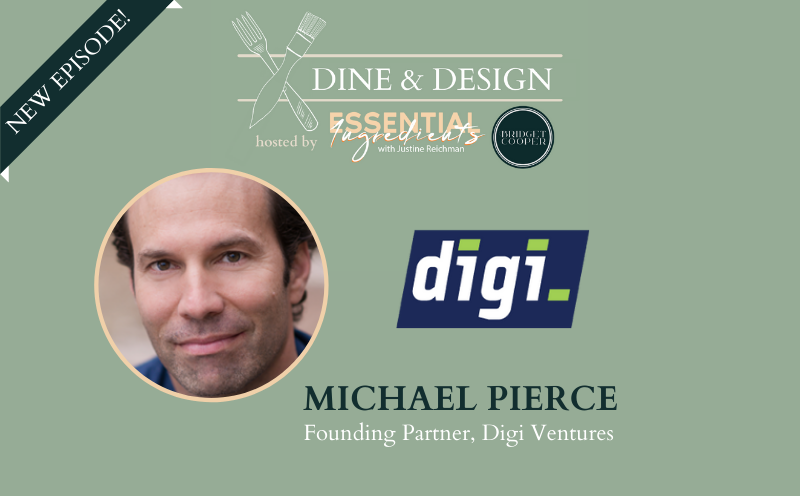
Michael Pierce · NextGen Purpose
Watch on YouTube
Is Impact Investing a Win-Win? Positive for Your Portfolio and Society, too? with Michael Pierce
The Incorporation Method helps you turn what matters into practical changes that fit your life.
“Post-seed investment is the most underrated stage of investing. Post-seed investment is a venture capital investment that comes after a startup's initial "seed" round. New startups often raise a seed round after launching their product to gather the funding they need to grow their operations and help their companies grow fast enough to make them valuable.”
Full Transcript
Full conversation between Justine Reichman and Michael Pierce.
Lovely to be here. Thanks for doing this. It's a pleasure to talk to you.
It's such a beautiful spot. Oh, my god, I can't believe it. I'm super excited to be here with you today and learn about your wine and what you're working on today. So can you tell everybody where we are and what wine we're tasting here today?
Yeah, sure. Thanks. So we are on the Mount Carmel vineyard in the beautiful Santa Rita hills and gorgeous Santa Barbara County. I mean, life is good. Yeah, exactly. This is kind of one of the, I think one of the most important qualitative vineyards. And historically speaking, one of the most important vineyards in the Santa Rita hills. And we're actually, specifically, we're in Block 2, Pinot Noir.
What does Block 2 mean?
Just one of the blocks. There are six blocks on the property, Block 2 is Pinot Noir. You are doing the (inaudible), obviously, 2017. I'm drinking Pinot 17. But the whole property is really, we'll walk and talk about it, but it's made up of six parcels that really act like puzzle pieces, and fit together perfectly.
For listeners and viewers that are not familiar, what's the name of this winery?
Yes. So the name of the vineyard is the Mount Carmel Vineyard, and the estate program of the Mount Carmel vineyard. Meaning, one of the owners of the vineyard works on, and the fruit goes to and we kind of keep to ourselves is called Mail Road. The road, as we drove in that long, winding very slow road to get here. It's called Mail Road. I don't know why historically, but it is. And the Mail Road project started in 2012. And we've had the pleasure, I'm incredibly honored to make the home lines of this vineyard.
Okay, so I want to just know, how did we get here? How did you get here? How was your journey getting to this Mail Road here?
Super difficult. I grew up in Kansas City. I was called the fine winemaking mecca. I grew up loving plants always. I always was a kid who just, people made sense, but plants almost made more sense. They're wonderful systems. They're wonderful, the way that they react, just plants makes sense. I went to University of Vermont, another fine wine growing mecca, and ended up getting into Plant and Soil Science. Planted a vineyard in Vermont in ages 1987 and just fell in love with it. I've been making wine and growing grapes ever since.
So you always wanted to be a winemaker since you studied plants.
I think in the schools in Europe and whatnot, you have to choose for your high school in essence, almost what you want to be. I want to go into engineering, I want to go into mathematics, I want to go into sciences, I want to go into these. In the US, I think we have kind of the blessing to say, I don't know what I want to do. Want to go into a liberal arts. I'm gonna go and do these wonderful things and figure myself out. I had no idea that I wanted to make wine. I mean, I grew up drinking. I don't want to talk about how I grew up. On a good day, on a special occasion. But I found it when I was 18. I was very fortunate, really blessed to say, get bit by the bug, as we say. You get bit by the wine bug and you fall in love with the grape, and you dance that dance.
That's pretty great. Because at 18, I had no idea what I wanted to do.
No, I just moved to New York hoping that I'd figure it out.
I think that's better. It's better to spend your life, and finally, take your time to figure out where you're going.
I'm not even sure I knew what I wanted to do at 20.
That's fine.
When you're designing Mail Road, where are you putting all the grapes and everything? How do you decide, this is a lot, how do you--
I wasn't here when it was planted. This is what we would call historic in Santa Barbara. You look at history in Europe and you're dealing with a Charlemagne vineyard or you're dealing with a vineyard that was planted by the Romans right here. This was planted by the beautiful proprietors, Ron and Nancy Piazza who are just exquisite people. They planted this in 1990, and they planted it with the help from the nuns at the monastery. I mean, the history of this place is really unique in this world. But I think they have these ideas, there's really one shard and a block that's behind us here, in front of us here, the rest being Pinot. Over the years, they've been tweaked a little bit. I think there are two remaining original blocks that were planted by Ron and Nancy specifically. And when you kind of start a project, that's a beautiful time because there's really no books written on what you have to do. And I think Ron and Nancy looked and they had ideas of the aspect, and they had ideas based on a couple of other vineyards, actually the vineyard behind us, Sanford and Benedict, which to me is the other impactful, older vineyard. The more historic vineyard planted in the 70s. So they took some of the cuttings from Richard Sanford, put them here. And a lot of their inferences, a lot of their gut kind of intuition blind luck. To be fair, in some cases it really worked. I think the Chardonnay vineyard right there is one of the finest Chardonnay Parcels in the United States, to be fair. I think they're Block 4 Pinot, which was the first vineyard block they planted and is arguably one of the finest Pinot Noir vineyards in the United States. And these others that came later. Our farm differently been planted differently, and everything just kind of works and flows. Yeah. And I think it speaks a lot not to be dorky, technical.
We love this.
But we're standing on a south facing Santa Rita Hills Parcel. So this mountain runs east and west here. And being south facing you, you take in the sun all day. In the northern hemisphere, the south facing slope, the sun goes up, the sun goes down, it's facing your slope all day. So these vineyards are just bathed in sunshine year round. But they're also something that we call refrigerated sunshine, such as never happens. Until today, to be fair for us, but it's like 65 degrees. So they kind of have that refrigerated sunshine quality where they're sunny, they're pretty cool. So they have a lot of fruit, but they also have really high acid, and they're balanced.
That's amazing. So I'm curious. As a winemaker, you came here, they found you. You mentioned to me that they found you. How'd they find you?
I won the lottery? No, I've been making wine in this county since 2004. And one of my passions was defined, how would I say this? I think the great winemakers of the world are people who stay in one place for a very long time and form a relationship with a (inaudible). Because you can't take lessons and transform all over the world to me, you kind of set your feet in one place, you plant your roots, you grow your roots, you kind of develop in a place, and you get to know a vineyard over the course of your lifetime in its lifetime. So I wanted to find a handful of vineyards that I fell in love with that I believed in and that I thought could make world class wines, and I also wanted to find ownership who felt the same way. Someone who wanted to really canonize their piece of land. And Ron and Nancy had that miss property I've been with since I tasted Greg Brewer and Steve Clifton's versions for this wine from back in the early 2000s. Some of the great ones ever made in Santa Barbara County. So when Ron and Nancy decided that they wanted to start making a little bit of their own juice, they wanted to start keeping some of the grapes for themselves. They contacted me and said: "We tasted your wines, we liked what you did. We've heard good things. Are you interested in working?" I said, absolutely. This is a winemaker's dream to work with an established vineyard like this and to be part of the written history of the place to take part to get, again, to get the honor to work and to make wine. Have been able to make these wines since 12. So for 10 years now, and it's incredible. I learned something new everyday. This was a dream. Yeah, absolutely.
Got your dream. So now, what's next?
No, no, no, no, no. Again, I've set roots where I want to be. And now, it's just a question of learning and kind of expanding the relationship and pushing these vineyards while simultaneously listening to what they say. It's a really funny push and pull. I have an idea of what this vineyard could be. This vineyard has an idea of what it is. So there's a constant evolution going on as the vineyard changes every year. Mother nature throws us a curveball. This is winemaking. I think that we can continue to expand this project. I think we can continue to make it better every year, as good as it has been for mother nature given us this great fruit. I think we can make it better, and I think that's where it goes from here.
It's exciting. One thing when I first saw your wines was an Ojai, and we talk about this a lot like, people buy with their eyes. They see a great bottle and they're like, we have to have that. When I saw Mail road, I just loved the simplicity of the wine bottle. Was that your decision? Or did you have input in that?
I was not even in the kitchen. So there are partners, Ron Piazza and Nancy, who planted the vineyard and are the proprietors of this property. And then this really brilliant fellow named Michael Palmer who also is McConnell's ice cream and Santa Barbara.
Oh, great.
Tried it.
Never tried it?
The vanilla.
Santa Barbara ones, remember?
I'm gonna send you some.
It's really good. What was your ice cream?
My favorite ice cream is coffee ice cream in general.
Oh, of course.
I mean, I've been eating that since I'm a little girl. Little girl eats coffee iced tea like an odd choice for a child. Okay, so I grew up, this is in the 1970s. Actually, as a little girl, I also liked Rocky Road.
As long as it's not (inaudible) ice cream.
Oh, that's awful. But okay, so Baskin-Robbins when I was a little little girl, and Haagen Dazs. My mom loved Haagen Dazs. Her favorite was the vanilla with the chocolate, with the chunks, no, the chocolate almond thingy. And then as I got older, we had like the more fancy ice creams in New York like the big fat guy, something around there. What's your favorite ice cream?
McConnell's, no doubt. I love it so much. I'm a fan. It's a biased opinion.
I will tell you, in Larkspur, we did have this great ice cream place that opened it. Well, the guy enlarged on magnolia.
Oh, yes, Keith, Keith, but it was very Italian, wasn't it?
It wasn't Italian. He was like a painter, and he made this amazing Ice cream. It's closed now, but it was awesome. Best ice cream ever. He's closed. Okay, back to wine.
No, no, that ice cream is equally as important. Michael Palmer is this really wonderful character, to know him is to love him. He is a brilliant marketing mind is great. butterfat guys, he calls himself with ice cream. But he came up with this really simple, pure label. And I think the label fits this site because people want to talk about the winemaking and what we do that makes the wines so great. Almost nothing. I mean, we're very diligent, we pay a ton of attention. We farm, we focus out here, which is the most important part. But this vineyard has such a pronounced loud, exquisite voice. It's like directing a phenomenal actor and makes it seem like, do your thing. This grape does its thing. And so Michael kind of paid homage to that. But this really pure, simple label. Like it's clean. It's modern, but it just speaks to the nature of this project, which is not a lot of bells and whistles of production. We use these barrels, and we use this kind of stainless, and we use these eggs. We ferment it to dry. We put it in a bottle, and we stick that simple label on it. You open it and it's anything but simple. I love the message there. And that's Michael Palmer.
Amazing.
And Tom Stanley who's also a phenomenal designer.
So I'm curious, I've gone to a couple of wineries recently, almost on the other side, oh, my god, Healdsburg. What's that?
Sonoma? Like Geyserville or the Russian River?
Yeah, they were biodynamic. That was my question. So I was curious what your thoughts are on biodynamic wine and the differences, and how you're wanting to compare us, and why people choose to make biodynamic, and where you guys fit in there?
Yeah, I love it. Well, I don't agree with all the tenets of biodynamic farming. I think, overall, if someone's going to tell me that they're farming biodynamic because they think it's a system that works, and they're going to follow it, then I support that wholeheartedly. Just from the standpoint that that's someone who cares about the long term soil health in general environmental health of their vineyard, I think it's wonderful. And I think as a consumer too, it's a wonderful thing to see on a label, and I get it. There are going to be less inputs that are questionable, there are going to be a more pure form of farming, there's going to be things that are followed that should make it in essence, a more pure expression of a site, and a more pure product. So again, I love it. And I think it's really funny, this part of the world, especially facing south in Santa Rita hills, the wind blows off the ocean, but the wind blows, and it's sunny all the time, and it dries out quickly. So there really isn't a need to farm conventionally here. It's pretty low input. There's not a lot of pests knocking on wood. There's not a lot of things that keep us from being pure in our farming and being essential in the sense that we really only spray what we need to spray. We'd not do excessive things that just wouldn't make money to the sense that you would actually lose money on the project if you felt the need to farm irresponsibly. So we're really blessed. We don't follow the biodynamic principles yet. Might we try and see, went to a trap. I love it. But you do see a lot of that in the market. You see a lot of people going organic, which is fantastic. Anybody who cares. Anybody who actually gives, anyone who gives a shit about farming and the way they're doing things, I support wholeheartedly, and tip my hat because we are all in this together.
So what are your core values around your farming?
This place is a magical spot, and this place needs to be here. And this place needs to have a future. I like the term canonization like we are here to canonize this place. Like we know what this site has, the potential. We know what this site can do, and we want to do it now. We're able to make the ones today because the vines are still thriving, and they're beautiful. But long term, how can we keep this going? How can we keep this on top of its game? And I think we're doing a good job with it. We're starting to refresh some of the older vines, and in Block 6, we're starting to look at ways to keep them longer, try to get them to 40 years to 50 years. It's not easy on diatomaceous earth but--
What was your favorite vintage in the last few years?
Oh, God. Such a good question. We're in California, again, it's such a pleasure to talk to a New Zealand friend. I remember making one in New Zealand and it would like rain like eight inches during harvest. Frogs would fall from the sky. Blood would flow in the rivers and all my friends would be right. Right here, it rains for like a quarter of an inch during harvest and everyone's like pulling their hair out and running around screaming. We've been really blessed and really kind of spoiled as California vendors. I don't think we've had a bad one. The 2012 is one that sticks out to me because I was so nervous because I knew--
Red or white, or you're saying in general?
Vintage a great, yeah, great question. But I think it's just the vintage, and I didn't know what to expect. I was so nervous because I felt this was a ton of responsibility for all of us to take this place on. This is hallowed ground for me, and it was a fairly wonderful, peaceful vintage site. It was a sun vintage, it was hot, and the ferment was just, the Pinot was black, but fresh. And the Chardonnay we made was just so crystal pure and like it was just a magical vintage. I remember finally being like, okay, we can do this.
Wracking to think, oh, what comes down terrible.
We're like Chefs that make dinner once a year. You make a wine a year. But I think that that would be one, and the other would probably be, last year was really exceptional. I also would say 20, which was a very difficult finish, but this site showed its pedigree and showed its kind of its strengths, and it made exceptional wine. For California standards, a challenge.
Amazing.
Awesome.
Did you get affected by the Thomas Fire?
How did that affect the wine?
We did not know. Didn't touch this far, but it was close. And then last year, we had that picture perfect vintage and there was a fire just right over there. We just watched it everyday like, no, we're so close. And we made them great wines. It missed us long term California, we can deal with fires. Yeah, probably. And so we're starting to put that in our plan, and like anything else.
Has that affected any of your vintages? As a winemaker, I'm just curious, how do you plan for that? Because I'm sure you've tasted wines that have been affected by it, so how does that affect them in general?
It has so many different effects, it can cause so many problems from just smelling a campfire and glass, which is not especially attractive. Your sensibility to smoke to just being a wine that doesn't show fruit, to being a wine that from a site that you know is exquisite and just saying, oh, wow, it's good, but something's a little off. It runs that whole spectrum, the whole gamut of offenses. But for growers and as caretakers of really special properties, it's something that's in our mind. And I think it goes in the way we farm, it goes into the way we pick, it goes into the way we look at future plantings.
I was gonna say, how do you prepare for like, is there a way to deal with it? Like if you know there's a fire coming, can you--
We're blessed to work with a really remarkable vineyard team who was able to get it off the vines quickly, which is, that's all you can do. And then we can plan for the future. We could pick varieties to put in here that are clones of Pinot and Chardonnay, that's really all that's planted here, that ripen a little earlier so that maybe we can get it up a week earlier. We're doing our best. But every industry is dealing with the difference in climate, and everybody industries kind of have to tweak the way that they approach their work, and it's just part of daily life now. It's really kind of scary at some point.
You do mostly sell to restaurants, or do you sell like, I know you sell in Ojai, but what is your model? Is it online, door to door?
People find their wine if they want to.
Thank you.
I wish we had a door to door method. I'm going to work on that tonight. Beautiful Drew, we're so small. That's the 17 shard, that was five barrels. So it's 125 cases. This Pinot was a 17 Pinot, I think we made eight barrels, 200 cases. So there's not a lot of it to go around. So most of it is sold through our website, direct to consumers. We have a couple of markets that we love. California, we want it to be in restaurants so that people can grab it there, and our friends know where to find it like Santa Rita Ranch is a great friend to us. They'd been pouring our wines for years. One of the great spots in Santa Barbara, there are a couple of big accounts like that that we really work closely with. We have markets in Tennessee, we have a market in Colorado, we have a handful of places that we really work with. But most of it, again, goes through the mailing list.
It's not a membership.
You get on the wine list and you basically get your offering every year.
Awesome. Well, I'm giving you a plan to spend the rest of your life here. What's the big goal here? What do you want to get out of this place? Or what do you foresee that you want to do here?
I think short term, there are a couple of vineyards that need to be kind of assessed, and maybe we need to replant sections. And I want to kind of get it off on its right foot so that everything's in its right place, and all of the vineyards are being maximized. I think it'd be really fun to make a little, didn't hear that from me. I think that over time, the shift between pinot and shar will probably come more into equilibrium. I think there are a couple sites here that maybe are Chardonnay sites not pinot. So those would be little tweaks over time, but I'd like to see the soil health improve. I'd like to see the vine health improve. They're little things, they're not giant.
Kind of a big dream. There's no big like, oh, I'd love to do this.
I'd love to do this. Yeah, I'd love to keep making this one. I would say this as a winemaker, it's really a blessing in any craft, in any profession if you can make a living making a product that you love, that you want to drink, or that you want to look at, or that you want to be a part of a, you want music, you want to listen to. It doesn't get better than that. So lovely.
Thank you so much for joining us and sharing your story with us.
Thank you very much for having me.
Share This Episode
Enjoyed this conversation? Share it and tag @nextgenpurpose
Listen on Apple ▶Listen on Spotify ▶Your Host
Justine Reichman
Founder & CEO of NextGen Purpose. Host and Executive Producer of Essential Ingredients — 11 seasons, 330+ episodes, and a growing movement.
About Justine →