Natasha Dhayagude · NextGen Purpose
Watch on YouTube
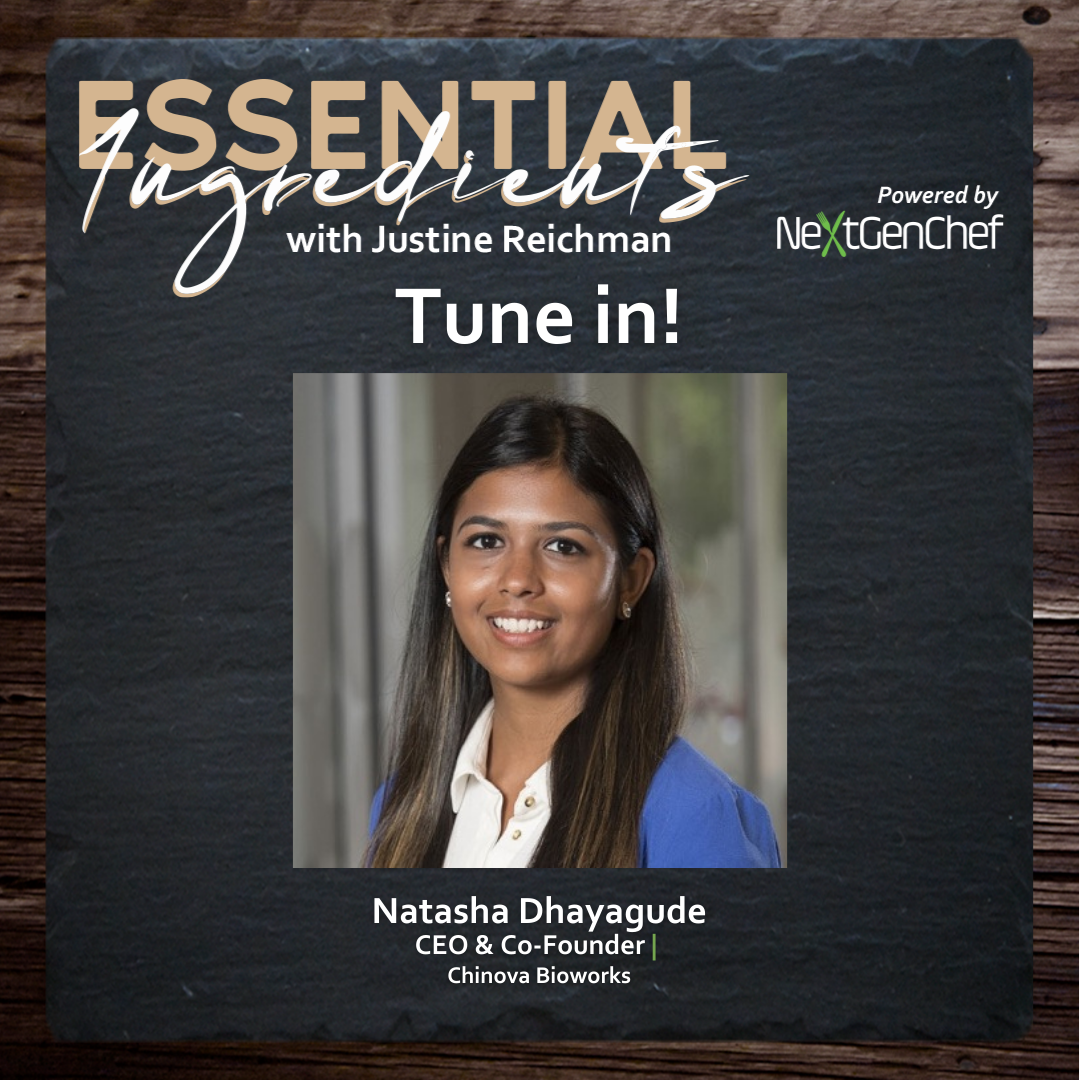
Clean Label Mushroom Preservative As Effective Catalyst For Waste Reduction with Natasha Dhayagude
The Incorporation Method helps you turn what matters into practical changes that fit your life.
“Climate change is one of today's most pressing issues, and one contributor toward climate change is food waste.”
Full Transcript
Full conversation between Justine Reichman and Natasha Dhayagude.
Hi, and welcome to Essential Ingredients. I am Justine Reichman, your host. Today, I'm very pleased to bring to you the Co-Founder and CEO of Chinova, Natasha Dhayagude. Welcome, Natasha.
Thanks so much. I'm excited to be here.
Me too. We're excited to learn more about Chinova and what you guys are doing. First, can you just tell us a little bit about what it is?
Yes. So Bioworks was founded in 2016, and we are a food ingredient manufacturer. So we develop natural clean labels of preservatives extracted from white button mushrooms for use in various food and beverage products to help improve quality, freshness and shelf life.
Okay. That seems like it's a very useful thing for people to have. Right off the bat, nobody ever wants preservatives. But if you gotta have a preservative, you want something that's a clean label and healthy. So why mushrooms?
So this kind of goes back into how we founded the company. My background is in biochemistry and microbiology. After graduation, I ended up working at a business incubator where I learned a little bit more about business--
Natasha, before you go on and talk about that, can you, just for our listeners here, tell us what an incubator is?
For sure. So an incubator is a co-working space founders and entrepreneurs, it can be a lonely life instead of working from home, you can go to an incubator or these co-working spaces where you can be with fellow entrepreneurs and learn to network and be just a part of that community and that ecosystem that's so important. Go there every day and just do your job and work.
But how is it different from a co-working space?
It can be called one of two things, an incubator or co-working space. Oftentimes, incubators have a lot of programming that they offer. So they have these additional networking events, or they'll have mentors or other people come in to provide startups with the resources. And then often, they'll also have programming which is called accelerator programming that goes on for about three to six month periods based on a variety of topics from sales to understanding markets to pitching to commercializing your product.
So an incubator is effectively a co working space with some programming, but it doesn't necessarily provide funding or financing.
That's right. An accelerator is something that you can apply to that is actual proper programming that will provide funding. Funding are some in kind resources.
I appreciate the clarification, and I think our listeners well too because there's a lot of lingo that we talked about. And I think it's important to just take a moment to clarify for people listening so let's continue with your story. So you and your co-founder were in this incubator.
I actually graduated from University, and I didn't know what I wanted to do. So I graduated from a degree in science, and all I knew was I just wanted to use my science degree in a creative way. I ended up getting a job at this incubator where my role was to help startups with what they needed and anticipate what they needed a year from now. So providing them with the resources that they needed to start their businesses. In my job there, I worked there for about three years, I ended up meeting my co-founder, David, and that's how everything began. My background, again, is in biochemistry and microbiology, and his is in biotechnology. So we really bonded over our backgrounds, our love of science and using science in a creative way to solve a real world problem.
So when you were working at this incubator, you were there, it was your day job. You were not looking to come up with an idea and start a business.
I definitely wasn't. It was my first introduction into the business world. I really didn't know anything about startups, entrepreneurship, business, anything like that. Coming out of a very traditional degree, so I really wasn't looking to start anything. I was just in the process of trying to help companies and deliver them what they needed.
So how did this incubator support you to launch your business, or inspire you to start your business?
I think the biggest thing for me and the biggest value of doing a job like this really allowed me to hone in on my skills. So it allowed me to develop so many amazing skills, which I use to this day and used to start the business. So because my role really involved helping companies kickstart their business, providing them with the resources that they needed to be successful, I learned a lot about startups without being a founder. It was really interesting. So I wasn't maybe in that circle, and I wasn't in the space of having a business. But in my head, I went through everything that a founder would go through rationalizing what I needed now, rationalizing what I would need six months from now. Knowing, okay, I'm going to need to talk to legal, knowing that I'm going to need to talk to accounting, knowing I'm going to need to figure out finances and things like that in order to help those companies and help those founders. So I was already in that mindset even before starting a business, which I found to be really, really useful.
So you're going through this process, and you're here at the incubator, and your mindset is now changing. It sounds like it to me, at least.
For sure. For sure. It's changing. And I'm just thinking, okay, this is great providing these resources. Could I do this? I'm not sure, but this is a great journey. I'm understanding so much of what it takes to run a startup company at this point.
So where's your head at then?
I think everything changed when I ended up meeting my co-founder. Because for me, starting a business, I always just wanted to use my background. I wanted to use my knowledge. I wanted to use that textbook foundation that I learned four years ago and amalgamate that with creativity to commercialize a solution in the real world. I think meeting my co-founder really helped kickstart my journey into starting a business.
So what was it about your co-founder that kickstarter that for you?
Yeah. I think there were a couple of things. One, because we shared similar interests and backgrounds that was really great, because he had kind of the same thoughts and the same mission going forward with what he wanted to do with his degree. That was really great. And then to an idea, it all starts with an idea. So he had actually been researching mushrooms. And mushrooms, as we know, have many amazing different qualities, but he was specifically looking at the stems of white button mushrooms, and looking at an ingredient or an extract that could be taken from the stems to then be a natural clean label preservative. And that idea really stuck with me. And we thought, okay, the industry needs a solution. There's an urgent need to reformulate brands and food and beverage products. So we thought, what a great solution, and we could really bring this to market to fill that gap. So that's kind of how everything got kick started, and we decided to incorporate the company.
It was fortuitous. We've been talking about this a lot on the podcast, the accidental entrepreneur, it sounds like you may fit into that category. Not that I like to put anybody in a box or categorize people, but it sounds like your story fits within that. And it's inspiring to hear that people can follow their passions that way. And for you, I love to hear your story. I'm listening to you talk about, you keep going back to your schooling, and your education, and what you studied, and how meaningful that was for you, and how you wanted to find something that would allow you to take that to the next level and do something meaningful with that. And sitting in your office in the incubator where you were working was your co-founder.
Right, right. Yeah, it was so great. I was very lucky and fortunate that he even walked into the building that day honestly, and that we shared such similar backgrounds because you don't find that, so it was really kind of a perfect match. One thing is the idea is really important to kickstart the company, but then the people that you've worked with isn't such a big thing. So for me, that was something that I really valued. Very early on when I met him, I knew what my strengths were, what my weaknesses were more importantly and what his were, and I found we were able to fill each other's weaknesses. So it was a really good partnership just starting out.
I'd love to just talk a little bit more about this mushroom extract, the first thing that comes to mind is, obviously, this mushroom. You chose this mushroom, and are there any side effects to the mushroom using a mushroom that people need to be concerned about when they're now buying this product? You have a preservative and you extracted it, what is mushroom extract?
Yeah. So the product that we use is a mushroom extract. And how we do that is, it's the common white button mushroom extract. We work with a lot of farmers that typically what you see in the grocery stores, you'll see the stocks of these mushrooms, the white button mushrooms that we consume. But typically, the stems are left over. So these farmers either pay to recycle, or they just kind of use this just waste material. It's a waste stream. So what we do is we collect the stems, and we will extract from the stems this ingredient then is used to improve the freshness or shelf life of a particular food and beverage application.
God, I understand. So where are you getting these stems from? Are you working directly with farmers? Are they giving you the remnants from the mushrooms before they sell them or before they give them out?
Yeah, that's exactly right. That's exactly what we're doing. So we work with farmers across many different areas. We work with local farmers in Atlantic Canada, so that's where a company is headquartered to source this waste material, and then do our extraction process with it. We also work with farmers in Ontario, in certain parts of the US. So they're happy to kind of get rid of this waste material. It's getting turned into or upcycled into a commercially viable product.
I'm glad you use the word upcycle because it's a great word. And it's really creating its own category these days. I'm sure you're very familiar with it being in this world right now and talking about it. I'm sure you're familiar with the Upcycled Association, you're probably even participating in it. So it's a great category. For those that are not familiar with Upcycled and the Upcycled Association, can you just talk about the term for a minute, because I think it's a really important term that people are using right now.
For sure. For us and for the industry, upcycling means to use waste material and convert that waste material into something that is a commercial product that is going to form some kind of value and generate some kind of value in the end product.
I think what's important also is to know that you're actually using a product or a portion of something that would really be food loss or food waste otherwise. I don't know if you know the numbers around it, and how much you're actually saving from being wasted by upcycling it, but I'd be very curious to know those numbers if you do.
Right, and that's what we're working on. I think the biggest thing for us and our biggest mission is to create value throughout the supply chain. So right from using waste material to upcycling it and turning into a commercial viable product that then extends the shelf life, and even reduce food waste in that instance is something that's our mission as we continue to grow is to really quantify how much are we saving from the farmer in terms of food waste. And how much of this material as we continue to increase our volume and capacity? How much loss can we account for to show our brands and customers that we work with the value that we're creating in that supply chain.
It's important, and it's a growing industry and category. So are you doing a lot of partnerships with a lot of the other organizations within the Upcycling Associations?
We're not currently working with a lot of those organizations, but we're more so focused on, I guess, the ingredient producers and working with them. Because there's not really been a lot of products that use this type of method. They just have an ingredient that's a natural and clean label, but this added component is so important. It creates so much value for the brand that's trying to be sustainable and uphold its integrity and reputation and add so much value there.
Between being an upcycled product, between being a clean label, you're really creating a better product for your product. That in of itself is a big deal. I want to get back to the mushrooms. I remember us talking about it earlier, you said they don't have a taste. Is that correct? They're not going to taste like mushrooms.
That's correct. The mushroom is extracted from the stem so there's no mushroom left in the final product because it's all of this extract. So even in terms of like allergens, there's no potential allergens. We always provide statements because that's a common question that we get. And then second, any sensory changes. So there's no sensory changes or changes to taste or flavor, you really don't taste the mushroom. It's really this extract, and it's using very, very small doses.
And since this is an organic product, how does it affect the shelf life of the product?
Yeah. It works at inhibiting the different types of spoilage microorganisms within a specific application. So for example, the different applications have very different microbial issues. So beverages have different microbial issues than dairy would have, or plant based alternatives would have. Our product all based on this mushroom extract targets different types of microorganisms within these applications then decreases spoilage and extends shelf life. So when working with beverage producers, let's say beverages typically have issues with lactic acid, bacteria, yeast, and mold. So our mushroom extract is really designed to target these primary spoilage issues and extend the shelf life of that particular application.
And what kind of products are you currently working with?
We're working with a variety of products really across the board all the way from beverages and categories, like energy drinks, flavored waters to plant based alternatives like meats, yogurt, vegan cheeses, to sauces, spreads. So such a variety of applications, because preservation is essentially important, all of these applications.
So now that you are a clean label and a different kind of preservative, I would imagine that there's a little bit of an education that has to go on for some of these companies that you're working with. Can you talk to me a little bit about that, and how you're getting people through this process?
I think in terms of education, the biggest piece for us is really working with other brands and having consumers understand through the brand, the value of the ingredients and the transparency of those ingredients. But we really rely on our clients and our customers to tell that story. We want to supply them with the best quality and the highest quality ingredients that we can provide. And then we support them in telling that story on their websites or through FAQ's where we provide answers to that end consumer.
How has it been for you as you go into new businesses? And as you talk about your product, what are some of the challenges that you're facing or have faced?
Yeah. I think a big challenge is just changing the narrative around preservation because there's been a lot of noise around preservation. It's a word that people just don't like to hear. But preservatives are essential in terms of food safety, for any product that you consume, and essential for consumers not finding mold growing in their products after buying a really high value item from the grocery store. So it's really changing the perception of preservation by bringing these high value, high quality ingredients to the market, just because there hasn't been a lot of disruption within the space does not mean that new innovations can't come through to fill that gap. And that's really what our mission has been. And that's our challenge.
So as you break into this industry and you carve out this new niche for yourself, after you really own this niche and you continue to innovate, what other kinds of innovations can we expect to see?
Yeah, for sure. I think the biggest piece is we want to continue to broaden our preservation portfolio. Just this year, we're launching a couple of different product lines for additional categories that will be exciting to see how they perform and things like baked goods. That's a big one for us. People are really looking for natural clean label solutions for baked goods. And then we want to look at what other preservatives could possibly work with, or have good synergy with, or be introduced into our portfolio. So that's all of our innovation work that we currently have going on.
Are there a couple things you might be able to share with us that are on your horizon?
Yeah. I think our most exciting thing right now is because we're in a high growth phase. So we're expanding currently. We just moved into a new R&D lab and we're moving into a new production site in order to continue to build our capacity and meet volume demands. It's been exciting. We're turning five this month.
Congratulations.
So the biggest thing for us is entering the plant based meat alternative space. So we currently have a plant based dairy product line, but we're now looking at launching in the plant based meat space, which is an incredible space. You're seeing so much innovation there with such a specific focus on taste and texture, but we want to come in and show people that food safety is a very important component of that, and you need to have that as a fundamental building block of your product. And so that new product, we're very excited to launch.
I know we don't have your co-founder here today, but it would be great to have a little insight into his head. How would he describe YOU in three words?
Okay. I'll say, I'm obviously going to say good things I feel. I say, organize, dedicated and find a little bit crazy.
They're all good things. An entrepreneur, we have to be a little crazy, a little organized, and all different things. And especially when you have a co-founder, you guys have different skill sets.
Exactly. Yeah.
So I just think it's interesting to hear a little bit about from his perspective, because you get to talk a little bit about him, especially in the beginning when we learned a little bit about him. What he brings to the table as your counterpart, so I just wanted to hear what he'd say about you.
Yeah. I hope he'd say those things at least. So yeah.
Who knows? Who knows? As we look at the future of food and your impact on it, we look down the road, how do you hope to impact it in years to come?
Yeah, that's a great question. I guess for us, in terms of a company perspective, we hope to really show people that ingredients are the fundamental building blocks to any brand. And as a supplier, we want to continue to uphold that for the brands that we work with and continue to uphold their integrity and reputation of what we can deliver to make those brands delicious for the end consumer. So that's really a big mission of ours, and really uphold the food safety side of that is a big mission. And then secondly, personally for my own journey, I think it's giving voices to other women, especially women, minorities like myself who look like me, and having them be represented within such traditional industries like food ingredient manufacturing. There's not a lot of us, so giving them a voice as I continue to build the company is essential and really important to me.
Any last tips for the founders and startups listening today to this podcast?
Be patient. Patience is key when going on this entrepreneurial journey, and the best things in life come with patients.
Well, Natasha, thank you so much for joining us and sharing a little bit about what kind of and the impact you hope to have on the future of food. I want to thank our guests for joining us today here on Essential Ingredients. Natasha, if our listeners want to get in touch with you, what's the best way to reach out to you?
Yeah, for sure. So they can reach out to me through LinkedIn, and they can reach out through bioworksinc.com email address.
Wonderful. And for those listeners, if you're not already, don't forget to subscribe and download Essential Ingredients with Justine. We're available on all the channels, and I look forward to hearing from you guys soon and seeing you here again next week. Thank you all for joining us. Thank you Natasha.
Thank you.
Share This Episode
Enjoyed this conversation? Share it and tag @nextgenpurpose
Listen on Apple ▶Listen on Spotify ▶Your Host
Justine Reichman
Founder & CEO of NextGen Purpose. Host and Executive Producer of Essential Ingredients — 11 seasons, 330+ episodes, and a growing movement.
About Justine →