Donna Pace · NextGen Purpose
Watch on YouTube
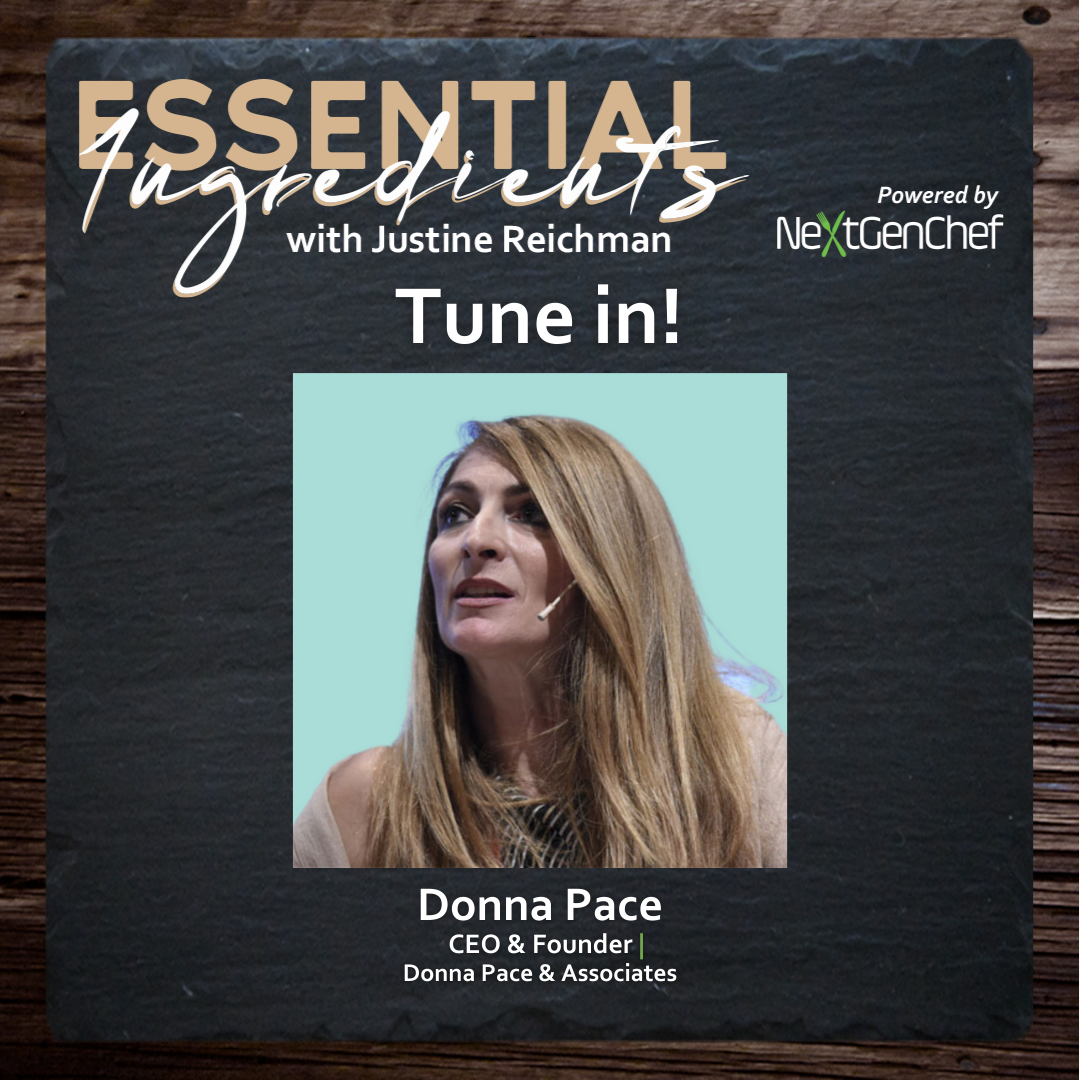
How to Creatively Get Ahead in Building Your Food Business with Donna Pace
The Incorporation Method helps you turn what matters into practical changes that fit your life.
“Donna Pace, creativity and innovation consultant based in Mallorca, Spain, brings a provocateur's spirit to the food business world.”
Full Transcript
Full conversation between Justine Reichman and Donna Pace.
Good morning, good afternoon, good evening, because we're all in different time zones. I'm Justine Reichman, your host at Essential Ingredients. Today, I am so honored to have Donna Pace with me. Welcome Donna. How are you?
Hey, Justine, really good to be on your wonderful show? What an honor. Oh, is Palma de Mallorca, Spain.
You are far away from me. I'm here in Northern California, and I wish I could see Mallorca, Spain right now. But Donna, thank you so much for joining me. I know that it is quite late there for you. But for our audience here, some of them are new to you, so I'd love for you to just take a minute and introduce yourself.
Well, what to say. I think I'll just start by saying that's my name, and surname means the women of peace. So that really determines who I am, Donna Pace (PAH-chay) and Italiano. That's what it means, a woman of peace. So that is a name I carry very proudly because we've already coincide it in our own professional interests. I run a consultancy and a training organization, and we essentially dedicate our time and energy to creativity, innovation, future trends, value decoding and leadership. But what I can say about myself is that I'm a natural provocateur. I'm a nonconformist. That when I was 15 years old, I was really inspired to be a missionary nun. That's what I wanted to be, really grappled with the calling of God. I really felt that I was being called to give up my life as a normal young woman of my time, and just really concentrate on following the call of God to be a missionary. I suppose I turn that calling into something else, because I still feel like I'm out on a mission. I still feel as if I'm on a sort of missionary drive, but that's in a nutshell is who I am. I think I'm somebody who enjoys waking people up. I'm somebody who enjoys exploration and discovery. And I would say that if I had to make you privy of what my main values are, because I think this really determines what kind of person one is. When you know where your values are and what you stand for, I would say that my number one value is probably freedom. My second value would probably be creativity. And my third important value would probably be coherence. So how many more in a nutshell, this is how I am.
Wow, thank you for sharing that, Donna. I really appreciate that. I think our listeners are going to love this because it's a little bit of a detour from what our ordinary conversations are about. But equally important because so often, we're talking about how to change the future of food. And today, we're really talking about how to support these food businesses on their mission to build a more sustainable and regenerative business. And the only way I know how to do that is to support them with building a business that is really about looking inwards, and dealing with, and building a strong sense of person with the skills that you are so well versed at helping them develop. So with that said, I'd love for us to just talk about some of these systems that you've developed and that you help these teams and individuals really work on, and some of them are communication systems, I think. And different languages that they can really work on. So let's start with the current communication system that many people are working with today, and then maybe dive into some of the tools that you might recommend. I'd love to hear your thoughts on that.
As I was contemplating preparing for your podcast today, Justine, I remembered that, only this week, I came across a quote by Henry Kissinger that said: "He, who controls food, controls the speaker. He, who controls energy, controls countries. And he, who controls money, controls the world." And I thought, that's a very interesting quote, I think I'll take it with me to Justine's podcast because I think it's relevant to what you are doing in the world of food awareness and food consciousness is so detrimental to the very metamorphosis and transformation of the societies we're living in today and the ones we're going to be living in tomorrow. I think the essence of this quotation is that, since we're at this crossroads, I know we've spoken about this before. I think I'm not standing if I'm not in the food industry. The food industry, as a more metaphorical topic is really something that is either going to push us down, or push us up. I think it's a do or die situation. So what you're doing is really tremendously relevant. I've seen some of the marvelous videos you've put up, and I think that you are driving this change from the food point of view. So coming back to my systems, and coming back to the idea of communication, I mean, whether you're in food, whether you're in the catering industry, whatever industry.
Whatever industry it is.
Patient communication is something that can either make or break anything. It's a deal breaker. Communication is the deal breaker. So this is my area of expertise. I think really today, one of the greatest problems with the idea of communication is that we still haven't learned 2,400 years down the line. And I'll tell you why I'm saying 2,400 years, why it is that, for example, my third value is coherence. Because the idea of being precise and being objective with the way you communicate. Communicate is absolutely key, because otherwise, you are in the danger zone of errors of perception. So why we need new communication, or at least we need some form of a 21st century language, as I call it, to be able to communicate in a way, which is clear, which is precise, which is respectful, which is tolerant, which models take time to interpret properly. There are three main areas really why we need this kind of communication too. And the tools are used are obviously very hardcore skills, but there's a why and wherefore. And the why and wherefore is one, we haven't really changed our thinking patterns for the past 2,400 years. And that's why I mentioned that that's the number of times. It's a long stretch of time, because all our mental hardware in the West is based on three Greek philosophers. And those three philosophers are Socrates, Plato and Aristotle. All our thinking, you just look back and you say, yeah, I see it. I see the pattern. Socrates brings us the value of debate and argument. And to debate an argument, you need to be in a position where you're able to defend truth, or on truths. And that's platonic. That's what Plato brings us. Plato brings us the value of true thinking. So if this is a pen, it's obviously not a phone. To say that this is a pen, and therefore now I can have an argument. I can debate this, the whys and wherefores. And then there's the logic of Aristotle that says, if this is inside, it cannot be outside. Which says, if you belong to one race, then you don't belong to another. The logic is very, very straightforward. It's worth thinking. Now, the thing is that the question of truth, and that's a really hot subject right now, very subjective. Truth is subjective. And therefore, that is the first starting point, and I am starting with a subjective idea of truth. They're my communication, my logic, and everything I communicate to you is likely to be rocky even though I can really die for it because truth is usually subjective. So when one understands, I think communication, there are many patterns, many ideas to keep in mind, then you're more careful when you communicate. When I write a message, I try to clarify and make sure that I'm not assuming that I know something that maybe I don't, that I am not taking for granted, or the other knows and perhaps they don't. And this happens in our communication all the time. I have seen companies lose a lot of money because they have made wrong assumptions, and wrong assumptions means not clarifying and not looking for that clearance in terms of making sure that all the dots, all the I's are dotted, and all the T's are crossed because they're in a hurry. So that's one of the reasons why we need to perfect our communication skills, because we're all using a basic hardware which is working on something which I call EBNE rather Edward the Barnacles who is my friend, mentor, the person who taught me everything. I really wanted to know about creativity in the beginning. EBNE means Excellent But Not Enough. It's an acronym. It's fun playing with acronyms. So in terms of communication, there are many reasons why we need to upgrade our perfection of communications, this is one of them.
I also think, just to throw out there that communication is different depending on the medium. So often, right? You ever get emails and people start, like halfway through their assault, or they forget to make a salutation and they' just start there. And you're like, well, where did this come out from? It came out of left field. They think they're having this conversation with you, and you're not quite on the same page. People forget that they have they're already, but you're not quite caught up. And I think that creates confusion sometimes.
It's often not because we're polite and respectful. We don't say, hey, what do you mean exactly? I think very often, we get lost in translation. We get lost in translation because somebody may be communicating something perfectly innocent. Because from where they're coming from, it's perfectly in this, and they're being candid [inaudible] because this is the second reason why we need to really upgrade our communication skills. The other person has made an error of perception. Now, areas of perception, Justine, account for 90% of our errors and thinking, errors of perception. So this means, and this is a study that came out of Harvard in the late 70's. It started from there. It means that very often, apart from our very great way of being able to say this is a phone or this is a pen, we are vulnerable. Our Achilles heel is misinterpretation and misinterpreting where the other person is coming from.
Right.
So on one hand is what you've just said, somebody sends something and you're wondering, hey, it's like an ambush. And then there's the other side of it that you've offered something perfectly innocent or perfectly candid. And the other has interpreted something because of baggage, because of perhaps a bad day, or perhaps because somebody said something about you, but you didn't know. That all of a sudden, the perception is warped. So being aware that areas of perception are 90% the reason why very often there's this mismatch in communication.
It's true, it's true. So here's a question, what's the best way to address that?
Well, there are obviously skills sets that everybody can learn. And then there's something else, there's cognition. It turns out that when you put people together, not everybody has the same preferential cognition. So there are some of us who have a preference as a cognition factor for the clarification. The asset answering all the questions or preparing, I would be surprised if you're a clarifier because you do a great job work putting everything in its place, asking the question, sending things beforehand, but not everybody's like you. So that tells me that probably, it may be a cognition, which is some place where you earn, where you gain energy. This is how you like to do things, or it may have been an acquired skill. So with this communication, you need to take in consideration. Two things, one, how the brain works. Two, where the errors of our thinking are. Actually three, and three, where that person actually sits in terms of their preferential cognition. So there are four kinds of cognitions, and they're also like a thinking process in my work. And the work that I'm referring to now is called Foresight. Foresight is another great skill set. For as in FOR, and site as in SIGHT, Foresight. We have been able to establish. Our people have four kinds of cognition, preferential cognitions. One of them is clarification. So these are people who are always asking questions, probably like you are not. Secondly, people who are ideated, once always finding solutions. But sometimes, they get bashed over the head because they have too many solutions, or too many problems. And we prefer to look at the problems instead of looking at the solution.
I like to fix everything.
You're an idea [inaudible], that's why. So that's probably your preference. You and I probably have the same preferences. These are assessments, that tests you can take 30 questions less than five minutes. And it's really interesting because it gives you a map, and it helps you understand where people are coming from. The third cognition is the developers. The developers are the ones who are like the project managers. They put all the pieces together, then they clear everything out there, make sure that it's, and then finally ready to go. And then you have the implementers, the go do it people. The Nike people, just do it. That is a cognition. So in communication, we tend to communicate according to our cognition. You and I may be really excited about the ideas, but we want to ask the questions. And then perhaps, there are the people on our team who are really good at putting the project together, and then taking it out there, and taking it to market. That's one way of understanding our communication skills. On the other hand, this is also a process. So in our thinking skill set, we can say, okay, I'm writing an email to somebody new. I'm pitching a new client. The first thing I need to do is to clarify, who am I? What is this about? What do we want to achieve? Why am I reaching out to you, instead of perhaps just go in directly for the end result? And you will get, so there is a process you can verify, you can ideate,and then you can develop, and then you can implement. So all this is one of the closest tools that we use. It helps you communicate in a more effective way. And then there are other kinds of tools you can use, including emotional tools, because we need to take that into consideration. Being sensitive to the pulse of that person, knowing how to read between the lines, knowing how to value decode of those 10 things that person told me, which are the three most valuable assets that I can stay with, that I can run with, and I can feed back with, and then it becomes a read process in terms of becoming an acquired skill. So communication whether you're in food, whether you're in government, or whether you're with your boyfriend sitting on the sofa is really important. And depending on the cognition, sometimes you realize that you're not speaking the same language. So here is somebody who really wants all the detail. When did this happen? Why did it happen? Did you ask this? Did you ask that? And the other one is, are you asking me all these questions? And it can create conflict. It's not just that this person has that competition, and the other doesn't have the same level of that cognition or doesn't practice it and they feel attacked, and it's not an attack. So you understand, when you understand about people or process, then all of a sudden, you can map everything out, and everything is a lot more respectful and tolerant fluid.
It resonates with me immediately because I can see myself doing that, and I'm not attacking anybody. But I am curious, I do want to know, and the only way I know how to respond better is to ask those questions so that I could then curate the way that I either do something or behave, or it allows me to change my behavior, or respond better, or in a more informed way. But equally, if somebody else finds that attacking, then what do you do?
Well, what you can say is, hey, listen, I'm a clarifier, okay. So it's just the way I've made it. I dropped into a mode, I use this all the time with my friends who now know about this. Donna, when you're asking so many questions? Because I'm a clarifier. This is the oldest church in the village. Wow, great. When was it built? Don't you believe me? Why ask me that question? No, no, it's just so great. So one of your values, and that's why values are important is curiosity. Another of your values is the love for discovery. So it may not be somebody else's value, so they don't recognize it. So between understanding value decoding and understanding how communication and brain processes work, you've got a real hot ticket there for being able to present yourself as you are, and having others try to understand that. Now, when you're in a group and everybody understands where everybody's coming from, then it's a different story. Suddenly, you can relax. Because everybody's just different, and that's wonderful. Then you can use everybody's different skills to create a nice big pie. Yeah. That's what I like to say, cooking ideas. I use a lot of metaphors connected to food because this is what we're doing. Food is creative, food is alchemy, food is inventing where there isn't, that's creative. Very often, yeah. One last tomato, and three different kinds of herbs, and a bit of olive oil, and it's a banquet because you've used the resources you have, and you've creatively created something new. So it's totally up my street, and my creative was, totally, I use that metaphor a lot. [inaudible] to your creative skills, they die like a plot.
Well, I think that it's really important especially for the founders and the food entrepreneurs that are listening today to this podcast, because that's who we're talking to. We're talking to these founders and these entrepreneurs that are building these businesses, and are learning how to talk to each other to build their business, build teams and need to be able to hone on their skills, and be able to talk to their team members and other entrepreneurs that they're dealing with. So this is a really important skill that they need to be able to build and to tap into. I'm so excited to be able to share this information with them. So as they're planning their future, and I know that they're talking about how to build their businesses, what are some of the resources and tools that you employ for building future projects, thinking about the trends that are coming down?
Yeah. Well, that's a really important question because this is something I suggest to anyone, everyone, and any kind of business. I have two definite processes or acts of governance that I always recommend. One is creating a future trends observatory in your organization, whether you won, or whether you're 500 doesn't matter future trends. And another one is having an ideas lab. You can have these on your computer, they can be filed. So it's like having vaults that you can access to be able to, all of a sudden like your ingredients, you have to open your cupboard on what you have. It's where you can really gain a lot of value added, and most have competitive value. So with regards to future trends, which is one of my key elements in my business, there are different platforms I use to be able to scan for future trends because this is like being something I always have here. It's also my reference. I always have my little lighthouse here. My lighthouse is my reference. So this is what you're doing, you're scanning the environment, both or for your creativity, and also for future trends. I use resources, like for example, the World Economic Forum. I use resources like the United Nations because they tend to be on the board with regards to what's happening around the world. I use resources like Fast Company, for example, newsletters that I scan, or newspapers that I get every week, and I'm scanning through them and highlighting all the new trends. And then I start to archive them. There are trends which are social, there are trends which are business trends, there are trends which are innovation trends, there are leadership trends, all kinds of trends. In fact, one of the first books I read on trends was around, about 1991, a book by Faith Popcorn, she was the first futurist, and that book was called The Popcorn Report. Faith Popcorn is still around, she was a woman, female futurist. When you think of the future as you think of perhaps Nikola Tesla, who is obviously way beyond his time. When you think of Thomas Edison or you think of Henry Ford. Or nowadays, you may think of Elon Musk, people who are visionary, they're looking far down the future. But somebody who's creative is essentially a futurist, or somebody is creative, always thinking of better ways of doing things. So creativity and futurism, they're like two hands of the same body, then two things that need to be taken into consideration. I obviously research all these different kinds of trends on privity with my students and matrons. My colleagues send me trends. I'm picking it up from LinkedIn. Very often, I scan them. I have a Whatsapp group to myself with all my trends. That's called my future trends list. And then you are often the one who uses it. I always suggest that you use these future trends as a catapult to be able to foresee your own future. So if you think of Jeff Bezos from Amazon, the way he started was he, in a little article in the newspaper, in his local newspaper, he saw a trend. It said: "Internet sales will go up by 200% over the next five years. That's all. And that triggered his own Amazon business, which triggered his bookstore. And after that, it was from here to eternity and back. So having that antenna up and having this lighthouse idea up, in terms of being aware of trends. Obviously, I know you're very much on the board with regards to trends. I've listened to some of the podcasts. I know you've been talking about the new kind of fabricated meats or plots, and I know you're interested in this. We shared some information the other day on food trends in 2030. But even the other complimentary trends could be [inaudible]. For example, the trend of growing your own food. So it appears to me as a creative artist, as a career activist. It occurs to me then, if people can be growing their own food, hey, perhaps it would be a really interesting trend. I've seen this already. I've seen a London restaurant do this, have a little orchard at the back, and everything in their restaurant is therefore homeroom.
There are variety of restaurants that are doing that now in New York and California, etc.
For example, something that may be interesting for your viewers. In Spain, there's a huge food culture, as you may very well know where your food is really important. You spend a long time talking about food and about the business. So food is a big deal. But up in the Basque Country, which is another part of the country, there are the kingpins of food over there. It's considered ungracious not to accept a business meeting food encounter, and I tend to skip because I'm always in a hurry. I like to eat in the evening when I'm calmer. But if I have to be thinking, I can't be spending three hours eating. It gets in my way. I love food, but in my right time. But for them, and they will remember me at the restaurant. Oh, this is the lady who didn't eat sushi last time. It's like a big deal. I have to wear it gracefully because I have poetic license because I'm a foreigner. So I get away with it. I'm a Cree activist, but they have something called txosos there, T-X-O-S-O-S, txosos. And txosos was a community traditionally of men, will use that to get away from the matriarchal society because there's a real matriarchal society that were on Sundays. They do bring their produce, they would hire a farmhouse out in the country, do their cooking and just enjoy their cooking. And those txosos became such high value things, or they became clubs, and you pay good money to become part of that club. Because all the people who came, they all knew about food, the latest food, everything exquisite, everything in its place. In recent years, they've started accepting women in these txoso clubs. And that is a real novelty. Because traditionally, it was gender specific. But the idea of txosos, even from culture, you can pick up ideas that couldn't be in some form. It could offer what I think today is going to be of great relevance, authenticity as a value in business. Authenticity, meaning, respecting people and nature, respecting the other having a sense of integrity and authenticity in a fake world. We're in a world full of false truths is something really relevant. So how can I jump the gun into the future? How can I be the one setting the trend? Not only because I know what's happening around me and I can pick from here and there. But perhaps, I recognize something, somewhere, and I run the trend myself. So the point of futurism or futurology as I like to call it is not only to be aware of what's coming. So you're not caught with your pants down like many art and businesses. But for you to ideally connect the dots with your creative skills, and create trends yourself, and become the trendsetters, and food is a big deal. It's at the front of the spear. What are people worried about today, they're really worried about restaurants that are closed in many parts of the world. So people are having to learn how to cook, or maybe there's an opportunity there, people are having to learn how to choose more wisely, people are having to realize that food affects their longevity. This is a whole new playing field that we're playing here. And I think that there's a great opportunity for foodies and entrepreneurs for that kind of business to really make a difference not only for their pocket, but for everybody else's well being. So it's a win-win situation.
We'll talk about the future, I just want to just tap into how COVID has impacted your ability to create social impact because I'm sure that it has, or maybe it's actually had a positive impact. Because I know for me, actually, I've turned COVID into, I think a positive thing.
I love that.
I know people have had a lot without, it goes without saying that it had a negative impact. But I feel, on a personal level, I've been able to turn it into a positive thing for my business and for my ability to have a social impact. But I turn it to you not because I don't think you could have had a positive, negative, it could have had a negative impact, I think it could have had a negative or positive impact.
I think where you're coming from there, again, I think it's value recognition. It has to do with attitude as a problem solution. There's your story, problem solution. So people who have this kind of training and this kind of cognition, it's a lot easier. I always say, a change is part. It's an intrinsic part of humanity, of our evolution, of our very life. You're not born, you don't die a baby usually. And I say that with a certain tongue in cheek, there's a process of evolution before we finally kick the bucket. But I agree with you. For me when I started with COVID impact, and incidentally, I was in the States when that happened. I almost got caught in Los Angeles, and I was supposed to be flying back and they stopped [inaudible]. My friends were a little bit panicky at that time, but then I said: "Listen, you know what? Let's just wait and see. Wait a couple of days." And I think about making my way back, and that's what's happened there. Again, it's an attitude. You can either really panic or saying, wait a bit, let's just check this out first. And with COVID, I turned it into something else. I took the name COVID, and I realized that the word COVID actually has two really nice words. One is CO which for me symbolizes co creation, collaboration and contribution. And VID which on the one hand means wine. Wine, which means life, COVIDA. So I've turned it into that aspect of more COVIDA. How can we better co create? How can we better collaborate? How can we better contribute? So for me, at the beginning, obviously, it was a very interesting experience because I was obliged to slow down and sit in my garden for longer spells than I usually do. And I was great. But on the other hand, what really triggered in terms of social and business impact is being in touch with so many more people, creating so many new business ideas and really being involved. Obviously, because of Zoom with so many more people that if this happened, I would have met you, to start with. So that has been important to me. Now, what I do miss is the energy of the real hug. The social distancing business is something for me has been very detrimental emotionally because I like to have my friends, and I like my students, and I like to look you in the eye and I like to be in your energy field. So that, yes, it has been detrimental.
I would agree. I also miss seeing my family. And the fact that they're not close by and I feel isolated because my father lives in New York by himself, my mom in Florida. That to me I think has been quite hard for them. They're by themselves. And while I'm a social person, I'm fine. I don't live by myself, and I have my dogs. For those of you that are watching the video, here's one.
A little dog.
I have two little dogs.
What's his name?
Minnie.
Hey, you're kidding me. I have the cat called Minnie, and she is 18 years old. She just passed away last Christmas.
I had a cat named Chili. No, I'm sorry, Vinnie who was 18. I did have a cat named Chili when I was a little girl. And Vinnie passed away when she was 18 too, when we were living in Mexico City. It's such a long time since we have these animals.
I was heartbroken. I was heartbroken for three days. It took me, for three days, I was--
I mean, I started a little weepy, and it's been a few years. Yeah, but I do know that I want to be respectful of your time because we are coming up on it. Just close out, and for you, for our followers, I want to just ask you, at Essential Ingredients, we focus on the future of food and beverage, and the hospitality industry is adjacent. Are there any learnings in the hospitality industry that you think our food and beverage entrepreneurs, or better for you food businesses can apply?
Well, I had to think around that question. I would say that probably the best thing they can apply is a very systematic approach to creativity and future trends, rather than the hotel industry. Because the hotel industry is being forced to take over by other options. So in life and in business, we know that there are some pillars, and there'll be there forever and ever amen. Hotels are hopefully going to be there, but I think that a lot of their management systems are going to change. And amongst others, they're going to start speaking the language of creativity. The 21st century language is creativity because it crosses barriers. It does wonders for your sign apses, and that's where you find your supernovas. So my recommendation is that they follow that rather than just that industry, which as you know, I also come from. But it's always been my flagship, the idea of creativity. And now, even more so the idea of being on the board with regards to future trends. What I would like to say, as famous last words, is Yogism. Yogi Berra was one of your famous baseball players, and he came up with an amazing amount of quotes. For example, it ain't over till it's over. But one really good one he had was, the future ain't what it used to be. Okay, so all you guys out there, the future ain't what it used to be. And therefore, you're going to make it better. You're going to make it better for yourselves and for others because we are now in a phase of metamorphosis where it's a brand new ballgame. So thanks to all you wonderful food entrepreneurs that are driving our well being, our joy, our interaction, our communication. Thanks to all this food and beverage that we enjoy both at home and outside. So people like you are important for this well being of this new human that is being born as we speak. We're moving into a new epoch, a new era. So thanks to all you guys. And to you, Justine, I'm very happy to have become privy of your little club here. I look forward to learning more about food and everything you're sharing because it's extremely valuable.
Donna, I really appreciate you sharing this because one of the really important things for me to share with our founders is not just the information so that they can make more informed choices to build better for you food businesses, it is how to build more sustainable regenerative businesses. And part of that is giving them access to the information they need to build those skills, and to nurture those businesses as they are regenerative and sustainable. Not just the food, but the businesses. So thank you for helping me embark on that journey. I'm really grateful because this is just the beginning of that journey as well. I really appreciate it.
All the very best, till the very best over to you. Thank you. Thank you. I'm sorry I have to rush, but I'm afraid I have a schedule and I need to get to--
No worries. I just want to thank our listeners for joining us, and let them know that if they like this, they should subscribe to our podcast, Essential Ingredients with Justine. It's on Spotify, it's on iTunes, any of the channels you like. And for those of you that are listening, please do join the NextGenChef app, it is complimentary. So if you're listening here, please download the app, connect with us there, it is a free app, it's a great community and has lots of special content. And we are inviting you this week special to be part of the Kickstarter mentorship program. There's lots of other free content and special needs. Mentorship programs available on this app so don't hesitate, jump on over there. It is a free app right now and we look forward to seeing you there soon. So again, thank you Donna for joining us, and we look forward to speaking with you all here next Tuesday for the next podcast.
Share This Episode
Enjoyed this conversation? Share it and tag @nextgenpurpose
Listen on Apple ▶Listen on Spotify ▶Your Host
Justine Reichman
Founder & CEO of NextGen Purpose. Host and Executive Producer of Essential Ingredients — 11 seasons, 330+ episodes, and a growing movement.
About Justine →