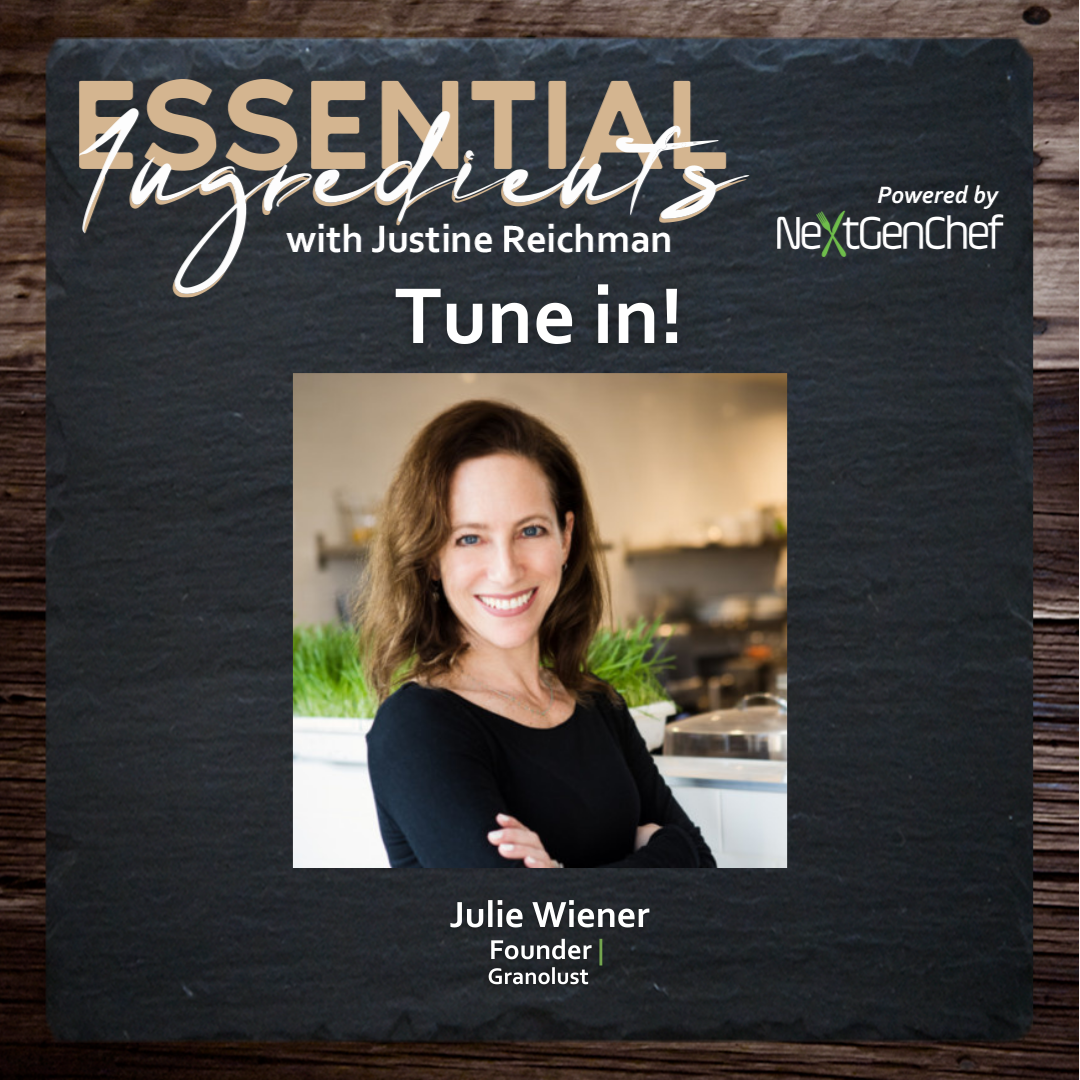
Julie Wiener · NextGen Purpose
Watch on YouTube
The Deep Desire for Granola with Julie Wiener
The Incorporation Method helps you turn what matters into practical changes that fit your life.
“For health-conscious individuals, granola is one of the best go-to snacks. Americans loved it so much, they even made January 21st National Granola Bar Day!”
Full Transcript
Full conversation between Justine Reichman and Julie Wiener.
Welcome to Essential Ingredients. I'm your host, Justin Reichman. Today, we have Julie Wiener from Granolust. Did I say it right?
Granolust.
Granola lost?
No. Granolust.
Granolust. That makes sense. All right. So guys, for those of you that like granola, this conversation is for you. It's an accidental founder, which I think a lot of us are. And it's a really intriguing story and an inspiring story. So truly, I'm super excited to get to know you a little bit better, and for you to share that with our founders. I hate to intro our founders, I never think I do any of you justice. So Julie, will you share with our audience a little bit about yourself?
Sure, I would love to. So my name is Julie Wiener. I was born in Montreal, Canada. I went to university for journalism and film studies, and then proceeded to work in the fashion industry for about 25 years, at which point I got really burnt out and had to just take a break from that, which I did. And then accidentally in the summer, the summer of 2017, Granolust fell into my lap. Of course, it wasn't called that at the time, but this became my third career, or second real career. And it was completely an accident. I was not looking to start a business, I was certainly not looking to start a business in the food industry, and I'm having a great time. So here I am.
Well, I love that. Okay, so excited to dig in a little bit deeper here, a little bit of how you started out in one place and ended up in another, which I think is more common now than ever. I mean, I can speak from personal experience. So many of the stories that I hear from so many founders, people fall into it. Especially now, during COVID, which happened pre COVID. But equally, there's so many fun and interesting stories. So we chatted a couple weeks ago, and I got to learn a little bit more about you. And I know that your last career was in fashion, is that correct?
Yep.
Okay. So we went from fashion to food, which is a complete shift. So talk to me a little bit about that. How did you fall into food from fashion?
I didn't really fall into it from fashion, I had stopped working in fashion. I had for the last 10 years of that career a very big job. I was the international sales and brand manager for a Parisian line that we distributed into North America. I was traveling all the time, and I was coordinating different showrooms across the states. And I loved it. It was just a lot by the end, and I just felt like my life was passing me by and I was missing out on my kids growing up, which I basically did. They're now 19 and almost 21. So I just felt like I was killing myself, and they didn't know why. I was losing touch with my friends. Everything made me feel guilty. If I was being a good employee, I was being a bad mother. If I was being a good mother, I was being a bad employee. And I got to a point where I just knew that for my mental health, I kind of needed to just take a break and take a breath. And really, I had never not worked. I think I took off six months when my first daughter was born, and I went right back and I loved it. But I just knew that I was at a point where I really needed to take a breath, so I did. I panicked a little bit at the beginning because I didn't know how I was supposed to fill my days if they weren't bookended by the office and all the work. I was used to getting all the errands and everything I needed to do for myself and my house done between 7:30 and 9:00AM, and 5pm, and after work hours. Very quickly, I got into a groove. But me being me, you're not good at doing nothing. Actually, during that first year, I went back to school at night for journalism to see if maybe there was something there that I did want to pick up on because that is what I had studied. It turns out that there was nothing that I wanted to pick up on journalism. I'd always been quite involved in philanthropy and charity events in Montreal, and I accepted to chair a big gala event. So that took up my year. I like to be busy. I definitely like to be busy. And so the other funny part of this story is really, I don't actually make any food in my house. My husband is an amateur gourmet chef, and he makes all the food for my daughters and for all of us. And he has for 20 something years, so I realize how lucky I am. I know that most people would die for this opportunity. And really, I just sort of got out of the habit of even trying to badly make anything because I knew that I didn't have to, and it's really his passion. It's really, it's what he does to relax at the end of the day. He loves to do that. So I always like to bake. Sometimes, things were good. Sometimes, they weren't good. But again, many years ago while I was traveling and working full time, I found a recipe for granola, because that was something that I just like to eat. And that's what I like to have for breakfast. So I found this recipe that was from some detox diet recipe.
That's an interesting place to find a recipe for granola.
I know, It was super clean, and it was the thing to me that was great about it, it was easy. And I knew it was easy, because I could make it and it tasted good. So I would have it every couple of months. I would make enough of a batch and it would be in a container in my house, and I'd have it for breakfast. Our friends would fight to come over to be invited for my husband to cook for them. So when they would come over and they saw that I was making something, I think they were half shocked that I was making something, and then they were half shocked that it actually tasted good. Maybe once or twice over the years, somebody would say, you know what? Can I have a little bag? I'll take some home and have it for breakfast in the morning. But it wasn't like I was selling. I wasn't pushing it all out of the back door of my house or anything. It was just easy. I could do it off by heart, and it was what I like to eat. So in June of 2017, a bunch of girlfriends, and I went out one night and one of the girls is the owner of one of the first and biggest and best juice bars in Montreal, it's called Rejuice. And her name is Joanna. And literally out of nowhere in the car, she said I need a new granola supplier. And my friends who had tried my granola said: "Joanna, you have to try Julie's granola." And I looked at them like they were crazy. I was like, I just made this at home, it's just my little thing. I had no not no confidence. I knew that I liked it. So she started quizzing me on the ingredients. And of course, because I've been making it for so long, and there were so few ingredients, and it was so easy. I knew everything off by heart. So she wanted to know what kind of oil I use, for example. And so I said: "Oh, I use coconut oil." And she said: "Oh, I like that it's not canola oil, or one of the more unhealthy one. And how do you sweeten it?" So I said: "Oh, well, I use coconut palm sugar." And she said: "Oh, I like that it's not a refined sugar." And of course, I had no idea that it was or wasn't a refined sugar. She wanted it to move away from the supplier that she was using because she didn't feel that their ingredients and values were in line with those [inaudible]. So she said to me: "Make me a bag." So I went home, I thought it was the funniest thing in the entire world. I baked a batch of granola, I brought it to her the next day in like a big Ziploc bag, and I forgot about it. And two days later, she called me back and she said: "It's incredible. I love it. My staff is obsessed with it. I need you to make me 12 kilos a week." That's roughly 25 pounds. So I said: "Joanna, that's really terrific. But there's no way I can make 25 pounds of granola a week in my house. It's just not possible." And she said, make as much as you can. And so that whole first summer, I just started doubling, tripling and quadrupling the recipe, and baking all the time. And I was getting up to 3, 4, 5, 6 kilos at a time, and she kept asking how much it cost. And I said: "I don't know, I'm buying ingredients at the local grocery store."
You were not taking it out of business, you were just like this was like a hobby.
It was the funniest thing in the entire world to me that somebody was gonna pay me to make food. By the way, for a couple of times, when my kids were in elementary school, I was known to be packing their lunch and send them to school with grilled cheese for lunch without the cheese. I'm not exaggerating. But the granola on the other hand really was delicious. And so that was sort of the beginning of how it happened. But it was a while before we got to the whole business side of it.
It's such a great story, and it's so organic. And I think it happens more than we think for a lot of people, because people these days are really doing what they love. And they're falling into things. And they're not necessarily business people, but they're doing what they love. And they're learning on the go. And that's one of the inspirations for Essential Ingredients is to share these stories for inspiration for founders that are building their better for you food businesses. So that they can hear stories like yours, where you were literally doing something that you loved, and you put great ingredients into it, and somebody came knocking at your door and say, Hey, can you make this for me? And you learn on the fly. So here we are. So tell me, you build this business, you're like, okay, great. I'm making this. But didn't you have lots of questions about the health regulations of what's legal? And how do I get this out there? And how do I make sure that I can't label this properly and create a package that the health department would be okay with? So tell me about that. How did you learn on the fly how to make all that. Because here you are, an accidental business person that doesn't know how to cook that just put together a really healthy granola product, and is now in the stores. But you're like, Okay, now what? How do I make sure that I protect myself and my business, and I don't get sued, that I have good ingredients, and that I am completely transparent on my product. Because I know, a lot of founders watching this right now are asking those questions.
So at the beginning, I was selling it to the juice bar in bulk by kilo. She was using it as a topping for her smoothies and smoothie bowls, and things like that. And really, I was just going with what she wanted. At first, she liked the first recipe. She loved co'z it was gluten free, it was vegan, and it was mostly 95% organic ingredients. She then asked me to give her a recipe, a flavor that didn't have nuts in it. So I took my original flavor, and I just took the nuts out. And that became the second flavor that I was giving to her, selling to her there. And really, almost right away, she kept saying to me, make individual bags, people really love it. But here, they can only have it on what I'm serving it on. I'm telling you, if you make the individual bags, they'll buy it, they'll take it home, and they'll have it on their yogurt in the morning or whatever. And I kept pushing her off and I was just like, no, no, this is not a business. Because to your point, I had nothing. I had no business name, I had no brand name, I had no packaging, I had no knowledge of the food industry. Now, I've always been a big believer of, and even now so more than ever in transferable skills. So did I know everything about food? Absolutely not. Did I know stuff about business? For sure. Did I know about marketing, branding and sales? For sure. So that definitely came in handy. After a couple of months, I went to a local restaurant supply store and I bought these cute little craft brown coffee bags and started with some friends. We brainstormed a name, and I was printing the labels myself at Staples. I mean the bag was like a hot mess of DIY. It was like a real etsy, exactly what you would imagine an organic vegan gluten free granola brand would look like. The name was printed on a background of oats and it was very sweet. So again, to your point, I said, oh, I have to put the ingredients on the bag. So we listed the ingredients and I printed a sticker for that. And then I was like, oh, god, I live in Quebec. Everything has to be bilingual. So I said, oh, I need the ingredients in French. So I printed another sticker, and they were clear. So the back had the two, the English ingredients and the French ingredients, and the front had the brand name. Then there were two flavors. I'm like, I need a sticker that says what the flavor is. So that was another font and another sticker. It was very cute, but it was like, not me. I was proud of it, but it was like not. Not a real brand.
It just was not like you, you didn't hire an agency to create this big beautiful apple brand.
So she put it on social media, Joanna from Rejuice, I put it on social media, and then the whole thing just exploded. And for two weeks, there were people emailing me and calling me. And now, I was selling a lot of the back door of my house. I was making bags, I was giving them to her. I was giving them, selling them to people, they were coming to my house. And it was really nice that people really wanted to support me. And she introduced me to a health food store that was up the street from her. So I just went in there and I said: "Do you want to carry this?" And they said, yeah. So I was in two stores. And then about two weeks later, a friend of mine called me and said, so originally, the name of this first brand was Granolove. So it had the heart for the O.
That's so sweet.
And so my friend, she said "Oh, I just bought some granola." And I said: "Oh, you went to Rejuice. She said: "No." I said: "Oh, you went to the health food of the store on the street?" And she said: "No." I said: "Well, those are the only places that I sell. So where did you buy it?" So she named his other store that's about three streets away and I said: "Well I don't sell there. Can you take a picture and send me what you're talking about?" So she sent me a picture of a bag that was just a beige bag with a sticker on it that just said Granoluv, spelled L-U-V. So somebody, I pieced it all together, it doesn't really matter. The point of the story is that another local company--
It does matter. Tell us, who are these people?
I don't want to tell you who they are. It doesn't matter because they actually kind of business, but they walked into Rejuice and saw that it was a great name. I said, we're gonna tweak it a little bit because they technically change the spelling. We hadn't trademarked it yet, but the lawyers came back to us and said: "Listen, we can register it if you want. Because technically, the spelling is different, your L-O-V-E, and they're L-U-V. But if there's any hint of confusion, we recommend that you change it now. Now, they were in two stores, I was in two stores, and everything was four streets away from each other. And I was so attached to granola, I thought it was the greatest name. I couldn't believe that I was losing it. I was just devastated. But I also knew that it's been a month. There's not a day, and I think that it's okay. I knew there was confusion, there would have been a lot of confusion. And I said: "Okay, we're going to change it."
The other side of this, but they liked it so much that they copied you. I mean, that is the biggest compliment. That's the sincerest form of flattery. I'm not saying it's not annoying.
What I thought was the worst thing turned out to be the best thing because we were trying to come up with a new name. And a friend said: "What about Granolust? And immediately, I knew this was 5,000 times better. This was 5,000 times better. Already, I can see where I was going to go with it if I could get to that point. And I was gonna play off of the fact that it really was super clean, organic, vegan, gluten free granola, but with a sexy personality, and then the sexy packaging. And so that's really, I believe, a big part of why I'm still here, three years later. The product was amazing. And until we started really branding it, that was what was driving the interest in it. I think that it really tasted good, and it was in a cute bag. It was okay to buy. Once we decided after a couple of months, okay, I'm gonna take some money and invest in branding and packaging. And that's when I went to the black by--
For our followers that, I mean, for people listening, they cannot see this picture. But if you do tune in and watch our YouTube video, you can see the beautiful packaging, it really is beautiful. Now, I'm just curious, where do you stand on sustainability with your packaging?
So it's an interesting thing that I learned. And I am going to get back to your question that you asked 10 minutes ago, but much like a product that uses organic ingredients. The ingredients themselves can be organic. If the entire product is not certified organic, you can't say that. Bags that are food grade. All of the components that make up the bags are themselves recyclable, once it's transformed into a finished product, it cannot have that recyclable logo on there. So the short answer is that it's technically recyclable and environmentally friendly, but it won't have that indication on it.
Okay, so can we recycle that bag? I don't think so. No, we can't.
There are certain, big concerns of ours, mine, in this business. I've tried repeatedly to get the packaging people to work with us. There are things in terms of food grade bags and protecting what's inside there, it needs to have different things that don't always lend themselves to that. The story is not closed for us and for me, and that it is very important, especially for a brand that is using mostly organic ingredients, vegan and gluten free. And it's really plant based and the demographic that is drawn to it cares about it's important, it is important. It is important.
But it's also, I think, that people that are buying the product are educated and also understand that they're looking on the shelves and they're seeing other products. And they're seeing that they're having similar challenges as well. Because a lot of these other granolas are, some of them have plastic in them and different kinds of things. And they all are choosing different and unique bags and solutions, because of the way that they need to ensure that the product stays clean.
Yeah, yeah.
So it is a challenge. I'm curious to see how it evolves and the solutions that they come up with. So I'm sure it's an ongoing conversation for you.
Yes, it is. It definitely is. It's definitely something that we're sensitive to.
Yeah, I'm sure. you have to make choices. Some things are more important than others. and maintaining the integrity of what's inside is really important, because that's what we're putting in our body. So I think that, I don't know, that's what's important to me at least.
For sure. For us, we like to say you can pronounce every ingredient in our Granolust. There's about 10 ingredients max in there. There's no additives, there's no sweeteners. We still only use coconut oil, we only use coconut palm sugar to sweeten it, a little bit of maple syrup. Very clean, simple ingredients.
Wow, it sounds like a great product. I'm excited to try it one of these days. I know you do sell it online, so I'll have to investigate that a little bit. I can't wait to see when you are selling here. And I'll talk to you more about this later. We are launching a NextGenChef Pantry for some of our community. So hopefully, that will be something that we could further investigate with you guys. But I want to talk more about your interest in the future of food and where you're hoping to see. I don't want to butcher the name, so I've been dancing around it for the last three minutes trying to figure out how I can ask this question without saying it or butchering it.
It's the product. Just say what the product is, and then you finished.
Okay, Granolust.
That's it.
Granolust. Okay, I was really dancing around my question for the last three minutes. So I didn't have to say, oh, geez. Okay, so Granolust. Now, I forgot what question. Okay, so as you're building Granolust, and as you're working on the future of food, because what you're creating is a better for your product, and it's another way for people to nourish themselves and eat well. So I'm curious where you see Granolust as part of that in the spectrum and the growth of the future of food, and what else you want, and where else do you hope to see you personally grow within that? And if there're any other products that you're hoping to build out?
So actually, we have four flavors right now. Three of them are traditional. I call them traditional morning granola flavors that you would add to smoothies, smoothie bowls, cereal. It's a Triple Nut Crunch with whole almonds and cashews. Maple Quinoa Crunch with puff quinoa and quinoa flakes, just the most basic, super clean, cleanest of the clean. And then we have a Mocha Chocolate Crunch with 70% dark chocolate chips, and especially on cocoa powder. They're terrific. They're incredible. They're really good. The fourth flavor that we have, which of course was the suggestion by my husband, the chef, he said--
It's the Rosemary one?
Yeah. He said, you have to come up with a flavor for men who think that they don't like granola. So I kind of rolled my eyes and I was like, anyways, it turns out that men do like granola, and everybody loves savory granola. Now, there's no other brands on the market doing this. So we came up with a Rosemary Parmesan using vegan Parmesan, and it has almonds and cashews in it, and it has a savory flavor. Obviously, it's not meant to go on your morning yogurt or cereal. This is meant to go on top of salads, or soups, like a healthy gluten kind of thing. People are so creative, they send me photos and the ways that they're using it. I mean, we just eat it out of the bag. Sometimes, we put it on salad. It's a great snack too, but they're putting it on top of avocado toast, sweet potato to post roasted asparagus, ground up and used as a breading or a bread crumb on chicken or fish. So this is a much healthier way of snacking, instead of reaching for the chips, or the salted nuts, or anything that's unhealthy like that. That's fried. So this is obviously a baked snack and a baked topping. And it's just super original. I had a funny experience. Every time I'm doing a market or I'm doing a demo in a store, and I can see people's faces because they're reading the bag and they're going, Rosemary Parmesan. Like their faces going, oh, that's disgusting. I don't want to put that on my yogurt. And I have to stop them, and I'm like no, no, no, no, that's not how you use it. And when I can explain to people what to do with it, their eyes light up and you can just see that they get so excited because they're like, that is so smart. Nobody's really doing, and it's healthier, obviously, than a crouton, and there are some trail mixes in there. Some salad toppers on the market, at least here in Canada, but they're mostly crunchy noodles and seeds, and not really a granola. That Rosemary Parm is just because--
I mean, when you originally using pecans, but almonds and cashews, but just pecans are, what came to mind for me, I don't think I was thinking it would be amazing with this thing that thinks, oh, okay, Canadian Thanksgiving, or for those of us in America, America Thanksgiving,. I think it would be amazing, because so many people are eating gluten free these days, or having tolerances or allergies. And I think it would make an amazing stuffing, if you could come up with a stuffing recipe that would include that. So you have the gluten free bread. And then you use those things. Oh, my god, how amazing would that be? Or wait a sec, what holiday is coming up for those of us that share the [inaudible] connection?
Passover?
Passover. Could you imagine like matzo brei, but like, oh, my God.
Of innovation that happens, and it's a bit disruptive. I have to tell you, I like that. I like that there's no one else doing it. And I really, as delicious as our traditional flavors are, and they are, Granolust is super competitive. I hear that a lot. Had I tried to start a business? I probably wouldn't have chosen something that was so competitive. But this fell in my lap, so I'm going with it. But I really think that our shot is with the savories. I have two new flavors that are launching, just waiting for packaging. So within six weeks, that will be friends for the Rosemary Parm. Now, I think part of the issue is that the four flavors, they look beautiful together. The bags, they look like a family, and they're living in a store in the cereal granola aisle. Which is so understandable that when someone's looking at the bag that says Rosemary Parmesan, they're in the cereal granola aisle, they're going there automatically assuming that that's how they're going to use it. But right now, it doesn't make sense to have the one Rosemary Parm bag being housed somewhere else. As soon as these two friends come, those three will be able to live in snack, nuts, salad departments, like in a different place. And I think that that right away cues people that, oh, I'm going to think about this differently.
I was even thinking like seasonally. When the holidays come up and they change things seasonally. So over Thanksgiving, they have the Thanksgiving stuff, and they have the stuffing and all that kind of stuff. And you put that with the stuffing, and then you have Passover, or whatever holiday, and you put that with that section. And as you have different holidays, Thanksgiving and all these different things, you could put different things in different sections to inspire, change, and then do recipes. Maybe your husband could grace us with a few that we could even share on our website to put with, and which Granolust you would pair with it. And then people could just, they would know which to buy and which recipe to pair with. For our listeners, this way they would know which one they want.
We do have recipes on our blog and on our website. And for sure, to your point, the Mocha Chocolate gets really popular in February, around Valentine's, love and whatever. Maple Syrup is one of Canada's biggest exports. So anytime that there's a store that has a maple section, or now we have these things called sugar shacks where it's a seasonal thing here where you're having maple syrup on snow and all these very specific foods. But maple is almost the season here. So our April goes really well with that. But yeah, I mean, it's a great marketing tool, what you're suggesting.
The other thing is, I went many years ago with my cousin skiing. And they have these, it's a snack, I forget what the snack is called. They're very unhealthy, very unhealthy. Yes, that's what it is. Okay, my cousin insisted that I have this [inaudible]. But anyway, they have these little kiosks, if you will, like in the little village, you could literally have a kiosk of snacks with the granola and have all these different ways of seeing it. So I'm just envisioning this as you're saying that because I'm envisioning coming down the slopes, and you can have bone broth with your Granolust, but the savory one. It's just a thought with a little side salad. You're not busy, you can help me execute this as well. So to get back to the future of food, so you're staying in your lane and Granolust, is there any other aspect of the future of food or bigger vision that you have in what you're hoping to achieve for just the future food and how it's changing? And the impact you want to have.
I mean, look, 10 years ago, the offerings, if you were celiac, there was not, you know, it's sort of become a little bit more in vogue and a little bit trendy to eat gluten free, whether you have food allergies, or intolerances or whatever. And there are certainly a lot of people that don't have any physical real disease with it, but like to eat that way because they feel better like that. So it's become a lot more mainstream. Having said that, we know it's such a tiny part of the general public. What I really see is that a lot more people are going to be going that way, the vegan movement and plant based movement, and we see it with Beyond Meat, whatever they're all called. Everything now is moving that way. I think that it's going to continue to take over a larger and a larger share of that market. I think that we, again, accidentally, the timing was right for us to be positioned as a plant based, gluten free, healthy food that traditionally, people associate granola with health and they associate it with eating healthy. The truth is the majority, if not all of the grocery store brands are full of sugar, they're full of crap. People think that they're eating well, and they're not. We're not in grocery stores, I want to say yes, but I don't think that that's our, I'm not sure that that's our plan for forever. At least right now, the people that, like you said, get it and understand it, and read the labels, they understand that they have to pay a little bit more. Maybe the future of food is going to be that everybody has access to better food that doesn't have refined sugars, it doesn't have the additives that still taste good. Because sometimes, you can find healthy food that's loaded with sugar or not actually good for you, and you find healthy food that tastes like cardboard. And that's not good either. And so I think that, really, we're that perfect bridge between something that is good for you that does taste good. And we have the added benefit of it looking good too. I keep talking about like, not all granola has to be like Ben and Jerry's Birkenstock Vermont Granola. We're like the Manhattan Granola. You can still have an upscale, beautiful looking design, oriented packaging, and it doesn't have to be this granola granola. So that's our little thing that sets us apart, I guess. But the truth is, what you're really eating and what makes us up is good for you food.
I like that. And I think that our listeners are gonna resonate with them. We have a lot of founders that are listening to this startup. But we also have people that are interested in learning more about how to eat healthfully. And so I just want to tap into a few things for those founders and startups that are listening. So when you started your business, I'm sure you had your growing pains. And I'm sure you had a lot of challenges. Are there any tips, maybe two or three tips that you might just give to our founders, as they're building their businesses? I mean, I'm still having growing pains. It's an ongoing thing. It's it, we will always have growing pains.
What I did right from the beginning was talk to anybody and everybody that I could. So again, to your point, I came into an industry, I didn't know anything about regulations, about what to put on the bags, about all of that stuff. And speaking to fellow entrepreneurs, most of them happened to be women for whatever reason. There's something about the food industry in Montreal that happens to be quite women centered, which is great. So I talked to anybody and everybody that I could, I took notes, and I took notes, and I took notes. And I studied, really, I learned what I could from them when I didn't have a clue about how to spend. Then we decided, okay, let's give it a shot. Because at the beginning, what I was doing was buying ingredients, making their granola, selling the granola, paying off the credit card bills for the ingredients. It was going, but again, there was no plan, there was no business, there was no investment in anything. And then after months and months when I was getting into new stores all the time, and the old stores were reordering all the time. I said, oh, maybe there's something here. and I said, I'm a big believer in social media. I believe in the power of it, and also the potential downfalls to it, but how necessary it is these days to harness and to market yourself and your business. So I met with photographers because I thought, okay, maybe content for this website is important, and Instagram is important. And then I met with people to build a website, maybe I had to spend money on that. And then I met with advertising and PR. And after meeting with all these different people who all were trying to pitch what they thought the most important thing for me to do was I looked inwards and said: "To me, the first thing that I think that we should spend money on is the branding and the packaging." And that set the tone for everything else. So I guess one of the things I would say is ask for help. I was coming from the fashion industry, which is definitely a little bit more cutthroat. I remember the first probably 18 months, two years, I was like, everybody's so nice. Everybody wants to help. And granted, I didn't go to other granola companies, but I went to others, and not competitors. But everyone was so forthcoming and so willing to help. All I remember thinking is, I can't wait until I can pay this forward. I have something that I can tell somebody that they can use. I feel funny giving advice, because I feel like it doesn't count what I did, because it happened by accident, and I just followed where the business was taking me. I think that people who have a plan and execute it, and are successful deserve a lot more credit.
Don't hold yourself short because a lot of it, I think, is taking your passion and doing the work. And when you do the work, it becomes organic, and you have to follow through. And when you follow through and follow your passion, and you put the hard work in, you see results, those results don't come without the hard work and without the follow through. So I think between taking your idea, your follow through and all your hard work is where the messages are. Does that make sense? So I think your ability to reach out to people, to ask questions, to not be shy, to realize that you have something to learn, to be open to people's feedback and their expertise is all something that these startups, founders and everyone can learn from. And I think that's a great takeaway.
I think that to follow that, what I would say is, it's a fine line between listening to every expert around you who has all the years of experience and knowing inside your gut. And I know what I know. I'm also good about saying, I don't know this, show me, teach me. And I'll talk to a lot of people until I can figure out where I sit on whatever the issue is. But sometimes, I just know it instinctively whether I know the food industry or not. To give you an example, within the first, I think eight months, people came to me, these two guys came to me and they wanted to partner with me, and they wanted 50% of the business. And I was so excited. I thought oh, this is fantastic. They believe in me, and they want to invest. They said: "We love you, and we love the packaging, we love the product, we love the brand, we love everything. The only thing is, you have to change the name." And I said, oh, why do I have to change the name?" They said, well, you don't have the word lust in it. It's not so family friendly. And we don't know. And then that. And I have to tell you, I almost did it. I almost did it. I thought about it. And I thought about it. And I was so sort of taken with, oh, my god, somebody sees something in me. I took my time and slowed down. I said, this doesn't feel right. I believe in the name. Maybe it's wrong to believe in it, but I believe in it. I stuck to it. And again, that happened to work out for me. I think it was the right decision, I think that I wouldn't have been passionate about something that they were making me change. So one thing is that you have to temper the advice and experience from other people with what you believe, and what is your sort of vision, even if you have to make it up on the spot. And the other thing that I would say is every time I do this, I just said to to our Director of Operations, I said, please remind me every time, I don't want to have a call or whatever, I take every call even if I know somebody wants to pitch me their business and there's no way that I'm, this has been going on for years. Oh, very fancy, whatever it is, the marketing, they want tons of money, they want this. I knew that I didn't have the budget for whatever it was, something comes out of every conversation I have regardless of where it starts from. You got to be open. Because if you, and again, I beat myself up about the fact that I didn't have a plan that I was executing. But now, I look at it as it's kind of a good thing because I was able to follow the interest where it came from. And I had a plan I probably would have been to get it into every grocery store. Now, I see, it's a high end product. It's nice. It's premium. Its gift basket companies versus grocery store, mass grocery store chains. Its monthly subscription boxes, its corporate gift, its high end stores, not every single one. So when I see that it does well in any one of those chains, then I go, try and find more of them. Because it's proving that that's where the success will be. If you are hard headed about what you think, you have to listen to the feedback also about the sales that are happening and where they're not no matter what you want, or think. So I would just say, be open.
Yeah. And I also think, to your point, I think plans are not bad plans or good. Not having plans keeps you open. I think that people can have success in varying ways. But the one thing is that plans need to be flexible even if you have a plan, because we learn new things all the time, to your point, which is why you've had your success because you've adjusted as you've learned new things. So I think that that's one really big takeaway for me. It is because I've made plans and COVID hit, and I had to adjust. We adjust as we learn new things, we adjust as the climate changes, we adjust as things change, as the world evolves, as we keep on living, and that's a transferable skill. To be honest, being adaptable in any facet of your life is only going to be a good thing.
You aren't too rigid and you're more open, it's probably easier in the end. It's not so easy for everybody. But I think that if you can channel a little bit of that, you're going to be more successful no matter how you define success. And it's not necessarily financial or whatever, it could just be personally.
It could be changing the future of food, creating new better for you food options, and making them more accessible to more people, and demanding a better food system. I don't know if that's just my personal take on what success is. That's why I'm talking to you, because you are making that possible for people. I'm trying, I'm definitely trying. So Julie, thank you so much for joining me today. I'm so grateful to be able to share your, have you share your story with our listeners and our viewers today.
It's always fun to talk about the birth of Granolust.
It is, and I love to hear these stories. I hope that they're inspirational for our followers, and our viewers, and our listeners. And for those of you that are not following us or subscribed to the channel, you can subscribe to the Essential Ingredients channel on iHeartRadio, on Spotify, on iTunes, on any of your regular channels. So we do drop new episodes every Tuesday morning. So if you are not subscribed, please do so and know that we are running a special right now, we're inviting everyone that downloads these podcasts, join our NextGenChef Community on our app, which is free and complimentary to you, and it's a way to connect with other fellow entrepreneurs and founders that are building better for you food and beverage businesses. So you can connect through text and email, watch older videos, and access resources, and chat with some of the fellow guests that we've had here, whether it's Julie, etc, whoever may be on the app at any given time. So I hope that you'll join the app. And I want to thank you to our listeners and our viewers for joining us today. And I want to thank you, Julie. But before we go, Julie, for our listeners and viewers, is there anything special you want to offer them today?
As a matter of fact, if anybody is interested in trying Granolust, you can go to our website at www.granolust.com. And we have created a very special promo code for Justine's followers, and the code is NextGen. So just N-E-X-T-G-E-N, and it is a 20% discount off all of our flavors, we have some combo packs and different things. And within about six weeks, our new flavors will be there. And we do ship worldwide, but definitely to the states is not a problem and everywhere in Canada.
Wonderful. Thank you so much really for that. I think our followers, our listeners and our viewers will be super excited to hear that. I think I want to get the one with rosemary. I definitely want to mix that with some matzah. I think that would be really nice.
That would be great. You have to send us a picture.
I will, I will, I will, I will. So thank you all for joining us. Again, join the NextGenChef app, follow us on Instagram under our NextGenChef and justine_reichman. And don't forget to follow the Essential Ingredients and Granolust. Where can they find you on social?
Instagram is @granolust_, Facebook is just Granolust, and our website is granolust.com.
Awesome. Thank you folks. See you soon.
Thanks, Justine.
Share This Episode
Enjoyed this conversation? Share it and tag @nextgenpurpose
Listen on Apple ▶Listen on Spotify ▶Your Host
Justine Reichman
Founder & CEO of NextGen Purpose. Host and Executive Producer of Essential Ingredients — 11 seasons, 330+ episodes, and a growing movement.
About Justine →