Dr. Rebecca Vaught · NextGen Purpose
Watch on YouTube
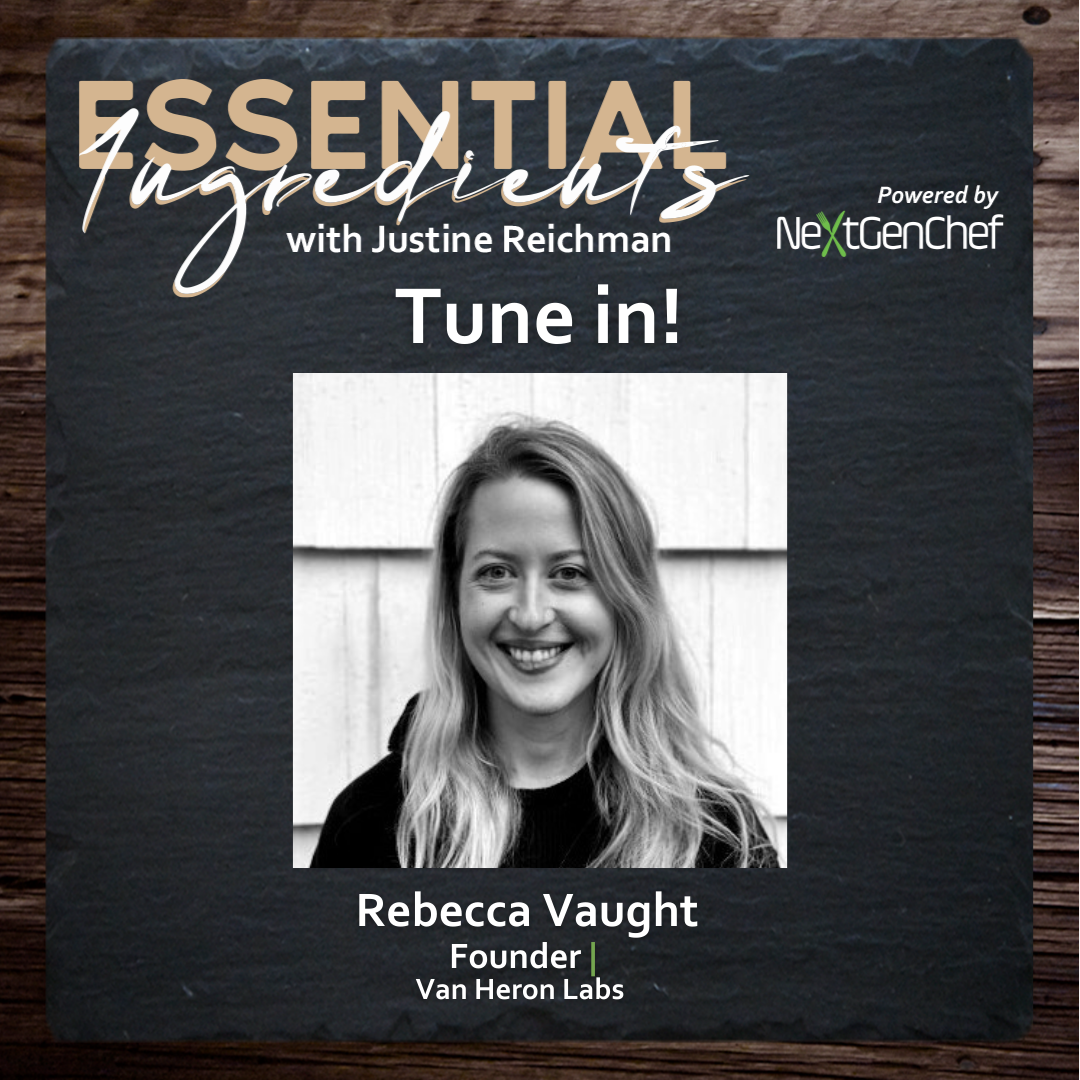
Producing Superior Alternative Proteins with Savings in Mind: A Novel Approach with Dr. Rebecca Vaught
The Incorporation Method helps you turn what matters into practical changes that fit your life.
“As the pandemic sparks a global awareness in health and wellness, the alternative protein industry is emerging in the mainstream. Yet, the process of producing viable cultured meat products is intricate and costly.”
Full Transcript
Full conversation between Justine Reichman and Dr. Rebecca Vaught.
Welcome to Essential Ingredients. I'm your host, Justine Reichman. Today with me is Rebecca Vaught from Van Heron Labs. Welcome, Rebecca, thank you so much for joining us.
Yeah, I'm so excited to be here. Thank you for inviting me on.
Oh, it's my pleasure. Rebecca, can you tell us a little bit about Van Heron Labs?
Yeah, definitely. So we are an early stage biotechnology company. We are actually a pandemic born startup. We, in essence, use genomic data and biocomputing to create genetically matched nutrients which optimize cellular and organismal performance.
Okay. For those of us that are not science majors, and maybe that's a little bit above our vernacular or our everyday conversation, could you break that down for us just a little bit, because it sounds really smart. I know it's completely intelligent, but I'm afraid that a lot of the people out there that want to know about this may not necessarily understand exactly what that is in layman's terms.
Yeah. It just means that we are using genetic information based on the DNA code, to figure out what a cell or organism we should be eating. So we are reading the roadmap, looking at a bio fingerprint and then giving the exact nutrients that match that biological fingerprint.
Okay. And this was born during COVID. So what inspired you during COVID to launch this business?
I guess a little bit more of the backstory, we technically existed before the actual virus was called here in the U.S. So we started out in the Texas Medical Center, me and my Co-Founder, Alec, we're actually accelerating the company within a program called BioVentures, which is organised by a nonprofit called Enventure. That actually started in January, late January of 2021. However, the idea behind Van Heron Labs was really just theoretical. We didn't have any data, we were testing it out whether or not it could be a business through that program. And basically, our accelerator program got shut down when the whole world shut down. That prompted us to actually create a home lab. So a very Google style founder story. The person who the company is named after James Van Heron. His family actually donated laboratory equipment, a full microbiology lab to us. I drove back to Alabama from Houston, got that lab equipment and drove it back to Houston. And we built a home lab in Alec's house, basically the week after COVID happened and started to get our preliminary data. So Van Heron Labs was an idea until COVID-19, and then it became a reality.
I'm intrigued. You're a scientist. Have you always been interested in this specific area? Okay, you're shaking your head, so where did this passion come from?
This is completely new. This is actually the fourth scientific field that I've worked in my career. I have no formal training. I mean, I'll go through it. I have no formal training in what we're doing now. I have a bachelor's degree in molecular cell and microbial biology from Auburn, which is a fancy way of saying a microbiology degree. It was a very unique degree at the time though. I also did three and a half years of undergraduate research experience studying, actually, a unique th shrimp species. So doing marine physiology and crustacean genetics, that type of thing. And then got really interested in mitochondria during the second year of my bachelor's degree, ended up basically pursuing that for my PhD, stayed on with evolutionary genetics mostly looking at how mitochondria influence very key traits like aging. It was while I was working within the aging space that I started to get interested in nutrition. Because basically, what I was learning is that the genetics that I was studying for my PhD were very important, but nutrients are also extremely important for determining how long you live. And it was through that interest that I had the idea behind Van Heron Labs. Basically, I wrote it down as an idea in my notebook. I graduated with my PhD about a year and a half later, and I've been pursuing it ever since.
Wow, that's exciting. So this is a real passion project for you. You've been working on it now for how long?
We're at about a year and a half.
So when you first launched this project, Van Heron Labs, what was your original vision for it?
It certainly wasn't where we are now. I don't think I could have predicted that we would be working within some of the verticals that we are in now. Particularly, one of the reasons we've come together is because we are focusing a lot on the alternative protein space. Didn't even know what alternative proteins were, back then, had no idea that people were growing actual meat, seafood products and a lab. So it is very different from what I could have imagined. But it's been a lot of fun, and I wouldn't have it any other way.
So today, being in this alternative protein space, what has been the greatest impact that you've seen so far for what you're doing?
There's so many impacts. I think the biggest conversation is about a lot of the ecological impacts. If we can actually grow the protein products in a lab, or create it from other methods rather than actually harvesting the protein from animals. But one of the biggest impacts that I always bring up are some of the core scientific impacts that we're getting from trying to do this very hard and very unique challenge. I think a lot of the innovation and scientific breakthroughs that come from trying to do this are going to inform virtually every other industry and every other practice in the future. So I think that aside from feeling very aligned with the mission of alternative protein, I think that's a core motivation for Van Heron Labs is one of a scientific interest. It is a very hard grand experiment that we're trying to do here. I think a lot of companies when they're starting out, well, they say, find the lowest barrier to entry, what is the easiest version of your technology that you can do? And we have come at this from a very different perspective, and that is, let's do the hardest thing that we can possibly do. And that is actually alternative protein. So that's why we're here, and it's very motivating. Just excited to be a part of this space.
I know you mentioned you were talking about nutrition, and you're interested in that. When I think about nutrition, when I think about alternative proteins, I think about the impact on our bodies, and I think about the impact on the planet. I'd love to hear you take on that as you're talking about what you're doing in the lab, and how that plays a process for you, or plays into your process, I should say,
Wait, sorry. So that again?
I'm curious about wellness in our body, and how the planet, how that integrates into your thought process as you're at the lab?
Absolutely. I mean, I think one of my core motivations is, I love meat. I am a meat eater. It is a very optimal source of nutrients for human beings. But the way that we're going about getting those meat, particularly seafood products, is just completely unsustainable. So one of the things that really motivates us, or one of the things that we think about a lot, is an optimal source of nutrition. And we need to solve this problem so that it is a viable source of nutrients for the human population going forward, even as the population continues to grow, grow and grow. And speaking of the population, obviously, there are a lot of ecological impacts, which you've mentioned, and I do have some marine and crustacean background, and I think about that a lot. It's virtually two disciplines, cultured meat and cultured seafood. I find that working within the cultured seafood space is extremely motivating because the impact on the oceans, the impact on those ecosystems is direct. Some of the species that folks are trying to recreate within the lab are endangered. So we think about that a lot when we're thinking about who our next clients are going to be, or developing our technology further. How can we truly accelerate the industry, but make the biggest impact possible.
Yeah, it's an interesting industry. It's timely. Time to be in the industry. Because even in the last year, I've seen so many changes that I'd love to hear. Just in the last year that you've been in it through COVID, talk to me about the changes you've seen because I feel like this has been a really crazy time to be in this. It's really coming to the forefront. I mean, people are really starting to get involved and talk about this now. And we're now seeing it more than ever before.
Yeah, definitely. I will be completely honest with you. I'll share a little bit more of our story, but we are fairly new to this space as well. So we are almost a part of that exponential increase that we're seeing right now. I knew of cultured meat alternative protein, of course, but I didn't realize how many companies were actually in the space and did not realize how far along the R&D efforts were, that sort of thing. So in December, I actually, we do a lot of customer discovery, or we used Van Heron Labs to build the company, and I happen to speak with a cultured meat executive and realized, not only is there a huge need for our technology, but just where companies within the space. It's not this nascent industry that it used to be there, or some companies that are really pulling this off pretty successfully. I mean, there's huge challenges still to face. But even just in the five or six months that we've been here, we've seen a lot of very substantial impacts. Companies are able to reduce the cost of their culture really, really substantially. There have been folks able to produce whole cuts of steaks, salmon out there. So some people or some companies have definitely figured this out. But the whole industry is still in this R&D heavy research scramble to try and scale. I think the challenge for the next six months, the next few years is taking those initial wins and then scaling them up to a really viable industry that can feed a lot of people.
So you talk about your technology, and you talked about some of the companies that said, how great it would be to have access to your technology and the impact it would have. Can you talk to us a little bit about that?
Yeah, absolutely. So there are a lot of companies that are within the alternative protein space.
Example maybe, just for our listeners today. They better understand who would be an example of that.
Yeah. So within alternative proteins, it's any protein that's not produced from an animal. So it could be a plant, it could be produced from fermentation, it could be produced from cells that folks are culturing in the lab.
Just so our listeners might have an idea, would that be just like an egg? What would be an example just so people can get an idea of what kind of products would use this?
I'm trying to think of some of the bigger companies that are out there. We are primarily within the cultured meat and seafood space. So some of the big players are BlueNalu, Memphis Meats, Meatable, or some of the larger companies that are there. So those are everything from pork products to bluefin tuna, wild type is making salmon, there's even a company in Australia that's making laboratory cultured kangaroo. So there's really a broad spectrum of products out there. And then there are other companies that are using fermentation practices to create the final protein products. But the similarities that each of those companies have, or the kind of the defining features that at some point in their process, they're going to have to use this nutrient broth to create their final protein product. That nutrient broth is called media. It's not news media or anything like that. It's literally a nutrient soup, and you put your cell or your protein in there, and there's basically a chemical reaction that happens, and that allows you to produce your final meat product via your process of choice. And that's where Van Heron Labs really comes in. We are a way to optimize that culture media so that you get a higher ultimate protein product for a much cheaper price. Our big challenge right now is trying to massively stimulate cellular growth at one a fraction of how you would do this at our pharmaceutical scale, which I think is one of the big characteristics of this entire industry. We need massive cellular growth for food grade prices. That's the challenge that Van Heron Labs is trying to tackle. And we're trying to do it in a completely customized way. So taking into account, the cells, genetics, its environment, and then the specific needs of the company, what challenge is it that they're trying to face head on? So we're trying to be that unique, customized solution for the alternative protein space when it comes to culture media.
So who would be your dream client?
I would say, we've already gotten our dream clients, and you're working with them right now. I guess it's very exciting. We're working with some amazing companies doing just amazing things. I will have to say, some of the brightest minds in the world have come together to work on this problem because it is so hard. So that has been extremely motivating, and it just really makes it a pleasure to come to work every day, email the clients and do project management, because everyone is on the same page. And it's just such a high level, it's just been really cool.
What are your hopes for Van Heron Labs for the next three to five years?
Yeah. I think our overall goal is to keep going to try to make an impact and just grow the company. It's hard for me to exactly make big expectations. Just this first year and a half, we've already exceeded everything that I thought we would up until this point. So anything on top of that is just kind of icing on the cake. Now, having said that, I will say that right now, we are bootstrapped, pre-revenue with one full time employee. So any growth on top of that would just be wonderful.
Well, it all starts with one, and an idea. I mean, you're really working to change the future of food, and in a big way, so I think that as we look at the changing dynamic of the future of food, what's your hope for changing the future of food? What's your role in it?
Yeah. Oh, my gosh, so many things. I just want to see this whole industry become commercially viable, see cultured meat products in the grocery store, see folks buying alternative protein products at sporting events, at drive thru restaurants, and it becoming very mainstream, and making a positive impact on the planet, and then also serving as great nutrition for our fellow humans. So that's really my only motivation for this. And I hope that Van Heron Labs can play a small role in that.
And if folks wanted to get in touch with you, how would they find you?
You can find me via LinkedIn. My email is also there. There's a link to our website. You can read more about us. You can follow our LinkedIn, we try to post updates there.
What is your LinkedIn?
Van Heron Labs.
Okay, want to make sure that everyone has it? Alright. I want to thank you so much for joining me today, Rebecca. It was great to catch up with you, learn a little bit about Van Heron Labs, what you're doing. You're really doing such great work, and I'm gonna continue to follow you.
I really appreciate it. Thank you for having me on.
My pleasure. And I want to thank our listeners for joining us. We have new episodes drop every Tuesday on Instagram, they drop on iTunes, on iHeartRadio, you can follow us at Essential Ingredients with Justin Reichman. So we look forward to seeing you here again next Tuesday. Thanks again.
Share This Episode
Enjoyed this conversation? Share it and tag @nextgenpurpose
Listen on Apple ▶Listen on Spotify ▶Your Host
Justine Reichman
Founder & CEO of NextGen Purpose. Host and Executive Producer of Essential Ingredients — 11 seasons, 330+ episodes, and a growing movement.
About Justine →