Francesco Arlia, Jr. · NextGen Purpose
Watch on YouTube
The Future of Farming: Higher Yields, Healthier Produce & Less Chemicals with Francesco Arlia, Jr.
The Incorporation Method helps you turn what matters into practical changes that fit your life.
“Farmers used to need pesticides to protect their crops from pests and diseases; however, the damage they cause in the long run outweighs the benefits they confer.”
Full Transcript
Full conversation between Justine Reichman and Francesco Arlia, Jr..
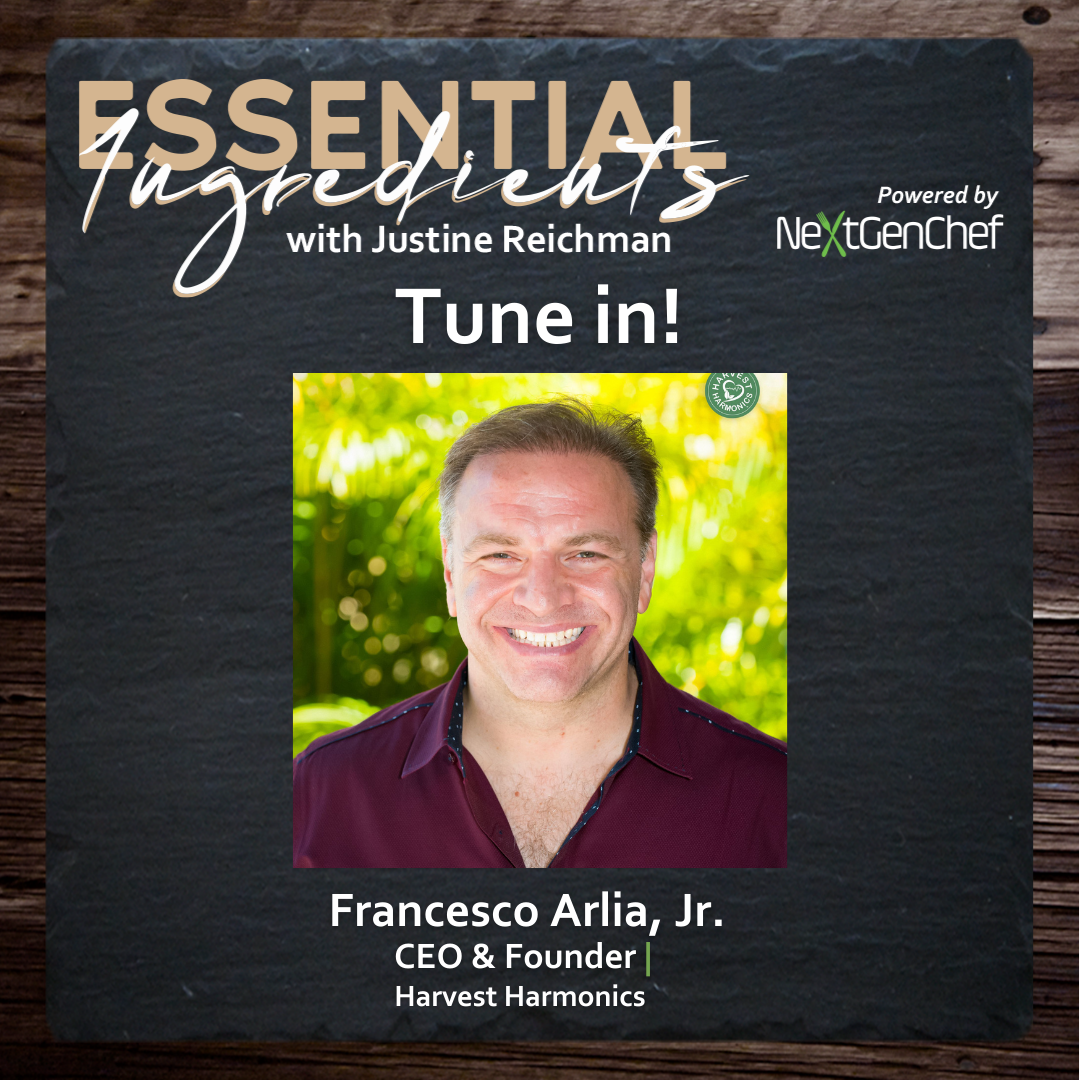
Good morning, and welcome to Essential Ingredients. This morning, I have the pleasure of having today, Francesco Arlia, the founder and CEO of Harvest Harmonics. Welcome. Thank you so much for joining.
Thank you for having me.
Thank you. Thank you. So you are the CEO and founder of Harvest Harmonics, and we're here to talk about the product that you have a licence for, and learn a little bit more about what Harvest Harmonics does. So can you tell us a little bit about Harvest Harmonics and more, specifically about this product that you have a licence for?
Okay. So the product or the technology behind the product is the Kyminasi Plants Booster.
Just before you go on, I just want to clarify, this is what you have a licence for, this is what we're talking about right now, just so our listeners can differentiate. This is not Harvest Harmonics. What you're talking about and explaining right now is the license for.
The original technology. It's a unique story because the original technology was developed by Fulvio Balmelli, and I funded his research, and that earned me the exclusive rights to the exclusive distribution worldwide. So there's the connection between Fulvio Balmelli and his company called K Project and my company, Harvest Harmonics.
Okay. So before we talk about this licence and project that you have, tell us what Harvest Harmonics is.
Harvest Harmonics is an international distribution company for the Kyminasi Plant Booster. The Kyminasi Plant Booster product is a low frequency radio wave system that induces plants to grow faster, healthier, completely natural, completely organic, just using their own natural bio resonance. And so what the technology actually does or how simple it is, it's installed on an irrigation system of a farm. And every time the water goes through the irrigation system, it's infused with over 3000 low radio wave frequencies, signals. Just think of us as communication signals that are sending these communication signals and sending this data, pre-programmed data to the plants, but the plants are receiving data that is inherent to their natural genetic makeup. So the plant is receiving data that is designed to help them and whatever their natural genetic makeup is. So it works with any type of plant, it just gets that plant like turbocharged, just a better you. Think of it as a better you. So the plant is dealing with old types of environmental issues, all types of tax from diseases, insects and weather changes. So the plant, they have all these challenges. But what we do is we give them these signals that help it deal with whatever challenge it's dealing with anytime of the day. Because once the plant absorbs the signals, the signals will stay inside the plant, and the signals are part of their natural genetic makeup. So it's not something adverse to what it's already used to. So if the plant is all ready, and all plants are absorbing sunlight from the sun for the process of photosynthesis, our technology helps the plant to absorb more sunlight more efficiently. Okay, it needs water. It helps it to absorb water more efficiently. It means, nutrients, we help to absorb nutrients more efficiently.
Okay. I didn't mean to cut you off. What I want to do is really understand, so for the people listening, what I want to do is break this down. I want to understand how this is different from what's been happening elsewhere? Why is this unique? How is this impactful for our health? Why should people, and why do people, why do we want to get people to do this? So if we could break this down by question individually, so look at one thing at a time. Let's look at the first question, why is this better for us?
Okay. There's several reasons, but let's start with the most basic. If the plant is absorbing more nutrients from the soil and more efficiently, then two things are happening. It's using less inputs from the farmer, so the farmer doesn't have to spend a lot more money to put into the field. So this farmer gets to save money. It's good for the farmer. So why is it good for the public? Well, the public now gets a more nutrient dense fruit or vegetable. So they're eating a healthier fruit, vegetable which, by the way, didn't cost the farmer much more money. Actually, the farmer is going to save money and make more money because he's going to be able to produce more. So the farmer can actually keep his prices the same and make more money because of the abundance, the extra yield that he's going to generate. Whereas, the public gets a better quality product because there are less herbicides used, less pesticides used, less synthetic fertilizers. I mean, if they're using natural fertilizers, it's fine. But if they use anything that's not natural, well, that gets into the food, and we eat all that food. So if we are producing better quality fruits and vegetables and it's gone even beyond that, we have cow farming, and I like that. They're not farming cows and milk growers. They're basically milk producers, but they have calves and have to feed them. So they had them grazing, and when they're grazing with our produced grass, because it's more natural, they're producing more milk and better quality milk.
Okay. So now, that's like a big deal. That's a huge deal. I want to just give our audience and our listeners an opportunity to understand what this looks like for the farmers. So what is the experience for the farmers, and how does it work for them?
Hold on a second. Actually, I can do that pretty easily. If I turn off my video, and I put my picture, it's a picture of me on a farm next to an installation I just did.
For our listeners during the podcast, you're not able to see this. But tune into the video cast, and you'll be able to see what he's showing us. Okay, thanks for showing that out.
Okay, so that's in North Florida. That was a tomato and orange grove. And there's a lake behind me, and the water is being pumped from that lake. You're looking at, you see the red, white and green label. Underneath that label is a micro transmitter system that I installed. And then if you look closely, you'll see three steel belts, and I lock it all in with a steel belt system because it's valuable stuff, people are going to try and steal it. But that's me, when I just finished that particular installation, the installations are not complicated. They're actually quite simple, and that's one type of an installation.
Once you've installed it, how easy is it for the farmer to use?
He doesn't do anything else, there's no maintenance required from him. The only thing that we do is every six months, we ask him to send us a little vial, it's a tiny little vial of water, it has about 10 drops of water in it. We want him to collect it from his field and send, he ships it to us. Then we ship it. Every Friday, we ship a package of vials of water from all over the country, and we ship them to Italy. And our laboratory in Italy analyzes them all to make sure that the frequencies are in the water operating at 100% capacity. And if they're not, we replaced the system. But as long as they are, then we just send an email to the farmer letting him know that the system is operating perfectly and just carry on. But the farmer, he's going to see it anyway because you start seeing his farm just doing better. The farmers know that.
So the farmer, he orders this?
Lisa, can you give me one of the pipes in the waiting area? The demonstration pipes. I'm going to show you what it looks like.
Okay. So how does the farmer find out about this, first?
We have different ways of contacting farmers.
And they pay for this? They have to order this?
Absolutely. They buy the technology from us. We have it installed. Either we train them to install it themselves, or we send someone to professionally install it.
Is this expensive for farmers? Is it prohibitively expensive?
No, it's an investment. It's an investment. Because anything that is a cost is something that doesn't, thank you. Anything that's a cost, it's something that doesn't give you a return on your money. So what we are, we look at ourselves as an investment to help you produce better products, make more money and get a return on your investment. And we have a 100% money back guarantee. If we don't prove that we're making you more money, we're doing better for you, then we take the product back, we give you money back. So okay, so this is what it would look like by the way.
Okay. So for our listeners, can you maybe walk them through so they can visualize this, because they can't see it if they're listening to the podcast,
Okay. So this is basically a one inch by three inch pipe that has an encasement. PVC and casement, and in the PVC encasement is the Micro Transmitter System. And then we have this filled with a resin so that's nice and solid, so it doesn't fall apart. So that's a small one.
So what is this Micro Transmitter System exactly? What is that doing?
Every time the water passes through that pipe, it is putting over 3000 radio signals into the water, low frequency radio signals into the water. And each one of those signals has to deal with a certain area of the plants environment, the plants health and plants production. So there are hundreds of frequencies that deal with photosynthesis. There are hundreds of frequencies, signals that deal with the digestive process of the plant. There are processes that help the soil to be more nutrient absorbable and other ways to help the nutrients in the soil be more easily absorbable by the plant. How is that done? We're making the water more absorbable. There are signals that are helping the water to be more absorbable. We actually are just about to put out a white paper from the company, it's about 150 pages that breaks this down step by step and really explains it. And we're about to put that up on our website. It came from Italy, and we had to have it translated, and then converted into proper English. Oh, there's a whole process, but it'll be ready in a day or two, it'll be up on our website.
Can you tell us, using this process, how is it beneficial for both our health? Let's start with our health. How is it better for our health?
So if you're eating apples, just because the farmer didn't have to spend the money on the pesticides because he saw that the apple tree was doing much better, farmers don't want to spend this money, they don't want to use these chemicals, they have to do it in order to protect the tree from the pest. But all of a sudden, the tree is so much healthier, that it doesn't need the pesticides, then we're not exposed to those pesticides. So when we're eating apples, that's just one example.
Pesticide free.
Pesticide free. I'd like to say, pesticide reduction, because we've reduced the use of pesticides. I can't say that we've eliminated them. But the idea is that the food is now healthier. Plus, if the tree is healthier and is producing more nutrient dense apples, when you're eating a healthier apple, it's usually a sweeter apple, and it has better tastes. What we've also noticed, which is a benefit for the consumer as much as it is for the farmer.
And for the environment. Really, I'm sorry, it's also for the environment.
But we're going to talk about, you want to talk about environments?
I was just, as you're talking about the farmer, you're talking to, I was just adding on.
I see that your eyes, your mind is already going, you're like, wow, this is incredible. That's what happens as we're talking to people, they start thinking, wait a minute? It's good for the plan, and you're reducing this, and you're reducing that, you're reducing pesticide, you're reducing all these other inputs. Because most people don't even know that the farmer is putting more nutrients, nitrogen, phosphorus, all types of nutrients into the soil. And when it rains, those nutrients, they leach, and they seep into the soil, and then they get into our groundwater. So it does affect the environment, because the plant is only utilizing 20 to 30% of that. So if the plant is using 20 to 30% of the actual fertilizers that are being put into the ground, and we have a system that gets the farmer to use less, because more is being absorbed by the plant. So less is being wasted in the environment, which hurts the environment. So now, the farmer benefits by using this. So there's several financial benefits to the farmer. There are several environmental benefits, as I just explained why. But the real benefits come to the quality of the food to the consumer. Another benefit is the products. And then I'm going to stick to the Apple example.
Yes. I would love, the other thing I really want to talk about in this conversation, because I hear your passion in it, I love that you're sharing and we've given our listeners a real opportunity to hear what it is you're talking about, and hear what the product is, and hear how the farmers get to incorporate this into what they're doing, and how they benefit, and how the end consumer benefits, both on a personal level with regards to their health and wellness, as well as the environment. So what piqued my interest is how you got involved in this because I hear the passion. As an entrepreneur, I wake up every day, and I'm excited to do what I do because I feel that it is directly related to what I love. So I got to ask, where does the passion come from?
Well, look, it's a long story. I'm going to give it to you as briefly as I can. But basically, I'm a first generation American. I traveled to Italy as a kid almost every two years for the last 40 years. I know the difference between eating food in Italy, and eating in Europe, and eating in the United States. And there's a big difference. Anyone who's traveled knows the difference. I'm not saying something that is not a valid statement. And I always have this idea that this should be better quality food. But my background is a forensic accountant, so I investigate criminals. I investigated crimes, financial crimes. But put all that aside, just put that aside. I always wondered why the food was so different in the United States and then in other countries. At one point, I was in Florida on some business and I got a phone call that my mom had just had a congestive heart failure attack. And this for me was a little nerve racking because I know, as a CPA also has many clients that are doctors, I know there's not a cure for that. Now, they don't know of a cure, so that concerns me. But then, I'm still on business in Florida when she had a second attack the following month. And that really concerned me. So now, I started looking for some solution because she had a third attack in January of 2014. And now, speaking to the doctors, we kind of got the idea that she had three to four months to live. So my mother was now terminal. That made me really nervous. My best friend, I didn't want to lose my mom. So I started aggressively looking for solutions outside of the United States, making phone calls on the internet just looking for solutions. A friend had recommended the Biomedic Center in Como Italy. And I contacted them, I translated all my mother's medical records into Italian. I sent them over to Italy. They reviewed everything, they said: "Look, she is terminal. She doesn't have much time. But if you get her here fast, we could possibly save her life." I said: "Okay, good." So against all odds, I convinced my mom, she knew she was going so I asked, I said: "You can either die at home, die on a plane. But if we make it to Italy, you will have a good chance of living." And she's like, Okay, let's go to Italy. So she's from Italy. She's going back to home country. So we went, we survived the plane, oxygen tanks, wheelchair the whole nine yards. I mean, did you know how expensive it is to bring oxygen tanks on a plane?
No.
You have to rent special tanks. They're $1,000 a week.
Oh, my God.
Special oxygen tank. So it cost me $4,000 just having the oxygen tanks because we were in Italy for, $5,000 because we're in Italy for five weeks. So I had to rent them every week. Anyway, pay the rent for five weeks. Anyway, the bottom line was, it was well worth the entire trip because my mum got there. She gets evaluated. And within one hour. Okay, Mr. Balmelli, who is the inventor of this technology figured out exactly what was wrong with her, and where it was coming from in her body. And he said: "Look, if you stay here for a month, maybe a little longer, we can save her life." And I said: "Okay, let's do it." So we stayed there. I quoted my accounting firm in New York and I said, this is gonna be the first tax season in 20 something years that I've ever not been there, so I'm not gonna be there, and they survived on their own. But I was there with my mother. And sure enough, I saw her start to blossom. She went from someone in a wheelchair to not needing the oxygen, to not needing the walker. I mean, not needing the wheelchair and using a walker. And it was an amazing transition watching her change. And while I was there for these 30 days, remember, I'm a forensic accountant, I'm an investigator. I'm like this Kojak type person. I started asking questions and investigating, how did you do this? How did you come up with this? And he was appreciative of my questions, and he answered a lot of my questions. And then he started asking me questions, and he found out that I was a very savvy business person. And he said: "Well, look, I have other technologies, would you help me bring them to the world?" And my answer was, you saved my mother's life, I will do anything. Any form of gratitude, I will do anything like that. He's like, okay. So he started showing me some of his different technologies. And then he showed me the one that he was working on for food, and how he was getting plants to grow better using just these similar radio waves that he used to save my mother's life. But they were for the body, these were for plants. And he showed me this lemon tree that he had grown. And he showed me all these other plants. I saw his laboratory and I was like, okay, this is like Star Trek type stuff, really, really super advanced. And he's like, yes, but it's not ready. And he goes, it's gonna need a lot more money to finish the research, but it can be done. And I said: "Fine, I will fund the research, and I will be more than happy to back you up because I have a passion for food. I have a passion for helping others, I have a passion for finding out the better way of doing things. And I have a passion for you because you saved my mother's life. I'll be more than happy to work with you." So I basically was working with him for two years. Just two years. And I kept sending money to Italy to do his consent, to continue his research. He had sent me some trial technology to use and started doing some trials. So we started doing some preliminary trials in 2015 and 2016. And I kept sending money, he kept sending me technology, kept trialing, and we were seeing results. The only thing that was impossible was we hadn't broken the code on how to get this into a commercial farm so that we can help farmers. Because by helping farmers, we can help people, and we can help people eat better quality food, we can bring health worldwide. And that was his passion. The reason he developed this technology is because he wanted to save more lives. He can save lives in his medical center in como Italy, but he can only save so many lives because there's only so many people that he and his team could see in a day. But if he could develop a technology that would influence the food and water on planet Earth, then he could save a lot more lives and keep people healthier for many more years. And that was his goal. So I became passionate about his goal. It aligned with my passion and I said: "Okay, so let's do it." So many years later now, I'm sorry. I mean, well, what happened two years later, I wasn't expecting this. Two years later, he says: "Listen, you got to come to Italy." And I was going to Italy, like almost every three, four months, maximum of every six months for meetings, and they said, but you got to come right away. I'm like, Okay, fine. So I went, he said: "Look, you've done an amazing job, you've helped us so much. We want you to be the exclusive distributor for the entire world, we want this to be your baby just as much as ours." And I said: "That was an honor." And they said: "Look, what you've gotten us to the finish line. We're almost there, but we want to have this agreement with you now." And I said: "Okay, fantastic." So then from there, I finished the funding, he finished the research, and the rest is history. By October 2019, this technology was ready to service the entire world and had already been tested scientifically documented.
Tell me, how many different farmers are you working with now?
We're up to, we did a soft launch at the end of 2019, we did have a hard launch at the beginning of 2020. And in the year of COVID, in the last year and a half, we're up to about 350 farms in 18 countries.
Wow, amazing. That's great.
Now, we're expanding more in the United States, we're focusing now on the United States.
And so what's your big goal now? What's the impact you hope to have globally with changing the future of food?
I tell you, I stopped drinking milk, 35, almost 40 years ago. I want to drink milk again. And we have farmers that are using our technology in South America. According to their statistical analysis and their scientific analysis, it's better quality milk, and it's healthier milk. I want to drink that milk that I was drinking many, many, many years ago. I want better quality fruits, I want better quality vegetables, but I want this for everyone. Everyone should be eating and drinking healthy products. At the end of the day, it's giving something to the world that they are going to utilize and benefit from. And if you think about it in the past year and a half, what's one of the biggest concerns that everybody has?
Health.
Health. The fear of dying has been spread all over the place with the pandemic. So people are really becoming more and more health conscious, and it's a good thing. That was my intention, to help people be more health conscious. I wasn't thinking when a pandemic that that would be the driving force. But the reality is, if you had a strong immune system, guess what? You wouldn't need all of this. You wouldn't need the vaccines, you wouldn't need all this crazy medication. Eat healthy food, drink healthy water. I'm not saying that medication is not important, I've used medication. I use medication. But the bottom line is, I'm also a very happy person because I eat healthy so I don't get sick very often.
I'm so glad that you were able to join us to share your story so that we can learn about Harvest Harmonics, as well as this amazing work that you're doing on this. And it's just great. Your story is inspiring, and I love the passion, I love the impact that you're having and what you're bringing to the world, so thank you.
I appreciate you having me on your show. I inspire everyone to check out what we're doing at Harvest Harmonics.
To reach out to you, how would they find out more about what you're doing?
You go to harvestharmonics.com. It's -H-A-R-V-E-S-T, Harvest, Harmonics, H-A-R-M-O-N-I-C-S.C-O-M. And if anyone is interested in knowing more, you could just give us a call 727-324-6750. We're looking forward to getting this out and getting more people involved actually.
Wonderful. Well, we all make sure to include that all in the show notes as well. And for those of you that are joining us on the podcast, we're so happy to have you. Again, if you haven't checked out our podcast, because we are video cast and a podcaster, don't forget to follow us each week on iTunes or iHeartRadio. And thank you again for joining us on Essential Ingredients. Thank you, Francesco. And we look forward to seeing you here again next week.
My pleasure. Bye bye.
Share This Episode
Enjoyed this conversation? Share it and tag @nextgenpurpose
Listen on Apple ▶Listen on Spotify ▶Your Host
Justine Reichman
Founder & CEO of NextGen Purpose. Host and Executive Producer of Essential Ingredients — 11 seasons, 330+ episodes, and a growing movement.
About Justine →