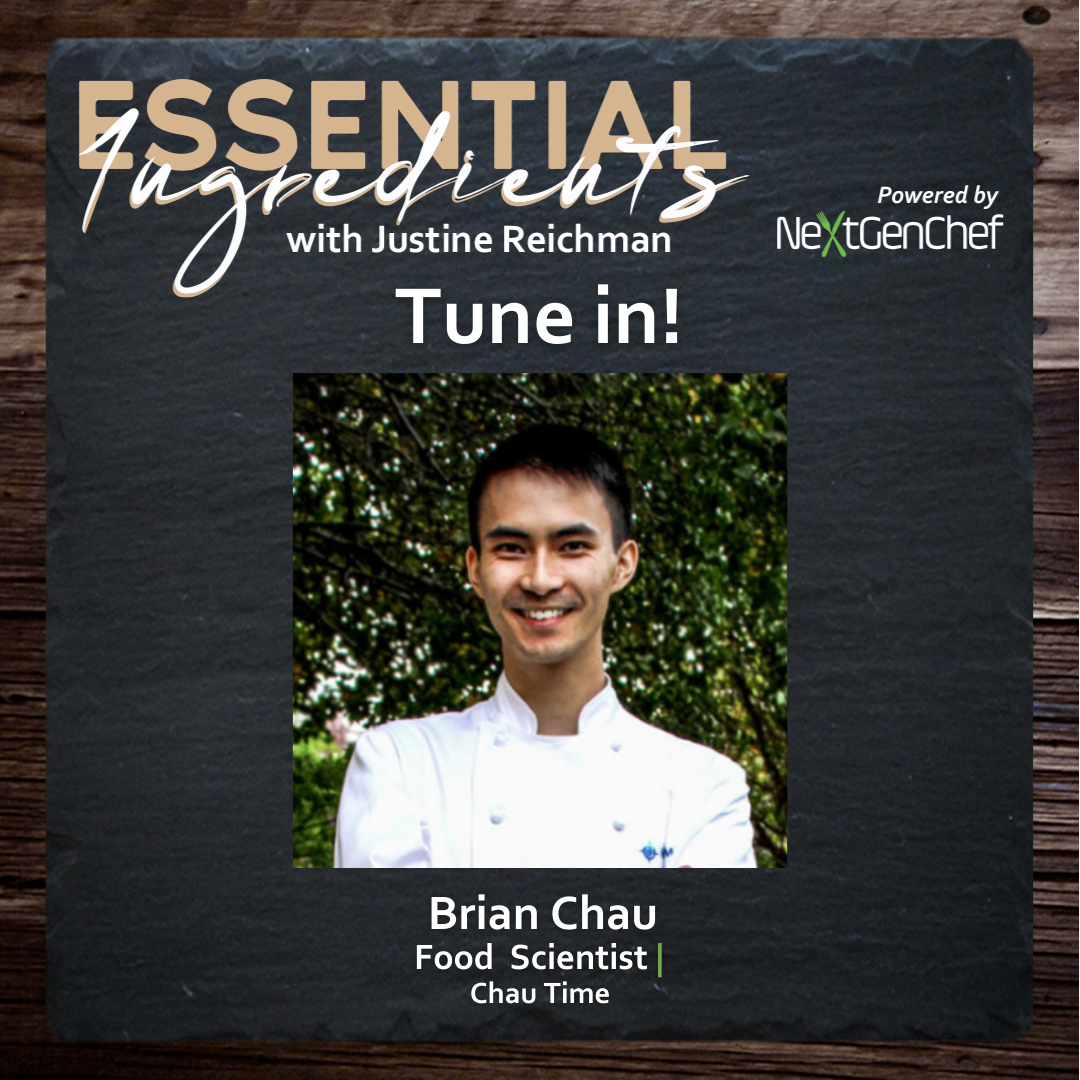
Brian Chau · NextGen Purpose
Watch on YouTube
Create a "More Effective" Brand Through Food Science with Brian Chau
The Incorporation Method helps you turn what matters into practical changes that fit your life.
“Food scientist, fungal fanatic, and food systems analyst Brian Chau breaks down how food science is the secret weapon for building a more effective brand.”
Full Transcript
Full conversation between Justine Reichman and Brian Chau.
Hello, and welcome to Essential Ingredients. I'm Justine Reichman, your host today. I am pleased to introduce you to, Brian Chau, who is a food scientist, a podcast host and is doing so many different things in the food space. And I'm just pleased to have him here today. Welcome, Brian.
Thank you, Justine. Anytime, Miss childtime. As long as I'm here, I'm Brian Chau, food scientist, fungal fanatic and food systems analyst at your service.
Thank you. Thank you so much for joining me. I'm excited to talk about all these different things that you do, and where you are in space, and how you're changing the trajectory of the food space. So let's start with food science. Talk to me about that. I know that you do a lot in that space, and I'd love to learn a little bit about where you are in it and what you're doing with it.
Certainly. Where it all started is very serendipitous. I think a lot of people who are in the food system or in the food industry happened by circumstance to stumble upon food. It's ubiquitous. I mean, all of us eat. For me, I ended up at UC Davis studying Food Science and Technology years ago. And that's only because my father went there and offers food science, but for electrical engineering. So just by him pushing me into UC Davis as an alumni himself, I just took at all the different majors out there. Nutrition as the number one choice. And because UC Davis said, oh, you have a couple of options for majors, they have over 100 different majors, they just called up and down, found Food Science, didn't know what exactly it was, clicked on it and then the rest is history. They placed me into food science and loved it ever since. And I've just gone into a lot of research development, and producing a lot of consumer packaged goods and a few food service items. I go from product developments and take a look into further analysis to shelf life, into sensory, into quality control, regulatory, the whole nine yards, if you will. And childtime, essentially is to take a look at all of those different components of building those products. And so what I'm doing now is creating a book of how to communicate or how to work with a food scientist, because there's a lot of jargon. In any industry, there's a lot of jargon. There's also a lot of framework and what a food scientist does and thinks that's not necessarily translatable to those of the people who were working with. So a lot of the brand owners that we're working with, they're coming from different backgrounds, not necessarily even science backgrounds. They're coming from Tech, finance, marketing, etc. So what I'm trying to do there is effectively communicate better. Because if we're able to communicate better with each other, we're able to build better products, we're able to communicate better in a context that we'd have less stress amongst each other. And we'd be able to have a much better impact. Because it's extremely hard, especially for brand owners with an idea in their head to try to translate that into something that's tangible. And have somebody else, the arms, if you will, or the designers, if you will, as food scientists take those ideas and iterate into something that is very close. If not, what the brand owners are looking for. So lay down a foundation of how we will operate three rounds of developments. Here's what we would expect as a food scientist. You can't read our mind, we can't read your mind. We're trying to figure out a means to iterate properly to be able to say, instead of saying, just pick whatever's the best. Or tell us as a food scientist, what is the best option? We're going to set parameters. We think a little more scientifically, what does it best mean? That's very subjective. So we tried to tie it to some sort of metric in the context of numerical value. Is it a shelf life measurement that you want us to take a look into? Is it a cost parameter, a nutritional parameter, a marketing parameter such as organic, or non GMO, local? And then from there, we try to figure out from all these different parameters which takes priority, and then we're able to communicate much better. It's like, okay, well, if priorities are based on cost or priorities are based on sustainability, we'll prioritize that more knowing that that product would change over time to best suit these parameters and priorities. So that's really the whole.
So Brian, when you came up with this, I have to imagine people were coming to you and you're working with different kinds of businesses. You probably saw similarities in what people were looking for so you developed something to deal with the pain points. Is that sort of what has occurred, you created a system. I'd love to hear a little bit about that story, what occurred and what the impetus was for you to be able to build this out?
Yeah, I think it was more reflection.
Okay.
I've worked with over 150 different clients from 2017 to 2019. And it was the pandemic that gave me pause, and really think about, what are all the different pain points? How can I streamline the process? And how can I lower the barrier to entry for a lot of my clientele. About 80% of my clients are small, medium businesses, or even entrepreneurs and startups. And a lot of the time, they're trying to figure out among all the different things in a business. Not just product developments, food safety and whatnot, but the marketing and all those other attributes. How can we make it easier for them to enter into the food industry to gain access to data, to be able to streamline the communication process so that they're able to easily tackle the challenges that they want to tackle? And that is more urgent, rather than just the product itself. Creating a product, in my opinion, is a little bit on the easier side comparative to other moving parts in the food business. So based on that reflection, having looked upon what were the stress factors? What broke down in the communication process in developing the products? What were the success stories in a lot of my clientele? And what were the pain points when I asked them in a working relationship, because I want to maintain good relations. And that's really part of the food system. At the end of the day, the people that are involved. And from there, I started to think, oh, it's a lot of communication. We're breaking down because they're thinking one way, I'm thinking a different way. And essentially, I think of food scientists as translators. We are translating the artistic component, the idea onto something that is more tangible, the product. We're also translating the science, the manufacturing, the operations and supply chain into something that is viable for long term growth and sustainability. That's no easy task, and that's a language.
When people come to you, do they understand why they're coming to you? Do they realize what you're bringing to the table?
I don't think so. A lot of people don't know what food scientists really do. And so a lot of it is trying to educate, and that whole industry of food science is very hard. It goes a long way in trying to demonstrate and educate people. But it's still quite an issue, because people go through four plus years of schooling to understand what food science is. And so what I tried to do is I try to break it down into a more simplified approach. I hope that the book is one approach in helping simplify things. But even then, that might be too much time or maybe a bit too complicated. So what I tried to do is within an hour's scope, the introductory screening call, I try to educate the clients a little bit more in what I do, like these are my capabilities. And if I am not able to fulfill what you're looking for, I can definitely connect you with somebody in my own network. That's one thing I try to do is like, how do I help the brand owners even if I cannot directly help them.
So for the listeners that we have today, for those that maybe think they know what food sciences are or maybe are unsure, and for those that think that they do, could we maybe just educate or give them your 32nd pitch as to WHAT a food scientist does?
Oh, that's a bit difficult. For me, what food scientists do is essentially taking the whole element of food production and food manufacturing at a large scale and evaluating long term growth. And sustainability is everything that has to do with food for long term and manufacturing purposes.
Okay. So if we have small businesses out there that want to grow or that are looking to see if they have long term feasibility and scalability and they're in their kitchens, and they've got this great idea, at what point do they call you?
I'd say that they can call me when they have a recipe that they're pretty happy with. But as long as they understand that that will change as they're trying to get into the markets, into the retail markets. So what that means effectively is a lot of testing involved, and they should be ready with minimal viable products as what people from the tech industry would say once they have a minimal viable product. That's when they should--
Just to clarify, because I like to clarify things. What does a minimal viable product look like? For those entrepreneurs that have a product, a CPG product, let's just talk about a CPG product, what would that look like?
That would be a recipe that's weighed out in grams, everything that's weighed out in grams, that has been tested in the market a little bit. So either you're at a Farmers Market, say about 50 to 100 people that's not necessarily direct friends and family that have tried the product and given some sort of critical feedback.
Okay. Okay. I want our listeners and viewers to be able to know when is the right time to call somebody like you, because I think it's important. We're talking about food science here, and I think it's integral to scaling food businesses so they should know and childtime is.
Exactly. I would also say that if they're not even ready and they just want an introductory call, that's perfectly fine with me. Essentially part of childtime is a little bit of that educational process. At the end of the day, when we're building out a food system, connecting with people and communicating, we want to be able to be open and transparent. And say, if we're not ready now, and I tell this to a lot of my clients, prospective, current and former clients, it's not a matter of if something can be done. Everybody's an entrepreneur when they come with an idea. It's a matter of when you want to have it done. And that comes with understanding project management. It comes with the vision and the drive, as well as the financing and all the other components with it. So I would say, never hesitate to ask the questions. And if it's not the right time now, that's okay. You can always come back later. Be prepared. And people have told me that they're going to come back to me later down the road, because they have enjoyed our conversation and the educational process. And that gives them a better clarity in developing a strategy.
Yeah. I think part of the process and part of building a business is education, connecting and collaborating. And we need to gather the information in order to make more informed choices. So it's a process and you gotta start somewhere, it's not going to happen the first time out.
Exactly. And that's part of the food system. I mean, if you don't mind, I'm gonna transition into the food--
Actually, we're on the same page. We're on the same page because I was gonna transition into the food system, and I was gonna ask you a few questions. So please, let's talk about the food system. As a food system analyst, I'd love to hear from you about that.
Yeah. Food Systems Analyst is kind of like a new term. It's been done in other segments, and a lot of it is in government or nonprofit. But I would like to take that understanding of the food system and broaden it. We're looking at a lot of different stakeholders, and we're trying to build out this ecosystem of stakeholders up and down the supply chain throughout all the different parts of the food system and of itself that we may not even think about. I'm trying to connect with people who are breeders, plant breeders.
Food System Analyst, you're saying. You're looking to connect with those people. So before you talk about that, can you talk about who you are as a food system analyst, what that role is and how you define that role?
I define it as looking at a framework of sustainability through people first, because the food system really comes with managing expectations and working with people. That is to say, from at least my perspective, drawing from the food science components to be able to connect the dots in the supply chain, and to be able to understand the framework of all the different people I've been working with as clients, as well as vendors, suppliers, etc. And to be able to say, all of you have needs and wants. And all of you are trying to achieve something in the food system, whether you're a distributor, a retailer, a supplier, a manufacturer, you're all connected, that's part of the food system. So let's be able to work together and find the right fit amongst each other, and be able to manage stakeholder relations and move forward together. So I'm trying to connect the dots essentially, that's what a food systems analyst would do. Where are the perfect dots? Well, maybe not necessarily perfect, but where are the appropriate dots, the right dots to connect. I see this as trying to combine the micro and the macroeconomics of things. We all start from one point of origin, and you can have a smaller circle if you're a small, medium business. But as you expand, there's a larger circle, and a larger circle, and a larger circle from there. And essentially, it all starts from that one central point. They're all connected and intersecting at that one point, whether it's a small circle, small supply chain, or a big circle, international. There's a lot of moving parts, and the food system is complex. But if we start from one point and we know we're connected at this one point, whether it's the idea, the brand, this strategy, something that's not necessarily tangible but we know that we're connected from this framework of operations, then that is part of a food system, big or small, connected at one points.
I couldn't agree more. What I'm really curious about is what is your overarching impact that you hope to achieve?
I hope to achieve to lower this barrier to entry. There's a lot of people that I've worked with, and I know there's a lot more people that I have yet to work with that have been struggling. I mean, looking at the pandemic and of itself, it has had a huge impact for a lot of small, medium businesses. How do we address all these different concerns in entering into the industry? All these barriers that they are facing, how do we be able to manage these resources effectively, and be able to provide data to all of these small, medium businesses which are lacking and the cost. I mean, a [inaudible] study is $30,000. That's a lot of money just to access the data. Communicating and understanding the time that goes with working with a food scientist is another example. Because a lot of times, a lot of my clients may not understand what food scientists do as one thing. And that's a lot of time trying to figure that out. So how can we synthesize that for the food consultants that are coming in to kind of actually help accordingly and appropriately so that we're able to move along with these short timelines and get things appropriately scaled by minimizing these risks? So what I'm trying to do is minimize risk. I'm trying to be able to find different, creative and innovative ways to be able to understand how to operate in the food system. Oftentimes, if we're looking at manufacturing processes, contract manufacturers, there's high minimums because the equipment that's involved requires a large capital expenditure. And if you're looking at small, medium businesses with big goals, they may not have that connection, they may not have the understanding of how to work with these manufacturers, or they may not even be ready. What if we can find it in between middle ground? We've seen that with some accelerator programs and incubator spaces, but there still is a missing gap in terms of operations. We are still missing the pilot plant, smaller manufacturing facilities are flexible. You can see this in kitchens and commercial kitchens out of some accelerators and incubators spaces to be able to produce smaller volume products. But it may not be applicable to all types of food products. Carbonated beverages, for example, are very hard to scale up.
There was an organization in New York, and it's not directly applicable. But the concept would be interesting to see if it could parlay. It was called the Freelancers Association. And the idea is that people that didn't work in large organizations could join this organization and have access, and to things that you didn't have access to because you didn't weren't part of a larger organization, health insurance, all sorts of things. So if you see where I'm going with this, these people that work in smaller businesses don't get the benefits because they don't have the large quantities. But smaller businesses got together to meet minimums to be able to make larger quantities. You see, it's not exactly the same thing. But I'm taking the idea for inspiration and saying that if we take, if we use that as a model and say, okay, we create an organization and we get smaller companies that are creating CPG companies. So they all create things, and they all use the same bottles, 16 ounce bottles, you get where I'm going with this? So you have 16 ounce bottles, and they all do this, and they all are non refrigerated and whatever, and then they all have to do at least 20. And then we have to reach 100 before we can do it, and I'm just using this, for example. Then once we get those and we reach that 100, we can then meet the minimum and then we get the better pricing so everyone benefits.
Exactly, exactly.
That's a good solution.
Yes. I mean, this is the reason why we're talking here. And we're hoping that by being able to discuss this here on the podcast, we send a message to a lot of minded individuals, whether it's a service provider, or service providers, or people up and down the supply chain, or even the CPG companies if they are localized. Or even if they find that there's one contract manufacturer that they all love to work with, but they're not able to meet the minimums, or they have a particular vendor, or supplier that they love to work with and they cannot meet the minimums. They can share resources together and create the products. And we have innovation in their policy stance in an equitable socio economic, equitable stance as well.
I think there's a lot to talk about here. And I think there's a lot of things that we could brainstorm, and see that we could come up with, and I'd love to continue that conversation. I'd love for the listeners and the viewers to continue and join us in the conversation, which we're going to be able to do on our app that we have on the NextGenChef App. But that being said, as you come out of COVID or things change, how is that affecting your business? Is that changing anything for you?
It's changing my mindset for sure. I think from 2017 to 2019,as I was working with 150 different clients, it was a lot of just doing it to survive. And now ,coming out of COVID, it's more to thrive. It's taking a step back and saying, okay, what is my mission? What is my impact? It's great that I've been able to create all these different products and help people from La Cocina, people out of KitchenTown, Tinker kitchen, just to name a few of the localized incubators and accelerator programs. But how can I further the impact on a larger scale? How do I create a system of minded people and the stakeholders, whether it's thought leaders like yourself, whether it's people from the tech side, in food technology and looking at transparency, whether it's the financing side, whatever it is. Let's try to connect those dots and create the system. And these ideas that you and I have just mentioned about the food system, and consolidating purchasing power or that nature, and improving, after that take all of these complex ideas and actually synthesize it so it's more market friendly. That's what I'm trying to do right now. I'm trying to not necessarily rebrand, but create a more effective brand. I have the foundation, but it's like paragraphs long. Now, to condense it into something that's more of a 32nd pitch. So that's what I'm trying to do right now. That in essence is, how do we make an impact under childtime, through a systemic lens, and be able to carry that conversation forward and actually put the actions necessary?
Well, I have a feeling that we're going to hear a lot from you. And I'm going to hear sooner than you think, that synthesize mission. And I can't wait to hear that. I'm excited for what comes in the future because it sounds like we're playing in the same waters. And I'd love to just continue to follow what you're doing and see how things progress. So thank you so much for joining me here today. And if our folks that are listening and watching us on the videocast who want to get in touch, what's the best way to get in touch with you?
Certainly. You can definitely find me on LinkedIn. If it's through my website, it's C-H-A-U-T-I-M-E.-C-O-M, that's chau-time.com. And if you want, I believe there's a contact page over there, and those are my main two points of contact.
We'll make sure to throw it all in the show notes as well, of course.
Thank you so much for having me, Justine, it's a pleasure.
Thank you so much. I want to thank our guests for joining us. We're here every Tuesday. We have a new podcast each week here on Essential Ingredients, and we'll see you next week. Thank you again. Thank you, Brian.
Share This Episode
Enjoyed this conversation? Share it and tag @nextgenpurpose
Listen on Apple ▶Listen on Spotify ▶Your Host
Justine Reichman
Founder & CEO of NextGen Purpose. Host and Executive Producer of Essential Ingredients — 11 seasons, 330+ episodes, and a growing movement.
About Justine →