Justine Reichman · NextGen Purpose
Watch on YouTube
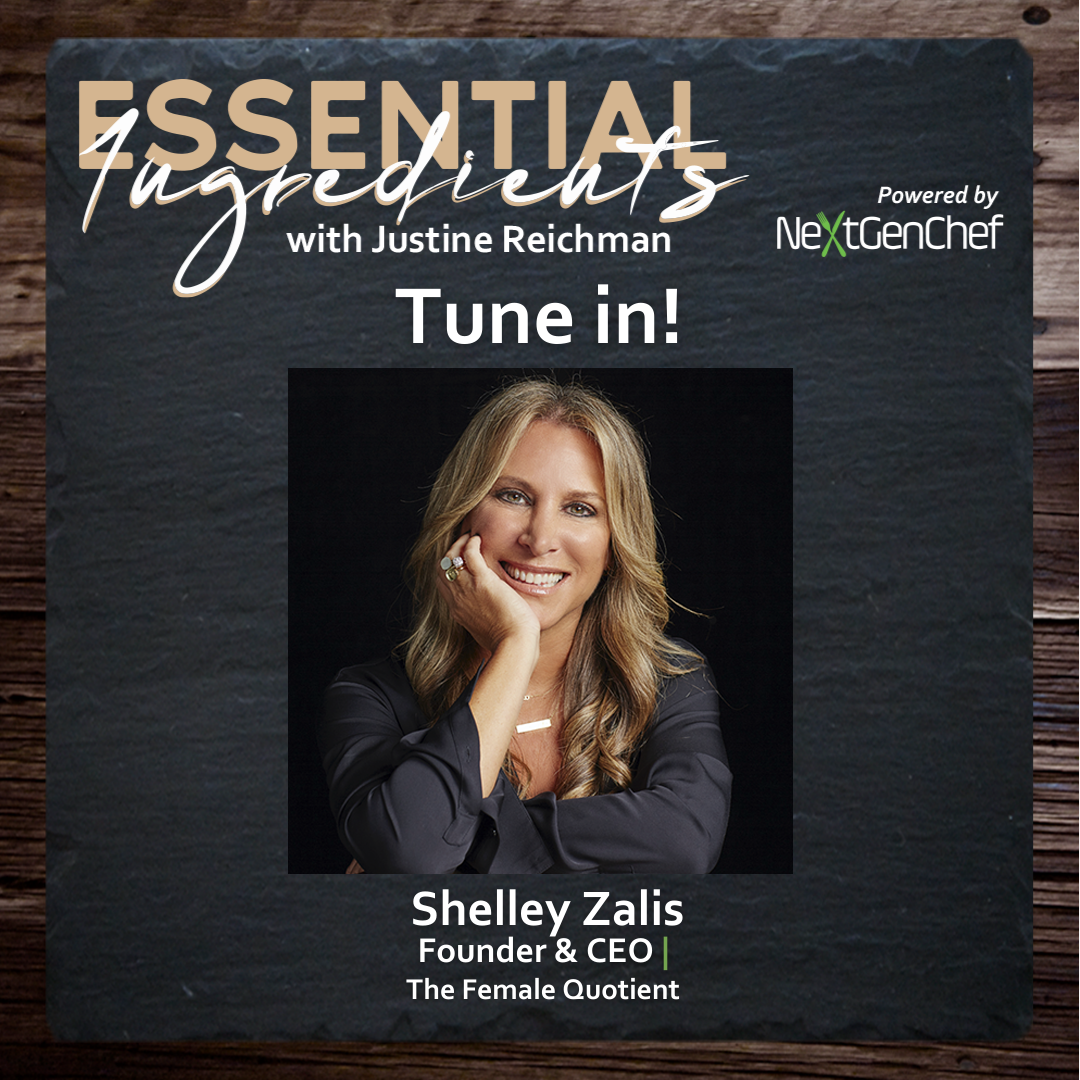
The Tables Have Turned Featuring Shelley Zalis in Conversation with Justine Reichman
The Incorporation Method helps you turn what matters into practical changes that fit your life.
“What needs to change is that people don't have the education, the information, to build good options and make healthy food accessible.”
Full Transcript
Full conversation between Justine Reichman and Justine Reichman.
Hi, and welcome to Essential Ingredients. I'm the guest today, and we have a role reversal. Shelley Zalis is your host, and thank you Shelley Zalis. She's the founder of Female Quotient, and she is taking over the role of hosts today on Essential Ingredients. Hey, Justine,
I am pretty excited to be playing the host of a podcast called Essential Ingredients, especially because I can't cook for the life of me. I can't even get a cake out of a pan. So for me to be hosting a show on changing the future of food and all that, Essential Ingredients and about NextGenChef, I am pretty honored, inspired, a little intimidated, but ready to go. So welcome everyone to?
Essential Ingredients powered by NextGenChef.
Okay, there we go. Welcome everyone to Essential Ingredients, powered by NextGenChef. So happy to have you all here. I'm thrilled to have my guest, Justine Reichman, who is the host of Essential Ingredients. So pretty silly that we're doing this, but pretty exciting. I have to say that friends come in the craziest ways, we met through our hairdresser. So if you can see how beautiful our hair color is, we say we are the Canali girls. Thank you Michael Canali for introducing me to such a remarkable human. So tell us Justine, what is the show, what is Essential Ingredients?
Essential Ingredient is a podcast that features entrepreneurs, founders, researchers, people changing the future of food sharing their stories so that other founders can make more informed choices. So that ultimately we can build a better food system. So what needs to change, like when we talk about changing the future of food, what's broken? So what needs to change is that people don't have the education, the information to build good options and make healthy food accessible. And whether you're a business or an end consumer, we just lack the information to make these informed choices. So my goal is really to rebuild the whole system so that if the businesses have access to the information, the end consumers have the access to the information, we can all have access to better food and healthier food options.
So how do you share that information? Are there food groups that you're recommending putting into your diet and certain food groups that we should be taking out? What's the right blend of food to live a healthier lifestyle?
I am not an expert. What I do is I interview all those experts, I interview the researchers, I interview people in agriculture, I interviewed people in food waste, I interview people that have been in this, and that are making remarkable changes, and that are doing the research and building the businesses so that we have the benefit of what they're doing. And so that we can take that information and make the informed choices to know what to put in our diet. So I'll bring on nutritionists, I'll bring on doctors, I'll bring on people that are building businesses and new businesses that might make a new food that is taking into account the way that the soil where the soil was, and how the soil contributed to the kind of meat. I'm sorry, not to meat, the produce that they're growing. So what goes into the soil determines what kind of produce you're getting. And so it goes back to understanding what people are putting in their soil, but people don't know this. We're not advertising this, this happens through education. So the more that we can educate, the more people can make more informed choices, again, both for the businesses as well as the end consumers. Because if the businesses understand they can make better choices when they're deciding at a restaurant level and chefs level, when they're making their menu, or when they're making soups to put in the store, or when you're buying food for your family or for your dog.
Dog? What's the best food for the dog?
Well, we make our food at home for the dogs, of course. There are a lot of healthy options, by the way for the dogs like just food for dogs.
Grass fed.
Grass fed meat.
I learned that already from you. And one quick minute, grass fed, when you drop your dog off for dog fitting, I know that I have to give them grass fed food which you've already offered to bring to me because I don't know how to make it, which we've already established. So some things you found, because we've already talked about junk in junk out, which is why it's so important to understand that we need good soil so that the soil produces good food. What are some of the lessons learned from the people you've interviewed?
So for some of the people, I've learned from talking with some of the people, I've learned about food waste, food loss, the difference between food loss and food waste, there's a lot of blame going on, and there's a lot of waste in our kitchens. There's a lot of loss on the farms because of produce that just falls off the trees, there's a lot of loss that's going on and waste that's going on in the restaurants these days. And what I've also learned is that a lot of these businesses can't succeed because it's very expensive when they get going and they don't have the resources that they need. And through COVID, they've had a lot of challenges. That said, there are a lot of resources out there. Not a lot, there are some resources out there, and people are really trying to support them. There are funds out there for people.
So there's a lot of ghost kitchens where you can share the resources, which I think is a brilliant idea.
Ghost kitchens are popping up left and right. And one of the things that NextGenChef is trying to do is really provide resources for these startups. Ghost kitchens because it allows them to work in a kitchen that they don't have to necessarily own the whole thing. They can pay for the time that they need. These collaborative kitchens also where they can just use it, and then they can walk away, so to speak, which I think are great.
Chefs. We have a workspace for chefs.
Totally we workspace, and it also allows them to collaborate with other people. There's one in the peninsula down here, collaborative kitchen kind of place, and there's a bunch in Oakland, and there's a bunch in New York that I know. And it allows people to connect with each other to collaborate, to work together. It's really a great option for people as they're starting out before they build out their own space, which is very expensive.
And what are people suggesting when you talk about wasted homes? What are some solutions around that?
Well, there's first in first ou. So what does that mean? That means that when you're buying food and you're putting it in your refrigerator, that if you're buying it now, you put in and then you leave, the oldest stuff is always in the front so that you make sure that you eat. But we did a podcast, and we invited the people from Imperfect Produce, which is a solution for people that want to eat the imperfect produce out there that often gets tossed. People don't like to buy it because it's not as pretty. And it's a great business idea because a lot of that produce would have just gotten wasted. These people created a great business model out of selling imperfect produce as opposed to wasting it.
So smart. So discounted for produce that's been on the shelf for a little while and ready to eat at the moment.
I don't even think it's been on the shelf for a while, it was going to be thrown out because stores didn't want it because it's not a perfectly red tomato or maybe it doesn't look perfect. It's not like a perfect carrot, maybe it has an indentation or something.
Very interesting, imperfect food. Imperfect food is perfect.
Exactly. I will say that some of their produce comes from Mexico, so it's not all local. Some people like to eat local food. So if you like to eat local, Imperfect produce or imperfect foods may not be your choice, but it does solve a really big problem. So there's a lot of you know, one of the things that I learned was from that podcast that we did with them first in first out another tip that I learned from them was with the celery and with a lot of the vegetables the carrots, cut them, put them in water, put them in a in a glass in the jar in the refrigerator they last longer. I've never even thought of that.
These are really helpful tips. Well, all of a sudden, I thought it's true that when you go to the supermarket and you pull the first items on the shelf, the further back you go are the newer ones. So they put the older ones up front to get them off the shelf and they keep moving up. So that's what you do in your refrigerator, first in first out, very smart thinking, Okay, I love these tips. These are really great tips. I'm learning so much so quickly.
I learned so much on my podcast all the time. We had one woman come on to talk about Eat Less Water. Because now, we have a drought going on. So how relevant is that? And it was about not the actual drinking water. It wasn't about just eating less water. It was about how to eat in your kitchen with foods that require less water. So the foods that you're eating require less water to produce them. So I thought that was super interesting.
Oh, what are some of your favorite foods?
So my favorite food, I love, I'm a big foodie. I eat every, I mean, I love everything from great produce, to a great steak, to oysters. I mean, I love it all. And I love it all. And I love innovative foods. I love when things are creative.
Like what's a great example? What's a great restaurant that has innovative food?
I mean, the other day I went to Hog Island Oyster, which is a seafood restaurant, fish restaurant here in Marin, and also in San Francisco, and also in West Marin. And they made this amazing crudo. It was a hell of it with red onions or shallots, and then some little green onions, and then a strawberry on top, and a little bit of olive oil, and a little bit of celtic sea salt. Or I might have made up that it was celtic, it might have been.
I can even know it's called celtic, salt is salt to me.
It was the big flakes, it's not like an iodized salt. It wasn't kosher salt. That's was not kosher salt. But it was amazing. And it had a little chili flake on it too.
Wow.
But it was also simple. It didn't have any heavy glazes on it or anything like that and it maintained the integrity of the fish, and the simple strawberry, and you can taste every flavor in it.
That sounds delicious. And so NextGenChef, is there a generation of new chefs coming in that? Are they just next gen because they're modern chefs? Or are they the new young generation coming in with a new mindset?
It's interesting you asked that. So NextGenChef, when it was in its infancy, was about the next generation of chefs. And since it's taken off, or since it's grown, it's really about chefs, food businesses, anybody changing the future of food. And it's about the next generation of people in food building better for your food businesses. And it's about encouraging, collaboration and building. I like to say collaborating, innovation, and being innovative. So that's presentation for, at our core, we're collaborating, innovating, and being, and working together to build the future of food. So it's really a movement to change the future of food to create greater access to healthy food. And it's not just done here, we're meant to build ecosystems around the world to support these startups and these entrepreneurs through collaboration, innovation and community. So we do this through the app, and we do this through our podcast by bringing together these, sharing these stories and these recipes that people are sharing, their personal recipes of success, failures and all sorts of things. So I use this podcast as a way for people to share their voice, what's worked for them, what hasn't worked for them. And the app which we use is a way for them to connect, and collaborate, and innovate, and connect one on one and really use it as a way to cross pollinate and connect around the world because we want these people to learn from each other. From here to Berlin and around, everywhere.
I think it sounds like a show in the making. NextGenChef, I think is a really great name for a show.
Well, you heard it here to have a show. But one thing I wanted to just go back to you said something about mindset. And it's really funny, because I do want to create the NextGen mindset and the NextGen philosophy, if you will. Because we want to support our community with the NextGen mindset. And we want to have the NextGen purpose. And it's all meant to create the NextGenChef.
Yeah, absolutely.
Family of NextGen purpose.
Are there great apps out there that have healthy, nutritious Essential Ingredient recipes?
There's a variety of them, and we're starting to curate them and add them to our good idea as they join the NextGenChef Community because they're building better for your businesses and better for your resources. So we're encouraging them as they build their businesses to join the community. It's free to join the community, and we want them to be a resource for the movement for people to be able to have access to this information. So there are a variety, we start to add them as they reach out, and as we reach out.
I think healthy eating, if you start your kids at a young age, they grow up wanting and knowing about Essential Ingredients and healthy, nutritious eating
Yes, it's true. Well, I think it's, what do they call that? It's like nurture versus nature. If it's inbred in you, I was having a conversation earlier on an earlier podcast with some people we were talking about in the 70's, the organic movement and how it was. And I was like, my mother was all over that the 70's. I thought she was a little cuckoo. And now, we have the regenerative agriculture setting. But it's true, I'm here talking about this because back in the 70's, my mother was buying organic lettuce. And she was dragging me to the stores to buy the organic produce or the organic things. And I thought she was a little off her rocker, but she was just ahead of her time.
Well, I mean, look now, there's Whole Foods and there's all these markets that we didn't, I mean, I'm 59, we certainly did not have that when my mom was raising her children, we didn't have a Whole Foods. So it's just really interesting times, and what's your favorite dish to make?
I love to make Passover. That's a whole thing, I liked Passover.
Never heard that one before. So limiting.
Aside from the potato latkes, because I like to make Passover.
Ever the hardest holiday to cook for.
Because the hardest thing to make, which is the potato latkes.
Oh, my god, that is hysterical. I think that is absolutely hysterical. Well, I am so thrilled to be hosting your podcast. I'm so glad that you are so much better than I am at hosting your podcast because that's what makes you you, that's what makes you the NextGenChef. Really, for everyone, please tune into Essential Ingredients all the time because it is a show that will keep you informed in the know and superduper healthy. So stay nutritious and tune in.
Thank you Shelley. Thanks so much for joining us. We're here every Tuesday. Essential Ingredients, you can find us on iHeartRadio, iTunes. If you like what you hear, please follow us and subscribe. We'll see you again next week.
Share This Episode
Enjoyed this conversation? Share it and tag @nextgenpurpose
Listen on Apple ▶Listen on Spotify ▶Your Host
Justine Reichman
Founder & CEO of NextGen Purpose. Host and Executive Producer of Essential Ingredients — 11 seasons, 330+ episodes, and a growing movement.
About Justine →