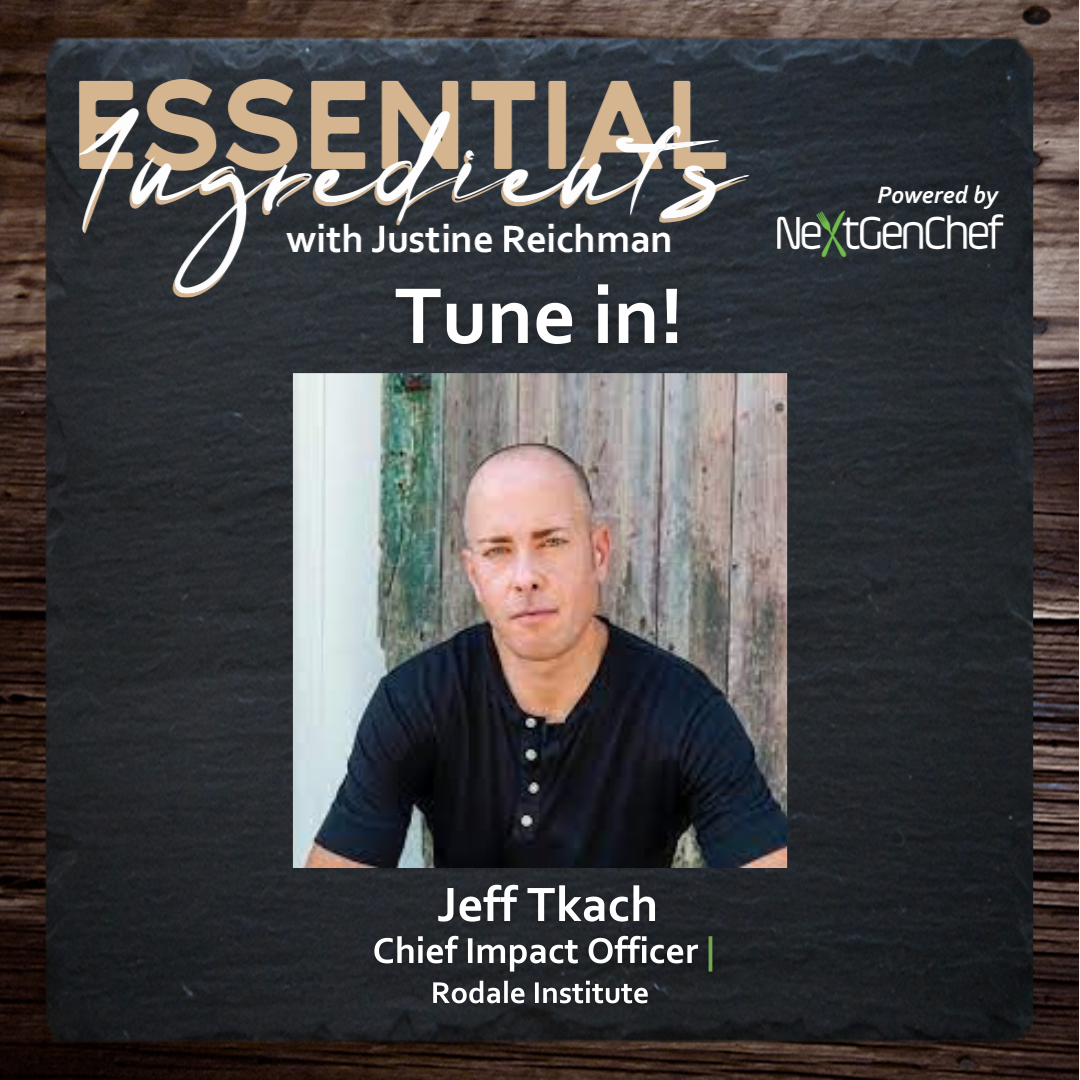
Jeff Tkach · NextGen Purpose
Watch on YouTube
Farm Your Body Back to Health with Jeff Tkach
The Incorporation Method helps you turn what matters into practical changes that fit your life.
“Jerome Irving Rodale, founder of the Rodale Institute, coined the term organic and was also an early advocate of sustainable agriculture in the United States.”
Full Transcript
Full conversation between Justine Reichman and Jeff Tkach.
Welcome to Essential Ingredients. I'm Justine Reichman, your host. Today, I have Jeff Tkach. Welcome, Jeff. Thanks so much for joining me.
Yeah, real honored to be here, Justine. Thanks so much for having me.
It's my pleasure. I'm excited to learn a little bit more about you and a little bit about the Rodale Institute, and the impact that you guys are having.
Cool, let's do it. Let's dive in.
Great. I think for our listeners, let's just start with a little background on you. Maybe you can just share for a few minutes, a little bit about how you got there and what you're up to.
Absolutely, yeah. It's been a bit of a life journey to arrive at the destination I'm in right now, working with Rodale Institute. Growing up, I had a lot of health problems. Actually a lot of health ailments that kept me from really feeling fully alive and fully vital. And that started at a very young age, like four or five years old. And between ages four and five, and maybe my early teen years, life wasn't really fun. Just constantly feeling sick and spending a lot of time going back and forth to the doctor. And through the context of that experience, I felt kind of deep into a sadness, a deep sadness at a pretty young age. I decided that I don't want to live this way anymore, and began to empower myself around the idea of health and wellness around the power of food. And I just became very curious. I had seen an ad on the television for a health magazine called Men's Health magazine. This was back like in the early 9's when a lot of publishing companies were using infomercials to promote subscriptions. I had seen this advertisement and I remember asking my mom to buy me a copy of this magazine the next time she goes to the grocery store. And so she agreed to do so. She brings me this magazine home, this glossy magazine. And like any kid, you read the whole thing cover to cover, like 10 times, including all the advertisements. And I remember feeling so inspired by everything I was reading, and I just got this overwhelming sense that I was in control of my health. And the next step was I took out a piece of paper, and I wrote down a grocery list. A very specific list of foods and I said: "Okay, mom, next time we go to the store, can we buy all these foods because this is what the magazine told me. I need to eat to be healthy." So we did that. Go to the grocery store and we bought all these foods. And over the next several weeks and months, I started eating differently. And little by little, my whole demeanor changed, my whole way of feeling, and being, and moving, and breathing in the world changed. Little by little, I started getting off the medicines. I had severe asthma and allergies as a young boy. And little by little, I saw a massive change simply by what I put in my body and how I treated my body. I was so moved by that that it set me on a path that ultimately landed me working in the publishing industry for a better part of 13 or 15 years. Right out of college, I worked in the health and wellness media industry. Came in contact with this nonprofit called the Rodale Institute, and fell in love, like really just captivated by the work that was going on there. I first encountered the work of Rodale Institute in 2004 and have been peripherally involved in the organization since then. I became a board member in 2015. tober
Wow. Well, Jeff, first, I just want to thank you so much for sharing your personal story. Because first of all, it's personal, and it's so empowering. And it's powerful to me because I think a lot of what I do is also empowered by how I felt as a kid. I don't know that mine was to the extent of your health issues. But it's really, I can imagine the people listening to this podcast shaking their heads or it resonating with them, and how that can make them feel, and maybe really enable them to make a change in their lives. I think it's really amazing that you take this opportunity to share that story, and I just want to say thank you.
Yeah, thank you.
You did mention that you were a child when you sent your mom to go get this Men's Health magazine? How old were you?
13.
13, that's pretty young to be that mindful. And that astute to send your mother out to make these changes?
Yeah. Other than that, I'm just that curious. Insatiable curiosity. You keep seeing these infomercials come across the television, and it creates a whole lot of intrigue like, how do I look like them? How do I feel like them? So I think it was really my curiosity around health and well being that triggered those thoughts.
And so you sent your mom out? And what was your mom's response when you sent her, when you asked her to go to the store to get this list of groceries and the Men's Health magazine?
Yeah. I think it was a total surprise because she watched me go through such suffering for so many years with my own sort of inability to be, a lot of my friends growing up were athletes. I couldn't play sports. I think my parents were pushing me to try but it was so painful, so uncomfortable because of how I felt and because of how sick I was, and so I think that there was a bit of compassion they had where they would push me but not so much because they felt bad. So there was a bit of a surprise, I think, on that day when I finally said: "You know what? This is up to me now. I don't want to live like this the rest of my life." What was really interesting about that too, I don't think I've ever spoken about this, but my father probably turned 40. Around that time, I remember that he had just had like a 40th birthday. He had always been an athletic guy, and my mom was a great cook and always set us really well. But I think he was around a time when he had stopped exercising, and he was starting to put on a little weight. He saw me go through this amazing change and shift and he thought, Well, I guess I better jump into and set him on a path. And he started getting fit and working out again. And actually, that routine stuck with him for most of the rest of his life, which was pretty, pretty powerful.
Wow, you're having an impact in your home. And now, you're having an impact in the rest of the world. That's pretty powerful.
Yeah.
Now, tell me a little bit about, you're at the Rodale Institute now, and it sounds like food has played a really important role in your life, both on your health and your wellness. I'd love to hear the impact that drove you to where you are today, and how that has inspired you on your journey?
Absolutely. So in around the year 2015, 2016, I had been serving in a position in the media industry in a prominent position. I was overseeing some of the largest health and wellness media brands in the world at the time, simultaneously, concurrent to that. I was serving on the board of directors at the Rodale Institute, and feeling like my heart was being pulled in that direction, but didn't really know what that meant at the time. And then about a year into it, I fell seriously ill. Just out of the blue, got sick and ended up becoming pretty debilitated. Had to go on medical leave, kept going back and forth to a conventional doctor to try to figure out what caused this health collapse. And every time I'd go to the same doctor over the course of a three or four month period, there were just no answers. I mean, we did all kinds of blood work, he sent me to all kinds of specialists, there was no evidence available as to what caused such a catastrophic health collapse. Until one day, my very last visit was December 27, 2016. I showed up to that doctor's office and he said: "Jeff, I think you're overworked. I think you're stressed. I think you need to just take a break. I think the reason for your health collapse is because you're taking too much on Nike." He blamed it on stress ultimately and said: "All I can offer to you as an antidepressant." That was like the scariest word you could ever imagine hearing out of your doctor's mouth. You're like, wait a minute, I know I'm sick. No, there's something seriously wrong with me, and you're blaming this on stress and offering an antidepressant like there's something so gut wrenching about that moment. So it was the last time I saw that doctor. I ended up going on medical leave. About three weeks into this whole ordeal, a good friend of mine encouraged me to seek out what's called a functional medicine doctor. And functional medicine is essentially like the systems based approach to medicine. So I found this doctor who happened to be like three miles from my home, which was a total score and total chance of luck. To this day, he's my doctor. He sat me down and he spent two hours with me. He said: "Jeff, you understand how agriculture works, right?" And I said: "Of course." He said: "I mean, organic agriculture." I said: "Yeah, I know what you meant." He said: "Well, what I practice is called functional medicine, and it's kind of like the organic agriculture of medicine. We're gonna farm your body back to health." And it was in that moment that I finally felt this overwhelming sense of hope. Finally, there's someone who can help me. And little by little, he actually did his own diagnostics. He found out that the core culprit for my health collapse was lyme disease. It just went undiagnosed. And at that point, it was seven months, and there was no medicine that was going to make me better. We had to kind of farm my body back to health from the soil up. And over the next several months, and it took a while. But little by little, we built up and I got healthy again. I mean, I'm happy to report that I'm probably the healthiest I've ever felt in my life. So it was really that sort of defining moment that led me to see that there is this incredible collapse, not only in our healthcare system, with doctors that are just simply not trained to look at our bodies as systems. But when I began to draw that correlation with the breakdown in our food and agriculture systems, it was like, okay, I'm giving up the rest of my life. I'm all in, like I'm all in. I left a pretty prominent position in the media industry. Fully, like was all in, I just said. I'm like, there's nothing else I can do but go to work with Rodale, I want to help move this mission forward because this is deeply personal to me now.
Well, that really connects. So maybe we can take this opportunity for our listeners, if you can just maybe give a quick intro for those listeners that are not familiar with Rodale to explain a little bit more about Rodale and what it focuses on.
Sure. Rodale Institute is widely known as the global leader in regenerative organic agriculture. So we're a global nonprofit that's focused on the science of organic farming. We're about 70 employees that are based at eight locations across five states. We work all throughout the United States, and we do some global work as well. Our sole mission is to help transition farmers and farmland from chemical conventional approaches to agriculture, to organic and regenerative approaches. So we're a team of scientists, consultants, educators, teachers, PhDs that are literally doing field work. We're doing science in the field, on farms. But we're also taking all that science and pushing it out into the world through all kinds of educational platforms, equipping farmers to move in a more holistic direction when it comes to agriculture. So that's a little bit about who we are and what we do.
And on a personal level, because this is very personal for you with your story and the challenges that you've had since childhood, what impact are you trying to have with Rodale and the future of food?
I'm really giving my life to this idea of connecting soil health with human health. Most people don't realize the wonder and awe of soil that's right under our feet. It is by far the most complex ecosystem on the planet. It's more complex than the deepest depths of our oceans. It's more complex than the most beautiful rain forest you've ever stepped foot into. It's more complex than any desert environment. It's a very complex ecosystem. They say that one teaspoon of healthy soil has over 10 billion microorganisms in it. So it's like this vast web of life that you and I rely on every moment of every day for life on this earth. And yet, current estimates would suggest that if we continue to farm the way we farm, using chemical conventional approaches, we only have like 60 arable growing seasons left before our soils stop producing because of the way we've been farming for the last 70 or 80 years. So there's this real urgency there. And at Rodale Institute, we're really trying to help. Number one, we're trying to help farmers to see soil health as the number one mechanism towards positive productivity. Not inputs, not chemicals, not equipment, but the soil itself is the tool to unlock successful farming. And that's a radical idea. And then secondly, as we see this failing healthcare system, we are now spending twice as much on health care than we are on food. Just in 1968, those numbers were flipped. We were spending three times as much on food as we were on healthcare. And so we see this crashing agricultural system concurrent with this failing medical system. I do believe that if we can make our doctors more literate in agriculture, then we can totally, we could change the world with that idea. And that's what I'm hearing.
I totally agree. And I'm a big advocate of these functional doctors myself.
Yeah.
I used to work with a doctor called Dr. Fred Alan in New York. I don't know if you know him. There's Dr. Mark Hyman, and there's Dr. Frank Lipman. There's all these doctors that are so amazing and really allow us to have a better understanding of how agriculture and our surroundings connect with our health. I think more people really should not have to, but I think it would be beneficial if more people could have access to the information so that they can make more informed choices, better understand the gravity and the impact that it has on their health and wellness. So that the farmers and consumers can all make more informed choices, so that they can better understand what they're putting in their body and so that the businesses can make better choices, so that they can make better companies and grow better food.
Yes, that's right. Yes. Yes. Yes.
I'm very passionate about it. Can you tell?
Yeah, I can tell it. Can I share something really cool with you?
Of course, please do.
In fact, the press release hasn't even been published yet, so I'm sharing something with you kind of hot off the presses.
The presses.
Yeah. This whole idea of connecting soil health with human health. I got very inspired about six or eight months ago by reading a book by a medical doctor who actually lives very close to you. Her name is Dr. Daphne Miller. She wrote the book Farmacology, but she also wrote a book called The Jungle Effect. She's amazing. She actually is on staff at UC Berkeley, or UCSF, or over near Oakland. Dr. Daphne Miller is really probably one of the most eco literate doctors in the United States. She's really the one that's teaching agriculture to medical students. Like her whole platform is, she really has seen her own perils of conventional medicine through her own lens and her own clinic. And it wasn't until she started, believe it or not, visiting organic and regenerative farms that she began to draw the correlation between soil health and human health. And so with all that said, most medical doctors get something like seven hours of nutrition--
Or something crazy like that. Yeah.
It's something pathetic. Well, Dr. Miller wants to change that. And so Rodale Institute has joined forces with her, and we recently received grant funding from the Dexter and Dorothy Baker Foundation, which is a national foundation that funds health initiatives. And we are launching a program, the first of its kind in the world, it's going to be called Health from the Soil Up. And it's going to be an accredited continuing education course for medical doctors and medical students that will literally come to the Rodale Institute in Pennsylvania to our global headquarters and spend a few weeks training with us. Literally getting their hands in the soil, understanding soil microbiology all the way through the end product of agriculture. So they're going to learn agriculture from A to Z. And the whole idea is that these doctors can then go back to their clinics and begin to prescribe food as medicine.
So it's awesome.
Right?
That's amazing. Wow.
So we're super pumped about this a lot. The first cohort will launch this September of 2021.
I'm not a medical student, but I'm super interested.
Yeah. There will be a minor application process, but we want to get as many people through this program as we can. The whole goal, we have a campus out in Ventura, not too far from you. So our hope is to be able to replicate this and other Rodale campuses in future years.
Because it would be great to be able to have, maybe portions of this to make it accessible to other people. So that the rest of the people building their businesses, and the end consumers can have access to some of this information while they're out there in the world trying to build businesses and buy products, so that they're making more informed choices. Maybe it's not the whole program, but it might be tidbits from it that you guys could make accessible through our app for our listeners, for our community. Yeah, maybe that's something we could discuss further another time.
For sure. Well, thank you for your passion for this. It's really important to me personally, and really important to the Rodale Institute.
Well, I would love to continue that conversation with Dr. Daphne and maybe we can have a whole nother podcast where we do that too, and talk about, we can maybe create a conversation where we could discuss this and make some of that information available to our listeners.
Sounds great to me.
I would love that. Well, we're going to take a short break for about just a few seconds so our sponsor could make a little ad. Well, I want to welcome our listeners back. Jeff, thanks so much. I'm excited to continue this conversation. We're just going to take a quick, deep dive into the regenerative conversation here. Talk a little bit about regenerative agriculture, the impact that Rodale is having on some of the stuff that we just talked about because I know that they're a leader in the industry here, and there's so many exciting things we spoke about before. I think I'm on a high already, but I'd love to just talk about that. Regenerative has been in the news and the media recently a lot, but that word is a little bit misused. It's also a little bit of one of those words that people are, it's kind of what that word that they call it, it's the lingo these days. They're like some of these, so what's your take on it? What's the correct way to use this word these days? And what does it really mean?
Yeah. Let me tell you about the origins of the word regenerative as it relates to agriculture. The founder of the Rodale Institute, J.I. Rodale, all the way back in 1942 actually coined the term organic as it's used today. And as you know that by now, the word organic actually has a whole audited certification process. It sits under the USDA in Washington DC, it actually is a highly efficacious word and means a lot, and it actually something that consumers can trust. So every time you or I purchase a certified organic product, you can rest assured that that food or beverage item went through a rigorous auditing process so that you can be sure that it is in fact what it says it is. Around the mid to late 1970's. J.I. Rodale's son, Robert Rodale who became the leader of the Rodale Institute was doing a lot of traveling at the time. So he was traveling around to different continents evangelizing about the work of Rodale, and he was meeting with a lot of farmers, particularly in third world countries. So he spent a lot of time in Africa and Asia. He even spent a lot of time in Russia shortly before his death in 1990. And as he was traveling and talking with farmers, a lot of people were beginning to use the word sustainable and sustainability. [inaudible] thought that was actually a terrible word. He thought it meant everything and nothing, and he would look around at these two certified, unproductive decimated agricultural zones in some of these parts of the world. And he thought to himself, what's here to sustain, there's nothing worth sustaining, these are fundamentally broken systems. So he started looking at the soil, and he was captivated by the power of the soil. He thought, and as he would teach these farmers about methodologies like cover cropping, or complex crop rotations, or using compost and other biological soil amendments, he began to realize, wait a minute, if I as a farmer begin to put all of my efforts and energies on the soil by resting it, watering it, feeding it, giving it what it wants and what it needs, then the soil health improves, then the plants growing in that soil get healthier, stronger, better, more productive, more flavorful. And the people eating that food, the same thing happens to them. They begin to get better, and better, and better. And then as a farmer, my bottom line improves. I'm getting more profitable. And if that happens, then guess what the entire community flourishes. So in a system focused on regeneration, again, the whole goal was how do we regenerate the soil. As we do that, everything around it gets better, and better, and better over time. And that was like a lightbulb moment for Robert Rodale where he said: "No, the focus is about regeneration. It's about regenerative agriculture." So Rodale sort of brought forth the word organic, and then later the word regenerative. And to us, we have a definition. In fact, if your audience is interested, we've actually built a standard called the Regenerative Organic Certification. If you go to regenorganic.org, you can read about that standard. It is now the highest bar food, the highest bar standard in food production in agriculture. It's actually the only standard in the world that's audited. It asks the farmer to be a minimum certified organic, then the farmer must adhere to strict soil health protocols, animal welfare protocols and human labor protocols. So we've defined those two words. However, to your point Justine, the word regenerative itself has begun to mean everything and nothing. A lot of farmers are beginning to adopt this word. Yeah, I mean, basically, what's happening is conventional farmers. Farmers that use chemicals are beginning to adopt some biological processes, they're beginning to reduce how much they tilled the soil, which is good. They're beginning to use things like cover crops, which is good. But to be a regenerative farmer does not preclude you from using chemicals. There's still a lot of large scale farmers that are farming thousands of acres using regenerative techniques. Your audience can't see me giving air quotes right now, but that's okay.
That's okay. For our listeners, he's giving us air quotes.
I just realized that I'm like, why am I doing this?
That will be in a YouTube video too. So in the video, the people will see the air quotes. But for the listeners, he's doing air quotes. I do have a question for you. For those people that are trying to do that, for those founders and those entrepreneurs that might be smaller, becoming certified organic, can be prohibitively expensive and cumbersome, the whole process. I know that Rodale does work and has people that go out into the field, or at least I believe goes out in the field and can help with this process for them. Is that correct?
Yes, that is correct. And I would also challenge that assumption that the Organic Certification process is expensive. Believe it or not, our own federal government has created a cost share mechanism. Most people don't realize that there's actually money available to farmers that do wish to transition to organic.
That's exciting.
Yeah, for sure. So that's pretty known information, easily find the information rather than the USDA. The US Department of Agriculture has created an organic cost share. I don't have all the ins and outs in front of me. But essentially, it gives money to farmers, especially small scale farmers that do desire to transition because the certification is probably a few thousand dollars a year, I'm guessing. And to a small scale farmer, that could be a big deal, $1,800, or whatever. And that's significant. So there is money that the National Organic program has set aside. And unfortunately, we think at Rodale Institute that that money should be more. So we're actually working hard to create better legislation to help empower farmers with more money. But yes, to answer your question, we do absolutely have a consultancy. Now, this was launched two years ago. So for the first time in the history of Rodale Institute, we now have a team of trained consultants that can go out onto any farm anywhere in the country. And maybe soon, anywhere in the world, and literally hold the hand of the farmer as we walk them down this pathway towards transitioning. We actually launched this last, I guess about a year and a half ago, not knowing what the demand would be for these services. And would you believe that we already have over 200 farms working with us that represent over 50,000 acres of land that will be transitioned over the next three to five years? And just on Tuesday of this week, we just dropped a major press release, a major announcement whereby Rodale Institute is partnering with Bell & Evans, which is one of the largest--
Bell & Evans chicken.
Bell & Evans, believe it or not, it's like a $600 million company based right here in Pennsylvania. Anytime you go into a Whole Foods around the United States and you buy an organic chicken, it likely came from Bell & Evans. So it's a wonderful family who has a big vision and a big heart for organic. And their founder and CEO Scott Sechler gave an opportunity to Cargill, which is the largest commodity producer in the world, a big, big, big grain company. He basically challenged me, he said: "Listen Cargill, I'm willing to give you a 500 million dollar contract for all of my grain, all the corn, all the soybeans that go to my chickens. I will buy from you under two conditions. One, all of that grain will be grown domestically here in the United States, we will not accept any imported grain. Number two, you hire Rodale Institute's consultancy, and your farmers must farm to their standard." And they said: "Okay, let's do it." So we've just launched the largest public private organic grain initiative in the world.
Wow.
And it will ultimately mean 50,000 more acres over the next five years.
That's amazing.
Pretty cool, right?
Yeah, that's amazing. I just want to go back to this so that our listeners, because we do get some founders that are smaller and I just want to make sure that they understand the process to get a consultant, is it prohibitively expensive? Is it accessible to get somebody from Rodale to come out and help them through this process? What is that--
Not at all? Yeah. So we're actually a fee for service consultancy, which is pretty normal in the consulting world. But our fees are not very modest. All the information if you're interested in working with us, it's easily found on our website under the consulting tab. However, I want to mention something super cool. So our consultancy launched because two years ago, the governor of Pennsylvania where we're based became privy to some data that suggested that Pennsylvania was then the number two producer of organic food in the nation. Second only to your state, California. And he's looking at this data, I can almost imagine that he's like looking at this data. And he's talking to his secretary of agriculture saying: "How did this happen?" He's like, I'm taking good PACs taxpayer dollars and bailing out, failing conventional dairy farms in our state because Pennsylvania's a ton of dairy farms. Like these dairy farms are failing on the conventional side, but we've got 1,400 certified organic farms in the state. Like how did that happen? And Secretary said: "Well, that's an easy answer because Rodale is here. And they've been here for seven decades doing this work and showing farmers how to transition." Governor Wolf actually wrote the first ever State Farm Bill in the history of America. There's never been a State Farm Bill, it's always a federal policy that always comes out of the federal government. So he passed the first ever State Farm Bill, and got bipartisan support for it, by the way. And a portion of that Farm Bill gave Rodale a little bit of money to start the consultancy. And now, any farmer in the state that desires to transition to organic gets free consulting under Rodale Institute. And so if you're listening to this episode and you are in the state of Pennsylvania, you would actually get free consulting, as well as another private family foundation that has enabled the same thing in Midwestern states. So we now have a team of consultants in Iowa that can work with 12 states across the Midwest.
So how do we make this happen in every state?
Well, that's our goal, actually. I'm glad you brought that up. I mean, our hope is that we can impact every Secretary of Agriculture in every state and show them a model that is very successful. So I think the call to action to your audience would be to write to your state policymakers, your state senator, your state representative, and reference Rodale Institute, and Governor Wolf's Barm Bill because this is a model for, this is just good business. So put the environmental and human health aspects aside. If you want to create economic vitality in your state, then fix farming. Because if you fix farming, you fix everything. You fix water, you fix air, you fix human health, you fix environmental health, everything in your state will improve including the bottom line. In 1945, post World War ll, almost 50% of all the food that we ate in this country came from our own backyards. Remember the whole Victory Garden era? Today, 17% of all the food we purchase in the grocery store comes from other countries, and that's sad. That's pathetic. That's very sad. And we have an opportunity to change that. Now, during the pandemic, as a result of the pandemic, we saw 22 million new gardens planted in the United States in the year 2020. That's a statistic from the National gardening Association. And we also saw direct farm sales, people like you and me literally, remember the grocery store shelves went there last spring? What did we do? People went to farms in their community. Direct farm sales, 420% increase year over year. So farmers began connecting with people in their own community. I started--
You have a garden? Can you show us?
I have a massive garden. I was actually gonna say, I think I could show you a photo here.
Show us a photo for, our listeners cannot see this, but those watching the video will be able to.
Oh, here it is here. Hold on one second.
Okay. Oh, make you a co host so that you can share your photo, because I'd love to see your garden. Let's see.
There we go.
Well done. Oh, look at that. Can we make it a little bigger? Oh, I like this, amazing.
That was the springtime. So yeah, in Pennsylvania, I was growing a lot of greens. But I have five or six raise beds and pretty much eat out of my garden all summer and fall.
I'd love you to, you have a recipe you could share with us that you started to make a lot of during the pandemic?
I'm certain, I could come up with one for sure.
Okay. Yeah. Maybe you can give that to me, and I can put it on, share it with our listeners. I'll put it on the show notes for everyone to check out.
Yeah. I think we're at a unique time in human history where we've seen this massive disconnection, we've become so divorced from where our food comes from and how it's produced. But I think we're at a moment where we're ready to reconnect to the source. And I think that your audience, I would challenge if you and I have the ability to grow something in our own backyard. It's actually our responsibility to do that. I think we all have this amazing opportunity to connect with nature by learning how to grow something, to garden. I'm not saying that you have to grow all of your food in your backyard, but just grow something. Try it. I can't do that. You did?
I tried. You said, try. I will try.
Yeah. If you can't do that, then you know what? The next step is to get to know a farmer in your community. I mean, there's these amazing Farmers Markets that are popping up all over the United States with amazing producers. Farmers and producers that need customers, they need customers. We've become so convenient with Costco, Whole Foods and everything else. And it's like, that's not a real connection. Even if you're buying organic food, that's not real. You're missing another layer of health there. I think the closer we cut down on, the more we cut down on degrees of separation in our food and how we interact with food, the healthier we're going to become as a society.
Well, I would completely agree, and I only shop at the Farmers Market.
Nice.
I do that. I like rapport, I like building a relationship, I like knowing the people I'm buying from as a small business. As somebody that runs a small business and comes from a family of entrepreneurs. I always appreciate knowing the person that's running the business. I like to support the business. I like to know the family. I like to know what they're doing with it, where it's coming from. I look forward to seeing them every Saturday. Hi, they know what I buy. I asked the same questions or I asked new questions. But I appreciate seeing them. I get to know the kids, and I like to support them. They're working hard. I like to know, is it grass fed? Is it this? Is it that? And I like to ask those questions and know what I'm putting on the table and feeding the people in my house. And it makes me feel like I'm making informed choices. I know what I'm putting in my body.
Yeah.
So for me, I feel like I'm doing the best that I can because I have tried to grow some vegetables. They didn't do so well, and I will try again. But in the meantime, I'm making relationships with the farmers, and we're in the county.
Absolutely. Thank God for them, right?
I encourage everyone else too because the farmers are, they're where to at right now. I like to know what they're doing and how their farms are doing. And they need the support because they're not going to be around if people aren't continuing to go to them also.
Correct. Yes, that's right.
So Jeff, I really appreciate you joining me today. I so appreciate you sharing your personal stories with me, as well as how you got involved in Rodale and the impact that Rodale has had and their plans for the future. And I hope that we can have many more conversations to come because there's so many more things that I want us to discuss.
Let's do another round.
We'd love that. Let's do that. We'll get that on the calendar. I want to thank our listeners for joining us today. And if you like this and you want to hear more, don't forget to subscribe to the Essential Ingredients podcast. We do put special podcasts, different episodes and special bonus episodes on the NextGenChef app, so you will want to download that. I hope to connect with you all soon. Don't forget, Essential Ingredients podcast is available on iTunes, Spotify and all the different channels. So again, Jeff, thank you again so much for joining us. And thank you to our listeners.
Thank you Justine. It's been an honor to be here today.
Thank you.
Share This Episode
Enjoyed this conversation? Share it and tag @nextgenpurpose
Listen on Apple ▶Listen on Spotify ▶Your Host
Justine Reichman
Founder & CEO of NextGen Purpose. Host and Executive Producer of Essential Ingredients — 11 seasons, 330+ episodes, and a growing movement.
About Justine →