Elysabeth Alfano · NextGen Purpose
Watch on YouTube
Is Animal Agriculture on its Way Out? with Elysabeth Alfano
The Incorporation Method helps you turn what matters into practical changes that fit your life.
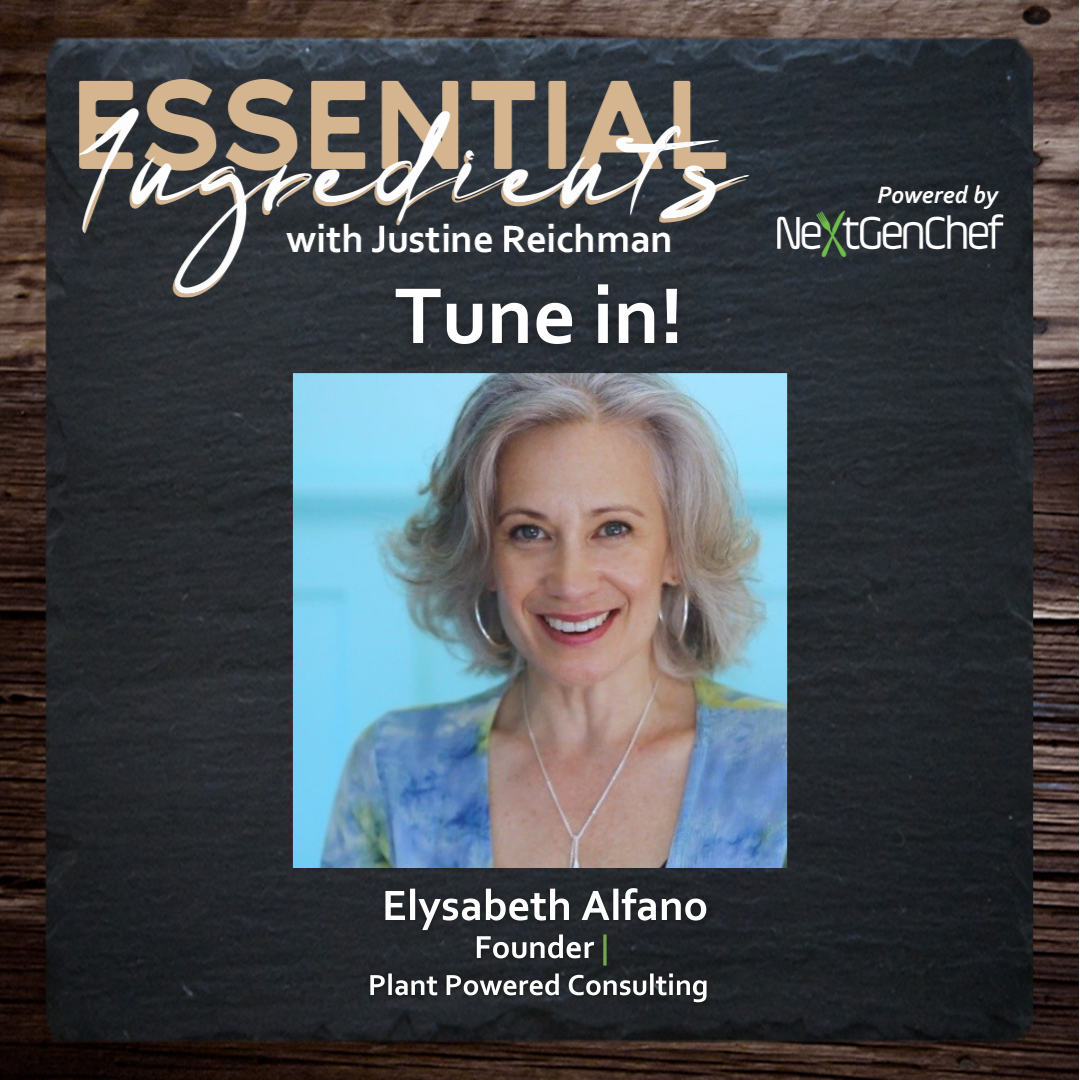
“Founder of Plant Powered Consulting and host of The Plantbased Business Hour on LinkedIn, Elysabeth Alfano has made it her life's work to accelerate the shift away from animal agriculture.”
Full Transcript
Full conversation between Justine Reichman and Elysabeth Alfano.
Good morning and welcome to Essential Ingredients. I am Justine Reichman, your host. Today, we have Elysabeth Alfano. Welcome Elysabeth, thank you so much for joining me.
Hi, Justine. Thanks for having me.
Thank you so much for joining me, I'm so pleased to have you here today. And just so you know, I have watched your videos. I watched them and I'm like, she looks so professional, looks like I'm watching CNN for LinkedIn. I was very impressed and a little bit like envy over your video, I wanted to know how you did it.
Oh, my gosh, so simple. I just give myself permission to fail. So I live on LinkedIn, I do it every week. It's called The Plantbased Business Hour. And it's every week, little plug here, 1:00 PM pacific time, Plantbased Business Hour, and they're long form hour interviews. And I just sort of say like the tech Gods are with me, it'll work out. I'm opposite natural light. So tip, natural light is your friend. I'm opposite natural light. I have a $40 microphone from Amazon, really not a lot of big things. Even my earbuds, these are what I got on a plane when we used to be able to fly. I mean, I'm not high tech at all, but I just kind of roll with it. And really, the guests that I bring on these CEOs, and entrepreneurs, and scientists, and advocates, and researchers, and athletes, and other things, but really primarily in business, these people who are moving the needle in the plantbased, and cellular ag, and fermented protein space for people to planet and animals all through innovation and creating an entirely new food supply system. Actually, that's what we're talking about. So when you're so immersed in this cutting edge, new world that we're building, I just started to say that if there's a tech problem, it's just not high on the priority list.
I think that's a really brave way to go about doing it. But not only is it brave, I also just think that your videos and the way that you show up looks so professional. When I look at your videos, it looks like you're literally in a studio. From the banners that you have on your video to the way that you present, it really does look like you have a team that it's not a one woman show.
It's a total one woman show. I'm so glad it comes off differently. I have my bunny slippers that I'm wearing on my feet, it's not CNN folks. But I do appreciate it, and sort of shout out to CNN, I would love to talk about the plantbased business news on CNN. So you can have me as a guest anytime. I do a lot of TV and radio anyway. So in addition to my own show on LinkedIn, The Plantbased Business Hour, I am a guest on radio and TV. I guess I'm also kind of over the hump of being nervous about it, and that might help.
Well, I'm so glad you shared that with us. And I'm glad that our listeners now know a little bit more about you and how they can actually hear from you outside of our podcast today, but on your very own podcast.
Yes. So the podcast, we're also crazy busy, particularly if we're mission aligned. Sometimes people say to me, Oh, I love that you do The Plantbased Business Hour. And I say like, Oh, I do. But that's sort of the volunteer are of my life. I mean, nobody makes money in journalism to start with, and certainly not in podcasts, particularly when you don't have a CNN studio behind you. So I do have The Plantbased Business Hour, which is this hour long, deep dive interview show. And The Plantbased Business Minute, which is a recorded headline news show. I break down the top week headlines, each in a minute or less, that's every Friday on LinkedIn. But those are just sort of to pass along information to the plant based landscape because I'm so personally deeply aligned that I know that information is the key to progress. So I just want to get people the facts and the less than obvious information, again, talking to a CEO, getting the behind the scenes of what's really happening for the plant based trends, market, etc. I want to get people all that information. Now, how I spend the majority of my hours is with my consulting firm, Plant Powered Consulting, and that is 60 hours a week, just that. We're not even talking about the podcast. There, I help plant based brands or non plant based brands navigate the plant based landscape. So a lot of people come to me initially for press because that's how they see me because of The Plantbased Business Hour. So I start on press strategy and execution. But because of my own business background, I have an MBA, brand manager on Special K and Frosted Mini Wheats. That's where I started my career with Kellogg Corporation. So because of my own background, people realize once they get through the press stuff with me that, oh, maybe you could stick around for some business strategy, and marketing strategy, and execution, and then even Investor Relations, etc. So I end up staying the long haul, people bring me in for some quick press, and then I just end up staying for a couple years usually. So I have a lot of clients because they never end, start with me, let's just do a two month contract for some press. And then they just stay. So I have this growing, growing list of clients. And if anybody is working in the plant based space, all I can say to them is thank you for doing all that you do. And I feel you because I'm working 16 hour days, seven days a week because I love every second of it.
You are one busy lady.
I'm pretty busy.
I mean, I'm not sure when you eat, sleep or anything else.
I usually eat standing up over the sink. I mean, I'm sort of joking, but my partner's like, you must sit down. And I'm like, well, I don't know when I'll have time to do that. But I do of course take time off. You need to, otherwise you burn out. I don't want to burn out, I want to be here for the long haul because this is, again, personally meaningful work to me. And before we started this podcast, we were talking about hair. So anybody who can see me now knows that I have silver hair so I want change in my lifetime. I'm not 25, I want change in my lifetime. So good to work people, we don't have all day, I don't have time to sit down.
Oh, but I got a good laugh out of you.
Oh, good.
You've got time to laugh, right?
Yes. Talk about the best medicine. Yes, absolutely.
I think so too. Wow. Well, I so appreciate you sharing all of that. What I'm curious about now is how did you get into the plant based business?
Yes, it's a winding road. So I was one of those people who was trying to go vegan my whole life. Really, for as long as I can remember down to the age of like five, I couldn't chew meat. I couldn't tell you of course at five years old that it was because of farms. But when I would bite into it, I knew something was wrong, instinctually. And I couldn't chew, and you know as a kid, I didn't hold back. So I'd be at the dinner table with my parents gagging, and don't make me eat that. And they thought I was being fussy and they said: "Hey, you know, this is really bad behavior on your part. You have to stop this." And I was like, I can't. And they're like, No, you sit at the table until you finish your food young lady. And they also were afraid that I wasn't going to get my protein. So they are really out of love for me, I love them and they love me back. But this out of concern for me, they are pretty strict. I said: "You cannot leave this dinner table or hang out with anyone in the family until you finish your food." So I would be there as a kid really not being able to do it. And so I started hiding the food all over the house, like in my pants pockets and under the table, and I would go to the garbage can in the kitchen when everyone had left and they're watching TV and I wasn't allowed to be included. I would hide all the meat at the bottom of the garbage cans so that it looked like I ate it, but nobody would find it. Okay, well, I'm only five or six. So ultimately, they do find these scraps. And then they punish me for lying. So I really have it in my head like, I have to eat meat now. Fast forward way into my 40's, I'm still thinking, Okay, we have to eat meat. But now I know about factory farms, and I know that everybody else knows about factory farms. So it becomes clear to me like, oh, gosh, I guess this is what it means to be an adult. We do that which we know is wrong, and we do it anyway. It was just a burden for me. Like everyone would order pepperoni pizza, I would eat it too. I would think like, how do I get out of this? I just didn't know what to do. So then my nephew who is an athlete, he comes back from the University of Oregon and he says, oh, the nutrition coach says that if I want to play for the team, no meat, no dairy. And I was like, I knew it all along. I had been waiting way into my adult years because I'd been so punished as a kid. I had been waiting for a professional or an adult to give me permission to not eat meat. And when my nephew told me that, like the whole team was no meat, no dairy I was like, that said, I'm a vegan mid sentence. So I've been waiting decades really to find a path to veganism. And so when I did find that path, I wasn't going to give up. I just shifted everything that I did in my work life, in my personal life. So as that, I have a business background and went to business school, I worked for the Kellogg Company, I worked for IBM, I started my own business that I ran for 10 years and international business. Alongside that, I was doing some investing. I just shifted my whole skill set to plantbased. So initially, I started with journalism just because that was kind of a fun hobby I was doing on the side anyway with my investments and my business that I was running. So I kept up the journalism and I kept up the business, but I just shifted the whole goal of it all to be plant based. So then I started Plant Powered Consulting, my consulting agency. And I shifted over to The Plantbased Business Hour, The Plantbased Business Minute. And I just kind of live and breathe it every day.
Wow. I'm curious though, when you were five, you didn't want to chew it. You couldn't do it. You didn't want it. And as you got older, what was stopping you from going to the barbecues and eating a hotdog or a hamburger, what made you not want that burger, or the beef taco, or whatever it is that all the other kids were eating?
I can't explain it to you. It was wrong. I just knew it like the whole thing. I mean, the taste is fine, I guess. But that feeling after you eat it like, gosh, I'm so heavy. Oh, gosh, I can't move around. You know that sluggish heavy feeling. Sometimes I remember, oh, gosh, I had a chicken burrito. It haunts me to this day. Meat is ligaments.
We call it mystery meat, it wasn't mystery meat?
I guess maybe it's mystery meat. I think of mystery meat. I think of like spam. Like there's this ground up thing, you don't know what it is. Or hotdog, you don't know what it is, but it's so ground. You can't really taste it. This had like, sometimes you bite into meat and you're like, I'm not on muscle. I'm on ligament now or something, or whatever. Or a tendon, I've got a tendon. That burrito stays with me to this day of like, how disgusting that was. And I had half the burrito. I just remember sitting in my car waiting for my nephew to pick him up in the train station. I was sitting in the car and I was like, I've got to find another way. This is disgusting beyond belief. I was so grossed out and I felt sick.
There was purpose in how it made you feel. And then ultimately, as you got older and learned about the factory farming and turned into a mission around that.
Yes. I'll say 100% yes. But I'll say that even though I hadn't connected the dots, this is not making me feel great, and it comes from factory farms. I think there was an innate connection in me, even though I wasn't making it consciously. Because I remember with that burrito sitting there and thinking like, this is bad all the way around, I have to find a way out. And I remember thinking to myself, I have to find a way out, I felt trapped from all the pressure of, you have to eat these things that are around you. You have no other choices but these meats. That same feeling I felt as a kid, like it wasn't my choice, I had to do it. I just felt trapped. I gotta find a way out.
Sounds like you were practicing mindfulness at a very young age.
But this time as a kid, I wasn't thinking any of this. At the table when I was five years old was a nate. Kids, they don't hold back. They have a feeling, they have a sensation. They’re just like, I don't like it. So that's what I had as a kid. But again, decades after that when I'm an adult, picking up my nephew at the train station, eating that burrito. I was trying to figure it out, and it's so funny. You never know what's going to hit you over the head in life. I mean, once my nephew said to me, okay, the University of Oregon nutrition coach says no meat, no dairy. Yes, it clicked for me. But I immediately remembered within the days to follow that I went vegan. I remember seeing things from Sir Paul McCartney, whom I love by the way. I remember seeing pictures of dairy cows thinking it's dairy too. God, now it's not just meat, it's flippin dairy. All these images came flooding back. It's just so weird. But that was the thing, that nutrition coach, that mainstream basically, university bore again. Nutrition coach was the one that nailed it for me. So you just never know what's going to be the bit of information, which is why I do so much volunteer journalism. You never know what's going to be the piece of information.
It resonates with you. That's gonna change. It's really what we're doing here today. Because yes, we have these conversations so that we can provide the information to the founders and the end consumer so that they can make more informed choices.
Yeah.
So hopefully, things will resonate with one of our founders or our listeners, so that they can create a more informed choice.
Thank you, Justine. Yes. Thank you for all the work you do.
Well, it's a work in progress. And it's something that I think we are both doing together.
Yes.
So you do your share, and I watched yours closely. I'm appreciative of everything that you do.
Thank you.
I'd love to continue the conversation and just talk a little bit more about some of the key whitespaces you see in the plant based market and the plantbased business, and hear from you a little bit about that?
Well, the whole world is a whitespace. I mean, in a way. I'm not kidding. I really think you start to pick apart the food supply system and you say, oh, we're gonna have some more plant based options. Oh, well, hold out. Hold on. They're going, the whole food plant has options to. Oh, well, hold on. There's going to be fermented proteins. There's going to be cellular ag. Oh, why do we want these things? And we can go into more detail here. But why do we want these things? Because they save land, they save water, they save time, they save health care costs. We can get into that, they save subsidies tax dollars. I mean, there's just so many benefits. And you start peeling away those layers, you realize, oh, gosh, we're really talking about a complete upheaval of the entire food supply system. Just like we saw a complete upheaval from let's say, the typewriter to the computer. There's not an app or an innovation that would make me ever go back to the typewriter. That's done, I've moved on to a computer. Same thing is true with a landline. Like there's nothing that would get me to invest in a landline. And I sort of think for people who are holding on to the animal agriculture supply system, it's like investing in the typewriter at this point. But one might argue that it served us during a certain amount of time. And in its day, it was innovative. But that scale has really run its course, it's not resource efficient. So as we go from 7.6 billion people to 9.8 billion people on the planet, but we're not getting more land, and we're not getting more water. In fact, with climate change, there's less arable land. So you have to feed a third more people with less resources. You just can't do that with animal agriculture, so you have to find a solution. And the next step and innovation for our food supply, which is, by the way, how we survive, it has to be a complete overhaul of the animal agricultural system. Basically taking animals out of the equation, and that's the best business equation you'll ever have. So I see when you look at the plant based meat businesses, oh, gosh, I think it's like maybe 1 or 2% of the meat supply is plant based meats. So you've got 98% of a whitespace, if you will, just the whole world as a whitespace. And I say that in food, but I also say that in farming. Because once we start changing the food we make, then we have to change the farming equipment that we have. And we have to change how we farm. So vertical farming is going to be big. I mean, you are really talking about people in the entire food supply system. So again, it's going to be like computers, you're going to have all these new things to make. So I see big economic booms, I see big job booms. Because just like we did with computers, you're going to put all these new groups of people to work to create new machinery, new farming, and this is going to be just a point of huge joy for the farmer. So this is not about leaving the farmer behind.
And I'm excited about it. I hear the energy behind it. I hate that word energy, but it's true. Energy, passion, enthusiasm. And I love it. One of the things that I'm curious about is you're talking about this with such passion and such vigor and enthusiasm. I'm wondering, I know that you work with a lot of clients when you're not talking about this, and when you're not doing the journalistic duty that you have, how do your clients respond to this when you're talking them through this process? And when you're helping them navigate it for their products?
Oh, gosh. Well, it really depends on the client. Some clients who are very mission driven, they know all this stuff already. They're like, yes, yes, yes, we can't do it fast enough. We just don't have money. Or they're mission driven, but they're not sure how to do it. So for them, I'm really helping them make the right connections, make the tactical moves. For them. It's about execution with small budgets. For the larger multinationals, it's really about understanding the space. 2% of the market at best may be plant based meats. And the 98% isn't. So there's still a lot of people out there who are still reading the memo. They've got the memo, but they just have to read it. It's on their desk somewhere. So those folks I'm bringing through a big informational rebirth, if you will, are sort of an indoctrination. I don't want to say that like a baptism. I mean, I'm giving them all the information. They're connecting the dots. They had heard a couple things before, but they weren't sure how they all played together. This is really bringing the story into life for them. And then they've got the budget, and they've got the big teams, so they can put people behind it. But first, they have to understand it. So it just kind of depends where the client is.
Yeah, you have to meet people where they are. But I would imagine that it is challenging sometimes. And I'm curious how you address that with people.
So usually, by the time someone comes to me, they're gonna put some time and money towards it. So they're committed. Every once in a while, the pullback I'll see from the client will be, hey, we're doing this in this department of this large multinational. But this other department down the hall, they're on a different mission. So I don't want to upset them or this kind of thing, but I'm hearing less and less of that, that brands are afraid of being too outspoken because they might upset their other colleagues. I'm hearing less and less that as the mission to incorporate plant based products into the overall company product line is now coming from the very top. It's not a department over here on the left that's trying to maybe make hay day or whatever. It's now coming from the top and all the apartments have to get on board and support the plant based department because that's a big profit source.
It's more ingrained in the core values of the company, which I think is going to make it easier.
Yes, the core vision. Yeah, strategy for the future, absolutely.
Yeah. I'm gonna imagine that's gonna make it easier for everybody to incorporate, because it's going to be a core value, it's going to be who they are. They're gonna have less of a choice about it, they have to get on board.
Yes, they have to get on board. They're putting money behind it, they're putting personnel behind it, their consumers want it. This is now the time of the empowered consumer, those people who read labels and know about companies from top to bottom. Not just the brand, but the company behind the brand, and everybody from the CEO down to the person on the line with customer service. And the consumer, millennials, Gen Z, and there is an X Gen, they're all really empowered consumers. They want to really feel that they can trust that brand. So this is a very interesting thing because it used to be damn known, and Nestle and Kellogg's, the big players had everybody's trust, and they sort of, for lack of a better expression made decisions for everybody. They told you what was good, they told you what you should eat, they told you how dinner was supposed to go down, and everybody followed that. And then you had millennials and Gen Z sort of saying like, I don't trust you, you have burned the bridge with me way too many times. And now, it's not these big guys that captivate, it's more the small entrepreneur. This is really, like they're having a moment. These small founders who are being treated like rock stars and getting all this venture capital money, because consumers are really forming relationship bonds and loyalty bonds with these new brands that really reflect the consumers values moving forward. And I will say that sort of a big downfall of the big corporation right now. They haven't gotten on board fast enough with the values of the new consumer.
Yeah. I mean, I'm starting to see some new things with some of the larger brands creating the healthy Reese's Peanut Butter Cup. I think that's what I saw recently.
Yeah, plant based.
Yeah, yeah, plant based. But I think that real innovators out there, right now are those startups. I think we just saw our first plantbased oat milk file for their IPO.
Isn't that so exciting? Get your wallets out everybody because that's gonna be quite the IPO.
I don't know about you, but I'm a big fan.
Oh, sure. Hard not to be.
Hard not to be a big fan.
Yeah.
It's a great product. I love it in my coffee, and I did have released my podcast with Bjorn yesterday. He saw that--
I love him. Yeah. Plant based businesses that were too. I love him. He's just great.
He's so approachable. He's well versed in the topic. He sits back and listens, but it also provides great insight. And he's got a great team around him of researchers, and they really are doing some innovative stuff, not just with Oatley, but now with Good Idea.
Yeah. I think he's really just a wealth of knowledge. I love that he's going after the diabetic, if you will mark it by sort of hate to like label them by their disease. But it's obviously type two diabetes, adult-onset diabetes is a huge problem in North America and around the world. And taking on this kind of healthy approach to curtailing diabetes, at least trying to diminish those food spikes that you can get from sugar. I think he's onto something again, quite brilliant.
It's really innovative, because oat milk is no longer innovative. It's now the norm. There are so many, I'm not gonna say it wasn't innovative, it completely was innovative. But now, his new innovation is this new Good Idea drink. And it really is the future of food. It really is food as medicine, if you will. I love what he's doing, and he really is all about education. I've actually sent it to a couple of people that I know at some hospitals and doctors to see if there's an opportunity there. Because I think that the product really, it speaks for itself. I've had it to drink. I think the way that he works with it is nothing short of brilliant. The way that they connected where you can see where your blood sugar is, where it spikes, where it goes. I mean, the whole thing, I just think it's super smart. I love learning about new products like that, and that just goes back to some of the startups that we're talking about, and how you were saying that some of the startups are really the new innovators versus the larger companies.
Yes, they're the new innovators. And they've really tapped into the zeitgeist of the consumer and how important the consumers values are, and have a consumer, again, we're talking about the empowered consumer. They've decided to not only put their spending dollars where their values are, but they've decided to take their health back into their own hands. They're not even listening to their doctor necessarily. They're reading everything themselves in labels, but also on Google, and they're really doing the research COVID being a huge tailwind for this. Everyone is concerned about their health. They're really sort of saying like, I don't trust, and I'm just going to figure it out myself. So plantbased is getting this big boom, whole food plant based is getting a big boom. I think just Bjorn is on to something great there.
I think so too. I also think that as we start to do more research, and we start to talk to more doctors, people are now more than ever incorporating food as medicine, and they're looking to include it in their lifestyle. And there's more and more innovators out there as they build these food businesses, which I'd love to hear from you on to see what you've been seeing as you talk to some of these founders. But what kinds of products you're seeing in this marketplace because I've been seeing a bunch.
Yes, yes, of course. I think, as we talk about plant base expanding beyond just the health component but the lifestyle component. So I think you're gonna see so much in plant based materials. And I think that's a really exciting area. Of course, cellular meat, you continue to see the innovation there. And you're still quite a ways away from any kind of mainstream distribution. But I think before we even get to sell your agriculture, you're going to see lots of foods with fermented proteins. So Perfect Day, being a great example. They create ice cream that has animal proteins, but without the animal. They just take the code of the gene and they map it onto a microbe, and the microbe grows the same protein. The cows grow, but now it's outside of the cow. Then you add fat, you add sugar and you get ice cream. I had it. They sent me a lot and I ate a lot. I didn't eat all, like everybody, don't panic. I did not.
We digress, what is the name of this company?
Perfect Day.
Oh, Perfect Day. Okay, just make sure that our listeners know, and they sent you eight pints. What are the flavors?
Oh, my gosh. I sort of ate them all. I'm not sure I remember, but there was like a prey lean one, chocolate one, and vanilla one, and blueberry one, and a like strawberry, white chocolate fudge one, and the Carmel one. So good.
I didn't eat [inaudible], but I'm sure this is their version of the basket [inaudible].
Yes, so it was ice cream. It was really ice cream. Again, fat, sugar and stuff. So this is not a health food people, we're talking about ice cream is still ice cream, but no animals involved. So now you're talking about this whole line of foods that are going to come out through precision fermentation, which is non animal proteins. So it's very fascinating. Man, I'm kicking it old school on a plant based side. You're gonna see a lot of whole food plant based. So that's really coming into its own when people sort of start to distinguish between comfort food, or junk food, vegan and whole food plant based vegan, and that's going to be great for health and healthcare costs. And we're really talking about lifestyle, again, as we get out of the food realm. So I'm hoping, and I think this is coming, that you're going to see insurance companies start to give a discount for plant based eating or support plant based eating in some way. If it's not through monetary discounts which, hey, makes a lot of sense to me because unhealthy people are very expensive. Dairy makes you unhealthy, you do the math there. So I'd love to see it happen in a way of discounts. I don't know how it's going to shake out, but it's going to move. I will say this is going to move so fast. So when the dominoes start falling, I'm gonna say by the end of this year or early next year. I mean, we're seeing some, but I mean bigger dominoes that fall, it's just gonna go really quickly. And I think it'll really start like a year from now.
Yeah. I think to your point about the insurance, it's kind of like how you get a discount if you do X amount of steps or something like that. I'm sure we've all heard of that. The insurance thing.
Yes.
It could be an easy thing. Or if you go to the gym, you get x discounts. For our listeners, they can't see my hand quotes, but I think that that makes a lot of sense. That would be very smart. And I just want to digress to the ice cream. Have you tried Eclipse?
Yes, I have, I tried Eclipse. Oh, my gosh, pre COVID September in person, with the founders, would have been September of 2019. Well, I was at a VegFest, and I waited till there was like two seconds of no line. So it wasn't very fast. I just got to quickly meet them. It's not like I know them, it's not like they would remember me. But yeah, I tried it in person, and it was super good. But the version I had, I was saying 2019, September. So that's like in plantbased years. Plantbased years are like dog years. That's a year and a half. That's a lifetime. I'm sure the product has gone through a gazillion iterations. But at the time, it was soft serve.
Yes, they came to one of the events that NextGen shifted, and they were giving out their soft serve, and everyone loved it. It was great. Big hits. People were loving it. And now I see it's hand packed, or it's packed, and it's in the freezer section, and saleable at a variety of supermarkets, and there's many more flavors, and it's really grown. And like you said, in dog years, it's grown exponentially. So it feels like that was back when we would hear the ice cream crop go with their ding, ding, ding. Now all the sudden, fast forward, it is 1995.
Yes, exactly. I mean, in a way, I feel bad for people who aren't working in the plantbased space. Because for some people, of course COVID has been deeply upsetting. And then the elections and just the general news of the world. I just feel like everybody in plantbased, we just have good news every day. I'm so glad that I work, and grateful that I work in this arena. Because for us, if you don't pay attention to the news, you might just think like, Oh, my God, it's good news every day all the time.
Yeah, no, I agree. And to that point, I'd love to talk to you a little bit about COVID, and how COVID has impacted your ability with what you're doing. How have you been able to help your clients, whether it's been able to have a positive or negative impact? If you could share a little bit about that.
COVID has just been a huge tailwind because it forced me for better or worse to not do interviews in person. I do so much more of them, and I can reach so many more people because I put out so many more, because I don't have to spend time, travel and all that. And it's much easier to get guests because they just have to hop on Zoom, the kind of investment dollars that we're seeing because those kinds of, I'll call them mainstream investors who look for large secular trends and large secular shifts. So they may be invested early in the semiconductor arena, or they invested early in Alta energy. They're here, they see the dollar signs, they're no dummies, they may not be mission aligned, but they see the dollar sign. So they're investing early and big in plant based and cellular unfermented proteins. So the kind of money that comes in, I'll quote Lisa Feria, the CEO of Stray Dog Capital and GlassWall Syndicate member whom I love. She just says it like crazy, stupid money out there. And I totally know what she means. I mean, people are getting in and they're getting in big. So that means that more and more small plant based businesses are getting funded. There's capital there, and there's this interest in everyone's health. So the consumers are there. They're there to listen to the podcasts, and they're there to try the products. So it's a great time for my clients as they get funding and their consumer base growth. It's a great time to be a journalist in this arena, and doing more and more radio and TV just beyond my own podcast. I'm doing more of those kinds of things. And I do a little bit of investing so it's just great to have so many options. I mean, there are plant based, I say plantbased, meaning all three of these pillars are mented proteins and cellular ag. All three of them together. There's so many more opportunities. I mean, they're just founders left and right coming to you. So it is a creative time. It's an energetic time. It's a happy time. It's a hopeful time. I mean, COVID has been tricky, of course, because I can't get to the gym. That's the real thing. That's been hard for me. I can't get to the gym, and I haven't been as good about just doing push ups and sit ups in my house, because I've been wanting to work all the time. So I do my work with my bunny slippers and like a lot done.
I know exactly what you mean in terms of that. I actually got the mirror.
Oh, you did? I almost got the mirror. Is it good?
Love the mirror. It made it really easy because guess what? You know where you have to carve out the time to go to the yoga class, because you got to be there early and that ends. And then you need another minute to get out of the car and then drive back,and none of that. You carve out exactly how much time you need. You know exactly what instructor you're going to boom, you're in, you're out. It's done. It's very efficient.
Gosh, darn it. I love that. Okay, I might end up doing that. I took boxing, that was my answer to this.
I did that when I lived in New York. I did boxing at a studio there, but it made me too broad so I had to stop. I didn't like getting that broad.
How long were you doing boxing before you got broad?
A couple months.
That's so not very much. Interesting. Well, I've been doing boxing with the bag, and I've got one trainer, we've both been tested and all that stuff. So I just really like boxing. But okay, I liked it.
I remember my punching, you'll be into it. And yeah, I loved it. But I got too broad, and I'm already a little bit I'm not that broad, but I got broad. So anyway, I digress from plant food plants. However, to digress through our thing, the other, like an electric bike.
Oh, you did? Oh, that's fun. That's super fun. And we've been thinking about getting electric bikes, and we've been thinking about getting like electric mountain bikes as we might go off trail and stuff.
Yeah, I got so I'll share my link with you. So now that everybody knows what we do with our workouts, we can share those in our show notes in case anyone else is interested in the mirror point to the show, or boxing show. I want to make sure that we can get as much information from Elysabeth as possible for all of our listeners. We got a couple other things I want to cover, because I know that she probably has some tips that she can share for some of those new founders out there listening today as they go to grow their businesses, their plant based business.
Okay. The superhero secret weapon for founders is it has to mean something to you personally. So that really is what gets investors behind you. And that really is what's gonna make your product stand out. I would never say that plantbased is now a crowded marketplace. We talked before about how whitespace is basically still 98% if you're talking about meats. But still, it's a much busier place than it was, let's say a year ago. So really do that thinking early on, are you just trying to, and I'm not saying anyone's doing this. But if you can see a trend and just kind of hang your hat on it because, oh, I can make some money here. I think that's harder to stand out at this point. And you really need to be that passionate entrepreneur from the beginning about how much you believe in it. Like I, for example, I always find it tricky when I'm presented to from a carnivore for a vegan product. I see that more and more, or people saying, oh, I'm on. I'm on the way to being flexitarian, I just don't understand it. And you're wanting me to invest in this vision that you haven't really brought into your own life? I don't know. I think you got to nail that one first. There's no time like now. We are living through an age that you may not ever see again, even if you're in your 20's or 30's. I mean, these kinds of complete shifts of how we do absolutely everything that affects us three times a day, they don't come around very long. So do your due diligence, do your research, make sure that you're testing the product, you're making it in your kitchen, and then you are getting it out to VegFest. I know that those are down during COVID, but you're dropping the samples off to all your neighbors down your block, whatever. You get out there and get that customer testing, because you can't get behind a product that doesn't have legs. But now's the time. I mean, this is just, I don't think we'll ever see anything like this again in the next 100 years. This is the big shift.
Thank you for that Elysabeth. I think our founders will really find that useful. And I just want to go back to a couple things, you mentioned flexitarian. So for our listeners that are not familiar with flexitarian, could you talk a little bit about what a flexitarian is?
Sure thing. In fact, I have a question for you after I answer your question. So a flexitarian is someone who eats primarily plant based. But they're at a party and it's pepperoni pizza, they'll have it, they're not gonna wrack their brains over it. Or if they're out and the only option is a cheese pizza, then they'll do cheese, even if usually they try not to. So they'll have eggs from time to time. I mean, they're drawing a hard line in the sand, but they get plants and they want to move that way. And that's kind of their regular way of moving through the world except when they kind of fall off. Just roll with it in a different way. I've reducetarian is someone who's a meat eater and they've made a conscious choice to reduce their intake.
I'm a reducetarian.
Okay, so what made you decide to become a reducetarian?
I think it was through education, through the research that I do by bringing on all the different people that I do, by doing what I do by providing the access to the information and enabling other people to make more informed choices. I inherently now make more informed choices myself while I do enjoy meat a lot. I also feel that I'm now more knowledgeable about the impact it has, both for our body and our wellness, as well as the impact it has on the environment. So as a result, I'm making an informed choice not to have it as much as I do notice the deficiency in it about once a month.
The deficiency--
My deficiency in meat--
What do I think you're not getting--
Out my cycle. So when I tried to take it out, then and I put it back, I felt the difference in having it. Then I've tried to do other things to replace it. I haven't been able to successfully do that.
Interesting. Are you thinking it's iron, because there's other ways to get iron for sure.
I've tried adding iron in all sorts of things. So philosophically, I've also done some research around Chinese medicine, and understanding, and I also did go to Pacific College of oriental medicine for a couple of years. And what they teach you is that you're supposed to eat red, whether it's strawberries, meat, all sorts of things.
Like tomatoes? Do tomatoes count?
Except that. I don't eat nitrates and [inaudible]. So for other health reasons, because I have a little bit more of a tailor diet for my needs, it makes it a little bit more challenging. That being said, it's not impossible, but I've made choices. Part of the choices to be more plant forward, to be more of a reducetarian. I do love me. I have to say I really enjoy eating it. But because of everything I've read, and because of the impact that I see that it has, I'm really making an informed choice.
Yes, I'm the aberration. Most people say, I like the taste of it, or I enjoyed the chewing of it, or something, which was not for me. But I think most people are in your camp, I guess is what I'm saying. The large market that we see is not because vegans are growing from 3% to 3.2 or something. I mean, it's because they're more flexitarians and more reducetarians. So you're seeing more people get rid of meats and try their way to plants. They've probably heard their whole lives like, oh, that's sad for your hearts. Your cholesterol numbers are too high, you have pre diabetic, or maybe you're already into adult-onset of diabetes. And a lot of people think that diabetes is just sugar. It's not, it's the fat in your diet. So saturated fat, if you want me to run through that for people, I can't explain that.
Yeah, I would love that.
Okay, so saturated fat for the best information, go to Dr. Greger. But since it's not here, I'll do the gig. Okay. So if you think of saturated fat, you're eating a lot of meat, what happens is you're eating more meat than your body's processing. So this is really just a high level, gross over exaggeration here. But basically, the concept is your cells start to line themselves with fat because you have all this saturated fat too much of it. So sugar is in the blood, the cells job is to filter out the sugar. And that's what it does. But it can't do that because it's stuffed with fat. So the sugar ends up staying in the blood, not because you have too much sugar, or you're eating too much sugar, but because you have too much fat, which does not allow the cells to do their filtering process as they should. So saturated fat, and that's animal proteins is a big culprit there for diabetes, as well as for heart, blood pressure, this kind of thing. So most people heard that somewhere along their lines, but it's not good for you. So a lot of people take their health back into their own hands, particularly during a pandemic, when they realize they don't want to be compromised because they have to be at their best and strongest. I think a lot of people are in your camp, and that's what's really pushing the market forward. And if you love meat, you're in luck because you have plant based options that this is not 1970. So things now taste great. You have cellular ag which is on the horizon, and that's meat. That's not like meat, that's not a meat replacement, that is meat. So you can have your meat and eat it too.
And really what makes me happy is that I'm hearing more and more people making informed choices around this.
Yeah.
And that's really what I'm hoping to do is to empower people to make those more informed and healthier choices. So before we wrap this up, the last thing I wanted to talk about was the power of the media. Because of course, I know that you've got a strong background in that. I know that you help a lot of founders and startups with that. So if you could talk a little bit about that and how a plant based company can grow their market share, tap into that. That would be great.
Sure. Okay. I think I'll start by saying hit me up, because you might have questions. We're going to go over this really fast. So again, you can find me at elysabethalfano.com, or just reach out to me at Elysabeth@elysabethalfano.com. And LinkedIn is a great way to find me. You can hire a PR for sure. PR is about relationships. So if you don't have those relationships because you've been busy in the lab, God bless you, or whatever universe blesses you wherever you want. Say it, well done you. If you're busy in the lab and you're not out there running around with journalists, and you don't have those connections, definitely, it's not a bad idea to get a PR person. But if you feel pretty savvy on social media, LinkedIn, and you feel like you have some connections, and you've maybe already followed some journalists and you found their emails, you can write your own press release. So if you are tight on a budget, this is not going to be rocket science. Can't recreate the relationships overnight. But if you can wiggle your way into a few, you can do the press release yourself. And that is one page. It's funny, when I get off this, I'm going immediately into giving a presentation on how to write a really good press release. But there are 10 points to a very good press release, anybody can do it, they're all very simple. I'm happy to share a template with people, or what have you the link is what I'll do to my next presentation. So you can save money there. I think the more important thing isn't just that press release, but it's that strategy behind the press release. Because please know this same is true for marketing. You can't do a one shot and goodbye. So you're not going to get it from one press release, you have to do the press release followed up by the other press release six weeks later followed up by the other press release. That is working in tandem when you get your product on shelves, which is working in tandem with that social media campaign, which is working in tandem with your direct to consumer sampling. I mean, it has to all work together. And that brand has to be consistent, that communication has to be consistent. And there's no such thing as like, Oh, I was listed in Forbes and now my company's made it. Not in this crazy busy loud, everyone's screaming and shouting at the top of their lungs on social media. So to stand out. My one major tip to you as we run to our next stuff is consistency, consistency, consistency. So a lot of the work I do with my clients is branding so that we get their brand really solid, really tight, really memorable because it's all about creating that memorability, that relationship, that trust with the consumer in a way that we never had to before. So a really strong brand so that we can then communicate our message consistently again, and again, and again.
Okay. Well, I think that our founders will be, that gives them a little tip of the iceberg. And for more direction and some a little hand holding, they can reach out to you. We'll have a link to that we could include whatever that link is in the show notes.
Wonderful.
Okay, awesome. Thank you, Elysabeth, so much for joining us. I really appreciate it. I want to thank our listeners for joining us. And this podcast is sponsored by NextGenChef. If you liked this, don't forget to follow us on iTunes, Spotify, it's called Essential Ingredients with Justine. And for all the listeners, don't forget that if you're interested, you can download the NextGenChef app for free. And you can connect with other like minded founders and entrepreneurs building better for you food businesses. So look forward to seeing you here every week on Tuesday when a new episode drops. Thanks again, Elysabeth, so much for joining me.
Such a thrill to be here. Thank you for all the work you do. And thank you to all your listeners, they are rock stars in and of themselves. We are all making a difference together. Thank you everybody.
And we'll talk soon.
Bye.
Bye.
Share This Episode
Enjoyed this conversation? Share it and tag @nextgenpurpose
Listen on Apple ▶Listen on Spotify ▶Your Host
Justine Reichman
Founder & CEO of NextGen Purpose. Host and Executive Producer of Essential Ingredients — 11 seasons, 330+ episodes, and a growing movement.
About Justine →