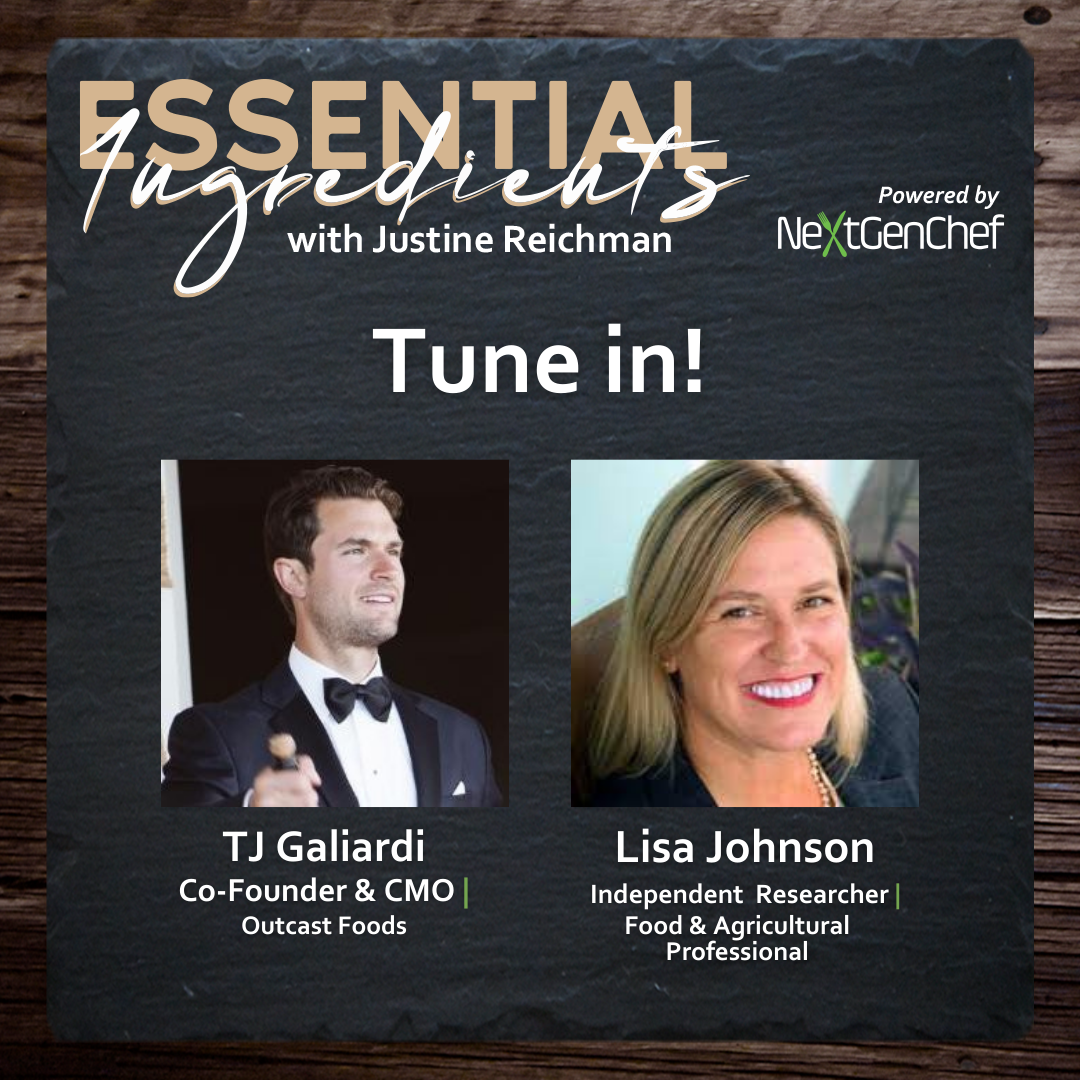
Lisa Johnson and TJ Galiardi · NextGen Purpose
Watch on YouTube
Reducing Food Loss Through Upcycling: Creating Highly Nutritious, Longer Lasting Food Products with Lisa Johnson and TJ Galiardi
The Incorporation Method helps you turn what matters into practical changes that fit your life.
“Nearly a billion go hungry worldwide each year — and one-third of our food is lost to waste. Yet, we are producing enough food to feed everyone. Can we use dehydration as a means to address the problem of global food waste? Absolutely!”
Full Transcript
Full conversation between Justine Reichman and Lisa Johnson and TJ Galiardi.
Okay, good morning. Welcome to Essential Ingredients. I'm Justine Reichman, your host. Today, with me is TJ and Lisa. Lisa is my guest/co-host today. This is the third one we've done in our series as my guest/co-host, and it's been so great and fun. Thank you, Lisa, for joining me.
Sure. Thank you for having me.
Yeah. It's been a great collaboration working with you bringing on these really interesting guests, guests that are new to me. So it's a great opportunity to meet new people like you, TJ, and expand the conversation.
Yeah, thanks for having me on. I appreciate it.
Lisa, just for those that haven't met you before, you want to just give a quick intro into yourself for some new listeners. Because every week, we get new listeners, and that's a really great thing. I just want to make sure that our listeners make sure that they get to hear who you are a little bit.
Sure. My name is Lisa Johnson, and I'm an independent consultant and a business owner based in Raleigh, North Carolina. I'm also an adjunct assistant professor at North Carolina State University, and I've spent lots of the last years trying to understand why we leave so much food in fields on farms? Why so much food is unharvested, yet healthy, nutritious, safe to eat and good for us. So yeah, it's kind of a part of food loss and food waste. And I've developed a huge network of partners over time. My work is usually focused on measuring what's left behind, which is a form of preventing food loss.
I'm just curious, I got to ask him food loss was a new word to me. Like three podcasts ago when we started talking about this. Were you using the word food loss before that conversation that we had? Or this was way before this conversation that we had? This is just new to me.
It's just new to you Justine. Food loss and waste are two different things. They're often broken out like that. But different organizations use different definitions. So my definition might be different than yours. Most of the time, I just say food loss and waste, it kind of covers the whole supply chain. But recently, since I work mostly in the field, I have been looking at losses in the field with a different lens, and seeing it more as growers could see it as an opportunity. And I've been calling it post harvest yield potential.
Oh, I like that. Well, I just to throw this out before, I want to make sure that we get to TJ and introduce him. I'm super excited for our guests to meet him. The reason food loss really sparked an interest in me and why I focused on making sure that I say that is, when we had that conversation with Adam a couple months ago, what really resonated for me was when we say food waste, it really places blame on food loss. It takes that we're not placing blame on anyone. And that whole conversation that we had for listeners that were part of it, and for those that weren't. When we say food waste, that whole conversation was about what we wasted, what the farmers wasted because the farmers didn't produce it in a proper way or because we left it in our refrigerator. I went to the store and bought too much, and then didn't prepare my meals so I had too much waste. I really embraced that word food loss. And I really liked that it took that away, and there is plenty of food waste in my house because I am not perfect at buying the right amounts and making sure that I prepare my meals So enough about that because I want to make sure that we can now talk about how we can take food waste or loss and create great products. So TJ, that's a good intro for you. For our listeners here, we have TJ, and I'm excited to introduce him to you or let him introduce himself to you. He started off in hockey from Canada, and now has a startup. TJ, if you would, I hate to intro people because I never do them justice. And the last thing I want to do is read your bio off your website because that is really dry. Probably not because your bio is dry, but because it will be dry if I read it. So you could just give our guests a little intro?
Yeah, absolutely. As you said, I'm the history of being a hockey player. I played professional hockey for 10 years and almost stumbled into the Food and Agriculture world. My co-founder and I wanted to start a business that was in the food space. He had started a supplement business before, grew it from a $50,000 line of credit to 25 million in revenue in the fifth year and had a successful exit. And then I met early in my playing career, when I was playing in the NHL and started a great friendship and business relationship that spawned over 10 years and here we are today. Three years ago we said: "let's get into this food game again. And let's find a way to tackle food waste." Everyone had always talked about the problems, you'd open up a newspaper or magazine, and all you could see is fields of fruits and vegetables going to waste, and no one really talking about a solution for it. Just saying, hey, what the heck? What's this big issue, everyone should know about it. We thought of a very simplistic idea that was really so simple, that it was shocking that no one else was doing it of taking these fruits and vegetables that are either late in their lifecycle, or being wasted, or not used for ridiculous reasons like, best if used by dates or logistical problems in the supply chain. Let's dehydrate them and give them a two to three year shelf life, and then figure out what to do with them. So we scoured the globe, no one was doing it. And it was such a big opportunity that we couldn't turn our backs on it and had to figure out how to do it. So that was three years ago. And now, here we are today with a brand of upcycled products. This is an example. This is our green product, and also a B2B business side where we sell the ingredients to other food companies.
Wow, that is an amazing, amazing idea. Especially because it takes that food waste, and it gives it a much longer life. I wonder, do you know the numbers? Maybe you know the numbers TJ or Lisa? How much waste are you saving and then giving this huge, long lifetime? Do you have any ideas?
Yeah. Well, last year, we had just about a million pounds that we saved. And this year, it's going to be probably anywhere from 5 to 10 times. Depending on when, where our new facility opens up.
Where's your facility right now?
Our current facilities are in Nova Scotia, Halifax, Nova Scotia which is in Atlantic Canada. For everyone who doesn't know, for the American listeners, it's north of Maine. We started our business there. My co-founder, Darren Burke is just outside of Halifax. An amazing place to start a business for any Canadian company. There's tremendous government support. We built our first facility there. We've expanded it already four times to try to keep up with demand for our ingredients and our products. And now, we're in the process of building out a new scale facility just outside of Toronto, in Ontario, Canada.
Wow. So can you just walk me through this a little bit? Because you have grown quite a lot over this period of time. Can you walk me through this process a little bit, and how it's grown, and how you've expanded through that time?
Yeah, of course. So when the ideation of the company came together, that was probably three and a half, four years ago. Darren and I just basically spitballed on the back of the napkin. And when we landed on the idea and found out that no one was doing it, the first thing we had to do was figure out how to come up with our own unique dehydration process. And we did that with the National Research Council in Canada. We had several projects with them and a couple universities, and we were able to come up with our own patent pending process, which is extremely energy efficient. And most importantly, it happens at a low temperature so the product doesn't degrade. So there's no point in dehydrating, let's say something highly nutritious like kale. At the end of the process, there's no nutrients left. So that was key for us. That took us quite a while to figure out and then to get through the compliance pieces of CFA in Canada and the FDA in the US. That was another added headache for us, but we were able to get through that. Because anytime you say we're using food waste, people automatically think of moldy fruits and vegetables at the bottom of the green bin. But in fact, Lisa has seen this with her own eyes. A lot of this product that's going to waste is cosmetically too big, too small, imperfect bruises, stem hauls, whatever it may be. And that's why it's gone to waste. So we're able to fit into that small niche where we can take this product in that stage and quickly process it into powder or pieces depending on what our final customers are looking for.
Wow. That's great. I got to ask you, what's your vision? Are you looking at having multiple products down the line?
Well, for us, it's about expanding our operations where we can process more food waste. So right now, with our first facility in Atlantic Canada, we're clearly growing that. So that's why we did a series A funding round, we raised $10 million. And that's going to give us the amount of money that we need to build a truly scale facility in southern Ontario. But from there, our vision is to expand across Canada, and then get into the US because the food waste problem is non agnostic. It's everywhere, you're gonna see it, you could basically spin your finger on a globe, drop a pan, and there's going to be food waste there. So for us, it's about getting to the places where the most waste happens, and upcycling as much of it as we can into products that can be used for human consumption.
Wow. Lisa, talk to me, he's like a great resource. I mean, look at what he's doing. So how does this compare to the other things you're seeing? How is he solving a problem that other people aren't?
Well, this is a fantastic solution for food loss and food waste, depending it could come from different parts of the supply chain to supply their business. But dehydration has been around for centuries. It's one of the oldest forms of food preservation, and one of the most robust. It's not that complicated to pull off. And of course, I'd be interested in all the details about your patent pending process. But having said that, it's pretty straightforward. You take out the moisture content, leave behind the nutrients, and then you can use it as a flake or powder, or reconstitute it into another dish. It's a great use. And like he mentioned, it adds years on to the shelf life. So you've expanded your marketing window on fresh produce, which is like two days to a year. You can spend time figuring out what to do with it. So my question right now that came up for TJ was, what part of the facility are you expanding? Or what part needed the most expansion? Do you need more dehydration lines or more storage? Or what is it that you needed to expand?
Yeah. So only our first expansion was about getting a larger dehydration system. So several pieces of equipment, and then it was expanding, and then a new line. And now, it's expanding everything. So more, more space. Although to be honest with you, we haven't had the chance to inventory much product because there's so much inbound interest. The second we process it, it's out the door. And I think that's a big part. And due to the growth of sustainability, the growth of food waste reduction, so we've kind of hit the wave at the right time. And we're just trying to ride it as long as we can, but also grow in a calculated manner and be able to expand and meet some of these larger customers' needs.
So where in the supply chain are you typically sourcing? Is it from farms, or from distributors, somewhere in between? And I'm wondering about indoor agriculture since you're in Canada.
Yeah. So it's all pre-consumer, obviously. So we have basically three main pillars of inbound suppliers. One is the farms. That would be that would make up at least 80% of what we get, I would say.
Great.
And then we go from the farms, we go up to the grocers, we have a great partner with the US and Canada. They're one of Canada's national grocers, we work with them at their distribution centers. So if you could picture a brochures distribution center where they're getting truckloads of product coming in all day, every day, let's say a truckload of bananas shows up and they're too yellow, they don't want to accept that shipment, and then send it out to all of their stores. And then the network has it basically rot or not last on the shelf long enough. So if the bananas turn, if they get spotted or a little brown, consumers aren't buying them. Because at the end of the day, we have this expectation of perfect produce. So as a grocer, it's a waste of money for them to accept that shipment, and then send it to the stores, pay more money to throw it out in the end. So before we came along, they would call whoever that company that sent them the bananas and say, hey, guys, they're too yellow. They're at this stage in their life, it doesn't work for us, what do you want us to do with them? And 99 out of 100 times, that supplier says, you guys, get rid of it for us. Build us back what it costs. And that product almost always ends up either in a landfill, or let's say at a pig farmer, a cattle operation. So now that we're here where we have the historical data and the real time data of these kinds of situations when something comes in that they're not able to accept and we can say, oh, we have a customer that wants banana chips, or we have a customer that wants banana powder so we'll accept that full truckload and we'll process it immediately. The second step is grocers. And then the third is food processors. So a good example I like to give is a company that makes baby carrots for example. They're just shaving down large carrots to make baby carrots. And the shavings are almost always the same thing. They go to waste.
I think you're blowing people's minds. Most people think of baby carrots or something else. But as a horticulturist, we hear this story all through school, cutting through school, carrots are just big carrots shaved down. I think you're blowing some consumers' minds right now.
Yeah, definitely. So there's a company that we work with. Over the course of two months, they have over 14 million pounds of carrot shavings. So that just gives people a rough idea of the amount of product that's going to waste just because people don't have a typical idea of where they should end up. So we'll hydrate that, and we'll sell it as carrot powder to a variety of companies.
The impact that it seems you can have, especially as you grow and expand your space, and you get this bigger space, and you have larger machines, and you have more resources, just seems just so robust. I mean, it seems like this is like Lisa's dream.
What I knew about the company was more of its consumer facing product. What I didn't know is that on the other hand, they're also an ingredients company, which is amazing.
Yeah. So it's been an interesting journey for us. And yeah, just to give you some numbers, our new facility in southern Ontario will be processing upwards of a million to a million and a half pounds a month of this type of product that I'm talking to you guys about.
So can we talk about what the impact is for that so that people understand what that means for, how does that translate into people, into farms, into carrots? If we could dial it down so that they could imagine what that looks like in terms of the ingredients that they would see in a supermarket or on a farm. Do you understand what I'm saying, so they can envision it?
Absolutely. So the product, let's say the carrot example that would end up in, let's say soup. So if you think about those instant noodle packs that have little small dehydrated carrots in it, we have a partner that makes that so we would sell carrot, dehydrated carrot pieces to them, it would go into pet foods, it goes into a better for you snack, so the list is long. And then also, we utilize those products to put them in our own consumer facing brand products. So this is an example. This is our protein powder. We have a blend of fruits and vegetables that have all been upcycled and dehydrated, and we put them right in here. So it makes us really the only first ever sustainable plant based protein powder ever.
I love that. Are there any products you can't take? I mean, I have a sense having done this for a while of the quality you can accept, and the quality you can't accept. You can't accept what's rotten and moldy, and we know that. But what you can't accept is a wide range of appearance quality, let's just say. But I'm wondering if there's any types of fresh produce you can't take, or if there's a group of products you're constantly looking for, things like that.
Yeah. Well, that's a big part of our IP as a business was figuring out how to dehydrate everything. So you'll get a lot of companies that are in the dehydration business, but they'll just dehydrate, let's say sweet potatoes or broccoli, just a couple things. Because to be honest, it's hard to figure out how to do everything, every product has its own unique recipe in order to get it to a high quality finish date. So that's something that took us really, at least a year and a half to come up with a lot of R&D around every different product. So we can accept anything as long as there's obviously no pathogens, no mold or anything like that involved. But the unique thing about a process is it has to verify the kill steps. So even if a product, let's say we're processing a million pounds of broccoli that was otherwise gonna go to waste. If one Florida broccoli found its way in there and it had some mold hiding underneath the floor or something that wasn't detected, it's not going to have any harmful effect on the end consumer because of those two kill steps.
Now, it makes me of course more curious because you said it's a low down process. Answer that if you want to, but I know it's proprietary information right now. But let's just suffice it to say I'm really excited about this process for y'all.
Yeah. And it's all about temperature at peak drawing point and how long it's at that temperature in order to reach the verified kill stuff. And we also have an organic acid wash that we use as well, which counts as a kill step.
Can you talk to me a little bit about the acid wash that you use, and what's in that?
Yeah. It's an organic product. I'm not a scientist so I don't know the actual ingredients. But it's something that a lot of food companies use, and it is certified organic and doesn't degrade the product at all. If there's any bugs on it, so to speak--
If you think lemon juice and vinegar are acid washes.
Exactly.
It's not like they're using bleach.
Exactly.
It just sounds worse than it is. Acid wash.
Yeah. I think people in the food space, especially in the manufacturing space, understand that similar to how Lisa explained it.
I know, I just like to make sure that for our listeners, whether they're founders or their end consumers, that they get the sense of what we're talking about, and that we're not leading them down a path where they have questions. And that is really transparent for them. So sometimes, I ask questions that while it's second nature to us or to some other people, that it gives them an opportunity to be on the same page with us.
That's great.
I'd like it to be accessible to all. Because really, we want to give this information so we want to provide the information to not just the founders, but the end consumer so that we can have a complete circle of people that can make more informed choices, right? The businesses can make more informed choices, and the end consumers can make more informed choices. Hopefully, we can create a greater demand for everything that's better for you. That's the goal. So what we're all here having this conversation learning more from you, TJ, learning more from Lisa all the time, and really just trying to use this platform to give founders and consumers access to more information.
Right. So let me ask you this TJ real quick. This is a huge upcycled trend right now. And you all seem to have gotten in at the front end of that, which are the brands that are getting you excited, or that you take inspiration from, or what are you using in your home? What upcycling products do you like?
Yeah, that's a good question. I think we were the third member ever of the upcycled food Association.
I was gonna ask you if you're a member of that.
Of course, yeah. Which now has over one hundred members and exciting things going on all the time. Turner's done a great job growing it. For us, we're so entrenched in the upcycled space that if there's any company that's upcycling, I pretty much know them. So it's an exciting time to be in it, though, because it's really a space that didn't exist for the most part until I'd say four or five years ago. And there's a ton of momentum in it. I think simply because it just makes so much sense. You're making use out of product that was being wasted needlessly so we're going to continue to see more brands pop up, whether it's in the food space or really anything. I even think of using tires and manufactured by products.
Everything from food to fashion, really.
Really cut down what's going into a landfill. And it's something that this next generation, obviously, is very aware of. I think the older generations, they just thought, whatever, the earth is big enough, there's no issues. You can have landfills everywhere, it'll be fine. Now that people are starting to see the effects of climate change, and myself, having two young kids, I'm trying to leave the world in a better place. Then I got here, so it's exciting that we can have our small little impact.
I would agree. I think just to reiterate, are there any other upcycled products that you really favor or that you use up that are go-to for you?
That's a good question. I think for me, it's more brands that we're working with directly that I know upcycling because they're buying our ingredients. There's some really exciting ones. We just came out with a partnership with a company called Happy Planet. They're making a smoothie product and using our ingredients in it, which is really cool. That's going to be, I think last year, they sold over 2 million of those products. So you're just expanding the growth of upcycling, and the people that have never heard the word, they start to understand, Oh, you know what? They can connect the dots. And it's pretty simple. So Happy Planet is a really cool one. There's always products that have been around for a long time. I subscribe to Imperfect Foods. They're an amazing brand, inspiring at the impact that they've made. I don't know the number, but I feel like they just came out with a report on how much food they saved last year and it's millions and millions of pounds. So I love seeing businesses like that grow, and I'm glad we're a part of it.
Yeah. I'm curious to know, as you grow your business, and as we look at other founders, we have other founders that listen to these podcasts, being specifically in the upcycling world and building an upcycling business. If there any recommendations or tips that you might recommend to somebody building a business, specifically in this world.
Yeah. I think the first thing is partnerships. So you have to find who your partner is going to be. For us, it was all the farms initially. So these are grocer partners, and just add value to them. So the [inaudible] example, they were paying a tipping fee to get rid of the product and throw it into a landfill. We came along and said, instead of saying we'll cut your tipping fee in half. We said: "You don't need to pay a tipping fee at all, we'll take it off your hands." So it's an automatic value for the business. And that's something you need to offer to any partnership and find the opportunity within that on what your actual products are going to be.
That's a great recommendation. I love that. Because I know that in every industry, there's different problems people are solving and different ways to navigate your way into the business. That's a really good tip. Thanks for sharing that. And then for any consumers that are learning, just learning about upcycling, is there anything that you think is really important to understand about upcycling that they might not understand?
Yeah. I would say just preconceived motion or notion that the product that you're getting was waste, because it was moldy, or gross, or should have been waste. The fact of the matter is, at the end of the day, it shouldn't have been wasted in the first place. And the founder that created whatever the business is was just smart enough to see that.
Right. I think that that's a good point. Sorry, Lisa, go on.
Yeah. Well, the resources that are sidelined or abandoned in our supply chain are just, they're resources and should be seen as an opportunity, not as waste.
Hence your new word.
Yeah. Oh, yeah. That was right. Post harvest yield potential. Yeah. Well, there's potential in anything like TJ mentioned, use tires or what have you. When we start tackling these issues and incorporating those waste streams, we're heading in a more circular direction. So if we can promote circular agriculture or circular economy, all of that is sort of a regenerative mindset just like you were talking about earlier. We have to think about the end use or the end of life for these products, almost before we put them out there. But yeah, tons of what makes me excited and makes me laugh sometimes is these companies who have been upcycling for generations, and they just are now realizing that they can use that term and promote themselves in that way. I think it's really funny. But there are companies for centuries that have been taking advantage of these waste streams. But now, we just have a more fun way to talk about it. It's just that they were visionary in their time and continue to be around because they were so resilient and used something that other people thought was worthless.
It's true. I think a lot of times we use, there's a lot of words now that we use that we didn't think of using before. I mean, it goes down to being vegan, kosher and all these things, and they become interdependent and interdisciplinary. And they all fall under all these different umbrellas. And now, we're labeling these different things, right? And I think that it's really important to maybe just focus on what's really important. And upcycling, there's a message in there and there's an impact in there that's implied. And so it changes the impact, it changes the purpose of the product. TJ is creating this product and he's got an implied intention there in what he's doing. He's not just building this product. He's using waste, and he's doing it mindfully and masterfully. And the impact that, and I don't want to speak for you TJ, but there seems to be a trajectory here that you're going to have a really large impact that's going to continue to grow exponentially for the foreseeable future. So when I see that, that gives me inspiration, and that is something that I would want to aspire to in a company that I'm growing to build. So I think being part of something like that is really aspirational. I like this upcycling thing. And I like how we are creating these different kinds of niches, and being part of them now. Even though before people were creating these businesses, they didn't realize what they were doing, but now realize that they fall into these. I don't know if I'm talking in circles, or if this makes sense?
Oh, no, it's great. Like I said earlier, you're gonna see more businesses popping up that are doing exactly that. And the more the merrier, really, because there's so much food waste. Let's say five facilities across Canada, we're taking a small chunk out of what the waste really is.
Yeah. And you're doing it very thoughtfully. And it's on purpose. And that's what I love. I love that it's on purpose, and you're doing it. I can't wait to hear, I always like to know and ask, right now, you have a purpose and it's clear. We can see what you're going to do in the next year, two years, three years. But I'd love to ask you, what's your big vision? How do you hope to change the future of food in the long run?
That's a big question for sure. I always try to come in lower than what our actual goal is because you're not disappointing anyone. But to be honest, I think what we've done at Outcast Foods is we've created the first real scalable solution to food waste. And for us, it's really on us now to expand in the right way to bring on the right partners to grow the vision of what food waste is and what upcycling is. So it's a big mission for us to tackle. But to be honest, even in the last year, the growth that we've seen and the growth that's happened in the whole market, it's very, it leaves me optimistic on what our future is gonna hold.
Yeah, I would imagine. And Lisa, this is going to change a lot, this is going to impact the future of food waste. And as a researcher, how do you see this? How do you feel like this is going to impact what you're going to say?
Well, I'm super optimistic about it as well. Like I said, dehydration has been around for a long, long time. And the growers that we have, I'll say in North America and include Canada, very nicely in that, are at the top of their game. Growers are producing amazing amounts of really nutritious food, and it's a crime to see that not used. So I think that when you can capture all of that economically and turn it into something that people demand, then that's a beautiful thing. I hope that Outcast continues to grow and can use this solution long into the future because it's really, really needed.
Yeah. I know that when we spoke originally, when we first chatted on our last call, you had talked about your morning smoothies that you make, and I'd love for you to maybe just share your recipe with us. Maybe we could share it with our listeners or included in our show notes if you don't have it with you. I know that I'd love to make it myself. Or at least share it with my partner who loves to make a good smoothie because he's very active. He too is an athlete, not hockey. Hockey is not his sport, but he does a lot of adventure racing.
Nice. Yeah. So I'll try to go through what it is, but the simple way is I use a base of a lot of different organic fruits and vegetables, frozen, because I like a nice chill smoothie. And then the main ingredients I put in, or put in a scoop of our supergreens plus which has a ton of different things in it that you wouldn't normally get in your day to day diet. So like wheatgrass, spirulina, maringa, all these very important products, and a mushroom blend. And then I put in a scoop of our plant strong protein which also is loaded with a fruit and vegetable blend, digestive enzymes, probiotics, so on and so forth. And then I add some typical things, some chia seeds, hemp seeds, different nuts that I have around the house, some more unique products like pine pollen powder--
This is in a written form though, for all of our listeners, including myself, Lisa, so that we can actually get into the kitchen and make this. So while I know that Lisa and I are going to get some products, how would everybody else get products?
Yeah. So the best way to go is just outcastfood.com. We always have amazing deals there.
Is there a deal that's a special deal for our Essential Ingredients and NextGenChef listeners, to the whole podcast here today.
Yeah. To be honest, I think if they just go on the site, I'm serious, we always have crazy deals on there. Our marketing team likes to push the boundary to get this product into people's hands. So where you're going to find the best deal is on the site.
Alrighty, okay. And if anyone wants to get in touch with you, what I'm going to do is I'm going to invite everyone that's listening today to download the NextGenChef app. It's a free app, it is a community for food and beverage entrepreneurs. And if you download it, it is a tailored LinkedIn. So you can download the app, you can upload your profile, you can connect directly with me, with Lisa. Hopefully, TJ, you will join the app and everyone can connect there and continue the conversation. Prior to the launch of this podcast, we'll even post this and then you guys can continue your questions and connect directly with all of us there via text or email. So again, I want to thank everyone for joining us here at Essential Ingredients today. I want to thank TJ so much for joining us today and sharing your story. And Lisa, thank you again for co-hosting with me. It's great fun, and always, you bring such great guests. It's always good to hear from you and share all the research that you have going on. And I'm excited to continue doing these series with you. And TJ, I can't wait to try that Outcast and make a smoothie which has a very long list of ingredients. But if you email that to us, we will put it up on the website so that when people order their products, they too can make this sort of thing.
Maybe we'll be athletic after we drink this.
Oh, my god, totally, we're going to be athletic. So anyway, I want to thank you all for joining us. And for those that haven't subscribed or downloaded the Essential Ingredients Podcast, it is available on iTunes, Spotify, you name it, all the regular channels, download and subscribe. If you like this, leave us a review. Tell us what you like. If you want to hear something else from us, let us know. We're so happy to see you here. And thank you again for joining us.
Thank you guys.
Thank you.
Share This Episode
Enjoyed this conversation? Share it and tag @nextgenpurpose
Listen on Apple ▶Listen on Spotify ▶Your Host
Justine Reichman
Founder & CEO of NextGen Purpose. Host and Executive Producer of Essential Ingredients — 11 seasons, 330+ episodes, and a growing movement.
About Justine →