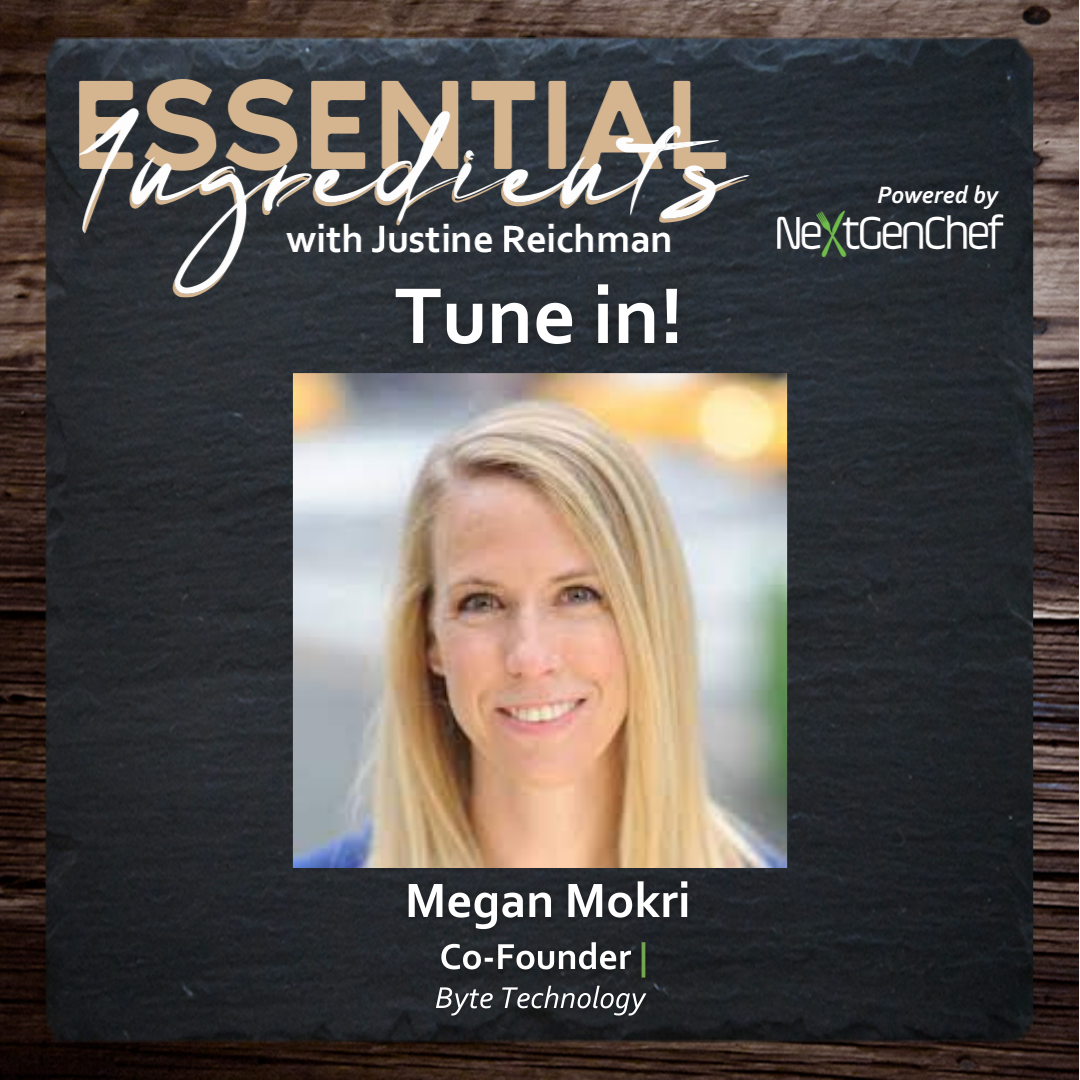
Megan Mokri · NextGen Purpose
Watch on YouTube
Vending Machines Revamped: Fresh, Healthy Food for Those On the Go with Megan Mokri
The Incorporation Method helps you turn what matters into practical changes that fit your life.
“When we think of vending machines, we think of unhealthy grab n' go junk food, but fresh and healthy foods are now served with that same convenience! In this episode, we're joined by Megan Mokri, Co-Founder and CEO of Byte Technology.”
Full Transcript
Full conversation between Justine Reichman and Megan Mokri.
Hi and welcome to Essential Ingredients. I'm Justine Reichman, your host, founder of NextGenChef. Today, we have with us, Megan Mokri, the co-founder of Byte Technology. Welcome Megan, so pleased to have you.
Thank you for having me. Started to chat today.
Me too. So tell me, I'm excited to have you, but I really just want to introduce you and Byte Technology to our listeners today. A lot of people are not familiar with it. They've probably seen it, they did not know Byte Technology so we want to share with them what Byte Technology is. Can you tell us a little bit about it?
Absolutely. So in a nutshell, what Byte Technology does is, through our hardware and software, we love food companies to sell their food completely unattended. So for those of you who are watching on video, you can kind of see behind me this glass front refrigerator, we outfit that refrigerator with sensors as well as a point of sale. And at that point, you can sell any type of food, salads, drinks, sandwiches, heatable entrees, snacks completely unattended. So we power the kiosks of several 100 clients across the US, and we have close to 1,300 kiosks live at this point.
Wow, that is a lot. I want to go back to the beginning. So when you came up with this idea, were you originally a technology? Did you come up with it? How can I get all these people to buy this food through this refrigerator?
No, the company looked very different. So when we first started, the common thread is that the problem we're trying to solve is to make fresh, healthy food very convenient. And the original way we did that was we launched as a meal delivery company, direct consumer, we deliver meals directly to people's households. And we ultimately found that economics have the potential to scale that business where it would require a lot of funding. So we really thought, okay, how do we still hit that need for convenient, fresh healthy meals, but hit consumers where they're already spending time away from home? And so that was workplaces, and we pitched this concept to workplaces where we would basically go in and stock all these meals that would be available for sale. And then their employees could buy a breakfast, sandwich, or a salad and a juice, or a snack at 3:00 PM. And so that workplace got tremendous value, right? So generally, workplaces want to have fresh healthy food on site, but most of them can't afford to either cater and pay for the full cost of that food. Or they're not large enough to have a cafeteria. So really, we stumbled upon this multi-billion dollar market. But the second piece of that equation of course was we needed the technology to enable that to happen. And so that's really what started our path into becoming a technology company at our core.
So when you first started this, were you actually making the food?
We were in the very, very early days because we had been operating a kitchen and doing meal delivery. And there were a few months where we operated both businesses in parallel so we were still doing direct to consumer meal delivery. And then we had a few of these kiosks and workplaces. And so initially, yes, we prepared all of the meals that would go into the kiosk, but ultimately pivoted away from that and more towards buying food wholesale to allow us to really focus on just getting out there doing the operations, selling the service into more and more locations. Over the course of a couple years, we scaled pretty quickly to over 500 locations in the Bay Area. And in broad and beyond workplaces into hospitals, apartment buildings where we were in San Quentin correctional facility for the employee population there. So we really wanted to simplify our lives as much as possible. That's why we didn't continue operating a kitchen. And we continued that simplification when we were looking at how we scale that model. When you look at servicing several 100 kiosks in a given market, you open market by market, so it's not like we could light up LA, Austin, New York and Seattle all at once. We probably could with a decent amount of capital, but we really rethought, okay, we can either continue building and operating, building the technology and offering the service, or or we could pursue really licensing the technology and just getting this into existing food companies hands. So ultimately, we ended up selling off that service side of the business or for us to really focus on the hardware and the software that we build.
Okay, so that must have been, was that a hard decision to make to decide to do that?
When we finally came, because it was always a background decision. We knew that we needed to make it at some point. But when it came to it, it was very easy because we were looking at the results at the end of 2018. And our licensing business just doubled organically that year with zero sales support. So it's very evident that there was a clear demand for being able to sell fresh food unattended in these kinds of new retail channels as we think of them. So at that point, it became a pretty easy decision.
I'm just curious, so you decided to now focus on this retail division. Was fueling those retail divisions with healthy food paramount to it as well? Or was it not about the kind of food you're putting in there but more about just providing the refrigerator to whoever wanted it?
It was always leading. I think, at the end of the day, when you compare to what the other options were in some of these locations, a vending machine, Lay's potato chips and Snickers bars, help was always number one, for sure. But it was also creating a well rounded set where somebody could get breakfast, lunch, dinner, or snacks and those in between times. So we would sell everything in that range. Of course, salads, sandwiches, burritos, wraps, juices, kombucha, hard boiled eggs, breakfast, burritos, breakfast sandwiches, the full breadth of kind of--
It sounds all healthy, though.
And most of it was healthy, but you'd still have occasionally like a mac and cheese for instance. So it was balanced, but it was all fresh.
It was all fresh. I'm just curious because it sounds like the market is really large. You were just mentioning that. Can you go back and just talk a little bit about the size of this market that you are able to carve out yourselves?
Yeah. There's this market of workplaces in particular that are too small to have a cafeteria. They can't afford to cater, but they still want to have fresh food on site. And typically, if you've got like over 100, 150 people up to where you bump against having an actual cafeteria on site, vending operators will serve that segment, but it's still just vending packaged food. So there's that segment, and then there's all the workplaces with under 150 employees that vending won't even touch them. Those are the guys that may want to have food on site, but they don't even have any options. Basically, everyone below needing a cafeteria, we found a way to unlock through offering fresh grabbing oatmeals, which previously wasn't possible. Because when you look at the need for this technology, in order to sell fresh meals, you have to have flexible shelving because your packaging for packers are very different. You can't dispense a salad from a coil vending machine, you need the data because it's a highly perishable product. So when you're going out and you're replenishing several 100 kiosks in an evening, you need to know what's in stock, what's about to expire and what needs to be delivered, which is oftentimes not data that a vending operator would know. So there were a lot of pieces of this market that were just simply unlocked by this technology. And yes, we stumbled upon the market, certainly. The other piece that I'll mention though is that even in these smaller offices where they would buy food, but not enough volume to actually be profitable on food sales alone, there was a willingness to pay for the service. So we would charge $500 a month just for the service, coming out at a regularity of anywhere from two to five times a week, continuing to update the product selection, taking all the risk of any food that didn't sell that we would have to donate. So that really made the economics in our favor there.
I'm sorry. Can you just explain that a little bit in greater detail for me, are you talking about as Byte Technology for the kiosk? You would charge that?
No, when we were operating the service ourselves. The workplaces that weren't generating a food sales volume for it to be profitable, they were willing to pay a subscription fee. And when they paid a subscription for that service, then it became profitable even though they were a very small location.
Got it. Okay, I just wanted to differentiate because there's a couple of moving parts here. So because we had pre Byte Technology, and now we have Byte Technologies, for our listeners, I just want to make sure that we differentiate for everybody so we're all on the same. So you've come a long way from the food delivery. Now, you have Byte Technology. You have these kiosks in so many places. Did you say airports? Working places, offices, hospitals, prison buildings, and that's where you're at now. Where do you see yourself in the next three to five years expanding?
I still see this as a Greenfield opportunity. These kiosks are intentionally very small footprint so they can go anywhere without any build out. All you need is a plug. So ICS went from the roughly 1,300 that we have today to 10,000 pretty easily. The desire for fresh, healthy, convenient food is everywhere. It's not a coastal phenomenon, it's everywhere. Not only in the United States, but across the globe.
And do you think COVID has positively impacted you or negatively impacted you in any way towards your growth?
Yes, both. COVID on the negative, and we're coming out of this workplace closer to the last year. Because so many of these kiosks were at workplaces, the transaction volume really dropped on that side of things. On the flip side, we really opened just entirely new segments that we were not pursuing. So we've been growing a relationship with HMS host, deployed now at like 30 airports across the US, both in the terminals as well as in some American Airlines, admirals clubs. So workplaces, if we fast forward over the next six months, this is kind of our sweet spot as offices that are reopening are planning to reopen. I think what's really fascinating is we're seeing a few buckets of what organizations are doing. Some are just going fully remote. And seeing that works, and they're continuing in that manner. 100% of employees will be remote. Then there's the opposite end of the spectrum where people are just gonna go back to work. Remote won't be an option, it'll be basically kind of going back to the usual norm of business. And then there's a number in the middle where it's kind of a blended workforce. Some working remotely, many who have moved out away from their headquarters, and then some at the home office. And that's really where a new opportunity exists for Byte is many of these locations that have cafeterias with reduced people on site, the cafeteria no longer makes sense. So they're using our fridges to basically distribute food around a building, or floors of a building, or a campus, or whatnot.
That makes a lot of sense as things change. And at schools or schools someplace that you are.
Absolutely. I'd say our biggest foothold is within higher education, universities and community colleges. But we have a number like K through eight and high schools as well. Serving both the faculty and the students in some cases.
Yeah. I can imagine that'd be a great place to be. I remember when I was in school, I'd love to pull a healthy snack out instead of something that--
Totally. And you pull it, you're staying late for sports , you're starving and you don't have anything available. Yeah.
Right. Because I remember they would have those little places where you can go after school to buy a snack like a little stand. I never had anything I'd like anyway. Okay, we're gonna take a quick break. I know what I was thinking as we come back from our break, a lot of schools have sports on Saturdays or even after school where they have their snack shacks.
Yeah.
And they have all these, I noticed that. The hall has their snack shacks, unhealthy snacks. The parents, they don't need to sit in the snack shack frankly, they'd rather watch their kids from the bleep doing the sports. That's why the kids get a nice fresh snack.
I've never heard that idea. We've been out for six and a half years, so thank you. That's an interesting one.
Okay. I'm not even a parent.
Well, it highlights just how many use cases are for this. I mean, I could go through Johns Hopkins using our kiosks to sell breast pump supplies. We have a gas station that has the kiosk next to the pump selling food for those that are on the go. I mean, there's so many novel ways of using the technology, which is part of the excitement of growing this company.
It sounds like there's a lot, and I'm sure our listeners, some of them may know this, and some of them don't. But your partner is your husband. I'm sure that you guys brainstorm a lot together. So are there any fun ideas that you guys have come up with together since you guys are brainstorming for the future on places that we might see this that you guys are investigating?
Yeah. I think a lot of the focus right now is just getting the word out, quite honestly. And thinking of creative ways to get the word out, or we have a lot of small businesses on the platform. And they're learning how to use both the technology, as well as kind of open this new revenue channel which has its own, there's a certain way of selling a service into location. Then figure out how you actually operate and replenish the fridges, and how you manage that account. So to say, we're doing a lot more content through what we call Byte Academy which is basically sharing all the learnings and know-how that we gained over the few years operating the business. But to go back to your question in terms of like some fun things that we brainstormed, or I could say some directions that we're heading is thinking beyond a fridge format and into other formats like ambient and freezer is one of the directions that we want to head, there's a lot that we'd like to do in terms of harnessing the insights that we have across the entire bike fleet to add even more value to our clients. When you get over 1,000 kiosks, 2,000 kiosks, the more that come online, and the more variety of locations you have, you can help inform the assortment and help with sales through all of these operators that we're powering. So we're excited about that too.
You mentioned just a minute ago a little bit about the education and Byte Academy, was that what you said? Byte Academy? Can you talk a little bit more about that . We get a lot of founders and startups listening to these podcasts, and I'd love to be able to have you share some of the insights that you have for these founders as they're starting their own startups and they're going through some of these challenges. Maybe you can lend some of that information or insights to them.
Oh, my gosh, yeah. I've learned every lesson in the book, I'm sure of it. Actually, no.
Always more everyday.
That's one of the learnings, right? When you've got it figured out, you reach a new scale, and you have to break things again and rebuild. It's a constant learning slope. And it's not just within your business, it's within fundraising and insurance. You're managing your legal team and HR, it's everything. I think that's part of the fun is if you really have a thirst to learn and be challenged, there's no better way to do it than starting your own company. But I also think it's the greatest, it's been my greatest source of personal and professional development, certainly, just far away.
And what's it like to start a business with your husband?
It works very well for us. Before we started Byte, we did some little side projects. So we both had our day jobs, and then we'd work together on these little side projects. And that was kind of our first taste of working together, and we worked very well together. I think early on, we figured out just after talking to other married founders that we have clear swimlanes and clear ownership. We both agreed that I should step into the CEO role, and that he should run sales and our client success teams. I respect that that's his domain, and he owns a lot of the decisions, and he respects that I'm running the organization. I think the other piece is we have three young kids. So we have Milo who's seven, Noah who's four, and Micah who just turned two yesterday. So they were all born during this journey, which adds another element to it. I think that having your co-founder as your husband with three young kids, there's just a natural empathy. Where if one of us is up early on calls, and the other person is just taking on packing lunches and getting everybody ready and vice versa. So it worked well.
It sounds like it's a true partnership in all sense, in all areas. I wonder if all families, if all husbands and wives would say that? You guys sound like you're really got a well oiled machine, and I don't know that everyone would say that.
It comes with its own bumps in the road. Certainly, my God, whatever it is that is intertwined, it's inevitable. I mean, there's challenges in fundraising, there's certain investors that won't invest in husband and wife teams.
And how do you address that?
You don't, you move on.
It's a non starter. Okay. Fair enough. I mean, there's some things, there's some battles, you just don't, I understand that. So to those founders out there listening, is there any advice that you would want to leave them with, or give them?
What advice would I give? It was funny one before we started this company as some business school and some entrepreneurship class and a founder was talking to the class and he said that: "Whatever you choose to do, make sure you have a lot of passion and conviction for it because you're going to be doing it for an average seven plus years." And I kind of thought to myself, yeah, right. So long, and here it is, like six and a half years in, and the data shows that the average exit takes about seven years. So I think that is really important to have, you could call it passion, you could call it conviction, call it just a strong belief that this little baby company that you're working on should exist. And that's always what I come back to. Because when you're at it year after year, there's times when you've been on what feels like a really steep uphill slope, pushing the boulder uphill, and you have to be able to come back to that. Do I still believe? Do I still think that this should exist in the world? As long as that's a hell yeah, that I keep coming back. I think I would say that.
I have to agree. I mean, for any entrepreneur, you got to if you're in it, and you're breathing it, and you're doing it every day. You really have to have a lot of love and affection for what you're doing, and drive, and passion for it. Because otherwise, I don't have another reason to get up in the morning to do it.
Right. Yeah, absolutely. And reminding yourself to come back to that. Because sometimes, you have to just make the conscious choice to come back to that and just let it marinate again and recharge you. It's like the shot of juice that keeps you going.
But I think what you just said is accurate. It's a conscious choice. Being an entrepreneur is a choice. And having a vision, building a company, coming up with Byte Technology, deciding to take that leap of faith, build that business with your husband and say, this is what we're going to build, this is the impact we're going to have on the world. We're going to be able to make healthy food more accessible, and fresh food more accessible. And this is the choice we're making is a choice.
Hmm, absolutely.
And I think it's a privilege. In my mind, it's a privilege. And I don't think everyone has that drive and that determination to be able to do it. That's why we've got people in the world that everybody, a variety of people that want to do different things.
That's true.
We need all of that. There's a reason that everybody wants to do different things. That's how we all have to go after what we want to do.
Absolutely. Hallelujah.
I truly believe that in any event. I have to ask you, if we were to ask your husband, and I asked everybody that has a business partner, a life partner, etc. How would he describe you as his partner?
Oh, that's such a really good question. How would he describe me? He would describe, as he tells me those regularities that I'm very good at coming into a problem anywhere in the company and kind of slicing right to either the right questions to ask or the right way to get everybody on the same boat and rowing in the right direction we should be going in. And he would say that I am incredibly determined. And when I want something, or I see something that needs to happen, I somehow figure out a way to make that happen. For better or worse sometimes.
Since he's not here, how would you describe him?
He could sell a ketchup popsicle to a lady in white clothes.
Okay, I've never heard that one.
He's a natural. His background is not in sales at all, but he's just a natural salesperson. He has an incredible way of both conveying information and then connecting with the person on the other line, and just like a fantastic sense of humor.
Well, you to make a great team and you've got so many places to take your company, it sounds like, and it only looks like it's going to expand, and grow leaps and bounds, and I can't wait to come back and talk to you in the next six months or a year and see where you guys are expanding, growing and going to. So I hope you can come back soon and tell us where else you're going and what else you have on the horizon.
Yeah.
But I appreciate you joining me here today on Essential Ingredients. And it was great to talk to you. How would our listeners get in touch with you?
So let's see, you can check out Byte Technology on YouTube, Instagram or Facebook. Our site is bytetechnology.co. I'm happy to talk with anyone directly. My email is Megan@bytetechnology.co. That's byte with a Y.
Okay. Again, to all our listeners out there today, thank you so much for joining us at Essential Ingredients. It's powered by NextGenChef. And if you want to listen to us, we are on all the regular stations on iHeartRadio, iTunes, etc. We hope to see you here every week on Tuesday. Thanks again, Megan, for joining us. And thank you to all our listeners for joining us here.
Share This Episode
Enjoyed this conversation? Share it and tag @nextgenpurpose
Listen on Apple ▶Listen on Spotify ▶Your Host
Justine Reichman
Founder & CEO of NextGen Purpose. Host and Executive Producer of Essential Ingredients — 11 seasons, 330+ episodes, and a growing movement.
About Justine →