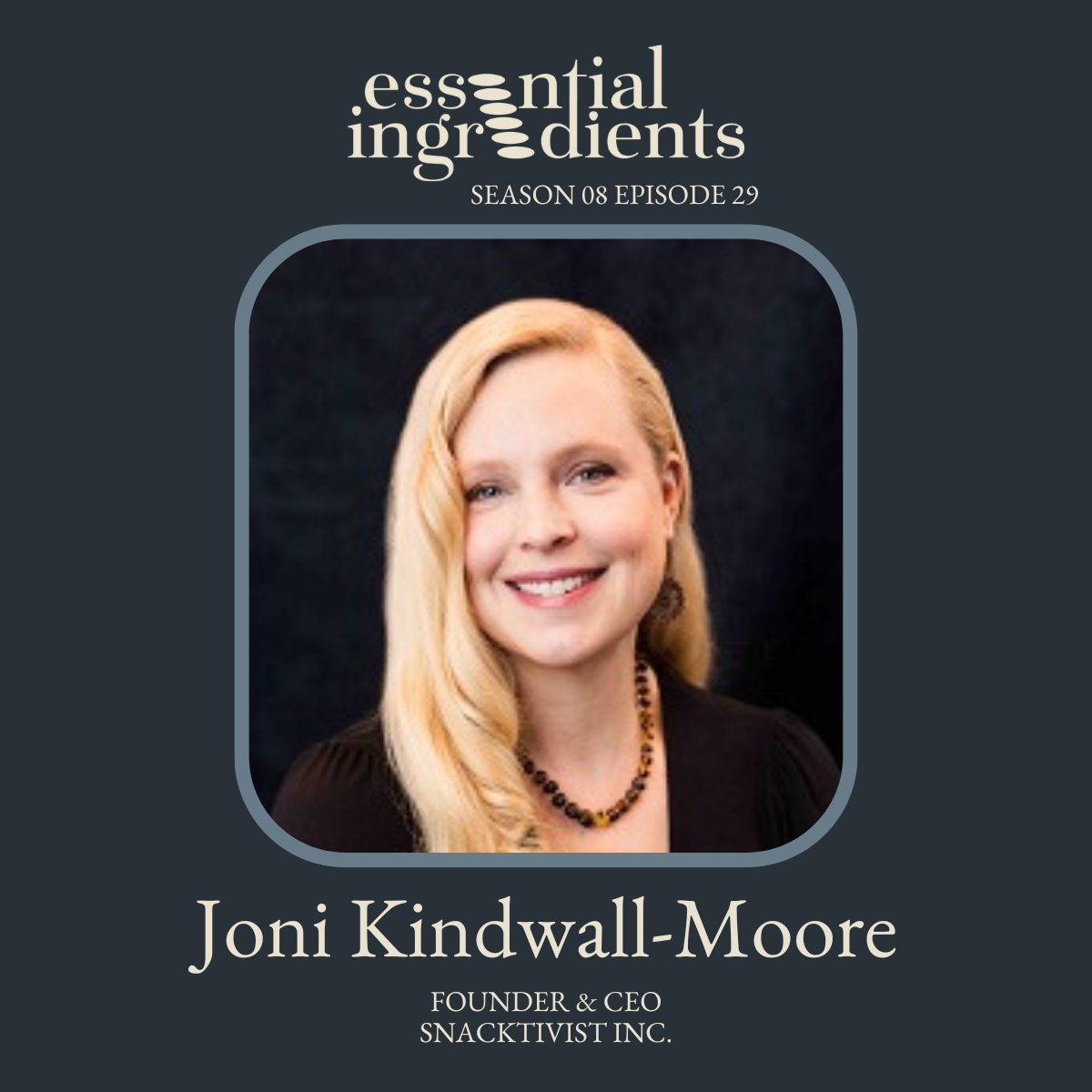
Joni Kindwall-Moore · Founder & CEO, Snacktivist Inc.
Watch on YouTube
Transforming Underutilized Superfoods to Revolutionize Diet
The Incorporation Method helps you turn what matters into practical changes that fit your life.
“When you're an entrepreneur, there's opportunities everywhere. And part of the art is the discernment of the opportunity that is not only going to be achievable but has the highest, long-term return. That comes with experience, but if you understand your tools better, you get there faster. —Joni Kindwall-Moore”
Full Transcript
Full conversation between Justine Reichman and Joni Kindwall-Moore.
Yes. I'm so happy to be here. Thank you so much. Yeah, it's wonderful.
Oh, I'm so happy to connect with you and have you here, and learn more about what you're doing. So for those that are unfamiliar with you and Snacktivist, could you just introduce yourself and your role?
Snacktivist, this is a food company that is focused on innovating. Basically, food innovation that elevates underutilized crops. So all of these ingredients that are out there, and farmers want to grow them, they're really important for climate smart agriculture, but we need to build products, and we need to build markets for them. And that's where Snacktivist works. Our sweet spot is connecting those critical crops to markets and making them really delicious.
Sounds yummy. I'd love to hear some of your favorite things that you do with that. And I have so many questions, because the first question I have is, do you know Lisa Johnson?
I do know that name.
She does a lot of research. She's been on my podcast about crops and upcycling. And also, it sounds like exactly--
I'll probably follow her. And that's why it's a familiar name. But I don't think we have the pleasure of being acquainted. So perhaps, you can do a little matchmaking.
I know I will. And you can also listen to her episodes if you want. We've co-hosted a couple of things together. But the minute you said that, I was like, okay, Lisa Johnson.
Yeah, fantastic. It's like a very small, but really focused group of people that are working in this space where we're trying to create a responsive feedback loop between what happens at the agriculture level in the field, and what happens to our body and in the market. Because they need to be responsive to one another. And really, they're not right now. So that's a problem.
I liked the way you explained that many people don't talk about the body as it relates to the crops. Yes, that's not a conversation we have so I'd love for you just to go into that a little deeper, so that the people listening really know what you're talking about.
It's actually one of my favorite topics. Because oddly enough, before I had a food company and got involved in this industry, I was an RN for about 15 years and worked mostly in critical care. So ICU, ER, places that people go to try to die of diet related disease, and we saved them. Honestly, that is a lot of what happens down there. I just found it frustrating that we weren't doing enough to keep people out of that critical care unit, and having those complex diet related diseases. And so I literally left health care to try to reestablish that linkage, so that we can advocate for crops and foods that are actually medicinal. And not only the things we need, they taste great, fiber, vitamins and minerals. But often things that are totally overlooked like phytochemicals. And that's a lot of where the medicinal properties of our food come from. And modern food has really had a lot of that bred out of it just because of modern agricultural practices.
And I have to say, I don't think this is a conversation that everyone's having very fearful or not. So this is really interesting to me. I feel like we could go on for hours. But this will be our first conversation, we can always resurface. I'm curious, obviously, you are inspired because of what you saw in the ER and in the care unit more specifically. How did you come up with Snacktivist?
Like you mentioned, a lot of it had to do with what I was seeing firsthand, and just the degree of human suffering. And in my work as a diabetic educator. I wasn't actually in the unit, I would work with an endocrinologist here and there a day or two a week. And I would work one on one with patients really trying to talk to them to understand their relationship with food. And the thing that became immediately clear is that nobody wants to say, okay, now I have to abandon all the things that I love. I can't ever have the things that my mom or grandma made for me ever again. And our modern diet kind of diatribe is often focused on reductionism. You can't have this, you can't have that. And it's punitive. It feels wrong. So with Snacktivist, I thought, how do we put food activism into everyday things? How do we transform basically comfort foods? And I was a mom. I am still a mom. I have three kids, and my kids didn't want kale chips and raw almonds. When their friends came over for sleepovers, they wanted pizza, and they wanted waffles and pink cakes for breakfast. Cookies and things that kids identify with in America as being typical foods that you eat every day, even though they are rather indulgent. So that was my goal at Snacktivist was, how do we make a better pizza crust? How do we make a cookie that has a cool upside nutritionally, and also a climate upside because of the sourcing? And how do we make us have a win-win with food? Really, that was a lot of my motivation from the beginning. And that's what Snacktivist is all about.
It's funny, because I think about it from when I was a kid, and my dad always used to say, everything's in moderation, Justine. And there's something to that. If you're doing it and you're not starving yourself of it, you're not denying yourself of it. You're still getting a little bit, but you're not being diligent in a sort of gluttonous way. Correct? So I go back to those values.
Yes. I'm so glad you mentioned that, Justine, because that is so important. And one of the things we have to realize is that a lot of our modern foods that we eat every day now, they're highly processed, so they've been chemically manipulated. And they're also being grown in a very intensive situation in the field, which we know now creates food that is low in micronutrients, and low in some essential nutrients. So we're essentially eating empty calories. And when we do that, it actually tricks our body into craving more. And so this more gluttonous pattern of eating is not always our fault, necessarily. It's actually like a hijacking that our body is adapting and responding to a diet that's full of empty calories. And it's saying, I'm still starving even though you've eaten a lot. I'm still deficient, and I need you to go eat more. And there's one more cool thing here at play, which gives me hope that we can fix this is that we're also feeding and cultivating our microbiome. Every time we eat, we're farming our microbiome essentially. And these highly processed foods that are grown in these more toxic intensive agricultural environments also have an incredible effect on our gut microbiome. And we know that the gut microbiome sends us all those signals to our brain, and chemicals that circulate through our bloodstream. And they also say, you're not full yet. Go eat. And now, we have an epidemic of significant obesity and metabolic syndrome. Not only in America, but around the world.
I think it's your soy rice. And it makes me wonder what you're creating? If you took a pool of children, or a pool of people that had diabetes, and you changed their diet to snack in this way, I don't know if you've done this, and if you have the information to share. But I'd love to better understand what the impact is that you've seen, or that you hope for?
We actually haven't had the ability to do things like, what I would love to do is collect information so we could get the real base foundation of like, hey, when people eat this every day, they're finding X as a result. And then that would signal people who are researchers in academia to actually do a proper study to better understand it. But what we have seen is that when some of our products actually haven't hit the market, but we've done smaller scale trials, and we'd say, hey, why don't you try eating this once a day? It's a product that you could have for breakfast, or you could have a snack. And it contains greens, sorghum in particular that we know has a really good gut microbiome and a great digestive health effect. And what we heard from people who did this every day for like 12 days is they said, after about 10 days, my appetite decreased. And they all mentioned that individual. It was an individual response. It wasn't in the group. And I found that to be really remarkable, even though it's not scientifically, there's no science here. This is literally just pure observation. I thought that's really peculiar. Those are the things I would like to investigate because those are the things that are going to be meaningful for people when they feel like, gosh, that was delicious. I loved it. I'm not missing out. But you know what? I felt better after I ate it. And I felt better when I ate it every day. So I think that that's a really powerful thing.
I think so too. And if you can create a pizza that's a little bit better for you, like the better for you option, right? It doesn't have to be the best. It has to be the better choice, in my opinion. There are less choices, and then there are better for your choices. And I think that if we can encourage people to make a better choice, and it tastes good, it's better than the alternative.
Absolutely, I agree. I think so often, people get too caught up on perfectionism. You're either totally perfect, or you're running from the wagon. Not just fall off of it, but you're like running away. And I just think that we need to be more permissive in society around like,hey, just do the best you can every day. Make something better for you, not perfect. Because perfection almost always fails in the long run, which is one of the reasons we have these cycles.
It actually gets wearing. It's such an expectation. And then there's an opportunity to fail. So if you say that you need to do this 100%, there's a greater chance of success. That feeds your mind, that feeds the way you do things. And it empowers you to do it more because you're succeeding. You're just not aiming. That's unrealistic.
Exactly. And the power of that momentum of continuous improvement actually is the most constructive behavioral pattern that we have. That is where the magic happens. Plus perfection is not really very fun.
I agree. And it's wearing on yourself. It's a lot of hard work. The truth is we don't know everything, and we can't do everything 100% of the time. So calling people for information or direction, or allowing ourselves not to be perfect is a bit of a relief.
It's so liberating. And it's funny because grains have been in the crosshairs of society and diet culture. And the whole anti-grain, anti-carb movement has been so pervasive everywhere the last few years. And with those, we see a really sharp pendulum swing when they can't be perfect any longer. And then suddenly, people just eat things in quantities. They wouldn't have normally eaten. But because they've been deficient for so long, it's almost like a self rebellious process. And I love the concept of making great quality, green based foods that give people permission to love carbs. Again, give people permission to find ones that agree with them, and have some nutritional qualities that make them superior to some of their modern commodity counterparts. And that, to me, is a very powerful thing because humans and grains co-evolved. You look throughout the historical record, and we have evidence that people were doing cultivation of grains long before they even had really formal organized societies. And there are people who have even hypothesized that Neanderthal communities did green cultivation, but they were nomadic so they'd come back. And that, to me, is a huge signal that humans and grains are meant to go together. And the fact that they're now our poison, it's because we've corrupted them as a food group. So we've got to just take that back. That means that if we broke it, we can fix it.
Well, the other thing is, so often people say, even myself, I was intolerant to gluten, and I was intolerant to eggs, and I'm intolerant to dairy. But they're on a different level. I have different experiences from all of them, totally. And so there was a point where I wouldn't eat any gluten, but what I realized was dairy is a much bigger problem for me in the nose and the sinuses, the whole heads, the whole thing. But I can eat a certain amount of gluten, and it's okay. I can eat a certain amount of eggs, and it's okay. Can I do it every day? No, because then I start to not feel well. And it gives me bloating and all those things. So it comes back to everything in moderation. The dairy is a bigger problem for me so I shy away from that. Unless of course, I don't know, something that I just have to try. I think that's part of it. So I want to just go on to a couple other things that I was really curious about. You started off as a nurse, an RN? Yeah. And now you're an entrepreneur, what was that shift like for you?
Totally crazy. And before I was a nurse, I actually worked in the science field as an ethnobotanist so I had no business training at all. It was a very steep learning curve. I had to do a lot of things on YouTube and classes like the Women's Business Center. And luckily, mentors, people who help walk you through the ropes of how to think like a business person, and how to think like an entrepreneur, because there's a discipline there. That's for sure. So it was wild.
Well, it's a little different when you're an entrepreneur versus when you have a job for somebody else. For me as an entrepreneur, nobody's more motivated than I am. If somebody that can't get it done in time, or can't figure it out, I'm just gonna take it, and I'm gonna run with it because who's more motivated than me? It's a special quality that you have to have that follows through that drive, that passion for whatever it is. I can see that your passion came from, science has been a constant throughout your life, right? Whether you bought this as an art, and now doing snack. It comes down to science. It really does. And the impact of food on the body. Yeah. Did you ever dream that you'd ultimately be an entrepreneur creating this, innovating this product? And now, helping people return to their health, and have better options. Was that something you dreamt up? Or was it never in your mind?
What's funny is that I loved the idea of being an entrepreneur. But I don't know if I thought I had what it took to do it. But then when we had our 20 year high school reunions and we opened up those time capsules, it was like, oh, what did we say we were going to do when we were 17 years old? Mine was I was going to be an entrepreneur, which I was completely flabbergasted because I didn't remember writing that down. We'll just put it that way. But I think I always just really liked creating things that hadn't been thought of before, or pioneering new ways of doing things. And that's always been really alluring to me. And my experience in healthcare and in the sciences was that this system prevented a lot of entrepreneurship, especially at the hospital level. I had some very frustrating experiences where we as nurses saw some things that needed to change. They were not contributing to good patient outcomes, they were wasting money. There were so many reasons. But because we were nurses, we were not allowed to be entrepreneurial. And it was literally not the culture, and you were kind of punished for it. So that's when I just realized that I couldn't, I had to go do something where I could do the things I needed to do, create the reality that I saw so clearly and could write the rulebook while we did it. You start to play by the rules, of course. But it's just different.
It's different. When you first came up with this idea, what were you most hopeful for?
Oh, geez, I don't even remember. It was so long ago. Honestly, when we found Snacktivist, we wanted to launch, grab and go snack products that were made from ancient grains like millet, teff, sorghum, and other clean label things. But we soon realized that we didn't have the money to launch that. It's expensive to launch things that have to be co packed. We quickly had to pivot into something that we could afford to do. And so it's funny how early on, immediately upon starting, it wasn't going to be what we wanted it to be. And we realized that it was going to be a much more windy path to get there. So I'm hoping this next year is the year we finally get to launch these products that we've always wanted to launch that are literally about better quality, grab and go food, making it easy. And really, just getting these incredible ancient grains and amazing ingredients into the hands of people so that they can learn to love it.
I keep hearing you say, WE. I'm wondering who's your partner?
My husband is my Co-Founder. He's really been running Snacktivist for the last year, which has been great, as I've been involved with some other projects that are helping to level up our work. And then our team, I have some very dear team. People who have been working with me for many, many years. And they're just incredible and so dedicated. I'm thankful for them. So they're the WE.
So when you first kicked this off and you realized it was gonna be so expensive to do, did you end up going to raise money? Did you decide to take a little bit of a left turn that windy path you mentioned to adjust to self fund?
We did. And we tried to do that for a few years and realized that we could never get over the hump, because we couldn't get branding, we couldn't get packaging that would compete at the level that we needed it to compete. So we did eventually have to raise some money. And we did that in 2020 when we started, but it was COVID so that was a really tough time to raise money. So 2021, we finally raised some capital, which was great. We had to learn the ropes of venture and angel investment and whatnot. And then this year, we've really been leaning into grants. We recently just received a $3 million grant from the USDA with a business partner, Zego Foods, and they're also an activism type. They're like an activism food brand themselves, radically transforming the notion of purity and exposure to chemicals in your food. A really amazing work. And so that's gonna allow us to join together and level up our game considerably with some help from the USDA. So thank you, USDA. We're very grateful. So now we're exploring what that's all about. It's very different from investing money from individuals or funds.
But more importantly, what's it like to work with your husband?
My husband's really cool. He's really fun to hang out with, so it's great. We love working together. We actually worked together in the ER. He was a charge nurse. I couldn't be working under him, but we would sometimes work on the same day if we were both staff nurses. And that was always kind of fun.
Neither one of you were entrepreneurs before this, but you both reached out to those resources around you to be able to build that. Amazing. That's inspiring.
We had flirted with entrepreneurship early on before we got married. And then we were like, maybe this isn't what we're meant to do. And that's when we went into health care for all those years together. It's kind of funny how the world works like that. But he's a lot of fun to work with. We have a good time when we work so it's not challenging.
And it's more fun to do it together, anyway.
We just have to know when to turn it off. There's times that I'm like, if you bring up work, someone's gonna get hurt. Don't do it.
I can appreciate the lack of boundaries, because it's always in the conversation.
My poor kids. We have three kids and they're like, oh, my goodness. They have many MBAs just from--
Feel like you got your on the job MBA starting your business, though?
Yeah. Yes, I do. I do. Because I'll have conversations with people with MBAs or business degrees, and I'll just talk in the language that I speak at the business level. And sometimes you're like, what are you talking about? This is not what we learned in business school. This is truly more of the finance and entrepreneurship, and it's just a different segment.
For those folks that want to get into entrepreneurship that weren't entrepreneurs before, is there one piece of advice that you might give them from your experience?
Definitely taking the time to, I think we were like, let's do it. We've been talking about it so let's just do it, whether we're ready or not. And in retrospect, I think it would have been smart to take some classes just to get more proficient with QuickBooks, performers and more of those applied technical skills before you start building the business. Because once you have a really firm handle on that, it changes the way you look at your business and maybe what you'd prioritize. And working with someone that can help you prioritize like, hey, what is the return on investment of this activity versus another activity? Because when you're an entrepreneur by nature, you love shiny objects. And there's opportunities everywhere. And part of the art is just that discernment of like, what is the opportunity that is not only going to be achievable, but have the highest long term return? And that's just something that comes with experience. But I think that if you understood your tools better, you'd get there faster.
That makes a lot of sense. I always believe that we have to lean into what we know how to do best, and surround ourselves with experts. It can help us as an entrepreneur doing so many things ourselves that we really need to learn how to be scrappy until we can become strategic. It's like a process.
True. And then really understanding that when you do have a team, people that are managing those things for you that you can look at and go, that doesn't seem right. And there's certain things there that no matter what, you just really have to have a good enough working knowledge to where you can either do it yourself if you have to, or really understand if it's been done when somebody else is doing it.
And you have to have that confidence in yourself to go with your gut. Are there any hard hitting statistics that you know about those diabetics, that if they were to shift to a little bit of a better for you option, how that would impact their life?
A lot of really good statistics out there for pre diabetes, there have been some fantastic large scale studies done. And some of them actually have come from the giant nursing cohort that started in the 70's where they followed all these nurses through their whole lifespan. And we know now, and I don't recall the numbers so I don't want to quote them because they're stuffed in the back of my head right now. I can't recall them. But it is overwhelmingly apparent that even when you have pre diabetes that there is a window of time in which you can actually stop the processes that are creating that cascade that would land you into a disease pathway that is likely to shorten your life, and significantly impact your quality of life even if it's long. So if anybody wants to see those studies, they can always reach out to me and I can send them your way. It's very much a science driven understanding diet.
Send this one so that we can include it in the show notes. So those folks that are watching or listening, they'll look if they're interested. We can also put it in our newsletter.
Oh, yeah, for sure. And I think diabetes has probably the most substantiation, and hypertension, high blood pressure. So those are two things that we just know that are diet related.
I have loved this conversation. There's so much more that I want to talk about. I want to talk about when you started this company, and the processes, the things you would do differently today. Come back for a second conversation.
For sure. I'd be happy to. This has been really fun.
I appreciate your time. It was so great having you on. And for those that are interested in learning more about Snacktivist and reaching out, what's the best way to connect?
The best way to connect is the most definitely snacktivistfoods.com. That's our website. That's very consumer focused. One of our product lines is focused on baking mixes. So people who are baking at home. But you can also reach out to me on LinkedIn. Me personally, Joni Kindwall-Moore. I am very heavily involved with food systems advocacy and activism. I feel like that shows itself more on LinkedIn than other places, which is kind of funny. So we're working on getting that translated over to Instagram, Twitter and Facebook. You can find us on any of those handles as well. We're getting there.
Well, thanks so much.
Thank you.
Share This Episode
Enjoyed this conversation? Share it and tag @nextgenpurpose
Listen on Apple ▶Listen on Spotify ▶Your Host
Justine Reichman
Founder & CEO of NextGen Purpose. Host and Executive Producer of Essential Ingredients — 11 seasons, 330+ episodes, and a growing movement.
About Justine →