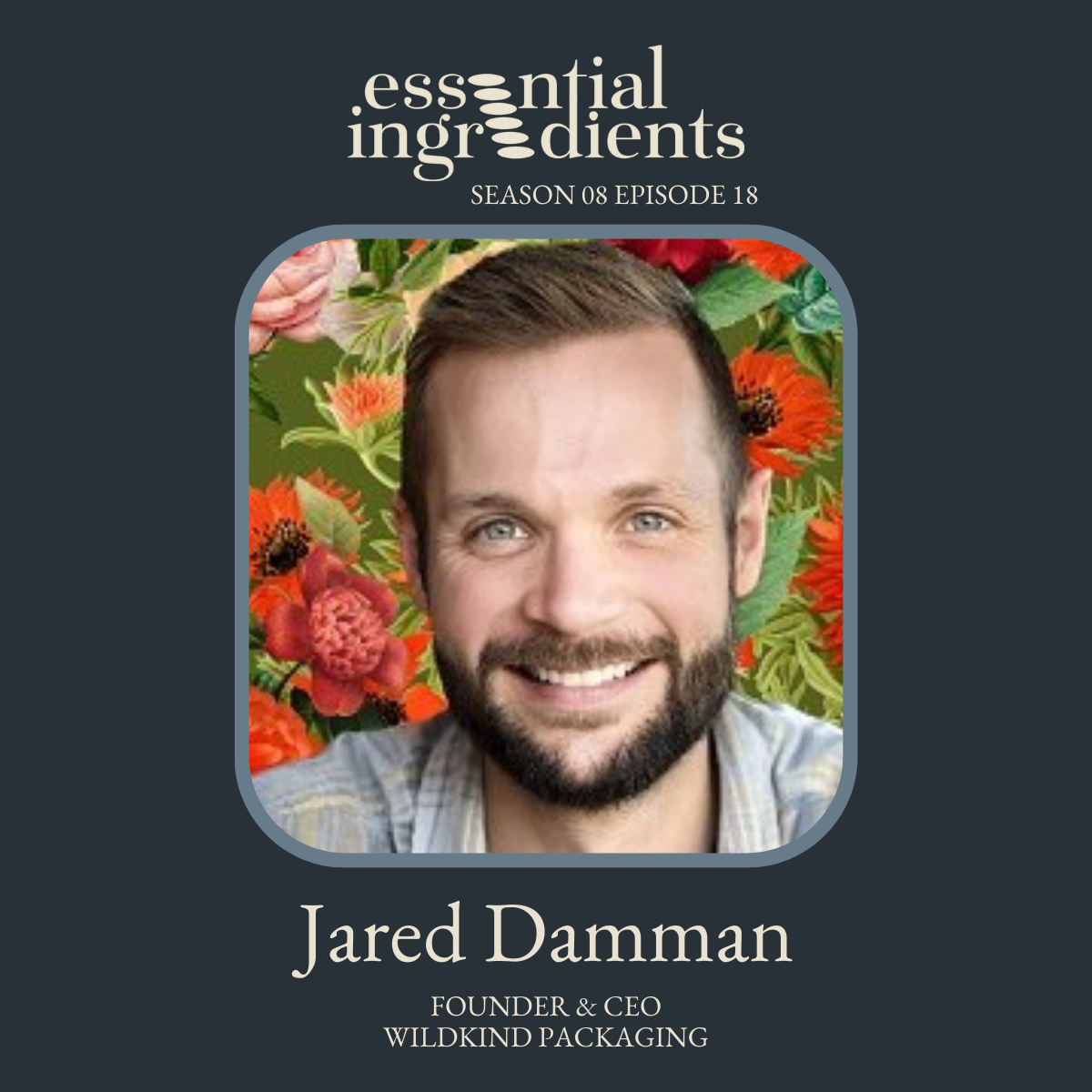
Jared Damman · Founder & CEO, Wildkind
Watch on YouTube
Purposeful Packaging: Plant-Based Packaging Solutions for a Sustainable Supply Chain
The Incorporation Method helps you turn what matters into practical changes that fit your life.
“Jared Damman joins Justine Reichman on Essential Ingredients for a conversation about purposeful packaging.”
Full Transcript
Full conversation between Justine Reichman and Jared Damman.
Thank you. Thank you for having me. I'm the Founder of WildKind. I have been working on this project for about four or five years, and it's been a heck of a journey. We've learned a lot as a team. It's something we're really excited about for the future, especially as it relates to North American stuff that we'll get into more later. But there's a lot to what we do, and a lot more still learning. And science is always evolving so it's a good place for us to be right now.
Okay, so before we go further into that, what is WildKind?
WildKind is a packaging manufacturer company. What we do specifically is focused on the flexible packaging industry. So when you think about coffee bags, or chip bags and things like that, which have traditionally been made of petro plastics, things that come from oil and gas, what we do is we manufacture those things, but we base all of our ingredients from plant based materials. In that way, we also have a better end of life. So instead of having to go either into a landfill or recycling, everything that we create is compostable. So that's how we very much differ. It's pretty fantastic. And it's definitely a newer technology that has enabled a lot of this, which is great.
I know that you have a strong background in product development. So how were you inspired to create WildKind?
Yeah, there's a lot of factors. I think it'll be kind of hard to parse through all of them. I think what inspired me more than anything is that I really wanted to be doing something that felt good. I think with a lot of product development these days as they relate to applications and software, which was nothing wrong with that, it didn't feel very tangible. And so I wanted to work on something a bit more tangible that we could see a direct impact, positive impact on the ecosystems that were a part of whether that's our customer base, or our stakeholders, etcetera. And that was kind of where it started from. There was a lot of research that went into why this specific industry, and I think the timing really mapped out pretty well with the advent of a lot of newer technologies just only coming online within the last few years that have really enabled us to jump in on it.
So previously, what kind of products had you developed before you kicked off WildKind?
Other things that I've worked on in the past have been these software applications connected to manufacturing processes. So we're actually a subsidiary brand of a larger company, which has been really instrumental in helping us launch this brainchild. And that company, they specialize in manufacturing postcards and things like that. But they bridge that with applications and digital applications. And so that's what I've been working on for the last 10 or 15 years. But the timing of me coming onto that team coincided strategically with the executive team wanting to do something different than what they've been doing for the last 35 years. And that's kind of how I was able to get enough space to do a lot more research to figure out how we could do something a bit better and a bit more unique. And that's kind of where it came from.
Was this a collaborative idea? Or did you come up with this idea and have to figure out how to navigate it within this larger organization that you already had your full time job?
It was the latter. It was my idea. It was something that I worked with the executive team on for many months before they could really fully commit to it. The amount of research I was going through and having to present over a period of months at a time, I think, slowly got everyone bought into it with the timing of it. But yeah, it was generated by me. And thankfully, I have a very supportive executive team that helped us pick it off.
The first thing that comes to mind is you have a full time job, you have an employer. How do you approach them and say, listen, I have this idea. I'd love to be able to work on this, because that can be kind of sticky.
I think I'm in any unique position within this organization. I was hired to start new ideas for them. I think they had been around for a long enough period of time that they knew they needed some new ideas, either for their existing business line, and they had an appetite to do big changes. And so as a result of that, even me coming in and starting their product development team and kind of seeing some of the success from it, I think I was able to get some goodwill before trying to present them with this larger opportunity. And I think that's kind of how the genesis of it and how there was, I think, at least invest in the future that I had seen for what could be with WildKind Packaging, and the packaging industry as a whole because there's not enough leadership in that industry. It's a very traditional industry, which I learned by going to a lot of different conferences. And I think, me, being able to come back and say, hey, I'm in a room of a lot of industry veterans, and I'm the only one speaking up for this path. I think that's a good thing. And I think that means that there's a lot of room for us to grow and take some leadership in this space that really needs to happen, especially in North America. So that's kind of how I was able to continually build upon the idea and showcase over a period of many months that, hey, there is room here. There is room to grow. And there's nobody doing it as I have envisioned. And in fact, pretty special people in the industry that had been around, were telling me to not do it because they didn't think it was viable. But every step of the way that we were able to actually do some of the math around unit economics, if we actually bought this and how to resell it, I kept proving them wrong. So I think it's just a really unique space, a unique time for us to get into it.
And so what role did research play in it for you in terms of building and getting them on your side?
Research was the primary role that I did for probably two or two and a half years before being able to pull the trigger on this. I would go through a lot of industry studies to look at what are the different packaging niches out there. Different verticals whether that's cardboard, or plastics, or flexible stand up pouches, which was like a big one that I was really interested in because of the growth trajectory of that. And I think the annualized growth rate for this particular segment of the packaging industry has really caught all of our attention. I think it was growing somewhat like three times on any other of the packaging spaces, and only had just gotten on into the place where it could utilize digital printing technology, which was a key factor for us because we have a lot of experience in digital printing technology. We were one of the first markets to say, oh, by the way, now we can still use a lot of our same expertise in this new industry that only has come online in the last year. I think it was a huge greenlight for us because we could basically repeat what the parent company quantum digital has done. But repeat it in a new way for WildKind Packaging that we already had somewhat of a blueprint and understanding of how it was going to go based on our past history.
Yeah, I think that's super interesting. I often talk to Founders about packaging and creating more sustainable resources because it's a challenge, right? For so many ways, you're making this product that is sustainable or regenerative, and you have all this goodwill and good intention with it. And then they put it in packaging made from so many things that you're like, really, the packaging is awful. So it's not connecting with your ethos. I do know that the packaging exists. The packaging is out there. Some people do it. Sometimes it's a bit cost prohibitive or a variety of reasons. So what makes yours revolutionary?
There's a few things. But one thing I wanted to highlight for another reason, a big reason for me personally was this tension point that you just alluded to. We, as a society, are very consumer forward. Amazon has been growing massively over the past X years. And as somebody who loves convenience, I love the convenience of Amazon and these other companies where you can order and show up at your house. But I'd always have this moment that every time I would open up a package, a little bit of me would die. What do I do with that? And I think that's actually where some of this research like energy came from was like, how do I solve that feeling? That feels awful. And so that tension is actually a big part of what I think led me down this path. So back to your question of, what's the technology that really changes the game? For us, as I already mentioned, it's digital printing technology. Thankfully, we have a really good partner in HP. They are the first to market with this technology to be able to print digitally on flexible materials that largely opens up the door for being able to print very customized, very high quality things on a very small scale. And I think one of the things that's probably worth highlighting is that one of the big emphasis for WildKind, either of our companies ever has existed is because we're really trying to create leverage points for the small businesses to truly compete with the larger businesses, because we really believe that small businesses change the game. They'll be the future of everything. And they are more adaptable. They're the bread and butter. So if we can really support small businesses, we think that's going to lead to a better economy and a better future for everyone. So that scaling has helped.
How accessible is WildKind so that the smaller businesses can get a hold of them to be part of the solution, utilize this solution?
How accessible?
Cost is our minimum. When I think about accessibility, I think about some of the challenges that come along for food and beverage companies. Sometimes they have to meet very large demands, the buyers are just too big. So when I think of accessibility, is it affordable? All those kinds of things.
Yeah, that's a great question. And that's why digital printing was important. And so we could get what has traditionally been an order. If you wanted to order a package, it would be like 200,000 plus pieces. And it's like, how does the small business do that? With digital, you can go as small as one, which is huge. I think being able to remove those minimums, especially if you're sticking to our standard sizes, and that's a whole different way of thinking about eliminating waste in the packaging process. They're significant, but we found ways to limit that. But being able to bring that 200,000 piece order down to one, or if you need a custom size, we'll say 5000 makes it approachable for your Farmers Market and brand. It's amazing to walk down a Farmers Market. We made that for them, and they're able to still make a profit. That's a huge deal. I think when we were getting into it, the compostable film supply, it still is today. It's still difficult to navigate. There's still not a lot of suppliers there. But when we were getting into this, everyone was saying, you can't do that. It's going to be four times more expensive than anything else on the market, and you guys are just not gonna be able to compete. Well, they were wrong. And the reason they were wrong is because you can manipulate with a digital press. You can manipulate how many different designs you can put right next to each other. Let's say a 30 inch roll. And now all of a sudden, instead of printing that one job, you're printing three or four on that same role, and you're able to create a significantly more efficient process so that every one of those brands can take the benefit of that. You don't have to change out these metal printing plates for every different design variation. Every single piece that comes off that press can be unique, and that has changed the game for accessibility in terms for the small businesses. In addition to that press, the other big factor that has changed the game for WildKind and for the accessibility of compostable substrates has been this technology called E-Beam. In this, what traditionally happens is for a package, you have three different layers. You have the food sealant layer that touches the food. You have the print layer, which is where the ink goes. And then in a normal process, you put an additional layer of film on top of that print layer to protect the print so it doesn't scratch off during distribution or retail. With the E-Beam, we don't need that third layer to protect that print. We can print straight on to that second layer. We put a coating on it, whether that's a matte or gloss, whatever your brand desires, and then we E-Beam cure it. What that means is we're shooting electrons at that substrate, and we're cross linking that ink into that second layer at the molecular level which prevents it from being able to be scratched off. That's really important for a number of reasons. One, we don't have to do a normal curing process, which is to put an adhesive on it, then you have to wait for it to cure for 48 hours. That may or may not succeed, and it's adhesion, and then you may have waste. We don't have to do that because we're crosslinking, and it's dry right off the press. The other thing is you reduce that third layer, which is necessary for compostable certification processes. By reducing that third layer, it's easier for those two layers to break down in a natural process which you will need for it to be able to be biodegraded in nature. Having less material is a good thing. And less chemical, less adhesive is a good thing. So those two machines in combination have really opened up the potential for compostable packaging.
I'm wondering, because when you're talking about this, what I think about is the education for the consumer. Because a lot of times, we order products and they do come in relatively thoughtful packaging that is either sustainable, recyclable or something. But I'm wondering what role education plays for you. I know that the consumers, that you're the founder, that you're talking to know about this, but is there anything that you guys feel like you need. You are communicating to educate, are the consumers becoming a greater demand for those founders?
It's a great question. I think the consumer education piece is largely not on our shoulders, because we don't really have that direct connection to the consumers. So we really do rely on our education to the brand owners, and then allow them to, we'll support them with the education and knowledge base to help them create marketing campaigns, or PR pushes to their social media, or email, or whatever to help communicate to their consumer base what it is that is different about the package, and how to interact with it at the end of life. And that's the way that we've been able to create leverage. We're still a small team. We started at the beginning of last year. And so I think there's a lot of ways that we're trying to create that leverage without having to hire an inordinate amount of people to do that. But in combination with the brand founders, we also are part of certain organizations that are able to pull resources to help with this kind of messaging to greenblue.org, or Sustainable Packaging Coalition. They do a lot of lobbying efforts to help push that education forward and create resources that we can then share or the brain founders can share across their network.
That's great, because I think it really is important whether they're doing it through social media, or whether they're communicating it at the time of purchase. Do you ever do food delivery?
Me, Myself?
Do you order lunch or order dinner? Do you order your groceries? Do you do any delivery?
I guess we do food delivery. We do grocery orders. Here in Austin, that'll be delivered to our house.
The reason I ask is because I'm born and raised in New York City where we would get food delivered before we had Caviar, DoorDash, and Seamless Web. You would just call the restaurant, they were delivered and you had all this packaging. I'm so curious if down the road, that's something that you guys might get into because it seems like they're for some sustainable packaging.
There's a lot of work being done in that space. I would love to get to a place where we are manufacturing a wide variety of packaging that's all geared towards this compostable story, and it's better for the planet. That takes a significantly different set of machinery. I think that would be maybe 5, 10 years down the line when we're a lot larger to be able to have enough space for that stuff. But yeah, the machinery that we have takes the whole production floor. It's huge so I think it would be tough to get into anytime soon.
I was just curious because I do know and I do think that people are more conscious around what they're buying, whether it's coffee from LA and it's getting delivered, or it's your groceries. My groceries, I order from Good Eggs, and you can give them back your boxes and your ice packs. I don't know what they're doing with it, but I presume they're reusing it.
I certainly hope so. Everything that we have in our modern day convenience society, there's just gonna be so many businesses that have to jump in and do these things. To have one company that will supply all of those is, it'd be a pretty big company. We will do all that. The closest thing we could do, like you said, the coffee bags. If you want to ship something, we can create those sleeves. And that's fine. And I think there's a big demand for that with a lot of these direct to consumer brands. And that's part of the reason we went with flexible packaging is because it's versatility that when you get into these hard molded things, or these boxes that have a specific coating on the inside for preventing leaks, leaks and stuff like that, it's a very different world. And a lot of those things have forever chemicals in them as well, which is not something we want to touch. Luckily with our current process, everything we have is PFAS free, so we want to keep it that way.
I just want to go back to the beginning a little bit when you said that this is under a subsidiary that you work with. So for the other founders that are watching or listening, I'd love to better understand what that meant for you in terms of building out your business financially? What role were they able to play? How are you able to sketch that out? Because it sounds really great. You've got all these great resources, but I don't know what that meant that you either had to give up or compromise on. I'd love to hear a little bit about that journey.
I'll answer that as best I'm able to. What makes this possible is kind of how unique it is in the way that the main company is an employee on business. So whenever the decision was made to also invest in WildKind and help it start up, it is wholly owned by the parent company. And as a result of that, all of the employees are able to get a benefit as WildKind grows. So it is unique. It's 100% employee owned through and through.
That's getting more popular these days.
It is. To be honest, that's the right way to do business in my mind. If your employees are putting their blood, sweat and tears into something, they should really be able to get a wealth benefit from it. And so I'm really, really happy to be part of a company that sees that, understands that and is allowing the employee to own it.
I really appreciate you sharing your journey and everything about WildKind and how you got there, because I think it's a really great inspiration for others that want to innovate, maybe are working somewhere, can figure out how to collaborate or leverage their resources in their background. Where in the past, it sounds a little scary to do that because you kind of get it sorted out.
I think there's a lot of headwinds right now for a number of reasons. There's tailwinds as well. I think some of the regulatory changes across the nation, the extended producer responsibility regulations that are still trying to get figured out both in North America and in Europe are great, potentially as a tailwind, to help us really kind of explode what the challenges are. There are a lot of definitions in policymaking that everyone will try to find different ways of navigating it and getting around. And compostable materials oftentimes aren't included in those. So where it could be a tailwind, it can also be a bit complicated, making the education process that we have for brand owners even more difficult. So that part is murky at best. And I think there's a lot of pushback against ESG stuff right now. BlackRock has pulled out a lot of their ESG funding. That means for a lot of companies trying to do good for the planet. But I am optimistic. I think being able to be a business that can model this idea of kind of steward leadership, the idea of how do you create a culture that is a for profit business, but how do you create a culture that is collectively looking at what is best for not just our employees, not just our customers, not just the profit, but what's also best for a collective future that doesn't have a voice in today's day? The climate issue is a future forward. It's a future issue that they don't get to speak up for so how can you try to help those future generations is a big part of the ethos. And I think most of my time is around, how do we make sure that everyone that's working in these businesses are making decisions and keeping those frameworks in their mind as they navigate, make decisions about what print varnish do we put on our packaging. That's relevant. We play a pretty varnish on there that's going to be a PFAS thing, that's a forever chemical or not. And having them be empowered to make that decision, knowing that it's about what affects the future generations, I think, is huge. In the packaging industry, they need a lot more people doing that.
Are there any hard hitting statistics that you know about that show the impact of using your packaging, and how it relates to businesses becoming completely sustainable?
Like a lifecycle analysis. We haven't gotten full numbers on that. And I think this is one of those things that can be tough in this space. I definitely understand the desire and the need to have all those metrics in numbers. And on a case by case basis, we are more than willing to work with people to do that. And we have different consultants that we work with, and will help us kind of navigate that for individual brands. But it really does vary brand to brand because we might have to source a different material for a particular brand because of their barrier needs. So as a whole for a company, it's a really difficult thing to answer. And in an ideal world, we will have to answer all of it. These different third party certification bodies, which is a more global standard, I have a really great idea behind them. But oftentimes, it ends up becoming the barriers preventing brands from adopting better materials because of the extra bureaucracy in processes and money that takes place to get those third party certifications. So it's kind of this really difficult place of like, okay, we know this is a better decision than what is currently available in the status quo. And do we invest $30,000.00 (inaudible) of time for each individual brain that uses us to do that? Probably not, because it'll break our business. So it's a really difficult place.
Maybe in the future, right? So this impact because I think it is important to know that. How does this affect the company's bottom line if they're including edible packaging versus not including it? They're gonna drop off, or what percentage of their sales will increase as a result of their ethos? Following that from beginning to end.
McKinsey & Company and NielsenIQ did a really large study about that particular question. And they finally saw the results last year, I believe. And they do have a lot of those numbers around, okay, this is going to help retain this many customers. X percent or the brands that do these kinds of things see this much growth. Maybe you can link in the show notes or something like that.
Pop over to me and we can put in the show notes, and maybe add it in our newsletter.
That's a really good thing to reference as a whole for an industry because they have a lot of the accumulated data for a variety of brands in a variety of industries. I think that's probably a better way to do it.
Jared, thank you so much for joining me today. I enjoy learning your unique journey and how you got there. Because I think that it really does, it really is different. You aren't sitting at your desk saying, oh, I have to do this. It wasn't a side hustle, you got the commitment of your company, you did your research. It really was exciting to learn about, and I think inspirational for those that may be in other situations where they could lean on their existing community so thanks for sharing that.
Yeah, thank you for having me. I'm definitely excited to be part of this journey to make the world a little bit better. And hopefully, people that listen to this want to join us on that journey. Reach out, and we can just try to make a better education system for everyone out there to get more excited about it.
What would be the best way for people to get in contact with you, to learn more about WildKind?
Go to our website, wildkindpackaging.com is probably the best way to get in touch with us as a whole. We also are very active on social media. So wildkindpkg is our Instagram. Pretty much any social media is the best way.
Share This Episode
Enjoyed this conversation? Share it and tag @nextgenpurpose
Listen on Apple ▶Listen on Spotify ▶Your Host
Justine Reichman
Founder & CEO of NextGen Purpose. Host and Executive Producer of Essential Ingredients — 11 seasons, 330+ episodes, and a growing movement.
About Justine →