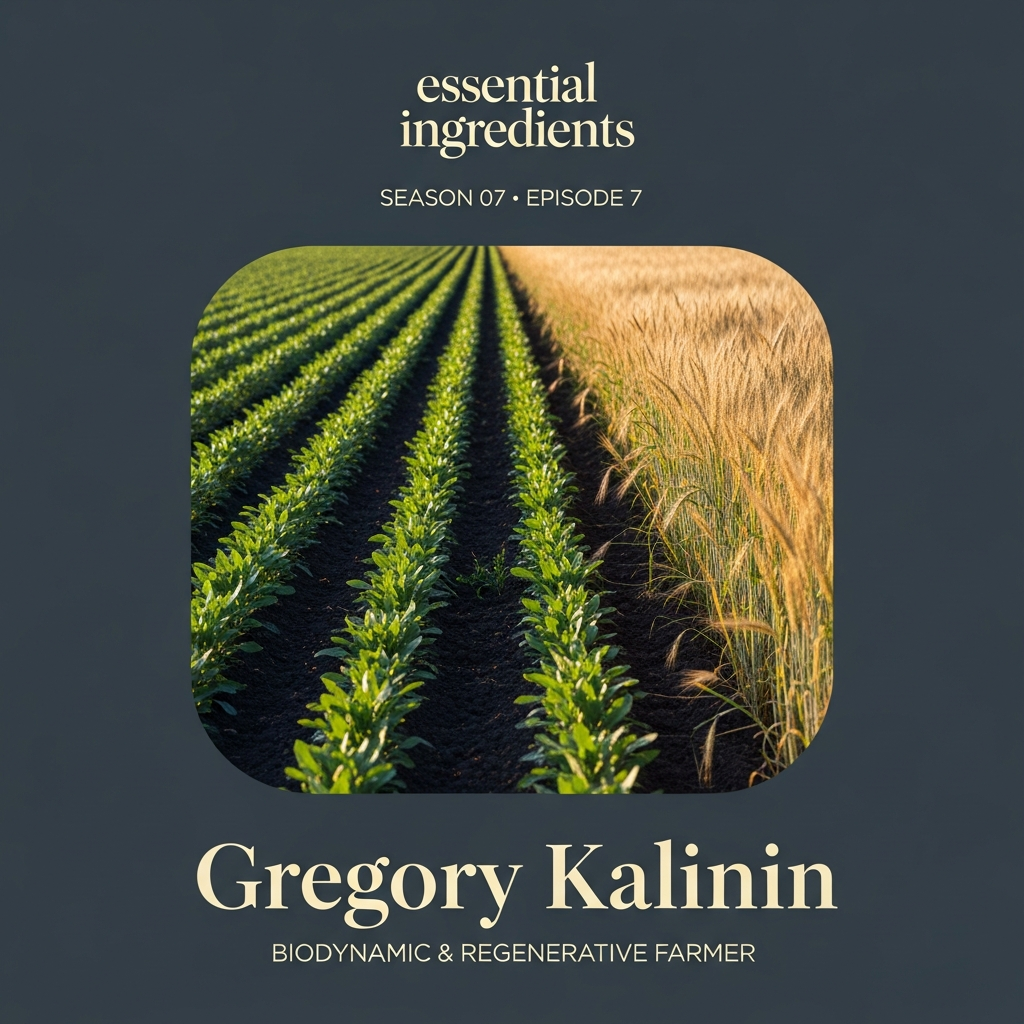
Gregory Kalinin · Farmer, Holistic Roasters
Watch on YouTube
Regenerative Farming: Beyond Organic and Biodynamic Practices
The Incorporation Method helps you turn what matters into practical changes that fit your life.
“Gregory Kalinin on why biodynamic regenerative farming goes beyond the organic label — how a holistic, rhythmic approach to land stewardship produces food that is more alive, more nutritious, and more connected to place.”
Full Transcript
Full conversation between Justine Reichman and Gregory Kalinin.
Good morning, and welcome to Essential Ingredients . I'm your host, Justine Reichman. With me today is Gregory Kalinin, who is a Co-Founder of Holistic Roasters. Welcome Gregory.
Thank you very much for having me, Justine.
First, just before we get going and we learn more about you, I'd love to just introduce so folks have a little concept of what we're talking about. What are Holistic Roasters?
Holistic Roasters is a company that has two brands that we work with, two types of coffees. One is a biodynamic coffee. We have three roast levels of biodynamic coffee, the Rubicon, The Rise & Shine and the French Roast. And we also do organic coffee and compostable bags, and it's called Melk, M-E-L-K. And that's associated with cafes in Montreal, so it's kind of a long standing third wave coffee brand in Montreal. And so we roast those two brands, and we've been doing it for about seven years now.
Congratulations.
Thank you.
Congratulations. So before we continue on this conversation, for those folks that are not familiar with the term biodynamic, we explore that for a second. When you're talking about biodynamic, what does it mean to you?
So biodynamic is kind of the OG of Organic Agriculture. It started in the 1920's, and it's basically a way of focusing on soil health. Maybe the best way I can describe it is where the link from today's perspective is kind of the big push around regenerative agriculture, and biodynamic agriculture is just another form of regenerative agriculture. So it's really focused on creating an ecosystem on a farm where you don't need any external inputs. That everything that you need to grow really high quality food is you can get from the farm itself. So that includes the compost. It doesn't require any external inputs like pesticides, or chemical fertilizers, or herbicides, or fungicides. And I guess, maybe your audience would be familiar with Apricot Lane Farms, there was a really great documentary called the biggest little farm.
Make sure that they're familiar with that.
And it's such an inspiring Movie or Documentary. It's about this couple who took this dilapidated farm and turned it into this thriving ecosystem. And it goes through the challenges of taking this farm that had completely been depleted. And basically, the land had been destroyed. And it took them several years. But now you look at it and it's an incredible transformation. The one thing they don't mention in the documentary is that they used biodynamic principles to do that. So I think it's a certified biodynamic farm. And just to kind of complete that story is it's biodynamic is a trademarked word that you need to get certification from an organization called Demeter. So they will do both the farms, looking at the firm's to make sure that all those principles in terms of soil health, in terms of biodiversity, all that creating of that ecosystem is done well. And I think it's probably the highest standard of what you would say either regenerative or organic agriculture there is, but it goes beyond just farming. So we are also certified by Demeter in terms of how we then handle the coffee beans in this case from the farm to our roaster, including even the kind of packaging we use. They want to make sure that there are no opportunities for any contamination in the coffee. So that's why we like to say our coffee is no compromised coffee, it's really clean, it's healthy. It's good not only for the environment, but I think it tastes really good because it comes from soil that is full of vitality and nutrition. And I think you can taste that in the coffee. It's also good for the farming communities because they're living a much healthier lifestyle, they're more independent, they're actually getting a lot better yields as well. So I think that if you look at it from a holistic perspective, I can't think of a better way of growing food and then that kind of focus on regenerative agriculture.
Yeah, I agree. And I think that a lot of people are not familiar with these terms. We're talking about regenerative agriculture. If you can give a short definition of what that means to you, that'd be great because I've had a variety of people come on and they're all similar but a little bit different. A little bit of a different take on it. So I'd love to hear from you, how biodynamic fits into the larger umbrella of regenerative?
Well, as I mentioned, I think it's the original way of doing regenerative agriculture. I mean, if you look at it from a traditional standpoint, that's just the way things were grown previously. There was low tillage or no tillage. In many cases, the farms were self-sufficient. They tended to be smaller family run farms. I would say that in this way, maybe most people are familiar with the term biodynamic when it comes to wine. A lot of people are familiar with biodynamic wines. And I think one of the things that got me interested in the concept that wasn't the only thing but it was one of the things is just seeing how many of the biodynamic wines were kind of award winning wines. They tended to produce really, really great wines. Not uniformly, but generally, they were cut above. You look at, what was the reason behind that? It came down to how everything was grown. And I think the thing that distinguishes it the most is back to that ecosystem. Creating an ecosystem that is harnessing. It's not technology, but if you think of it, because I'm a tech guy. I am kind of always fascinated in tech, and like really wanting to understand systems from that perspective, its natural systems. How does nature work creating a symbiotic relationship between the microbial life in the soil that works in harmony with the plants? The plants give off sugars through the roots that feed the bacteria and the Microbiology in the soil. And that in turn then extracts the minerals and the vitamins from the soil and feeds it to the plant. So if you think of that process, it's a perfect symbiosis between those two things. The problem happens when you look at conventional agriculture. You start to say, well, we're going to supplement that with, say, chemical fertilizer. But what that ends up, or pesticides, are things that you're trying to disrupt that ecosystem in a way to try to improve it. But the problem is then you've become dependent on those chemical fertilizers because it tends to destroy the Microbiology in the soil, and it disrupts that symbiosis. And so then you could become stuck that you need to use fertilizer every year in order to get the maximum yields from the plants. And this is a way of reversing that and saying, well, let's go back to a way where that's not needed. And in fact, it's a better way if you look at it from the perspective of giving the plants everything they need in terms of all the nutritional requirements of a plant is actually much better fulfilled from that symbiosis with the Microbiology in the soil rather than just the chemical fertilizers, which are focused on your phosphorus, nitrogen and potassium. So there's at least 40 nutritional requirements that plants have, not just those three. And I think you end up tasting it in the food too, as I mentioned. When you get an heirloom tomato that you pick fresh from your garden or from a Farmers Market, and you taste that compared to conventionally grown tomatoes. And there's a huge taste difference. And I think in part that taste difference is in the antioxidants in the trace minerals, in the nutrition in the tomato, and you can taste it. And so that to me is where from a consumer perspective is like, I want really healthy, good tasting food. And in our case, we just happen to focus on coffee.
So I know that you focus on coffee and I'm curious, was the interest in coffee, what came first? The interest or the regenerative agriculture and building something from that standpoint, or was coffee? So what happened first?
Coffee actually happened first. I can remember my first, I wasn't a coffee drinker in high school. I started drinking coffee in university just to study for exams, and it was from the machine. It was not great, but it gave me caffeine. And that helped me study. I was always happy about that. But I was working in Japan, and do you know what a siphon coffee is? Siphon coffee is the one where they have the bunsen burner underneath, and it almost looks like a chemistry experiment. So I was having breakfast in a restaurant sitting at the bar and somebody prepared a siphon coffee and just the visual aspect of it,kind of impressed me,and then the taste of the coffee was so amazing. I loved everything about it. And eventually, when I came back to move to Montreal and I got into coffee just kind of by accident, but I went deep. I ended up buying an espresso machine, and then a grinder, and then I got a little home roasting machine. I like sourcing green beans and doing all that. Freak like I became a geek, a coffee geek. And luckily in my neighborhood, a couple opened a third wave coffee shop, Dominique Jacques and Mirriam.
So for those not familiar, what's third wave coffee?
Third wave coffee is just it kind of grew out of the, when Starbucks started introducing a higher quality of coffee rather than just the instant or the kind of coffee you'd get from the grocery store, kind of a higher level of coffee focusing on espresso and espresso drinks. The next stage was the smaller kind of local coffee shops that really focused on high quality beans of really creating, kind of almost inspired from maybe the Italian espresso, that next level of coffee which is really focusing on just high quality beans prepared in a really good way. As you know, you have a coffee ritual, I think, that you do every morning. That's all came out of the third wave coffee kind of movement.
Yeah, because my first coffee started, actually, it was with the espresso machines that you boiled the water on. and then you had the little espresso, and I used to make my Illy coffee there. And then my Illy coffee, I upgraded to or upgraded, or just moved to Nespresso with those big machines when the machines came out. And then after the espresso was when I was like, no, I really want to make my coffee so I made French press. And now, I've arrived with the rocket. At which point did I become part of the third wave?
So I think with the rocket, I would also say, if it sounds like you were using a Belletti on the stovetop were you, yeah. I think that's also a really fun way of preparing coffee. So one thing I would say is Nespresso probably was a diversion from that trend a bit, but it's super convenient. So I definitely understand why I used to have an espresso machine as well.
I think everybody's gotta do what they want to, but it's really interesting to understand the different kinds of beans. And then the opportunity to have these biodynamic or organic, or something that's part of the regenerative movement because, A, it's better for us, and it's better for the planet. So you're making a better choice when you choose that. So if you're given one bag of beans and they're not from that kind of thought process, and you have the option of buying the other, buying this enables you to have something that's better for you, better for everyone else, it supports the business that's doing it to create a better environment. So I mean, there's just so many reasons why that sounds like a good idea.
Yeah. I feel like it's part of being a good citizen, a good global citizen. And it's not just helping your own community. So from my perspective, when this a couple open this third wave coffee shop around the corner from where I lived, it was part of creating that community in our neighborhood of, here's a local couple who are starting off in their business, opening a coffee shop, and participating that becoming friends with them, seeing the impact it had on the neighborhood too, and how much everyone loved it, the baristas that were there, you could see that they treated their employees really well. It was always like, such a positive interaction to go into that milk coffee shop and spend some time, and have conversations with people, the baristas, the owners. And the interesting thing is you couldn't tell, oh, that's the owner, and that's the barista. In fact, a lot of people thought one of the baristas was the owner and treated him as the owner. Whereas the actual owners like, I'm fine with that. It was such a nice kind of atmosphere that they created.
So as you're exploring these things and living in Japan, and being introduced to this new coffee shop, where did you and your co-founder then come up with a holistic coffee?
So it actually started off as a fundraiser. So the school that my children went to was a Waldorf school and they said, we'd like to do a fundraiser and we thought it would be interesting to maybe figure out how to do coffee because they were always like very much had looked at a Farmers Market that they used to raise. And so it was a lot like local firms who were biodynamic farms that would bring in their produce and sell. So we can sometimes get some wine too, but we feel coffee would be really good, but we don't even know if biodynamic coffee exists. So I kind of love the challenge. And so I was like, oh, well, maybe I could help with that. I like entrepreneurial ventures. And so I sourced some biodynamic coffee from Peru. I had a few 100 pounds of green coffee shipped up to Montreal, and I found a local roaster who was willing to roast it for me, put it in a bag with just a scoop and a scale. I was doing it all by hand and putting a label on it. And we used that as a fundraiser at the school and became popular. And they said, let's keep doing this. A nice little extra revenue stream for the school, and it helps us to make sure we pay our teachers a good salary and everything. It contributed a small amount of that, and then I decided, I will talk to Dominique and Miriam about it. And I was like, this is kind of interesting, and I think it's maybe something that you could be interested in and get involved with. And initially, they thought, well, we don't really have our own brand of coffee. We don't really want to become roasters, but we're really interested in the idea that maybe this is something we could expand into. And so Dominic and I kind of last minute because we're both kind of, we like to do things kind of last minute, sometimes as many entrepreneurs do. So we decided at the last minute, we're gonna go to Honduras to visit this biodynamic coffee farm. So we met up, we took separate flights because I was on vacation already. I was in Florida, and so a very short trip from Miami to Tegucigalpa, and he flew in from Montreal. And we spent three or four days with this family who is in the makalah region of Honduras, and it's known for its organic coffee. So they had worked really hard to kind of transition from conventional coffee growing, which tends to rely really, really heavily on pesticides and chemical spraying and they converted 80% of this coffee region into organic coffee. And they were in the process of then moving that to the next stage which was biodynamic. It felt like we were there for two weeks. We packed in so much time with the family, stayed with them, went on adventures, hikes with them, explored the coffee farm, which is interesting. You think, what does a coffee farm look like? You think, oh, most people think rows and rows of coffee trees, right? No, this was completely integrated into the forest. It was like walking through the forest and just happened to be a number of coffee trees that were growing there. And it was so interesting to kind of feel like it was just part of nature, it didn't seem like a farm. And we decided at the end of that, well, let's make a go of it. We ended up importing, I think it was 50, 60 kilograms of bags of coffee and decided to launch Holistic Roasters and Biodynamic Coffee.
Wow, that's exciting. So out of curiosity, were you both entrepreneurs beforehand? So you've had experience, this is not your first time at the rodeo. And so doing this, this time versus in your previous ventures because you had that experience, what did you do differently that you think you might not have done without that experience?
Well, I knew what to worry about and what not to worry about. So the first time as an entrepreneur, you think everything is a crisis, where everything is super important. You're worried, you panic about a lot of things that you don't necessarily need to panic about. So it's just that once you go through it once and you know here's what's important, here's where we need to put in some effort, here's where we can not be as stressed out, that always helps. But not to say that we didn't make mistakes. Because anytime you go into something new, my previous experience had more to do with E-commerce, online marketing and other manufacturing businesses, things like that, but never in the food business as a direct consumer product that we were doing the importing, and the roasting, and the shipping, and the packaging too. So we're definitely some mistakes we made along the way nevertheless, but you learn from them, and you fix the mistakes and just continue on. So it's not the end of the world when you make a mistake, typically, hopefully.
It's part of the process, frankly. For those listeners that are new to entrepreneurship, what are some of the things that maybe you'd focus on that are red flags that you need to worry about, and other things that maybe you can just take a breath?
Well, so one of the red flags is, I guess, product market fit. So sometimes, you're in love with something, but nobody else really cares. And that's important to kind of see. Is it just something you're obsessed about? Or is it something that other people are going to be interested in as well? But that's the process there. And the reason why it was fairly easy for us is because it started small. We started with a, let's just do a fundraiser, a small amount. Let's test it out. Let's see if people like it. And you don't have to commit to a big process. It can be very small just to test something and then you say, okay, with that feedback, can I go to the next level? And then do another small test like, well, if I do this, does it work? Is there any demand for this without deciding I got to do a huge business plan, I have to get a loan, I have to get fundraising that just do some small tests to see. To test the concept, I think, is one of the key things that we did. And we took it pretty slowly just to determine. But at one point, we decided, okay, this is worth kind of going a little bit further. And that is when we decided to pitch the coffee to Erewhon. And that was very early on.
For those who are not familiar, it's a better good for you food market. That's an elevated experience in the last Southern California area.
A lot of food companies. When they're starting off, they kind of have Erewhon as they're, if I can get into Erewhon, then I know I'm legit. It also brings a lot of credibility and things like that. So we decided to try it, and it was really easy for us because we were such a good fit. They were interested in biodynamic and organic agriculture. They knew about Apricot Lane Farms, they were working with them. It just was a perfect fit for everything. We would look at what they said on their website and what we had and was like, well, they're also interested in soil health, or replenishing aquifers when it rains, or climate change, and carbon sequestration, all those things. Okay, so how can they say no. It's like a perfect product for them, and that's kind of how it worked. So that was another kind of, okay, we can go a little bit further with this and see how it goes. So little things like that.
And I think that's super important because I can tell you, people fall in love with their ideas. What I found is that many people, including myself, I've fallen in love with ideas. But I think one of the things that I've learned is that falling in love with ideas, okay. But you have to be able to be open to hear what other people are saying about it, and be able to evolve and pivot accordingly. Because the more information we get, the more we dig into it. It's only natural that we're going to learn more things. So learning from that, and taking that advice, and those experiences that other people share can really allow you to create a more robust and meaningful brand or product. I think when we dig our heels in just because we love it, we're not doing anybody a service, including ourselves.
The best thing is, customers who are upset about something because there's such a good source of opportunity to improve things, when a customer is upset or has negative feedback, that's--
They care. They want their product almost.
You should listen. Listen to what they're saying and move on from there. So yeah, we had some of that early feedback from customers around the packaging in particular that we decided to pivot on.
And that's such an important lesson. So if you weren't open to hearing what those customers had to say, you might not have tweaked your packaging, which would ultimately, is probably more brand aligned now and allows you to really be in a market with sustainable packaging. Everything that works to make a holistic product, not just the coffee, but the packaging and everything in the greatest sense of the word holistic.
Absolutely. Just to go into that mistake we made on the packaging is we thought, okay, we want something that's going to really stand out and be different. So we decided to put the coffee in a compostable bag, but then inside a box, and then put a label over it. And the issue was, first of all, it looks different. And so it kind of helps us stand out. But the problem was, it was in a craft box because that was the most compostable way we could do it. And it didn't stand out on the shelves. It was a lot of material for you. I think we have a bag and a box and a sticker. And from a labor perspective, it was very labor intensive to do all of that. Also costs a lot of packaging. Packaging, doing the opposite of what we were trying to do where it's like we're focused on compostable but like, why don't you focus on just reducing the amount of packaging? The other thing was the cost. And then two are shipping those boxes. They tended to get crushed in shipping. And so then, they tended to look really not great on the shelves and they didn't stand out very well. Craft box on the shelf is like, I could stand in front. I was at Erewhon looking for the coffee, I know it's here, and I can't see it. It's like, oh, there it is. It just blends in with everything else. So we changed that, we took that feedback and decided to redo things. And maybe the second piece of advice for entrepreneurs is as soon as you can afford it, work with experts. Don't try to do everything yourself. If you know you're good at some things, focus on the things that you're good at and that you like doing. And as soon as you can work with experts who know what they're doing in some areas and who will make your lives so much easier, if you just accept that, you can do everything yourself.
Well, I would say another thing in addition to that because I think that's super important. But many times when you get started, you can bring on advisors and mentors in that capacity to surround yourself with those experts before you can afford to pay them, or give them a piece of whatever it is you're building. But entrepreneurs are happy to mentor new entrepreneurs, many times. I mean, I'm not gonna say every single person, but the ones that I've spoken to are always eager to help these new generation of entrepreneurs build a better world, a better place, better products. So I would say that when you have the money, and definitely when you have the funding, and before that, people are not inaccessible. People are accessible. They want to share their wins, they want to share what's worked, what hasn't worked, and resources. So in the beginning, for me, I went to advisors and mentors before I could afford to hire the team with that expert with those expertise.
I love that because people often think of resources as, oh, I need the resources. And then they think, I need the money. But you can also look at resources for putting your time into building that network of advisers. That's another way of looking at resources. And it's a bit of time to build that. But then you get so much value out of that network of advisors, of supporters, of cheerleaders as long as you're willing to listen. There's a saying that a friend of mine taught me a long time ago. He said, it's really important to have strong opinions, but not to hold on to them. So his opinions are loosely held. So if you're presented with information that you should change your opinion on something, don't be afraid to let go of your old opinion and be updated with the new facts and the new information that you're presented with.
Which I think directly correlates to the conversation we were having about. Don't be too attached to an idea. Listen to what the customers are saying, listen to what people are saying, and be able to be open to pivot and evolve as you learn new information. So I think that's super important. I'm curious, though, you have a couple of skews out there, what's next for you guys?
So next is really just kind of focusing on the expansion. So we are mostly in, we do a lot of direct to consumer, we do wholesale, we do some white labels as well. But I think the next is to expand to other grocery stores. So we're working with greenspoon to help us build out our distribution network across America. And eventually, I think what we might do if we're looking at adding another product would be to potentially look at doing something that you could add to your coffee. So you know that not every time you have a coffee, you want to add any kind of functional benefits to it. But there are times when you're focusing on, you're at work and you want to increase your mental acuity, maybe there's a coffee booster that you could add to your coffee that would have that functional benefit. So we're looking into that, or maybe you want to offset the energy you get from coffee with kind of something that will help make you feel a bit calmer, so what could you add to your coffee as a coffee booster that would do that? It's something we're looking at, but it's not something we would do. I would say this coming year, it's kind of further down the road as we, I guess, our focus for now is on the coffee side of it.
That's great, Greg. So for those folks listening and tuning in today, whether on the podcast or watching the video cast, where can they find your product?
So the easiest way is at biodynamic.coffee is the website. So it's B-I-O-D-Y-N-A-M-I-C.coffee. In Instagram too, Biodynamic Coffee. And if you're looking for organic coffee and compostable bags, it's Melk , M-E-L-K.cafe, C-A-F-E.
Awesome. Greg, thank you so much for joining me today. It was great to learn about you, your whole journey and what you're building. Keep us posted.
Thank you so much, Justine.
Share This Episode
Enjoyed this conversation? Share it and tag @nextgenpurpose
Listen on Apple ▶Listen on Spotify ▶Your Host
Justine Reichman
Founder & CEO of NextGen Purpose. Host and Executive Producer of Essential Ingredients — 11 seasons, 330+ episodes, and a growing movement.
About Justine →