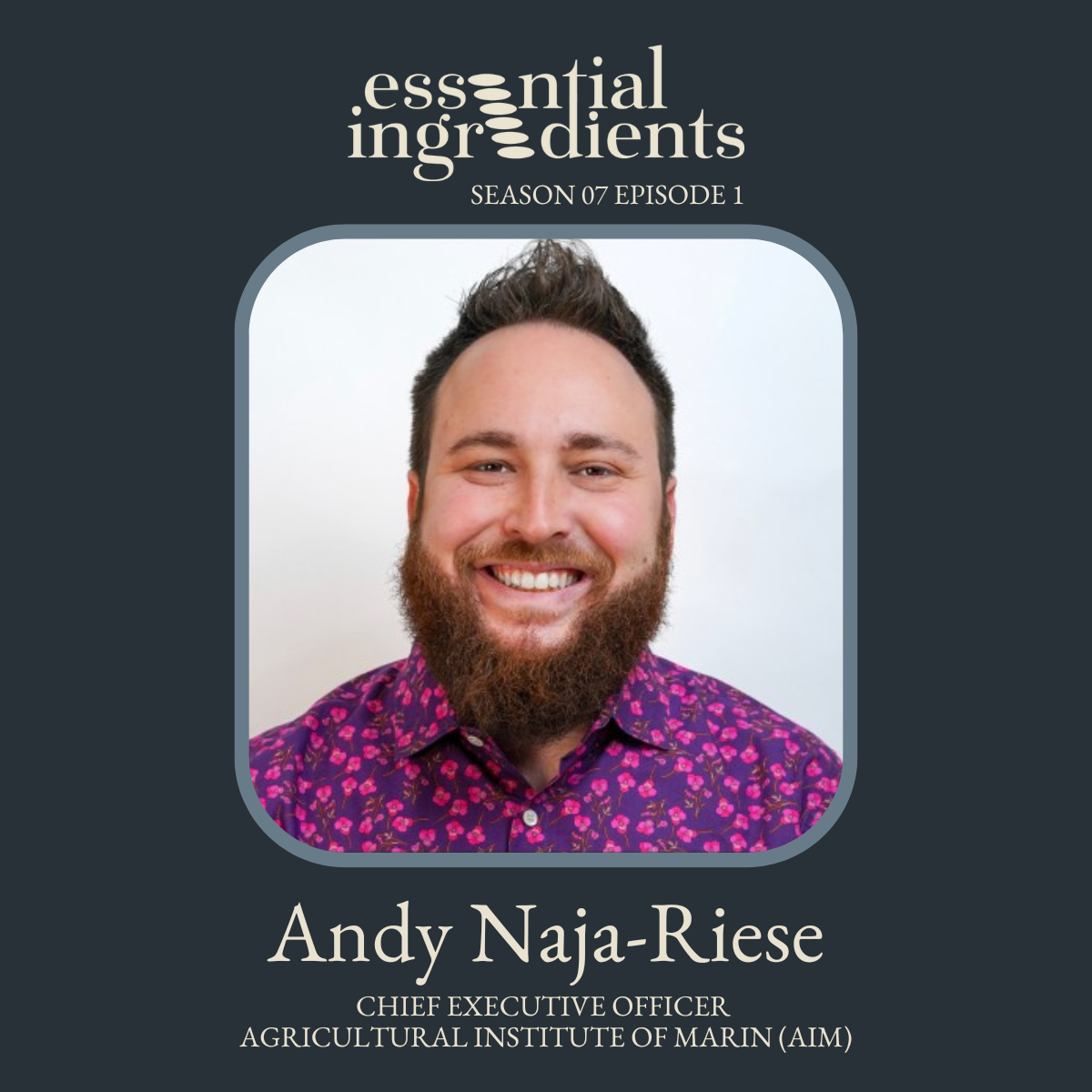
Andy Naja-Riese · CEO, Agricultural Institute of Marin (AIM)
Watch on YouTube
Boosting a Healthy, Accessible Local Farm-to-Table Revolution
The Incorporation Method helps you turn what matters into practical changes that fit your life.
“Andy Naja-Riese on how the Agricultural Institute of Marin is building a more equitable local food system — making farm-fresh produce accessible to everyone, from farmers markets to school cafeterias, one community at a time.”
Full Transcript
Full conversation between Justine Reichman and Andy Naja-Riese.
Hello, and welcome to Essential Ingredients . I'm your host, Justine Reichman. With me today is Andy Naja-Riese, who is the CEO of Agricultural Institute of Marin.
Hi, Justine, thanks for having me today. Glad to be here.
It's great to see you, as always. Love catching up last week for lunch, and I'm excited to talk about change in our local food system here in Marin. Because I know you guys are doing so much, and I just want to be part of it.
Well, you're already part of it by shopping at your local Farmers Market and eating up local farm to table restaurants, and growing your own food. So bravo to you.
Thank you. I was very excited to show you my edible garden.
It was wonderful. And like I was telling you, it was really exciting to see the peony trellis that you created.
I would love to take credit, but I'm just not that handy.
So your pea plant.
Okay. Well, I'm so excited just to have you here. We've had you on a couple times and learned a little bit about you, and a little bit about, let say the topic is a little bit broader and it reaches further because I think that the idea here is how do we create chains on a local level with regards to food. And you're such a big part of that. You're leading that initiative here, doing so many different things that I think that if we could just talk about that a little bit, learn what you're doing. Some of the things that you hear are some of the things you know that need change, and how everyday people can maybe start to make incremental changes of their own to help make that possible.
It's interesting because even right now, we're dealing with a climate crisis and just so many challenges as we're coming out of the pandemic, and it can really take us down a path of gloom and doom. There's one thing we can all do, and it's to shop at our local Farmers Market and support our local producers. And you can make change through your food purchases. And if we can support our local farmers, they are small farmers that often have greater biodiversity at their farms. They may be certified organic, they're growing multiple different types of products. They're supporting pollinators and healthy ecosystems. And when you're buying food from those farmers with those practices, that helps to keep them in business and helps us support our local ecosystems, which is really important especially right now with the climate crisis,
I would agree. I do try to shop at the Farmers Market and do those things. Because every small step, when you put them all together can create a greater change. So I'm curious from your perspective, you've been doing this for how long now?
So I've been working in food and nutrition and health for about 17 years.
Wow. And so when you moved here, because you're originally from the East Coast and you moved here to take this job if I remember correctly.
Well, I originally moved, I was working for the Government Centers for Disease Control and moved out. So I was working in Heart Disease and Stroke Prevention and Policy Work, and then came out to Oakland to work at a local community organization as part of a field assignment. And that brought me out here in 2010. And I came here from New York by way of Atlanta.
Well, when you said the CDC, I was like, wait, you must have lived in Atlanta.
I lived in Atlanta for about three years. Really wonderful city. Lots of good food, a little too hot for me.
Little inland.
Yeah, so I've been working on food and agriculture and nutrition for about 17 years.
So when you first got into this, were you thinking more globally? Or were you always thinking locally? Or is it that if you think local, it can ultimately be global?
Well, it's interesting because I was working for the Federal Government, first at the CDC. And then I was working for the USDA Food and Nutrition Service, and working on national and regional work. There are many benefits to working at the national level because you can impact many different states and communities. What was really missing for me was being on the ground and seeing that local impact, and actually thinking a lot of change comes from local communities. So being able to lead an organization like (inaudible), and being able to support local food systems and local policy change is so important because we can create change right here in our own backyards. But then also the work we too can bubble up to inform state and federal policy as well.
So you've been here since, you say 2010?
So I've been in California since 2010.
And you've been in AIM since?
2018. I just had my five year anniversary.
That's a big milestone. And it's also enough time to create change. I'd love to just talk to you a little bit about the change that you've helped inspire and lead on a local level with some of your initiatives, and the impact it's had.
Yeah. Its Farmers Markets have been an institution for so many years. I came in to really think about how we can fully embrace aspects of our mission focused on educating children and families about where their food comes from, and also focusing on food access. So despite the Bay Area, in particular, being home to some amazing Farmers Markets, not everyone is able to access those Farmers Markets. So we really think about, how do we make markets that are inclusive and welcoming for everyone? And that ensures that people from all backgrounds, all income levels are able to come and shop at the Farmers Market and buy food with dignity that was grown locally right here within their region.
That's amazing. I'm curious when you first came and sort of spearheaded that, let's just say between then and now, how much has it grown?
We've more than doubled the size of our organization. We've created new programs, we've implemented new initiatives. We've also developed the plans for our future Center for Food and Agriculture that will be our permanent home for the Ag consumer, and that will include a zero waste climate friendly inclusive Farmers Market right here in Marin County at the Marion County Civic Center.
And I'm curious, did you come up with this all in your head?
No. I can't take credit for, there's been a movement for many years to actually create a permanent Farmer's Market here in Marin County. And actually in 2014, there was a ballot measure that was passed by 84% of the voters of Marin to allow for the construction of a permanent Farmers Market. Marin County has always been full of early adopters of buying local and supporting local foods. And when I came into the organization, so much of the work had already been underway. I work with our board of directors to really think about how we can re-envision and develop a plan for a new center devoted to food and agricultural education, and supporting small farmers. So I worked with our team and worked with our community members to develop a full master plan for what is now called the Center for Food and Agriculture. And that included a lot of public workshops and focus groups with farmers, and spent a lot of time at the Farmers Market getting people's input. We did a lot of dot surveys, see what people really want to find out what's most important. Because people love the Farmers Market, but we also know that there's challenges. 83% of farmers in California are considered small based on their acreage and their annual sales. They're not getting subsidized by the federal government. The federal government generally subsidies corn, wheat, soy, and mostly what's grown in the Midwest. And so we need to support our small farmers so they can continue producing and growing food. We also found that, and especially during the pandemic, that for many people of low income, there were barriers to being able to access healthy foods. And that actually increased rates of hunger. The third thing as we know the climate is changing, and we need to be thinking of solutions that can address the climate crisis. And that includes progressive agricultural policies becoming certified organic, or using conservation strategies, or carbon farming that was created right here, pioneer here in Marin County. So we're building this whole center that will be devoted to addressing these challenges, and making sure that small farmers can continue to farm, and community members can have a consistent, reliable source of food.
That sounds amazing. And it sounds like it's much needed. I'm very passionate about education myself. And because I don't have all the answers, and I don't pretend to, but I do like to bring the people together to share that information. As I recently told you that we launched this Region R&D. And so I'm curious, from our perspective, because we all about aggregating research and supporting development and initiative. And within that, you're gonna have so much education. I'd love to know, is there any intersection there? Is there an opportunity there so that maybe NextGen Purpose and Region R&D could collaborate with you since we have that mutual desire to provide education.
We're a center devoted to education. Both education of consumers, shoppers and eaters, as well as education of producers through training workshops to help them grow and innovate in their businesses. For us, education really takes the form of hands-on learning. So we think about how the farm, or the kitchen, or the greenhouse can become your classroom. We think that people learn by doing, and to help teach people about foods that are grown locally. But also one of our team members, Akiko, who's one of our educators, really focuses on how to demonstrate using all of your senses when learning about food, but also teaching people about different flavors, seasonality that's really important. We often get questions like, why can I get tomatoes in December? Or understanding foods that are grown in California with questions like, where are the pineapples or the bananas. And so we have to do a lot of information sharing so people understand about foods that are grown here within the state, and also understanding seasonal patterns of living, and how you can develop a diet and eating patterns in line with the California seasons.
Which I think is important. Because when I first moved here, I don't know if you experienced this, I went looking for all the things that I used to buy in New York City. And none of them were here. I was like, why aren't they here? Why can't I get that? I have to change my home menu. I was very confused because you're growing different things. Things are available at different times. There's not as much accessible in New York City as there is here. And it's a different climate. And when they don't have it, unless you're going to the Union Square Farmers Markets, it's not a Farmers Market every single day like we have in Marin. Maybe there is now, but there wasn't back then. So the opportunity, they have education around this because people don't have the information, and they don't know why they're making one choice versus another, or know how to make that choice.
Yeah. And sometimes, we can only make the choices when they're available to us. And we are really fortunate to be in a place like California where we have year round growing seasons, and we produce such incredible food, amazing fruits and vegetables and dairy products. And we're feeding the country, if not the world. And we're also with local food systems. We can develop pathways and systems to feed ourselves in our own communities. The thing that's funny about it, even for me growing up in New York, we had fresh fruits and vegetables. Oftentimes, when they were grown and imported from Mexico, from other places, by the time it actually got to your plate, oftentimes, it was harvested way too soon or too late. So we didn't necessarily get the true taste of ripe fruit. And here when you buy food from the Farmers Market that was just recently harvested, it didn't go to a shipping warehouse, or it wasn't on a cargo ship or sat in a warehouse for weeks, being able to get food when it was recently harvested, it tastes better, it's more nutritious. And you're also experiencing food just like the joys of eating.
And I think that's so important because some people eat like they put gas in a car just to keep them going. But if you're taking a moment to chew your food, taste your food and really taste those different flavors, you can taste the difference of the Thai basil I have outside in my garden versus Thai basil you bought in the supermarket, and picking it right off of it and eating it. There's no downtime, it hasn't been sitting out, and it really does taste different. I think if I had not had that experience, I might not have known that. It's similar to when I was in Florida and I had the best cantaloupe ever. It's like some crazy cantaloupe that they grow there, that they get for like two weeks. It's like the honeybell oranges. I don't know if you remember the honeybell that every grandparent or parent sends to their kids in February when they come out for a hot minute. And they taste so different. You're never gonna get those here or New York. So the different things that you can get in different places was new to me back then, and it took a long time to understand the gravity of it, and the opportunity that we have here.
And I think for us, we really focus on how you can develop, we really think about eating by the season. So right now as we're heading into summer, knowing that we have harvest of cherries, and blueberries, and stone fruit, and summer squash, and being able to anticipate that and then take advantage of fruits and vegetables grown in their peak season, and just enjoying the incredible tastes and flavors and incorporating that into your diet is really meaningful. But at the same time, we want to make sure that everyone can access these amazing products that are grown here. So that's why as an organization, we really think about ways to make local foods affordable and accessible. So we run a program where people can use their CalFresh, formerly called food stamps at the Farmers Market. They can come with their food stamp card, it's a debit card, and they can swipe their card, and we give them tokens that they can use to buy fresh fruits and vegetables from the Farmers Market. We also give them a match. So we match up to $10 per day through a program called Market Match where they get an additional $10 up to $10 per day in free fruits and vegetables. And all of that goes back to the farmer.
So I was just having, what did they call this? A light bulb went off in my head, a light bulb went off. I had a light bulb that went off. And as you're saying that, I'm like, oh, I want to support that. I know you're having this gala, and I know that I'm switching topics, but that's what it made me think of. And I thought, well, why not do something with that and have people match it like you do the fund to fund with that in your upcoming gala, which we can then talk about too. But it just made me think of that because of the amount of people that I'm curious to hear from you that you're now able to reach because of that. So before, they didn't have CalFresh. And now, you're giving out these CalFresh tokens. So before, we don't know what they were eating, or what they had access to. And it probably wasn't as fresh and as local. And now that you have this, you know how many people it is reaching and how many people now have the benefit of the access to this food that is so great quality, organic, local, all those things.
So we serve about 47,000 people per year at our Farmers Markets who shop with their EBT and also are able to benefit from Market Match.
Okay, so let's pause for a second. So that's 47,000. So if you go back before this program started, those 47,000 people were just eating somewhere else or buying food somewhere else?
They could have been eating somewhere else, or buying food somewhere else. And we actually have some, I don't have it off the top of my head, but some data that shows an interesting chart to show the growth of the program.
Okay. Out of curiosity, I don't want to put you on the spot. But I'm curious, have you ever spoken? Or have you spoken to some of the people that use this CalFresh and talk about their diet and what it looked like before? Can you tell me a little bit about it?
We've done surveys, and we've talked with people who shopped with CalFresh. They've talked about how it's changed their lives. It's allowed them to access fresh and healthy foods. It improved their nutrition, it improved their health, it helped them stretch their food dollars so they're not running out of food at the end of the month. But again, it comes back to improving their overall nutrition and wellness for themselves and oftentimes for their families too. It's a really incredible program.
It sounds like now they've got greater access to it. Where before, they didn't have that kind of access, they didn't have as much money necessarily on their car. And they also may not have gotten such good quality, and it might have been more expensive. If you have to go locally here to Woodlands or Good Earth, it's very expensive.
It can be really expensive. So providing that Market Match makes a really big difference. Because without the Market Match, it can be challenging to afford local and organic foods. We also want to make sure that the farmers who are growing our food have really thin margins so that they don't have to offer discounts, so they can still get paid a fair rate for their products. And then people who use food stamps can shop and buy local healthy foods.
I think that's amazing. I also think that everybody deserves to make a living wage. Everybody needs to make a living wage and something that they feel proud about. So when the farmers are growing their things and they already have thin margins to haggle or try to negotiate leaves them very little room. It always occurs to me that my instinct, maybe it's cultural, I want to negotiate for everything. But when I know because I'm educated and informed, I would never go to negotiate with these people. I might negotiate for a new car -- because I feel like I'm taking the food out of their mouth then.
Yeah. I wouldn't say there's no negotiation. There are definitely some deals and things that people can work out. But what's really important is that there's actually data from USDA that talks about when farmers sell their products directly to the public versus selling through wholesale and grocery stores. So for every dollar sold at a Farmers Market, the farmer will earn on average up to 90 cents on the dollar. When farmers are selling products through wholesale and other types of channels, they earn about 15 cents on the dollar. That's a large gap because so much of the gap goes towards marketing and distribution. And every time food touches another layer, someone else takes a cut. So when farmers can sell directly to the public, it really helps to support their economic viability. And I think that's one of the pathways that we have to support our local and small farmers.
So down the road, you've done so much in the five years you've been here. But what are you hoping to achieve with AIM in the next five years?
Yeah, that's a really good question. Number one, we want to open our new Center for Food and Agriculture. We are also really excited about expanding access to climate smart agriculture. SoAIM and a number of partners in Sonoma, we formed a collaborative called the Sonoma Marin Agricultural Climate Coalition. And we were really fortunate to receive funding from the US Department of Agriculture to implement a new program focused on climate smart commodities to help support local farmers and ranchers with adopting strategies that start with healthy soils and conservation techniques to actually reduce greenhouse gas emissions. So we're really excited that we'll be able to work as a partnership to implement this, and our roles and organizational come in to create a region wide marketing campaign. So that way, we can help educate and inform shoppers, buyers and institutions like schools, hospitals and health care about why they should pay for local foods grown with climate smart agricultural techniques, foods grown organically, and also provide more storytelling so people can learn about the farmers and ranchers that are using these really state of the art practices and learn, what does it mean? What is carbon farming?
I was gonna ask you that myself. We sort of created an uneven playing field for everyone that's listening or watching this.
So carbon farming is a way of farming to sequester or trap carbon emissions in the soil. And John Wick who's a rancher in Nicasio was one of the pioneers and actually learned about strategies when you're growing grass, and through the application of compost that this can actually help to sequester carbon in the soil. And there's many pioneers here like Albert Straus with Straus Family Creamery. As well as Loren Poncia with Stemple Creek Ranch. I mentioned John Wick before too that are really demonstrating through their grass farming techniques that they're able to actually address the climate crisis. So often, dairy and beef becomes villainized when it comes to carbon emissions. But some of the progressive work that's happening here is actually working to reverse the climate crisis. And it's really important that we can lift up and tell those stories so people can learn about why they should buy products from farmers and ranchers using carbon farming techniques, or from farmers and ranchers that are certified organic or have healthy soils. So really exciting things.
I'm guessing that if we go to the new center, when it does open, you'll probably have some classes so that people could learn more about this?
We will. So onsite at the new center, we're going to have our climate resiliency gardens and our children's learning gardens so people can actually learn the difference between healthy soils and dirt, and actually learn how to grow foods using carbon farming techniques. And we'll also have educational workshops in our kitchen so people can learn how to cook healthy meals using foods that were grown locally, and grown by pioneers with carbon farming practices.
I'm so curious, I've about 100 questions, but I won't go into that deep. I'm curious about the impact on the soil using this process. I'm sure you wouldn't be doing it if it doesn't have a negative effect. But is there any effect?
Yeah. There's overall a net positive effect, and people can learn when you actually see healthy soil and you see all the microorganisms that are in the soil. Healthy soil is the foundation for healthy plants and also good nutrition. And if we can really help to improve the soil, that can help to improve the health of our overall communities and our own nutrition. So it all starts with the soil.
Yeah, I love that. I can't wait to come in and learn more from all these people and what their experiences are because our goal really is to create change on a local level and create greater access, not only but to give people access to the information in a broader way. While you're working locally, we want to work globally. Hopefully, this can be replicated in other places.
There's partners like the Carbon Cycle Institute that are working on strategies to replicate these practices across California. I think it's really going to become the standard for how we farm in the future.
Wow. Well, thank you for sharing that. And before we go, in order to have this nice center that is being built, and I've seen the pictures, I've heard about it, what do you guys need to make that happen?
Well, to make that happen, we need to raise an additional $13 million. Just 13 million. So we've raised 7 million to date, which is really exciting. We've met our round one fundraising goal. So we're now launching into round two. And round two will include a $13 million fundraising goal. Once we're able to reach the $12 million mark of total funds raised, and once we've completed our environmental impact reviews and negotiations with the County Marin, our key partner in this work, we'll be able to start construction. I mean, once we've done bidding, we'll be able to start construction where we'll be able to build the market foundation, as well as all of the infrastructure for the market, overhead canopies, restrooms, hydration stations. And then our second phase of construction will be the educational facilities, our teaching kitchen Visitor Center classrooms, and meeting space gardens.
I want to plan my week according to what's going on.
I think that's a great idea. I think you get to be the ambassador for our new center and plan your week accordingly.
I will do my best. So now that we know how much you're raising, what it's going for, I do know that there's a gala coming up mostly because I just went to a launch.
Well, we're so glad your honor gala host committee, so we're hosting our second annual gathering for the Planet Gala. It will be on Saturday, November 4 at the Amazing Haven at Tomales, which is located in West Marin, a really beautiful barn. It's a working ranch. It's actually a property that's protected by MALT, Marin Agricultural Land Trust. And it is going to be an incredible event. We're expecting about 250 people, world class food entertainment, auction funded need. And it's going to be a night to remember to help celebrate our 40 year anniversary as an organization.
That's a big deal. It is a really big deal. I went to the fundraiser last year, and I also went to a fundraiser you had, I don't know what that was.
Studio 333. That was our first fundraiser that we did when I joined the organization, a little celebration party. That was fun.
That was fun. But last year, I went to a variety of galleries. It had a nice balance of food and dance, and it was accessible. It wasn't too stuffy. It was a nice environment. I mean, I had a good time. I wasn't looking at my watch to say, can I go? Yes, I had a lot of fun. And I have the pictures to prove it.
We are all about creating fun and good food. I mean, at the heart of Farmers Markets, they're fun. They're a joyous place to be. It's a festive environment, and we want to bring that to our events as well. So we want people to have a good time, enjoy local foods and help to support our educational mission.
I can't wait to go. I'm excited and honored to be on your host committee. I guess we'll share your message so that we can hopefully support you to raise more money, build awareness, and get people excited about the new building.
Well, we love that support. And we look forward to seeing you at the gala on November 4.
I have it on my calendar. I've already invited the people that will be at the table. I'll put it in their calendar. I sent out invites.
I love that. You're way ahead of the schedule.
Andy, thank you so much for joining me. It was great to learn about all these milestones and all the things you've achieved. I'm looking forward to the next five years and seeing this all come to fruition.
Well, thank you for your support. Thanks for having me today. Remember to shop at your local Farmers Market, and you can learn more about our work on our website at agriculturalinstitute.org .
Awesome. Thank you.
Share This Episode
Enjoyed this conversation? Share it and tag @nextgenpurpose
Listen on Apple ▶Listen on Spotify ▶Your Host
Justine Reichman
Founder & CEO of NextGen Purpose. Host and Executive Producer of Essential Ingredients — 11 seasons, 330+ episodes, and a growing movement.
About Justine →