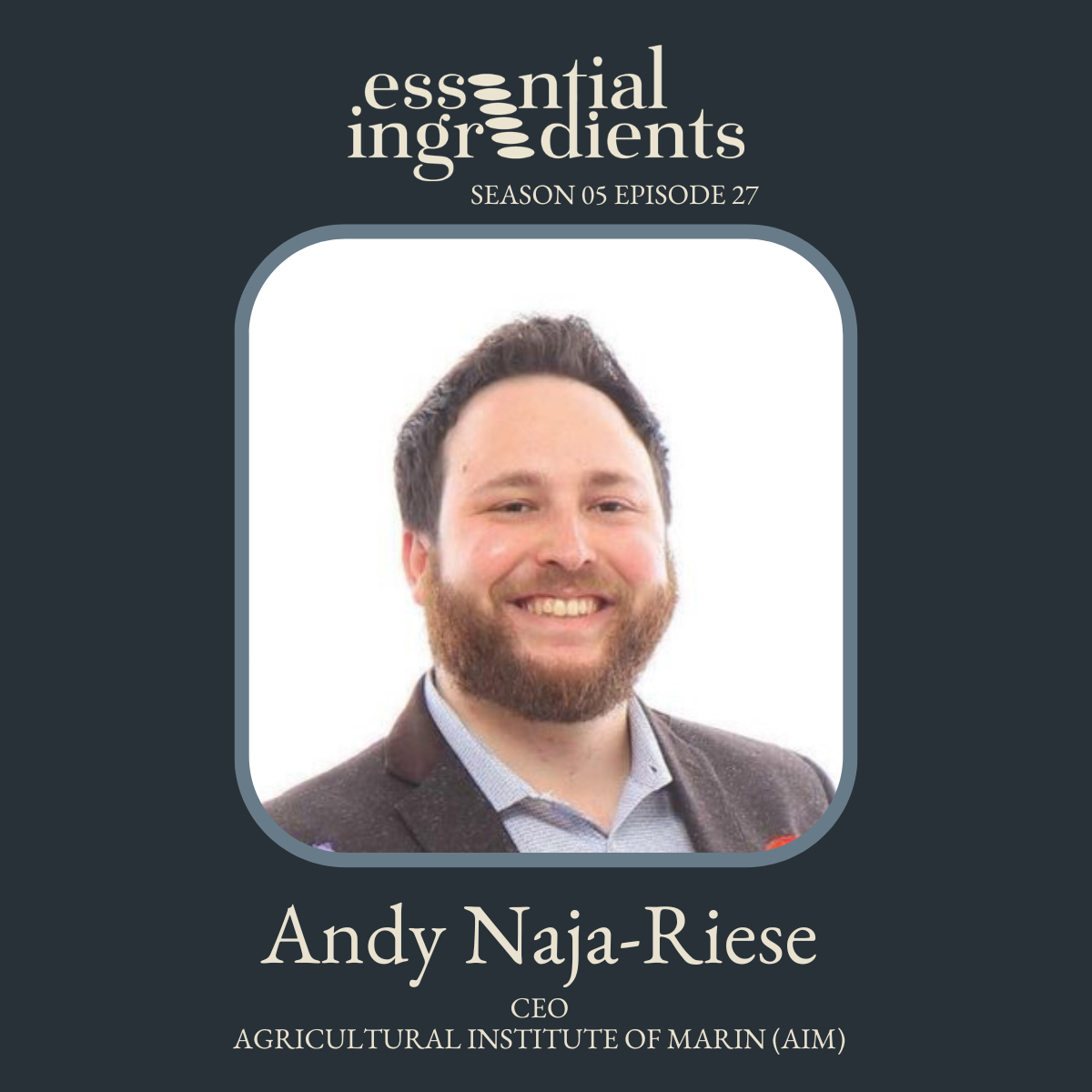
Andy Naja-Riese · NextGen Purpose
Watch on YouTube
AIM — Preserving the Farmer's Market for Everyone with Andy Naja-Riese
The Incorporation Method helps you turn what matters into practical changes that fit your life.
“The Farmers Market offers a variety of benefits to the local community. They provide a convenient and accessible place to buy fresh and local produce which is often healthier and more sustainable than the produce available in the supermarket.”
Full Transcript
Full conversation between Justine Reichman and Andy Naja-Riese.
Welcome to Essential Ingredients. I'm your host, Justine Reichman. And today with me is Andy Naja-Riese, the CEO of AIM. Welcome, Andy.
Thank you, Justine, for having me. I'm really glad to be here.
I'm so happy to have you here. I feel like I've known you for a couple of years now, and I've seen Aim grow. I've seen what you've done, and it's so exciting. I'm excited to learn more, so welcome.
Thank you. Yeah, it's been an incredible journey since I joined AIM in 2018. And we've grown the organization and we've been able to navigate through extraordinary challenges, whether it was COVID, wildfires or drought. You name it, we've been through it, and we keep moving forward. And here we are today.
Yeah, it's true. I met you when I first started NextGenChef, now NextGen Purpose. And AIM was what to me seemed a small portion of what it is today. I mean, now the ideas have grown and come to life. I remember hearing some of what you were talking about and some of what your plans were. So if you could just share with our guests and the people tuning in a little bit about what AIM is, and maybe about who you are and why you joined AIM?
Sure. So I am really excited and honored to be the CEO of the Agricultural Institute of Marin, we go by AIM for short. I like to call myself the chief eating officer because food is such an important part of who I am and what we do as an organization. And we're a nonprofit. So we're based in Marin County, but we operate Farmers Markets, food access education, training and policy initiatives across Alameda, Morin in San Francisco counties. And we also work to influence statewide and even national policy work. So we have quite a broad geographic reach. I've always wanted to run a nonprofit. My background is actually is in health and food. I came to AIM from the USDA. So I had worked for the federal government for about six years at USDA, and before that, a little over three years at the Center for Disease Control. And the connective thread was always food and food justice. And we can help people be healthy by the types of foods we're able to produce and have access to, and I bring that to my work every day.
Wow, you have such an impressive background. And I love the fact that your mission threads from beginning to where you are today all the way through and where you've taken it too.
Yeah. For me growing up, food was very important. I actually learned a lot of my values related to food from my grandfather, from my mother's father. I grew up in a Jewish family and our tradition was always Saturday morning bagel and lox sandwiches. My grandfather would go to the smoke house in Queens in Rego Park, and we would have bagels, lox and freshly smoked salmon every Saturday. And it's kind of funny how things came full circle because a few years ago, I actually started a group called a Bay Area Group Eating Lox and Bagels. And we had a Bagel Fest and a big gala to celebrate all the amazing bagels we have in the Bay Area. It's a fundraiser as well. So it's been an important part of my story and my cultural identity.
Wow, that's really nice, because I think part of the Jewish tradition is food. And whether it's not really a religious thing, it's part of the culture.
Yeah, yeah. I wouldn't say I'm a very religious Jew, but I'm definitely, I practice Judaism. It's largely related to food, thinking about food related traditions and how I keep those going. And a lot of that started with my experiences as a child with my family.
I would say I have similar experiences. Because for me, it's not about the religious aspect. It's about the food that comes with the holidays. It's about remembering those experiences and sitting around those tables, and making that food, and what my grandmother made, or what my mother made. Even sometimes adopting them to make them new, but making them year after year, and everybody then asking for those recipes and looking forward to that.
A couple of years ago when I made a really great brisket using Stemple Creek brisket, and I use my mom's recipe for the first time, my family is still on the East Coast and I'm out here with my husband and dog, and we still stay connected through food. So I was so proud of myself and I think that I did it. Well, I gave it the respect it deserves to have a really wonderful meal, so I was proud of that.
I have to tell you something funny. This year, I had the luck and libations you know, Hanukkah party, right? And I made some brisket, like you did. And I made my grandmother's recipe.
Oh, perfect.
I tried to adopt it to be better for you because I'm all about making better for you foods creating greater access to healthy food. So my grandmother's recipe incorporated, I don't know what yours did, but might have incorporated Heinz ketchup. Yeah, Lipton onion soup.
So it's interesting. The trick my mom always used is chili sauce, and a cup of black coffee. And the coffee really tenderizes the meat so it just falls apart when you go to eat it. It's so delicious.
Well, you're gonna have to send me your recipe.
I will send you that recipe. I will be very proud that I'm sharing.
I will tell you how I made mine 2.0 version. I took out the Heinz ketchup, the kind without the sugar, like the Keto version? You know that there's a Keto version of all these ketchup, no sugar. So I use that. Long story short, everything without sugar, and then I went to taste it. I had all these people coming and realized that this is awful. I called up my friend Tamar and I was like, oh, no. And she's like, well, you need to add sugar. Sugar in my house. Yeah, I added a little maple syrup.
That's perfect.
Anyway, that's the 2.0 version.
But it's interesting for me because, really, my life's work is focused on creating access to healthy foods for everyone. And doing it in a way where people who are stewarding the land, especially small farmers can succeed. And that really is something I bring with me every day when I go to work, when I go to the Farmers Markets, when I go to policy meetings, because we can actually feed everyone if we think about having local food systems. Most farmers in California, actually 84% are considered small family farmers, and we have the ability to feed everyone and keep small farmers in business. And it's through programs like certified Farmers Markets and our food access where we can keep farmers farming and really steward the lands and take care of the earth and our natural resources. So that's what really inspires me every day to do what I do.
That's amazing. I'm wondering, so other people that want to be able to create programs like yours in other parts of the country, how might they do this?
One thing I've learned over time is that programs really require community buying and support. And of course, funding. You can have the best ideas without funding to get them off the ground, their ideas. But I think that what we've learned over time is really about, how do we make sure that we hear from farmers and food makers, or hear from communities about what's most important to them, and then create programs in that way? We're also really lucky to be here in the Bay Area in California where we have some of the best food in the world that's grown and produced right in our own backyard. So it's really a privilege in so many ways. But at the same time, we still know that 20% of people go to bed hungry at night where we live. And there's so many causes to that, whether it's poverty, or systemic racism, or long standing injustices in our food system, but we can actually find solutions that work for both farmers and food makers and our community members. And that's kind of what we do every day. So we really work at AG in Sukumaran to connect, inspire and educate small family farmers, responsible producers and communities to create a healthy, equitable earth friendly food system.
I know that there's so many things that you see and things different from place to place. And California is a unique place because we have so many resources here. I would like to provide a resource here. We want this to be a resource and inspiration to other people. Is there anything that you might recommend that people look at first, or trends that you see that you could share?
Yeah. I think the core of what we do and what other communities can do is really focusing on direct marketing of food products. So whether that's Farmers Markets, or farm stands or community supported Agriculture. These types of direct from farmer to consumer initiatives, really, I'd say to continue to grow in popularity. And in many ways, they were really reinvigorated through the COVID pandemic. So if you remember early on when the shelter in place orders took effect, grocery stores were empty, there were no fresh fruits and vegetables. Even more recently, cargo ships with food products sitting on them. Well, throughout all of this, we've learned that one of the most resilient ways to feed people and to keep farmers and businesses is to create a platform where farmers can sell directly to the public. And that's why the Farmers Market model has really endured so many changes over time. It really helped to assure that farmers can have a viable way to make a living. So I would always say to start with thinking about a model that works for farmers, as well as small family businesses, food makers, people producing value added products, so jams, jellies, hot sauces, things like that. I think that we really focus on how we maintain a model that works for both farmers, as well as community members. And currently, we run eight Farmers Markets across the Bay Area. So we have three in Marin County, two in San Francisco, and three in Alameda County. And we know that time and time again that farmers will come, food makers will come and community members will shop for food because it's the experience that matters. There's really nothing more authentic when people can look directly in the eyes of the person that grew or produced their food to know that it was grown with love and produced with care, and to give that direct feedback to food manufacturers. So Farmers Markets are just really a core of what we do. And everything right now around us feels like moving online or thinking about ways to, we know the whole world is moving quickly and moving online. I think Farmers Markets really helped to show our community values to support our local economy, and support our health, and support the environment, and just to connect with each other.
So I know that every time I go to the Farmers Market, and I went during the pandemic a lot and I still go, but I got to connect with the different farmers whether it was stemple creek, what's the cheese company? You get to know them, you get to tell them which cheeses you like, they get to make recommendations, you get to tell them what you cooked, you build a rapport, you build a relationship, and there's just so much more than just picking up your food. I even got to learn how to choose what you want, and how to pick a steak that I'm going to appreciate more as I'm telling them how I like to cook it and what I want, how I want to eat it. And when you go to the grocery store and you're doing that, you get a little bit of that. But it's not the same thing. You're not learning about how they fed their meats? How the system is, and how the farm is set up? And it's just a very different experience. It's a bit more second hand or third hand in a grocery store, and it doesn't feel as personal when you're at the Farmers Market. These people really can give you a sense of where your food came from to give you a really specific example. I'm allergic to chicken eggs and my doctor had said go to the Farmers Market and go to this aisle, and go get these chicken eggs and you won't be allergic. I was like, what? Anyway, she sent me over there, and I went over there and they were actually duck eggs she was sending me to get. So apparently, there's a protein in the chicken eggs that a lot of people are allergic to. But in duck eggs, you're not allergic to it. So I went to this farm and they explained to me that I wanted the duck eggs, and they gave me this whole explanation that I've never gotten anywhere else from them because they had both the duck and the chicken, and this is not an uncommon allergy. Have you ever heard this before?
Not specifically on duck eggs, but we have heard that and other products like certain types of dairy products. So Alexandre family farm that sells at our Farmers Markets with their milk that oftentimes people who may be lactose intolerant or have dairy digestive issues, can tolerate it.
So I do have a question, these markets are all organic. Is that correct?
No, that's not correct. We have about 400 farmers and food makers who are part of our Farmers Markets. We do not require organic. We give priority to producers who are either certified organic, or who are in the three year transition period. So we do have a much higher percentage of farmers and ranchers who are certified organic compared to the general state average. I mean, in California, only about 5% of producers are in fact certified organic. There's many others that may use organic practices. But unless they go through the third party certification, they can't say they're organic. But what we do as an organization, we really help to prioritize producers that are using either a certified organic program or they're using sustainable practices. And the way we do that, we actually go, and we have a farm audit program. So what sets our organization apart is we actually go and visit every farmer, rancher, cheese maker and fisher before they're allowed to join the market. So that way, we can really learn about their business, their philosophy, and also to verify that what they're bringing to market, they've grown or produced themselves. So we do all the legwork. So you can show up and trust that you're buying foods that were grown and produced directly by the farmer.
Well, you go yourself?
Not me, personally. No, I have an amazing team that does. No, we have our team, they go out and do farm audits. And they come back, and they can tell the stories of the farmers, and it just makes it so much more meaningful. So we really vet the producers that are part of our markets so you know that we're finding the best of the best, and we have farmers and ranchers that come from over 40 of the 58 California counties to be part of our markets.
Wow. Question for you. Before the roll in route, and before you had this new building that's being built, you came in, I did not hear of any of this going on. The Farmers Markets, there was a lot of stuff happening, when did all these big plans start to happen? And what was your vision for it? Is this exceeding it? Or was this the big plan?
Well, I think that in many ways, our vision evolves. But for me, given my backgrounds, think about how we can provide access to all of our communities and our producers to places to sell and buy food, places to learn about healthy eating, and places to access affordable foods? So I had worked at the USDA and I oversaw the food stamp program. So it's federally known as Snap, and in California called CalFresh. And through that, I oversaw nutrition education work in the western US that was delivered by cooperative extension agencies, nonprofits and health departments, and also creating farmers markets. And those experiences, I was in places in rural communities in Idaho and out in areas of Hawaii that tourists don't necessarily go to to really see what can we do to help to promote food access by growing food in communities through urban agriculture, community gardens, and then providing education. Because if people don't know how to cook and incorporate those foods into their day to day lifestyles, then it just leads to waste. So it's not nutritious unless it's eaten. And I brought that vision and that history with me. And what was really inspiring for me was working with our board of directors, and our farmers, and our team members to really move closer to a vision of a more equitable, healthier food system. So we actually created a new strategic plan. And that for me, I think, was really a defining moment. And having that important three year strategic plan as an organization created in partnership with the board where I could really lay out these overarching goals, this is what we want to accomplish. And then that trickles down to all of the work we do day to day. We also created a path to racial equity as well. It was right around the time that we were dealing with the national news and the murder of George Floyd. Really, it was the beginning of a reckoning with racism in our food system. And that's when we as an organization started thinking about what changes can we make, and one of those changes was launching our racial equity fund, where we now raise funds and provide startup grants to beginning black and brown farmers and food makers so they could join the Farmers Market so we can all benefit from the amazing cultural foods that are brought to the market and create business opportunities for people that have been left behind.
You guys have done a lot.
We've done a lot. We've been able to accomplish a lot over the last few years since I've been with the organization. I think much of that growth really began with the role of roots on our mobile Farmers Market when we recognise that despite the popularity of Farmers Markets, we know there's people that still get left behind, and it's most often older adults that lack mobility or transportation. So we created a model with our team to bring the Farmers Market directly to where people live. So our team started that program in 2018 with one day of operation. And over time with additional funding, we've received more community support. We're now operating the rollin route four days per week in Marin County and in San Francisco, and bringing the Farmers Market experience to communities that have traditionally lacked access to local healthy, mostly organic foods.
And how many people are you now serving with that rollin route?
We serve approximately 120 people per day. And then over time, it's several thousands who benefit from the program. And it was really a lifesaver for people during the pandemic when they perhaps didn't feel safe going to grocery stores or even leaving their homes if they were at high risk. They could just go outside and we bought this beautiful food truck with local fruits, vegetables and dairy products directly to where they live. So it's really a beautiful experience, and we've continued to grow it.
It's amazing. So what's new and what's next for you guys?
Well, I think for us, the most exciting thing is obviously to keep doing what we're doing, running the Farmers Markets education and food policy, but we're building a new permanent Farmers Market at the Marin Civic Center. So we're putting down our roots and creating what we think will be the world's first closed loop zero waste inclusive Farmers Market.
That's amazing. That's great.
What we're planning to do is, so we're working in partnership with the county of Marin. So we have access to a space, it's currently known as the Christmas tree lot. It's about a 4.6 acre site where we'll have a state of the art Farmers Market with better amenities for farmers and shoppers. So we'll have overhead canopies, restrooms, hydration stations, permanent seating, then also have well three buildings totaling 6000 square feet that will include an all electric teaching kitchen in classrooms, meeting spaces, a visitor center, our offices, along with an outdoor learning center and edible gardens so everyone can learn where their food is grown, and how their food is grown, and how to live healthier lifestyles.
That sounds amazing. I can't wait to go. I need to do it. Meantime, if there's anything that we could do to support you, Andy, you let us know.
Yeah. I would definitely recommend visiting our website centerforfoodandagriculture.org to learn more about our vision and our plans. We're currently going through the environmental impact process right now. And so if all goes according to plan, we'll be breaking ground in 2024 and be fully open in 2025.
Sooner than we all think.
It feels real. We have a video of the new project going through the county permitting process, so it's really exciting. And I'm just really looking forward to preserving the Farmers Market for everyone.
Well, you inspire me all the way through because I keep watching and seeing what's being accomplished. I'm in awe of all that you've done.
Well, I appreciate that. The work we do has to work for the farmers and food makers. It has to work for our team members and colleagues. And I just think about how we can build positive momentum for everyone.
So that's the way it has to work. My mom always told me that it has to be a triple win.
Yep. Yeah. And we think for us to win for our community members with access to food, economic opportunities for small families, farmers and producers. And then right now, return on investment for the climate and our natural resources. So we're doing it all in so many ways.
Well, for those listening today, don't forget to check out, Andy, give them the website one more time?
Our new center for food and agriculture, you can visit centerforfoodandagriculture.org, and you can also learn about our Farmers Markets and our programs and education initiatives at our website, agriculturalinstitute.org.
Wonderful. Andy, thank you so much for joining me today.
Thanks for having me.
Share This Episode
Enjoyed this conversation? Share it and tag @nextgenpurpose
Listen on Apple ▶Listen on Spotify ▶Your Host
Justine Reichman
Founder & CEO of NextGen Purpose. Host and Executive Producer of Essential Ingredients — 11 seasons, 330+ episodes, and a growing movement.
About Justine →