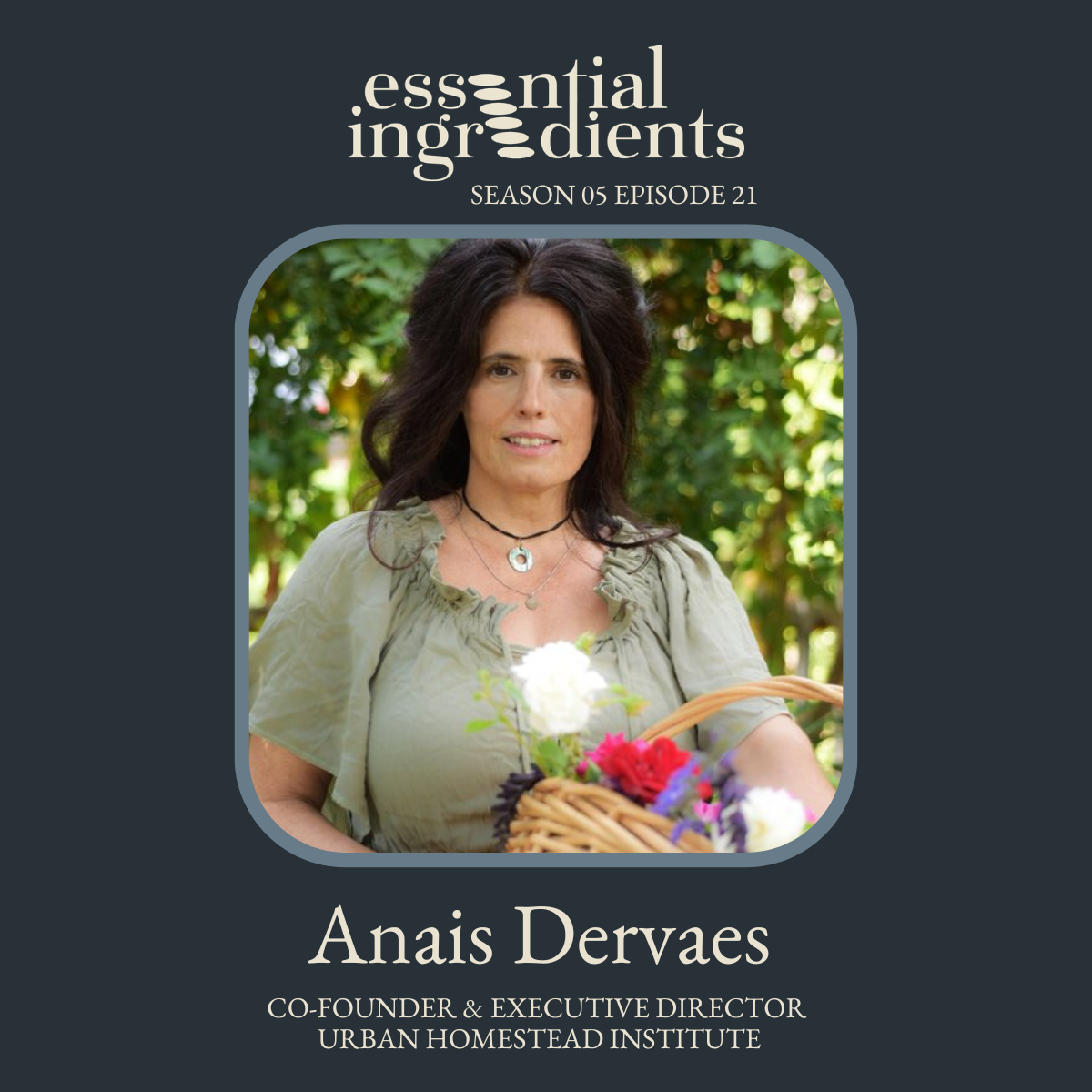
Anaïs Dervaes · NextGen Purpose
Watch on YouTube
Urban Homestead: A Lesson on Sustainability and Self-Sufficiency with Anaïs Dervaes
The Incorporation Method helps you turn what matters into practical changes that fit your life.
“An urban homestead is a space where people grow their own food and raise animals, as well as produce other goods like soap or candles. It's not only going back to nature but also making sure that we have access to high-quality organic products.”
Full Transcript
Full conversation between Justine Reichman and Anaïs Dervaes.
Good afternoon, and welcome to Essential Ingredients. I'm your host, Justine Reichman. Today, I have another Easter Day, proprietor of Urban Homestead. Welcome Anais.
Thank you for having me.
Thank you so much for inviting us here. We're so excited to learn a little bit about what you do.
I'm excited to share it with you.
It's beautiful. We had a little bit of a tour, and I just got a little bit of your story. But I'd love for you to just begin to tell us before we start for our guests, for the viewers watching, what is Urban Homestead?
Well, Urban Homestead is a homestead in the city. So we're in the city of Los Angeles, centrally Pasadena, right now. We've been on this property since 85, and we just basically transformed our ordinary home into an extraordinary homestead using elements of sustainability and urban farming.
Wow. So for those people that may not understand what does that mean. Does that mean that it's open to the public?
That is a good question. Yes and no. It is a home. But we do have public days, which is farm bucks pickup, and we have tours and workshops as well that are open to the public on certain days.
So let's go back to the beginning. This opened in 85, but you grew up in this environment, right?
Correct. I am a second generation urban farmer or homesteader, as you would say. So I was born on a homestead in New Zealand, actually with my father. After graduating from college in New Orleans, he emigrated to New Zealand to homestead to get back to the land that was there back to the land movement, the hippies trying to return to nature. And so he was one of those that wanted to just simplify his life and know where his food came from. So he emigrated to New Zealand, that's where I was born, and has been living this lifestyle on and off ever since.
When you graduated, did you envision yourself continuing in this lifestyle? Was that how you saw your future?
Well, I always felt drawn to growing things. Ever since I was a little girl, Dad and I planted a flower garden where he had the vegetable garden. So growing things were in my blood, and it was named durveys. It is Belgium. We had a nursery. My great great grandfather had a nursery in Belgium. So we have green jeans in our blood, so I can't do anything about it. I would class if I was on the moon, probably anything. But yeah, this lifestyle, I would say has a transition or evolved to be more of an inspiration worldwide to not only cultivate food, but humanity to educate. I did not see that as myself because I'm a very shy, reserved person. And to be out there educating and being a spokesperson for urban farming and homesteading, I did not see myself doing that. No.
So I'm curious, I think back to when you originally grew up in this lifestyle, what was that lifestyle like, initially?
Well, as a young kid. It didn't make any difference. We just did what was fun.
But what did it look like? Like what was the experience for you as a child growing up on it?
I loved it. I remember going out. This was after we only stayed in New Zealand for two years. And then my dad went back to Florida where he had 10 acres. I remember as a kid just going out in the garden. There's a picture of me actually, on the website. It's my brother, the corn was about 12 feet tall. I remember harvesting that year, and there were just like that round, that big, and I just tore it off. Be warm with the sun and just eat that. And those memories for me going running across the street to play with my playmate, Stevie, who had a barn on his farm and jumping on the hay bales, and landing in a snake sometimes. Those were my memories. And that's my first memory of this lifestyle. Yeah.
And so what did that mean as you love to create your own life? How did you envision, what did that look like for you?
So it evolved to where it became mine. There was that point in teenage years where you're questioning your parents, why do I have to eat this way? My friends are doing this way, sort of trying to find my way.
What was that way though? Like what was eating that way? What did that mean?
Well, they had sugary treats, we had treats with honey. Or we had to eat swiss chard, and they had blanch celery from the store. That sort of thing. So I was like, why do we have to do this? Why can't I be normal?
So you're eating basically everything off your farm. And everything was mostly healthy.
Yeah, healthy. Eating just differently at that time. This was before blogs and cable channels. This was odd. Whole Foods stores were not, now, all the options of vegan and gluten free options that this is like kid in a candy store. It's like, well, you guys have it so easy. Now, back in the days, you got to help your store. You look down, you're going online. You're thinking, oh, gosh, that's what I have to eat. So yeah, it comes a long way. The health food industry has come a long way. Or the food consciousness has come a long way. So back in my days, it wasn't so.
So back then, it felt more constrained. So then, of course, you arrive and you're gonna build your own homestead. And so there was an opportunity to create your own vision. So now, you had his own vision, what was it?
So the vision shared with me was when I read the book, Diet for a New America, I was in my early 20's. That book changed my life, then it became my passion. I was like, yeah, this is not right. That's not right. What were doing to the animals, to the planet. And then I started reading more books about nature and becoming conscious of like, well, the fact that that backyard garden makes a lot of sense. Now, it is impacting the environment. It is impacting animals and happy people. So then I started doing searches like, well, let's grow more, let's do more sustainable things, let's get solar, let's get gray water and started just doing my own projects, and then morphing that into the family's homestead.
And so what were some of the pillars that you built this on in hopes of creating greater impact or change in your community.
So the pillars are just about being self sufficient, but then maybe self reliant on. But not not singular. It takes a community, it takes a village. So even though we're trying to be self-sufficient, self-reliant, not rely on or be conscious of our outputs and inputs, it does take a community. So I say we're not only cultivating food, but we're cultivating a community to support and help each other to educate each other, to inspire each other. And during these challenging times to grow hope and inspiration as well because the news, you know that you go outside and nature doesn't care how bad the news is, doesn't know what's going on in the world. We had a monarch hatch the other day in beauty. So beauty surrounds us. And so that grounds us, and it helps us mentally and emotionally to deal with the outside. And certainly, we hope that we can show people how they can survive and thrive.
I'd love for you to share a couple stories, maybe some of the people that have come through here, and the impact it had, or you've been able to have on them.
My favorites are the children, the kids. I'm in charge of the educational program for the nonprofit. To just see the wonderment in their eyes, and to be in LA, on your 20 minutes to come to a farm and hold a chicken, and hold a real sunflower, and for them to be just amazed, and the wonderment, and to educate them. I tell them, and my sister, and my brother were also involved in this operation. When they're holding the chickens to educate them saying, if you were a chicken in the modern food industry and industrial complex, you would live your life. That chicken would live their life on a piece of paper. And I would pull the piece of paper up to give them the visual, and you could see the end. So just giving them, so they can't do what we're doing. Of course, just being aware and cautious. I tell them to just ask questions to be aware and conscious where we are as humans, consumers, we can't change that vote to be aware of what we're choosing, how we consume, and the impact that our food choices have on the environment, and the animals, transportation and people, because people machines do pick it, but also people pick our produce as well. So the welfare over them as well.
Yeah, it's so important. Education is one of the biggest pillars we have at NextGen Purpose. And I think whether you're a business or an end consumer, the ability we have to educate or provide information so that people can make more informed choices is so powerful.
When we have to educate even our chef clientele, they call us up, in December, we have a tomato.
The wrong season.
But I can get it at the vendor because they're getting it from Mexico. So it's just education. I had one foreign box customer come and she's like, I would like a melon. We said, oh, it's not in season. She said, but it's at the store. So my brother politely told her, he said, well, it's probably not from California. She actually went back to the store. Check that essentially. And she came back to us and said, yeah, you were right. I did not know that. So yes, education is important. And we're so disconnected from the seasons because we have 24/7. We're given food 24/7. Everything we want, we have at our convenience. Nature is not a convenience store. Nature has seasons. It's good sometimes. It's growing with the season, and growing with nature, and being aware of our food choices.
I think that a lot of times, people don't actually know the importance of eating seasonally, or why they should. Do you even get asked that question sometimes?
Sometimes. I mean, I think there's scientific, like health benefits. I don't think the body is programmed to eat certain things in season. Before, when we didn't have a pre industrial revolution, we stocked up. We had maybe warmer foods in the wintertime, we didn't have tomatoes or corn. So centuries of living that lifestyle, the industrial revolution changed even our rhythms, where we sleep, our eating habits. So we have changed. So I think going back to that maybe has more rhythm internally with the patterns of nature.
I think so. I also think that you have greater access to what's available now. It's gonna be more accessible too.
It is amazing.
Tastes better, always. I mean, the riper there. I mean, everything, it's all good. Now I'm curious, you run the education program, and you work with the children. Do work to give them takeaways so that they can take it home, so that they can talk to me about that.
Yes. So the programs we give them in the springtime, they'll come in, we'll have them smell the herbs. So it's almost like sensual. So smell this, taste that. So we'll have them smell the mint, taste the tomato. And then we give them bags to take home. And some classes will make things like jam. With after school form a table program, one of the first questions they ask is, what are we going to eat quite easily that I will feed these kids? And so we make things from the garden, and they just gobble it up and enjoy it. And I've had parents come to me and they say, I can't get my kid to eat a salad, but they'll eat yours.
So yeah. And so my question then goes, this way, they eat yours. And what is sort of next step to making it possible for them to take that experience home so that they can then replicate it? Because so many of these kids don't have access to that, or they think it's unattainable, or they think it's too expensive, or it's not available to them.
So that's a good question. So I tell them that they can support the Farmers Market. Hopefully, a Farmers Market area or now organic is easily more accessible in pretty much every store. There are options. And one of the classes we did was we dissected dinner, and we made macaroni. So we did mac and cheese from the box. And then we made homemade macaroni, and made the cheese sauce, and we broke it down in terms of price. And it was pretty. We got more macaroni for the price with homemade and it tasted better. So it was this way of looking at things. Sometimes convenience, like I told them to go home. If they get a cheese pizza, top it with fresh produce. Go out in your garden and pick rosemary. So just little hacks that you can eat a little bit better.
So I think that's so important. And sometimes, it's right in front of us, and we don't realize it. I mean, I have rosemary in front of my house, behind my house, on the side of my house. I have all these things. And I have to take notice so that I don't buy them in the store because I really do have access to them. And I've got so much that I like to spread the love and give it to all my friends. So what's new and what's next? I mean, you have a lot of programs going on, but things are changing, things are evolving. There's all these new innovative things. How are you, and what are you looking at for the future?
I like to do some ebooks maybe, or more videos. We're so busy farming, I don't have the time to go on the other side and do educational videos, or ebooks, the farm to table program online so that you scale it into their things. So making it maybe more accessible around the world to do that. Right now, we have a lot of programs. We have an internship, we have the education program, the farm box. So it keeps us busy. But I hoped maybe something in the future, more online things.
Wonderful. Thank you so much for participating. I'm excited to just check out your garden and learn a little bit more about what's going on. Thank you.
Share This Episode
Enjoyed this conversation? Share it and tag @nextgenpurpose
Listen on Apple ▶Listen on Spotify ▶Your Host
Justine Reichman
Founder & CEO of NextGen Purpose. Host and Executive Producer of Essential Ingredients — 11 seasons, 330+ episodes, and a growing movement.
About Justine →