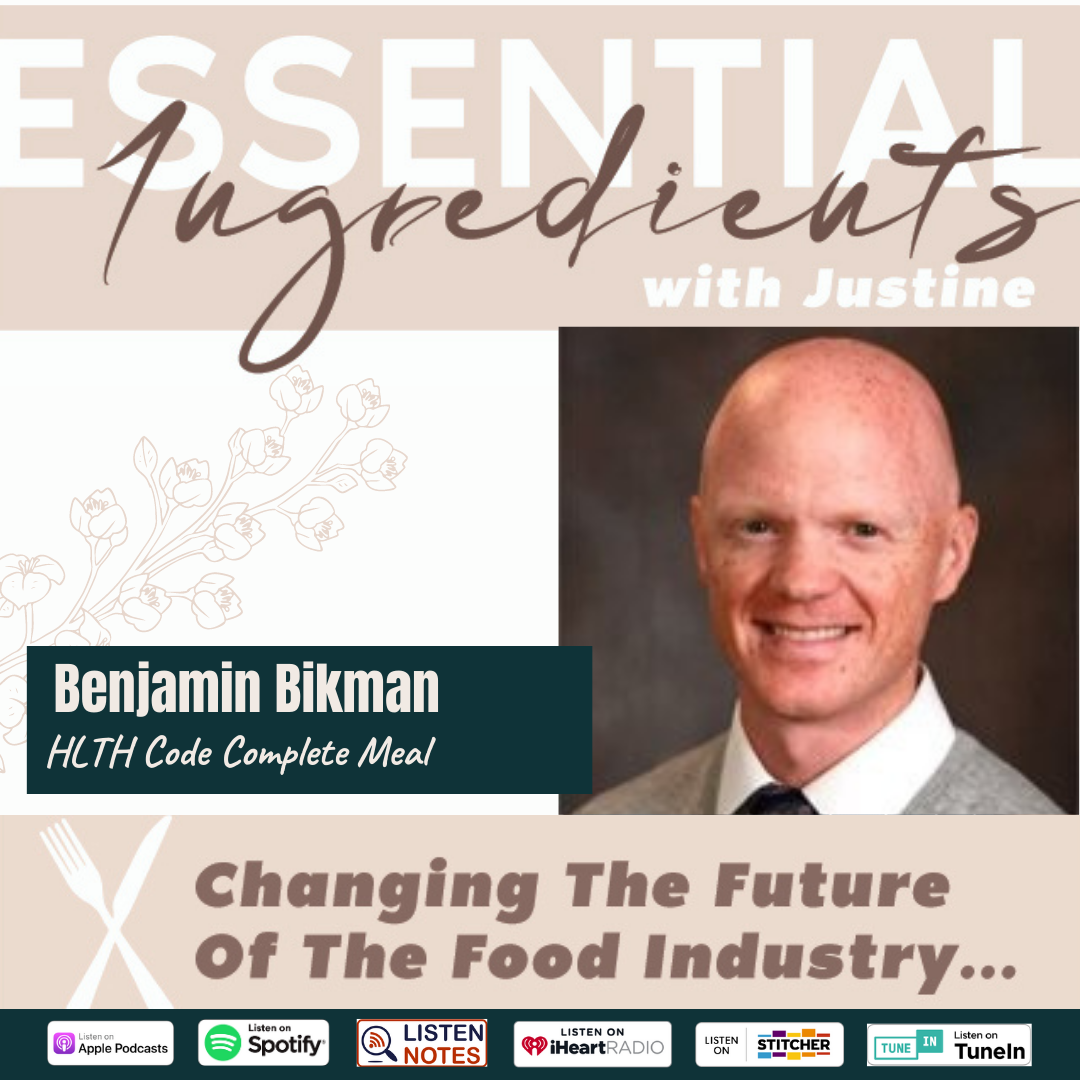
Dr. Benjamin Bikman · NextGen Purpose
Watch on YouTube
The 3 Pillars of Nutrition to Hack Your Metabolism with Dr. Benjamin Bikman
The Incorporation Method helps you turn what matters into practical changes that fit your life.
“”
Full Transcript
Full conversation between Justine Reichman and Dr. Benjamin Bikman.
Good morning and welcome to Essential Ingredients. I'm Justine Reichman, your host. This morning, I have with me Dr. Benjamin Bikman. Good morning, Dr. Bikman, how are you?
Justine, I am doing well. Thank you so much. I'm delighted to be able to spend some time talking with you about metabolism, human health and more.
I'm so excited too, and this is a little bit of a departure for all of us, a new conversation, a new way to integrate it in the future food. I'm excited to learn a little bit more from you so maybe you can just introduce yourself to our listeners here this morning.
Yeah. I am a metabolic scientist and a professor. So as a scientist, I am the director of the metabolism research lab here at BYU, and I teach an undergraduate class actually about health and disease called pathophysiology, which is basically the sick body. So all the nursing students and many of the pre med students, they've got to get through Professor Bikman and get the good grade to be able to move on in life. My focus in the metabolism research lab is really just to understand human metabolism and what are all the variables that go into it to help it work well, and then have good health as a result.
Wow. And a lot of people are always talking about metabolism and changes over our lives. It's faster, it's slower and how eating changes too. So the more we eat, the less we eat, and how we can change our metabolism. Is that fact or fiction? How can we change it?
Yeah, yeah. So there is some fact and fiction to how we conventionally understand metabolism, it is an overused term. Metabolism is the sum of all chemical reactions happening in every cell of the body at any moment in time, that is metabolism. And some people do have a higher metabolic rate than other people. The relevance of that metabolic rate is debated. People will typically start to get older and they'll say, oh, after high school, after college, I got married, I had kids and boy, my metabolism slowed down and I gained a lot of weight. There isn't a lot of truth to that perspective that metabolism slowed, and then weight was gained. There is some evidence that we can manipulate our metabolic rate and maybe that can give a bit of an advantage. But that is real, and much of it comes down to what is happening to our hormones, especially insulin. Insulin has a very powerful effect on metabolic rate. So if someone can kind of leverage their insulin, keeping insulin lower, for example, throughout more of the day than that does accelerate metabolic rate. But metabolic rate matters, but probably not as much as people think.
So there's so many things I want to get into with you. Before we get into maybe stories that you can share about how you can manipulate that, what you eat does all that, I just want to learn a little bit more about you and how you got into this.
Yeah, yeah. So during my undergraduate, I just had a moment in my undergraduate degree, I was really concerned about what to do as a career. It weighed very, very heavily on my shoulders. I part of this was because I was very much interested in being a husband and a father, and kind of taking care of my family. That was something that I had been focused on. I had wanted to have a family and--
Were you a husband and father at this point?
I had just gotten married the last year of my undergraduate degree, and that was the beginning of sort of an early life crisis, what am I going to do to provide for my future family? And I just had a moment in one of my classes where my professor mentioned a person that I really looked up to, he said to the class: "I can't stay after class. So ask any questions before class, because right after class, I have to leave to go coach one of my children's athletic events." Or something. And I just was so struck by that and made me start looking at all of my professors, realizing that they really had a wonderful work life balance. in a word, if I were to sum up what it's like to be a professor, and what I hoped it would be at the time and what it really is, it's freedom. There's so much freedom that comes with this profession to really have a freedom of schedule, a freedom of curiosity, what I do in my lab, what are the questions I ask, how I spend my time and kind of what I do with my time when I come and go. And that was the beginning of me wanting to pursue academia. And then it was a matter of, alright, well, what am I going to pursue to become a professor? And it was me really leaning into this interest in human health and metabolism. And then the more I learned, the more I became interested in fat cells. So that's actually how I describe myself nowadays, I'm a fat cell biologist. I understand fat cells, and it's a very relevant focus. People might think that means I only know about getting fat cells, big and small. I know a lot about that. But when fat cells get too big, it starts to send messages throughout the body that start to promote other problems and other tissues of the bodies like the brain, or the liver, or the ovaries. Once the fat cells get a little sick, they start kind of spreading that.
Wow. Okay. I want to go back to where we started to get into some of the impacts of what you're eating and how it impacts your metabolism. I wanted to just share with listeners your story so we didn't really get into those stories you were talking about in terms of the metabolism, and why you eat and how it impacts your metabolism. Could you talk to us a little bit about that? Because that's surely a big topic for people, how we often say that starving our body, how that impacts our metabolism by not eating? Oh, I'm not going to eat till this time, or I've been eating so much, I have a fast metabolism. Are these facts? Are they fads? Or is it a myth? Can you talk to us a little bit about that, and then maybe share some stories of how people have changed their metabolism, if that's something they can do?
Yeah, yeah. So the metabolic rate is very much modifiable, we can absolutely manipulate our metabolic rate. This can be, of course, it's obviously influenced when we just get up and get physically active. If we go out on a run or something, obviously, our metabolic rate goes up because we're just doing more, there are more metabolic reactions, there's more chemical reactions occurring. And that would, of course, accelerate metabolic rate as opposed to just sitting and doing nothing. That would slow down metabolic rate. So there's that obvious influence there. But beyond that, if we put that to the side, and what I alluded to earlier, I'll come back to now, if someone is increasing their insulin levels by eating, well, maybe I should even back up. So Insulin is a hormone that we all have flowing through our blood, unless we are a type one diabetic. Type one diabetes, a person that is no longer making insulin and they must then inject insulin every day in order to survive. For the rest of us, we're making insulin all the time. When insulin will go up, if blood glucose starts to go up, of course, blood glucose will go up if we start to eat a lot of refined sugars and starches. When there's a lot of glucose coming into the blood, from sugar and starch, things like bread, or cereal, potato chips, or just candy, then the glucose will go really high, and insulin will come in. Glucose can stay high for too long, that's dangerous. So insulin comes from the pancreas, and it basically opens the doors into the cells to allow the glucose to go out of the blood into the cells of our bodies. And when glucose comes down and insulin comes back down. But insulin, again, just to kind of reiterate, goes up if the glucose demands that it come up. And if someone is eating a diet that is keeping their insulin high, then their metabolic rate will slow down by about 100 calories per day based on where it would have been before that. However, if they are eating foods that keep their insulin low, in other words, avoiding refined starches and sugars, then their metabolic rate will go up about 180 calories per day based on where it would have been before a normal day of eating.
Does age play any part in this?
Well, probably. Although this study that I'm citing right now didn't look at the influence of age, but in general metabolic rate will go down with age simply because we have less high metabolic rate tissue, or muscle mass starts to decline. And muscle is such a main driver of kind of resting normal metabolic rate that as we start to lose muscle, it stands to reason that metabolic rate will come down to. But that doesn't have to happen. One of the tragedies of our kind of long lived societies is just this kind of grim acceptance. Well, I'm going to get older and I'm going to gain weight. No, that is something we ought to fight. I believe that I might be getting too far ahead in the conversation now. But to me, the best way to control insulin, which I believe is very important beyond metabolic rate. In fact, let me pause there for just a second. Controlling insulin is pivotal to almost every chronic disease. If someone is living a life that continues to spike their insulin all the time, then they will start to become what's called insulin resistant. And that is a fundamental cause of diseases like heart disease, Alzheimer's disease, fatty liver disease, polycystic ovarian syndrome, the most common form of infertility in women is also fundamentally a disease of insulin resistance. So there is the relevance of controlling insulin really extends--
Talk to me about foods that we can avoid in our diet to change that. We have an opportunity to look at our diet to change what we're eating to directly impact this?
Yeah. Oh, yeah, absolutely. Yes, this is--
What are the hot things that we should think about changing in our diet so that we can change the impact of this?
Yeah, right. Yeah. My philosophy when it comes to nutrition and food is to nourish the body while keeping insulin in control. So try to prevent insulin from spiking all day throughout the day and that happens. The average person, they wake up in the morning, and breakfast is a starchy, sugary mess.
I'm thinking I should not eat my croissant that I just bought.
Yeah, yeah. Well, there you go. I mean, good example. A croissant, or it's bagels, or it's cereal, and they spike their insulin to several times normal. And then the insulin will take anywhere from two to three hours to come back down. Of course, by the time it's coming down, they have their mid morning snack, then they have lunch, and then they have an afternoon snack. Every waking moment, is then in stage elevated insulin, and that starts to make the body fatter and sicker. And back to the fat cells that I'd mentioned earlier, my focus on fat cells, you cannot have a fat cell shrink if insulin is up. And in contrast, a fat cell will grow. Insulin is like a fertilizer to fat cells. Insulin directly stimulates the growth of fat cells and inhibits the fat cells from breaking down its fat to be used for energy and thus shrink. So someone who wants to control their weight or lose weight, one of the fundamental strategies is to help keep insulin low. So get off that constant roller coaster of insulin. But most people today, unfortunately, spend every waking moment in a state of elevated insulin rate.
So what are we telling them? What do we recommend they eat to keep their insulin low and be healthy? And to keep their metabolism in check, what are you recommending here?
Yeah.
So what are the workarounds?
For me, I break it down into kind of three, maybe we'll say four simple strategies. I do think they're simple, not to say they're easy though because it's hard to change diet, it's hard to change foods, but I do think they're simple. With the first one, we need to control carbohydrates. And that's not to say we don't eat them at all, I'm not saying that. But if these are processed carbohydrates, like breads, cereals, crackers, sweets, those are not good, and they have a significant effect on our insulin. We just need to control the carbohydrates and be smart about how we consume them. Focus more on fruits and vegetables, but eat them, don't drink them. Fruit juice and smoothies, they have a very different effect. There was a study that had people eat just blueberries and then ate just the fruit, just the juice of that same amount of blueberries in the insulin effect was significantly different between the two. So we eat the fruits and vegetables, we don't drink them.
Well, I'd love you to share that study with me after maybe you could just give it to me so we can include it in the show notes.
Yeah, it was a study in type two diabetics.
Yeah, a lot of people, including myself, we do a lot of juicing. I think just being able to share that information with our listeners so that they can dig away little deeper into it, so that they can make an informed choice themselves. By no means an expert, but I do want to be able to provide the information so that the listeners here can be able to take that information and make more informed choices.
Yeah. I'm okay with your listeners just saying, well, forget you, Ben, I like my juicing too much. I would say that's fine, but there may be a consequence to that. And if a person finds that they're struggling with their weight, that might be a very simple strategy just to say, all right, well, I'm going to juice less and then just eat the fruits and vegetables rather than juice. But I get it, juicing and smoothies, they are delicious, they are so yummy, but there might be unintended consequences. So that's the first rule to me, control carbohydrates, just be smart about it. The second one is to prioritize protein. The more that people are eating processed foods, most processed foods, what they have removed other than the fiber is the protein. That is a problem. Protein promotes greater satiety than any of the other foods we can eat. It would tell the brain to stop eating, and it actually accelerates metabolic rate more than any. Protein has a high cost of digestion. When we eat protein, the body works a little more than normal to digest it and the metabolic rate goes up actually. It's something called the thermic effect of food when we eat this food and we just feel a little warmer, perhaps there--
Are there any downsides to having a high protein diet?
No. That's a good question. It's something that is very debated.Some of the fears classically had been that high protein will cause cancer, and that is completely unjustified. There is no convincing evidence. There's no evidence to support that idea. Some people will invoke a book called, The China Study, which I consider one of the greatest travesties of science ever written. Maybe I don't believe there's any validity to the claims that protein is going to cause cancer, that's one of the worries. And then any other claim that it's going to hurt your kidneys, that's false. That's been proven false. I don't know what the other claims would be. Now, I'm not saying someone should only be eating protein, that's not healthy. But we need to make sure we're getting enough.
Before you go on, there's a variety of different kinds of protein. We're not only talking about steak, a lot of different kinds of protein that are not meat.
Well, that's right. Yep, that's right. Yeah, I'm happy to elaborate on that.
No, I'm just saying, it doesn't necessarily need to be meat, it could be plant forward. I mean, there's a lot of different kinds of protein that can focus on including their diets. I mean, I am a meat eater, but I do think that people need to be meat eaters or even fish eaters, or they can incorporate in a variety of ways.
Yeah, I agree. There are multiple proteins. I will say that this won't be, I will say it very diplomatically, but I hope it won't upset any listeners. There is no question that animal source proteins are superior to any plant protein, there's no question. The profile of amino acids is superior in any animal protein, whether it's meat, or dairy or eggs, the amino acid profile is superior, and the digestion is superior plant proteins. Every plant protein, pea, pumpkin seed, soy has chemicals in them called anti nutrients and this sounds mythical, but I encourage anyone to look it up. This is published research. These proteins come with things called trypsin inhibitors, or tannins, or phytic acids that will prevent some of the digestion of that plant protein. Not to say that they can't get these amino acids, you absolutely can, but you will get less. Some of these plant proteins come with high levels of heavy metals. I encourage anyone to look up something called the Clean Label Project where this third party evaluated the composition of metals in protein supplements and the biggest offenders were plant proteins. And that's just a natural result of what we do when we try to get protein from a pea. A pea, any plant is very, very low protein levels, that plants aren't intended to be sources of protein. But when we've made them into sources of protein, we have to take a thousand peas, and we concentrate all that protein from a thousand peas in order to get a serving of protein. We unintentionally are concentrating the natural metals or minerals that are in peas, for example, or any other plant protein. And this is things like lead and arsenic. And this third party group found potentially toxic levels of heavy metals in plant proteins. So anyone who's trying to get all of their protein strictly from plants, I feel compelled to just say, be careful. That is not a normal way, humans aren't meant to get protein from plants. We aren't ruminants. We don't have all the stomachs and the microbiome culture that ruminants have that they can get all their proteins from plants like a cow, or a goat, or a horse. We aren't built that way. So I do think that there is a note of caution. I say this somewhat, it's hard for me not to mention this because as a university professor, one of the most common I consider eating disorders I see is a college age students, often females who decide to follow a vegan diet, and the consequences are disastrous.
What are some of the consequences you see? Can you share a story?
Oh, gladly, gladly. Yes, I'm happy to elaborate on this. But again, I hope anyone listening, please, I don't speak this with any ill intent. It is strictly out of scientific curiosity and a genuine concern. A vegan diet is incompatible with human life. If a person is strictly following a vegan diet, they will die. I can say that with absolute certainty. Now, I will say a vegan diet is a privilege of the elite because a person has to know what they will be deficient in. And I'll elaborate more on that in a moment, because you will be deficient in essential nutrients on a vegan diet. But if you know what you're deficient in, then you may be also lucky enough to be able to afford the supplements to make up for it. So for example, a person who follows a strict vegan diet will become iron deficient and will suffer from iron deficiency anemia, which is why so many vegans are on iron supplements to try to make up for that deficiency. Because someone can say, well, I can get all my iron from broccoli. No, you can't. It's the wrong kind of iron, and there's not nearly enough of it to make up for this being the wrong kind of iron, you cannot get enough iron from plants. Second, you won't get enough vitamin B12, you cannot get B12 from any plant, It is impossible, you have to take a supplement. So the iron deficiency will result in what's called an iron deficiency anemia, the B 12 deficiency will result in something called pernicious anemia. Once again, it's a problem of blood cells. But also not only red blood cells, but immune cells. And in fact, that happens in adults. AIt can happen if a woman is breastfeeding and she's following a vegan diet, it will start to develop in her child as well. So two different types of anemias. And then lastly, the person will be deficient in omega-3 fatty acids. There are benefits to the omega-3 fatty acids. You can get from things like flax and chia, there are metabolic benefits from that, but it doesn't convert into the essential amino acids that we need for brain function in addition to other cells, which is EPA and DHA, you have to get that from animal sources or algae. If someone is eating algae oil, they can get enough of those essential omega-3 fatty acids.
So Ben, just to recap for a minute, what you're saying is, it's not that people will die from being vegan if they take the supplements. It's not the one percenters that are being vegan and supplementing, it's the people without the resources to be as supplements, to be able to have the knowledge, to be able to figure out what it is that's missing in their diet, to be able to make sure that they have all the nutrients and the vitamins that they need that they're not getting on the vegan diet. That in itself is not enough. Is that right?
That's well said.
We're gonna take a short break to have a word from our sponsors, and then we'll be right back. So we're back here. Thank you guys. I just want to circle back to a couple things as we move forward in the second half of our show here and let our listeners get to know you just a little bit better. I know you have a book coming out so I want them to get to know you, and what inspired you to get into this? I know that you talked a little bit about your family, you talked a little bit about building what to do with your life and what your work would be, a lot of this is about building a healthier life. I just would love for you to share with everyone what inspired you to do this, and what your hope is for the future of food, and how these connect with your book that's coming out.
Yeah. Well, in fact, full disclosure, the book is now out. The book is called, Why We Get Sick. That book is basically a primer on insulin resistance, what it is? Why it matters? Where it comes from? In other words, what's causing it, and then what to do about it. It ends on that happy note, which is really true, that if someone has insulin resistance, I kind of lay out a plan to try to determine whether the way to find out, whether they have it, and then it's such a changeable variable in their health. If someone has insulin resistance, they can start to reverse that within a day and continue to see improvements in the following weeks, and profound improvements. That has consequences far beyond just insulin resistance. Someone hears the term insulin resistance and thinks, well, I don't know what that is, and why should I even care? Because you care about it, because of what I mentioned earlier, it is so fundamental to virtually every chronic disease, infertility, hypertension, fatty liver disease, migraines--
Share a story with us, do you have one about infertility, something where people can see the impact and the change by making these adjustments in their life.
Yeah. One of my great delights is I have shared the story with enough local doctors, physicians, and they have started implementing some of these policies in their clinical practice. We published a paper with this clinic last year where we took 11 women with full blown type two diabetes. The clinical visit basically went something like this. This is the conversation that my physician friend had with these diabetic women as they were newly diagnosed, it was basically, you can leave the office with a prescription for diabetes medications, which will never end. That's so important that people realize that if someone is taking medication, say, for example, to fight their type two diabetes, they will never get off the medication, they will be on it for the rest of their lives. Or the alternative was you change your diet, and then we can hopefully totally reverse the disease. These 11 women that we published in this case study took the diet course, that's why we followed them. We found that within 90 days, their type two diabetes was completely gone. There was zero evidence anymore, their glucose had come normal, their hypertension, they lost about 20 pounds incidentally, they had every improvement in their blood lipids, their triglycerides came down their HDL cholesterol and up, those are both considered very good changes. And this just happened within 90 days. The diabetes diagnosis was reversed. We had cured diabetes, these women had cured their diabetes by simply following those kinds of three nutritional pillars that I laid out earlier, which is all focused on just lowering insulin. The same physician friend has helped numerous women with polycystic ovarian syndrome. So women who would start this within months get pregnant after having tried unsuccessfully for years. And that's because polycystic ovarian syndrome, once again, is fundamentally a problem of insulin resistance, and how it affects the ovaries and the ovaries production of sex hormones. Then they are able to start going on a normal menstrual cycle again and get successfully pregnant. Another last story I'll share is here, I have a colleague about six doors down the hallway here. He was talking with me one time, I'd seen him and he just looked miserable. I said: "You aren't looking too good, what's up?" And he said: "I'm in the midst of a terrible migraine, headache, I get about one or two a week. And it typically kind of really lays me down for 24 hours or so." I mentioned to him the long history of research, and this is over 100 years ago, we have published human evidence from humans to find that if you put someone on a diet that I outlined earlier, that puts the carbohydrates low or in control and focuses more on protein and fat. In other words, improving insulin than the migraine, headaches get significantly better, and in many instances stop entirely. So I mentioned this to him, I shared the research with him and he said: "I'm going to give it a try." And then I didn't see him for a little while after, our schedules don't always align. I saw him probably, I don't know, six weeks later and I said: "Hey, what's going on? You look good." And he had lost weight, he wasn't particularly over weight to begin with. He said: " Oh, Ben, this has just been transformational. I went from having about one bad migraine a week. Now, I have it based on what I've seen about, one a month." So an enormous change in him, and it continues, this was months ago already, and it keeps getting better, and better, and better for him. You think about the quality of life change for him, what this means with his career, time with his family, and it has been a significant improvement. There are so much incredible nuance when it comes to the brain health, migraines, seizures, Alzheimer's disease where it's really kind of an intricate energy disruption where the brain starts to become resistant to insulin, and now it can't get as much glucose in to feed its metabolic rate, and then the brain starts to suffer. That's a rabbit hole that I won't go down. So numerous, numerous reports of people, some that we've published to suggest the power of shifting the diet to be one that helps insulin come down. When insulin is down, everything gets better.
Wow, that's amazing. I feel like you're gonna help so many people. Are there any emerging trends that you're seeing? I mean, I know that you’re talking about diabetes, and I know that we're talking about infertility. But are there any other emerging trends that you see that you're going to be investigating and working on?
Mm hmm? Yeah. So we are starting more studies, helping people learn to use something called continuous glucose monitors. And continuous glucose monitors, these are little kind of wearable devices that just embed a teeny little kind of wire, you can't feel it at all.
Embedded into us?
Yeah, but you don't, I mean, it sounds scary, but it's nothing.
That's very scary. I was thinking maybe we could just embed it in the Apple Watch.
Well, it might get to that point, actually. I know Apple is pursuing this. But basically, what I do, this will constantly be communicating with my phone and you just literally push it on, and you don't feel it at all. It's so teeny, and constantly my phone will be telling me what my glucose level is, my blood glucose at any minute of the day, and that is transformational. This company that I've been working with is called Levels. But basically, what it enables the person to do is see any food they eat. What is happening to their glucose? How high did it get? How long did it stay high? Did it go really low afterwards an hour or two later, making the person get hungry again. And when someone can see these kinds of glucose changes in real time, it naturally starts changing their behavior. They would look at that croissant and say, oh, my goodness, that croissant bumped my glucose up to 180, and my glucose level stayed high for two hours.
I'm not going to eat the croissant.
Yeah, I'll quit picking on you.
That's off the table now.
But in contrast, the person who would say, maybe eat some cheese or eat some, like an omelet with vegetables, onions, and tomatoes, and cheese, and eggs, and they would see that their glucose level didn't move at all, that modest little bump, and it just kept on moving. They'd look at that and say, wow, my body responded much better to that food, the bagels or the two bowls of cereal. That's one of the projects that I'm really excited about now, trying to see how people can start leveraging these modern technologies to help them start making changes of their own volition. It's not that someone's enforcing a dietary change. They look at this and just conclude naturally, this isn't good, I don't want to see that. So they just make their own changes.
Have you heard of sparkling water called Good Idea?
Never.
Google it.
I love Club Soda sparkling water.
Good Idea was actually made by a scientist. They're the same people that made only milk. They're out of Norway or Sweden. So if you look up Good Idea water, it balances your blood sugar. And the reason I'm telling you about this is because it's a Swedish sugar buster. It's sparkling water with amino acids and chromium.
I see.
I just thought for somebody in this field that this could be something interesting for you to know about. Equally, there may be an opportunity for you guys to do something together. If it's interesting to you, if it's interesting to them what you're doing. I'm always looking to connect people that are looking to change the future of food and offer people new solutions that look great.
Oh, yeah. I'm a big fan of getting sufficient amino acids. That's kind of back to my prioritize protein.
So one of our co founders, or founders of this, his name is Bjorn Oste. He was one of the co-founders of Oatly. He lives here in Marin County as well. We've had him on some of our talks that we've done. He's a wealth of knowledge, and he's one of the founders of this product. He's really done a great job, him and his team, they've developed really innovative products that are really changing the future of food. I'm super impressed by them. And everybody that I've shared, the width is super impressed. The science behind them is really innovative, changing things and giving people great opportunities to really, I mean, by drinking this after a meal, you level out your sugar, it gives you more energy. I mean, you don't get that slum, I'm just a walking advertisement for it really, and I don't even get a kickback.
Yeah.
But that being said, I just thought it was a relevant thing to bring up in this conversation based on what we're talking about. I thought I'd share it with, if you're interested, I can always connect you.
Thank you.
He's really great. They're doing lots of really interesting stuff so check them out, and let me know. But let's get back to you, what you're doing and the changes you're making in the future food, so that we can share that with our listeners. Because I think it's really interesting. I want to share with them the things that you have to offer. So tell me, has COVID played an impact on what you're doing and the trajectory that you have set now for that going forward?
Yeah. COVID, boy, what a beast this is and what it has been on the world. COVID isn't directly affecting me, thank heavens or my family other than limitations with the kids school. But as a scientist, I cannot help but be very interested. Because of what the data suggests, and as much as people want to invoke science and invoke data, I'll do a little bit of it now. We know that COVID does not affect all people the same way, and that's true of any disease. But more than other viral infections, COVID appears to have a greater impact on people who are suffering from poor metabolic health. And I say this, based on the data we got early on this, especially from New York, we found that almost everyone, like 90, 94% of everyone who had a bad COVID infection had pre existing conditions. Often more than one, on average, they had almost three pre existing conditions on average. And again, this is the distinguishing feature between someone having a mild infection, if they noticed at all, or a very bad infection. And those pre existing conditions in order are obesity, hypertension and type two diabetes, those are all metabolic problems. There's a fascinating connection between COVID-19 and fat cells. Maybe I don't want to get into too much of the detail for the sake of time, but it's increasingly obvious. If someone has too much fat on their bodies, COVID is going to be generally much worse than what it would be otherwise. There are some kind of cellular mechanisms that explain that connection, but I won't get into that. The evidence is clear. If we want multimedia, evidence is clear in multiple ways. One, this virus is not going away. We will never eradicate it, it is now a new part of the global ecosystem. So two, we should try to control our own health to try to improve our immune defenses. So my sentiment is let's really address improving metabolic health so that when we inevitably get infected, we can beat it more easily otherwise.
I think that's super smart. I mean, who wouldn't want to be able to do that?And to be able to have the tools to do it, I think is what everybody wants. Everybody is looking for a fix a solution, how we can support our immune systems and be healthier so that should we get infected with it, we can have a better shot at recovery. I appreciate you sharing that. So just as we wrap up, I'd love to be able to maybe just go through a couple tips that you might have for, I know that this is not necessarily in your wheelhouse, but a couple of tips as new food and beverage on fairs are building their food system and forums. You're talking about the body and the systems that we have within us, so what should they consider as they're building their products? What should they do so that they can create and support a healthier food system?
That's a great question. I cannot speak to the most sustainable ways. For example, when you and I first started chatting, you had a wonderful expression from soil to shelf. I think I love that perspective so I can't speak to that. My sentiment is I can only speak to what happens once the food gets in the person's body and how that will influence their body.
Equally as important.
Oh, well, we'll share what just the only thing I can lean into. I would just say that I would encourage people as they're imagining products, new products, revisions of products, I would just whisper to them, I want their little conscience to be whispering to them, what would this do to someone's insulin? There are benign, there seemingly benign things. For example, someone would say, well, I'm going to use stevia because stevia is a sweetener that will have less of an insolent effect than sugar. That is absolutely true. But most stevia supplements, if they're buying little packets of stevia from the grocery store, and they rip open the stevia and pour it in their drink or whatever, actually, the bulk of that stevia is just pure glucose. It's powdered glucose which will go right into the bloodstream and spike the insulin. So the stevia itself isn't a problem at all, it would be what's coming with it. Not that anyone listening is a stevia manufacturer or making these supplements, I would just say, look at, wonder what that food or product might be doing to a person's insulin. I would just say, maybe rely on those three pillars. And maybe those are my three tips. Control carbohydrates, so be smart about the starches in the sugars. Prioritize the best proteins. And then my last one that I didn't end up getting around to actually, don't fear fat. Humans are built to eat fat, and that is animal fats and fruit fats. The fruit fats are coconuts, olives, avocados. We've been eating these sources of fats for millennia, and it's the new fake oils, as I call them. These seed oils, things like soybean oil, canola oil, cottonseed oil, corn oil, those are unnatural and not healthy at all. And yet, they find their way into almost every packaged food. Soybean oil has become the single most commonly consumed fat in the Western diet, and that should not be the case. We should focus, don't fear fat, fat is very nutritious. It has no effect on insulin, we need it, it is essential. But focus on the animal fats and the fruit fats, not the seed oils. Those are industrial oils that have no place in human diets.
Thank you for that, I think our listeners will appreciate those three tips. I know you have mentioned some recipes that you guys, you and your family, or your brother, I believe made during the pandemic. Maybe you can go through that quickly so that we can share that with our listeners. And equally, we will then include that in our show notes. For those that want to make it.
Yeah, great. In fact, at the very beginning of the year before COVID, actually, it was a terrible time to start a new business. Two of my older brothers and I, I actually have seven older brothers. So two of my older brothers and I were looking at meal replacement shakes and just weren't overly impressed, at least none that were fitting the rules, the three kinds of pillars that I outlined earlier, so we just started making our own. And anyone, I won't oversell it here. Basically, it is a low carbohydrate, but rich with fiber, low carbohydrate, high protein and high fat that is intended, that's deliberate, we actually put a one to one amount of protein to fat to match some of the most nutritious foods like an egg has, for example. And there's a lot of reasons for that. We added extra little things like apple cider vinegar, some prebiotic fibers and probiotics. And again, anyone who's listening who wants to learn more, please just go to gethlth, and health is spelled H-L-T-H, we didn't have time for the E and A, so gethlth.com to learn more about the shake. It's a wonderful meal replacement shake. I'm very proud of it. I use this in my home because I'm very much mindful how to best feed my children, and we will sometimes make waffles from it. I just take two scoops of the shake, and then I think it was about six eggs, and then a little bit of a baking powder, I just blend it up and then put it in the waffle iron.
It's actually a protein powder that you made. It's not actually like you make it, probably a meal replacement.
Yep, yep.
So you actually made this, it's a product that you created. It's a new project. People can go and buy this. Okay, great. Is there any sort of coupon code that you have?
Yeah. Yeah. You bet. Yeah. Anyone listening, you just enter the coupon code, Ben 10, and you can just get 10% off any order. Yeah, give it a try. It's really fun. It's a great shake. It's been a fun project to start to do with my brothers. And it's been wonderful seeing so many people improve, especially to see as people are measuring their glucose levels and they see that this doesn't do anything. The glucose levels just stay nice and flat because we follow those three pillars that I outlined earlier. It has been a fun project, but I'll say, starting a business during COVID-19 is not the best time to start a business. But things are going fine.
Well, that's great to hear. Do you have a next project that you have planned? Or is this what you're focused on for the moment?
Yeah, this is definitely the main focus. I'm also working, my book, anyone who's curious, please go anywhere books are sold, I'm really wanting to increase the awareness of the book. The name of the book is Why We Get Sick. And again, it's just this general idea that the sooner we understand insulin resistance, the better we can address chronic diseases and be healthier as a result. So between the shake and the book, the busy family life and career as a scientist--
You're pretty busy.
That's enough for now. Yeah.
Awesome, Ben. Thanks so much for joining us today. I want to thank our listeners too, for joining us. If you like this podcast, don't forget to subscribe to Essential Ingredients. You can download our episodes on iTunes, iHeartRadio, Spotify, etcetera and all the rest. We are sponsored in part by NextGenChef, and we are here every week and we hope to see you again soon.
Share This Episode
Enjoyed this conversation? Share it and tag @nextgenpurpose
Listen on Apple ▶Listen on Spotify ▶Your Host
Justine Reichman
Founder & CEO of NextGen Purpose. Host and Executive Producer of Essential Ingredients — 11 seasons, 330+ episodes, and a growing movement.
About Justine →