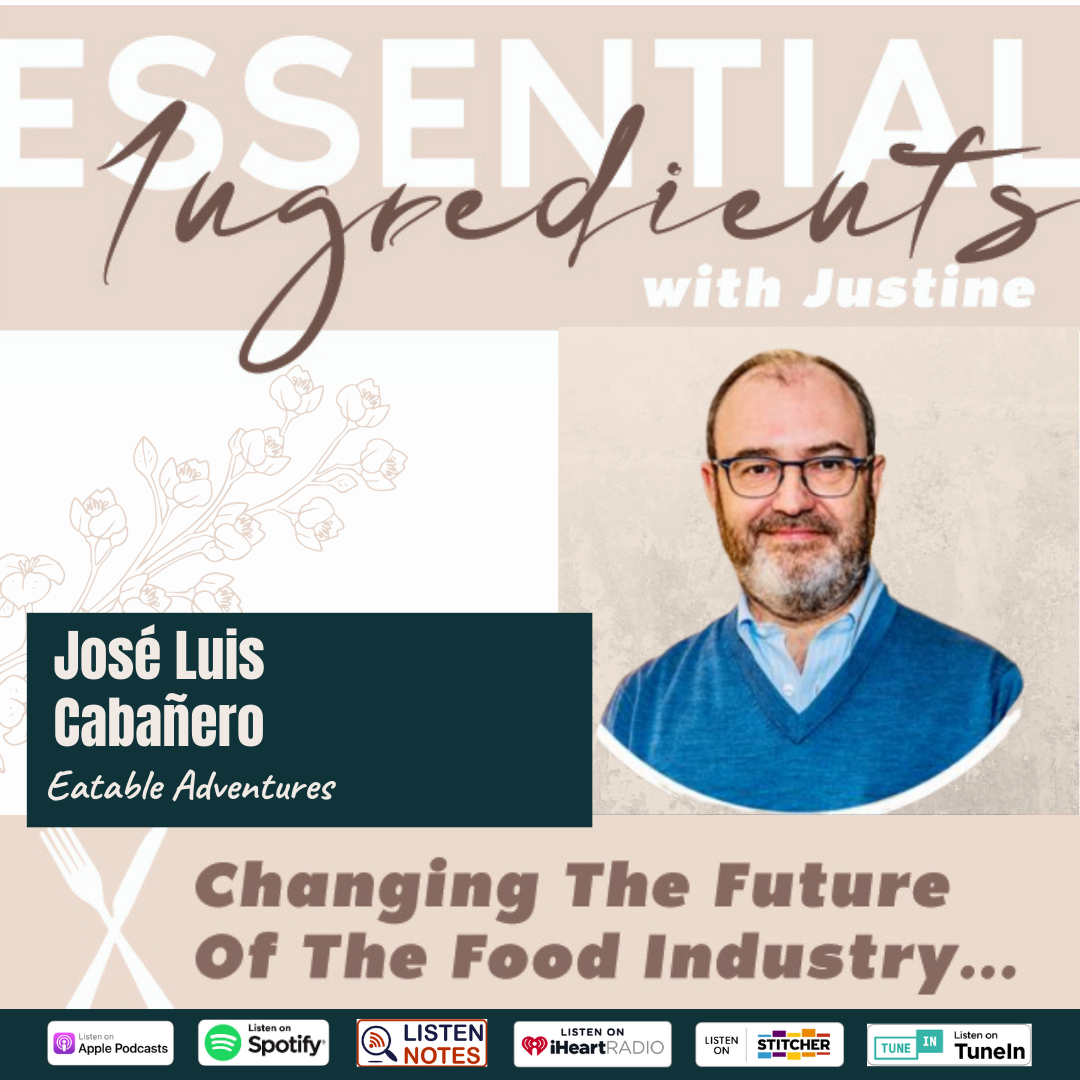
José Luis Cabañero · NextGen Purpose
Watch on YouTube
How to Build a Viable Business in the Food Ecosystem with José Luis Cabañero
The Incorporation Method helps you turn what matters into practical changes that fit your life.
“Food is an amazing human experience, and the chances of exciting adventures are high. Justine talks to José Luis Cabañero, Founder of Eatable Adventures, about how to increase production outputs while minimizing food waste.”
Full Transcript
Full conversation between Justine Reichman and José Luis Cabañero.
Good morning, and welcome to Essential Ingredients. I am Justine Reichman, your host. Today, I have the pleasure of welcoming José Luis Cabañero. Welcome Louis, thank you so much for joining us.
Thank you for having us.
I know it's a bit later there, so thank you so much. I know it's well into your evening, where you are, co'z you're in Spain. But yeah, thank you so much. So for our listeners, Jose is with Eatable Adventures. And I don't know how many of you are familiar with this, it is a company out of Spain. I'm excited to bring them to you both because he got quite a vast experience in food and working with startups. And for our listeners, this is the perfect match. It talks about changing the future of food, it talks about investing and building sustainable and regenerative businesses. It's exciting to learn a little bit about you so let's get right to it Jose. I hate to introduce people because I never do them justice, so I'd love for you to maybe just introduce yourself to our listeners. And then they'll get a deeper dive into who you are as we continue the conversation. But maybe just a quick little intro if you would.
Yep. I've been about 28 years working for the high tech industry. My background training is a computer science engineer. I was in this amazing telecommunications industry for about almost 30 years. And at some point, I decided to take a shift for my career. Basically, I stumbled upon a business that I still think is marvelous. It's actually a NGO out of San Francisco called La Cocina, a culinary incubator. They are doing an amazing job about helping immigrants to get into the American society by building food businesses. And I thought that this is something that could be quite interesting and appealing in Spain. At that time, this was 2013, there was a team coming up with a previous crisis. There was a high unemployment rate. The young people unemployment rate was also super large. At the same time, our chefs and all the culinary world has a big influence in the worldwide cuisine on price. So I thought it was something interesting to do, and then I told the idea to my two founding partners, Mila and Jose.
Wow. So that's quite a journey. And before we dig deeper into what you guys are doing at Eatable Adventures, I would just love to just talk a little bit about your experience and your journey from tech studies with business to Culinary Studies at Stanford. Can you talk to us a little bit about that journey? And what encouraged that shift for you?
Well, actually, Stanford has been quite fundamental on the center point of all this decision and change. I took my business school program in 2006. A few years later, in 2013 as I was explaining, I took coaching service in the university. And after something, like a couple of hours, the coach basically told me: "Looks like you want to do something different." My response was: "Yes, but I don't know what." And then they asked in the Farmers Market in the Ferry Building in San Francisco, this is where I met [inaudible]. It was something like the illumination moment when I thought that I could be transitioning my skills, transitioning my experience into a market that actually needed those skills. That was 2013. I was working for Cisco at the moment, and then I decided to leave at the end of the year. 2014, it was the moment to kick off a new venture. I realized I have no deep knowledge about the market. So the best thing I thought I could do was to get myself trained as a professional chef at Liquid Omelette. Those were nine amazing months of waking up at 6:00 AM every day and going to the kitchen at 8:00 AM. Learn a lot, not only about food preparation, but mostly about the culture of food and the culture of excellence, how you can do, and you should be doing good things that are good for people and are not providing more than tuition to the consumers.
Wow, that's quite a journey. So now you've gone to the Le Cordon Bleu, and now you've gotten your MBA, and now you're in Europe back with your co-founders and starting your business. So what was your vision at that point?
At the beginning, when you are in a startup, you need to do almost everything, and you need to invent everything. You cannot go to Amazon and purchase a book about how to run an accelerator, or how to run an incubator. There is no literature about what is the business model that you need to be making. The three of us, we have a very clear concept of having to do a business. And this is not like an NGO, and it's not something that is not sustainable itself. So for the first year, I was working on my own. One of my partners, Mila, joined the team. And the two of us started to put together all the wrong content. We start putting together all the ecosystem, all the elements to generate a nice deal flow and start getting nice startups into our program. Little by little, we start rolling the team. We are now 20 people in the team.
Yeah, I'm sure. So when you guys started this, how did you guys know that you had something that was working? At what point did you know that this was going to move forward and was viable?
That's a good question. I never stopped to think about it today. I think it's working on this viable and is effective. I believe that one of our challenges was actually to be Madrid and Spain is not a country that is recognized for entrepreneurship. It's not recognized for being at the leading edge of technology innovation. I believe that in our area in the agri food tech, we are in that moment where we are starting to get widely recognized when startups start getting recognition in international events, and they get tension from international investors. I believe that is the moment when you can realize that this is actually working. That happened possibly a year and a half ago, when a few of our startups were starting to receive calls from foreign investors asking to get more information about what they were doing.
Wow, that's probably a big moment, I would imagine.
Yes, I do realize later, you don't realize in the moment you get very excited, but you don't really see the impact. I believe that the way you create an ecosystem is evolutionary. So the success of a company of a startup attracts more investors, attracts other entrepreneurs, attracts corporations. So their success in these ecosystems is actually on the individual successes of startups compounded.
So for the founders that are listening to us right now, are their key traits that you look for in companies in startups as they come to you?
We focus a lot on people. I know that this is something that everybody mentioned. But for us, the team is super important. When you bet in a company in the very early phases, you are betting on people. You're not betting on a business model because the business model will change. You're not betting on a specific market position, because in most of the cases, there is no defensible market position. So the people, and the courage, and the willingness to make it happen, and to work hard is very important. We have a number of red lines that we draw in the playing field. They're very pretty basic, but they go to be responsive, getting information quickly when you ask for it. Being proactive and understanding the rationale, the changes that we're asking them to do, or the rationale of the position that we're asking them to evaluate, etc. When they basically follow and they are open for improvement, they are open for reassessing their position in the market to maybe throw away everything that they have done previously, those are the moments we realize that they are committed. And they are committed not to us, they're committed to their business. I had one conversation with one of our portfolio companies when we were closing the agreement for acceleration. [inaudible], the CEO, the entrepreneur, he had to drop the product completely. I said: "I like everything, is that your product?" So you don't need to drop it, I will drop it. But what do I do next? So we basically reassess their market position, reassess their client, reassess what they are willing to do for society.
Wow.
It's called Moon water.
Moon Water?
Moon Water, yes. It's basically sparkling water on fruit juices. No sugars that are added. So this company launched that product, they've been progressing in the market. They are converting the product in ecological bio refreshment, and they're getting an incredible traction across Europe. So the entrepreneur that we were going to help looks like is actually working.
Wow, that's amazing. What a great story. What an example. You mentioned that this was a natural product, can you talk to us about this space that you're in, and your mission is around the future of food.
Yeah. Basically, we try to look for natural products. We think a clean label is a necessity, it's good for the people. We actually need to be more proactive, getting cleaner and better products in the market. The future of food, I believe that is gonna have a substantial transformation. The food industry is at an inflection point. Technology is coming very strong. A lot of primary production is going to be converted into industrial production. And a number of reasons for that, and the most important one is that the population is increasing dramatically and we need to produce food for this new population. But at the same time, we are wasting resources and we are wasting food. So for us, the best approach to serve the needs of humanity in terms of producing or creating food for future generations lays on our capacity to optimize the use of the actual product at maximum levels. And that implies upcycling products, that implies getting the maximum output from landfill, from the products that are already put in manufacturing. Set of new technologies is appearing that will make it possible to get all these waste products, and is currently wasted and converted into high quality premium products. That's a main objective for us.
Yeah. I know there's a lot of exciting stuff happening now from alternative proteins to fermentation. There's so many new things that we're at the cusp of, that we're seeing from these, the new nut melts to all the different things that are happening. And it's happening, like rapid fire these days. I turn on the news, or I'm watching something come on LinkedIn, the news is there's just a lot of new innovations coming out because it really is looking at food and a new way. And it's positioning food in my mind as a way to look at food as medicine, as a way to heal the body, as a way to heal the planet. If we can think of this in a really thoughtful way from cycling to the way that we think about packaging, right? And to that end, are you familiar with the Upcycling Association?
No.
So I'll just throw it out to you, check out the Upcycling Association. I think they launched about a year ago. They're a great organization, and it's global. And I think you had mentioned that you are looking to bridge the gap and become more of a global organization, and come a little bit more. That organization has members from all over the world, and it might be okay to make your entree into the US aside from, through the Essential Ingredients Podcast. And if you check it out and you want an intro, I'm happy to introduce you to some of the people on there. We actually had a couple of interviews with them, and conversations with them. We had a podcast recently with Daniel Kurzrock from Regrained. I don't know if you're familiar with ReGrained, which is, yeah. So anyway, to that end, I'm happy to make that intro for you.
That's perfect. Thank you.
But I want to get back to Eatable Adventures. And I'd love to learn a little bit more about some of these products, or some of these entrepreneurs that you have. What kinds of innovations are you seeing come out of there that might be even different than some of the stuff that we're seeing? Is there anything that we're not seeing come up in the news or on LinkedIn these days?
Well, I believe that the intrapreneurs are trying to find their lens into the market. And that means that at the end, everybody's doing similar things. When trying to reach the market, the best way is to walk a path that has already been working. That's why everybody is at the same time to do [inaudible]. We have pretty exciting startups in our sustainable food tech program that we are running this year. Some are in the fermentation space that we have been commanding, with the tools of artificial intelligence being used to define how the different microbes and the different microorganisms can blend together to produce multiple elements in a single fermentation process. For example, we have also very amazing 3D printing solutions for meat and fish that we'll be hitting the market in a month and a half for now. Pretty exciting. People that have seen the output can't believe that this is a 3D print. We also have some nice work on mycelium substitution for alternative proteins in the form of burger patties, or similar but also to create a whole cut of meat. And I have tried that on the [inaudible] is super similar to the meat texture, and the look as well. And also, we are working on an area that I really, really like, this is climate affected precision farming.
Oh wow.
So we are working on one of our startups, identifying water species that are used by the food industry are being severely damaged by climate change. The production and the GLA is reducing year by year. I'm trying to help out to preserve diversity by breeding them, and creating them, and quartering them in indoor farming environments. And that is an area that we will live in, fundamental is going to be much needed. Here in the Mediterranean, climate change is heating dramatically year and year. I don't know if you heard of the biggest snow we had in Madrid a few weeks ago. Following week, we were 12 degrees or 16 degrees. Now, we went back to 0 degrees. So the Mediterranean area is really suffering from the changes in climate. We believe that a big mission that we need to take on our soldiers is to help preserve our biodiversity and to help preserve the agricultural production that is down in this area. And that's why we have a strong focus on identifying how indoor farming can help. Not the general agriculture, but specifically species that we can preserve in the production, and the output that they have in the market at the moment.
Wow. So there's a lot going on there. I think it's a great opportunity for people to really take advantage of right now. Because I think, really, it's timely for the founders and the startups that are listening right now that have an idea or have a business that they want to launch or investigate and determine whether or not this is something that they can move forward on. What are some tips that you might give them? Or what are some next steps or ideas that you might suggest for them before they run full steam ahead?
Yeah. We get a lot of requests for startups to help them find out investors, to help them on their fundraising endeavors. Most of them are not getting the market, and they don't have a product in the market. And possibly the best advice is to basically tell all these entrepreneurs that they really need to get their product in the market before getting professional investment on the table. Any of these founders lose a lot of time trying to secure funding before they have even started a company, or before they even start to have a product that is squarely fit to specific consumers. So the first for me, the best recommendation will be to define the product, get the product viable, get it on the table, get their MVP ready as soon as they can start selling. And that's the best moment to start looking for investors and people that come back to do what they're doing.
So often that a lot of entrepreneurs and founders think that it happens in a hot minute, and they don't realize that it took them 20 years. That the story is an overnight success. We've only been dealing with it for the last few years because that's when it came into our vision, that's what we started seeing in cafes and in coffee shops. It takes a long time, it doesn't happen--
Yeah, that's true. You go to Beyond Meat, you go to Impossible Foods, Perfect Day or any of their pioneers, everybody thinks that beyond, like a few months before their IPO in the market, and actually they were something like 10 years before that. And it took a large amount of time and a large amount of funding to get ready for the success moment. Absolutely agree that many entrepreneurs think that this is something that you can do in five minutes, or a simple idea, possible is a great idea, just an idea can get a lot of money on the table, and simply doesn't happen.
Yeah, it just doesn't happen. I think patience is really key. And to remember, it's not a sprint, it's a marathon.
Yeah, correct.
It's a good idea, it's got to have longevity, and you got to be indoor.
Yeah. And then you have played the sport, that one match, you can be perfect. And therefore, with a match, you can have the worst day ever. So resiliency is super important to keep a steady line and to continue going, knowing your direction and be ready to see if it's needed or if there's a good opportunity.
So obviously, this has been a difficult time and a challenging time of the last year because of COVID. I think everyone's going to ask this question, how has COVID affected your time with the startups in the past year? Has it changed? How has it impacted these businesses and your ability to help them?
There's been several phases. The initial phase in March a year ago was to talk to every single attendee. See where they were, check out the impact, check out their finance, make sure that everything was stable and sustainable. That was the initial reaction. The second reaction was for the community. As they said, we sustain a large community. So for this community, we basically put very, very quick succession of events to get them prepared to change. So we run a lot of webinars, one every week or something like that with a finance advisor, with the link advisors, with HR advisors, with a number of people that could provide hints about what to do and how to react to many things that are happening. We did it in our response community, and we did it locally because we thought that you need to help locally first and then expand. So that proved to be quite useful. A lot of people actually call us. I say: "You have helped us to find new ways to survive, especially in the hospitality market." And from that moment, we decided to continue doing it. We ran a series of seminars very rapidly as well in order to keep the community alive and to get people talking to people, and so on. So that proved to be very successful and very interesting. We stayed like that until late summer.
You can pack a lot in, you can be very efficient.
Yeah. Before that, you could have one meeting in the morning because you had to commute there, had to make enough return. And now, in the same period of time, you can have two or three meetings.
And then of course, in the day, then they have a siesta.
All weekends, we do, at least myself.
Okay.
Yeah. Today, we started working very early, and we ended up very late. In Madrid, people leave the office at 8:00 PM.
Of course. Well, it's the nature of also being in the startup community. I feel like during COVID, I don't know about you, but there's nothing else to do but work.
Yeah.
I mean, I might as well work. I can get so much done. I'm just sitting here, what else am I going to do? And it's the only thing I have to think about. It's not like I'm going out to have dinner, drinks and cocktails. I mean, aside from that, and for those people that are watching the video, I have these little munchkins, but I go for a bike ride, I guess. But my main focus is to create change, help get information out there, help change the future of food. So when I'm sitting here, I can do more work. I'm sitting out here in my office or just in my house to just continue and perpetually do work.
Yep. Some people doesn't like it, but I believe that--
I also think that we should have boundaries because we do need to have balance. We need to set that balance, we need to have family time, we need to be able to get outside.
That's correct. I don't know when this pandemia will finish. But eventually, I believe that whenever it is, everybody will be totally reversed. Everybody will be on the street every day, so let's see what we can do.
Well, hopefully. I want to invite you and your community onto the NextGenChef app. It's complimentary. It's free. It's a way to connect one on one with them. You can put videos up there, you can create community boards, have conversations, continue the conversation around it. And it's a great way to extend that conversation. We host a lot of stuff on there, and it's a tailored LinkedIn for those people in food and beverage. It's a way to connect people in Madrid, Europe, London, Paris, Brazil's, wherever with people all over the world, the US, etc, Asia. We want to invite the people listening today, those founders of startups, those thought leaders to join us there as well to connect with me personally. I would love to connect with you. Connect with me Justine, connect with Jose Louis, I hope that you guys will all join us. NextGenChef is the sponsor of this podcast, which you can find on iHeartRadio, you can find it on Spotify, wherever you listen to. So if you like this episode, please download it. We drop a new one every Tuesday. I want to thank Jose for joining me today talking about Eatable Adventures. I want to thank our listeners, and hope to see you here again next week. Jose, thank you so much for joining me, I really appreciate it.
Thank you for having me, such pleasure to get to know you.
Likewise. It was a pleasure to get to know a little bit about your history, what you're working on, and I hope that we can collaborate and maybe join forces and support your community, because I feel like there's a lot of synergy there. And there's ways that we can support you with our resources.
Likewise.
Awesome. Well, thank you all, thank you to our listeners. And again, don't forget to join NextGenChef, the app is nextgenchef.com. It's available on iOS and Android, and it is free. I hope to see you all there. Don't forget to connect with me. Thanks again, and follow Essential Ingredients on iHeartRadio, Spotify, etc. Talk soon. See you next week. Bye.
Share This Episode
Enjoyed this conversation? Share it and tag @nextgenpurpose
Listen on Apple ▶Listen on Spotify ▶Your Host
Justine Reichman
Founder & CEO of NextGen Purpose. Host and Executive Producer of Essential Ingredients — 11 seasons, 330+ episodes, and a growing movement.
About Justine →