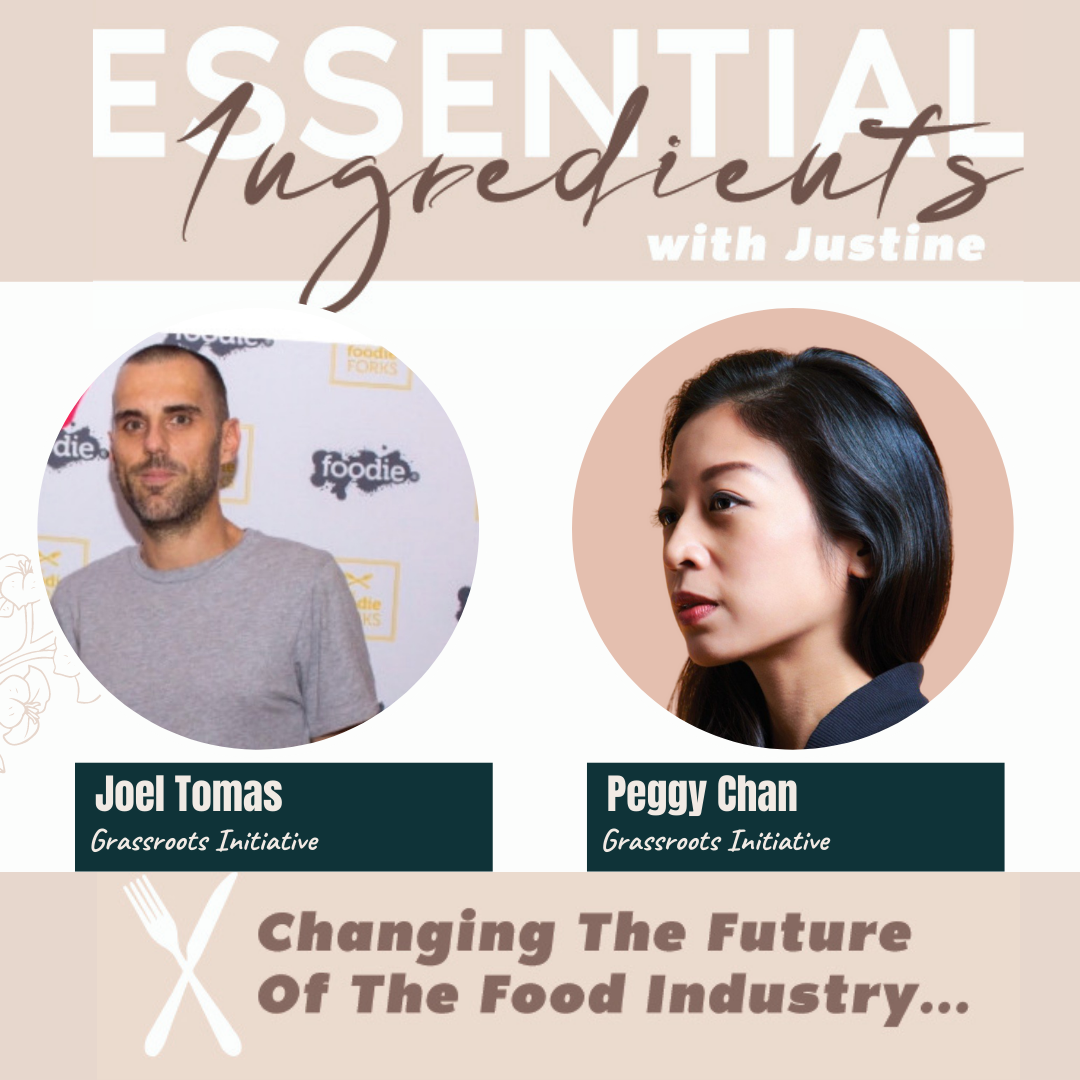
Peggy Chan and Joel Tomas · NextGen Purpose
Watch on YouTube
Where Healthy Food Begins with Peggy Chan and Joel Tomas
The Incorporation Method helps you turn what matters into practical changes that fit your life.
“Zero Carbon Footprint — is it possible? A great percentage of waste and carbon emissions come from the food industry, but with the growing awareness, the world is now gradually moving towards a more sustainable future.”
Full Transcript
Full conversation between Justine Reichman and Peggy Chan and Joel Tomas.
Good afternoon. I'm Justine Reichman, your host. Today, I have Joel and Peggy from Grassroots Initiative, as well as Yvette Yuan from NextGenChef. She's our marketing analyst and producer for this show. We're really excited to welcome you here today. Thank you both for joining us.
Thank you.
Thanks for having us.
Yeah. We're excited to share with our listeners a little bit about you, to talk about a little bit about your book that you're doing, as well as the Grassroots Initiative. Would you guys like to just get into it and share with our listeners a little bit, give them a little backstory as to who you guys are?
Sure. You go first.
All right. Hi, everyone. My name is Peggy. I am a founder/owner of Grassroots Pantry, which was a plant based restaurant opened in 2012. And classically trained, I've been working in the food and beverage industry for the past 20 years. So I started off as a cook. I went to culinary school, learned all the French techniques I thought I needed to survive, but no. Then I went to hotel school and Business School in Switzerland. So that's kind of how I got that fallback training. Then worked in corporates for a couple years in Hong Kong and Tokyo. And before I decided that enough was enough, I'm going to open my own place and make it meaningful. And that's kind of how the journey began.
We'll, thank you so much for sharing that. You have had quite the journey, quite the food and beverage journey, education wise as well. Sounds like Hotel Management, Business Management, you're really got a lot of education that supports your love and your passion to be able to do this. So that sounds like it's quite a win for you. So Joel, can you share a little bit about what you're doing and how you got there? And then I'd love for us to connect the dots on these things.
Oh, right. So I'm not classically trained, or institutionally trained. I like to say the school of Hard Knocks, which is hospitality. So I started working in Fremantle, Western Australia where I'm from at the age of, just before I turned 14, which is the legal working age in hospitality. So that's about 25 years ago, over 25 years. And then from there, just a gradual sort of progression, then I moved into pubs and sort of bars, then moved to Melbourne at 22, which is [inaudible] is the epicenter of Australian hospitality. Lots of bars, restaurants, cafes there. Worked around there. Was up in Sydney for a little bit. And then sort of in my early 30's, I've moved into restaurants and cafes, just needed to get out of the bar scene. And then about four years ago, I got the opportunity to work with a large restaurant group to come to Hong Kong. I worked there for about a year and then went to Grassroots Pantry, which was more aligned I think with my values, being a plant based data, and obviously that thing of plant based restaurants. So I worked on every position in hospitality from picking up glasses, to bussing all the way through, to looking after multiple outlets. So Grassroots, yeah, like I said, more aligned with my values. But then now, we've just transitioned to consultancy in the last year. And also, we're looking to start a new initiative in this coming quarter.
Wow, that's amazing. How did you guys both connect?
It's an interesting story. We actually met at groceries when I got flown out to Hong Kong for a job trial with Black Sheep which is a large restaurant group here in Hong Kong, and Grassroots was one of the only places that I could safely eat at in Hong Kong in terms of it being completely plant based vegan. So yeah, we met there. And when I came back, [inaudible]. For the bar type thing when I was sitting there doing my homework, then I went back to Melbourne to sort of pack up my life sort of thing. I was still unsure whether I would come back. And then when I came back, we met again.
You met again for work? Or you met again because--
The truth is, when I first met him at the bar, it was at my juice bar. He ate a lot. Like he kept ordering, and ordering, and ordering. And I was like, Whoa, this guy's been sitting through my entire brunch period, and he ordered so much food. So when I went up to him and asked him, what are you doing here? He moved to Hong Kong. He's vegan, and he works as an operations manager. There's very few of that in the world. I thought like, okay, I'll give you my number, and please call me, if this work thing doesn't work, work out for you because you might have a position here. Yeah. So that's why I really connected with him. But we ended up actually dating when he came back, yeah.
Oh, see, the story just gets good now?
Yeah, yeah. You could do a whole podcast about this. No.
No, I know. I know. Okay, so then you started dating, and then, no, I'm just kidding. Yeah. So how long ago was that?
Pretty much since I, I think April 2017?
So how long were you at the other place before you jumped ship and joined Peggy?
Close to 12 months.
Close to 12 months. Okay. So then you jumped ship, you joined Peggy and all sorts of ways.
Yep.
And now, you have the Grassroots Initiative. And now, you're doing some consulting. Tell us about what you're doing now, during COVID, how did COVID impact what you guys were doing and really help you sort of check in and now start this consulting business that you're doing.
I think that COVID actually helped us in a lot of ways. And it was very timely. Prior to COVID, Hong Kong had already been going through quite a lot, the six months prior to that. So we kind of went through that process earlier than everyone else who was experiencing the detriments of COVID in the winter last year. We closed a restaurant in December because of all of those situations. And I think it was really timely because we ended up--
I'm sorry, was the restaurant name Nectar?
Yeah.
Just for our listeners that are here, so that when we talk about these different things, they can know that we are all the different partners.
So we transitioned to Grassroots Pantry after seven and a half years to Nectar. That was kind of like a phase of growing out of our cafe style plant based offering. I guess we'll talk about it more later, plant based seems just becoming more and more saturated. There was a lot of competition, all kinds of serving that same range of food. Or when it comes to more high end, more slower service, more thoughtful, it was lacking. So we wanted to kind of elevate and move to that position, which we were already doing with certain pop ups. So we do around the world with tasting menus and earth our menus, that was like 12 courses long. So I want to kind of just bring back that classical French style of service. But at the same time, new fun, educational. So yeah, COVID really, that just gives us a reason for believing that the reason we close has pivoted us into something more meaningful. And again, we had already already been trying to do that for quite a while in terms of splitting our time between operations in the restaurant, creating menus as a chef, and then down to the education side. So teaching, whether it's professional chefs or teaching students, we want to put more time into education because that's fundamentally how we're going to get more people on board. But then, I guess with COVID, it really just started all of the operations side out. And then we could really focus on the education part, the consultancy and training part.
Just to add, I think with COVID, sort of helps people realize what's important. And I think people sort of shifting towards, like more plant based sustainable operations.
Yeah, I think that it's a common thread. And I'm sure Yvette, feels like we've had this conversation a variety of times in a variety of subjects, all within the food in the confines of food where people are more focused now more than ever on education. And I would say the foundation of both NextGenChef, as well as Essential Ingredient is rooted in transparency and providing access to information, which is one of the reasons we're here, because we want to be able to give people, our listeners, the founders access to information so they can make more informed choices, whether the business or an end consumer. So it's very aligned for you to say that right now because that's really what we're rooted in. Our goal is really to give our listeners the access to that information. So here you are telling us that as a result of COVID, we're really trying to help our friends, people in the industry to rethink what they are creating from soil to shelf, which is really what we're hoping to provide those resources. We're not necessarily the answer, we're the conduit to be able to bring resources like you. I'm really happy that you're sharing that with our listeners. So if we could just go back to Nectar because I do want to talk about that before we move forward. And maybe if you could just share you operated Nectar, it was a high end dining service featuring seasonal tasting menus, easily locally sourced plant based ingredients. What insights have you learned about your consumers and diners as a result that you share with our listeners?
When we first opened in 2012, the common idea of what plant based food is, or actually the word plant based wasn't even hit back then. There was vegan or vegetarian, people's ideas were salad wraps, maybe like vegan pasta, lasagna, and that was it. But I've always said that vegetarian food is in every single culture, and we just really need to dig deep into it. And also remove the meat and replace it with something that is equal texture, flavor, and people won't ever complain about it. Because what does meat taste like? It's not seasoned, it's blood and iron, right? So vegetables are the same. We just need to learn how to cook it right and how to season it right. So back then, we really were just trying to push for that common understanding of what vegetarian and vegan food really was to make it tasty to demonstrate it through our restaurant platform. But as things grew, we started seeing a lot more people coming into this space, which is great. You want to be accessible and affordable. But then also alternative meats entered the market in 2017, which really started to change the way that people saw vegan foods and the pricing behind it as well. What we do is, first and foremost, source as much as possible from local farmers. And generally, the quality is much higher, the nutrition part is much higher. And therefore, there's a reason why we price the things that we do price that way. But when you're comparing a lot of the processed foods, it's very different so we wanted to really differentiate that part, and hence why Nectar was so important for us. Now, our people are doing 350 covers a day, nonstop, seven days a week. We had maybe two days a year off. And that kind of service, and that competition, and that kind of pace is great for the economy, great for the market, great for growing your business, but it's also really detrimental to the removal of connection between customer and the creator. So what I thought was really missing was, over the last two years, we started to feel disconnected with our consumers, and our consumers were really looking at the surface level of price. I was pretty much in portion size maybe, and that was pretty much it. But without acknowledging all of the work that had gone behind it, all of the farmers that grow the food, so there were a lot of things I wanted to talk about. And with the surgence of UN SDGs in 2017, there are more and more information coming out on each one set that was published in 2019. This is all new science, and I really want to connect that with diners. So Nectar was a way to kind of slow things down. Let's reconnect, and let's talk about this at the dinner table together. Yeah.
And then on that, like from the service side, being able to explain to guests and customers where the food was coming from, like this is a [inaudible] mushroom, this is from a locally grown farm. People like all those farms in Hong Kong. It's like 40 minutes away. We also then had our farmers from the organic market for the organic farms at the front of the restaurant on Saturday's, on Tuesday, Thursday, Saturdays and Sundays. So then being able to tell customers that you could come back on Thursday to buy vegetables, or compost on the weekend to buy these vegetables, to then cook at home. So really then connecting table to farm, farm to table, whichever way you want to put it. So there was that aspect to it. And I think people now will really want to know where their food comes from. We've been doing that since I started there in 2018. But more so with Nectar when you've got the chance to explain at the table, and the customer had more time, more access to you, I suppose as well rather than frantically running around, trying to just turn tables and serve people, get them out, get the next people in. So slowing down the service really helped in that aspect. And then another interesting one towards the end was game changes. The documentary on Netflix, the amount of men that would come in, like willingly and like acceptingly as well, like it was so it was so funny saying, I didn't know people could be strong and eat vegan. You saw this new wave, I suppose, of people being accepting of it, and even people reaching out to me about it as well. Normally, they are giving me shit about it, they're now asking questions. So from a holistic point of view, it just brought more awareness. And like Peggy said, slowing down the service allowed us to communicate where the food was coming from.
That's really interesting. I really appreciate you sharing that. And I just want to circle back, we were talking about Nectar. And before that, we were talking a little bit about how the Nectar evolved into your consulting as a need during COVID for some of your friends and people in the industry. I'm curious if maybe there's some stories that you can share from clients or friends, you don't want to share names or anything, of the impact you've been able to have with them, some of the tools that you are able to share so that it could impact them in their business.
So on the consultancy side, it took about like a month or two to figure out what would be the best format to roll this out and the best format to train. Because as few service providers, we don't have much time. We don't have time to read through things, so it was very much a one on one type of thing. One of the first consultancy projects we did was a completely new concept, a new brand. I'm sure you've heard of Bubble Tea before? Bubble Tea? Yes. So essentially, it's very heavy on cow's milk, sugar, fake tapioca pearls. And so that's kind of like what people associate Bubble Tea with. But our concept that we created was an entirely clean version of it. We basically got this machine, this court press machine from the State to Hong Kong to press that can actually press about 150 litres of milk per day, per hour and like that. So we wanted to start from the milk itself, it has to be completely clean, and no fillers or stabilizers, whatsoever, and that they could make. And the pulps that were leftover from pressing the milk can be also used for bakery items or raw food items so that there's essentially zero waste. Plus, you're actually decreasing the food costs because you're utilizing every single bit of it. And also the tapioca pearls would be homemade, and also the sugars are all low GI. So that concept really rolled out fantastically in, it's a fast casual place, they want to expand it. Nobody's ever done that before. So that was one of our first projects.
Yeah. And then another one, Bubble Tea is like an everyday item for a lot of people here. And to have a clean version, these guys were brand new into hospitality and into the market. So seeing it as an opportunity to get like rents and those sorts of things as well that people don't think about good location, we help them identify that as well in terms of, yes, it's not a good time to get into it. But it's also you got to look at the positive as well from this. Like it's a good time to get into the market. Another project that we did was a very local hospitality group. So they did a pop up inside one of their restaurants. It's about a 300 seat restaurant, I think. They partitioned off part of that and did like a whole sort of new makeover inside the restaurant. They were quite not skeptical, but they were a little bit cautious of their other chefs' reactions. Like being traditional Chinese chefs, just making the same sort of food over and over, big portions, how would they react to cooking? This was probably 50/50 in terms of plants based to meat. And how he went in and spoke to them, it was hard to break down at the start, but it ran for like two months, they were booked out for two sittings every night that they were open. And the chef's have now come back saying: "We want to learn more." We want to be able to, the operations managers and the big bosses are saying: "There's now potential to roll this out as a standalone restaurant. Let's start." And then they'll allow us to get into their supply chain as well to then help them source cleaner ingredients. That was a real sort of positive and an eye opener for us to show that, even though chefs are trained in a certain way that people are willing to try new things. Yeah, that was really interesting. That only finished up a month ago or a month and a half ago. So that was like a three or four month project.
Wow, that's amazing. Do you foresee that this consulting could potentially overshadow your work, or be a larger part of what you're doing?
I think it complements the greater goal that we want to reach. And the greater goal is to create as much impact as possible in terms of education and also climate, how can we help collectively solve the climate crisis? It's complimentary because we're not just telling people what to do, we're showing them what to do, and what can be achieved if we all do it together. So it essentially complements us. We don't want to put way too much energy on consultancy small projects, because there is so much that we need to do as well. But there's a lot of engagements. And mostly it comes from chefs wanting to learn more. But without having to go to culinary school or reading a book. They want to connect, they want to work together, which is fantastic. That's what we want to build a more collective.
Collective, collaborative and impactful.
Correct.
Well, I want to make sure to include Yvette in this conversation as well. Because I know that she's really passionate about what you're doing as well. I know that there's a couple questions that you have in mind, and I want to make sure that you have an opportunity to ask those questions. Take this time, and maybe shoot those questions over to Peggy and Joel, and we'll continue this conversation.
Yeah, it's a great transition point. We've dug through Nectar and Grassroots Pantry, but we know you guys are up to something bigger and more ambitious. Would you like to announce or share the blueprint of Zero Foodprint Asia with us?
Yeah, sure. So it's a San Francisco based company, which I did mention on our previous call. Their goal is to mobilize the food world around agricultural climate solutions. We first met Anthony and Chris at the Melbourne Food and Wine Festival back in 2018. Peggy was on a panel with [inaudible]. Their first slide had a slab of steak and eating our way out of the climate crisis. And I was thinking, I was sitting up in the crowd, I wasn't down there on the panel thinking, what are these guys on about? What am I going to say? That they're going to say, we need to cut meat out, or they're going about this. But there, it resonated with us in ways that, one, we know people aren't going to stop eating meat overnight. And two, when my grandparents came out from Croatia, they farmed in ways that weren't using pesticides, they were working with the land, they had some small animals there, they wouldn't unnecessarily kill for food, but we're there to help regenerate the soil. And that just really got us thinking. So then we listened to their talk, we spoke with them backstage, and then continued the conversation. And two months later, we're going through a lifecycle analysis. So doing a scope [inaudible] in our restaurant. And from that, it was a lot of back and forth on the paper, going through our supply chain. And then from that, where I ascertained that compared to restaurants that serve local organic meat that we were, we emitted 60, 65% less greenhouse gas emissions. So that got us thinking about, we started looking into it. And then from that part, the per diner who was worked out on a dollar basis, so we implemented a 3% carbon tax on top of the bills. And then that money went to help fund projects in America that were helping to draw down carbon from the atmosphere. So we're intrigued by it, but then we did our own investigating. And in the middle of last year, we got back in touch with Anthony when the Chinese and Hong Kong government both mentioned about becoming carbon neutral by 2050 and 2060. And Peggy sent Anthony an email and said: "Hey, I think it's time you moved to China. Who's going to do it?" And Anthony wrote back: "I thought you guys would." So we got thinking about, wow, this will be a really good opportunity. It complements what we've been doing for so long. And yeah, just sort of started from there. So we're looking, we've spoken to about a dozen restaurants here in Hong Kong, speaking to university professors, people whose projects we could potentially fund. They'll still need to apply for the funding, but it's mobilizing the restaurant industry, it's a 1% pledge. So it's 1% of their turnover on a monthly basis will then help to fund these projects. So a fair portion of those 1% will help to fund projects in Hong Kong, practicing regenerative farming. It could be our organic farmers, it could be composters, it could be anyone that wants to transition to more regenerative farming practices. So yeah, we've been on a massive learning process these past six months about that. Kiss the Ground is a great example of what these projects are all about. Peggy's reading up and joining every online course to do that. So yeah, do you want to explain a little bit more.
Yeah. And also, though Foodprint isn't simply about farming, it's also about ensuring that when we do find better, our soil is more healthier, and therefore our food is more nutritious. And so we want to connect those dots as well, for our consumers and for diners to understand that there's huge implications to how we grow to our food, just by how we grow our food. Were essentially the people who are administering this and organizing this, because there have been a lot of people doing this type of work. It's just that they're all very tiny organizations. And so, are food system is entirely fragmented, and it goes with the restaurant industry as well. The diners don't connect with suppliers, so they never know where to get anything. And the restaurants don't connect with the farmers. And no one knows how to deal with waste issues, so we want to just connect everything together to make it as seamless and easy for people to contribute and participate, and lowering our carbon emissions, having zero waste and reducing our meat consumption.
Wow, that sounds amazing. And interestingly enough, I have another initiative that we're working on. It's not really an initiative, but I'm trying to create a collaboration of people that are working to create a definition and an association so that people can work towards building more local, healthy, regenerative businesses. Because creating something organic, and certifying it is really expensive and cost prohibitive for many people. So I'm working to create a board of people from all over, from the USDA, to people that are at large corporations, to people that are farmers, etc. So that we collaboratively can come up with what this definition is, so that it's accessible for people, so that everyone can work to create something that's better for you, that they can understand how to achieve it, that they can have access to the information, and that more people can attain this, and then the end consumer can have access to better food as well. Because right now, it's a loss for the businesses, that is a loss for the consumers. Because so many people can't, it's not accessible. So working right now to put something like that together.
I just registered to the real organic project, real organic symposium. And this is very, very new. Basically, like you said, organic certification is so different to what it was 30 years ago, 40 years ago. And all of the big agri businesses want to jump into organic, what you are going to see with alternative meats as well. And so the identity of organic and the definition of organic has changed so much. It's missing that component of what it really means to be organic. So yeah, a real organic symposium is just started, just launched. So yeah, get on it.
I'll also send you an article on Counter, which was really good about organic farming, especially in the US.
Yeah, I love that. Because I think it's important also for us to understand what's happening around the world. People are doing things differently. The soil is different, the farming is different. And I think it's interesting and important for us to share what's working in different places so that there could be a better understanding. I mean, there's a reason why people in Europe, we don't experience the same thing. How many times do people go over to Europe, and they can eat gluten, and they can eat vegetables, or they can eat all these things and they're like, I feel fine, I feel great. And then they come back to the US and they're like, I can't eat gluten, I can't eat this. I can't eat cheese, I can't eat all these different things. I just don't feel well. And whether it's the antibiotics, whether it's what's in the soil, I'm not gonna say I know the answer, but I do know that there's enough of a difference in the way things are processed, and the way things are created that we do need to pay attention to it, we need to investigate it more and better understand what's going on. So that maybe we can set some precedents and share those learnings across borders and work together to create something that's going to work more universally.
Absolutely. Yes. 100%.
Yeah, so I'm just trying to create that board of people that can share their different expertise, because I certainly don't have it. But if we can get people with different experiences to share their knowledge, hopefully, we can get enough brains in the room with different experiences to be able to come up with something that will allow us to make a better decision and more informed choices for both the businesses as well as the end consumers and share that information.
This year, food has become the center of every global organizations topic. So everything from the United Nations, not even FAO, it's just the United Nations talking about how food is the fundamental way that we can actually solve climate change. WWF is also now focusing on the food supply chain, rather than just conservation. So everyone's moving into the food space, because we know that the entire food system contributes to 37%, if not more, of the global greenhouse gas emissions now. And what's interesting is also more than half of the entire world's population, one way or another, working within the food system. So we actually have a lot of power to make these changes. So yeah, there's a lot of people doing this stuff, which is great.
I even think on a day to day basis, I mean, the things that we're learning even by bringing thought leaders and folks like yourselves on this podcast, we brought somebody on that wrote a book called Eat Less Water. She wrote the book because she realized that she's taking all these bath's and different things, and she's like, it's really not about the bath. It's really about her daily life and how she can, she found by process of elimination that really was in what she was cooking in the kitchen. It wasn't about the showers, it wasn't about the bath, it was about what she was doing in the kitchen. And by changing what she bought, and how she cooked, and how she prepared her meals, she would use a lot less water. So she wrote a book about it. I think we all have the power to make choices. And it's not about shaming anybody, it's about doing what resonates with you, and what feels good to you. Because we can't do everything, we have to do what works for us. But I think by sharing these different recommendations, people can pick and choose what works for them. And then hopefully, we can make enough of a change with ourselves through food to help change the climate. I mean, I learned yesterday, what was it today about cheese, right Yvette, we were talking about cheese.
We're talking about a way to produce animal free cheese that performs way better than the current market solutions for cheese. We don't have any plant based cheese that mimics the stretch, the melt. So yeah, we talked with change foods, the CMO this morning, talking about how they use fermentation to improve the functionality of cheese.
But Yvette, the big thing was she was talking about the impact it has on the environment, and for the cows, and what it was taking from them. It was like 10, you had to go to 10 cows to get one piece of cheese.
Yeah, animal proteins, if not very productive, it also takes nine calories to feed a chicken to produce one calorie of chicken meat. And that is the highest yield of animal meats across, I think that's no news to us. So yeah, but like Joel and Peggy said, this is a coalition. And Justine, you're also trying to build the bridges between different groups in society because this cannot happen alone. It's a huge system, so we love to ask you about it. We know we are learning a lot. Where are you at in terms of Zero Waste Asia? When can we expect to hear from it? Actually launching? Yeah, what's the growth strategy?
So we're aiming to launch around March, just with the situation. We're going through a fourth wave of COVID here in Hong Kong at the moment. So restaurants have just been banned, just been extended for another couple of weeks, which will almost take us to about Chinese New Year. So they can't have dining after 6:00 PM, two people per table, 30% capacity. So yeah, we've engaged with friends in the industry, people are willing to put the 1% up, but we need to be prepared ourselves. We also have a meeting with the Secretary of environment for Hong Kong at the end of this month, where we're going to pitch our idea. So yeah, we then hope to, we've had interest from other parts of Asia as well. So hopefully, by the end of this year, we can also launch into other parts of Asia. But we want to get it set up in Hong Kong correctly first, because it does take time to identify the projects that are working towards regenerative farming, and just to make sure that they are aligned. And then we also need to get a board of advisors who will then assess the applications for people that are applying. So we've got friends in other parts of Asia, Singapore, Philippines, Thailand that can assist with that. But they also have their own things going on as well, that they can connect us with the right people in those areas. So yeah, it's exciting to be able to launch another impact venture in the coming months.
Yeah, I'll just add to that, at this stage, we are really seeking out all of the stakeholders that can contribute. And it doesn't just stop here, right? We're going to be consistently onboarding new restaurants, we're going to help with the communication collaterals, which is important to educate diners, as well as the restaurant industry of the impact that it's creating. So even after a year or so of getting these regenerative farms on board, we need the researchers and the professors in the universities to do the measurements of how much carbon can actually be absorbed through X amount of acres being filled with compost, or being applied with compost, or whatever practices that they decide to implement. So even finding out whether there are people, scientists, you can do that in Hong Kong, it's like a real challenge. But we're lucky to see that there are actually people doing it. It's just that their work is not being activated yet, so we're activating a lot of that new science right now.
Yeah. That sounds super exciting. And it sounds like there's a lot of opportunity there. So we wish you a lot of luck with that, because it sounds really ambitious, but it sounds like you're on the right track. So that's super cool.
One thing I want to add also is like, when we talk to these academics and farmers, they're really surprised that people like us would be interested to learn more. So they want someone to help them communicate their work to the public, to the media, and what else but the restaurant platform. The media is constantly hungry for content. And the restaurants here publish so much content for the media to talk about celebrity chefs, what's the next hippest ingredient? There's always something to talk about so why not feed this information for the media to talk about, you know?
I'm sorry. I like on top of that, like I mentioned off there as well chatting before, like Hong Kong has got the highest density of restaurants in the world with 15,000 on such a small island. And people eat out 10 to 15 times a week here. So to get to have this information out there in these restaurants so people can then talk about it, and they're getting information for different restaurants, but the same information, I think that's very important as well. That's a way to then start educating the masses.
And normalizing carbon and climate solutions. Yeah.
Yeah. Well, I think the media is also going to be very interested in the new cookbook that's coming out.
Nice one.
Maybe Peggy, you want to share with our listeners a little information about the cookbook, sneak peek, maybe even share a recipe?
Yeah, for sure. So Provenance is a--
Provenance is the name of the cookbook, right?
Is a project that I decided to do two months ago. And the whole reason is because actually, I've been wanting to do a cookbook for a long time, but we get super busy, and we don't have time to sit down and stuff. But this year is perfect. I wanted to really just slot two months to focus on this. We've already collected about a thousand, or created about a thousand or more recipes in our database. So it's not like it's difficult, that part is already done. The R&D is already done. It's more about the creative process of putting the book together, writing the stories behind it and then finding the right team to kind of manage all of this. So that's what I've been doing for the past month now. We decided to put it on Kickstarter to crowdfund it for several reasons. One, I believe that a Grassroots Movement is what we need. And yes, I can go and find big donors. But the whole idea and the whole concept of Provenance, and knowing where to source your food, and connecting with your farmers, and connecting with the players, that your stakeholders of the entire food system is what we want to engage people with. And so with the whole cat crowdfunding campaign, and I'll shoot you the link later, you'll get a sense of what it's about. And most of the proceeds will actually go into helping us start Zero Foodprint Asia. So it will help us on the operation side, get a few staff on and get us going there. So it's all kind of like a one loop thing. But the cookbook itself is all dedicated to helping people make source and cook food that is healthy for both the planet and our health. And it's also not just for regular home cooks, it's also for professional services. I always say that with professional chefs, the knowledge of healthy food or cooking food for nutrition is limited to people who are cooking at home because we don't learn that in culinary schools. They're not taught nutrition, they're not taught to create food for health, they're taught to create food for Michelin Stars. So the whole entire idea of the cookbook is to elevate what it means to source, farm to table, to the players, and then get to normalize this type of cooking and treatment of food in the food service industry.
So when is this going to be kicking off on Kickstarter?
Already launched, it's been two weeks now. I'd love for more people to get on and read about it, and pledge because we're an all or nothing type of thing. So if we don't meet our goal, it's not getting published.
What is the goal?
It's 350,000 I think?
It's 350,000. It's about 40 something thousand US, I think.
How far are you into it, and how long do you have--
I think we're about 15% funded now, but we have until the end of February.
Okay. So I would love for you to share the link with us so that we could put it in the show notes, so that our listeners can check out the show notes. But for those listeners that want to just hear it on this podcast, are you able to say it for them? Do you know what it is?
It's a bit long. But if you search kickstarter.com, Peggy Chan Provenance, I think it will show up. Just recognized our campaign as a project. We love campaigns, so that's pretty cool.
Great. Well, you have so many interesting projects, so many impactful projects that you guys are both working on. I'm so pleased and honored to be able to have had you on the show to be able to share them with our listeners. I hope that our listeners are as inspired as I am, so thank you so much for joining us. I want to thank our listeners for listening today. And for those of you that like these podcasts, please subscribe to the Essential Ingredients Podcast. They are available on iTunes and Spotify, in any channel you'd like to watch them on, so please do that. And I want to thank you all for joining us today in this podcast. And all the others are sponsored by NextGenChef. And for those of you that want to get in touch with Joel or Peggy, I've invited them to connect with us on the NextGenChef app. So hopefully, they will upload their profiles and you guys can all connect with them there. Otherwise, you can connect with them through Instagram--
@chefpeggychan or at Grassroots Initiatives.
I don't have--
And I think we're gonna go to the NextGenChef. It sounds like it's safe, and it's all in the right place. Because after all, NextGenChef was built to connect people in food and beverage. And that's what we want to support and encourage. I'm really going to invite everyone to join us there. Again, thank you guys for joining us. Thank you Yvette for co-hosting this with me. And thank you to our listeners for joining us.
Thank you.
Share This Episode
Enjoyed this conversation? Share it and tag @nextgenpurpose
Listen on Apple ▶Listen on Spotify ▶Your Host
Justine Reichman
Founder & CEO of NextGen Purpose. Host and Executive Producer of Essential Ingredients — 11 seasons, 330+ episodes, and a growing movement.
About Justine →