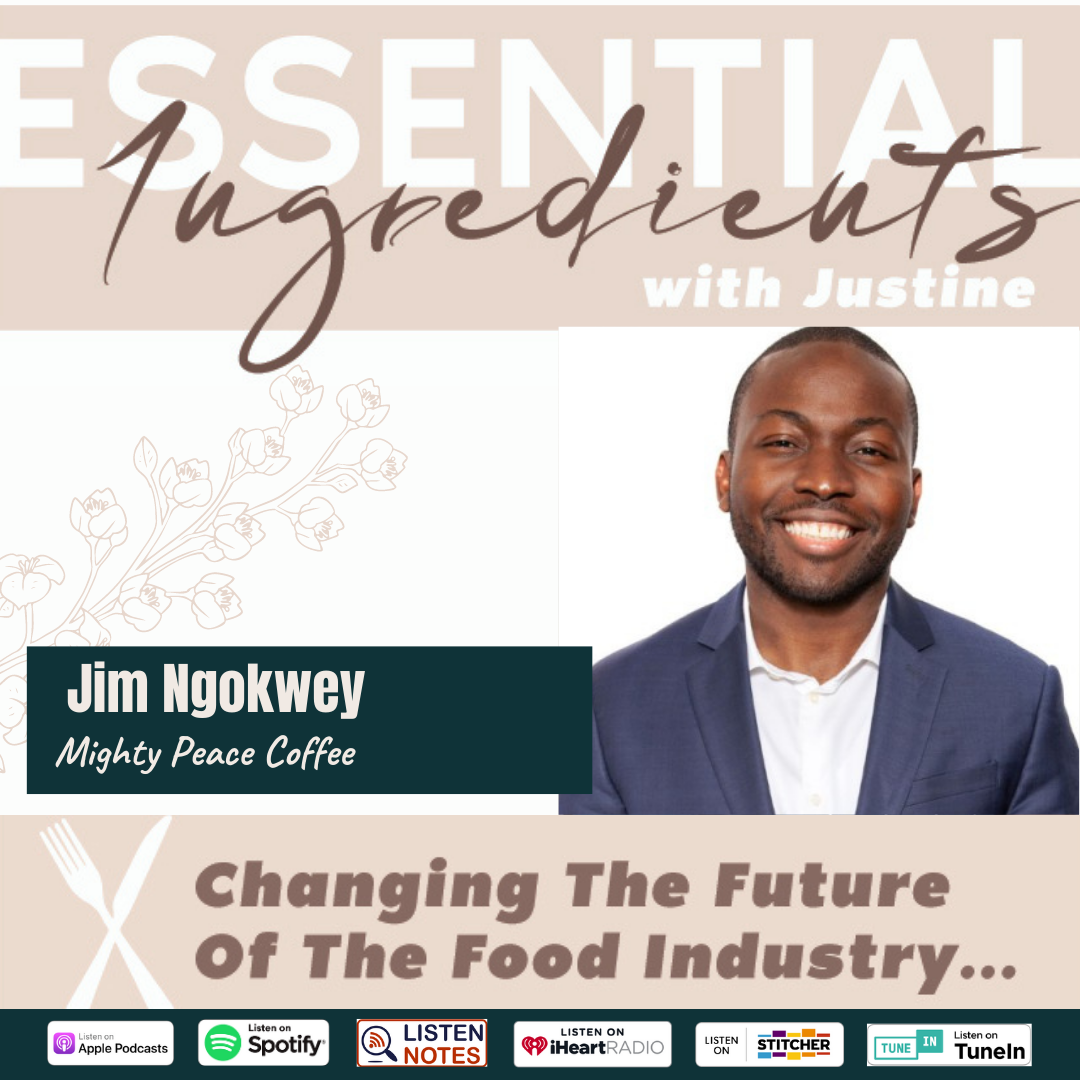
Jim Ngokwey · NextGen Purpose
Watch on YouTube
Impact the Food System in a Global Level with Jim Ngokwey
The Incorporation Method helps you turn what matters into practical changes that fit your life.
“Have you thought about how you can live your dream in a way that would make a difference? Jim Ngokwey shares how he was able to connect his passion with his heritage, bringing a great impact on a local product to be globally competitive.”
Full Transcript
Full conversation between Justine Reichman and Jim Ngokwey.
Good morning, and welcome to Essential Ingredients. I'm Justine Reichman, your host. Today, I have the privilege and honor to welcome to you, Jim. Jim is a former US alumni as well. He is the co-founder of Mighty Peace Coffee. And I'm super, super thrilled to have him here. We are connected through the UNIS Alumni, and we connected at an alumni event that we had, which was a virtual event that they hosted. I'm just so excited for you to share your story here. And I never like to intro my guests and read their bios off the back of a website or something because I don't think it does anyone justice. So Jim, would you do me the pleasure and just share a little bit about yourself, if you would, for our listeners?
Absolutely. Thank you so much for having me. I really appreciate that personally, and the platform to share my story with your audience. So thanks again.
My pleasure.
Last small correction. I'm not a co-founder of Mighty Peace Coffee.
Oh, my fault.
After some Ad investment a month after giving partner, I don't want to quite declare as a co-founder, but a Managing Partner at Mighty Peace Coffee. Were founded in September 2018. Been around for two years now. And honestly, it's been a wonderful journey of entrepreneurship. I always tell people, I feel like I'm literally living my dream where I get to work every day in a way that makes a difference in my country of origin, Congo. And really, being from Congo is a key reason why I got involved with my VPS coffee and the managing partner.
I loved that story that he shared with me. After we originally connected through the UNIS Alumni event, we just started chatting about Mighty Peace Coffee, and about what you're doing. You shared with me the inspiration for you joining Mighty Peace Coffee, and I'd love for you to talk a little bit about your journey there. And when you went to the Congo. Why, in particular, coffee was important to you.
Absolutely. So even before starting with a coffee, I'll talk about how I got to America first, and what my journey to America pushed me towards, and how he led me to Mighty Peace Coffee. So I came to America when I was about 17. So two years ago.
Just yesterday, right? Just yesterday.
Literally, actually 17 years ago. So I came to America. I finished high school in New York, UNIS, a great institution in New York City. And there was a big gap between when I first came to America to finish high school and college. Then I went back to Congo, about a 13 year gap. I spent 13 years away from home for multiple reasons. Again, first, I mentioned that I came here. I was about to be a senior in high school and I went to college. And there were multiple reasons for why I didn't go to Congo. But despite that big gap between me coming to America, me going to Congo, it was important for me to stay in touch with my country. So whether it was talking to my family there, my grandmother, my uncles, aunts, cousins, and also reading anything I got my hands on when it came to Congo, whether it's books, articles, anything I got my hands on. And the unfortunate thing, being so far from Congo and reading the news about Congo that the headlines are largely negative and they focus on, really the worst events happening in the country, whether it's articles about genocide, corruption or lack of governance, lack of transparent governance and things like that. And I wish I could tell you those things are false, fake news, but they're true. So those things have been the reality for Congo, things are much better now. When I first came here to America, what the reality is, these were accurate headlines, but I felt like they didn't tell the full story. And I finally told a very incomplete story. Sure, those things are true, but there is more Congo in the headlines. So what can I do as a Congolese, immigrant American now, to show a different side of that. So again, I want to mention that I finished high school in New York. Went to college, studied media. I thought, maybe to change the narrative, maybe I'll just write new stories. My first semester in college at Temple University in Philly was actually journalism. I was like, now, there's gonna be a journalist and write about Congo. But then I realized that I don't like writing that much, [inaudible] journalism school to be a journalist. No offense to anybody, I did that. But that was not the path for me. So I switched majors and declared a minor in business, because I really had a sense that business can make the biggest impact long term when it comes to Congo and Africa in general. I think when it comes to dealing with Congo's challenges, people usually go to charity. What charity, can I donate to to help children, help this, help that. All great causes, but I feel like they're not sustainable over the long term. So I always told myself, no, business is the way to go. So again, I went to college, I went to business school later. After graduating, I worked in Ecommerce, eBay. I work at healthcare at Siemens. Mostly, we sell YOUmedia, here in New York City. But during those, getting those corporate jobs, I was also doing some pro bono work and pro bono consulting for the African Chamber of Commerce. Because I know business was the way to make the biggest impact, but had to learn about business in Africa. So I was doing that in advance consulting, and I went to Congo Island there. 2017 was my first time in about 13 years, I was there for two weeks. So I got to spend quality time with my family, but my main focus really was to actually do a lot of research and understand the realities of business on the ground. So I talked to entrepreneurs, lawyers, corporate executives, anybody that knew about business in Congo, that was really my goal to gather information. So after spending just two weeks there, I came back to New York City and I wrote a report for the African Chamber of Commerce. The two industries highlighted were energy and agriculture. If we're able to invest in those sectors, we'll see a major change in Congo development trajectory. So my goal for this report was, okay, I know what industries to tackle now. It's just as easy, right? Just find some investors and take it with me to Congo. Most of us tells about coffee opportunities, energy, all that. Those come with me will invest in, you know, I'll change the world. But around the same time, actually, the State Department issued a travel warning that said: "If you're American, don't go to Congo. Congo is not safe, you're at risk of being a victim of violence. So don't go to Congo." So that was a challenge. As a result of that announcement, no investor wanted to come with me to Congo. I was like, trust me, I was just there, it's safe. But the State Departments says, we're not going to Congo. So I had to go back and look for other ways to make an impact. And around the same time, actually met all the founders of Mighty Peace Coffee, stereo partner now. We produced a film called When Elephants Fight. So we actually met both on a panel at Columbia University, discussing that film we produced. And that film title, When Elephants Fight is actually from a proverb that says, when elephants fight, is to grass that suffers. So basically, it was a Congolese proverb about really the impact. And it's an analogy that's looking into supply chain issues. So that film focus on mining in Congo. To put in perspective, Congo is the world's highest deposits of coltan and cobalt. There are minerals that are in every cell phone, every electric car, every iPad, so odds are on my MacBook right now. Documentary actually called out Apple, IBM, Intel to say: "Hey, you may not know it, but us your suppliers of these minerals actually causing conflict in Congo, what are you gonna do about it?" And to our surprise, the feedback in America was great. Apple intellectually vowed to be more transparent with their sourcing. Today, didn't do that. The film was on Netflix. It's on Amazon now. So again, great feedback in America, people were happy. But in COVID, the feedback was, hey, near those mines, we have great coffee. But people are afraid of coming to Congo. When it comes to calling to only hear about conflict, minerals, wars and things like that. So what really helped us is you helping us find buyers for our great coffee in America. Can you do that? So JD came back to New York to me yesterday, I was like, Look, I don't know much about coffee. I know business, I know Congo. And then agriculture is one of the sectors that can make the biggest difference in the Congo, so I'm in. We had a condition in August. And in September, I joined the team. And here we are now, two years later, the Mighty Peace Coffee is one of the fastest growing coffee companies in the US. We had some big growth this year despite the challenges. And we're very happy to really be putting all these coffee on the map in the country. And that's really why I joined because it was an opportunity to do business in a way that impacts my country in a positive way.
Wow, that's a really impactful story. Ever since you told me, I've wanted to share it with people. I was excited for you to share it with our listeners, because it really talks about the future of food, and it talks about the impact you're having. Not just on a local level, but on a global level. How you're connecting your passion with your heritage, and bringing it here, for everyone to share and making that impact extends beyond just the local community, but bringing your local community from the Congo here, and just really connecting all the dots. So I really, it's just so impactful for me. I hope that our listeners get a sense of it. And maybe, if they watch the YouTube video, they'll get a sense of it. Because when I watch your face, and I see the emotion in it, and I see the authenticity, it really comes through. So for me, I know that it comes through when they're listening to you. And when they are listening to you, they'll understand this. But I hope that our listeners will take a minute and download the episode so that they can also watch, and listen, and hear, and watch your face. I really hope so. Anyway, let's move on, what was the biggest aha moment for you when you realized what you were doing was having an impact on the future of food?
Honestly, it is twofold, both on the supply side and demand side. The supply side, hearing directly from farmers about how they're able to use their coffee earnings, that's really, being able to hear them say directly, because I was able to sell this coffee to you or not, I'm able to pay my school, my kids tuition for this upcoming semester. We're able to pay back the best we able to deposit on the house. Really basic things that we really all want, want to be able to do these things we all do. And hearing farmers say that, because of coffee, able to do that was like, wow, just to business and to find the men for their great product, we can make a real impact where it's not charity where people work, we get compensated fairly. So hearing that from the supply side, from farmers saying that was a big aha. Like, it's a feel good story, but also a real story that there's a real people with real money getting their hands up, enabling him to make a real thing, a real impact in their lives. So I think that was a very big aha moment for me. And really, on the demand side was talking to clients here and people that are in the coffee space, and then saying that, when they like, they really appreciate transparency. Because a lot of people I think now, it's cool to talk about transparency from a marketing standpoint. But a lot of times, there's the marketing speak, there's not much substance behind this. When they talk to us, we can show them the numbers, we can call the people in Congo. Like with WhatsApp, anybody wants to talk to you in Congo, we can make that happen really quickly. So I said, well, I was talking to a new client out in Cleveland. And we were basically doing a zoom with our chief quality officer in Congo. They were saying that they rarely do that. It's usually a good third party somewhere else that maybe isn't read about, Congo or another coffee country, the fact that they were talking to somebody in Congo. So let me know, what happened yesterday in the field? Like, it's very rare. I think buyers also are happy to have transparency be a real thing. And I'm just a marketing buzzword. I think that aha moment that basically people here want it, and people in this having a real impact in Congo, I think was an aha moment. I'm very happy to experience, as recently as last week, actually.
Well, I can imagine if I was behind the counter selling the coffee, I could share a story because I heard it to somebody. On a personal level, it's personal for me, and I can share that with the customer. And that connects the customer more personally, and then they want to buy something because, wow, it makes it personal for them. So I think it changes the dynamic for people. It's not just something that they're reading, they get to really connect with the story. So I'm curious, I know what your aha moment was, but how does your aha moment connect with the impacts that you're trying to have on a personal level?
So when on a personal level, you mean, how I want it to be impacting the people we work with in Congo myself?
Yeah. For example, you've had these aha moments when you've realized you're really having an impact. And then you have these goals that you've set up for yourself and for the business, and you're really making it happen. But how are you making sure that you're staying so connected, because you are.
Honestly, I think, literally regular communication every day. You talk to our partners in Congo,they didn't tell us what's happening in real time. If you share a coffee symbol with a buyer here and he says you love this thing, like this as much I can share in real time farmer teams in Congo, and the next harvest probably be able to implement their feedback as possible. So I think the thing is technology makes a big difference. The fact that I can talk away in Congo right now and get feedback to a question that was asked 10 minutes ago by a client in LA, that makes a big difference. So being able to really be that bridge to connect the people that are working hard and feel the best possible coffee to the business owners here that are trying to provide coffee in their communities, I really feel like every day is an aha moment. And it makes me want to work that much harder. Because I think that the more we can do, the more impact we can have in Congo. So it actually makes me want to work harder.
I can imagine, because you're getting that direct feedback, you're hearing directly from the people the impact it's having, and you want to do more, you want to fix more problems, you want to have a greater impact, and you want to continue to see the success. What's more motivating than that?
Okay, I can't think of something.
I mean, I can't think of anything more motivating that would get me up in the morning.
What I do every day, I know it sounds a little cheesy, but I do wake up with a pep in my step, I think my wife gets tested that.
I feel the same way, I do. And I feel grateful to have that opportunity, and grateful to have found something that really motivates me every morning and allows me to have an impact on the world and be able to share stories and inspiration for other founders, and create a movement that really will impact the future of food. So it's taken a while to get here, but I feel grateful now that I'm here. So now, we look back at 2020. It's been a challenging year for so many, for everyone. I don't think there's a person that hasn't been affected by this last year. So I cannot ask how has COVID impacted your ability to have this impact?
On us, I think the most challenging part is probably earlier on. I'm going to see March and April, you're like, we're expanding Mighty Peace Coffee, we're founded in September 2018. And if literally in March 2020 is the global set down. Like, how are we going to make it through this? So it was just from, we had figured as a team, we had to look within and really get back to why we got into this in the first place, and find a way to be supportive to our partners in America and in Congo. Whether it's being flexible and things of that, but finding a way to still be there for them and continue to grow our business, and most probably added value to our partners in Congo and in America. So definitely, very challenging. But when I said earlier, probably the scariest I think probably was scariest for most people. And in terms of the biggest changes, I think a big one is probably most of logistics in Congo because of the distancing guidelines, things that may usually take two weeks, take a month now because you can't have as many to go closer--
The supply chain has been affected. So pre cut that your supply chain was a little bit more streamlined, you would say?
A little more streamlined and took less time. So maybe assessment takes two months to come, leaving Congo gave him maybe half months, three months.
And I don't want to say streamline because it's not really streamlined. It's just that there's more obstacles now because of COVID. And we're more, they put more processes in place to protect everyone. And I would imagine that because of everything going on, there's just more challenges around the supply chain to access.
Absolutely. And because, especially when it comes to Congo, Congo is almost landlocked. And the coffee in the region where the coffee grows actually has to go through our other neighboring countries to export it. So we have to go through other countries. And if those countries are having stricter or less strict, COVID-19 rules, it also impacts us. I know that there was some department that reports in Kenya, actually because of COVID, we're actually exporting more from the port in Tanzania and other East African. So we have to be flexible and find ways around solutions. And because no matter the situation, people still drink coffee. So how about we were just trying to find a way for them to drink coffee from Congo? What are you drinking right now? What was your coffee?
It's not your coffee. But I do hear, I think you mentioned you're gonna send me some. So I'm excited to try it. This coffee is from Colombia. It is good coffee, but I'm excited to try the Mighty Peace Coffee. In the meantime, can you talk to me a little bit more, and tell me a little bit about what you're planning for post COVID? Is your plan sort of gonna stick with, given everything going on, are you just being very cautious about how you plan for the future so that you can always be protective, if you will, given we don't know what's going to happen with COVID. So that things won't ever go back to what was normal. But there really is a new process that you're creating, I guess, is what my question is.
The destiny in terms of planning, we try to plan that further ahead. It's tough, being a new company whereby initially we just take an upfront risk and hope we're able to sell some coffee out of this. But because of COVID, it's definitely delaying that. But nevertheless, we have to still be cautious, yet still take risks. Because again, if you're too cautious, then you know we're not going to make it as a new small business. But most importantly, we really invest in relationships. I think because coffee is a commodity, some people may view it as very transactional, but we take pride in really building relationships. And I think it's gonna be important for us to continue to build on those and strengthen them. I think to really understand what our partners need here, so we can better support them until we can all grow and make it through these challenging times. I think really investing more in relationships to really build that trust without partners.
Basically, my question is pre COVID, there was one process in place. Now, as you plan post COVID, are you creating a whole new process to take into consideration all the new obstacles and challenges?
I think because we're so new, it does a lot of processes that we know are always very flexible and very new to us. So we always, it's less difficult for us to just change the process another because everything is still so new. So prior to COVID, we have been around for a year, we're literally learning. Everything was new to us. Green coffee here, how do you sell coffee? I tell people about Congolese coffee. So because it's so new, I think that the biggest change is really about a little bit about long term planning. And it's hard to do that because people don't know how much the coffee they'll need in six months, a year or more. So planning further ahead of things is the biggest change. I think a big challenge with COVID is that a lot of other buyers are like, hey, we have all this coffee here that was supposed to sell out last month, but because our coffee shops are closed, you have a lot of extra inventory. So I think planning ahead of time so you're not the one caught, so you don't have excess inventory is the biggest process change, really planning ahead of time and forecasting.
All right, Jim, we're gonna have a quick break and have a little message from our sponsor. So bear with me one second. Listeners, we'll be right back after this message from our sponsors. Okay, I want to welcome everyone back. Thank you, Jim. Thank you listeners. I'm glad to see you guys are all back here. We are going to get back into this conversation with Jim, and we have some more questions. We're gonna have a recipe for you. There's a special at the end so make sure you stay tuned for the whole episode, make sure that you can claim a special coupon code for your Mighty Peace Coffee. You won't want to miss it. So Jim, your products have a high bar for ingredients. What was the ingredient sourcing process like for you?
Honestly, I think the key to the process is our team. One of our team members and partners in Mighty Peace Coffee is actually based in Congo. She's an agronomist, and she's done a lot of coffee training and coffee tree grading. So basically, the fact that she's in Congo talking to farmers, because she gets all the credit for that.
All right. Can we just go back? Agronomist?
Yes.
So for our listeners that are not familiar with what an agronomist is, can you talk to us a little bit about what an agronomist is?
She basically studied land, soil and how to grow crops the most efficient way in college. Considering the ground, the engineer and in hard knowledge of the soil, particularly Congolese soil, and really how to improve from one season to the next, I think the key advantage of us and for us, and what enabled us to always improve the quality of coffee to bring into America.
Okay, so she's very qualified, clearly.
Absolutely.
Okay, I didn't mean to cut you off there. I was just excited to share, I wanted to share with our listeners so that they were on the same page. Because I know often we talk about agronomists and other really industry leaders, researchers and people that a lot of our listeners may not be familiar with who these people are, so I just want them to be on the same page.
Absolutely. My pleasure. And I think what makes the sourcing process really seamless and efficient for us is the fact that one of our team members and partners in Mighty Peace Coffee, her name is Linda Mugaruka. She's an agronomist engineer based in Congo. She has a master's in agronomy, so she's really an expert in Congolese soil, harvest cycles and crop cycles. And her being on the ground, talking to the farmers regularly, the cooperatives, and being able to test the coffee on a regular basis enabled us to bring the best possible coffee each time. So she gets credit for that.
I want to meet Linda. All righty, maybe you have a little clip of Linda that you can share so that they can include that in the video. I mean, our listeners won't get the advantage of hearing a little bit about Linda, but those that check out the YouTube video on our YouTube channel, which any of you can, we will make sure to include that in the YouTube video. It'd be great to even include a little clip from the Congo from the farm. I love that
The farm, the river, the lake nearby.
That would be great. So artisanal coffee is a highly competitive space, what are the market challenges and opportunities for anyone who wants to work in this space?
I think, especially given the current situation with COVID19 pandemic and how it's impacted coffee consumption, definitely two major opportunities. And because of different state regulations in terms of how many people can dine into and things like that, unfortunately, many coffee shops have had to close or really drastically reduce their hours. but the thing is, despite these changes, people are still drinking a lot of coffee. So coffee consumption as a whole has not changed, It's just how they do so. So I think the major opportunities if you're starting to get into the coffee industry right now, I think the two main avenues are so important to have a strong Ecommerce presence or have strong partnership at the grocery level. Because basically, these are the two avenues where the highest volume of coffees are being sold. Through grocery stores or online. So I definitely recommend focusing on doors, because from a coffee shop standpoint, it's been really tough for coffee shop owners lately.
I love that. So three tips, Ecommerce, specialty shops and remind me the third one.
Ecommerce, grocery stores are the two major avenues. But to really differentiate yourself, you have to have a great story about yourself, you can't just be a coffee brand that--
No, it's true. I think you really do need a great story. And there's a lot of great stories out there, so you really need to make your story special and differentiate. So it's true. I stand in the grocery aisle reading each one. Looking at the bag, looking at the name, does the name resonate with me? I bought one yesterday because the name was Bauhaus, and I liked Bauhaus. I like the furniture, it's mid century modern, literally. So you never know what resonates with anybody. Can you share three to five tips as a better for you food entrepreneur for some of our founders that are listening?
Absolutely. I think one is to always remember why you're doing it. I think you can experience challenges along the way, it's inevitable. So I think when windows come up, if you know exactly why you're doing it, I think being able to send yourself around that will make a big difference in helping you continue forward. Really having a good team. And I can't stress enough the fact that the people you work with every day, if you don't get along, you have very different visions. I mean, it's gonna be hard to make you work over a long time. So definitely, make sure you have a strong team. And make sure also that it's a product you believe in. Though necessarily I have to use that product every day, but it has to be something you believe in. So that when you talk to another investor, or potential client, or customer, that you're being authentic. Because I can't imagine how difficult it would be to build a company, if you don't believe it.
Yeah. You can see it in your face when you're talking about it if you don't believe in it.
I think being authentic and be a great team, knowing your WHY things are the three most important things. I think no matter what you get for the product you're working on, if you have those three elements, you'll be in good shape.
Yeah, I would agree. I think it's so important to be authentic. Because I don't know about you, but people can read my face immediately. So if I'm not being authentic, you know that I don't believe in it, that I'm not being authentic or transparent. And I think the minute you can be transparent, authentic and true to yourself, people get on board, people will be more supportive. And you will be surrounded by a truckload of people that are right behind you. It's so much easier to create a movement, a team and a group of people that will support you because they see what you see in it.
Exactly.
So it becomes infectious.
I wholeheartedly agree.
It becomes infectious. So you've been home for a good nine months now as we all have, I imagined. I'm sure as we all have, we've all come up with our favorite recipes. Do you have a favorite pandemic recipe you can share this cold wintery New York afternoon for you because you're in New York
There is one that actually, I have not used it yet, but I've been reading about that. I'm actually very tempted and trying public--
Can you share?
So Hot White Russian.
I got an Old White Russian.
Add coffee and use Mighty Peace Coffee or something. I'm gonna try this holiday the Hot White Russian Soviet, brewed coffee with some kahlua, vodka and some cream. So this stuff is I'm gonna try.
You have a recipe that maybe you can share with our team so we can upload it to the website? So that people, when they want to order their Mighty Peace Coffee, they can then reference the website to make their Hot White Russian.
Absolutely. I barely said that.
Wonderful. So just a funny little anecdote. When I was 13, we did the Bar Mitzvah in the Bar Mitzvah circuit. Because, well, I'm Jewish. So that's what you do. But my cousin who was a couple years older introduced me to the White Russian. So of course, we're 13, we can't really drink. But she introduced me to this White Russian and I used to like the White Russian. But I never knew that they were hot. Like, we had them cold. They were very milky, and didn't really taste it. It tasted like ice cream. I'm curious now, how many blends are there of Mighty Peace Coffee?
We started with two. We call them offering, [inaudible], respectively mean solidarity and let's go in Swahili. But next year, for March, we're going to have six different single origin offerings. So not blends, their coffees are coming from this particular region in Congo, and we don't blend them to others. And they have, because of their region, the volcanic soil and other soil components, we have a really unique flavor profile.
So what's your favorite offering?
The most one that we actually drink the most.
So that's your favorite offering.
Yeah, the origins of vision in Congo, in the South Kivu province. When you do a light roast with that offering, it's very, you can get the fruit flavor profiles.
Wonderful. So is there anything that you want to offer our guests before we sign off today?
Absolutely. The entire Mighty Peace Coffee team is very, again, very grateful for the opportunity Justine, we want to share with your audience a 15% discount code. Just go to mightypeacecoffee.com and get yourself a Peace package. So we call our coffee bags a Peace package, you can do so with a 15% off if you use code NextGenChef. NextGenChef 15% off of the Peace package. It comes with a 16 ounce bag, one pound bag, plus a four ounce sample you can share with your friends and family, like coffee as well.
Thank you so much, Jim, for joining me today on the Essential Ingredients Podcast. I want to thank our listeners for joining us. If you like this podcast, please do not forget to subscribe to the Essential Ingredients Channel. You can do that on iTunes, Spotify, any channel you wish, please download the episodes. If you want to hear something in particular, please leave us a review. Let us know what you want to hear. We are here every Tuesday with a new episode, so we look forward to seeing you again. And as well, these episodes are live on YouTube. So if for some reason you can't download the podcast or you want to watch us in person, please do so on the NextGenChef YouTube channel. Thank you all for joining us today for this episode of essential ingredients. Thank you Jim for joining us. If you guys have not subscribed to the Essential Ingredients, please do so. We're available on iTunes, iHeartRadio, any of the channels. And you can download all the episodes, we will have a complete first season uploaded by the end of next week, and season two will be starting January 5. So if you would like to watch any of the videos, they are available on the NextGenChef YouTube channel as well. We look forward to having you here with us every Tuesday as a new episode drops. Thank you all.
Share This Episode
Enjoyed this conversation? Share it and tag @nextgenpurpose
Listen on Apple ▶Listen on Spotify ▶Your Host
Justine Reichman
Founder & CEO of NextGen Purpose. Host and Executive Producer of Essential Ingredients — 11 seasons, 330+ episodes, and a growing movement.
About Justine →