Jian Yi · NextGen Purpose
Watch on YouTube
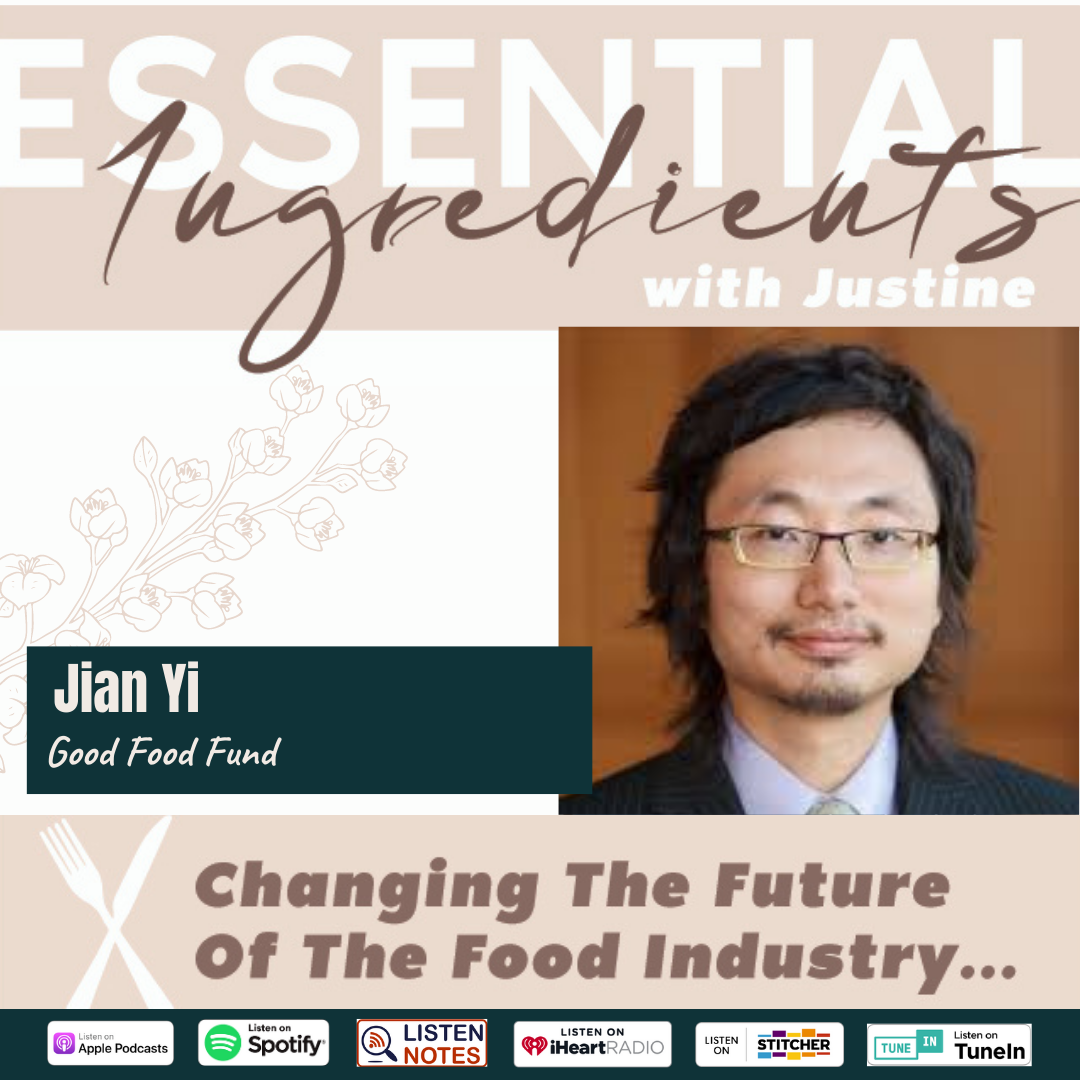
Good Food for Public Good with Jian Yi
The Incorporation Method helps you turn what matters into practical changes that fit your life.
“We all love good food! In this episode, Justine and Yvette interview Good Food Fund Founder, Jian Yi. Listen as Jian shares 3 of their initiatives in transforming the food system and why we should start reimagining the market space.”
Full Transcript
Full conversation between Justine Reichman and Jian Yi.
Okay, welcome to Essential Ingredients. I'm Justine Reichman, your host. Today, we have here Jian Yi, I'm just so thrilled to have you. We also have Yvette, and she was the one that brought Yi to this conversation. They met a couple weeks ago at a virtual conference, and I'm so pleased to be able to have you here today and let you introduce yourself. Because again, as I said to you earlier, I just will not be able to do you justice. I'd love for you to just introduce yourself to our listeners today.
Thank you for having me, Justine. My name is Jian Yi, you can call me Yi. My background is filmmaking. I'm also the founder and president of the Good Food Food under China Biodiversity and Green Development Foundation.
Wow. I'm super excited. I mean, just from the minute, Yvette mentioned that she had spoken to you and she was talking about the Good Food Fund, and that you launched this. And everything about it, from promoting a sustainable food system, and getting the Chinese government involved, and being able to create a system that would not only talk about this, but make it accessible is something that I think people don't think it's possible and people don't talk enough about. So I'd love to just hear from you a little bit about what inspires you. How did you come up?
Yeah, the next generation, the next generation of chefs, the next generation of people, I first became aware of the issue when I was making a documentary on the environmental impact of the meat industry. And I was alerted to this fact how our diet is affecting our environment and affecting the chances for future generations. So that was my entry point, and that's what actually keeps me here in this space.
So before we get too far into the Good Food Fund, for those listeners that are trickling in and listening to the podcast that aren't familiar with it, can you tell us a little bit more about the Good Food Fund a little bit about its fundamentals, and what your goal is for it?
Yeah. Here in the Good Food Fund, our mission is to promote good food to enhance public health, animal health and health of the planet. So we've been working very hard for system transformation in China. It is a very, very new topic. We are also a very new organization. Now we've only been around for almost four years so we've been mostly doing two things. One thing is to identify and foster leadership among different stakeholders, including chefs and people who cook at home, community leaders, and policymakers, and academia, and people in the industry . Second, we've been providing what we call public goods,to the community, to the space including an annual good food summit, an annual good food festival for chefs, and an annual food forward forum for food services.
That's a lot. You do these, these are annual summit or annual--
Right, right. Once a year. Yeah.
Can you go back, I know you mentioned three, right? You mentioned three, can you go back to the first one, remind me what was the first one called again?
Good for summit, the Good Food Festival.
Can you tell us a little bit about the Good Food Summit first.
Right. Oh, wow. Back in 2017, we were very involved with the vegetarian movement in China, which I call is the second wave of the vegetarian movement in China. The first one being in 1910's. So exactly 100 years ago. And then the second wave happened in 2010's. But we realized back then in 2017 that people were not connected, the dots were not connected. People who work to advance vegetarianism in China, they were very keen on pushing forward to a vegetarian agenda. People who are working for ecological agriculture, they were very keen on reforming the way we produce our foods. And the policymakers as well. There's no like integrated governance on food issues. So we realized that we need to connect the dots. So we, for the first summit, first edition of the summit, we put together vegetarian activists and activists who work in ecological agriculture, and tried to create a conversation during the three days of the summit. And that was quite a success so we kept doing that. We kept doing that for four years now.
Wow. Can you share some of the impacts that you've had by doing that? Maybe before you had this summit, and before the conversation, what were people thinking when these conversations were separate? And then when you brought them together? What was the impact that you had? What were the realizations that people were coming to?
Yeah. I can give an example. 30 years ago, when people in China started to talk about environmental protection often than not, they were kind of confusing the environmental protection with sanitation, like, how to keep the city clean, though the leader, and I know this is very important, but that's not whole picture. So after we've been, our economy has been developing, our environment has been deteriorating, and our understanding of environmental protection hasn't been deepening. We realized the human, or mental production, or environmental sustainability is actually a systemic issue. Samething with food. Still, even up until today, people most, the general understanding of food related issues is very narrow on food safety, which is also very important. But food safety is not the issue alone, and is not definitely not the only issue. So what we have done without summit is that we make a case for systemic change of our food system, which we think is very important, and which is connected to all the issues that we are talking about, including food safety, healthy food and sustainable food. So I think we have done a relatively good job in that. And also the second relative success. When I say relative, I mean, this is still a cause that needs a lot of time to advance is that we connect the people, we can ask people who are working in different areas and so we can look at these issues together and work together.
I think it's super important. If you're heading this, I'm sure it's gonna go a long way for you. Every year that you grow, you're going to have new findings. Do you think that you know you'll extend beyond China?
We did. We did get requests from other parts of the world and saying that they are very interested in learning from what we have been doing in China. And they would like to start something similar in their own country, something like a good fit program. Right now, we don't have a lot of capacity to really expand to other countries, but we would love to help people who would like to do similar things, make similar efforts. And also, we think what we do here in China is very important for the rest of the world because China is the largest consumer and producer of food. And also China consumes 1/3 of the world's meat. So what we do here in China has a significant impact on the rest of the world as well.
Yeah, it's true. So many of the things that are happening today, so many of the initiatives when we are talking to people around what is it cultivated meats eat, and the impact it's going to have, they look at China. When they talk about planning or things, when they talk about the impossible burgers and as they change that whole cultivated meat industry, they look at China as the impact it's going to have is tremendous because of the size of the market. I don't want to detract, but because you were talking that there were three initiatives that you have when we spoke about one, I'd love to just hear a little bit more, if you could tell us a little bit more detail about the other two, if you would.
Sure. And then we have the Good Food Festival. The Good Food Festival targets chefs because we think cultivating leadership among the chefs for healthier and more sustainable food is extremely important. Because everybody knows chefs, they are the experts, they have the potential to be the leaders. Not just leaders of how we can make tasty food, but leaders of lifestyle, because food is so central in our lifestyle. So every year, right before the Chinese New Year, because that is like the most important festival for Chinese population. We normally hold the festival two weeks before the Chinese New Year before everybody gets so busy and traveling. Yeah, so we have kind of a national competition for chefs. And they have to follow certain guidelines, we actually use our good food pledge as the guideline. The Good Food Pledge, I can explain a little bit is our effort. Yeah, is our effort to create something similar to the UN SDGs, the United Nations Sustainable Development Goals. So we would like the pledge to be like the UN SDGs in the Sustainable Food space. It contains eight principles, including plants forward, animal welfare, healthy cooking, supporting local agriculture, reducing food waste, recycling biodiversity, and food education. So basically, if you follow these eight principles, you're largely supporting a more sustainable consumption pattern. So we use that as a guideline and guiding principles, and the chef's have to cook meals in that way. And then we select the finalist to come to Beijing and we have a final competition. And then we select the winners. The winners, they will then champion the food that they create in their fellow contestants create. And then these recipes will be shared nationwide for the Chinese New Year because the Chinese New Year is so important, and people will eat so much during the festival. We want them to eat more healthily, more sustainably, more responsibly, as well.
I love that. It's experiential as well. So you're creating this whole experience, you're walking them through the process, it's very mindful. And then at the end of the day, you're supporting them to create that experience. And then you're giving the end consumer an opportunity to also experience it. How much of the messaging, do they know that? Do the consumers know that that's the experience they're getting? Do they understand that?
Yeah. We help them contextualize why we are doing this and why this is good for themselves as well. It's not just good for the larger good, but it's also good for their own health and the health of their family. And we made it very interesting as well. Like this year, in January, we were so lucky. We're so lucky. Just a couple of weeks before the outbreak on COVID, we were able to do this. We didn't know that something like this was already going on in the city of one. We were in Beijing. Yeah, so we had this latest one in January. We had 20 finalists coming from all over the country, and we put them 20 in a local village in Beijing with 20 different families. So they basically conduct their final competition in a village family. And the chef's win didn't know what we had for them until they walked into the kitchen of their family, and they saw on the table, those were the things they needed, they have to cook with. So what was fun, and it was very creative because they have to do something within 90 minutes.
Wow. I love that.
Something that impressed us.
So maybe, I mean, I know that other countries are asking for your support and guidance in doing this, are there any tips that you would give them or ideas that you might recommend if they wanted to be able to start to create a program like this to support a more sustainable food system for their country?
Sure. Well, I would suggest that to be as inclusive as possible, try to reach out to the biggest possible community out there with chefs and also try to utilize internet, social media. So like for the last one, we work with going to kitchen, which is the largest recipe sharing app in China. They have a few million or more than that. I think 10 million, more than 10 million subscribers. They were so generous for us to use their resources for free. They promoted our events on going to kitchen app and hosted all the recipes. So that was tremendously helpful.
Well, I think we'll make sure to add that to our notes so that all our listeners can check that out too, just so that they can be abreast of all the resources. I know that you also, you were talking about COVID. You did a lot of this just pre COVID. Obviously, COVID has had a tremendous impact for a lot of businesses. I'm curious to hear how COVID has impacted your ability to have this impact. What did your process look like, pre COVID, during COVID? How are you planning for post COVID?
Yeah. Well, I personally was affected because I went right after the Good Food Festival in January. My family and I went to Nepal for vacation, and then now, this happened. So we were not able to come back until the end of July. We were stuck in Nepal for more than six months. That's not a bad thing.
At all.
Not a bad thing. Nepal was a good place to be stuck in. We were able to spend a really long time on a local eco farm, organic Farm. That was really fun.
So what took you to Nepal? Was it family? Was it friends?
Just vacation. Yeah, just a random vacation. We just say, okay, l[inaudible] before the Chinese New Year. And we come back during the Chinese New Year. And then that happened. We were not able to come back in February as we had planned, but it was fine. It was relatively affordable. If I was stuck in New York City or in Mumbai, somewhere, yeah. So yeah, and we love Nepal. We love the local culture. And we will be able also to learn a bit more about a more traditional agriculture in South Asia, that was really challenging. We appreciate the experience. So that's a personal level. My family and I basically missed the COVID 19 that was happening here in China. We were in Nepal. And when they started to escalate in Nepal, we actually came back here in China. So that was the lucky part. Yeah. So the whole year has been so disruptive. We were not able to travel for our work. But luckily, we were able to do most of our work online. And we were also able to start some new initiatives like Mama's Kitchen, as well as the wet market, the wet market reform. Because after the outbreak of COVID-19, I got a lot of requests from international media asking me for my comments on wet markets because of his association with COVID. So basically, the idea was that people in the West would demand in China to close the wet markets. And my response is, number one, we don't have a term in the Chinese language, like the wet market, we don't have that term in the Chinese language. We have 10 different words for this kind of market. So you can say that all the markets at the same, all wet markets. Because they're marketing in Wuhan, where the first case of COVID-19 was identified is actually a seafood market. So it's basically an animal market. But most markets are not like that. Most markets where people can access fresh produce, it's very similar to your Farmers Market. As Chinese, we can't imagine to close down all these markets just because they are called wet market in English. Second, we think there is room so we don't think we need we have to close down these markets. But we do think there's room for reimagine the role of these markets, and reimagine how these markets can be better places for food and to prioritize health and sustainability. We actually reimagined these markets to be the good food urban hub that connects producers and consumers. So that's what we've been doing. We actually just edited a handbook that we call the Good Food Handbook For Revolutionising Wet Markets. And we actually redefine the English word WET as W-E-T capitalized wet. W stands for Well Being, E stands for Ecology, T stands for Transformation, which really captures what we hope this markets to be.
Is it W-E-T wet?
Yes. All capitalized? Yeah.
All capitalized. What's confusing for me in the beginning, because that also is the workforce education and training committee.
I didn't know that. We were just reinterpreting it.
Worse. But I'm just thinking, wait, that's the workforce. I was on that committee.
Oh, yeah. Such a thing. Yeah. Yeah.
Just so you know, so you can keep it in context when you're talking about it so people don't get confused. But I did for a second.
Yeah. So tell me--
It sounds like you guys have a lot going on. And given everything was COVID, you were able to make the right pivot and create new opportunities. What happened to those three large initiatives that you're working on? That really does seem like they're very much in person, community driven events. Did you put them on pause? Did you put them online?
Yeah.
What do they look like?
There's good news and bad news. The bad news is that we cannot convene offline as we nominate to because we really appreciate the contacts of people already on site. But the good news is that we were able to hold our fourth edition of the Good Food Summit in late October this year. We still had quite a successful event. We had more than 50 speakers from around the world. Guess what? We had much more of an audience this year because of the internet. We had a live stream, so we had more than 300,000 people watching.
Wow.
Yeah. 300,000 people watching, we didn't know, we didn't expect that. And so next year--
What did you expect? Because I would never expect 300,000? That's huge.
Yeah, for the last three auditions, we usually have 300, a little over 300 people on site for offline events. So that was what we were expecting.
Okay, so what did you expect online? What was your guess? In your wildest dreams do you expect?
A few thousand.
A few thousand.
A few thousand. Yeah, yeah.
Wow. A few 100,000. Were you prepared for it? Were you ready when they got there?
Yeah, it was a live stream. So we weren't on a Zoom call. Zoom call, you can't manage that. It's still overwhelming. It was live stream so they could still ask questions. They can still go type in their questions, but it's not like that we have to manage, like people getting in the chat room, things like that. That wouldn't have been possible. But next year, next year, if circumstances permit, we'll still have an offline event. We will definitely add a live stream.
Well, that's amazing. Well done.
For the festival thing, we don't know how we are gonna do this year because we can have a big gathering. Although, if you look at me, and I'm here in the city, it's like any other year, nobody's wearing masks. It's like really normal here. Yeah. The market is open like any other year. But this year, we are doing something really exciting. In lieu of our offline event, we are doing an end of the year 24 hour relay on December 31. So we have 24 time zones around the world. So people will join at 7:00 PM at their own time zone, and the showcase was on their plate as the last meal of the 2020. Because it is such a special year so we feel like we need a proper farewell dinner. So it says farewell dinner. And Mama's kitchen, which is our project, Earth Relay. Yeah, of course, you can help us promote. And we do have some core partners. You can be a partner in this.
We'd love our listeners to know how they can participate. Tell us more.
Well, definitely, definitely. We will encourage as many people to participate as possible. But we will ask them to, there are two ways to participate. One way is they will create ways they can or showcase their plate. And second, we will feature because we only have certain capacity to do our live stream. So we have featured them, feature about five to six people for every hour,every time Zoom, per se. They can join with Zoom. So those people who are selected as the featured people, they will join by Zoom. And then we do live stream with the top Chinese social media. So we're expecting like a million people to watch this one, at least in China and around the world.
Yeah. Okay, so you're gonna have to tell, we want to be able to share this information with our listeners. So once you have the information, we'll put that in our show notes. After this call, after this podcast, you and I will then talk about partnerships. So in the meantime, I want to continue talking a little bit more and learn a little bit more from you. I know that you've interacted with numerous key stakeholders all over and across the world as activists, filmmakers and presidents of the GFS, do you think there is a need to establish an effective international coalition to accelerate global mass adoption of healthy, sustainable and ethical food? What would it take to make this happen?
Yeah. Oh, for sure. For sure. Nobody can change this alone. No country can change this alone. The food system is a global system. For example, China now, what we consume in China impacts the rest of the world. Where does the feed for the factory farms come from? From Brazil, from somewhere else and vice versa. What is produced and consumed elsewhere affecting China as well. So it has to be a global effort. And when I say global efforts, because I think it's not just international efforts off the states, the government is very important. They have a very important role to play. But it's not just a responsibility, and also the capacity of the government to change. This is the people, all of us people, industry, media, academia, young people use denaturation, and mama's parents, grandparents, as well as policymakers. So it has to be a concerted effort. Otherwise, there's no way you can change this. And there's good news that's been used. Next year, the UN is going to convene the first ever food system summit, as they call it. It's a very high level summit is promoted. It's actually an initiative promoted by the Secretary General himself, and supported by all the major UN agencies, including WHO, UNDP, FAO, World Food Programme and others. They are all part of this. So it's a very high level summit and involves all the member states. I'm also personally involved in this so I personally think for organizations like us, or for any other fellow activists who work in this space, this is the opportunity because we've been working on this for a few years. And if this is not the opportunity, when is the time?
Yeah, no, of course not--
The first time humanity sat down together and discuss what food we should have on our plate.
I would love to chat with you further about that and see how I can also get involved in that. I think it's a great initiative, and it's a great opportunity for us to be able to collaborate and work together. I know that there's so much opportunity there that was just able to join us. She was in transit before participating on the call, and I know that she was really eager to participate in this conversation. So I want to give her an opportunity also to chime in and participate. I hope you don't mind.
Yeah, sorry. There was one lesson, a question I didn't hear.
That's okay. I said a couple of things. One was I would love to participate in that and talk offline with you after this, not necessarily, and participate and see how I might be able to get involved in that. Having gone to the UN school, as I mentioned, it's always been a dream of mine to be able to connect whatever I did later on in life, going back to the UN. So that's on a personal level. I really love to be able to connect Essential Ingredients and NextGenChef with this initiative. I also said that Yvette likes to join us. She had been participating on this call on this podcast through the phone. She was traveling, but she was very excited to be able to put this call together, it was very meaningful for her. And I hope you don't mind if she joined us. I wanted to give her an honor, also to be able to ask some questions. She participates sometimes in these podcasts with me, and our listeners are just getting to know her as well. She is really interested in sustainability and building a healthy food system, and I enjoy having her perspective. We are both from a different generation, and allows us to reach different generations and ask different questions with different experience and expertise. So with that, I hope you'll chime in with a couple questions and be able to share some of your thoughts with Yvette.
Cool.
Absolutely. So as a Chinese citizen living in the US, it is a very exciting time, especially for someone who's interested in the space of animal welfare or alternative proteins, if you may say. I think he has mentioned a little bit, discussing a little bit about the nomenclature of meats in Chinese. We were talking about the wet market, how there is not a perfect translation. I also know that he is perfect currently working on a research on the evolution of veganism in China, and how it's important to understand this movement and to translate into modern languages that consumers adopt. Or they think it's delicious, healthy, and they understand what this product is, what this food is, but they also have an appetite for it. I know that the Good Food Fund has funded a competition to crowdsource a word for meat veganism in China. Would you share some of the findings with our viewers too. Explain this space of veganism in China?
Yeah. There's so many layers of messages in your question. I'll try my best to answer all of it. First, alternative protein. We didn't have that word before because the very word protein is a Western word, right? It was translated into Chinese. It was based on Western nutrition science. But as a good way to capture, in a good way to capture what we want to say, because protein has actually stirred some excitement here in China as well. Because a lot of money is going into this, and the market has been taking more and more market share. So that has been playing a good positive role in terms of raising public awareness of, then people are starting to ask WHY? Why are people creating this? What kind of problem are they trying to solve? So that's a good thing. But the other side of the story is that a lot of people don't think the alternative protein products are healthy, is necessarily healthy. And it's not necessarily environmental, be sustainable either. But people do understand that it takes time. This is such a new thing and it takes time for it to evolve into something that's more sustainable and healthier. So that's the first layer of your question. And the second is that we, [inaudible] found, we haven't been very actively involved in that space. Our work is mostly promoting what is already in our traditional diet that is plant based, and very healthy, and also environmentally sustainable. So we think that kind of culturally based promotion is very, very important. And yes, the Good Food Fund, we support the vegetarian movement as well. Although we are not a vegetarian or vegan advocacy organization, but we do think people in the vegetarian or vegan community have done a lot of important work to help change our force. So we would like to support that, we have been supporting that as well. And then at the last question, you asked about crowdsourcing Chinese characters that can describe what we tried to promote. In Chinese, we don't have a word for vegan. And there's one Chinese character called Su, which can mean a lot of different things. So when we are promoting more plant based food, this kind of our language actually lags behind. So we often create more confusion than understanding because of the words. So last year, we had an online competition for people to suggest old Chinese characters that can help us describe our, how can I say that? Our spectrum of food choices. Because when we promote more plant based food, we don't want it to be a black and white. It's either vegan or non vegan in that period. We don't want that. And it's not true. It's not a true representation of our food choices because our food choices are a spectrum as a rainbow. There are people who eat more plant based, there are people who eat completely 100% plant based, but there are people who either live or less. So we call this effort painting the spectrum, or naming the gray area. Even the gray has a lot of different shades, right? So we want words to be able to describe that. And we did. We did find a word, actually four words that can help us describe the spectrum of people's food choices, and they gave the price for that person.
Yeah. The reason I brought this up is that we have spoken with Oatly. They have recently introduced their products in China, the oat milk, Swedish oat milk company. And they face a similar situation, that oat milk is a new product category in China. So they have to work with a Chinese characters, which is a logogram. Sometimes it represents the pronunciation. Sometimes it represents the significance. What they did is to place a grass component above the traditional milk character. So it's still pronounced as naai, which is how you pronounce milk in Chinese. But they added a component. So to create this totally out of the world, non-existent character to introduce their products, to explain what it is to the Chinese consumer base. So yes, that's some similar situations people have encountered navigating the Chinese market. And in addition, it sounds like, yeah, yeah, yeah. It's from what you said, it sounds like our food system, of course, has all problems in terms of environmental impacts, humanitarian and animal welfare. The solution is not singular. We need the plant based movement, we need the alternative proteins, we need regenerative agriculture, everything to come together. It's not either or, instead, we really need collaboration. Not just across the industry, but even internationally, like what you do as the Good Food Fund right now.
It has to be my [inaudible] approach. Yeah. I don't think we can solve the problem by just tackling one of the problems.
Yeah, amazing. So why don't we pass the crystal ball to you and allow you the magic ability to predict the future a little bit. Nothing is precise, but we want to hear your vision from your special perspective. What do you think is going to happen to the Chinese food system in one year, and in five years?
Wow. Yeah. I wish I had the magic power to predict. I mean, just think about this is November, the year ago, who could have predicted 2020. It's like the world is different now so I try my best. I mean, people say, COVID will still be around for quite a while. Nobody knows how long, at least we're into the next year. I hope that will give us an opportunity to further reflect on the problems with our food system, and with our lifestyle in general. We have witnessed that a little bit, but not enough. We hope that with more reflections, with more people joining in the reflection and also actions for change, we will see some major breakthroughs in the next few years. Already like this year, you have seen Chinese government making some major commitments to a more sustainable future. For example, President Xi Jinping has pledged China going carbon neutral in 2060 at the UN assembly this year, which surprised everybody, both at home and abroad. That's a big commitment. There's different speculations why President Xi or Chinese Government would make that pledge. But whatever you notice behind that, that pledge is there, that commitment is there. And there's a way to engage the Chinese government in realizing that, in meeting that goal. And also President Xi Jinping has commented on biodiversity, the necessity, the urgency of protecting biodiversity also this year. And he also has been leading a campaign on reducing food waste. So all the things that we couldn't have imagined last year, maybe it's partly related to COVID. Maybe it's not just about related COVID. We hope that next year, especially with the UN Conference going on, with all the existing commitments China has made, and also with the US has a new president, there are many new possibilities, we want to remain hopeful and optimistic. Although we know there's a lot a lot of work to do, and there's also a lot of chances that might go the wrong way, but we want to remain hopeful. And that's what our energy for change and for action comes from. So, yeah, let's hope for the best.
It's really great. I love this optimism too, because I feel like it's such a challenging year with so many things working against us. It's not just this conversation, I think the whole industry is very optimistic. People continue to make great strides, people continue to collaborate, continue to build community, and continue to walk across the lines and work together. So if that can continue, we can continue to make improvements, we can continue to create, change and change the future of food. Not just for our community, but together.
Exactly.
Around the world. I'm super impressed with what you're doing, and I'm really excited to see how maybe we can collaborate and NextGenChef, as well as Essential Ingredients can support your initiatives, and what kind of impact we can do together, and have together. I'm really pleased that you met Yvette at that conference and we're able to have this conversation and share these insights with our listeners so that they too can share your story and hear your story because it's inspiring. I think on a local level and on a global level, it gives us so much to look forward to, and it gives us inspiration. So that whether we're in China or Brazil, or wherever, it's an opportunity to be able to build something, use what you're doing and create it for other places that they too can build a more sustainable and healthy food system because that's really what we want to do around the world. You're leading the charge in China?
Yeah.
You're leading a really great example.
Yeah, no, no. I mean, that said, we only had relative success. I wouldn't say we are successful, but because there's so many things you need to do. [inaudible]. Thank you.
Depends on how you can find success. Affected this last year, we did our annual, our listeners can't see what I'm doing, but we did a year end review. And I'm sure everyone does. This is the beginning of the year. You put down all these things that you wanted to write, and we may not reach all of them, but if you do a year end review and you look at them, I have felt a great sense of accomplishment. And it depends how you look at it. Some people look at it, did you make zillions of dollars? Okay, and maybe that's how they qualify it. My qualifications are, did I have an impact? Did I help create a better food system? Did I have an impact on a food or beverage business? Can I make somebody, did I help somebody make a more informed choice and create more sustainable packaging, or choose a new way to build their food business that is more sustainable, or healthy, or create greater access to healthy food. That to me is a sense of success. So when I hear what you're doing, and what you're building, and those summits, you're touching so many people, and that is exponential.
Thank you. Thank you. Thank you for inviting me to the podcast, we do think it's very important for the world to hear voices from China because we all tend to think in silos, it's hard to think out of box for every one of us. It takes effort to get to know other countries, other cultures. So when people elsewhere think of China, it's easier to think of it. That's one thing, it's one thing. But we would like people to know that China is not just one thing, there's so many different layers of efforts, so many different people in this country, and China has created a lot of problems we all agree with. China is a big country. Of course, we have wonderful fifths of the world population. Of course, it creates a lot of problems. Because every individual creates problems. So if you modified, multiply that, there's 1.4 billion people. Of course, it's a big problem. But China is not just a problem. China can also be the solution. And there are people like us, we are not the only one. There are so many people in China, both in the government and also in the civil society industry, and they're making efforts to find a solution. I think it is important for the world, this voice that we are part of solutions. We also are actually helping to find the solutions. And this whole issue of environmental divert stations is not created by one country, and it's not even initiated in countries like China. So we have to all be part of that solution.
I just want to ask, I know that you have an upcoming movie. Is that correct? This film that you have, and where we can watch it? Because I'm curious, but I'm sure our listeners are curious as well.
Yeah, yeah. So that's another thing we want people to hear, people talk about China from assumption on me that's huge. As I said, we consume 1/3 of the world's meat, and that's not right, and that's not good. So we have to reduce that. But also people in China who have become vegan or vegetarians who really care about animals, like myself, I didn't grow up in, I didn't grow up eating plant based. But when I become aware of these issues about environment and animal sufferings, I can't stand that and I went plant based. So this film that I've been planning for a few years now is called Zodiac 12. In China we have 12 zodiac signs, like the year of the cow, the year of the pig, you know? They've arrived around the world now. Yeah, this year is the year of the rat. That's right. A few years ago, I was thinking of ways to tell stories about how we relate to non human animals in our world today. I thought of zodiac signs are the best way to help people in China to connect to animals. Because ever since we were born, we kind of went wherever we remember things, we knew which year we were growing. Like myself, I was born in the Year of the Rabbit, and I love the rabbits ever since I grew up. Rabbit was probably my only toy because I was born in the mid 1970's.
I still love the animal that we were born in the year of.
There's a kind of interesting dynamic, because--
I think I'm a rat, and I just--
Yeah. Your parents will tell you that you have a loving animal that you were born in, in the year that you are going in, but you somehow, that kind of environment is created for you. Like for example, my toys were mostly rabbits. So I felt like very strange if I eat rabbits so I never had rabbit in my life.
Rabbits are so cute. I mean, how could you, it's a rabbit.
In America, a rabbit is a bunny. In other cultures, rabbit is food.
Even in America or in the Western world where they think rabbits are cute, people are using fur.
You have a good point. I'm the I'm a rat, I think I'm the year of the rat. There's nothing cute about a rat. I don't want to eat a rat, I don't want to touch a rat.
Yeah. But still, even people know, as we said that in the world, even people think some animals are cute, they still consume them. It's the old like scheme. They're rabbits and use them at fur.
Okay, I'm sorry, I digress. I got a little all consumed that I had to like the rat. Go on, sorry.
And snakes, it's hard to like snakes for example.
Some people think it's cute. Some people see it as a very smart animal.
Yeah. People who are going to you have the dragon in the year of the pig where hence he dies, the luckiest thing. I don't know why. Yeah, yeah, for sure. Because people, I don't know why because pork--
Makes her smart, pigs are really smart.
Entirely in China, we don't have a word for pork. We call it pig meat. I mean, pork is like meat for the Chinese. But somehow, some others think people who are born in the year of the pig are the luckiest because the pig is lucky. I don't know why pigs are lucky.
They are plump.
They eat, and they eat and sleep, then they're lucky. They don't have to do anything, that's what people think. I don't know why they are lucky.
Let's get back to your film, Yi.
All right. Okay, so yeah. My film is to look at how we relate to non human animals in our modern world through the lenses of these 12 different animals. And they're very representative. For example, there are farmed animals, like pigs and cows. And their animals used for sports, like horse. And there are animals used for laboratories, like rats. And animals use for fur, like rabbits. We use for fashion industry like rabbits and goats. Yeah, so they're very representative. And this dragon which a lot people ask, how do you deal with a Dragon? Well, in the Chinese fable, the dragons dwell in the sea. So our dragons at night, like old dragons, old dragons are water dragons, your dragon Fire Dragon. So suddenly, in our favor, water dragons dwell in the sea. So for that, I will tell stories about fishery, about animals in the sea and use for food. Yeah, so it's got a job to do 12. And we are lucky that we--
Can dragon people watch this film.
I haven't finished yet, I only started filming a little bit. And next year is a big year, next year is the year of the cow. Okay, how is such an icon, our traditional agriculture, If you think of traditional agriculture, there's always a cow there, or the ox, whatever, call it, depending on their role in the agriculture system. So it's so iconic, and also so iconic in terms of our dietary patterns of our modern world. Because the Chinese traditionally didn't need much beef, or we can drink milk. But because of the modern industrial factory farming, the Chinese are consuming more and more dairy as well.
Interesting. Okay.
So it's a very good story to tell.
I mean, I feel like we can go on for forever. There's so much to discuss, and so much to learn, but I do know that we have to wrap up. So before we wrap up, I just want to go over a few things. What's the next activity that you have going on with the Global Food Fund, what the Good Food Fund listeners can look forward to?
Well, we have the end of the year thing that--
With the dinner, you have the dinner?
Yeah, yeah, the farewell dinner of 2020. That's like--
We have to make sure to put a link up for that for our listeners in the show notes. We're going to make sure to do that. So listeners, if anybody's interested in that, stay tuned, we're going to make sure to put a link up for that. What's the next after that in the beginning of--
The next thing for that is the beginning of the Chinese New Year, it will be the early February. I will kick off my year cow project. So it's not just a documentary, but I also have an online participation for that. It's very interesting. I don't want to say that now, but it's a very interesting project.
Great. Is there a way that you'll be able to provide us so that we can make sure that we give it to listeners, so that if they are not yet on--
I will. People can follow that on our website, Zodiac 12.
Can you repeat that for our listeners, please?
Yeah, zodiac12.net. 12 is not English word, it's a number. So zodiac, Z-O-D-I-A-C, and the number 1, number two, and .net.
Okay, perfect. All righty. Okay, wonderful. So thank you so much for joining us. Yi, I want to thank you for taking the time out of your day, your morning, Sunday morning for joining us for this podcast. I want to thank our listeners for joining us. Yvette for coordinating. And tell you that if you like this podcast, you should please subscribe to our Essential Ingredients channel. You can do it at any of your favorite networks, whether it's Spotify, iTunes, iHeartRadio, whatever you listen to. Share it with your friends. If you have a story, or you've got a certain philosophy, or position, or you're shaping the future of food, we want to hear from you. So shoot me a note. Any other thoughts, ideas we want to hear for you, Email me, connect with me directly. Yvette thanks so much. Yi, thanks so much. And thanks again for tuning into Essential Ingredients.
Thank you both for having me. Keep up the great work.
Thank you as well. We're excited to continue to support you and collaborate.
Sure.
Share This Episode
Enjoyed this conversation? Share it and tag @nextgenpurpose
Listen on Apple ▶Listen on Spotify ▶Your Host
Justine Reichman
Founder & CEO of NextGen Purpose. Host and Executive Producer of Essential Ingredients — 11 seasons, 330+ episodes, and a growing movement.
About Justine →