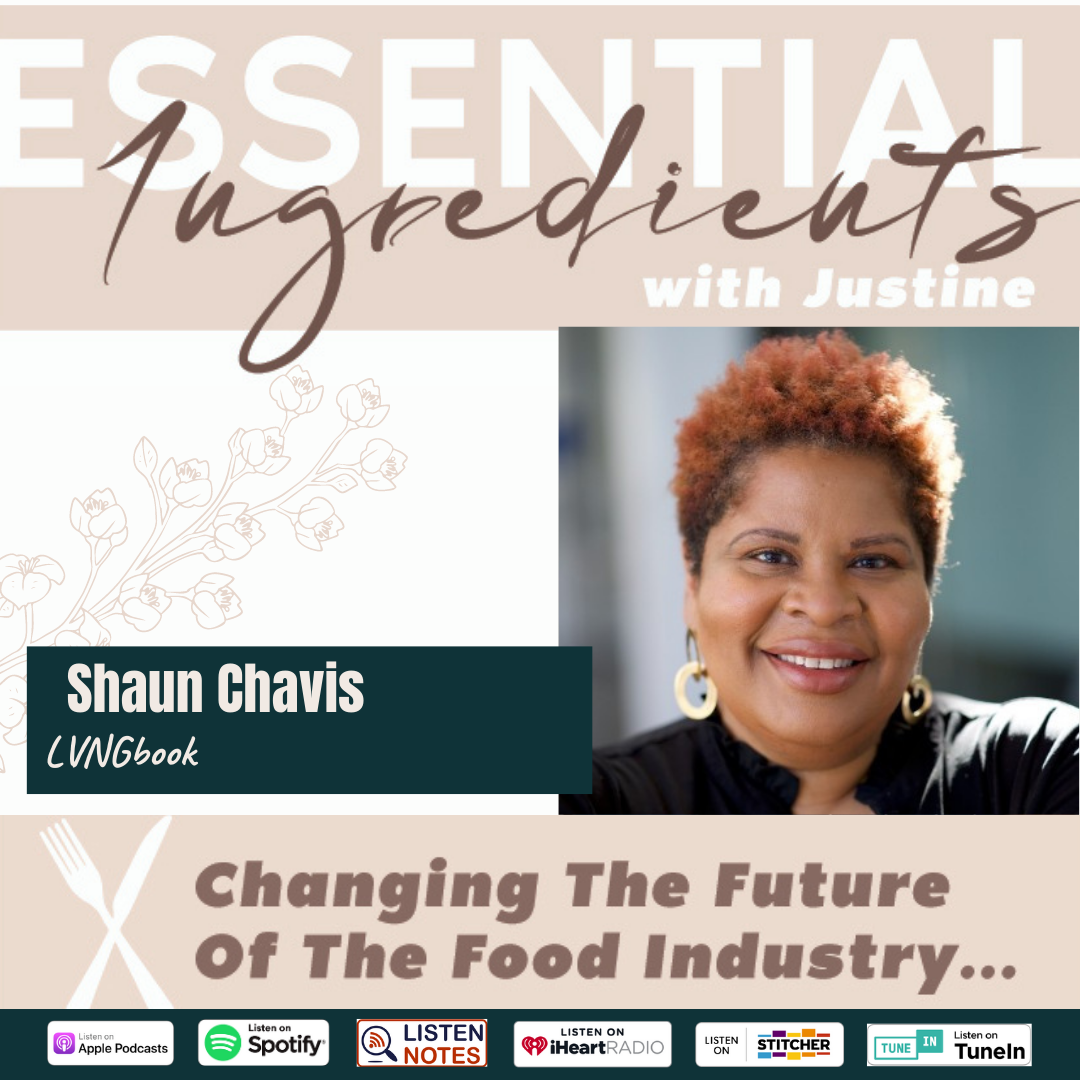
Shaun Chavis · NextGen Purpose
Watch on YouTube
A Close Look at Diversity and Food Tradition with Shaun Chavis
The Incorporation Method helps you turn what matters into practical changes that fit your life.
“A change in medical condition often means a change in diet. Having a long list of things you can't eat becomes a daily torture. As a result, many people become isolated from their family food traditions. Is there a way to stay healthy while enjoying the food you love? Justine interviews food journalist and founder of LVNGbook Shaun Chavis to find out.”
Full Transcript
Full conversation between Justine Reichman and Shaun Chavis.
Good morning. Welcome to Essential Ingredients, I'm Justine Reichman. Today, we have Shaun Chavis with us. Welcome, Shaun.
Thank you so much for having me. I really appreciate it.
Thank you, Shaun, for joining us. This is the Essential Ingredients Podcast, and I'm super excited to talk to you and learn a little bit about your history in food. It seems like it's been varied, and it's been around in a variety of places. So I'd love for you to share a little bit with our listeners about your history. I always like to let our guests share their stories because it comes from them, as opposed to me reading their profile off the back of a book or their website, which sounds so contrived. So if you would maybe just give us a little short brief synopsis of what got you started in food.
Sure. So my name is Shaun, and I'm a startup founder in Atlanta. My business is focused around food and healthy eating. I'd loved you all my life, I started cooking when I was six years old. I grew up in a military family so we traveled around a lot, and that exposed me to a lot of different cuisines and different dishes. I also married a Moroccan man, and he did not like food in America. He didn't like grocery store food. So that forced me to start looking at Farmers Markets, locally raised foods and sustainable food. So that kind of pushed me into the Slow Food movement. And since then, I've gotten a culinary degree. I have a master's in gastronomy, and I've worked for publications such as Health Magazine, as a diet editor. I was a cookbook editor for Time Inc Books. Over time, many books. I also was a content marketing editor for an ice cream company. So I've kind of seen all different sides of the business.
It was really interesting. When we spoke before this podcast, I was in awe. I had a little envy for all the experiences you had. From going to culinary school, to working on cookbooks, to working with a chef. I think you even said building recipes around ice cream, I think that sounded super interesting as well. And then you'll get more into this creating customizable cookbooks, which I think in this day and age sounds very interesting, but helpful also, and allows people to really think about what is good for them but makes it easy. I'll let you get into talking about that, and how user friendly they are but equally, how innovative they are. And that's a whole, we'll get into that down the road. Because there's so much as you can see that I was listening to you. I just want to get into all of it. But let's start at the beginning. I know that what inspired you to go to culinary school was because your husband, because of the interest in food around your husband? And was that what inspired it?
I was actually at a point in my professional career. I was a professional journalist, and I was working in a TV newsroom. And I was like a web editor. So I worked on the TV station website. And it just felt very routine, and like it wasn't going anywhere. And at the time, I thought, do I leave news altogether and start a food business, like I thought about, start a bakery. And then the other part of me was like, I really love journalism. And finally I was like, duh, go be a food journalist. So I went to culinary school to do the education that I felt like preparing me to be a journalist. So that was really, I mean, I've always loved cooking. And part of me just really wanted to go to culinary school, just to go. But that was really, my real reason was, the reason that I talked about it on paper reason was, I wanted to prepare myself to be a really good food journalist. And I felt like you have to understand it in order to write about it.
So I'm curious on a personal level, when chefs put together food, how prevalent is it? Do you feel the nutrition aspect of it? We have chefs that make amazing, beautiful food, right? And I'm a big foodie, and I love food. I love the tastes of the herbs, but there's another aspect to food that is not just about creating beautiful food, it's about the ingredients that go into it. And it's about where you get it, and it's about how the soil is prepared. So from your perspective, what percentage of chefs, or where does that come into play for a lot of these chefs?
I think that we hear a lot in media about the chefs who are doing really good, thoughtful, intentional work like that, where they're being very intentional about where they're sourcing food, and how they're how they're creating food, and the locality and sustainability, and how it's grown and raised, whether it's organic, or is it passing toxins and things on to us. But when I think we look at all of foodservice, and you think about all of the restaurant chains that we have, all of the hotels, all of the places where we buy food--
Hospitals, like what about even hospitals?
Yes.
School, outside of the luxury hotels and that kind of thing.
Exactly. It's a big world. And to your point, I think I was hoping like when we had the big movement of really paying attention to feed in schools, I thought nursing homes and hospitals were going to be next. And that hasn't happened yet. But I mean, for seniors, they really need good nutrition, and they want good food. But just because you're over 65 doesn't mean you want boring, bland food, right? But you really have to be intentional about creating flavor when you can't use a lot of salt, fat and sugar. And it's possible. But that movement hasn't happened yet. So when you look at the large view of all the ways that we eat and consume food, and all the venues for that to happen, we still have a long way to go. I do see some food distributors who are developing lines of organically sourced foods. But that's not the normal way that we do things yet.
Right. To talk to you about the dietary guidelines that are expected to be released in December, and that they hope that they'll be more inclusive and reflect the diverse population and food traditions we have, why is diversity so important?
That's a really good question. We have such a diverse population. I'm in the southeast, I'm in Atlanta. And even just in the southeast region, we have white Americans, some of them trace their roots back to Italy, or Germany, or England. We have African Americans. We have Latino Americans, Mexican Americans and people from other Central American and South American countries. We have South Asians, we have Vietnamese, we have Mediterranean people from different parts of North Africa and the Eastern Med. All this diversity, and all these future decisions. And even when you're like the second generation or third generation, those food traditions get passed down. And when you look at the US dietary guidelines now, or guidelines from organizations that focus on specific diseases, they're very bland. And I think in some ways, that comes from a place of, they just want to give you a framework and you plug in your flavor profiles that you love, but it still has to start with something, and that something has been very Eurocentric. And people really are so confused about what's healthy to eat, what's not, that when you give them that list, they think they have to stick to it. And so that makes them feel like they have to divorce themselves from the foods they grew up with or the foods that they enjoy with their families. So in my research for my company, I talked to a lot of people. I talked to over 100 people who had chronic disease as an example of why this is so important. And a lot of people said, well, I am from the Caribbean, or I'm from West Africa, or I'm from India, and the foods that I grew up with or the foods that I eat are on this list. So a lot of people either gave up on trying to eat healthfully because they didn't see their food traditions reflected in that. And that does not help produce the outcome that we want of good health, maintaining good health or managing a chronic condition, or preventing chronic condition. And it divorces that person socially too. There was a study of Latina women who are diabetic, and they got the list from the doctor, and it did not reflect their traditions. So they found themselves, a lot of them are cooking two meals a night. They're cooking a traditional meal for the rest of the family and all those great Central American flavors and dishes. And then they would cook a meal that reflected the list they got from the dietician, which didn't reflect anything like that at all. So they're really isolated. Number one, you're cooking two meals a night, that's a lot of work. That's extra expense, that's a lot of time. And then number two, you're socially isolated from your food traditions, it sends the unspoken message that all of these cuisines are not healthy. And that's not true. There are studies that show that a traditional Mexican American, Latin American diet has lots of antioxidants and can help reduce inflammation. Traditional African diets have lots of produce and also help manage chronic disease. So we really need to get diversity into the US guidelines to reflect the population that we have, and to show that all of these cuisines do have health in them.
I think it's very important for these people, for the people writing about this too, and when they write the guidelines to understand, I mean, why are they not doing that? Why are they not including that information?
It's really interesting. I can say that when I was working for Major Media as a person of color, a lot of times the default that some decision makers have in their heads is, well, that's not our audience, or well, that's not the majority of our audience. So those kinds of statements make it easy to dismiss all of the diverse populations. But when you look at how America is changing, it won't be long before people of color are the majority in this country, the Latino population in this country is growing. I mean, at some point, we have to acknowledge that our country is changing, and our flavor, our flavor profiles, and food traditions are changing. And I think the other thing is that there's almost a default, as you know, a food editor, or food writer, or recipe developer, when you're in Major Media, there's this default of what the American family wants, or what the American family eats. And that idea is 30 years old.
I also have to just say, let's look at people's backgrounds, and you look at what they grew up with. And then today, people want to have new experiences, and don't want to have new experiences, we should encourage them to have new experiences and try new things. And if nobody's telling them to, well, then we should be telling them too. And if we're not giving them that opportunity, then they don't know any better. So it's really our fault. Write down the opportunity. So I live in Marin, the lack of ethnic food here is just abysmal. I mean, we have a Burmese restaurant, a Chinese restaurant, a Japanese restaurant, and that's about it, maybe an Indian restaurant. But coming from New York, I'm used to having options, Ethiopian food, you name it, everything. And I miss it because I know it, because it was available to me. But that's because I'm privileged to have grown up in a place where it was accessible to me. If you don't have access to it, you don't necessarily know what you're missing.
Exactly, exactly. And we have so much to learn from the rest of the world. So one thing that I often tell people is that Americans eat whole grains wrong. We grind it into like whole grain bread. I remember as a little kid, my mom experimented with whole grain pasta and everybody was like, well, you know?
It was like dairy free. Oh, try this. It will be better for you. You'll have less congestion.
So yeah. But when you look at cuisines in North Africa and the Eastern Med where they're using a vulgar, and they're using sweet berries in interesting ways, then that's when you really get to enjoy the texture of whole grains. And some of them are chewy and muddy. Yeah, it's different. And it's fun to eat. And it's delicious. But because we don't have exposure to those cuisines, we're missing out on not only a fun flavor, adventure and fun things to eat,. But that's an important part of nutrition, like, one of the dietary guidelines. And certainly, the whole grains council is telling us to make half of our grains, whole grains. And the thing is it's so accessible here, like we don't even really think about it. I usually tell people to start with brown rice because there, pretty much, everybody eats rice, oats, right? Get some old fashioned oats and corn, whole grain corn products, which you can find some really nice whole grain tortilla chips, eat the whole grain corn, and other popcorn is a whole grain. And I think they're accessible things that people forget about. But then also, there's all these food traditions that are represented here in the United States that have so many interesting, delicious ways to enjoy all these foods. And we just need to broaden our horizons.
So one thing I know that you shared with me before was that you create these customizable books. So now that we've, you've shared with me some of the issues around culture, and the cultural challenges, and the lack of diversity, it only seems natural for you to be able to share with me the ability people will have, or do you have by creating a customizable cookbook with you. So maybe you can share with us one of the customizable cookbooks that you've created with one of your clients, and how that has enabled them to be able to integrate their culture, or their favorite foods, or what they're able to eat into their book.
Yeah, absolutely. So I have a couple of samples here. I want to give you a little background. This is my company, it's called LVNGbook. And it started because I had a good friend who was Southern, but I think they're from New York. Her mother, I think her grandmother was a Holocaust survivor. She was Jewish, but a very social person. And she had symptoms for years that doctors couldn't diagnose. And finally a doctor said--
What kind of symptoms? Sounds like you're talking about me.
But there's certain traditional foods, and holidays, and then how food is integrated into those holy days and holidays. That's really important, special, and unique. So my friend was diagnosed with this rare autoimmune disorder. Her doctor said, okay, you'd have to change the way that you eat and gave her this really long list of food that she couldn't eat anymore. And it was truly random. Like it was not like all gluten free food, or all low fat food. And she was so overwhelmed by that list. She literally called me crying and she was like, you gotta help me. I don't know what to eat. And the process of helping her. And it took her about a year to figure out how to eat. I mean, it was all about how she modified the recipes that she loved? Where does she find substitute ingredients? How does she navigate eating in restaurants? And it was a big deal. Like how did, what does she do for coffee. Even like, she couldn't have coffee anymore she was like, what do I do for my morning drink and went through several different products before she found something she liked. So there were things like that. Like, she loves smoothies in the morning, but she couldn't have certain dairy products. So she had to develop like a, we developed a smoothie recipe that really worked for her. So in the process of all of that, I was like, this would be so much easier. And she would onboard quicker and feel more confident if she could get a customizable cookbook full of recipes for food that she likes that are already modified for her condition. And it could help refine the products really easily instead of her looking everywhere. So I created a company that creates customizable cookbooks. So here's an example of a cook--
[inaudible] epic kitchen, fast and tasty meals. I'm just saying it out loud for our listeners that are not watching the video so that when they're watching the audio, they have a sense of what you're talking about. So this cookbook was specifically designed for Nicole Washington.
Exactly.
Correct, and gave you a list of items that she was given by the doctor. And you created a new list, is that right?
We've now digitized it. So now Nicole can come to our website, and she can say I have high blood pressure. I love Mexican food. I'm allergic to peanuts. I'm on a kosher diet. And we have an app that takes all that information, creates a profile and comes up with a list of recipes that match your profile.
I'm sorry, what's the app called?
It's called LVNGbook
No I.
Yeah, yeah, it's L-V-N-G-B-O-O-K.C-O-M. It's on our website. You don't have to download it from the App Store or the Google Play Store. So it's a responsive website, you just go to our website, lvngbook.com. So you build a profile, you click create my cookbook, build a profile. and tell us what your food preferences are. You can tell us your food allergies, you can tell us your cooking style. So we've got things for people who are just learning how to cook all the way to people who like our experienced cooks and want to be chefs, or love indulging their wanderlust in the kitchen.
Wow, do you have anything plant forward or vegan? Or I can put all those preferences in awesome [inaudible], pause for one minute while we take a break. Just have a little advertisement from our sponsor.
Absolutely.
Great. We'll be back in a minute. Okay, so we're back now with Shaun. For our listeners, wonderful. Okay, great. So now Shaun, and people want to buy this book, I'm just wondering, I want to make sure that they go to your website. They can download it, and they can specify what they want, they can create their own book, what is the cost to do?
It's $35.
Okay. Are there any discounts for NextGen, for Essential Ingredients listeners?
We're offering like a free meal planner and habit change guide in there. So we're not just going, not only we're going to give you delicious recipes, but we're really going to help people change their habits. So we are working on a journal subscription, but I'm happy to offer a free journal with everyone, for every one of your listeners. So when you order your book, we'll get a free journal with a 26 week meal planner.
How do they get that?
We're going to offer it on our website for the next month. So just come on the website and we'll send it to you, will include it in your book
Awesome. That's super exciting, I can't wait. I want to go get a book myself, Justine Reichman, I can't wait to input all the things that I can't eat, put all the things I love to eat and can't eat. I want to talk more about all the different brands you've interacted up until now because you've interacted with a bunch of brands, right? I was wondering if you could maybe share a couple of tips for our aspiring entrepreneurs in this space in terms of marketing and branding as they build their businesses.
The number one thing that I would say is storytelling is so important. I think that has to be very forward in anything you do. Because story is what makes you stand out. There's so much competition now for our attention and for our money. And there's so many, it's rare that anybody comes up with anything unique so you distinguish yourself by story. The reason that story is important is because we are 22 times more likely to remember stories than we are facts alone. So it really sticks in your head when you can tell a good story. And the other thing is that once you, stories have like triggers, emotional and chemical responses in our brains. So once you start telling a story and you really hook somebody in, then they become, they experienced transportation so they're hooked. And once somebody hits that moment of transportation, that's when the emotions start to engage. That's when their brain starts to release oxytocin and some other feel good chemicals, and you want that as a marketer. It's an important hack because then people are more likely to do those calls to action that you ask for. So storytelling is super, super important. I would totally like, understand your audience, tell a story that really appeals to them that relates to your product and is something that they want to be a part of, or want to experience.
I think it's really important also to tell a story that your listeners and your audience can connect with and say, Oh, my God, that sounds like me. It's like when you were telling that story and you're like this Jewish lady that has intolerances or whatever, like that's me, I've got intolerances, I can't eat dairy and I don't eat refined sugar, and I'm Jewish, and I'm from New York. I mean, I think I had a bunch of those things. I don't know how many of our listeners are also from New York, and also have intolerances, and also are allergic to dairy, and this, and then right off the bat, I was connecting with that story. Because of course, we all make it about ourselves in an assistive way, but just because we're connecting with it and we can see the relevance for ourselves. And that's the beauty of the story.
Exactly. And I think when it comes to food companies, because like eating, and recipes, and cooking are things that we can participate in food, and story has a unique advantage for engaging people. If you tell a story and then give a recipe, I can be a part of that story by cooking the recipe. I can live the story through the recipe and the act of cooking, or the act of eating helps me participate. And that's where you can really engage people in a sensible way to like, you can taste and smell, and if you're cooking, you can hear it and got a beautiful plate to look at, it is really engaging. And so if you're in the food space, I think you just have a whole lot of power.
If you don't mind my next question for you, what is your favorite pandemic recipe?
Exactly. My favorite pandemic recipe is a breakfast recipe. I love a good breakfast, and it's one of the recipes in our cookbooks. We have a breakfast fried brown rice recipe. And because I'm working from home now, it's so easy to make this recipe and just batch cook it and make breakfast really easy. I just grab it out of the fridge and warm up. So yeah, so it's breakfast rice, brown rice. It's got turkey sausage, it's got eggs, it's got bell peppers and onions. I had ginger, I added sesame seeds. Sometimes if I've got some chili crisp, I'll add a little spoonful of chili. Yeah, so it's really a great breakfast way to start the day.
Wow. So, okay. And then I want to go back to as we were talking about culturally inspired meals, do you have a perfect meal that's culturally diverse and inspired that you might recommend? Or some ingredients that we couldn't leave today at the culturally diverse inspired meal?
Sure. I could certainly go through a list of different ingredients from different cultures--
--maybe three to try.
Yes, totally. So I love tahini. So I was married to Moroccan man, so I really fell in love with North African and then Eastern Med, Middle Eastern cuisine. So I love tahini. It's really important to get, you can get the best flavor from a tahini if you look for one where the seeds were hauled before the tahini was made. So there's a company called Stoom Foods that makes a really good one. There's another company, I can't remember the name but they're Palestinian women who make tahini that's roasted and it's really delicious. And tahini can go on everything. We know it's in hummus but you can also put it on chicken, on fish with caramelized onions. It's fabulous. Just one sweet potato and other roasted winter squash. Those kinds of things will be really great greens, it's good on greens with some other sesame seeds. So tahini is one that I really love. I recently fell in love with chili crisp, which is a Chinese condiment and it's made out of oil, red peppers and a lot of spices. Every brand has a different kind of combination of spices of crisp sliced garlic. I really like that condiment because it's gotten a lot of flavor. It's got a little bit of heat, it's got a little sweet, it's got warmth from spices like Star Anise and some cinnamon or other things. But the other really cool thing about it in our household is we were taking care of my partner's aunt. She recently passed away but she had kidney disease and heart disease. And so she loved Asian food but she couldn't have soy sauce or fish sauce, so we just covered chili crisp with a lot less sodium, but a lot of flavors.
Is there a brand you can recommend for all those, there's a lot of people that can't eat soy and stuff like that.
Yeah, yeah.
Is there a brand you can recommend for our listeners.
Yes, there's one brand that I see a lot of ads on Facebook called Fly By Jing, Fly By Jing. And then there's another brand that I've tried that I really liked called Mr. Bang
Mr. Bang. That's easy to remember, Mr. Bang.
I know, right? And you can find both online. But yeah, we really love chili crisp. So that's another condiment that I recommend. I'd say the third thing is I would say just like a really, have a good olive oil, like flavorful olive oil, because--
We all have our favorites. I've got my favorite, I use a Meyer Lemon-Olive oil from--
Yeah, yeah. Olive oils or peppery olive oils, I think that olive oil can really just add that nice, special something to a meal. So I totally recommend keeping a good olive oil in your home. And we certainly know that olive oil has a lot of health benefits, especially when you think about all the other ingredients in the Mediterranean cooking, which is very diverse. But there's kind of like a common body of ingredients. Their studies show that when we eat olive oil in combination with some of those ingredients, we actually maximize the health benefits that you get from olive oil. I'd say some good olive oil would be something to keep in your pantry too.
Wonderful. Thank you Shaun so much for joining us. So if our listeners want to get in touch with you, hopefully you've downloaded the NextGenChef app. And if you haven't, I hope you will so that all of our listeners can connect with you on the NextGenChef app, which is available for any listeners that haven't downloaded on iTunes and on Android. Otherwise, how can they get a hold of you? What's your website? Can you share that with our listeners?
Sure. It's LVNGbook, L-V-N-G-B-O-O-K. Oh, no I's, lvngbook.com. And you can reach me at Shaun, it's spelled S-H-A-U-N, shaun@lvngbook.com. I want to hear from people. This is so exciting.
I want to thank you for joining us. I want to thank our listeners for joining us today. If you like this podcast, please subscribe to the Essential Ingredients Podcast which is on iTunes, iHeartRadio and on Spotify. If you like what you hear, please subscribe and leave us a review. We are here every week and we want to hear from you. So hope to hear from you soon. Thanks again, Shaun for joining us.
Share This Episode
Enjoyed this conversation? Share it and tag @nextgenpurpose
Listen on Apple ▶Listen on Spotify ▶Your Host
Justine Reichman
Founder & CEO of NextGen Purpose. Host and Executive Producer of Essential Ingredients — 11 seasons, 330+ episodes, and a growing movement.
About Justine →