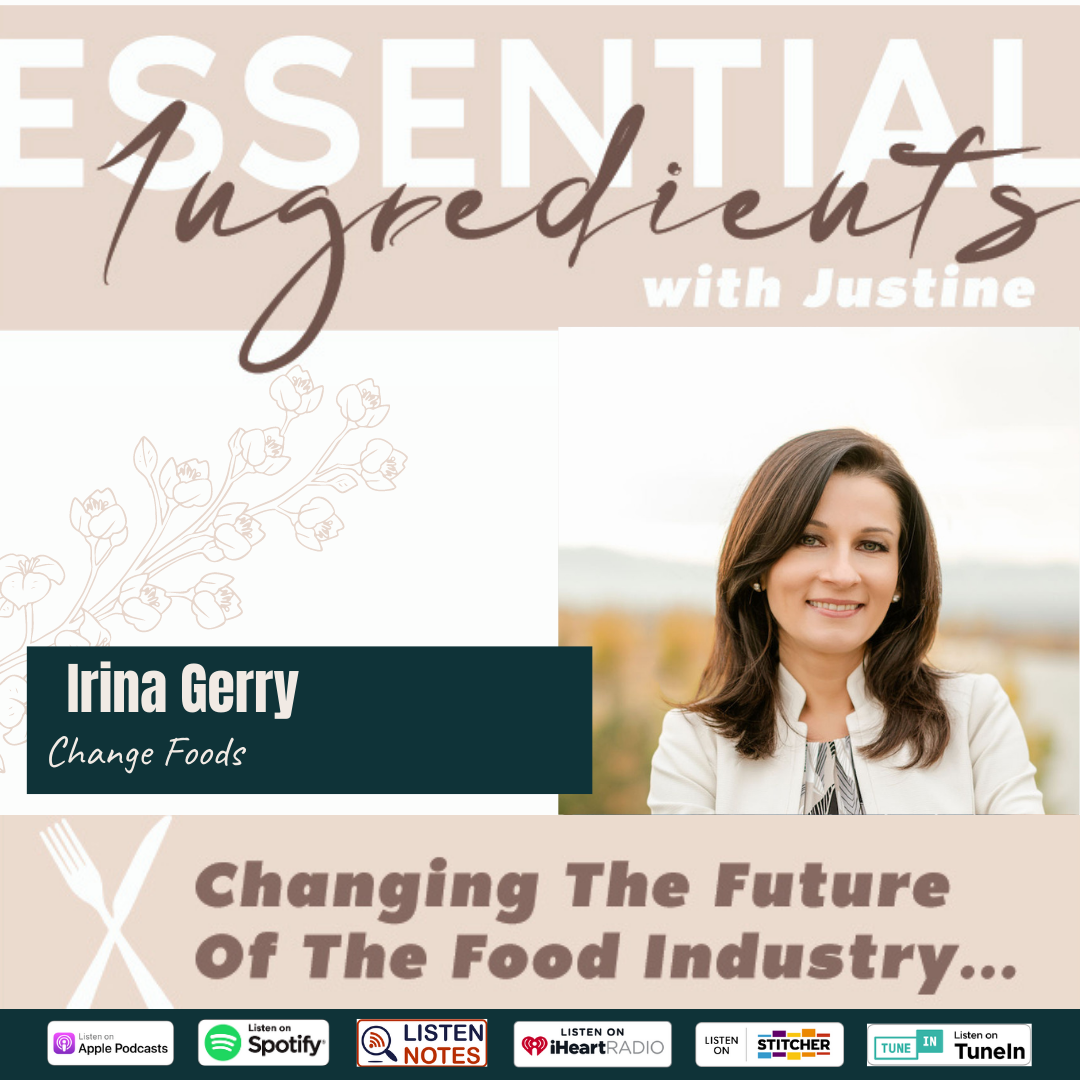
Irina Gerry (NEW MEAT FOCUS SERIES) · NextGen Purpose
Watch on YouTube
Exciting Trends and Products That Will Make You Love Change Foods More! with Irina Gerry (NEW MEAT FOCUS SERIES)
The Incorporation Method helps you turn what matters into practical changes that fit your life.
“We are living in a time where sustainability is more urgent than ever. As a response, people are now more aware and concerned about how their decisions affect them and the earth. The trend in alternative proteins proves that this is slowly being realized. Irina Gerry gives her insights about creating a greater impact with change foods.”
Full Transcript
Full conversation between Justine Reichman and Irina Gerry (NEW MEAT FOCUS SERIES).
Good afternoon. Good morning. Welcome to Essential Ingredients. I'm Justine Reichman, your host. And today with me is Yvette Yi Yuan and Irina Gerry. Welcome, Irina. Thank you so much for joining us.
Thank you for having me.
It's so great to have you here today. I'm excited to learn a little bit more about you. I'm excited for our guests to meet you. And Yvette, thanks so much for joining us as well. It's always great to have you join me here chatting with our guests about something I know that you're particularly passionate about. So thanks for joining us.
Thanks Justine.
For our listeners, she's part of the NextGenChef team. She does marketing analytics, and is the producer of the Essential Ingredients Podcast. So it's fun to have her here, especially as she is so passionate about this specific topic. So Irina, please, I want to get in jump in and share with us a little bit about your background for our listeners so they can have a little background about who you are before we jump into the conversation. Would you share a little bit?
Of course. So I'll kind of work backwards because I think that's more relevant. So I'm at the moment, Chief Marketing Officer at Change Foods, and I'm sure we'll talk more. It's a startup in the precision fermentation space. I joined that very recently, just in December of last year. Prior to that, I spent four and a half years working on plant based businesses under Silk and So Delicious brands at Danone in North America. And prior to that, I had experience working at Procter and Gamble, kind of learning the fundamentals of consumer marketing. As well as Deloitte Consulting, learning the fundamentals of business strategy. I also have an MBA from Harvard Business School. And Fun Fact is, I grew up in Moscow, Russia. So I kind of had a long and very path that led me here. But I think overall, I've become very passionate about plant based and alternative protein space, as well as sustainability. So that kind of led me to combine my professional career in food marketing, with now Change Foods, which is really leading the new space revolution in fermentation.
Wow. That is quite a background, a strong background, a varied background, but equally, I'm excited to learn more about it. I really appreciate you sharing that with us. I've got so many questions. The question is where to begin. So I'd love to learn a little bit about, more of that, all of that, and really focus on the future, because that's what we're here to talk about. We're here to talk about how you're changing the future of food? What you hope to see, and the impact you hope to have? But I'd love to learn just a little bit about what you've done at Silk, and your experience there, and your experience at some of these other places that you've been. Because I think that it builds a lot of the foundation for you to be able to move forward in what you're doing today. So yeah, maybe you can share a couple takeaways from us about how you led Silk as a leader, as a dairy alternative, and how that's evolved and grown.
So I joined the Silk team in 2016. It was kind of right in the middle of acquisition by [inaudible] so they announced the acquisition 2016, and they've completed in 2017. And I had already at that point made kind of a personal transition to, I would say predominantly plant based lifestyle. I started learning all about it probably about 10 years ago with Forks Over Knives, as I'm sure many of you come into that space and knowledge with this documentary. So my family and my personal life was already kind of undergoing a significant transition. And I was a Silk consumer and I love the brand. And I had the opportunity to go work as a Brand Manager on the business, and jump both feet in, and was super excited. While I was there, I worked on a variety of initiatives that I was on the plant based businesses for over four years. So I've done things like Silk almond product, flagship product, product improvement, formula improvement. I worked on the new campaigns, [inaudible], if you've seen that about three years ago. The campaign that's running now with Michael Phelps was. So much fun coming up with these creative ideas, and filming that. I worked on introducing new segments into the plant based space, so as you know, there's almond milk, soy milk, coconut milk, and all these other milks. And in the last three years, this nutrition forward segment really started to form within plant based milks as people started to wonder, how do I get more nutrition from my beverages? We introduced the 10 gram protein Silk product which offered 10 grams of plant based protein, very close to dairy or parody to dairy milk. And then lately, and that's my latest baby that I worked on the past one and a half years there is just hitting shelves right now. Literally, just starting to find it in stores, it's called Silk Ultra. It's a brand new performance forward segment. So we've taken the page from performance beverages and powders, and kind of how people want to enhance their performance and nutrition, and taking that to the milk aisle, which is really innovative. So the Silk Ultra product is going to have 20 grams of high quality plant based protein, as well as vitamins and nutrients to kind of help you metabolize the proteins better. As well as provide some antioxidant benefits. And it tastes like chocolate milk so you should definitely try it. If you're looking for that boost, whether it's like boosting up your cereal, or you went and did a workout and you just want a glass of chocolate milk that opes carries 20 grams of protein, [inaudible]. So that's my plug. That's my baby that I worked on. Other things I've done was just helping think about, how do you take the number one plant based beverage brand in the United States today, and build further? So we launched into creamers, we launched into yogurt. I led the launch of the plant based latte where we said, hey, look, we are experts in making plant based beverages. Tastes really great. And people love their lattes. And you cannot always run to Starbucks and order something, so how can we give you a solution at home that's equally delicious and good for you? So we launched that. I have a pretty broad experience from day to day marketing business fundamentals to these new products and innovative spaces. And I had a great time, it was a really fun learning experience for me.
It sounds like a lot of fun. And it sounds like it worked in a really innovative space, and you're ahead of the curve. Are there any other products that are creating something similar to that?
That's new. So if you look at that high protein space, that's entirely new. Today, if you want to get kind of that protein boost, you're looking at a protein powder or maybe plus some milk, and if you're a plant based consumer, I've tried them all. As part of my research, I had to do it. I've tried all the plant based protein powders, they all suck to different extents. They're all challenging. And that was our biggest insight is people want to have this benefit in their lives, or whether it gives them satiety, they want to boost up their smoothie. They feel better when they consume higher protein, but they don't want to go to dairy. They don't want to load up on whey protein. How can we give them a solution that actually tastes good? And that was the challenge. I think we nailed it. And Silk is going to be first to market with that. So I'm pretty excited.
So when you try that, what was the impact you had?
What do you mean?
So you tried the product, right? When you tried the Silk product with the protein, right?
Mm hmm.
What was the experience you were doing? Were you working out? Were you just testing it?
We were developing it. So now, in the course of development, but I would say for me, I have two little kids, we like to eat cereal in the morning, that's typically void of any sort of nutrition, being able to add some protein to that and that's wonderful. As a parent, I do exercise regularly. So like being able to have a quick smoothie that already comes with protein that I don't have to add powder is wonderful. So I think it's this kind of multifaceted product that will hopefully do well. So let's say, like I said, it's brand new. It's brand new.
And really easy to access?
Yeah. It's going to be across the country, including Walmart. So it'd be very widely distributed.
That sounds exciting. Okay. Well, I can't wait to check it out. When will we be able to see that in stores?
Should be now, rolling out.
That's exciting. Well, I feel like we got a little inside clip here soon. A little inside scoop. Well, I appreciate you sharing that with us. I also know that you're working on some fermentation, and I'd love to dig in a little bit deeper on that. Talk a little bit about that, and what you're bringing to the table there. Can you give us a brief overview of precision fermentation? And for our listeners, tell them maybe what precision fermentation is?
Right.
Did I say that well? I don't even think I--
You did great. Okay. So this is brand new space. If you look at the alternative protein, umbrella, we kind of all are used to seeing plant based. Vegan products, plant based products are very well established. Silk is a part of that. The second pillar of that is cellular agriculture. So think of the cultivated meats that just launched their first chicken in Singapore. That's the second pillar. And the third pillar is this fermentation pillar. And what is it? It's a fascinating brand new technology where we're using biotech to create dairy proteins, in our case, and dairy lipids or fats, by using micro organisms rather than animals. So we're kind of creating products that people know and love. So you can make milk, you can make cheese, yogurt, etc, without ever involving a cow. But the products you create actually have bio identical or identical dairy proteins in them. What that does is it allows you to have product that tastes, smells, has the texture performance of the deer equivalent without the harm to the planet and animal cruelty. Which personally, having been in plant based space, I'm very, very well familiar with the benefits and the drawbacks of plant base. There's still that gap, there's still a performance gap, there's still a nutrition gap with some of the products, and that's hindering the very wide scale adoption of some of these products. Plant based milks are well on their way, but maybe cheese and yogurt are still fairly low. And how do you break through that? How do you create cheese that is amazing, that is going to hit all those check marks on the deliciousness that we all love without hurting the planet? And when I saw that, and for me, sustainability is such a big part of my personal mission and motivation to get into space. I saw that we can produce these foods with a tiny fraction of resources. That's fascinating and super exciting to me. So that's precision fermentation kind of at a helicopter level view. It's high tech, it's kind of biotech meeting food. But I do think that it's coming on the scene pretty quickly, and it's very exciting.
That is really exciting, and that's what Change Food is all about. Can you talk to us a little bit more about that? Because that was the leap from Danone to now Change Foods, right?
Exactly.
I want our listeners to understand that you're no longer Danone, you're now at Change Foods working on fermentation. So can you just give us a little insight into Change Foods, who they are and what you're hoping to achieve there?
So Change Foods, this is a startup where we're at a pretty early stage. We kind of have our core team of founders built. We have our founder and CEO David Bucca. We have COO Luis Espinoza. And our CTO, Junior Te'o who are all on board so we can have the core team built. What we're doing is we're currently working on creating that animal free cheese, and we're still working on nomenclature a little bit. But for lack of better words, it's going to be cheese that tastes, has an attrition of stretches, melts and is delicious just like your dairy cheese without ever using any animals. In order to do that, that's why we have our kind of Chief Technology Officer because it is a biotech company and it's kind of foundation. But the reason why COO Luis is coming from, Justine, with the food manufacturing background, and I'm coming in obviously from plan based sector consumer goods and consumer marketing background is because we are ultimately building a brand around this product and want to launch a B2C, so direct to consumer product with the Change Foods cheese is kind of our first out the gate product. This technology however can be leveraged in the future to create other dairy products. Milk, yogurt, cheese, ice cream, you name it, all kind of part of the playbook for us.
Wow, that's exciting. Do you guys have, is there a trajectory so, do you guys have a plan, or your--
Of course, we have a plan. Of course, we have a plan. Like I said, Cheese is first. I don't want to reveal too much of the plan. And it's wonderful, but I can't tell you. So that's partially what I think makes us different than some of the other companies in the space who are looking at more of that B2B play and are just looking to be the ingredient supplier to different brands, we actually believe that it's better and potentially faster path to market, and more effective path to market to build our own brand and tell our own story. And that's where I came into the picture with all my knowledge and background.
Is that plan informed affected by COVID? Because service today is unfortunate. So instead of supplying to the service, you decided to do direct to the consumer.
For us, it was always a strategic decision to go direct to the consumer, it was not driven by COVID. I know for some companies, they did have to pivot and change their plan for us. This was always the plan so we're kind of going forward with that.
Sorry, Yvette, you go.
Yeah, yeah. So you didn't mention that the reason you're looking to cheese first is because there is a plant based, lack of a good enough plant based alternatives in the space of cheese, any other reasons that Change Foods is looking into creating the gap first to market fermentation takes you?
Our company, our founder and the rest of the executive team, we are very mission driven. Part of what we're building, we're launching a product or launching brand, we're also building a company that we all felt from our collective backgrounds that we wanted to build, kind of think of it as at Patagonia Food. We want to be both product and brand, but we also want to be the mission. We want to embody the mission of creating a better kind of food system. And we do that because we are all very much into combining the kind of sustainability mission that we have with kinder, better food systems. So when we think about which product, right now, if I look at which of our food products and kind of do the most damage to the planet, cheese is actually number three. And the reason for that is because while dairy has a significant impact, I'm sure you guys know, it takes 10 gallons of milk to make one pound of cheese. So essentially, you're taxing the impact of dairy when you make cheese. So it's a combination of, where do we make the most impact from our mission? Also, where is the biggest gap in performance, and where we feel like we can come up with a product and a solution that will resonate with consumers. I actually worked quite a bit on plant based cheese as part of my Danone adventure on So Delicious brand. And that's actually my second baby that I worked on over the past year. That is hitting shelves again right now is the restage of So Delicious plant based cheese. So there's gonna be shred slices and cream cheese, it's all going to be coming on shelves again starting in January. So I worked on plant based cheese, I know a lot about plant based cheese. And as long of a way as it has come, it is still not meeting the requirements of many of the flexitarian consumers. It's a pretty good option if you're a vegan, and you've been in this space, and you've tried these products, and you can be used to them. But if you're the flexitarian who loves the cheese, and people love their cheese. Plant based cheese is just not quite there, and it is primarily driven by the fact that you need those dairy proteins to make cheese stretch, melt and have that amazing kind of a tooth bite feel. So that was the other reason I got so interested in working with Change on this new cheese because I know we can close the gap, and it's just super exciting.
It is exciting.
Yeah, yeah. Change Food, but their technology definitely can improve on the functionality of precision fermentation derived cheese. And that definitely is a whitespace in the current plant based cheese offerings.
So where do you see the business alternative proteins going within the next year to five years?
It was gonna be a lot. And I think there's been a number of kinds of predictions and trends, but I could tell you what my feelings are. I see growth acceleration across all of the different segments within the plant based space. Obviously, plant based milks are still growing. They grew 20% in just 2020. Oat milk is on fire, it grew 300 some percent. It's about, it's already overtaken soy milk in a kind of second pop most popular milk type, it will likely overtake almond milk at some point because of the superior taste and texture and some of the sustainability story that it brings. The other exciting thing in plant based milk that is coming is this much closer dairy analogue option. You've all heard that Impossible is working on their version. NotCo just launched and is trying to use plant based ingredients to get much closer. So we're moving away from this ingredient based milk options such as soy milk, almond, milk, cashew milk, whatever to now say, look, we just want to create a milk that delivers on all these aspects of nutrition, taste and performance doesn't really matter what it's made out of so you can combine and blend ingredients as you wish. I think that space is poised to accelerate significantly in the next five years. I expect the household penetration and percentage growth of that sector to continue to accelerate. Second one is obviously you guys have seen triple digit growth in plant based meat over the last couple of years, right? With Impossible and Beyond kind of really accelerating that whole category that is only going to continue every single player in food, and their cousin has gotten into the plant based meat space. So it's a bloodbath. It's ugly, but it's driving great consumer options. There's so many options. And I think what's more exciting to me is that, not only does it now exist at home, it's starting to come into restaurants. And that's wonderful because so many people, especially in the United States live on the go lifestyles. They don't want to cook, they don't have time to cook. So being able to offer plant based options away from home is absolutely critical. And I think it's happening, even McDonald's. Once McDonald's is in, this is everything that will only accelerate. The other one is cultured meat and seafood. Just coming on the scene, the first approval in Singapore is just the bellwether. Like it's starting. And I expect the dominoes to continue to fall in the next five years in major ways. There's still cost issues to work through, there's still a lot of things. But if I look at 5, 10 years out, I think that sector will just continue to grow. Of course, animal free dairy and eggs, this sector that I'm in today, precision fermentation based foods, not just dairy. You can make eggs, you can make other animal analog products with this technology. And it's actually because it requires so few resources. The hope is that as this technology scales, the cost will come down and actually be cost competitive with their animal analogues within the next five years. And that's very, very exciting. Because again, nobody eats the mission. People eat food, and the food needs to taste good, and needs to be priced, needs to be accessible. In order for us to do that, we have to scale it right. And I do think that that fermentation technology really lends itself well to scale. And then I do think that the animal and dairy industries are really peaking out. I know people look at population growth, and they say, no, they will continue to grow. I don't think so. I think they reached their max, and I based consumer kind of awareness and perceptions around health, sustainability, and animal welfare. I do see this combining into a perfect storm where we're now bending the curve on meat and dairy globally. So I do see that 2020 is the first year of decline for the industry. And in fact, if you look at it, and I've talked about it in some of my other appearances. There's some pretty out there, Bowles reports. RethinkX put out a report last year that said, given these trends, they're projecting the dairy industry will go bankrupt in the next 10 years. That is major, doesn't mean there's not going to be a single cow farmed ever anywhere on the planet Earth. No. But that means that the dairy industry as we know it today, that the animal kind of mass farmed, factory farmed, animal industry may well no longer exist. And that's a great story for the earth. Like, if we can, and there's argument to be made for regeneratively farmed systems where some animal presence is a part of the system. That Kiss The Ground movie came out this year, or last year I guess, talking about that. There's a place for that, but that's maybe 10%. This is not what it is today, this is tiny because the amount of land per animal you need within that system means that these animal products are becoming these precious commodities that are maybe a special occasion thing. It's not something you eat five times a day, because there's just not enough first period for this kind of regenerative farming to be supplying the mommies eat. So I do think some of it will probably remain, but I do see a major reshuffle coming for dairy. And the other one is that the Edison Investment Research quarter reports out about the future of meat. And meat now includes cell based and plant based. And what they said is in the next 10 years, the alternative sector is going to be about 30% of total meat consumption. And in 20 years, it will be 60%. Meaning, it's now becoming a majority. So the question is, is that still an alternative? I know we all got used to it. We all use this language of alternative protein, but I'm kind of looking at it and saying, guys, we're the alternative? Or is it time to start calling ourselves something else, because we are on track to become the main thing. So how do we, as industry, look at that? And understand, what does this name tell about us? And is it time for us to start acting and defining our space by something that we stand for, and something that we provide more than above and beyond being an alternative? So I think there's this whole interesting conversation to that.
I think I was gonna say, I think that's a whole different interesting conversation, because I have said that from the beginning about all these dairy free milks, and all these plant based things creating their own names, making them their own nations, because they deserve to be--
Because we knew this brand new thing. Soy milk was 30 years ago, calling a dairy free makes sense because that's it's kind of main definition and point of difference. Even 10 years ago, people wanted dairy free milk. And that was good. Now, the consumers are evolving. And instead of just defining the product by absence of, now, they want to define the product by presence of other things. Is it nutritious? Is it sustainable? What is in it? What is it made from is becoming more important. Oh, by the way, what kind of company makes that is becoming more important. It's not mass market, it's not mass awareness yet, but even if you look at our kids, to my kids, to them, milk is this white substance. And they're like, when I say, do you want some milk? Which one? Coconut, soy, almond, whatever. They don't see milk as cow milk. In fact, they got into this interesting debate with their grandma over the holidays, who were still very much in the dairy milk space, and they called the almond milk I was giving them milk. And she's like, no, that's not milk. Milk comes from a cow. And they were like, what? No, this is milk. I don't know what you're drinking. So interesting because with generational changes, the perceptions change, the requirements change. And therefore, I think some of the vernacular is likely to change. So I think people in space need to start thinking about what we call this product and what matters. And I think the absence of it is still there, but it's starting to wear itself out.
It's interesting, because I've been saying that for ages, and everybody has been looking at me like, what are you talking about? I think they deserve to have their own sort of space on their shelves, like having their own identity, not to be lumped into this other sort of category, they need their own category. And I've been saying that for ages because I don't think I don't want to consider this a vegan cheese or a dairy free milk. It's whatever it is. It's always interesting.
If you look at the plant based milk evolution, it started in kind of like this vegan part of the store. And over time, as it became more popular and more widely available, it migrated to the dairy aisle. And now, if you go to like a Kroger, it's dairy milk and plant based milk sitting side by side, and plant based milk continues to take more refrigerator doors year over year, and dairy milk is shrinking. If you go to Whole Foods, the non dairy milk is bigger than the dairy milk, they still sell organic dairy milk. But if you look at their total sales, it's way outpacing the dairy equivalent. The plant based meat recently published a study where when it was shelf next to animal meat, it actually sold better. There's a good reason for that. Consumers are looking for a solution to a problem, they're not looking for a particular thing. They're not looking for a hammer, they're looking for a tool to nail something. And when you give them an option and it's competitively priced, and it tastes just as good, and they know where to find it, and it functions the way they want, they may as well opt in for a more sustainable better for you solution. So there's a role, I think, to be played in this placement. But the timing of it is very important. Because unless you have products that could really stand up and do the job that consumers want to do, then it's too early. So there's this particular transition where you kind of incubate some of these innovations in the vegan set. But then once they become big enough, then they can move over to the main set. And in cases of plant based beverages, the Whole Foods overtake their animal equivalents. So it's interesting.
I think to your point, it's like 20 years ago, it was really important to be an alternative because people could, it was an identifier for them. They knew how to use it, they knew what it was for. And now that we all know what this is for, we know how to use it, we are given those instructions, it can now have its own category. But it was important to create that for us, and to tell us how to use it. I don't know how else we would have done, what we would have done with it before.
It's all part of this evolution, and now we're going to do it. Our food system is changing. Our vernacular is changing. And our products are changing. And it's exciting to be a part of that. But I do think the conversation of what we call these products is incredibly important because it ultimately sets tone and expectation with consumers as to what it does.
So to that end, Irina, we have founders listening to this podcast, our listeners, many of them are entrepreneurs, are there any tips that you might be able to share with them that might be launching a brand in this space? So are there any tips that you might be able to share with them as a marketing leader, or a brand management perspective?
Well, first, my whole world kind of lives around the consumer. So my number one advice is, understand your consumer. And by that, I don't mean to say demographics, it's not just women between the ages of 20 and 45. Understand what is it that they're after? What are those needs that may not be articulated? I've recently heard some folks say, Oh, you can never trust consumer research, because consumers can't tell you what to do. That is very true. They won't tell you exactly what to launch by the time they can articulate it you're way too late to the sector. But what you do need to understand is, what are those needs? What are those motivations? What are they trying to be as humans in the world? And what kind of food would they like to bring into their lives? If you understand that, and you understand where the whitespace is, and where the gaps are, then you can create a product that solves a problem. What I see a lot of startups make a mistake of is their solution looking for a problem? Like, Oh, everybody's going into CBD space. Okay, I'm just going to launch something with CBD. And then they're running around trying to figure out how to make it fit somewhere. And it's a very ineffective way to do that, because you will make a lot of mistakes before you find your spot or not versus always starting with consumers kind of my mantra. The second one I would say is the younger generation of consumers and the ones that are really driving growth within this plant based space or the alternative protein space are consumers who care to know about what is your company? What does your brand stand for? What is your mission? Who are the people of your company? And do they really care about the mission? How are you sourcing your ingredients, etc. So it is no longer enough to have pretty packaging and a nice product. Now, you have to create this whole business behind it to stand for something and mean something. So I would say, if you're thinking about launching a new product, ask yourself, what am i launching as a product? Who am I as a company? What kind of people do I have? And tell that story because that matters a great deal. Last one I'd say is understand your business fundamentals. So many startups are mission driven. They have a lot of passion, but sometimes they don't have the food experience. They don't have the business experience. And at the end of the day, you only make a difference in the world if your product is on shelf interning full stop. You can have the most beautiful vision and the most wonderful packaging. But if your stuff doesn't taste right, isn't priced right, or isn't available, you don't have a business, then you just have yourself a nice postcard. And it's wonderful, like this fine, but then you're not making shifts in the food system. And I think for me, that's one of the things that I think a lot of the younger founders don't necessarily know or understand, like once I get to my dream distribution at a retailer X, what is it going to take for this retailer to put me on shelf and keep me on a shelf? It comes down to understanding units per store, per week, sale, pricing, the brass tacks its supply. Can you supply consistently? Can you keep pace with demand on top up just having a product idea? So I think those would be my thoughts.
Well, I appreciate that. I think our listeners will really appreciate that as well. I know that we have a couple questions left, I want to make sure that Yvette gets a couple as well. But one question that I have that I think our listeners would really appreciate is maybe just, I know that you've been in this world of food for so long, from fermentation to plant based food, what's your big dream? Your big dream vision for the food system that we should have?
For me, like I said, it's a long personal journey of learning about food, the effect it has on our health and the effect that it has on kind of our longevity and well being as humans learning about sustainability. And I think over the last few years, so much information has come out about the impact of our food system that it is actually the largest contributor to climate change of all the other sectors. It's a bigger contributor than all of the transportation sector combined. And that creates such a tremendous need for us to change how we make food. I think human history is peppered with examples of progress and unintended consequences. And that's where a food system is. We've made so much progress at very efficiently delivering calories to people that we've just optimized the hell out of that. We can give you calories till you're 800 pounds. The unintended consequence of that progress was the fact that we've now created these monocrop fields. We spray them with pesticides, we feed them to animals that are kept in these terrible conditions, the workers in those plants are not treated very well. So it's the system that is while very efficient, it's incredibly unsustainable. And I would say unkind. It's unkind to the animals that are in it, and some kinds of the people working in it, as well. And I think we're all starting to wake up to that and say, we cannot just keep going to where we're going, and we need to reimagine the way we make food. I think plant based is a big way in which we do that. Cultivated is another. And then fermentation based is another. Because in order for us to move the needle at scale, which we have to do, we need to bring in the masses. We cannot just sing Kumbaya with our favorite vegans as we eat our kale. It's wonderful, and I love it. And I love kale, and I love my vegans, but there's like 2% of the population. We need to bring the 40%, 50% of those who are open to the idea of changing what they eat and the impact that it has by giving them products that satisfy their needs. Because again, nobody eats a mission. People don't do that. They don't need science. Otherwise, we would all just be eating a whole food plant based diet if we all were just rational machines or not. We eat for pleasure, we eat because it's fun, we eat because we're with friends and we want to taste the new thing. And there's so much emotion in food. So in order for us to bring the masses, we have to provide the foods that satisfy all these different needs. And sometimes, it's frickin junk food and it's okay because we just need cake. You just need that cake, and that's fine. So I think for me, the vision is how do I apply my skill and talent to propagate all of these sectors right. And right now, I was a plant based for a while, I switched into the fermentation space because it's so new. It's so exciting, and it's going to grow so quickly that I felt like that was such a big opportunity to make the biggest difference. So to me, the food system of the future is not sustainable and satisfying. And the other piece to it is resilient to climate change. That's the other component that I think we all got exposed to with COVID is the risks that our current way of farming animal springs, as well as to the people that work in the segment, as well as to just future crisis proofing our food system. If you have a system that is distributed around the world that is predominantly plant based, that different countries can supply and have their own food security, all those things matter. So it's a massive thing. It's a massive change. It requires a lot of people from all kinds of walks of life, and industries, and expertise to come and start pulling at it together. And I do see this happening. It's very exciting. Everybody from the vegan burgers to the investors are looking at this and reevaluating the space, including governments to say, hey, how do we provide food security and better way to feed our population, and to reduce disease burden and all of those things. So it's coming, I think we are literally in the middle of the beginning of this incredible changeover in how we feed the planet.
Yeah. I would say that it was last year, we've seen a lot of movement issues and a lot of diseases. And we've seen a lot of people be proactive from government, to private sectors, to larger companies, to innovators, and startups. So I'm enthusiastic, I'm cautiously optimistic, but missed it nonetheless at all levels of all generations. So it's exciting. I love that you were able to share your experience from big business to nothing and a startup. And I'd love to just also include and hear from Yvette, see if she has any other questions. Because part of the reason that I bring that in is as somebody in a little bit of a different generation, hearing what she has to say, and some of her questions allow us to tap into some other information and perspectives from you that I might not think of. So I'd love to just make sure that we include that. Yvette, is there anything from your interest level that we can tap into and make sure to include? Because I really, you've just been so generous with your time and your expertise to share with our listeners. And it's been a really interesting conversation. I really appreciate you sharing your history, your hope for the future and all that you're doing. And I hope that it allows our listeners to be able to make more informed choices. So with that, Yvette, maybe you have a couple questions that you want to just throw out to Irina. And I appreciate that. It's been great.
Thanks Justine, Irina for setting a very informative and crystal clear overview of the space of plant based versus fermentation. Right now, we can do a little deep dive into precision fermentation. Irina, you have mentioned that precision fermentation, this new biotechnology really is performing strongly improving the functionality and the texture, the mouthfeel of, for example, non dairy products, and also occupies way less land use, has lower carbon emission is all very strong points. But what are some areas that Change Foods is investing in right now? That's sort of like a critical business challenge that you're allocating the most resources to make this commercially viable and accessible?
Well, we are in the early stage. So in fact, this whole industry is in its early stages. There's only one company in this entire sector that even has a product, a test product in the market. So all of it is very new and very much in development today. What we're doing today is we're focused on optimizing our technology in developing our prototypes of our product. So a lot of the work that's happening right now is actually still on the tech/science side. It's figuring out which of the strains of the organisms will you work with which ones can you optimize to provide the highest yield. Because as you learn and develop this technology will improve how much protein you can get per liter of your fermentation. Think of this, honestly, a lot like a brewery, we are using the traditional fermentation technology where you take your microorganisms and you give them some sugar, and you put them in a fermentation tank for a couple of days and then you can get protein that way. That's all. That's a centuries old technology. The new piece of this technology is which strains and how do you program them? How do you instruct them to produce the exact compounds that you want in the most efficient way. So what we're investing our time and money in is kind of in this optimization, the initial optimization of developing the strains to be efficient. And then the second part to it is, how do you even scale it? How do you take it from a single tank to a much larger facility so that you can produce food at scale? Because again, our mission is to provide this food to the masses to drive this wide scale adoption and not to be this tiny niche product. And a lot of industrialization goes into a lot of know how goes into the scale up of these products. So I think there's kind of two business, so to speak, bottlenecks that everybody in this space has to work through in order for this technology to become price competitive, in order for these products to be price competitive. Because as I mentioned, no one's going to pay 10x for a piece of cheese. A few crazy people would like, we'll pay $1,000 for something brand new and cool. But if we're talking about having it on store shelves in real grocery stores and having people buy them, we need to get the price down to a level where consumers are willing to accept it. Otherwise, again, we stay at the postcard level, and we want to be a business. So that's what we're focused on, and that's why our team is built with that in mind, with all of the kind of functional expertise on board early because we know that these are the steps that we need to go through.
Awesome. And now, I would love to hear about you and Change Foods perspective on gene-editing. We know that some existing precision fermentation players proudly use gene-editing as I think Impossible Food that's that they introduce genes from the soy heme into the microbiome host. So some people are very pro GMO IFISA world, some people are trying to stay away because consumers are still pretty careful about that. So let's change fields use genetic methodologies--
I think we need to back this up a little. This whole GMO debate, it's a political thing in a way. I personally was working in plant based, the Silk products were always non GMO. And I think where that came from, or you have to understand where that came from, the desire to be non GMO came from these initially very few monocrop genetically modified crops, such as your corn, your soybeans, etc, that were put in the fields and then sprayed with copious amounts of glyphosate, roundup. I think the concern for health and sustainability came from that technology. It came from the fact that, hey, I, as a consumer, don't want to eat something that's been sprayed with these chemicals that are essentially antibiotics and are going to wreck my gut. There's enough science now to say, hey, glyphosate is probably not good for you to consume. In fact, even lawsuits that have been filed. So it came from kind of the concern for personal health and not wanting to consume products that may have glyphosate in them. And it also came from a sustainability concern that people realize, look? These giant monocrop fields of corn, beans and soy are not good for the planet because they erode the soils, and there's this runoff of chemicals, etc. That I think was the essence of the movement against the GMO. That's kind of the old world in many ways. I could still exist, but that's [inaudible]. The new technology that you're referring to with Impossible using genetic editing techniques to produce new to the world food is entirely different for two reasons. One is, while genetic editing is evolved, there is no glyphosate. Nobody's spraying fields with anything. There's no toxic compounds that are getting introduced into your food so that takes away the concern around, what am I eating? Does it have other things in it that I don't know about? And the other component to that whole story is that a lot of the times, foods produced with this biotechnology do not actually, the final product does not contain the host organism. So I'm going to geek out with you for a second. When you program the yeast or the fungus to produce the compounds of interest, the compounds they produce are, let's say in case of Impossible, that heme protein. You then later separate the compound that you want to use from the host organism right. And perfect days, another company that's in this space, they clearly explained and stayed on their website, look, while we use this technology in our production process, the final ingredient does not contain any of it. So it is not genetically modified in any way. Does not contain any harmful residue. Does not involve damage to the planet. Does not involve any glyphosate. Very different tech. It has the same fundamental underlying process in its history, but it's entirely different now. To have this conversation with consumers, it is impossible. It just took me, what? Five minutes to explain this to you. We live in a [inaudible] world where we operate in 160 character capacity of the brain. It's really, really hard to have this conversation. And I think that's the essence of some of the concerns is people hear GMO and they're like automatically say, no, because they have this baggage and perception. They don't necessarily take the time to understand the new versions of this technology, how it's being used, and why those concerns that they have don't really apply. So it's a longer conversation. And I think, we, as the food industry, as humans and as consumers will eventually hopefully come to learn the nuance around us. But as of today, I agree with you, there's this kind of gap in knowledge that exists that we need to start talking about.
Irina, thank you so much for that. This has been amazing, there's been so much content that I am just so grateful for. Because really, one of the missions of Essential Ingredients and NextGenChef who sponsors this podcast is to get the information to both other people in the community, as well as founders and consumers so that people can make more informed choices. And be able to, whether they're building a business or buying a product, better understand the choices they're making. So I'm so grateful to have had the opportunity to bring you on to the podcast to be able to share this information and make it accessible to everyone. I hope our listeners got a little bit a nugget out of this so that the next time they go to the market, they'll be able to think back about this conversation and make a more informed choice. So thank you so much for that. I really appreciate that. I also want to be able to just share with everyone how, if they wanted to get in touch with you, to learn a little bit more or connect with you, to learn more about what you're doing, what's the best way for our members to connect with you?
Change Foods, we're still new and we're actually updating our website as we speak. So it should be rolling out in a couple months. Today, the best way to connect with us is you can go on our website and subscribe to our newsletter, and we will kind of keep you informed of fun developments and what we're up to. You can follow us on social, we're on LinkedIn, we're on Instagram, on Facebook. So that's an easy way to kind of stay up, and what we're doing, and how we're building both the product but also the company. And because that's such an important part for us is like, who are we bringing on board? What are we working on? How are we making our mission true? And in a couple months, once our new website rolls out, we're actually going to have this new feature that we will add which will be called The Change Makers Club and we're still a working name in progress, but something like that. We actually will recruit a group of consumers to be co-creating with us, which I think will be super exciting, where we can actually talk to them directly and have them help us with product development. So maybe get a taste of some other early prototypes or help us with packaging, design, evaluation etc. And then as a special reward, maybe be invited to some of our early members only events and unveilings etc. So like a really an insider community. So that's coming. And I'm super excited because, again, I told you, I'm a consumer person. To me, you've got to be in touch with your folks. And I want to be doing that--
I can make an offer to you as well. NextGenChef has an app, and it's a relatively new app. We're still building it out, and we're still cultivating our community. But we invite all of our community members and everyone that's in the space to join the app right now. It's free. You can download it to iPhone or Android, and we invite our listeners to join it as well. It's kind of a tailored LinkedIn for people in food and beverage. And it allows you to upload a picture, and it allows you to upload a little profile. You could connect with other people in the space, share what you're doing. Email, text and connect. There's also a community board. So if you did want to share any news, you could do that. It allows you to watch old videos that we have, but also it's another way for you to connect with our listeners here. So I want to invite you to connect there with me, as well as upload your profile. And then for listeners, gives them another way to connect with you as well. So everyone listening, I hope you'll join the NextGenChef app. It's free. It's on iPhone and Android. And NextGenChef sponsors this podcast. So for those of you listening, I hope that you will download the NextGenChef app. I want to thank you Irina again for joining us. I want to thank you, Yvette, also for joining us. And if you like this podcast, please do subscribe to the Essential Ingredients Podcast. It's available on any one of the many channels that you may choose to listen to. From iTunes to Spotify, etc. We are here every week with a new episode. And I look forward to seeing or hearing from you guys soon. If there's something special that you're looking forward to hearing from and you don't see it here, please do send me a note. I get them directly and would be open to, and excited to hear from each and every one of you. So again, thank you all. Thank you, listeners.
Thanks. Bye.
Bye.
Share This Episode
Enjoyed this conversation? Share it and tag @nextgenpurpose
Listen on Apple ▶Listen on Spotify ▶Your Host
Justine Reichman
Founder & CEO of NextGen Purpose. Host and Executive Producer of Essential Ingredients — 11 seasons, 330+ episodes, and a growing movement.
About Justine →