Bjorn Öste · NextGen Purpose
Watch on YouTube
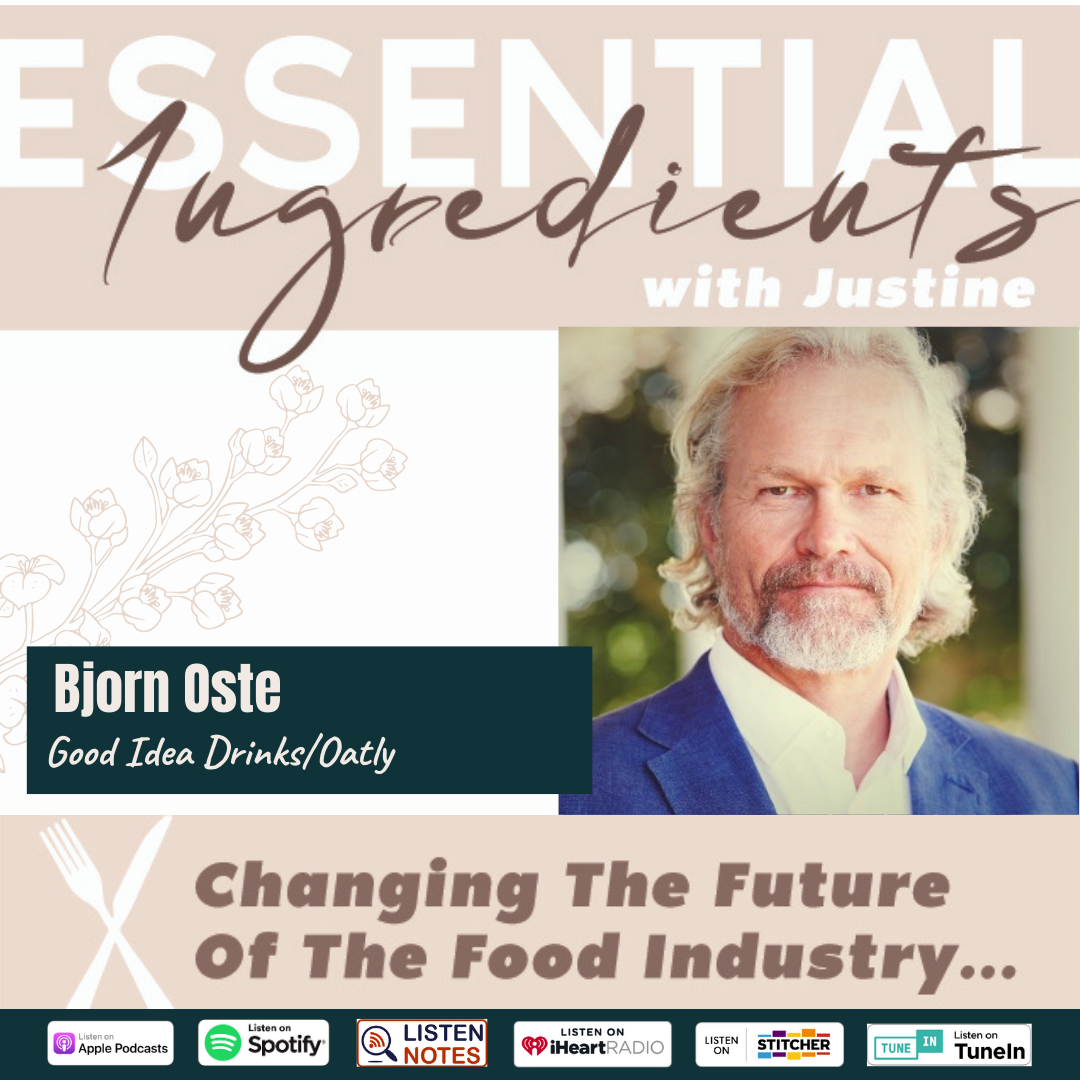
Astonishingly Good Ideas to Avoid Lifestyle Diseases with Bjorn Öste
The Incorporation Method helps you turn what matters into practical changes that fit your life.
“In this episode, Bjorn Öste, the CEO and Founder of Good Idea and Co-Founder of Oatly, talks about how to create and launch a better-for-you product that has a solid foundation and how we, as consumers, can benefit by being aware of how our food is made.”
Full Transcript
Full conversation between Justine Reichman and Bjorn Öste.
Good afternoon, and welcome to Essential Ingredients. I'm Justine Reichman, your host. Today, I'm excited to welcome your host from Good Idea. He is the CEO and founder of Good Idea, and the Co-Founder and Board Member of Oatly. And with us today also is Yvette, one who is part of the NextGenChef team. I'm excited to have her here to participate in this conversation as well, welcome Bjorn. Thank you so much for joining us.
Thank you, thanks for having me. It's great to be here.
We've always had such great conversations with you in the past, and it's wonderful to see Good Idea and Oatly both around. It's lovely to be able to participate and have a conversation with a local brand, local to us because we get to see you here. And learn a little bit more about your story, how Oatley has grown and how you were part of that brand from the beginning. And now, how you're bringing Good Idea to the world, and how that's expanding. So maybe if you would, for our listeners here, just share your story and how you started that off at Oatley.
Oh, how many hours I have as you said?
Oh, as much as you'd like, but I can edit it down.
Gosh, it's been quite a journey for sure. Started in the mid 1990's actually, I don't know. I know the listeners were probably not even born.
I probably wasn't born in the mid 1990's.
Right, exactly.
I love that part, the other day too.
Myself, I had my 25th birthday just the other day for the 25th time. Anyway, in the mid 1990's, my brother launched the product that he developed at the University where he was a professor, food chemistry, back in Sweden where I'm from. And he'd been playing around with how to make a perfectly, solves a lot of the issues that we all very familiar with today, sustainability in the fields of allergy situations, like intolerance of course, but also nurture from an additional point, cost and accessibility, availability across the globe, all that good stuff. And a long list of issues that he wanted to resolve in the current area. And obviously, try to come up with challenges to the big dairy industry that we all love to hate so much today, as for many good reasons. But of course, launching an alternative to milk in a country like Sweden where everybody drinks milk. I'm convinced it is holy and nobody has a problem, and that seems like a big challenge. I was fortunate to start a software company I've been undeveloped in 97 and decided to change or go from computer security to peddling oatmeal. I felt that it was a very natural progression for my career. And then it was a real interesting challenge what do you do with a product that the world's never seen before and don't ask for it. They don't look for it because they don't know what it is. But we loved it, we were close to it. We felt that it has so much potential and tasteless to pro functional properties when cooking with it, or baking with it. My mother used to come to show off her latest sourdough breads use with oatmeal. They are just delicious. So we saw that there's something in here. And in the beginning, we didn't quite know how to person market. We tried an ingredient game, managed to actually get a deal with Danone, which was very educational in many different aspects. For one reason, for one thing, they taught us how to produce extremely high quality and document the entire production process. That was a big bonus for us being a small company to earn a contract with a major CPG like that. You have to know what you're doing and document it, produced with ease and quality over time. And oats are organic materia, oats industrying is not the same assumption default. So how do you maintain even quality when you produce it over the year, when you use our kernels that have been in silence for almost a year. So there's a lot of that stuff that you have to go through. Anyway, long story short, Danone sale for the August they launched was very educational for us. They had a challenge, competing their own products, of course, so they couldn't really sell the [inaudible] on its own merits. And that was very frustrating for us, but we also saw that we could do that much better ourselves. So in 2001, we decided to go on behind our own brand and launched Oatly. So the brand overplays from 2001, has a history of the product going way back. The first element of it was launched in 1994. Yeah, for the historic records.
So just [inaudible] though before, and I want you to continue on, of course. But what made you come up with oats? Why did you choose oats?
Well, my brother looked at aots, I don't know how many he looked at a large number of plants to see cost nutrition content, tastes, functional properties, availability across the globe, and all that stuff, and fairly quickly landed in oats. I think it partially helped by the fact that the FDA or the first, I think in 89 was a no trace in the US because some of the first studies came out that showed that oats reduce cholesterol. And FDA subsequently, in the late 90's, I think 94, 95 ,somewhere in that timeframe actually allowed health claims on oats, the first time they ever did that on food. And it's all about the reduction of the LDL cholesterol. So that helped. And the other aspect of that is that we have plenty of very high quality foods in our part of the world, in Scandinavia, so it's a very abundant crop. You combine all these aspects and it was a pretty obvious choice at the end of the day. The other thing we like, but it's actually pretty hard to make them promote, take something on, or pretty much any other plant base there. And today, they are all generic, anyone can do them right? You can go home and do excellent on the mixing arm kitchens, It's actually pretty hard to make an oatmeal with consistent quality that delivers on taste and functional properties without adding ingredients. In the traditional food industry, you can add anything you want, anything to make you foaming coffee, or mask off notes, or all that good stuff. It's easy, only consumers have learned that and are typically rejecting a long list of ingredients. So the trick is really to have the shortest possible list of ingredients like oats and water, that's a pretty short list. And then actually make something that is homogenous that tastes well. I think that's the key invention. And actually, there's a whole battery of patents around that process in the making. And I think you can see that today, there are a lot of footnotes out in the market, but many of them struggle to actually reach the quantities that opium indeed, some of the others later entrants are starting to reach.
I would agree. I think the consistency of Oatly is very close to its creamy. Anytime you want to use it in a cereal, in a coffee and in anything that you want to replicate it as milk. It's a good job in terms of consistency. It's not watery, it's not thin, it adds that nice richness that you're looking for at least.
And I think those are exactly the profits why oats is now becoming the dominant plant based alternative.
But not all oat milk has that consistency.
Correct. Correct. Okay, definitely a non partial but has definitely a leading, yeah .And I would challenge pretty much any other challenger that meets all these quality aspects that oat has. And I think one part of that comes back to the fact that Oatly was founded by my brothers. It is built on science, deep science. And he didn't invent this by himself if he couldn't. That was, it would be too complicated. He pulled together a team of multidisciplinary experts, he pulled them out of their silences and started having them collaborate, whether that was enzyme experts, or protein, or oats, or food, processing food, or medical expertise. I mean, we mentioned FDA health, so when he started developing the oatmeal, he ensured from day one that it not only maintained those properties, but actually optimized them. And there is indeed, I think, five published studies on Oatly, and how it uses cholesterol. In order to do that, you have to pull in medical expertise in those days. And I would argue, and still today, most people in the food industry, when they heard this and hear this, they shake their heads like, why do you do that? Why bother? Well, we could because we had to pass them. So the other reason was we felt it important to, when you bring a brand new product that nobody knows so that it actually didn't prove them and we can prove that it delivers on the properties that are otherwise considered generic. We've also seen that a lot of our competitors in the field of those cannot make that claim because they're in process, they break down the necessary fiber components that are attributed to healthcare. So yeah, there's a lot of it's under the hood, if you like. At the end of the day, we all get to sit down and enjoy a creamy, great tasting neutral, little nutty flavor maybe but smooth oatmeal.
I would agree. That's my coffee this morning.
It's hard to go back to dairy milk after you put out a coffee, right?
And it's hard to go back. It's hard. I've tried all different kinds of oat milks. I've tried all different kinds of nut milks and seed milks. And I really, I like coffee. And trying it with different milks, it hasn't worked for me because I like the richness. I like the creaminess. And having tried, and I'm not trying to say something not nice about other kinds of milks. This is my preference, because I like a creamy rich coffee espresso.
You're not saying that just because I'm sitting here.
No. I've tried them all. And I'm not gonna sit here and name all the different ones that I've tried because I'm not looking to shame anyone.
The interesting thing from the store, when we actually meet the Barista version that comes well and bland smelling coffee was in itself the result of a long research project. It took us years, quite early in the life of Oatly, again, launched in the brand in 2001. We learn to realize that, don't hold me to the numbers, but I've read somewhere, I believe it's fairly accurate still today. Somewhere between 60 and 70% of the white milk consumption on a global scale is consumed with tea or coffee.
Oh, wow, really?
So it makes sense. Go to India, for example, one of the largest milk producers in the world by volume, and they all drink, or they drink some lassi maybe, but it's with tea. But in the UK, the tea coffee, for sure, they love the coffee or they do the modern coffee culture that really has saved the dairy industry, or given the dairy industry a little extended lease on their life. A Starbucks and [inaudible] rolling out. Look at Starbucks, it's really not a coffee shop, it's a meal for coffee. I think it's still today the world's largest buyer of milk.
I got it. So let's talk about Starbucks for a minute. I mean, earlier this year, I think it didn't only launch through Starbucks in Shanghai?
So openly today or in a number of, I'm sorry, a number of Shanghai stores, and a number of Starbucks stores or shops across the world really. We launched in, I think 4,500 or so in China. That's all of China's Starbucks, right? But you're already in the US and I think their number is 3,000, I don't know the exact number. Starbucks closed on a President coming out last week, right? But as of next year, you will find Oatly in every single Starbucks.
So what do you think contributed to this tremendous international success?
I think when we launched the Barista in 2014, as a result of some exciting research actually to make oats home naturally. And we developed that with some coffee roasters in Sweden. And one of the people in that team was actually a former world champion barista, we learned from them that the barista world had a problem. There was no good plant based alternative that married with the coffee milks in flavor. And of course, was hard to make the same left art with soy or almond, it's never out there. So there was a big vacuum in the marketplace for an alternative solution for a problem, looking for a solution there. And when we realized that we nailed it with our barista version, we got the entire top tier of the coffee culture, the worldwide profit culture behind us, they loved it, they took it. We didn't sell it, the theme of don't they hate, I say that, but they didn't really sell to the coffee. That was the coffee industry that bought our product. Okay, so fine tune that the way you want. But we saw that we had a product that fitted, and the biggest reason is that the coffee taste notes really marries extremely well with oat milk. There's many different aspects of it. If you think about those good old days when you had a laptop or a cappuccino with milk, that you have to finish that cup, you feel in your palate, you'd feel for the sticky surface that's actually very pleasant as actually a pretty bad aftertaste. The main proteins that stick to the palate, but we're so used to tastes are acquired, right? So when you're used to that, you don't react to it. But when you start to compare and you drink oat milk, cappuccino, you have a much cleaner aftertaste. You don't need to take that chewing gum after your cappuccino. [inaudible] that we never thought of because we were so used to it. And when you start comparing, realize that, Oh, wow, it really highlights the defined taste notes in the coffee in a very, very good way. I mean, we see a lot of roasters and baristas, they don't even serve meals in their cafes anymore because their passion, their life is the best taste, the best tasting coffee you can ever make. That corresponds to the product that marries the taste note in the absolute best way. Today, that is ultimate.
The product that the baristas are using to make coffee latte art is the same Oatly that we can get from the grocery store, or it's--
Depending on the different markets. But here in the US, you can find the various stores.
[inaudible] gray one?
Yeah. You have it in refrigerated cases, at Whole Foods for example, in quart containers. The half gallons are not exactly the same. They're differences, it's typically the fat content that Oatly line of products may make sort of what they've learned from milk consumption as you see in a meal, 2% on your full meal tray. And Oatly has exactly that same range to.
My [inaudible] version, it's available for those listeners that do want to go out and get it. For those listening that are here in the Marine area, I buy it either at Equator, or at the Drivers Market in Sausalito. I'm sure more places that he can tell you, I could just tell you where I go get it.
Oh, food nuggets, [inaudible] market. They are everywhere. But my neighbor here, a good friend, he just told me about the last several parties I've done a lot in the market. So I need to get it. It's all [inaudible] fault. But anyway--
Okay. We'll have to let them know. And there's so much more that I want to talk about with oat milk, and with this whole space around nuts, and seeds, and legumes, and this whole space plant based milk. But I do also want to talk about Good Idea, which is the other product that you are now more focused on. So it's not exactly, yeah, Good Idea, because it is a good idea. It's a really good idea. And I want to go back to actually something that you said about oat milk, about Oatley, how you built this company with your brother and how you brought in the scientists to build out this. And I'm wondering how that played into you building out Good Idea? Because from all the conversations we've had, and it sounds like you surround yourself with scientists and the people to help you build out these brands and these products so that they're not just food and beverage, they are meant to be food as medicine, they're meant to solve a problem, they're meant to be well, I'll let you take it from there. But yeah, I'd love to hear from you about that, because that's what's inspiring to me.
Yeah, thank you. And that's really very inspiring for us too. And that's what keeps us going to work every day, or going to the computer, I guess, long walks to work anymore. But when he pulled together that team of experts in various different disciplines, we discovered a couple of different observations came out of that. First of all, as a traditional food industry doesn't do research at all, they completely, at least not what I call research. Never forget, we went to the nest lays incredible research center on Lake Geneva in a town called [inaudible], 200 people in white coats, computer equipment and the state of the art scientific equipment from floor to ceiling. My brother and I were there and he was just drooling all over nothing, right? 200 people, they're all highly paid and the smartest of this market. And one simple question, [inaudible]? Nothing. I mean, of course, they would argue differently. They maybe change one ingredient to another one, or maybe they improve the minute details in something. But the true innovation is not coming out of there, that's for sure. So what you see is that the food industry, the CPG companies are not innovators, they just don't know how to do that. And I think part of the problem is that big companies have struggled to combine big fat research budgets with how do you drive, you push people with the Excel spreadsheets in there to monitor costs. The minute that person walks into the room, innovation walks out to the other door. So we found that we're going to be the rebels, some offenders home, because there's so much to do. And we've seen that over the last five, six years for food tech development, not the least in the US, but it really is the global movement now. There is an endless number of opportunities in food if you start applying deep science, and nobody's done it before. So wonderful news. And we had this incredible team. We started building the OCA team and realized quite quickly that we had our R&D power was too big for Oakly, so to speak. In order for scientists to be truly creative and innovative, you can't confine them and you can't, it's doing them a disservice to have them under the auspice of the brand like Oatly and have to focus everything on the best for a short term. Innovation is not short term, it takes years in most cases. But you have to let it take time. So what we did was we took all the R&D out of Oatly in the early 2000's and created an independent company that today is called Aventure. It's my brother and my food tech lab. Good Idea is an invention that came out of that lab.
What was it called again?
Aventure.
Aventure, okay.
Aventure, yeah. You can look it up, aventureab.com. Today, some 30 people, half of them are PhDs. And in there, we look at developing new foods that deliver true health properties that are addressing some of the leading issues and health issues in the world today. Typically associated with [inaudible] the metabolic syndrome. We look at cholesterol to learn that from the [inaudible]. And science took us into many other adjacent areas, blood pressure, blood sugar, obesity, all those lifestyle diseases or conditions that are avoidable, totally avoidable if we eat right and exercise more. But they're also diabetes, deaths from diabetes have put COVID to shame, right? It's a much bigger problem if you like, although it's a slow death. And I think we have 30 million diabetics in the US and 90 million pre diabetics, 400 million diabetics, close to 500 million worldwide. Numbers are staggering, the health cost is the cost of health care to help them heal insurmountable. So diet is absolutely part of the solution here, has to be. So that's an interesting challenge, an interesting area for us. We look at delivering, inventing new food products that address in one way or the other. And we prove that clinically. We have a very good medical clinical team that looks at, me as an example. I mentioned the old property of cholesterol. At that time in the 1990's, nobody, everybody knew that oats reduce cholesterol, but nobody knew why. If you want to understand and improve that property, you need to understand how it works. So you need to have food scientists collaborate with medical expertise and start, really dig deep into understanding of metabolism and food to structure on cellular level, and even smaller particles than that. And it's complicated. I'm not saying that we have solutions to that, all of that yet. Far from it. But it's an area that is essentially a virgin territory. And there's an infinite amount of opportunities to develop stuff there. So in that process, to look at products that address health issues, and if we, as a small independent company, if we have processes, technologies that we can patent, and we have a patent protection, then we can also go all in and do clinical trials and prove that it works clinically. And Good Idea came out of a research project from Lund university where people just got a couple of scientists led by Dr. Ellen Osman. She's now the head of science for Good Idea. They discovered that amino acids in combination with chromium have some incredible potent efficacies on blood sugar management. And why is that important? Well, blood sugar spikes, repeated blood sugar spikes followed by crashes, you get the blood curve that goes up and down up and leads to, but first of all, you get tired after lunch, you get sleepy. And then in the afternoon, you get your sugar cravings. We all have been there, right? If you repeat that over time, and when a bigger sugar spikes, a lot of sugar in your diet or past carbs from processed carbs, you start wearing out your body's systems. And ultimately, this is what leads to diabetes, to obesity, high blood pressure, Alzheimer, other than nasty stuff. It seems that it's inflammatory, drives inflammation in the body and consistent inflammatory load starts knocking out essential bodily functions like pancreas not producing enough insulin, or the insulin that is produced is not effective. Good Idea is just a light, and you were just drinking yours. You enjoy the flavor of sparkling water with lemon and lime. And being stuck with your food, your blood sugar uptake from the food will be reduced 25 to 30%. It's really a brilliant way of harnessing your natural energy, and you have energy, you get energy from your food. The problem with their blood sugar curves is that we burn it to fat, and then the body's source excess energy as fat. If you can balance the blood sugar curve, you can enjoy that energy over a longer period of time. You don't get tired after lunch, you don't get the sugar cravings in the afternoon, not anywhere in the same way. So Good Idea, it's a really good idea for everybody to drink all the time. You eat, you can drink it anytime you want. But the minerals and the chromium, and they are five amino acids are, the beautiful thing with active components, which are those, right? That they are essential, they have to have them in our day to diet, it's just that we discovered if they're in liquid form and in these specific proportions, they actually deliver an incredible boost on your blood sugar balance. So when we present this to the diabetes, or they had an attrition of diabetic communities to get standing ovations, they make the wave. And this is potentially a really good tool in the pipe. It's not intended for diabetics necessarily, but for pre diabetics. Or anyone else that wants to avoid even getting pre diabetic or just want to stay awake after lunch. So we change the dairy industry with Good Idea, we're going to change the water industry.
That was really fascinating. We heard that Oatly is really science focused, and you're also backed by market research. We hear that you took all of those knowledge into, and secrets into launching Good Idea. And one of the key reasons that you mentioned that contributed to the success of Oatly is the partnership with baristas. What about for a Good Idea? Can we see this? Can we order this for lunch when it goes to a restaurant where we can dine out again? Is that where people consume their sparkling water?
Yeah, for sure. We were supposed to launch around a number of offices here this spring. Obviously, COVID had other thoughts in mind for us. So COVID has thrown some wrenches in the system for Good Idea to pass for so many others. So we are actually, right now, we sold out on our inventory this summer. We regrow things, we're going to launch a couple of new flavors and be really exciting actually, we're coming back in vengeance in the spring. And it's very exciting because I have a new Chief of Operations here that is going to help build the business here in the US call center. It's a good friend of mine, happens to be the founder of Fiji Water. He knows a few things about selling water and how to build a solid large game water business in this country. So he helped me with Good Idea, though.
That's great.
Yeah, I see. And another really important question is health, we always get people asking about plant based alternatives healthy. But actually, that's not the main cost driver when they're making the purchases. It's good to be healthy, but {inaudible], that's for everyday food consumption. However, Good Idea sounds like a different lane. It's more functional food. So can you share with us some of the similarities and differences between like grocery foods versus functional foods?
Yeah, that's a great question. Actually, the term functional food has been around for a long time. And I think it's been abused in some ways. But you could also argue that all foods are functional in one way or the other. Hopefully, there are some examples where that's not true for sure. But what we're talking about here is really taking it to the next level when you have products that actually we can document and prove that they have some distinct health properties. I mean, vitamins that have been around forever, we need them obviously, critical for our diet. But Good Idea has a function, two very distinct functional properties that improves the body's ability to regulate and maintain blood sugar. But it is still a regular food, you can drink it, it's a water you can over consume, it doesn't hurt you if you don't have a problem. If you want to have healthy blood sugar, it's not going to change anything. It just provides essential nutrients that are essential in providing that function in your body. And unfortunately, a lot of us don't get enough for that. So if I provided to you, I'll help you boost that property. I mean, with Oatly, and cholesterol, and oats, I think the biggest functional property of oat milk, oats in Oatly, in particular is the dietary fiber. Dietary dietary fibers is one of the nutrients that we love the most in our regular diets. The nutritional community will tell you that, I remember 20, 30% under consumption of dietary fiber, it's not even more here in the US. And dietary fibers are essential for our bowel, and for our microbiome, and for many different [inaudible]. That comes up a healthy microbiome, for example, or a regular stomach.
I'm curious, so with this firm that you have that does the research and builds out the products and the investments, as you are now in the plant based and you're doing research around the food, the plant, you know, Good Idea. What will you be looking to do research on next and potentially invest some time--
Aventure already has five different companies. Good Idea is the one we're taking to the market here in the US. We have a pharmaceutical company, actually a very cool project. It's a 100% food based pharmaceutical company, there we've gone next to the extreme. On the other end of the spectrum, it's actually a beverage your drink that fills your small bound and serves as a conscious medium when you do x-rays, CT scans or MRI. So if you're out, when the doctor wants to see the inside wall of yours [inaudible], you need to fill the bottle. And there has been theory innovation in that field for the last 30, 40, 50 years. And the products that are available have a lot of problems with them. Taste is just one. And that's an extreme example of how we found that we can use our deep science, deep knowledge in protein technology combined with our clinical expertise. So we're actually in phase two of getting ready to get into phase three trials next summer for pharmaceutical approval. That's very unique, that you take it as a complete product and get certified for pharmaceutical. And we're extremely excited about that project because it's sort of from oat milk to contrast agents and diagnostics. Yeah, we're spending a pretty wide field here. But I love to talk about it because it shows what you can do with food if you're smart and know what you're doing. Apart from that, which is a little bit of an outlier. In that sense, in our portfolio, I think we have three or if not even four products in Aventure that are in clinical trials right now that are targeting cognitive function. They are targeting, we have 800 patients that have heart attacks that they consume the product they only developed that will dramatically improve their chances and dramatically reduce the risks for follow up heart attacks. It's very medical. And we have two different products that are targeting type two diabetics. So we're seeing, the more we learn, we can be more and more focused and actually really address people with diagnosed conditions. And if you look at diabetes, again, 90 millions or 30 million diabetics in the US has an incredible market. They have real issues. So if we have products that can help them live a better life, adds tremendous value.
Wow, you are doing so much. Was there something personal in your life that drew you to this?
No, not really. For me personally, I got pulled in by chance. My brother's a scientist, and I think one thing led to the other, right? He was doing his thing, and we started talking, and we started pulling in other people, and we're starting to learn this web of all the experts and in their own journey. In 2012, we felt that we needed, we had the world's best product but we needed to have the world's best marketing. So we set about to find a team that could deliver on that. And I think it's safe to say that it exceeded our expectations.
By the way, marketing is a whole nother conversation.
It's important, because some of the lessons from our side and many others, it's not enough for the best product. It's not enough for the best marketing. That if you combine the two, you have a really exciting opportunity to change mountains or to move mountains into some extent. I would say that's for those who are doing right now. They are growing and they are all over the world. And it's an amazing journey. But it took 20 years to get there. So one has to be patient, but it's easy to be patient. It's easy to be quote unquote, patient, if you believe in what you're doing. And you see that it's moving all the time, it's moving in the right direction. So hang in there, don't just do it for the quick wins.
I think that's a really good message for our listeners, and for our founders that are listening because I always say that myself as a founder. I look back and I'm like, okay, so how quickly can I get this going? But it's really every little step. You look at it, and every little step makes a difference. And I look back at the last two years that I've been working on NextGenChef, and then when I put it all together, you see the big picture, and you see how much you've done. But when you look at each little thing, or just a little bit of time, you don't realize the impact you're having. And it takes time. So I think you guys have, I mean, I look at what you've done, and I look at Oatley, and it's amazing.
Thank you.
And it takes time to do that. And somehow, when I look at it, to me, it happened in a hot minute because it's like we see it and we think it happened overnight. But when we hear the story from you, it didn't happen overnight. You've been working on that for a very long time. And everybody thinks it happened overnight, because we walked in, what they found out--
Yeah. No, it's natural. And to some extent, you could say it's almost been an overnight success story in the US because, okay, launched as late as 2016. That really didn't do much of anything until 2017. And that's only what? Four years ago. Today, it's quickly becoming the market.
The consumers are ready. You said the love to hate the dairy.
So what can we expect in 2021 for Aventure, for Oatly, for Good Idea?
More of everything. I think, yeah. But good idea, as I said, we are gearing up for launching new flavors. And that will be very exciting. Actually, I'm very, very happy about what's going on there. They're very cool. And we'll see. We're not going to bring in new products from the Aventure world to the US next year. But I certainly spent a lot of time with the team back in Sweden. But looking at growing that business, and only ever locally is only on a continuing journey for sure. As we've said, Starbucks announced on Starbucks on karaoke during next year. So I think it's safe to say that you will find Oatly in many more locations closer to you, wherever.
So for our listeners, that one Good Idea, they're gonna have to stick around--
Unfortunately, it's sold out. And COVID really made it hard for us to do new productions. We had to rethink a little bit. And in some sense, it's kind of weird. But you can't go out and do promotion in stores anyway. So we kind of found like, well, if COVID served us with an opportunity to do it in timeout, which would be impossible otherwise, well, let's make the best out of it. So we are really, we're not idle, we're working hard on our side. And then we'll come back with a vengeance. We have a number of retailers that have been carrying us that are ready to take us home again. So I'm excited about that experience. It would be a good year for Good Idea for sure.
Well, you'll have to keep us posted because we're always a big supporter. We'll make sure to let everyone know that.
Yes.
Yeah. NextGenChef, Good Idea, what are you going to be launching within this spring? For viewers that are watching this, because our listeners do not know what we're showing them. But in the US, we have an aluminum bottle, and Bjorn was showing the glass bottle which they have in Sweden. So for those listeners in Sweden, you'll be familiar with the glass bottle. For those listeners in the US, it's an aluminum, but we're going to be launching the marketplace as well online. So we'll keep you up to date on that. And we'll be able to add on the NextGenChef products that are local, accessible, healthy, regenerative, so that there'll be a whole lot of that accessibility to those products. Bjorn, I want to thank you for joining us. Yvette, I want to thank you for joining us. Our listeners, I want to thank you for joining us. And for those that want Oatly, Bjorn, where can they find it?
In a supermarket near you. If you're in the US, Wagmans, Target and Whole Foods are the big, I actually don't know personally all their sources. And next year, they will be in more places. So if it's not in your local store today, check tomorrow. It's spreading. There are more stores taking it in.
Is it available on Amazon?
Well, isn't a bit on the line of this website, for sure. Yes.
Okay, and for those that care, my favorite one is the barista one, or the dark blue one. Mine just in case, I don't know. I don't know, Yvette, if you want to share what yours is, or if you do, or be or not?
I do like it in a cup of Starbucks latte. I need to start making my own coffee, guys. Good point.
My kids love the chocolate. So I'll plug for that. Delicious. Thank you.
All right. Well, thank you all for joining me. And I want to thank our listeners. And for those of you that have not subscribed to the Essential Ingredients Podcast, please do. We do podcasts every Tuesday, so please subscribe. And we put these up every day for you to listen to. And if you want to join in, just send us a note. And we hope to see you here again soon.
Share This Episode
Enjoyed this conversation? Share it and tag @nextgenpurpose
Listen on Apple ▶Listen on Spotify ▶Your Host
Justine Reichman
Founder & CEO of NextGen Purpose. Host and Executive Producer of Essential Ingredients — 11 seasons, 330+ episodes, and a growing movement.
About Justine →