Jennifer Marcks · NextGen Purpose
Watch on YouTube
How to Build a Gluten-Free Diet with Jennifer Marcks
The Incorporation Method helps you turn what matters into practical changes that fit your life.
“”
Full Transcript
Full conversation between Justine Reichman and Jennifer Marcks.
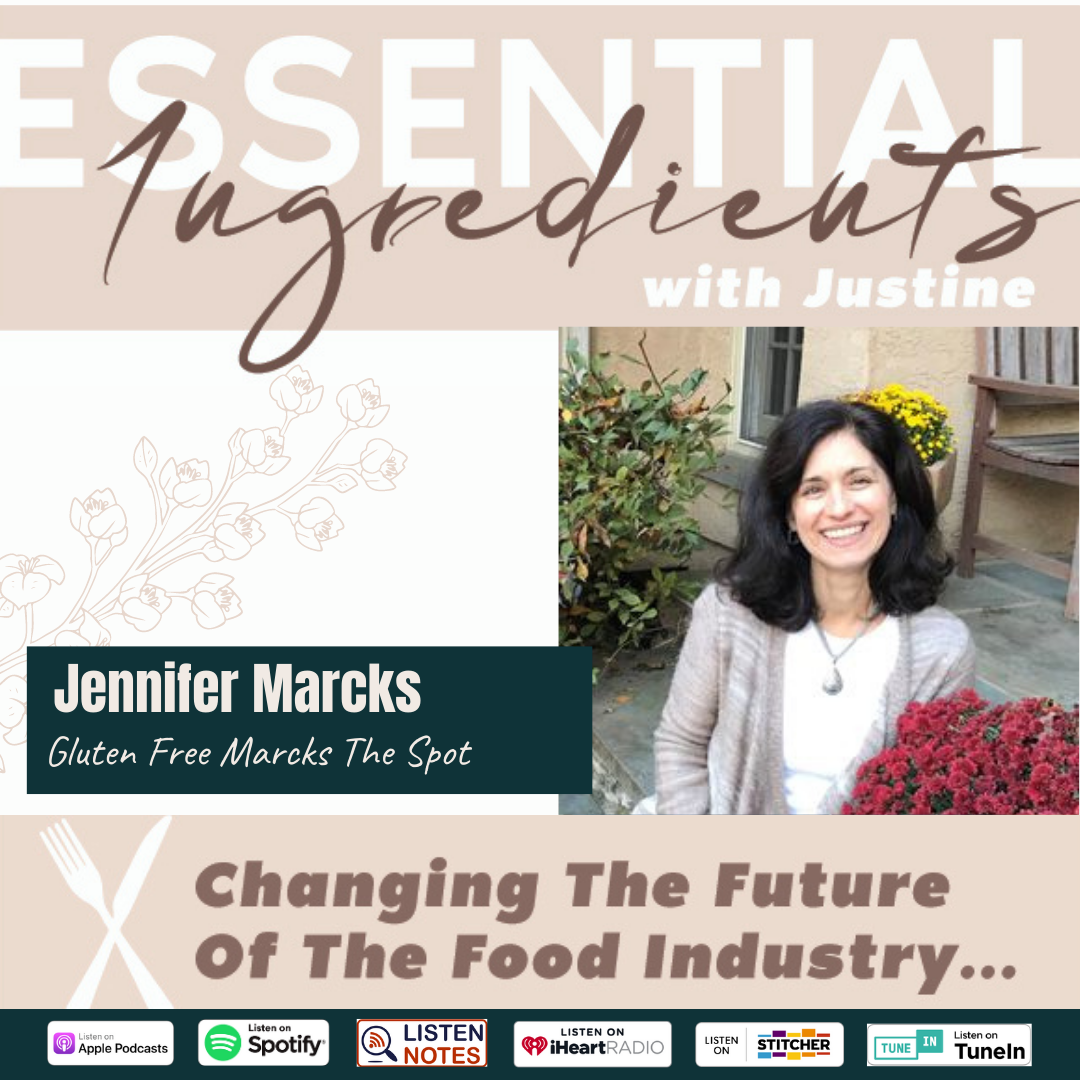
Good afternoon, and welcome to Essential Ingredients. I am Justine Reichman, your host. Today, we have Jennifer Marcks. I'm excited to introduce you to her, and welcome our listeners to today's episode. Welcome, Jennifer.
Hi. Thanks, Justine. Thanks for having me today.
Thank you for joining us. I was really excited to read a little bit about you, to your E-Guide and see what you've put together here. It's exciting. For those of you that don't know, Jennifer has an E-Book out about guiding those of you, moms and families through building a gluten free diet. I'll let her tell you more about it, because I will totally just butcher it. But I know that many people suffer with a variety of different health issues, and I'm excited to talk to Jennifer about the experience that she's had and what inspired her to put this together. Jennifer, can you share with us a little bit about your story and what got you here today.
Oh, absolutely. Yes, so I've been living gluten free for 11 years now. And all three of my children are also gluten free. So four out of five of us at home live gluten free. We've been in this a long time.
What is that like for the fifth person? Is he gluten free now?
I would say he's probably 90% gluten free. He is the only one that brings gluten into our home, which of course being home with COVID changed things a lot. Because now, he was home making his meals all the time. Whereas he would eat his gluten filled meals out of the house typically. So that changed a little and opened our eyes of how important it is when I tell my clients, yes, you have to set up your gluten free kitchen. It's important to have your separate spaces. But yeah, so he's a good sport about it. He eats with us and whatnot. But 11 years ago, it wasn't so easy to live gluten free. I can tell you that there wasn't much information, or what I say information that was reliable. You could hunt for information. No one around me knew what I was talking about when I said I needed to be gluten free.
Wait, Jennifer, before you tell us about that. Can you talk to me about what it was like to be diagnosed? Because back then, what was it like to get diagnosed? And who diagnosed you with this because it wasn't very popular.
No, absolutely not. So when you put pieces together of a puzzle and you see the whole picture, that light bulb goes on and you're like, wow, that took years. Put that together. We had moved a lot and I have seen doctors, my regular doctor, my different gastroenterologist and I would say: "I don't feel right. I think it's what I'm eating." And they would all say: "No, no, no, no. Food has nothing to do with how you feel." Hello? Please don't ever believe that statement. Food has everything to do with how you feel. So thankfully, I know that and like to preach that now. But back then, I was right. No, I know. I eat this, and I feel this. No, no, no. They told me I was stressing myself out trying to figure that out. Finally, I found a Doctor who said: "I think you're really allergic to quite a lot of things." So I had had every test in the book, nothing came back that showed anything. He said: "Let me send you to a dietitian." I saw this girl and she said, yeah, we're gonna do a food allergy test or whatever. But she said: "No gluten, no dairy." I was like, what is gluten? She basically gave me a piece of paper and told me to go to Whole Foods and buy some gluten free bread and make qinhuai, which I also didn't have any idea what the heck that was. And that was about it. I mean, I can Google what gluten was.
Just before you go on, I know there's a lot of different ways to test for allergies. What did they--
That's a whole nother podcast.
Okay, fair enough. I have to be fair to the listeners because I also am interested on a personal level so I have to manage. Okay, we'll talk about that after. So we'll get past the testing, we'll come back to that on another one. So you got tested and they found out that gluten, gluten and dairy.
Gluten and dairy for sure were my triggers. I didn't get very far with the people that I was seeing, and even my doctor could only give me a little bit of information, which was so surprising back then. But I was a teacher and an administrator, I read and research so I dove right in and figured it out. That's what I do. And found where do you find gluten in your pasta, in your bread and in your cookies. Basically, everything you're eating. All that hidden gluten is what really gets us, the hidden gluten in the spices, and in soy sauce. Teas and coffees are naturally gluten free. But think about the teas and coffees that we all want now, the lattes, and the pumpkin spice, and all that good stuff, that's where the gluten hides. That's where the gluten sneaks in. So learning all those little tips, tricks and strategies was a very long road. But when I went back and put the pieces together and saw, okay, my high school self on the floor, in the bathroom, holding my belly in pain, in college being taken to the emergency room because I was in such incredible pain, no is answers to any of this. As a young mom being exhausted by carrying just a laundry basket up the stairs, so gluten can hit you in so many different ways that it's really hard for doctors to diagnose because of that.
So what was it that inspired you to create Marcks the Spot?
Gluten Free Marcks the Spot was inspired from, yeah, so with my journey, I found out that I needed to live gluten free. And then when I was studying everything, I was like, wow, this describes my daughter. My daughter was in third grade at the time, she had belly bloating, she had vitiligo down her leg, or your skin discolors, and she's starting to have some tics, like her arms would just fly out, and no explanation for any of it. We didn't even connect it together. My son at the time was in first grade, and he was a real short little guy. I was always small so I didn't think anything of it. But then he was also a little behind in his dental. So as I was reading and studying about celiac disease and what gluten does to your body, they were all red flags for my children. So I brought the information to the pediatrician and she said: "I'm just learning about this." This was 11 years ago so I'm just learning about this. She was going to a conference on it, and she came back from the conference and said: "Let's test the kids. You are right, they were off the charts for celiac disease."
Wow. Wow.
Yeah. So if I hadn't figured out that I needed to be gluten free, I don't know that they would have, or we wouldn't even know that information. Because until you put everything together and say, wow, everything stopped. My son grew four inches, four inches in one year.
In one year. Well, that's amazing.
He was in first to second grade, four inches. That's crazy.
Was that just by figuring this issue out?
Yes. gluten free, going gluten free. That was it. My daughter, no more belly bloat. Her energy was sky high like a third graders should be. And the vitiligo stopped in its tracks, and her tics went away. And I was talking to top neurologists saying: "Could it be her diet?" Nope, nope, nope, nope. They wanted to do all these tests and all these other invasive things that I was not for, or medications and drugs. We are gluten free and that all went away. No more issues. So that is what empowered me.
It's amazing because it's so powerful how many entrepreneurs start from personal passion, personal experience, it's so impactful because it's a personal journey that gets us there. It's impact that we see on a personal level that drives us to create greater change for the greater good. So with that being said, what are you trying to create with the future of food on a more global level? With your initiative?
Yeah. So just trying to really get people to know and see, and be mindful that what you put on your plate makes a difference. You change your plate to change your body, to change your health. And when people see that correlation, they're like, wow, I feel better without gluten, or without dairy, or without eating potato chips every night. Whatever your revelation is, you see that. I think once people see that, they really can change their health for the good.
Is there a story that you can share with us? Whether it's a client, of course, I want to be respectful of names, of course. Is there a story that you can share that might really communicate the impact you've been able to have with a client on how, by isolating what it is they're eating has really impacted their life personally and positively with change in a positive way.
Absolutely. Actually, I could share about my daughter who was third in third grade at the time. Now, she's in her second year of college. I'm very much about empowering your children with food allergies because they don't want to be different, they don't want to stand out, and she always said: "I love being gluten free because my friend's parents know me." She's that girl, they have something special for her. She loves that. Whereas another child would say, Hi, I don't want anyone to know that I'm gluten free, right? I think you have to empower them and make sure that they have what they need. We go to a birthday party, and she has what you need. I bring a gluten free cupcake so she's not left out. I call ahead and find out what they're eating. You bring that so they're not left out. And you make it more about your friends and things, instead of always about the food, although foods are important, we know that. But last year before she went to college, she looked at me and she's like: "Mom, how am I going to do this?" And immediately I thought, how is she going to live gluten free in college? And that was a big question for us. The colleges that we toured, the colleges we looked at, that was the big question because eating is your necessity in life. I have to know if she's going away from home, she's going to be able to eat. So the college had to have gluten free services and things in place, right? She said: "How am I going to do this mom?" And I said: "Eat gluten free." And she goes: "No, continue to live a healthy life."
Wow, well done. That's a good job on you.
Thank You.
You instill that, you built her to believe that, to live that.
I was blown away. I was blown away and I was like, look at you. And then when she came home at first I think it was probably Thanksgiving, she is telling us how she taught all her friends about being gluten free. They would go out and they would find the restaurants with her to eat gluten free.
That's amazing.
It was amazing. This year she chose girls to live with, and they got a place with a kitchen so they could cook gluten free foods. They came to me and said: "We want you to teach us because we want to make sure we're not cross contaminating and all that." I'm like, wow. She's amazing.
Well, I have to say I would imagine that, especially this year, it's challenging. I'm sure that COVID is playing a role. I can imagine an even more difficult for them. So, yeah, has COVID impacted your ability to have an impact at all?
Absolutely. I spent last year writing a six week gluten free course to help people live gluten free, weave it into their lifestyle because gluten free living isn't just about the food, it's actually knowing how to live gluten free. How to go out to restaurants, how to shop, how to have a celebration, how to have your holidays, how do you have your whole family over for Thanksgiving dinner when you're gluten free. So my whole program was about that, and I just started to launch in March. We know what happened in March.
Right, yeah.
Like, pull it back, pull it back, pull it back. I stopped the launch because I can't tell people, this is how you learn how to shop gluten free if you go to different stores and you go out. I wasn't gonna tell people to go out into pandemic, or to practice going to a restaurant, you have to get comfortable speaking up for yourself, and to practice. The more you practice, the better you get. But I wasn't going to ask people to practice that during this time. So that changed. It did push me to meet a lot more people online, which has been fabulous. We've met online, so it's a great thing.
People go out of their comfort zone going online, be more open and expand their networks. So that part of it I think has really empowered people in a new way. I'm grateful for that. So yeah, that aspect of it at least.
Yeah, yeah. Not any of the rest of it, but yes.
Right. Well, that's true. What did it look like for you, pre COVID versus now? So pre COVID?, we have during COVID, so what are you preparing for post COVID, now that we have all these new things?
Yeah. So it kicked me into doing some virtual gluten free cooking courses, which have been super fun to do over Zoom. Who knew that would be fun. But when I do a cooking class with other people, you're sharing the food, and you're eating it, and everybody's tasting. I'm doing it on my own, I'm then feeding my family for the week. So you have little benefits there. But yeah, so post COVID, we're hoping to get back out to cook with clients, to shop with clients, to do in person workshops. Because talking to people face to face, you need that interaction, you need that.
Actually, I have a friend who has crohn's disease that lives in Philadelphia, on the main line. I'm going to have to connect you guys.
Absolutely.
I think it could be interesting. She's got kids. Actually, it was my friend, I'm friends with her husband from college. I'm going to connect you guys because you never know, there could be some synergies there just in terms of personal lifestyle kind of thing. But we're gonna take a short break and have a word from our sponsors, and then we will be right back to learn a little bit more about some of those recipes you have going on, the ingredients you use and how we can share them with our listeners.
Welcome back to our listeners. Welcome back Jennifer, thanks again for joining us this morning. This talk to me is really personal. I'm intolerant to gluten, I'm intolerant to dairy, I'm intolerant to eggs is the worst, and that's in so many things. You were talking about glutens and so many things that we don't think about, eggs and so many things we don't think about. I feel it the day after I eat them, I am most conscious of that because I feel it. While the doctor has given me a list of these things, that is what I noticed the worst. So in any event, it's so important to be able to build out recipes and try to figure out different ways to create recipes and meals that make us feel good. So your recipes have a high bar for ingredients without compromising the flavor. What was the recipe development process for life for you?
Oh, wow. I grew up cooking with my dad and baking with my mom. I kind of always have been in the kitchen. So when we had to start our gluten free journey, it was a journey switching things over. But I really found that if you find the right substitutions and the right foods, you can create any meal, gluten free and really enjoy it. Our meals are gluten free, dairy free and corn free. So talk about corn, thin corn and everything. I'm intolerant to corn on top of that.
Wow. I eat all of that instead.
Yes. And that's what I did at first. When I first went gluten free, I ate the tacos, and I had cornbread, and I had corn chips, and I was more sick than ever. And then it came out that I was intolerant to corn. So you learn to go down your path, you figure it out. But I've really found that if you find the right substitutions, we have recreated every meal we've ever had. So to be gluten free, we continuously create new things all the time. We have fun with it, just to get in the kitchen and have fun. That's what I can tell you.
I'm right there with you. Because I tried to do the same thing with things that I like. And many times, I'll Google recipes. Ad I'll look for, I'm not a vegan, I'm a bit of a carnivore if I have to be honest. But I don't eat eggs so I'll often Google vegan recipes, even if I'm making something with oatmeal and like a crisp or something. And sometimes, it will have an egg in it just like for the crust or something. I'll Google the vegan version of it to have like a crisp because I don't eat eggs. But I get a lot of ideas on how to do it, and it's fun. I'll use a variety of things. I don't also like refined sugar, that doesn't make me feel good. I have no idea if I'm allergic, intolerant or whatever, but everyday, I'm learning about a new substitute for them. I'm always trying something. I've now gone to maple butter, maple syrup butter.
Wow. Okay.
I love it.
Yeah. Sugar is another whole layer on your whole gluten free lifestyle as well. Because what is gluten does, it irritates our gut and causes all these imbalances in your body. But sugar can do that just as well. So cutting back your sugar, you don't want to go for substitutes. You don't want to do a lot of the sugar substitutes because they are, especially the artificial sweeteners and things because they actually harm your gut even more so you have to be careful on that. I hear you on that.
Yeah. So I've created a lot of fun recipes. Trying some are better than others, I have to be honest. Anyway, I'm sure you're very familiar with the gluten free market. I'm sure you've seen a lot of new innovative ideas out there and a lot of new innovative products. What are your thoughts on the market? Do you see it growing?
Absolutely. When I started this journey, I had to read every single label and be vigilant of every word that meant gluten. There wasn't much out there, and a lot of the products were not tasty. They had a lot of extra added sugar, or preservatives, or things to make it taste better because they took the gluten out. Now, you can find healthier versions of gluten free items and more. Like everyday, every week, every month in finding new products in the grocery store. Just a few months back, we found pretzels. I haven't had pretzels in like 10 years. Because if you find any gluten free pretzels, they're always made with corn. FitJoy pretzels, they're made from cassava and they're so good.
Oh, really? I used to love, do you remember where they Grossman's or something? The big hard ones?
Oh, yeah. Yeah.
They're like burnt a little. I haven't had them in 100 years. But the big salt rocks--
Yes. Yes, yes.
Those are my favorite.
Yeah. Try these cassava ones, they're really good.
Okay. I will try that.
There are so many new products coming out. And again, you just have to go back to reading labels to see what you're choosing.
What's your favorite gluten free bread?
Great question. We make our own.
Oh, that's not fair. And that's not as much fun as answering the question.
No, it's not. But do you know that little additive and almost all of the gluten free products, xanthan gum?
Yes.
Xanthan gum is not good for me, though. So if you try to buy bread, it typically has that in it. So we started making our own. And then of course, yeast was nowhere to be found during the pandemic, so we started making sourdough bread. It's something I always wanted to do and I thought, oh, be so hard. It is not hard, my friends. You need organic brown rice flour and water.
Have you tried Seriously, SRSLY, gluten free sourdough bread?
Oh, no.
Okay. The woman is originally from Brooklyn. Her name is Sandy Shaffer, I think, and she is out of Oakland. That's one. Then there's another one, there's a bunch of sourdough gluten free. There's another one called, I forget the name, I have it here. And it's fig, and rosemary or something. It's really good. But I only buy sourdough out here, gluten free sourdough. Anyway, I'll send you a couple names.
Yeah.
And for our listeners, Seriously is the sourdough I buy or this other one, which of course, it's going to be hard for you to buy unless I find the name and add it to the show notes. I promise I'll do that.
If my kids chose, they would choose O'doughs, which makes a really thin bagel.
Oh.
A little sandwich, like a square sandwich bread that is pretty nice.
So can you share a couple tips, maybe three to five tips as a better for you food entrepreneur?
Oh, sure. As an entrepreneur teaching my clients, I would say, be mindful. That is the key. When you start becoming really mindful of what you're eating, how you're feeling, and changing your plate over slowly, I think you make such a huge impact in your lifestyle. And knowing that, people think, Oh, I'm going to start this healthy lifestyle, but then they go and think, I can't do it. There's so many things to do. So it's a big change. But if you take small steps, you can make a huge impact in your lifestyle. Just change drinking water, ditch your soda and drink water. Cut back on your coffee, drink water. Coffee is good one day, bad one day, depending how that affects you. A lot of people that are gluten free, coffee can really irritate your gut as well. So that's something to think about. But just knowing that you don't have to change, like when you start gluten free living you're just like, Oh, my gosh, this is a whole new lifestyle. I have to change everything about my life. But when you break it down and have support to walk you through the steps, it's so doable. It's so doable, and start where you are. People think they have to go from here to someone eating processed foods, that's what you grew up on, you can't have someone telling you to go buy qinhuai and drink smoothies that day, it doesn't work. So take your favorite things and substitute them out. If your family loves, we have kids that are gluten free and they love spaghetti and meatballs, find a good pasta. Trader Joe's brown rice pasta is great, Tinkyada pasta, those are great pastas. Try that and make your meatballs gluten free. Don't use bread crumbs, use gluten free oats. And to bind your meat and make your meatballs, and you have your gluten free meal, and now your child's not left out. So start with your substitutions and then weave in healthier, healthier, healthier living as you go. It works.
You have a pandemic recipe you want to share.
Oh, gosh. We became very obsessed with black beans at our house. I don't know why, I think meat, family of five and you can buy one pack of meat a week and it's like, okay. I think we turned more to beans. But we started making black beans sweet potato chili. That was so good. And then we started making just black bean soup. It can't be easier, you need carrots, onions and celery, a sweet potato, a can of diced tomatoes and two cans of black beans. You throw in a little cumin and some chili powder, and it's delicious. I made this for my kids and they asked for it again, like two days later. Can we have that again? Can we have that again? They really like that.
So very similar. I'm going to just share with you. I got a recipe from a neighbor, which I've tweaked and it's a little bit different, not quite as healthy as yours. But we have a local farm that we get some meat from, and I got these bacon burgers, not terribly healthy. I know that they come in packs of three. So I put some onion and garlic, and then I put the pack of three of the bacon burgers, and then I add carrots, celery, a can of black beans with the liquid in, and then some whole peeled tomatoes, cumin a little bit, and then the salts already in with the bacon burger, and then I put it in the pot, and boom. I've got my, what I'm calling chili.
Yeah, that sounds amazing.
Two different chili recipes that we can now put up on the website for people to see the vegetarian one, and the meat one.
Yeah.
Gluten free.
Yeah, yeah. They can be very much, Oh, watch your spices. Your hidden gluten is in your spices.
Exactly. So that was totally agree. Well, I really appreciate you joining us. I do want you to share a little bit about how people can get in touch with you, and a little bit about your offer for our listeners. And if you could just tell them a little bit about your Ebook.
Oh, sure. Okay. I do have a Gluten Free Moms Starter Guide Ebook that you can easily download on my website, which is glutenfreemarcksthespot. My children came up with that name because Marcks is our last name. That gives you five steps to take, to get started on your gluten free life. So it takes out that overwhelm, and get you started in an easy manner, which is great. And since you've listened to the end, we're also going to share with you my holiday meal survival checklist. Because as we were saying earlier, holidays are coming. And what happens is we get all stressed out, how am I gonna eat at my mom's house now that we are gluten free? Or how are you going to have your extended family over when you're gluten free? Do you serve everybody gluten free meal? Or do you have to now allow gluten back in your house? Which you might not want to do. So this checklist will walk you through, how to survive both of those, for sure. And if you really like the cooking and want to learn more about gluten free cooking, I've started a virtual cooking classes once a month that have been super fun on Zoom. Who knew that would be so fun on Zoom. With everybody's faces on there, we're still interacting, which has been really, they'll ask questions, the only thing you can't do is taste the food and smell the goodness. But you get the recipes, and I'm always weaving in how to live a healthy gluten free lifestyle within the recipes, and why we eat certain things over others. So you get a lot of good healthy tidbits out of the class. It's more of a class than a recipe cooking. It's not just a cooking show, you're really involved so it's a lot of fun.
Awesome. Thank you so much, Jennifer, thank you for joining us. Thank you to our listeners for joining us. If you like this podcast, please subscribe, download. You can hear us every week. We always have a new episode, and we'd love you to continue to join us here at Essential Ingredients. We have our podcasts on iTunes and Spotify, and all the regular channels so continue to join us here at Essential Ingredients each week. If you want to share your story, please reach out, we'd love to hear from you.
Share This Episode
Enjoyed this conversation? Share it and tag @nextgenpurpose
Listen on Apple ▶Listen on Spotify ▶Your Host
Justine Reichman
Founder & CEO of NextGen Purpose. Host and Executive Producer of Essential Ingredients — 11 seasons, 330+ episodes, and a growing movement.
About Justine →