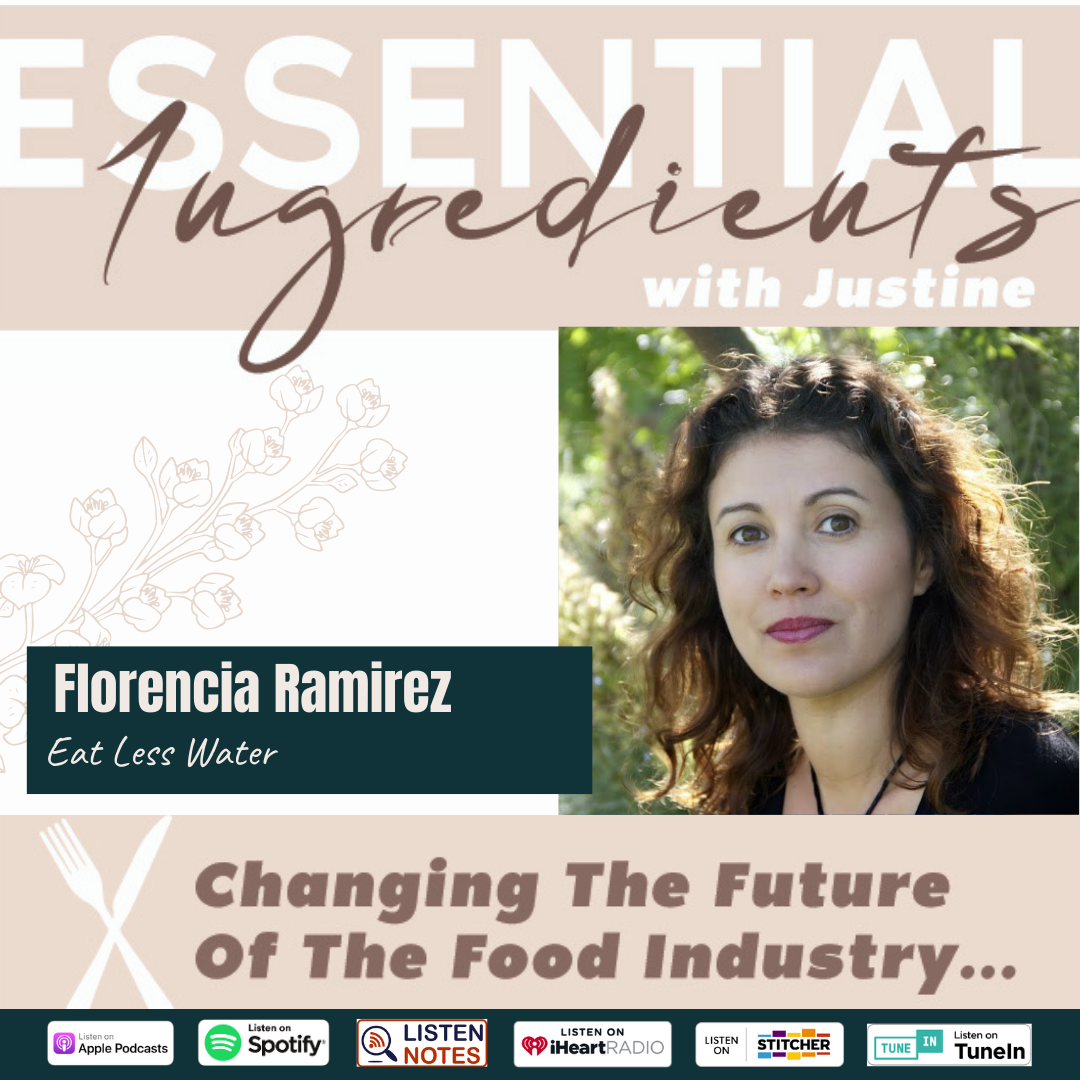
Florencia Ramirez · NextGen Purpose
Watch on YouTube
Your Part in Water Conservation from Farm to Your Kitchen! with Florencia Ramirez
The Incorporation Method helps you turn what matters into practical changes that fit your life.
“Lack of water is a global crisis. Billions of people experience a scarcity of clean fresh water. Without urgent intervention, a great fraction of our population will experience recurring water supply interruptions within the next few years. In this episode, Justine invites the author of Eat Less Water, Florencia Ramirez to discuss this pressing issue and how practicing regenerative agriculture can save a tremendous amount of water.”
Full Transcript
Full conversation between Justine Reichman and Florencia Ramirez.
Hi, welcome. My name is Justine Reichman, I'm your host of Essential Ingredients. We have Florencia Ramirez, who is the author of Eat Less Water. Welcome, Florencia.
Hi, thank you for having me.
Thank you so much for joining us. I'm excited to learn a little bit more about you and about Eat Less Water, which is your book.
Thanks so much.
I'd love to just get started, share a little bit about you with our listeners, and get them to have a chance to know a little bit more about you and what got you into this space. I'd love to just learn a little bit more about you before we get going and dig deep.
Yeah. So I'm the author of Eat Less Water. I would consider myself to be an author, but also an activist and a mother, and just a person who is, you're going to hear this probably a few times during this conversation, but I'm not here to tell you how things are broken and how we should fix things. But rather the way that I approached this is, to look at what are the things that are really working in the world because most things are working. And there's so much beauty and so much good work happening. So for me, it's really focusing, the book is focusing on my work that I do, the activism work I do is really focusing on how we grow well being for this planet and for ourselves. So that's really what will drive this conversation.
I love that. That's amazing. And that's very similar to what we're doing on a little bit of a different level. Because NextGenChef and Essential Ingredients is really a platform to provide people with information so they can make more informed choices. I'm not really activating for one thing or another, but giving people access to the information. So people like yourself, as well as other thought leaders and activists can come on and share their point of view so that people can have access to the information. I'm excited to be able to have you share your point of view today.
Yeah.
Maybe tell us, how did you get involved in the food space?
So actually, the food space, it happened for me through water. About 10 years ago, this was a few droughts ago because I live here in Southern California. So this was three droughts ago. I just gave birth to my youngest daughter. And during that, I just had given birth, and I was reading this piece in the newspaper talking about all the ways that we could save water. We know all the same action pieces that they roll out during every drought, which is you take shorter showers, turn off the tap, those types of things. I was really stuck on taking shorter showers. So I go to take a shower, and I wonder how long my shower was. And at that point, I would consider myself to be an environmentalist, I recycled, I composted, but I really didn't give a whole lot of thought to water. I think it would be interesting for your viewers because this is also kind of a story of just following your passion and listening to those guides. So I, at that same time in my life, I was really asking the question about, what is my purpose? What am I here to do? I'm here, use my talents to do the work. I get in the shower, and this idea comes really strong. And you've had those ideas, that's how this this whole--
That's how this all started.
Really strong ideas, they won't stop until you do something about it. So for me, it was shower timers. And I thought, really, that's what it is. That's my answer, shower timers. So I got out of the shower, that idea just kept nagging at me. I started doing research around shower timers. I thought actually I had invented the whole concept of shower timers.
I've done the same thing.
What did happen is I found this woman in Australia who had these really interesting brands of shower timers. My background is in policy. I went to school at University of Chicago for public policy. I liked the idea of using the shower timer to modify behaviors. Because that's essentially what policy is, how do you change behavior? In this case, it was through a product. So I ended up selling 80,000 of these shower timers. And during this process, I'm going to Earth Day shows, I'm showing up at water agencies to sell them, or to pitch this idea of selling these shower timers. I would talk to them about the water footprint, and how you know you can save, if you were to reduce your shower time by four minutes in one year, you would save 2400 gallons of water. And the reason I was concerned is because the projections by 2030, half the world population will not have enough water. 1 billion people today don't have enough water. And it's not certain, it's not something that we can keep out of the borders of the United States. The United States has issues with water scarcity, and that's expected to intensify. I have my spill, you know about how much you can save. One day, I'm reading a book. And in that book, they talked about the water footprint of food. That was a whole new concept for me, and it might be for some of your viewers. So essentially, every single thing that we touch has a water footprint, and food is no exception. So they do a calculation on how much water it takes to produce anything. For example, a glass of wine or glass of beer has a water footprint of 32 gallons of water. One A is 23 gallons of water. Pound of beef, then you start getting higher totals of, I think it's 1300 gallons of water. And cheese, a pound of cheese is like 2300 gallons of water. So everything has a water footprint. I'm reading this for the first time, and I come across the statistic that we each eat, here in the United States, anywhere between 500 to 1300 gallons of water every day. So here I'm talking about how you save, to save 2300 gallons of water in the shower for over a year, when you could essentially save that much water over a week's period of time in the kitchen. I knew that I needed to move if I was really going to create some effective change, make a difference that I needed to move out of the shower and into the kitchen. That's what brought me to food. And so, go ahead.
No, I'm like, okay, now I'm thinking we could do meal planning that could really change. We could change even just the things in what we eat and what we plan for the week, and then think about restaurants. My mind is going everywhere. I'm thinking about supermarkets. I'm thinking about, even before we get to the supermarkets and I'm thinking--
Right, right. And that's where my mind came, doing as well. Because when I read that, one, because I'm an ideas person. So I was like, all right, I'm gonna write a book and it came to me right then to, just like the shower timer. But the shower timer, what that was doing was getting me prepared. It was getting me prepared for what would come next. And that's what is all that we are doing. We're just always getting prepared for the next thing. So I took what I learned from doing that work with the shower timers, and then realized that it was preparing me to write this book. And that's what the title came, Eat Less Water. So I'm reading this book, actually, it was the first time my husband and I got away from our kids, this was years ago, for a nice long weekend and I'm like, poolside in the morning with him, and I'm reading this book and I'm like, Michael, I'm going to write a book, it's going to be called Eat Less Water. And he's like, okay, let's go out for breakfast. And that was it. But I had to declare it, right? You have to say it out loud to make it like to start that progression of completing that. So then it was like, okay, so I've come up with the title. Now, what does that mean? All those ideas that you just had, what is that? What does that look like? Does that mean that I can't drink that glass of wine because that's not going to go far for me. So then it became, okay, so if it's Eat Less Water, what are the kinds of foods that are using more water? Or what are the kinds of things that I need to look for as an eater?
It could be different for every person and every family because people eat different things.
So it is, and it isn't. There's essential things that I found. If you are an eater, and you really are looking at your own diet as a way to save water on this planet, and also to reduce greenhouse gas emissions, which I learned while doing this work for water, that this is also a solution for climate, as well. How do we eat in our diet around it? The great news is, what I learned is that you don't have to not drink that wine, or not eat that chocolate, it's not about not having those things, but about who you're aligning yourself with of who's producing those things, and how it's being produced. So that then took me on this journey that took me seven years to visit with farms around the country and food producers to understand what are the best techniques out there. What are the agricultural practices that are using less water? That are building soil?
Soil to shelf, I like to say.
Yes, yes. And actually, when I first started, I was really thinking about water. But I came to learn very quickly, that really, it's about soil. How do we build the soil, the microbiology of the soil, that's why every farmer that I go to, these regenerative organic farmers around the country, which was a whole, I learned a vocabulary that I didn't have before. So regenerative agriculture, I didn't know what that was when I started.
In all fairness, I think today, people are still questioning what is regenerative agriculture. I think there's about a variety, there's a variety of definitions, and depending on who you ask people look at it. They're not quite sure how to answer that question. And I think people are still, to answer that question is still evolving.
I think that things that are beautiful and are real will always evolve. I think that's why that word is actually such a great word, because it is so encompassing, and it's not something that can easily be answered, because it's so many beautiful things, and it's vibrant , dynamic and alive. And that's essentially what we want. We want to keep a vibrancy on this planet, and a vibrancy in our own bodies, and is reflected back with us.
Yeah. And as we learn more, we want to be able to add to it. So as we learn how to regenerate, and what regenerates, and we want to be able to make that more robust, so that we can continue to evolve and be more inclusive. And so that we can be able to, so it can be more expansive.
Actually, I love the way that you're talking about it right now because, just naturally, the body language in which you're saying it, you're doing like a circle motion and it really, regenerative agriculture, if you put it in the sense of body of movement, it really is a circle. Conventional agriculture, for example, when you're looking at water, and looking at how they're drilling down our water tables, you think of it, for me, I think of it as a straw. Like we're just slurping up water, you're taking all of this water that took a million years to get underground, and within a few generations, it's diminishing. We're using it as a renewable resource, and it's not. So you think about it as a line, the take, take, take, and it's not being regenerated in that circle of giving to the land, and it gives to us, and then we give to the land, and it gets to us, and we give it. So really, ultimately, that's what it is. Regenerative agriculture really is, these farmers who are truly the heroes in this story, these farmers who are against all odds, because things are structured in a way that's not necessarily as supportive as it could be to these small farms. These farmers who are using regenerative practices, who are building the soil, who are giving to the land by doing crop rotations, or using their animals, as well as a crop rotation or like as a rotation. And then as a result, it gives more the food that's more nutritious for us. And then we get back. So as an eater who's not a farmer, you and I who are not farmers and are not on the front lines of this, but we are eaters and we are consumers who can back this type of farming. So we are then part of that circle. Whenever you make that decision to buy, I've been mentioning wine, instead of getting what I love the Von's that's near me, there's the woman who manages the wine area, she calls it corporate juice. I love that term. So instead of being part of this corporate juice where it's like slurping water and putting pesticides in soil, it's killing and diminishing the nutrition and the ability of that soil to hold water, or to hold carbon. So getting off of that, and instead moving and choosing a bottle of wine that is part of the solution, that is part of building well being for this planet. So that's biodynamic wine, that dry farmed wine, that's organic wine. And a lot of times, you won't even see that on the label. But if you do a little bit of research, or you're just asking around to find what those labels are. So that's how simple it is. Instead of reaching for the corporate juice, you reach for this other label that you've learned, supporting regenerative agricultural practices. That's how simple. Yeah, it's going to the farmers market and supporting those farmers who are not using pesticides. For example, when I buy my eggs, I'm looking for eggs that are coming from farms, that are rotating those chickens so that the chickens are giving back to the land, right? That regenerative agriculture, instead of just taking from the land, so they're part of the system. It's like they're rotated. You can find those eggs at the grocery store too. I've noticed that if you open up the flap of some of these cartons of eggs, some of them will say ROTATED. But the piece, and the book that I wrote is very much about taking you on this journey, but also to build the language. because you don't know, how can we possibly ask for things that we don't know to ask for?
So your book goes through the language so that people can go out there and independently choose things that you did not delineate for them. So that as they find things that they like, they can ask, does this match up with these things? So they can make an informed choice, but also include names of things that you found independently on your own that may fit that criteria, is that correct?
I'm not necessarily giving brand names.
You're just giving them the tools to be able to find their own.
Right. If you follow me on Instagram, you'll see some of the brands that I like.
How can people follow you on Instagram, just for our listeners in case they want to know.
Just Eat Less Water.
Eat Less Water. Now, I'm going to throw out one of my favorite wineries that is biodynamic, DaVero wines. We are club members there. And then coincidentally, last week, we went for a very safe socially distance trip to Paso Robles and we went to Austin Hope, which is also, I believe biodynamic. And I have two wines. They're amazing. We got the syrah and the cab, just love them. I'm just throwing those out if people want to follow and look up just to confirm using Florantilles language and tools to make sure that the ones that I'm recommending, which I believe are biodynamic. We're gonna take a quick break so that we can have a little message from our sponsors, and we'll be right back in about two minutes. I just want to thank our listeners for staying with us for a second while we have this message, and we'll be right back Welcome back. Thanks for joining us. We're back here with Florencia. And I'd love to just learn a little bit more about the ways our listeners can get a hold of your book before we move on. I know I want one for Christmas for my family. So in case they want to get it, how can they get a hold of a copy of that book?
Simply go on Amazon, Barnes & Noble. It's also in audio form, you can get it on Audible. Yeah, and I mean, certainly support your small scale bookstores as well. It is available anywhere that they sell books. I have a friend who put together Christmas baskets where it was Eat Less Water, and it had some of the different items within there. Like tequila, the organic tequila, the wine that I went to Benziger, for the wine.
Great gifts, I'm gonna go do this. Can I copy her?
Yes, absolutely. Taza chocolate, she puts different things in there. And of course, people loved food.
I think the great gifts. I think that's a great idea. Okay, wonderful. And interestingly enough, with NextGenChef, we've been putting together some NextGenChef certified products that are local, healthy, regenerative. And a similar idea to that, so that our food and beverage entrepreneurs have an opportunity to be part of something and people can have access to these products. So it's a similar idea. I love that. Great idea for the holidays, for those listeners out there. And I'm going to jump on that bandwagon. I'm wondering if they're, you as an activist are promoting this, and you're promoting regenerative agriculture, what are some of the challenges, the critical challenges that you're facing?
A big challenge is just a lot of people are still learning about regenerative agriculture. It's this feeling of, why should I care? Why does organic food matter? Why should I pay more money to buy that gallon of milk versus a conventional gallon--
I think people are still not believing that it's healthier for them?
If you think about it, I mean, it's been a few decades of what we've been fed to believe that we should be paying hardly anything for food. That we should get cheap food, and that it should be fast. We have this whole fast food industry that does really well. I mean, even my kids, I have to fight back on it. It's not perfection that any of us are after, and also recognizing that we live in this time period as well. But you want that fast, salty, tasty, like that's what they want. They'll talk to their friends, for example, and their friends have a conception, a misconception that organic just means healthy, not tasty food, right? So there is a lot of work to do in terms of changing our perception of, what is organic food? What is regenerative agriculture? Why is it important? Why is it important not just to make that connection of one health? That's how I like to look at it, what we're talking about is not just, oh, buy organic food because it's better for the environment. But rather, it's good for the environment, and it also happens to be really good for your bodies. And it also happens to be good for workers. It's all connected. For example, I mean, we are mirrors of this planet. When we're born, we're 70% water. Our bodies are 70% water, this planet is 70% water. That's not an accident. I like to think of our guts. For example, when I really started to look at in the book when I was writing about beer, and looking at it as a fermented food, the woman who I went to go see in Chicago when I wrote this book, when I featured, she saw beer as soup. It's just such a great way to look at it when it hasn't been cleaned of all of its good properties, like all of its nutritional value, it's a fermented food. So when I started to do more research on what it means, what does that mean, and looking at how it's building your gut, right? Fermented food builds all the good bacteria in your gut so that you could then fight against disease, and you're just healthier. And that's exactly what the soil, what's going on in the soil. When we treat our soil without pesticides, when these farmers are building the soil with crop rotations, and just the different things that they do, what they're doing then is building that good bacteria just like our guts. And as a result, that soil has a capacity to hold water up to 1000 times more than soil that's been treated with pesticides or chemicals. It also has the capacity to draw down carbon from the sky and put it into the ground, which will absolutely be our path to reducing greenhouse gas and move ourselves out of a climate crisis. It also is producing more nutritious, flavorful food. So all of these winds around when we look at our food, and we're intentional about our food, and we change the perception around food, it's not just like a fast thing of having, just getting through your three meals in a day. I think there's a lot of that versus it's a ceremony. Every time we have a meal, it could be seen as a ceremony. But that's a change, and it's happening. You can see it shifting. You see it in your world shifting, I see it in my world shifting, it's this gradual shift. And all I know is that I can't fix it. I can't change for how people are thinking. All I can do is how I think about it, what I'm doing in my kitchen and what I'm serving. I am serving well being in my kitchen? Am I serving well being in the things that I'm writing about? That's all that I can do. There's people who resonates with, but that's how I'm approaching it.
Well, I like that approach. I think it is inspiring. And it makes me want to read the book and see how I could improve what I'm serving in my kitchen and share that with my friends and family. Because if we can each do a little bit, I mean, I can't do everything, and I can't take on everyone else's. The way that everyone else does it, I can only do what resonates with me. But that resonates with me. So if that's what resonates with me and I can make an impact that way, then I should do that because I can't do everything.
Right. And that's so important to think that way too. Because there is so much honest all the time to make us feel like we need to be perfect, that we need to do things in its entirely, like you have to do a completely or just don't do it. And that's not at all what this is. If you're doing a little bit, if you're making some changes, and I am, and your neighbor is, your friend is, like all of that, I say that there is power in the collective. Gather, there's power in that, there's incredible change that will occur as a result of these little decisions that add up to big ones. I mean, that's what creates a wave. All these little tiny water drops create waves.
Because it could be overwhelming. I mean, from recycling, to food, to cars, there's so many different places that people are making choices every day. From the car that you drive, to the foods that we're now picking up, plastic, and this and that. I mean, do we all now go drive a battery car, and then what about the battery? And do we all stop doing delivery because it all comes, I mean, you could feel, I could feel the pressure coming out on me. But this I can do, and this resonates and leaves me feeling inspired, that it's something I can do, and something I can feel good about, and something that I can share. And I hope that our listeners that are joining us today feel like this is a change that they can make in their kitchen and share with their family and have an impact.
Right. And it doesn't have to be, for me, when I approach anything, of course, food is such a huge part of our lives which is why it makes such a huge impact on both climates. And water really makes a huge impact on everything, because there's very few other things in the world that are as big as food. But whether it's food or anything else, it feels so much lighter when I approach it from a place of well being like, does this bring me joy? Is this fun? Is this happiness, and just vibrating that, then everything else, then it smooths. Then there isn't that heaviness of, what are the choices? Really? What am I doing here? Is this the right thing I should be doing? Then that's when you start moving into a guilt space or a stress space. If you're feeling that it's like, for me, it's like, okay, reset. It's delicious. This is a joyful place to live in, to be in support of people like you and the work that you're doing. Farmers and food producers, like we're gravitating towards each other for a reason because we are all wanting to grow well being in our life. And from that place, it is light, and it's fun, and it's joyful. And isn't that the point of this whole exercise?
Definitely, but not without you sharing a recipe. Because if it's gonna be joyful, and it's gonna be yummy, and if it's gonna use less water, we want to share with our listeners one of your recipes, would you share one with us?
One of my, in the book, every chapter ends with recipes, because I would ask the farmer, what is your favorite recipe, and some are my own. So that's how I collected those recipes. And then when you read the recipes, you'll see that I'm using some of this vocabulary of the world of regenerative agriculture, like biodynamic, or rotated, those different things, holistic management. Some of these words that maybe don't mean anything to you now, but after you read the book, they would have meaning and resonance. So what am I, in fact, what I'm going to, what I'm making tonight, actually, after I finished this, what I want to make is a quiche, because it's so easy to do. It also helps to reduce waste. Because we throw away between 30 to 50% of all of our food in the United States, even if you didn't pick up a single organic fruit or anything for the rest of your life, but you really just focused on how do I reduce waste, the food waste. It makes a huge difference. So what I do is I look to see what vegetables need to be used, and then I saute that, put that in with six eggs, some milk. Generally, I use a plant based milk. And I'll always keep like an organic crust. When I feel really motivated, which isn't that often to make the crust. But generally, I just have always in the freezer, an organic crust they're waiting. The best way is I'll do two quiches at once, and then I'll put one in the freezer for a later dinner, and then one for that day.
Well, that sounds great. It sounds super easy. I think our listeners can do that. I can do that. We'll share it on our show notes. We'll share your website, can you repeat your website for our listeners?
eatlesswater.com. Eat Less Water, and there are recipes on there you can find as well.
Wonderful. Okay, so we'll share those on our show notes. Florencia, thank you so much for joining us. I really enjoyed this conversation. I hope our listeners did as well.
Thank you so much.
Thank you. I want to thank our listeners for joining us. Remind them that if they like this episode, make sure you subscribe to the Essential Ingredients podcast, to download our episodes and leave a review if you liked what you hear. We're here every week, and we are excited to bring you new thought leaders and founders, and hoping to change the future of food with more conversations like this.
Share This Episode
Enjoyed this conversation? Share it and tag @nextgenpurpose
Listen on Apple ▶Listen on Spotify ▶Your Host
Justine Reichman
Founder & CEO of NextGen Purpose. Host and Executive Producer of Essential Ingredients — 11 seasons, 330+ episodes, and a growing movement.
About Justine →