Daniel Kurzrock · NextGen Purpose
Watch on YouTube
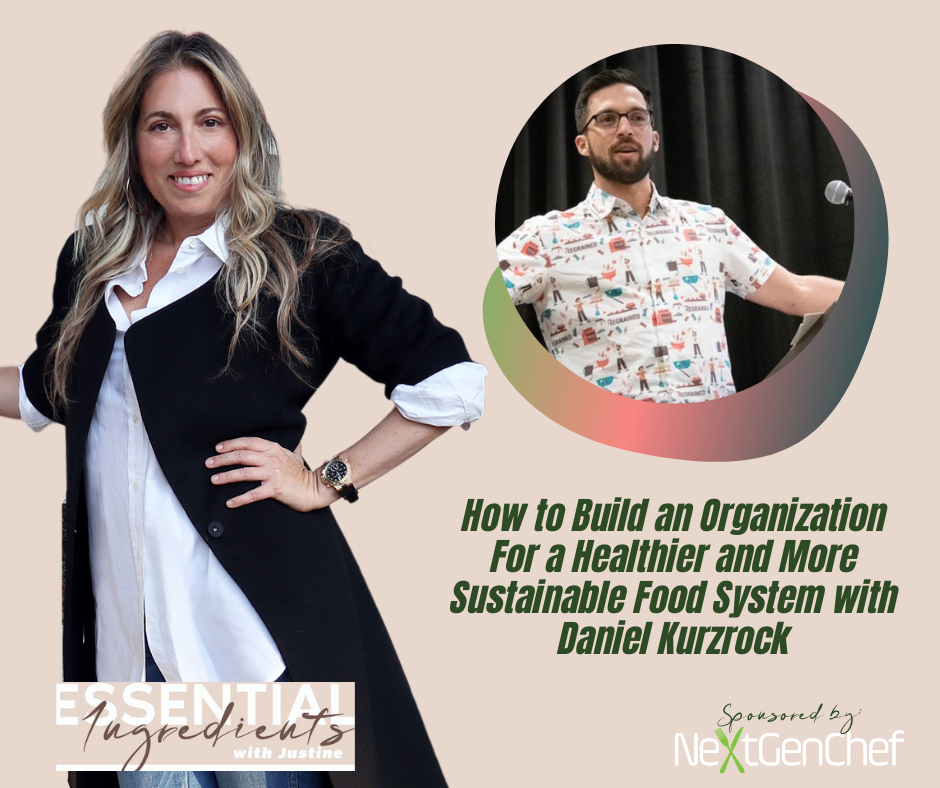
How to Build an Organization For a Healthier and Sustainable Food System with Daniel Kurzrock
The Incorporation Method helps you turn what matters into practical changes that fit your life.
“Could upcycling food be the most promising solution to reducing food waste? This week, we sit down with upcycling pioneer Daniel Kurzrock, CEO and Co-Founder of ReGrained. Daniel relates how his simple hobby of brewing beer turned into a greater purpose. As an organization, their goal is to bring together companies and people who are passionate about food-system level solutions.”
Full Transcript
Full conversation between Justine Reichman and Daniel Kurzrock.
Good morning, and welcome to Essential Ingredients, powered by NextGenChef. Today, we have Dan Kurzrock, the co-founder of ReGrained. Welcome Dan.
Hey, thanks for having me, Justine. Great to be here with you.
Thanks for joining me. I'm super excited to have you here, and for our listeners to get to know you.
Yeah, me too. Hopefully don't let anyone down with this Christmas Eve recording. Better thankin’ to Jews and Food do besides record a podcast interview on the day of Christmas Eve?
Well, it's funny one of that, our podcast producer, she sent me a list. I have three people that are interviewing today.
You got a busy day.
I have a busy day. She's like, they're all scheduling for you. I'm like, and I look at all the names and like, that's all right. Oh, they're all Jewish. I'm gonna pause this for one second. What better things do we have to do on Christmas Eve day? Anyway, I'm glad to be here, I'm glad to have you here. I think our listeners will be too, because there's a lot that we can chat about. You've got a lot of stuff going on. I'd love for you to just to tell our listeners a little bit about yourself. I always hate to read them from people's bio's, they just never do anyone justice. And it's a bit of a bore.
Yeah. I also hate listening to the bio.
I feel the same way. But I hate listening to my voice.
So yeah, Hi, everybody. My name is Dan Kurzrock. I'm the Co-Founder, Chief Grain Officer, was my cute way of saying CEO of ReGrained. I'm also the Co-Founder and executive board member of the Upcycle Food Association, which maybe we'll spend some time talking about as well. I founded ReGrained, which is a food tech company as I would describe ourselves now, we really play in the ingredients space, we make packaged foods. What we focus on is finding an overlooked underutilized value in the food system. So basically finding ingredients, talking about Essential Ingredients right on the show. Talking about finding ingredients that I've been really hiding in plain sight and kind of being left off the table of our food system using some innovative technologies to actually bring them in to product developers and to market. So we primarily, right now, work with a grain from breweries that they've already used to brew beer. I'm sure I'll spend some time talking about that. But what a lot of people don't realize is that our company also is applying the same technology and process to things like oats leftover, from the oat milk process and other ingredients that have kind of traditionally been considered byproducts because you can't create their co product without also creating lists. That's not part of the production process. But that doesn't mean it can't be used better. So we're here to really promote the best use for food, feeding people, reducing waste is a great way to address the climate crisis and create some delicious food that's just better for people on the planet. And I've been doing it for like 10 years, and I love it. I'm stoked to spend a little bit of time chatting about it with you today.
I'm so excited. And as you were talking about what you're doing, both the association as well as ReGrained, I realized that there's so many different things that I want to touch on. But I'd like to just start at the beginning first and have you share a little bit about your story about where this all got started.
Yeah. I wish I could say it was some grand plan that was hatched from a great course or something in college, or whatnot. But really, I stumbled into this as an underage homebrewer. So I was at UCLA and learned how to make beer in my freshman year of college. As a kind of, I guess, crafty entrepreneurial student, I really fell in love with this idea that it was actually perfectly legal to go by the ingredients and the equipment to brew your own beer. And I had a close friend who was my roommate freshman year, the state of being a very close friend who actually learned how to make beer from his uncle and came back after winter break on our freshman year. He was like, Dan, we gotta make beer. So we really fell in love with the hobby, we were making five gallon batches of beer. That's like a third of a keg. We were doing it every week, and we eventually moved into a, I'm embarrassed to admit, into a fraternity house. I lived in a fraternity house for a few years in college, which was great because we actually had a commercial kitchen. The chef let us use, or maybe chef is generous, let us use because we had a great relationship with, and actually commandeer to like a closet to use for fermentation as well, and got really into this hobby for making beer. And Justine, have you ever made beer before? By the way I make all kinds of food.
No, I've never made beer. But I would like to. I'm really intrigued by those kits that they have. I wanted to, I just haven't.
If you can make bread, you can make beer. I mean, it's virtually got the same ingredients, there's only four ingredients in the beer making process. There is barley, malt, grain, and that's like the beer equivalent of flour. There are hops, which is what everyone knows about, especially like IPA's, and things like that. Very popular ingredient. Water, core ingredient of beer. And yeast, which is where the magic happens. The yeast is contributing to the fermentation, and the creation of the alcohol and everything that we like about the way that we feel when we drink beer. So when you're making beer, you use a lot of grain, about a pound for every six packs, and you're basically extracting the sugars from the grain. And that's what formats the beer making process, but you're left with all the insoluble nutrition. So you've got fiber, you've got protein, there's a lot of actually phenolic compounds and other nutritional benefits that are actually not able to make it into the beer physically. It's like having a giant batch of oatmeal that you're creating when you're making beer. So, five gallon batches, it's a third of the keg pound per every six packs. It's approximately 20, 30 pounds of grain that we were using every time we made a batch of beer. I grew up in Northern California with a vegetable garden in the backyard and a compost service readily available. I was shocked, and I'm sure it's different now. But in LA at the time, there was no compost service, let alone a vegetable garden, or farm animals, or anything like that. So every time we made a batch of beer, I was literally taking this cooler full of food and tipping it into the dumpster. And something just felt wrong about that. And while we didn't have farm animals around, we did have party animals, lots of people around all the time. So I started taking, but tasted it and was like, Oh, this stuff tastes pretty good. Did some research then that it was pretty nutritious, and came up with an idea to make bread, actually with the grain, which I would then sell to friends, people around the house, and then use the revenue from that to buy more ingredients to brew more beer for free. Well, today, RegGrained is the company that is really trying to promote a more resilient food system that does more with a less circular economy. There's a lot of mission behind what we're doing. But early on, it was really born out of this idea to have one hobby that could find another hobby. And just be clever, and have some fun with it. The more and more we did it, the bigger and bigger we realized the idea was but the, yeah, the origin was, I suppose and elicit homebrewing although it wasn't illegal as long as we didn't drink what we were creating. Which of course, we never did. It was just about creating the beer, and led to what has been my life's work to date. And it's been really exciting.
That's great. That's really funny how it all evolves. So you went from making beer in these tags to them, evolving and creating this new product and use it. It's really interesting. So now, today, it's a new product, and you've created this association to it's now a movement organization.
Maybe complete, kind of, what it is that we're actually doing today.
The listeners, because they may not know.
Yeah. Our main ingredient, we call it SuperGrain+. Think of it like a flower that can be used to make all kinds of new food products. And as we started thinking about what this business could be, when back in college realized that there's billions and billions of pounds of this grain available. Right around when craft beer was booming too, and started asking some bigger questions about what commercial breweries were doing. And realized that the best way to build like a big business could be to create an ingredient company that's kind of connecting the dots between the supply from commercial breweries and food companies that could use the ingredients to make new food products. Before that, the original idea was, okay, we should have a brewery that's also a bakery. So a lot of people think that you come up with a business idea and you just kind of pursue that like myopic intensity.
Happen that way.
Things like talk about pivoting, there's all these like jargon you can use to talk about it. But the reality is that you start with one idea and it gets you down a path. And when you're building a business, you're like a downhill skier or anything like that. Like I am, I like to think about it in these terms where you're like, you can only try and plan what you want to do on a given round or something. But really, you can only see if you, so many yards in front of you at a time, you have to make real time decisions, and you end up where you end up.
As you learn new things, or the climate changes, or the world changes, or you meet new people, all changes, and as we learn new things, I mean, NextGenChef has changed, right?
Totally.
New partnerships, and as the world changes, and as we need new things in the world.
Yeah. And this year has been a great example of that. No one saw the pandemic coming, and a lot of different kinds of changes. Unfortunately, many of them, for the worse. But there's definitely some silver lining around it. And back then, no one was even talking, when I really started focusing on ReGrained in earnest, no one was even talking about food waste. Really started hitting the kind of global awareness in 2014 with Dana Gunders, Landmark's NRDC report wasted, that first quantified, the 40% of all food that we're growing is going to waste. That was just kind of a common sense thing. We get a lot of credit for being innovative and creative in what we're doing. And while I appreciate that, it's really not the most revolutionary idea to do more with less, and that's fundamentally what we've been doing as humans forever. I mean, any chef will tell you, especially a trained chef, use every part of the vegetable, of the animal. Even industrially, if you look at products like whey protein. Whey protein is created as a byproduct from cheesemaking for a while, like years, and years, and years, decades that it was going to agricultural use, or just being disposed of generally. And then of course, a huge market emerged for whey protein as an ingredient, and now you have whey producers for cheese's, the byproduct. Baby carrots are not baby carrots. They're not grown as little tiny carrots. They're cosmetically imperfect carrots that are cut down to be baby carrots. This idea, we call it upcycling, and there's a whole philosophy behind upcycling, and bottom line environmental goals that come with it. But the idea itself is pretty common sense. Business, no one likes waste. Waste is not good for anyone. It's better for everybody to put things to the highest use possible, which in the case of food, is feeding people. So we know we have to do is figure out a way to actually operationalize that. We weren't the first to come up with the idea of putting brewers grain into human food. But there were some technical hurdles as to how that can be done in a safe way and an economical way. And we ended up working with the USDA, actually, over in Albany. And we have a patent on what we created to do that which really provided the infrastructure to scale our business in a really exciting way. And then the last thing I should say was, I get really excited and talk a lot. So we're an ingredient company, but we have consumers, and your unmute Justine, by the way. We have consumer products as well that are distributed in the market. We have a snack product, they're like puffed chips, a really cool product. We're not a consumer products company, we have those out there so that we can get something to everyday people that tried SuperGrain+, to try upcycled ingredients. Tasting is believing, right? And with doing that, we can help build the market for the ingredients and the bigger picture vision that we're trying to create.
Right. So there's a couple things, one is you mentioned the restaurant wasted.
Actually, I was talking about the report wasted from the--
Okay. But there was also a restaurant wasted. Sorry. Because I was thinking about the chef that I think I believe you worked with from, Oh, my God, New York.
I don't know Dan barber personally, he's definitely one of the--
Was it Dan barber? He's from Upstate New York?
Yeah.
But maybe it wasn't Dan Barber. I'm trying to think of his name now.
As a culinary director is Adam Kaye?
Adam Kaye, he knows you.
Yeah, yeah. So Adam Kaye and I know, he's doing this Fair Food--
He was on the podcast a couple weeks ago.
Oh, great. Yeah. Huge fan of Adam. It's been awesome getting to know him over the years. His work over at Blue Hill with Dan Barber, who has been a huge advocate of, among other things like plant based diets and whatnot. And also using underutilized, like squash stems and things you wouldn't think of.
Well, that's what he was talking about. We were talking about you, actually on the podcast. We should probably put these podcasts next to each other so that people can hear about you on the first one. And then on this one, they'll learn more, or vice versa. But in any case, because we were talking a little bit about that, but I wanted to then bring up the idea of working directly with chefs and putting this in the hands of chefs, and the impact you could have by working directly with chefs. Because I think that working directly with chefs can have a large impact.
We actually actively do work with chefs. Not that we're not selling much into restaurants right now, that's something that we were interested in the years to come. But we've done a lot of work with chefs, as well as research chefs around, really exploring the culinary potential of SuperGrain+. So initially, I was making bread. I mentioned that some people know us for the nutrition bars that we've made for--
That's what I knew you first. I wonder if our listeners are familiar with them? Because for me, that was like the first thing I knew about ReGrain were the bars.
Yeah. Which is why we did it. We had to put something out there that people can try. We're actually not making bars anymore. It's not part of the long term strategy, really. But we had them in a few thousands stores at one point, and it was a product to put out there. But concurrently with that, we're also working with chefs to figure out, okay, well, what else can we do with this ingredient? How does it work in pizza? How does it work in crackers? How does it work even like plant based meat systems, or beverages. The chef pretty early on discovered that he really liked to use the ingredient as a, in like a roux, to thicken the roux instead of like toasting a flower because it got some nice toasty kind of malty notes that add some complexity to it. Actually, Chef Adam has made a bunch of really interesting stuff with our ingredient, and really pushing the limits of it. And with that helped us do, working with these chefs, is to really expand all the different ways that we could see this ingredient being used. And that's important, because there's so much of this grain generated every year by the brewing industries, and same with other beverages. There's all kinds of byproducts that are out there. Billions and billions of pounds. We could be, just put in perspective. Let's say we sold $100 million a year of nutrition bars, that would be a successful company. Our X bar sold Kellogg for like--
Financially, that's a successful company. But I'm curious, what's the impact is having? Because it's upside, because it's using a product, what's the impact it's having globally or on the world?
Yeah. It's about resources and putting them to best use. So like, if we were in a $100 million company, we only work with like two or three breweries. That's why being an ingredient company is so important to us because we can put much more volume of this ingredient to best use, if you look at just food, and one of the resources that goes into producing food is water. Waste food, you're also wasting the water, for example, that's in the crop. And beer making, 90% of the water footprints in the agricultural supply chain, mostly in the grain. So it takes over 300 gallons of water, about 330 gallons of water to produce the barley malt that goes to one, six pack of beer. That's the equivalent of like a two hour shower. That's just one six pack of beer. So what we can do is actually, instead of having--
Can you say that again? So one six pack of beer, just so our listeners can hear this. Say that again, please.
Yeah. Use about one pound of grain. I mean, these are averages. So one pound of grain, approximately for one 6-pack of beer. That 1 pound of grain takes the equivalent of approximately a two hour shower. But yeah, about 330 gallons of water to produce. So with upcycling, what we're doing is we're saying, hey, all these resources have already been expended on producing this. Yeah, so like, let's put it to best use. Instead of composting, or an animal feed, or energy generation, if we can feed the same principles behind plant based diets, let's reduce entropy, let's keep as much at the top of the food chain as possible, feeding people. One metric that you can think of is like, why does it make sense to upcycle? Why does it make sense to reduce food waste? Because when you're wasting food, you're not just wasting nutrition and flavor. You're also wasting all the resources that went into producing that crop in the first place. So it's kind of like found food--
Yeah.
We're actually creating new crops by connecting dots, and new ways throughout disparate parts of the food system that are kind of hidden for most people.
Yeah. I was having a conversation, interestingly enough on an earlier podcast where somebody was saying, they don't like to call it food waste, they like to call it like, there was another word. Now I'm having a bit of a brain freeze, of course. But there was a better word for it. I'm gonna find it and share it with you.
Yeah. I mean, terrible term.
Horrible term. But there was a much better term, and I'd love to tell it to you because I really liked it. It was good. What she used, and it was called food, unused food, extra food or something like that.
Well, Adams company is actually called Spare Food Co.
On that conversation--
Yeah.
Spare food. They don't like to call it food waste, because it's free. It's food that falls off of a tree that wasn't wasted. It fell off, or it was this, or it was that, it was spare food.
Yeah. And the whole idea of waste is a human construct to begin with. In nature, there is no waste tenant of biomimicry called, whether it's actually like waste equals foods. We've got closed loop systems. We are creating waste and not putting things to their best use. I want to be clear, though, what we're doing with Upcycling, this relates to byproducts, we're not always diverting from landfill. I mean, landfill is like the worst possible place that this can end up because when food ends up in landfill, it breaks down into methane, which is like an extremely potent greenhouse gas and horrible. But there's a whole hierarchy of uses. So above landfill is compost. Compost is better than landfill, but it's not necessarily the best use. So Upcycling is all about promoting the best use of brewers grand mostly by volume is going to animal feed, it's going to feed cattle predominantly.
How can people, if people want to, on a personal level, people are all about composting, and people want to, on a personal level, do better. How do people do better on a personal level?
Yeah,. Well, a lot of food waste actually happens at home. So there's ways that you can upcycle at home and also just generally reduce waste at home through,. We've got a lot of these resources on our website for people to check out. But like something as simple as an upcycling something, as simple as making a meal plan actually makes a huge impact. Or having a, like in your fridge, having a section where it's like a US first fridge. So there's this idea of supply chain management, first in first out. Making sure that your fridge is organized so you can find things that have been there the longest and put them to best use. We just posted a recipe for like a soup, for example, that will use up some veggies that might be wilting in the fridge and you can upcycle them into soup. Let's say you roasted chicken, you ate the chicken the first night, the second night, maybe you made tacos or something like that. And the third night, you use everything that's left and you make soup,. There's lots of things like that that you can do at home. There's a lot of misconceptions around date labels, as well as a lot of people think. You see a label on a product that that product expires when it's really a best buy date. And actually, the only federally regulated date label that exists out there. Can you guess what product is the only regulated date label Justine?
I was gonna say milk originally, but I don't think it's milk.
Yeah, it's close. And not milk, infant formula is the only--
That makes sense. Because I would imagine kids and with that kind of thing that is more highly regulated.
Yeah, but you would think maybe that more products would have some guidance around what the actual--
Definitely.
So what you get the result is you get these codes that are put on there, which primarily for the distributors and the retailer so they can manage freshness of quality and whatnot. But then they create confusion for the consumer. So you get home and you see, I don't know, a pack of almonds or something with an expiration date, you throw it out. Whereas like, chop it up and bake with it, because it's not going to be maybe as fresh as like a snackable almond, but it can still be used in food. Actually, about 40% of food waste happens at home. There's a lot that we can be doing just as humans around, what we eat and how we eat it, and getting creative. And one of the other things I like to advocate to you probably as a chef Justine is like shifting the mentality of when you're thinking about dinner, for example, there's this, you often ask this question, what do I want for dinner? What do I have for dinner?
All the time.
Then you can tend to get a little more creative, and you'll use things up as opposed to being like, Oh, I need to go to the store and get all these ingredients. What do I already have, and what can I make with what I have? And kind of shifting your thinking there can make a big difference across the long run for sure.
And I've started to do that as well. Thinking about what do I have to make and thinking about what I want, sometimes just for like Christmas where I'd really like some dim sum. But I'm not thinking that's not going to work this year because all good Jews have Chinese Christmas, apparently.
To go, you know?
To go. I know I've been googling, where can I get Chinese food to go on Christmas?
Yeah, there's a great dimsum to go.
Can you send me the link?
Yeah, for sure.
I even texted Alex, you know her. Alex from, she's got the thing on Facebook.
Oh, Alex Wall. Yeah.
Alex Wall, yes. I texted her to ask her for a recommendation to Jews in food or something.
Yeah.
Yes. So those things, like I kinda like to stick to, I'll make a recipe for the holidays. Or if I want crabs for New Year, but in any event. You know what? I want to learn a little bit more about, because we've talked a little bit about ReGrained, we've talked a little bit about Upcycling, and we've talked a little bit about how people themselves can manage upcycling in their homes where that's some of the greatest waste we see. But I'd love to learn a little bit more about this association that you mentioned if you could tell us a little bit more.
Yes. I've always been very interested in the food system and systems level solutions, to addressing something that's actually a market failure. It's created where market forces have failed. And so there's kind of a lot of dynamics that play there. But one of the things that can be done is to foster cross-sectoral collaboration between business and government, kinda like what we did with USDA, as well as pre competitive or non competitive collaboration within an industry, which can be done through something like a trade association. So the Upcycled Food Association, there's actually two organizations that run by the same group that were part of this. A foundation and an association. Associations for members of foundations like consumer education and things like that. We co-founded this with a handful of other brands. There's, I think seven of us originally, and there's staff for the Association, the founders. Turner Wyatt is the CEO. And the goal was to create a center of gravity to really bring together all kinds of players within the Upcycled Food world and have some pretty clear goals around what we want to do from just a pure numbers standpoint. Though we started with seven companies, we now have over 130 coming up, actually 150 pretty soon. We got some global players, big companies that have joined like DOL.
That's amazing.
Yeah, it's been a really exciting year. And we've only been around for one year, officially.
That's a big accomplishment during this year.
Yeah, exactly. And the COVID. So one of the first things that we got done was a formal and pretty academic, honestly, definition of Upcycled Food. So defining Upcycled Food, what is it? What is it not? And then building upon that, we've actually created, we're now at the tail end of this, we should be able to release it in Q1, the world's first certified Upcycled Food program. So we have an actual third party certification that we're getting to certify products as being upcycled, which has been a huge effort. So we've created the definition, we've grown our membership, we've got the certification process that will be coming out next year. And the whole goal is to help support the development of a market. So building demand, which will then increase the supply that is going to service that. And when we're talking about increasing supply as it relates to Upcycle Foods, that supply chain is what is directly reducing food that would otherwise be wasted. So it's all about creating a market to build a healthier, more resilient food system that puts ingredients to their best use feeding people. Now, food for people is where we started, but we also have groups that are looking at doing companion pet food, things like dog food, cat food, stuff like that. There's some cosmetics companies that are looking at Upcycled opportunities, because not everything is edible. And there's things to better use. So what we're trying to do is, as an association, as an organization, is really provide the platform for companies to have, first of all, that leadership right up to fight creating definitions and certifications, and common voice, but also a place to interact with one another. And we already have a lot of great collaborations that have come between brands that are in there, and it's been really exciting.
That's great. That's super exciting. It's really refreshing to see that. Because for NextGenChef, one of the things that I am trying to build is an association around that, like a stamp of approval. So that's local, healthy, regenerative, and all those kinds of things. Similar but different. I'm inspired to hear your story, because it's similar to what I hope to build. Of course, I've done that, I'm still working on it. But as I hear yours, I'm like, Oh, I can do that. I can do that. So I hope as the listeners are listening, and they hear your story, they'll be inspired to be able to go often. And whether they're a business participate in it, or as a consumer, look for that.
There's a role for everybody, for sure.
Exactly.
Hope that NextGenChef will be participating in the Upcycled Food Movement.
Definitely, definitely. And I hope to learn more about how you created it as well, because it's a big deal. As I'm looking at it, building NextGenChef and that certification, building out that definition is no easy feat. And coming up with the words that you want to do and making it encompassing to make sure that it encompasses what you want, and not too limiting, but not too specific figuring it all out was a big deal for you guys.
It's all about the team. The whole point is it wasn't just ReGrained, it wasn't just, you know, renew a meal, it wasn't just in perfect foods. All of us and more coming together and collectively were greater than the sum of our parts. And that also means that you have to let go of control. Is the definition exactly how I would word it? No, the whole point like, and the certification, for example. There was a committee of I think was 18 or 20 people, I should know that because I was on the board support group for that really impressive people, people that helped create the Organic and non GMO certifications, run in academics, we've done a lot of collaboration with like Drexel University, as well as UC Davis and have PhDs that are involved,. It's all about creating a brain trust, as I said, we're not all grain companies, you know, creating a movement that's bigger than yourself. So it starts by having a team that can kind of create that. So this few times, like center of gravity that creates a place for people to come due to be drawn to, and then making sure that you're not doing things in silos, and you're really engaging all these different stakeholders and bringing them together to do something, that hopefully across the long run is really powerful and becomes one of the next, central like tenants of the food. I got your organic, or non GMO, your fair trade, right?
Exactly. And I think it's so important to surround yourself with all these different experts in the industry that have different experiences.
Especially when you know nothing like me. I mean, you gotta surround yourself with people that are smarter than you that have seen the movie before.
All the time. That's how I move in the world. I got to surround myself with people that are much smarter than me.
That's right.
So Dan, I know you have so much going on with ReGrain, and you've got a lot of new things coming down the pipeline. You've had a lot of new stuff that just went down recently, and I'd love you to be able to share just a little bit about that so people can hear what's gone on at ReGrain. What to look forward to, if you would,
Yeah. So tons going on with ReaGrain. We just released this new snack this year, the puffs, which are--
You have any [inaudible]?
I don't have them in my--
I love the [inaudible] So I just thought that--
Yeah. I should walk over to the kitchen. But yeah, it's a great snack, even if you don't know that they're upcycled. And this was kind of the idea. They're in distribution rowing. It's been an interesting year to get a new product out there so we've done a lot of like, of Ecommerce through perfect foods, and in places like REI. We got a launch with a corporate division coming up. Like this year, a lot of stuff that was supposed to happen is gonna happen in 2021. That's kind of how it goes. We just concluded our second equity crowdfunding campaign. So one of the interesting things about ReGrain is that we're owned actually by our customers. We have over thousands investors that are not just elite rich folks, which is great. Love having traditional angel investors too. We've got some great angel investors as well that have helped get ReGrain gone. But these are people that have invested a minimum of $250 in the company, so 3 figures checks. And it's a really exciting way to democratize venture capital. We did it first in 2018, and we just did one on Wefunder that just closed last month, that was really an exciting achievement for the business. It's something that I really see as strategic capital, because we're trying to build a movement, and engage as many people as possible. I think it's a really important part of the frontier of how, especially triple bottom line, businesses will get funded in the future. We have a plant in Berkeley that we've been hard at work at opening with our patented machines. We got our patent last year, and we built the machine to that spec, and we've got our plant that's just about ready to go cranking out products. This will be an order of magnitude difference, we'll be doing it like a day what we do today in a week. And this new plant, we've got some really exciting partnerships going with other food companies. We've got dozens, like many dozens actually of active projects of bakeries, snack companies, restaurants and all kinds of different groups that are looking at different ways that they can use upcycled ingredients in their products. So if anyone listening out there has a food company that's interested in Upcycled Food Innovation, something that you know, we would love to work together on. In the year ahead, it's hard to make predictions these days. I think everyone's boat got rocked pretty hard this year, we're very grateful to be able to continue to build our business, accomplish the things that we did this year and still be able to push out ahead. There's certainly a lot that we're trying to do as a business, we've got a lot of indications that we're going to be able to pull this thing off, but we know that we're not able to do that alone. So we're super, super grateful to all of our community, the various stakeholders, whether it's retail buyers, or product developers, and other companies, or our customers, or people like you Justine, we can only build a better fit system if we do it together. And ReGrain wants to be a really big part of that, and everything that we're doing is trying to help us to kind of march towards that goal. You're on mute.
It's a common theme apparently. I keep having to mute the dog, sorry. I'm just guessing the listener doesn't want to hear the dogs barking over you.
Sometimes, dogs have good points to make, you know?
Always. Always. They always have a good point. I agree with you though. I think that for me, at least, I always think it's more fun to do together. It can get more done together, we have better ideas together. While I'm a solo entrepreneur, because I don't have any partners, I've always wanted to have partners. So while I don't have a partner, per se, and of course, our listeners can't see my air quotes, I've always wanted to bring on a partner or somebody with me at NextGenChef while I host Essential Ingredients myself. Because I always thought that it'd be more fun to do together. We'd be able to cover more ground, we'd be able to create a bigger movement. So in the meantime, the only thing I know how to do is create partnerships with people like yourself, and other organizations, and people like the Haas School of Business at Berkeley and other people changing the future of food. Thought leaders and innovators that I help move the needle just a little bit, and to give you and other entrepreneurs a vehicle and a platform to have a voice and share what they're doing. So that's me playing my part in this.
Probably more impactful than you realize. People like me, we appreciate it. Yeah, so I don't know how you do it alone, I wouldn't be able to do it alone. But I guess your point is that you're not truly alone.
Yeah, I'm not truly alone. I wish that there was a partner with me, making it happen.
--offering their partnership, potentially now.
Well, you never know. We'll put this podcast out, maybe one of our listeners will shoot me a note. But in the meantime, I thank you, Dan, for joining us. But do you have any, maybe you can share a few tips. We do have a variety of founders that listen to these podcasts, and they're building better for your businesses. And as an entrepreneur that has built your own better for your business, maybe there's a few tips that you could share.
Yeah. I mean, no one knows what they're doing. So that's important.
Number one, no one knows what they're doing.
People get caught up on just taking action on their ideas in the first place. That's really what an entrepreneurship is all about, putting creativity in action, not just coming up with a perfect plan. You hear that there's all kinds of adages about perfection, get in the way of progress and whatnot. Don't let perfect be the enemy of the good, that sort of thing. And it's true, you create your own opportunities to be lucky by putting yourself out there. And luck is a really important part of that long term success. I've been extraordinarily lucky in doing this, although I'd like to think that one of the ways that I've contributed towards being that, being lucky is by trying to generate opportunities by trying to put ourselves out there and saying YES to things, asking for help, offering help and just like making those connections. I mean, that is probably the one takeaway that I hope people have, that they don't need to just take action, do something and then see what happens.
Don't get stuck in the process.
Yeah,. No one knows what they're doing, so don't let that scare you.
The one thing is people get paralyzed by process. I know that's like a little cliche that people say, but it's true. People do get paralyzed by process. I see it all the time. And that's the biggest frustration I see. I get frustrated when I see people that are stuck and paralyzed.
Yeah.
Just go. Just ask some questions. Put it out there. See if people like it. See what people think.
Our first version of the bars, first two versions of the bars arguably were like, they tasted like a good idea. They were not going to sell a ton of product, but we had to put something out there so that we can see if our idea was real, and you're gonna change things like a million times. And I do things differently, in hindsight, different parts along the shirt, because I know a lot more now than I did then. I was a 21 year old entrepreneur, trying to figure it out, and you do that by making some mistakes. You don't talk about cliches, can't make an omelet without breaking a few eggs.
That's a good one. I like it. Well, Dan, I really appreciate you coming on today. And before we go to the last questions, do you have a favorite ReGrain product?
The Mexican Street Corn Puffs are probably my favorite. Commercial product that's available out there. Although probably my favorite, like application of our ingredient that I've ever tasted, actually -- just come out with an ice cream that has rerender that's really good, and also I love it. I have a bunch of really great pizzas that have been made with our stuff. I love pizza so that's one of my--
Okay, I'm gonna have to try them all. We need a ReGrained, like map of places to go like a little treasure hunt.
Coming in 2021, we'll put that on the--
That's cute. Upcycle little treasure map of places to go with, all things upside--
That will be great.
Okay, so for our listeners today that have listened all the way through, give us anything special for them.
Oh, my gosh. Well, we do have a discount code, NextGenChef -- I'll give you 15% off your first order if you want. But I also love to hear from folks directly. I'm Dan at ReGrained, really easy to find. It's great to connect and do this all together. Thanks again, Justine, for having me. Thanks to whoever suffered through my babbling for this and this entire episode. Hopefully, there's a nugget or two that was insightful, and I'm looking forward to a better year ahead.
And for any of you listeners that are interested in some of those resources that Dan mentioned, regrain.com has a list of them, right?
Yes.
And if you haven't already, you can subscribe to the Essential Ingredients channel on iTunes, on iHeartRadio, on Spotify, on any of the apps that you like, and we hope that you'll subscribe and download. We're here every Tuesday with a new episode. Dan, thank you so much for joining us. To our listeners, thank you so much for joining us, and we hope to see you here again next week on Tuesday.
Share This Episode
Enjoyed this conversation? Share it and tag @nextgenpurpose
Listen on Apple ▶Listen on Spotify ▶Your Host
Justine Reichman
Founder & CEO of NextGen Purpose. Host and Executive Producer of Essential Ingredients — 11 seasons, 330+ episodes, and a growing movement.
About Justine →