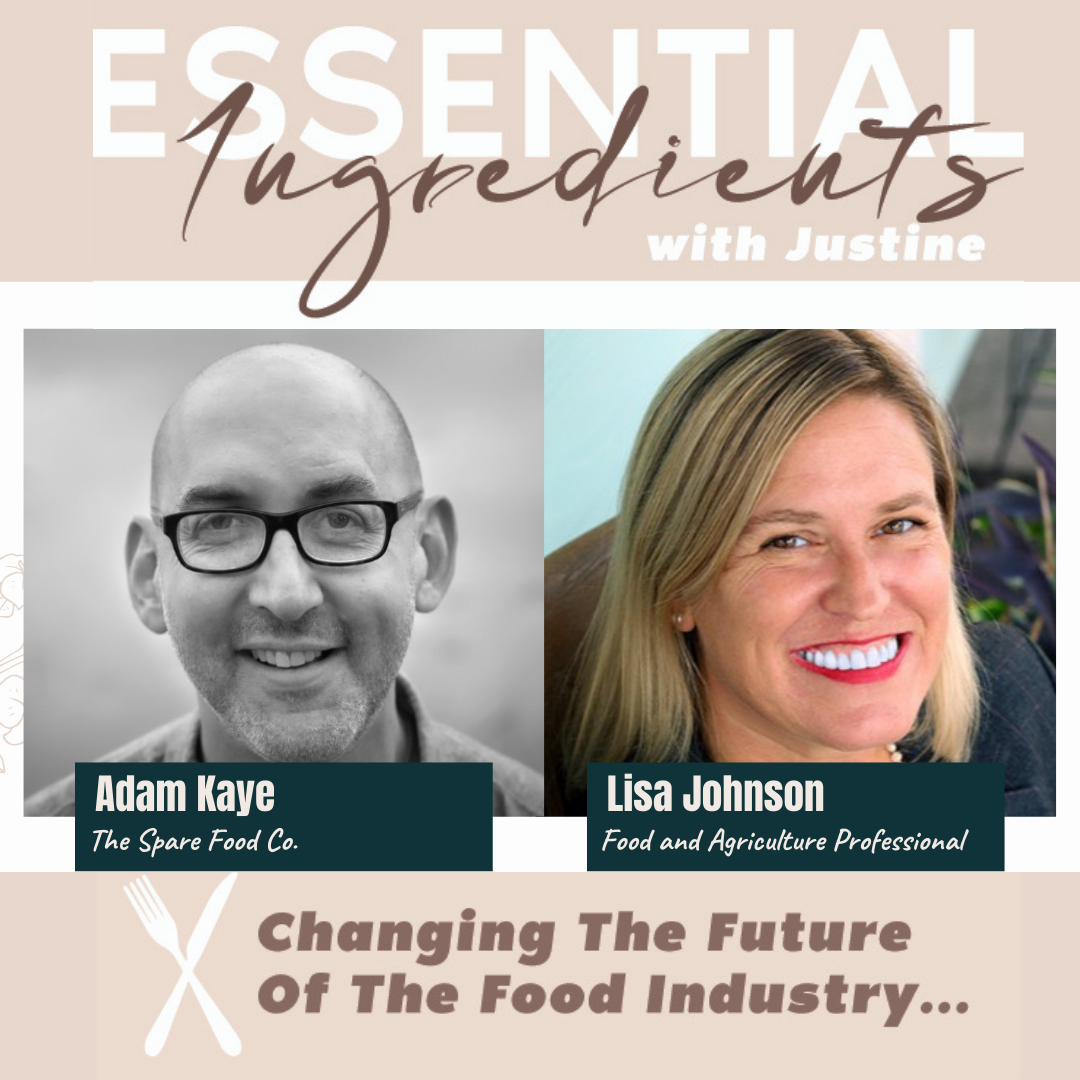
Lisa Johnson and Adam Kaye · NextGen Purpose
Watch on YouTube
The Food Waste Problem Solved: How to Bring the Value Back to Food Produce with Lisa Johnson and Adam Kaye
The Incorporation Method helps you turn what matters into practical changes that fit your life.
“”
Full Transcript
Full conversation between Justine Reichman and Lisa Johnson and Adam Kaye.
Good afternoon, and welcome to Essential Ingredients. I'm Justine Reichman, your host. Today, we have Lisa Johnson and Adam Kaye. Thank you Lisa, thank you Adam for joining me. I'm so excited to have you both here.
Hi, thank you.
Thank you. Good to be here.
Yeah. Lisa, thanks so much for helping me put this together. It was really amazing. I called Lisa out of the blue. Found her online and was excited to connect with her. She's got an amazing background. For our listeners that don't know her, you're gonna be excited to learn about her. She's got a tremendous background in food loss research. She helped me find Adam Kaye, who she knew, and helped put this conversation together. At least, maybe you can just introduce yourself and tell our listeners a little bit about yourself.
Sure, Justine. Thanks for inviting me to be on your podcast. I'm pretty excited about it. I started studying food loss and food waste while back, maybe 2010, while I was doing a Master's at Georgia. And I found out so many things that I just couldn't unknow about food waste. I really had more and more questions come up. Since I'm a horticulturist, I wanted to find out more about what happens on the farm. So that's what I've spent the last several years doing, literally digging into how food is lost on farms. And along the way, I've become a researcher, a speaker, author and a partner in lots of exciting projects.
Wow. That's a lot of work. How did you get started in horticulture?
I've always been interested in food. From a young age, we had a garden. My grandparents had dietary related conditions so I got really interested in food. And when I was in college, I just could not hit on the right major. I tried Nutrition and Dietetics, and I tried Food Science and eventually hit on horticulture, which is like this happy marriage between hugging trees and growing tomatoes with a funny hat on. So it was perfect for me because it kind of married my love of food and growing things. And I was hooked. Since then, I have a bachelor's, master's and PhD in horticultural science.
Wow. Well, I could probably take a few lessons from you. The pandemic inspired me to get into horticulture, but I don't even think I got past kindergarten. So I've killed some plants.
Yeah, we kill things all the time. Don't worry about it.
It's not so good here. But I'm trying, I'm trying. I really was inspired with the pandemic. I'm sure that a lot of people were to grow their herbs, and their fruits, and their vegetables and everything, but it's not working so well for me. So we can talk about that offline, maybe, and you can give me a couple tips. In the meantime, let me know how you met Adam.
Sure. I met Adam at a conference in Harvard that was given by Reef Ed, an organization that's leading the way in describing, talking about food loss and food waste in the US. I was involved in a panel that discussed the art and science of measuring food loss and food waste, and it was intensely dry, and there were all of us nerdy types up in the front of the room, really awesome people who I still keep in touch with. They're all measuring food loss and food waste at different points in the supply chain. But my focus area is on the farm. which remains kind of a mystery for lots of people, and so they thoughtfully included me on this panel. And Adam came up to me after the event and he said: "I'm starting this company. I really enjoyed your talk, and I just wanted to keep in touch with you later on." Lots of things have changed since that time. But I reached out to Adam again recently, and we have so many overlapping interests, yet such different backgrounds. So I just love to hear things from his point of view, and I thought it would be perfect for your podcast.
Okay. We're excited to hear from your point of view now, Adam, you want to introduce yourself to our listeners?
Thanks for having me on here, and especially thanks to Lisa for bringing me here. This is fun. Lisa and I have plenty more conversations in the last, I don't know, three weeks that we have had in the previous two years, and they're always just such great conversations. I usually end the conversation within like minutes. I'm sending her emails of all the questions that I have with things that I've felt. So yeah, just a little bit about me. I studied history and geology at college, and I became a chef. That's what I did. I've been cooking for about 26 or so years. Foods in my DNA. Fourth generation food entrepreneur that I know of. I grew up in South Africa. My family was always in the food industry in some form or another. As I said, I was just the crazy one to go into the restaurant industry and made a life out of that. And for many years, for almost two decades, worked with Chef Dan Barber's at Blue Hill restaurant, and Blue Hill At Stone Barns as part of the team that opened up Blue Hill At Stone Barns in 2004. And really a part of this incredible team of thinkers, cooks and farmers in this, no pun intended, but this incredibly fertile place in terms of thinking about a food system, developing a cuisine, really truly based around agriculture, farm driven cuisine. Got to work on incredible things really alongside Dan all those years. And for me, a real turning point was in 2014. We launched a pop-up restaurant concept called WastED. And it was a two and a half week pop-up out of Blue Hill, New York and Manhattan. It was this kind of little calorie challenge for ourselves to create a menu out of product we wouldn't ordinarily see in restaurant kitchens. Not just scraps that we're generating ourselves, but really looking at the whole continuum of the food system and identifying products, ingredients that otherwise are getting wasted. We created this menu, and it was wildly successful. People lining up down Washington place and in the West Village to get in. It was just unbelievably exciting and fun. Did not come at it from any kind of largest scale food waste issue perspective, it was really this kind of calorie challenge more than anything. Cut forward a couple of years, 2017, we went to London and we did a seven week version of the pop-up in London. I came back from that knowing that this issue was something I wanted to do, to really focus my attention on. And through that time, I'd really developed this awareness of this global epidemic, if you will, of wasted food in our system. The fact that 30 to 40% of food that is grown and produced is not eaten. It's just hard to wrap my mind around. So coming back from that, I just knew there was this business opportunity and started speaking, actually to my older brother who doesn't come out of the food industry, about a business idea, and the spare food company, a new company was born in 2018. And it was then that I got to meet these athletes at the Refit Conference that she spoke about. I just got to say one thing, and this is why I love talking to Lisa. She said something, I wrote it down, you said: "Once you started knowing about farm losses, you couldn't unknow it." And it's so funny, as I know, we just kind of like kindred spirits here. Because what we talked about, and what I talked about a lot, especially from the colori perspective is seeing the unseen. And once you see something, you cannot unsee it and it's like getting a new prescription on my glasses, and suddenly, the whole world becomes a lot clearer. You see things in a new light that you've never really seen before, and that's sort of my approach to this issue. Knowing the unknown, seeing the unseen, I think we're on the same wavelength here.
So Adam, for our listeners that are not familiar with spare food, can you tell us a little bit more about spare food?
Yes. So we are a calorie innovation platform, a product ingredient platform. We identify ingredient streams at scale in the food system, and specifically through the lens of culinary innovation, develop new food products. So we're actually very soon going to be launching our first branded spare food product, which I can't get too deep into, I'm just going to say that it is a product just because we're going to have a fairly bigger reveal coming up soon. But it's a product that is made from the byproduct of the Greek yogurt industry from acid way, which is a very big issue. But we also have been doing a lot of work initially as the coming out of the gates. We were doing a lot of interesting consulting work with large scale food service companies. Same idea, looking at menus, looking at supply chains, how can we capture ingredients and transform them into delicious food products. Also working with like, again, large scale food service companies, fast casual restaurants. But really through the past eight months, the product was always on the horizon for us. The changes in the landscape of the food service and restaurant world really gave us the opportunity to double down on product development, and we're pretty close to launching an incredible new product.
Wow. So what's the timeline on the launch?
Early next year. Hopefully by mid late January. So we're getting pretty close. We were doing a lot of behind the scenes, we're very busy right now to get this product out there. But again, this is the silver lining in a way of the past eight months, it's actually given us the space and time to really focus on the work that we need to do. And as I tell people about this product, it's the spare food story in a cab, it is what--
I love that.
Yeah.
I love that. Are you going to be launching this on the East Coast? Is this going to be--
Yeah. Initially, it is a very targeted sort of local launch. And really looking at New York City, Hudson Valley, kind of my stomping grounds for lack of a better word. Part of it I think is also, this is something nice and I've spoken a little bit about the idea of really, the future of regional food systems. I think what we're doing here is we're creating a model that is actually replicable that we could actually apply what we're doing with this particular product here in the Pacific Northwest, in Southern California, in Chicago Midwest, for example. So yes, sort of a targeted regional launch, but eventually expanding from there.
Well, congratulations on that. And while I'm not in the East Coast anymore, I do hope to be able to--
I get you some samples.
I'm hoping. Here's to hoping, although hoping isn't really a strategy, but I'm hoping. I'd love to just talk a minute about the data and the analysis that goes into the waste. The analysis and the research that you do in order to get to where you were, to come up with that innovation. Because I'm sure that there's a lot of research and data that went, what is coming up with that?
Yeah. I think a lot of that is dependent on the work of brilliant people like Lisa, who actually have the way and the means to actually quantify whether it is produced on farm losses, or whether it's food Manufacturing Co- Product. I think for us, it's really taking a very close look at the food system. And at any point, this is a food system that is obviously not working. And if there was ever any doubt about that, I think the past seven or eight months certainly has shone a light on that. But being able to really take a close look at different parts of the food system, and being able to sort of tease out or identify where these ingredients streams are, where we come into it. I'm very interested in the potential of work that we could be doing with Lisa, for example, down the line. Once we've identified what these ingredients stand on, know that I'm using the word ingredients streams, I'm not using the word waste streams, it's then on us to figure out what, how can we keep that food in the system as food. For us, we talk a lot about finding more ways to use more, everyone's talking about more ways to use less. So actually, we kind of turn that on the head. Actually, what we want to find is more ways to use more of what we already grown, produce. It's a slightly different sort of land at the issue, but it is we've got plenty of resources to work with. Just look at Lisa's research.
Please, I'd love for you to just give us your thoughts on this, and what you're thinking?
There're so many reasons to love an effort like Adam is putting his energy behind because what he's doing is identifying surplus and starting from there instead of making what you want to make, and finding who's growing it, or asking someone to grow it for you. So he's utilizing something that's already out there. In my work, I've identified lots of crops that are left in the field to a great degree. For example, something like cucumber, which is hand harvested over a few harvests, but produces so abundantly. It just keeps on producing the instant you aren't looking at it. So I've identified like, in some cases, 8 or 10, or 12,000 pounds per acre that just get left behind and tilled into the ground. Another example, in North Carolina where I live, our most important crop is sweet potato. You can make nearly anything out of sweet potato, and there's great demand for lots of sweet potato processed products. However, there's not enough demand to pull all the 4 to 5,000 pounds of sweet potato that are still left on every acre. After we make baby food fries, flour, muffin mix, what have you out of sweet potatoes, even pet treats are made from sweet potatoes. So finding those items and then adding in the creativity that chefs have inherently to come up with new ways to solve this food waste problem in a delicious way by eating it. The tackling it from that end is what I really love about it. I know a little bit because I've only scratched the surface on some of this research. I just know a little bit about some of the numbers that we have seen out there. But the difficult thing is being able to utilize all of that. So with food processing, you sort of have to be nimble and be able to handle whatever surplus is coming your way. Perhaps like tidal wave style, and be able to turn that into something delicious, and maybe shelf stable or value added that can last longer, and give you a bigger marketing window. So I really like what his company is doing. There are more out there that do that in different ways, but he is doing something unique.
Yeah, it's interesting what you say. They said that we have the data, this is actually something that's also, it's mirrored actually in kitchens. There's a lot of great work that's been done around capturing food waste data in kitchens, and there's incredible software that chefs can use. And again, this is on a much smaller scale, not obviously on an agricultural scale. But really looking at individual kitchens, although large scale food service kitchens, let's say. What we found, certainly in our work with some of the larger, we've been doing some work with some of the largest food service companies in the world, that there is a lot of this data and they're aware of the data. Nobody quite knows then what to do with all that data, where to find that inspiration and how to create delicious new food. It really sort of requires a real shift in cultures and a way of thinking, but that data is absolutely and incredibly, it is a critical first part of the process. Throughout the day, we just don't know what it is. We don't know the scale and the scope of the problem.
I'm just curious, you've done this here in the US, and you've explored London, etc. I'm just wondering, have you noticed any trends in research among food waste here, and the differences between here in the US versus other countries?
Yeah,. It kind of depends on whether you're talking about losses, for example, in agriculture and distribution, or waste that's more at the restaurant or consumer level. But yeah, there are huge differences in trends. For example, they sort of split down a developed and developing country line. So for example, in developed countries like ours, and in Europe, and other places, there's a huge spike in food loss in agricultural production, there's a huge amount of food that's just not accepted into the supply chain, or not paying enough, the farmer can't get it for whatever reason. And we really don't know how big that spike is. Because there's only 2, 3, 4 people that have done research on how big that spike is, me being one of them. Then we know that there's another huge spike at the consumer level. The thing is, that piece we know more about plus it's really economically and environmentally damaging when that food gets into the landfill. So people pay a lot more attention to that spike than the one at the farm where you might find a lot more utility, maybe some more social nutritional value, but not as much economic or environmental value. In developing countries, for example, there's a lot more lost and waste in the middle of the supply chain. So for example, smallholder farms would harvest everything. And when they take it to market, the consumers purchase everything without concern for a lot of the aesthetic qualities that we find important. But it's in the middle where there's not as sophisticated refrigeration, transportation and packaging where food gets lost or wasted.
Interesting. Yeah. I was just curious because I feel like, so often from country to country, from city to city, things are very different. We learned so much by researching what happens in different countries, their supply chain, their process. So from your perspective as a researcher, I was just really curious on a personal level what you knew, what you were finding out as you dig in.
I was just gonna say, and I'm certainly not an expert on this, I think on a policy level, there's a lot of differences, and perhaps this will change. But there you see food waste as being a real priority. There are countries that are really kind of leading the charge, certainly in Europe.
Yes, I got, I felt like [inaudible] in many ways.
Certainly, in my experience of these, the two pop-ups that I was a part of, that I was talking about in New York in 2015 versus London in 201, there was like a chasm of difference just in terms of public awareness. Like the discourse around this issue was very much more in favor of what we were seeing in the UK versus here in the US, but it's changing. It's definitely changing here. Absolutely.
To that point, I'll tell you that in about six years ago, 2014, I spent a couple months in Europe, Paris, Switzerland, where everyone had a composter in their kitchen in Switzerland. I lived in New York City, we didn't compost. It was not something that we did. I don't know what's going on in New York City right now, because I'm not there. It's much more prevalent here in Marin. But it was not what was going on in New York City. In Switzerland, Paris, everyone was doing it, and it was very common. So it was partly cultural and what people were talking about, and it was part of the lifestyle, it was already part of what was going on. And it was not really part of the conversation that I was experiencing when I was in New York City at that time.
My mother grew up in Stockholm and they had composting in their apartment buildings since the 40's.
Apparently, we are really far behind. And on that note, we really are going to take a quick short break from our sponsor, NextGenChef, and then we'll be right back.
Walk me through food laws. Talk to me, tell me what's the difference, our listeners want to know.
All right. Justine, here's the deal, okay. I really like to make a distinction between the definitions of food loss and food waste. And they are very different depending on who you ask.
Before you get into that, I want to know why it's so important for you to make this distinction.
It's very important because the word waste itself, which is kind of falling out of favor among food waste, among people with a food waste interest, it implies blame and it really assigns that you have behaved in a certain way to create this waste, which is problematic. So the words that we use really matter in this way. When we assign that word waste in particular to agricultural producers as in, why do you waste food? Do you have any food waste? How do you interact with food waste on your farm? All questions, I would hope no one ever asks to a grower.
Now, all of a sudden, I feel really bad and guilty.
Yes, exactly. It's exactly the same as if I went to you and said, what's in your trashcan? Now, let's talk about it. It's the exact same thing to a grower. They have never intended to waste food in any way. In fact, they grow food so that people can eat it. The reason that food gets left behind on farms is because that's the only biological response that growers can make to market or weather conditions. They don't have any choice in the market price, or how the food has turned out looking. So it's very difficult for them. I do refer to food that's left in agriculture and in distribution as loss.
But the stuff in my refrigerator that went bad is food waste.
Yeah. It bothers me a great deal when I see a newspaper article or a magazine article that talks about food waste, and then shows a picture of a bee having dropped its apples. So you're in essence saying to that grower, you have wasted food, you have done something wrong, when that's not at all what has happened.
And that's a really good way to illustrate it. Because I think that that really does, It's not the growers fault, it's not. It is my fault that I bought food and wasn't able to use it, or decided to go out to eat, or let it grow too bad. Now, my bananas have too many brown spots on them, and I like them green.
And truly as recommended by the FDA, we're supposed to have eight or nine servings of fruit and vegetables a day, and we Americans eat two, maybe three. So that kind of behavior hurts farmers, causes farms to go out of business and many retire on news like that when demand drops. So in order to support growers, we need to be supporting them and incentivizing them to reduce losses, certainly not blaming them.
Yep. I appreciate you sharing this because I've never looked at it through this lens. In fact, I've used the word food waste a lot. I don't know that I've used it with agriculture in mind, but I now will thoughtfully not do that. I will feel shame a lot more on my refrigerator, and maybe not make those choices as much. Adam, what about you?
I agree. I think this is such an important discussion. I think the words that we choose to use are incredibly important. I think that as an issue, I think it kind of needs an overhaul just in terms of the language around it. And quite frankly, that's why we called our company Fair Food Company, not the food waste company, right? That was a very conscious decision. Even Sunday, and I think it is important to make distinctions that you can't look at sort of take this blanket approach because to Lisa's point, losses on a farm are very different to food coming back from a buffet at a hotel compared to food that's getting thrown off from your refrigerator in your home. It's incredibly powerful when you just sort of stopped to think about it. We talked about food waste, we talked about wasted food. All right, just turning those two words, just putting one before the other, completely takes the emphasis away from waste and puts it on to the food, and that's really important. We need to reframe this discussion. And as long as we are thinking about it as waste, we're not going to value it. And this ultimately comes to just how we assume, Lisa and I were chatting about this recently, how we assign value in our food system? And anything that's trash, we're not going to value, right? I certainly don't. Crumpled up piece of paper, it doesn't have value, it's trash. Well, maybe it does have value, certainly when it comes to food. So I think the first, like one of the most important things we can do around this issue is just really think about the words that we use. It's very powerful stuff.
It's interesting that you're saying that because as I was thinking about some of the questions that I had written down here, I was thinking about what we are going to talk about the future of food, and even talking about what the post food waste world looks like. Even those, the choice of those words, I really think should be changed, as to your point. It should be, what does the world look like if it was waste free, wait, now I can't even figure it out.
Yes. Well, that's one of the great things about the upcycled food movement because upside it has UP in the name.
Why did you join the association that just launched?
I know Adam has been a member for a long time.
Okay.
I was actually just presenting--
Because the organization is like one year old--
You know the people from ReGrained? Because you had asked me before, Dan.
Dan is a great friend of mine.
I love him. He's great. We've done a lot of stuff with them.
They're great. Yeah, because you're right there, and--
They're right here. So upcycled, that's the word? We got to just get rid of food waste.
Yeah. Well, food waste is difficult, up and down the food supply chain. If you consider that much of food that would be wasted is then donated, there's no dignity in eating food waste, getting food from the emergency food system wants to be eating food waste either, nor do they want wasted food. We do need to sort of bring the value back to what we have in front of us. It's just food.
How are we going to promote upcycled fair food--
Make it delicious. Make it absolutely delicious and craveable. And that changes people's hearts and minds through their palate.
Yeah. I think it can be absorbed into the concept of sustainability. For example, if you had a restaurant and you wanted to focus on ugly produce, you wanted to find a way to order in ugly produce and use this every day on your menus, what you would find is that you're actually getting surplus produce in the box. All of these little distinctions kind of blend together. Everything in the box is not ugly, as anyone who has ordered a box from some of these home delivery programs--
We have our box right there, from whatever it's called.
Yeah. Everything left in the field is not ugly, it's surplus. And when do we have surplus, we have it at the height of the season, and toward the end of the season when people just don't want it anymore. So when you add in this element of creativity, such as Adam is doing with his work, then suddenly, you're sort of nudging people to eat in a more seasonal direction which ends up shortening supply chains and making our food system a little more regional. So anytime we can promote the use of ugly, or surplus, or excess, or spare food, we are using something that is already out there. We've already spent resources to create it, we're just moving towards a more circular system rather than the take make waste system that we have been using. So it's brilliant at any way you look at it. As long as we can stay away from the word waste, I'm happy with all other words that describe what we have in abundance in this country.
So just to recap, I want to make sure our listeners know upcycle to good word, food loss is a good word, we have spare food as another one.
Mm hmm.
I miss anything?
Yeah.
Bounty.
Well, yeah. put that one in there. How about food?
Yeah, food. Okay. I just want to make sure we're letting our listeners know what words are good and positive to use. As on what not to use, I like to leave them with what to use.
Well, if you have gardened, and I know that you have Justine, how challenging it can be to grow a zucchini or a tomato, or even like a green beam that looks so delightful that you really want to eat it. But then when you grow that, you're so proud of it that you eat it, even if it looks funny. Not everybody in the country is fortunate enough to have those experiences as a young person. There are other ways to promote using everything we grow. Like putting more gardens at schools, for example, reminds people that food is grown outside, it's subject to natural elements, it's not going to look like the basket of fruit you see on the side of a bus or in a magazine. It has personality, it's going to look different. But the thing that's important to focus on is that it's fresh, it's healthy and it's good for you. I agree with Adam, just call it food.
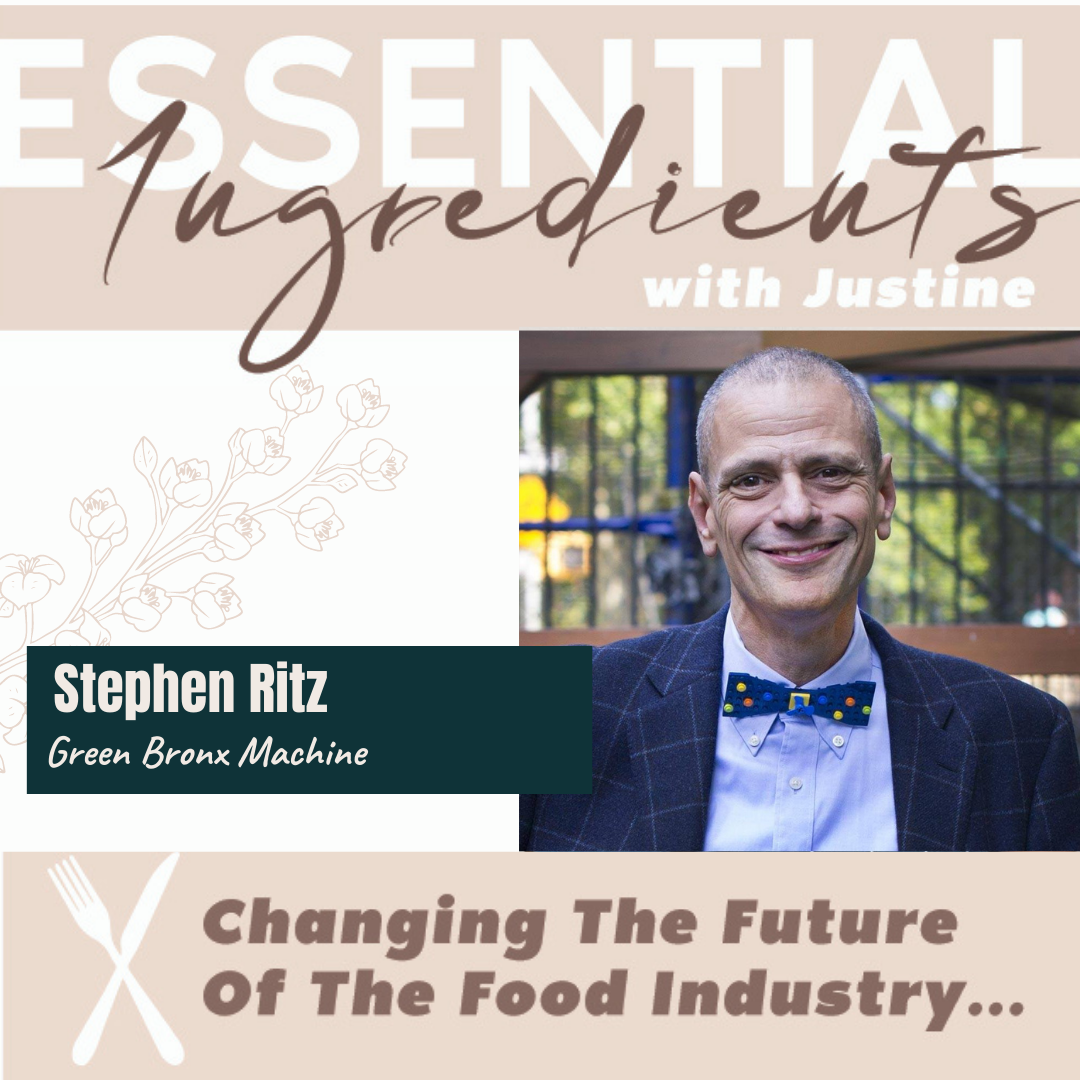
A great idea, and kids can learn to grow these gardens early on. I mean, even in New York, I don't know Adam if you know Steve Ritz? Do you guys know Steve Ritz?
No.
Steve Ritz, I'll send you his link. He's doing this in all the schools and all the public schools. He started, I had him on my podcast last week. He's awesome. And it's called the spear of the green gangster? Garden gangster? I forget, I'll send you the link. But it's awesome, and he's teaching kids how to grow gardens. And it's great.
Well, I've taught students in college who didn't know, I've had to tell them, you plant the green side up, who had never grown gardens in college, and that blew me away.
This is an interesting discussion because I also think it speaks to the fact that, when we talk about this issue, I think people tend to also have a fairly narrow sort of idea of what this is. I think the ugly fruits and vegetables, expired dairy products, these are kind of, no pun intended, sort of low hanging fruit that people can kind of latch on to, you can kind of create ad campaigns around these things, which have been done very successfully. I would say that that's only the stuff that we kind of consider food. And you bring up a guy like Dan Kurzrock from ReGrained who's doing unbelievable work. He's working with [inaudible], well that's food, but people don't even think of that as being food. At that point, you're so far the left field from like a crooked carrot or slightly bruised apple. I had a long chat to Lisa about this, with my brother recently. The fact that broccoli, as we know it, Broccoli, the head of broccoli, what's at least probably knows better than I do, but that's probably about 30% of the biomass of a broccoli plant, the rest of which is actually edible. So again, that's going back to how we assign value. People talk about the need to grow more food, and we need to genetically engineer and modify our food for higher yields, etc, etc. I mean, we're leaving mountains of nutrition in the field that we're not even considering food in the first place. I think it's also really, it behooves people like us to really expand the definition of what this issue actually is.
Yeah, I would agree. I just wanted to tell you, it's called the power of the plant, which was what I was talking to you about Steve Ritz, and he's called the Green Bronx Machine, just to let you know. Because I think you'll love them.
Oh, yeah.
But as we're wrapping up, I guess I'm putting you on the spot because a you are a chef, but we ask everybody, and our listeners are just lucky enough that Adam, your chef, do you have a favorite pandemic recipe that's maybe upcycles that you could share with our listeners?
He does.
I do. I think that the last few months, in a way try to look for silver linings over the crazy year that we living in, and in a way this time is really making us think about issues, like the issue we talked about now, in a life that perhaps we haven't really thought about before, as we've seen food supply chain disrupted and people really having a hard time folding food and just really food access issues that were always there, again, have really kind of had come under the microscope, to me, it makes me think of the kind of cooking that I love, and it's kind of the cooking that is really the backbone of culinary traditions around the world, and that's just being thrifty, right? What better time to be thinking about that then right now. For me, something that I just love, and I cook all the time because it's like the ultimate dish that can sort of absorb everything is a frittata. I absolutely love, like three times a week probably, I'll cook it for [inaudible], number one, breakfast, lunch or dinner is one of those dishes that is equally at home at any meal. And as long as you got some eggs, I defy you to find something in your pantry, or your veggie basket, or something that couldn't end up in a frittata. So it just works out really well.
Lisa, we need a recipe from your garden. What do you want to share? What can you share?
I also love kitchen sink dishes. Adam mentioned a frittata, we don't always get that fancy at my house. But really anything that we eat in our house starts with a big pile of chopped vegetables. So if I'm making something like an omelet that starts with whatever veggies we have, as does spaghetti sauce, or shepherd's pie, or chili, any of these things.
That sounds very fancy shepherd's pie. You can throw vegetables into anything. How about that crust? That's not super fancy.
It adds up the nutrition, as well as uses up what you have that's ready to go. I know people religiously make vegetable soup too, but I haven't gotten that fancy.
Anyway guys, I want to thank you so much for joining me. And I want to thank our listeners for joining us. This is such a great conversation. I want to let everyone know that we are here every week. And if you like this, you can download the episodes on Spotify, iTunes, etc. Subscribe, share it with your friends. If you have a story you want to share, email us, you can find us at NextGenChef as well. And we look forward to seeing you here again. Thank you guys, thank you for our listeners also for joining us.
Share This Episode
Enjoyed this conversation? Share it and tag @nextgenpurpose
Listen on Apple ▶Listen on Spotify ▶Your Host
Justine Reichman
Founder & CEO of NextGen Purpose. Host and Executive Producer of Essential Ingredients — 11 seasons, 330+ episodes, and a growing movement.
About Justine →