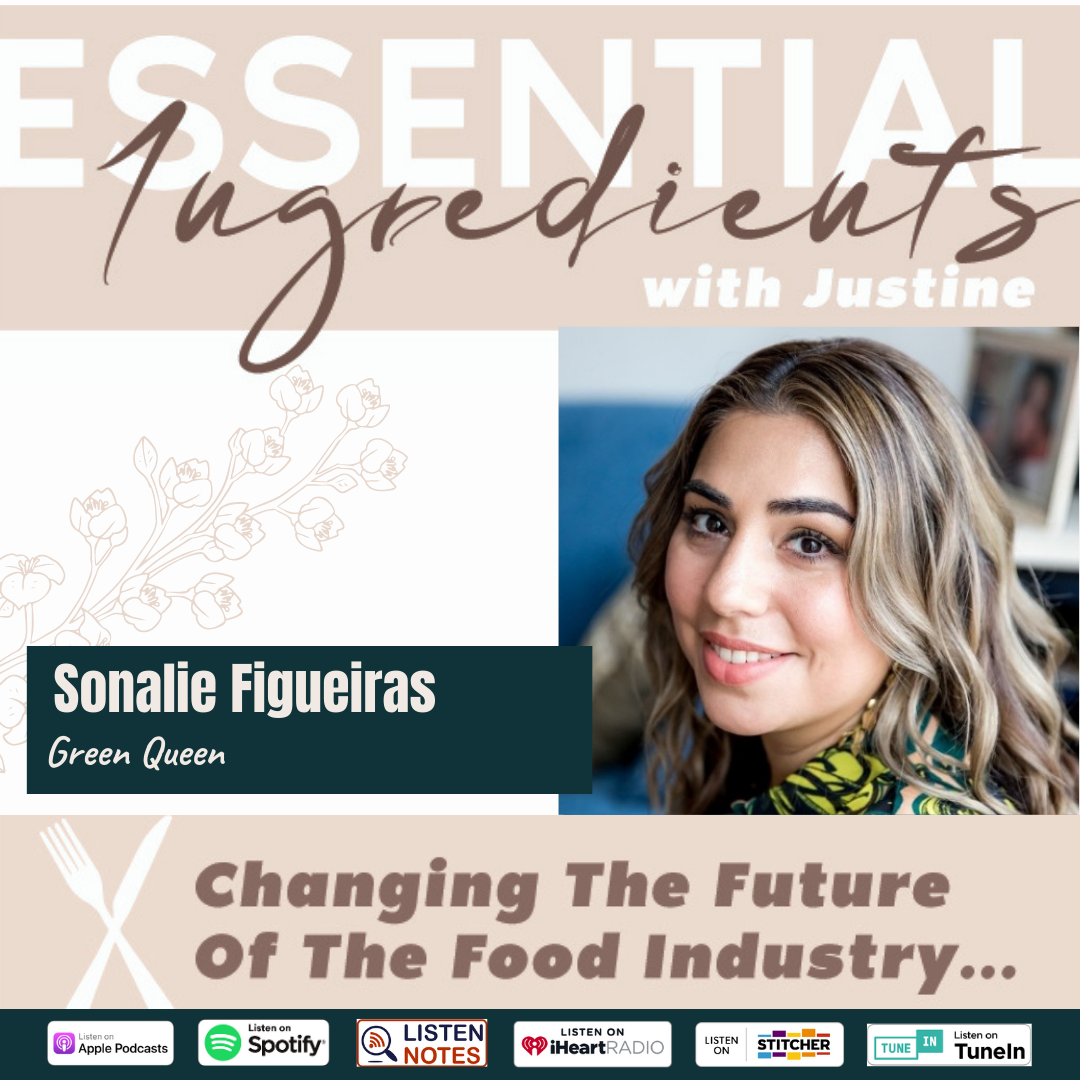
Sonalie Figueiras · NextGen Purpose
Watch on YouTube
How to Revolutionize the Alternative Protein Industry with Sonalie Figueiras
The Incorporation Method helps you turn what matters into practical changes that fit your life.
“”
Full Transcript
Full conversation between Justine Reichman and Sonalie Figueiras.
Welcome to the Essential Ingredients podcast. I want to welcome our guest today, Sonalie Figueiras. Sonalie comes to us from Hong Kong. We're super excited to have her here today on our special track, talking about alternative proteins. She is the Green Queen. And I'm super, super, super thrilled to have you here today. I'd love for you to maybe just intro yourself a little bit. It's always better to help the guests do it because I will just butcher it or just read it off the website, and that's never good. So suddenly, we can maybe give our guests a little intro so they could learn a little bit about who they're hearing from today.
Sure, sure, sure. I'm based in Hong Kong, it's my hometown, though I am actually half French and half Indian as well. I'm your classic third culture child. I am the editor-in-chief and founder of Green Clean Media. We are today's Asia's largest English language sustainability media. We're also the leading Alt protein news platform in the region. And we basically see ourselves as an impact media, a term I created to explain that we do have an agenda. Most media's do, but I'm just gonna say it out, right, our agenda is in fact to create behavioral and social change, to change people's minds, change people's behavior, change people's ideas and really introduce people to all the fantastic solutions, innovations, news, founders, brands, companies, organizations that are working to fix both human health and planetary health issues, which is in our view is the biggest crisis of our time. So the consequences of climate change to all of us as humans, but also to the planet.
So first, can we just talk about impact media? Can I get on board? Can I be part of that bubble?
Sure. Sure. Sure. Absolutely.
I love that. I want to create impact media.
Yeah, I think that basically, all media has a purpose. And I really wanted to come out and say that, this is media to create an impact. So it is different, it is trying to move the needle. And it's worth calling that out.
I love that. As you know, NextGenChef and Essential Ingredients are working to change the future of food. And the mission behind this podcast is to create a movement to change the future of food. Does that qualify?
Oh, for sure. Absolutely. I think as long as there is this kind of, yeah, that's the agenda. Basically, our agenda is to change people's minds and change people's behaviors, and that makes us different from just a news media.
I love it.
We're just an entertainment media.
I like that. I like that you coined that phrase. I want to be part of your group, ao tell me, how did you become involved in the space of alternative protein.
So I've been the editor of Green Queen for a long, long time. It started as a really small blog, and then it kind of grew into the largest green media in Hong Kong, and then I started looking outside. I also run another company called Ekowarehouse, it's the largest certified organic online trade platform. So essentially, it allows buyers in trade to find ingredients, products, suppliers from around the world. So connecting food manufacturers with producers or farmers and such. That part of my job leads me to go on a lot of traveling to trade shows and food shows. Obviously, not this year sadly. And through my visits to the shows, I started connecting with some of these, let's say food 2.0 companies. For me, it was very, very clear that these companies were not your average veggie burger company. They were really thinking about the food industry differently. They were really kind of altering the paradigm. I connected with that so early that even though we were in Hong Kong, and at that time, still more just focused on Hong Kong. We wrote a piece called, these companies are going to revolutionize what's on your plate. And we featured impossible foods and beyond, and the NotCo. I mean, these were the first batch.
Sonalie, what year was this?
This was back in 2015.
2015. So you're talking about these in 2015? I'm trying to think what year we were just talking about these, because it's 2020 now. That still feels very advanced, very forward thinking.
I think it was. I think the fact is that I definitely felt there was this huge kind of change happening. And parallel to that, I'm very close to the Green Monday team. So Jenny, who's the executive director, and David are people who are obviously just pioneers. David is a visionary. He's changed the future of food, the face of food in Asia, there's no doubt about that. And we started around the same time. I'm sorry, they started a little earlier. MThey started in 2012, my blog was late 2011. We started around the same time. And at the time, there was really no one else other than this other really fantastic chef called Peggy Chan, who was the pioneer plant based chef of Hong Kong. The three of us were really at the beginning of looking at things differently. And what was very interesting about all three of us is that we all felt that food was the defining change making path, right? Where other people were talking more about fashion or waste, and I think we were reading all this, all of us were reading the same research, and we were making that connection between food production, and livestock, agriculture and the unsustainability of it all. So we would go on these trips together, because they were also looking for new products for their Green Common stores, and they were exploring the market. And I think when David decided to distribute the Beyond Burger here and launch it in Hong Kong, so that was the first time the burger was launched outside of the United States. It was also, to be honest, one of their first launches at all. Because at that time, Beyond Burger wasn't available everywhere. This is, we're talking about 2017. I got to try the burger, I was at the Green Monday, Green Common launch of the Beyond Burger, and that's when it accelerated. I realized, okay, David has just put Hong Kong on the map for alternative proteins. But at that time, we were still calling it pluant base, right? Because we're still learning about cell based and fermentation based. So yeah, so we're talking about now, a good three years from when I think we went from Beyond Burger started selling and Whole Foods, I want to say in late 2016?
Mm hmm.
I believe.
I think so.
It's either late, yeah, because it launched in Hong Kong in 2017. Yep. So in 2016, that's when Beyond Burger kind of changed their products, because they originally had chicken strips, and they had this thing called the beef, the other burger that they had which I think they prefer people not to mention, but there wasn't a beef burger, it was called. And honestly, it wasn't that good. So we were still at like phase one. And then they came out with the beyond meat burger, and an impossible was coming up and launching with David Chang, and the burger that bleeds, and they have their team. And once beyond was here then impossible wanted to come, so a year later there they were, and that really put Asia in the big conversation. And to this day, Hong Kong remains one of the most exciting places to enjoy alternative proteins. The range out on offer for us is astounding. It's also, of course, the home of OmniPork, which is David's own food tech arm from Green Monday, and that launched in 2018, their first product. This year, they launched the Omni luncheon meat, which is the vegan spam, which is now on menus at McDonald's here. It's just been non stop ever since. We decided, well, we're gonna start. We're going to be the media on record for that. We've been covering it anyway, we believe that the biggest impact you can make is by your plates, but we're still going to continue to also cover everything else. Fashion, packaging, beauty, climate, crisis, activism, all of that because that's all part of it. And for me, it's not just food. I think the more you change what's on your plate, the more you want to do all this other stuff. Like consume less and buy secondhand, and just tread lightly on this earth.
It's interesting you say that, because I think that food, there's so many things that food impacts. Food impacts the way we look at fashion. I think the way that we look at so many things, the way that we live, and the way that the world lives in so many ways. We're having a conversation, actually, next week on the impact of food on fashion. And so it's just an interesting conversation the way that you're presenting it through your media as well. I don't know if you think that actually fashion impacts food or vice versa, or what are your thoughts on that. For my own, I would love your thoughts, what you're thinking there?
Oh, I absolutely think they're connected. One of the most exciting things is that the rise of plant based foods has kind of legitimized the vegan lifestyle. And prior to this, I think it was very fringe, it was very kind of misunderstood, it was very kind of looked at as extreme. And now, vegans really seem like the most, the biggest empaths, the most compassionate people. And so what that's done is, what's really exciting, and the connection for me is that now, it's not just about cruelty free food, but cruelty free fabrics. You have this whole alternative materials kind of sector that is exploding. And once again, this is something that we've profiled for years. I think in 2017, we had an article where we talked about pineapple leather, and soy leather, and mushroom leather, and these were very tiny little German germinating companies there, they barely had a product. And then this year, we did another piece, and we profiled all the alternative materials. And now, you've got Apple leather, grape leather, and of course, cactus leather. And what that shows you is that people want more than just a PVC leather free alternative, and that's really something. So there is a connection. Another connection that I thought was really brilliant is that we always talk about positive things, because Alt protein essentially, and I think that's why so many people have connected with it, it is an inherently hopeful inspirational industry. But the reality is that food insecurity is coming, and we are going to have less land to grow our crops on because of climate change and global warming. I was on a panel with one of the heads of supply chain and sustainability from H&M and he said something that really stayed with me, because he was talking about how they're trying to future proof their supply chain in terms of fibers. And he said, they envisage a world where the decision is going to be food or fiber?
Mm hmm.
Because we're going to be limited by resources, land, water and energy. And so we're going to need fabrics that do not compete with food crops.
Right, that are more regenerative.
Yeah, or that don't need to be grown in an agricultural setting. So it's super interesting from that point of view.
Well, that's gonna be a whole nother conversation we can have. I want to get us back on track, I took us on a little bit of a detour. But for our listeners, we are back on track. I want to make sure that we stay on track because I did divert for a second there. But if we get back on track, I just want to continue on our path on alternative proteins and maybe just talk a little bit about the key challenges. In launching the full potential of the Alt protein movement in Asia, and maybe if you could just talk a little bit about that, what you think about that and share your thoughts on that.
On launching the Alt protein movement in Asia?
Yeah.
I wouldn't want to take credit for that in any sort of way, I would say--
Or participating in it.
Definitely, the honor would go to Green Monday and their whole team. But certainly chronicling it and also giving the space of voice.
Okay.
I think as I mentioned earlier, we really saw this coming as a huge revolutionary change. We really saw that there was a chance to really get people to connect with the message. Because the idea is, you can enjoy great food that you taste exactly and looks exactly like its animal counterpart, but in doing so, you are an empowered consumer that is making a difference with that bite on your plate. And what's been really exciting is that early on in this year, we decided to take on the herculean task of basically putting together this Asia Alt protein report, which was the first of its kind. So the idea was to put a flag in the ground and say, this is what the industry looks like now. And then we could benchmark it. So we profiled all the companies in the space, we looked at all the funding records, and at the time, we were talking about less than 25 companies. This is in January, and like less than $10 million in funding. And we're just about to come out with a big funding update tomorrow after a couple months of research along with an investor in the space, and the numbers are just incredible now. There are over 70 startups now in less than a year in Asia Pacific. And so the space is just booming. And for people who don't live in Asia, they might not kind of feel this the same way, but one of the most exciting things about Asia is that once there's a fit, or once a trend kind of takes off, it goes so fast. And that's been really exciting to be able to do that. I mean, we can barely keep up with the new. And it used to be a few months ago where we had a few stories a week that were big. And now, it's non stop.
Why do you think that is?
Because I think that climate change is going to affect Asia more than anyone else. I think that we will have the most people, almost 5 billion by 2050. I think that millennials and GenZ consumers here are actually the same as millennial and GenZ consumers across the world. So they've become more conscious, they've become more aware, they've become more literate in climate news, and they want alternatives. I think that in 2018, when all those scientists got together and said to the world: "Hey, the number one thing you can do to reduce your carbon footprint is to reduce meat and dairy consumption." I think that that was a big kind of turning point for the world. I think the guardian broke the story, and then everyone covered it. I think now it's much more difficult to argue that these are not major, that basically eating less meat and dairy is what you need to do. Essentially the public is ready for these solutions, and they need them. And I think big tech has been a huge kind of, let's say, industry of innovation and younger people wanting to get in jobs with Google and Facebook. And I think the new food companies are the new tech companies. I think adding tech to food and calling it food tech has made it a very attractive industry, and everybody kind of wants to be involved. It feels like there's a revolution happening. And it feels like money is pouring in. So as a young founder, if you're looking at how you can have the biggest impact, there is.
Right, yeah.
Yeah. Sonalie, you have been talking about this very exciting tipping point and global trend of millennials, and young people embracing efforts to combat climate change, but we have heard that the Asian consumer base tend to be a little more price sensitive than the western consumer base. In addition, veganism traditionally has been associated with Buddhism in Asia, so the branding might have to be put a little bit. Would you mind explaining, to say for a burgeoning plant based entrepreneur who wants to break into the Asian alternative protein space, how does he have to strategize differently if he were to launch in the US, for example?
Let's take a step back. You name the Asian consumer as price sensitive, I think maybe that could potentially be a little bit unfair, because I think that food in America is artificially cheap. I don't think that that's a fair thing to say. I also think that Asian consumers have to be measured within their own contacts, and GDP, and salaries, and an income is just lower here so people buy in accordance with their own budgets. I don't think that they're necessarily more price sensitive, it's just that we live a different standard of life so things tend to be cheaper in our world. And if you're bringing in beyond meat and an impossible, and it's an important product, it's obviously going to be priced higher than it is in the US, and it's going to feel like a premium product. But from my understanding, even in the US, those are still considered premium products. They are currently priced to compete with expensive meat, they are not priced to compete with the cheapest Chuck from Walmart. I don't know if I would totally agree with that. I think that just like anywhere else, there are different segments of consumers. And I think they're, I was actually just talking to a chef the other day who had lived all around the world. He was telling me that nobody in the world has as much buying power as Hong Kong, Chinese consumers, and that they spend the most money on food dining out of anyone in the world. So I think it depends what you're looking at. So what I would say to a budding Asian, Alt protein consumers know your segment, know your market and launch a product that's for the locals. I mean, if you're in China, maybe a burger is not the number one way to go. And I think that's why OmniPork has been so successful, because it's a product developed for Asian people, and Asian people eat mostly pork. They eat a lot more pork than they eat beef. And pork is part of almost every Asian cuisine, and has hundreds of applications. And so it's been a huge success. I think one of the things that sometimes I feel missing in product development, and is super important is empathy, and just understanding who your consumer is. Really understanding their food culture, their consumption culture, their budget culture and working as within. And on the budget side, I think we've got India, which is a very exciting market. Because in India, there are a couple of startups in the plant base space that are already reaching price parity with me. If anything, they're cheaper. I think every Asian market also is different. It's not going to come down to just one mark, one solution for one market. Asia is not like the US in that way. It's not one country. There are 13 major cuisines and hundreds of sub cuisines. And the companies that are gonna do the best are the ones that adapt to their local palette and local food culture.
That's very helpful to hear you say that you kind of demystify seeing the Asian consumer base as one unity. Absolutely. We have a whole wide range of consumers, have different demographics, not only by geographic regions, but also by economic level. So yeah, it's really helpful to an optimistic to hear you demystifying that common claim about the Asian consumer pace. Would you like to add a comment on branding around alternative proteins food today, mostly plant based, not many cell based options out there, how to dissociate and to create unique and attractive branding, but dissociate from religious vegan food.
I'm not a branding expert. I don't want to speak outside of my expertise. I think in the previous question, I definitely covered what I would think is important, which is having, doing lots of testing with local consumers, understanding the different culture around packaging. Americans like a certain type of packaging. Europeans like a certain type of packaging, but an Asian consumers like different types of packaging. And remember, we have so many different major languages. If you're in Malaysia and Indonesia, you need to be thinking about things like halal because there are significant Muslim populations. If you are in China, you need to be thinking about safety because food safety is a huge priority. If you're in the Philippines, yes, price is definitely going to be a consideration. And maybe the local is not as of a key factor. So every market has its own requirements. I think you'll get your brand if you understand your local market and who you're marketing to. And I think maybe you might need to have different packaging for different markets. Certainly that's been the case for some of the products I know. In OmniPork for example, known as Omni meat in the Muslim majority markets like Indonesia and Malaysia. Because let's be honest, pork is not something that Muslims consume. AThat's not appealing to them. So that's an example of having to adapt to a local market. And I think it's great.
That's awesome. Thanks for sharing the couple of anecdotes of the marketing adaptations in different geographic regions. We totally agree that market research is the precursor to great products for different markets. Based on your experience, would you kind of play with the crystal ball and share with us where do you see the business of this booming space of alternative proteins going within the next year, and within the next five years.
I think you're gonna see hundreds of companies launching. So huge amounts of activity in space money is coming. I mean, we're gonna do, as I said, a big funding piece tomorrow that's going to drop, and it has a lot of exciting info. But I think the number of startups is just going to skyrocket. I think the money going into those sectors already, the growth rate, compared to last year, in the last few years is astonishing. I think that's only going to keep going up. So there's going to be a lot more money coming into Asia, remember that Asia is where the fastest growing meat, it has the fastest growing meat consumption trends. And so it's really where the impact needs to be made. We cannot afford for all the Chinese consumers in mainland China to start eating as much meat as American consumers, we literally just don't have the planetary resources for that. So in terms of impact, we need to transition to slaughter free options immediately. I think Asia also has some of the world's best scientists, so you're going to see a lot more government support and government grants given to us, especially spaces like cell based, and I think fermentation. As far as I know, there's only one major fermentation based company here, and that's in Asia Pacific that's in Australia. I think we're gonna see a lot more fermentation based companies coming up. And then finally, going back to the earlier point, a lot more individualized, customized products that are specific for Asian market. So today, we just did a piece on [inaudible], which is a company in India, and they just came out with plant based shami kebab. Now, if you're not, probably don't know what a shami kebab is, but it's a hugely important part of our diets and of the cuisine. So that's going to make it a lot easier to entertain for vegans, if you have ready made shami kebab, Just a lot more of that, a lot more customize specific products that appeal to certain localized food, tastes and cultures.
For those listeners that are not vegan, could you tell them a little bit more about what that is, just so that we could include them in the conversation that evolved that you're just talking about. Just so that they can feel included in the conversation.
In Indian cuisine, we have a ton of different kinds of kebabs. A shami kebab translates to basically, you could call it like, some people might see it, I translated it as a Syrian kebab, but it's basically a small patty of minced meat. Usually, it's beef lamb or mutton. You can find shami kebab, it's like a little patty. It almost looks like your breakfast sausage patty in the US, but it's a smaller size. It's a smaller circumference and a little bit thicker, and it's very soft. There's a lot of interesting myths about how it was developed. My understanding is that there was an emperor, a Mughal emperor who had a problem with his teeth, or he was sick or something, and he wanted something soft to eat. So his chefs developed this very soft minced meat patty, but they're very popular. If you go to any kind of cocktail, or wedding, or party in India, you would get served these shami kebabs. You can also have chicken ones, but they tend to usually be mutton. And yeah, now we have a plant based version by greenness.
Cool, that's great.
So that might not have much of an appeal for a North American consumer, but there are billion, 1.3 billion Indians, I think when you look at the market size of Asian countries, and Asia just as a region, it's actually a much bigger market opportunity. There is no other market that comes close in terms of size.
Yeah, definitely from what you said, there is tremendous room for growth in Asia. Not only in terms of the market share in total, but also in terms of product categories, just because there are such an insane variety of cuisines and cultures around foods in Asia. I am Chinese myself, and I love crayfish and chicken feet, which sounds a little weird to our American audience.
I've tried chicken feet actually.
Yeah, those are actually huge, really important proteins, sources snacking in China, so can't wait to see animal free options of those different parts of animals that you can create either through on base, cell based or fermentation technologies.
Exactly, exactly. The idea is that you would have a slaughter free chicken feed option, and that's the thing. Obviously, a lot of the initial tech innovation has been happening in the US. But eventually, that innovation will spread all around the world. I mean, there's also now two major Africa based startups. I don't want to even use the word Africa because we often just put all countries in Africa together in a basket when they're all so different. But you've got a Nigeria based plant based company. You've got a South African based cell based company, manzo meat. Things are changing over in the Middle East, it's actually interesting. There is a rising demand for plant based food more from the health factor than from the sustainability factor. But that's also happening right now, in terms of growth in demand and growth in companies wanting to start to meet those needs.
Well, I think what's so interesting about this, though, is that we will have the ability to be able to have options that are both healthy, better for the environment, more sustainable, more generative, which is better in so many ways. It's better for the animals, it's better for us, and it creates more options. I'm excited because I think that this is not only going to extend in Asia, but it's also going to extend to the US, it's going to extend all over the world. We're excited to be able to share your message and what you guys are doing over in Asia to be able to hopefully inspire those in the US and around the world. Because what you are doing is really having an impact. And really enormous. The task, what you're chronicling there is both inspiring and aspiring. It's inspiring and aspirational for everyone. I'm just happy to be able to share your story and what you're doing. I really appreciate you joining us today and being able to share that with us. I wanted to thank you for joining us. I want to thank our listeners for joining us. How can our listeners get in touch with you? How can they connect with you? How can they follow your journey and hear what's going on, continue to hear what's going on in Asia?
Well, obviously, you can check out the website, which is greenqueencom.hk. I would suggest that you sign up to our old protein newsletter which comes into your mailbox every Thursday. I'm proud to say that it has been called the best newsletter in the industry by more than one person, multiple people. I think it gives you a great overview of everything you need to know from funding, to product launches, to consumer trends. So if Alt protein is kind of something you love, then you should be on that newsletter. It is global in scope so it doesn't just cover Asia. But it is more interesting in that way, and that it is global so you get an idea of what's going on everywhere. Not just in the traditionally North America heavy news roundups. The other thing I would say is LinkedIn. I'm pretty active on LinkedIn, I share a lot of what Green Queen does there. And then yeah, at GreenQueenHK for Facebook, Instagram, Twitter, that should cover it. And LinkedIn, yep.
And then of course, I do have to make a little plug for NextGenChef. So if we can invite you Sonalie to join the tailored LinkedIn for those of us in food and beverage to join NextGenChef, the app, which you can download it for iPhone or Android, and connect with all of our founders and food entrepreneurs, and talk to them through text or email there. Share your news there, we'd love it. And this way, maybe our founders can connect with you through the app as well.
That sounds great. I'll definitely check it out. I have a Samsung, I do not have an iPad, it might be the only one.
Okay, it works both ways. So for our listeners, if you liked what you heard today, please don't forget to download the Essential Ingredients Podcast, subscribe, listen, leave us a review if you liked what you heard and share it with your friends. Thank you, Yvette. Thank you, Sonalie for joining us today. We appreciate your time.
Thanks.
Thank you.
Thank you guys so much. Thanks for listening. We'll see you again soon.
Share This Episode
Enjoyed this conversation? Share it and tag @nextgenpurpose
Listen on Apple ▶Listen on Spotify ▶Your Host
Justine Reichman
Founder & CEO of NextGen Purpose. Host and Executive Producer of Essential Ingredients — 11 seasons, 330+ episodes, and a growing movement.
About Justine →